

urbanmakers and Selva & Maugin Wrap 54 Social Housing Units in a Seamless Brick-and-Tile Skin in Bordeaux
On the right bank of the Garonne, a blonde brick residential block channels Bordeaux's mineral tradition into a new urban district.


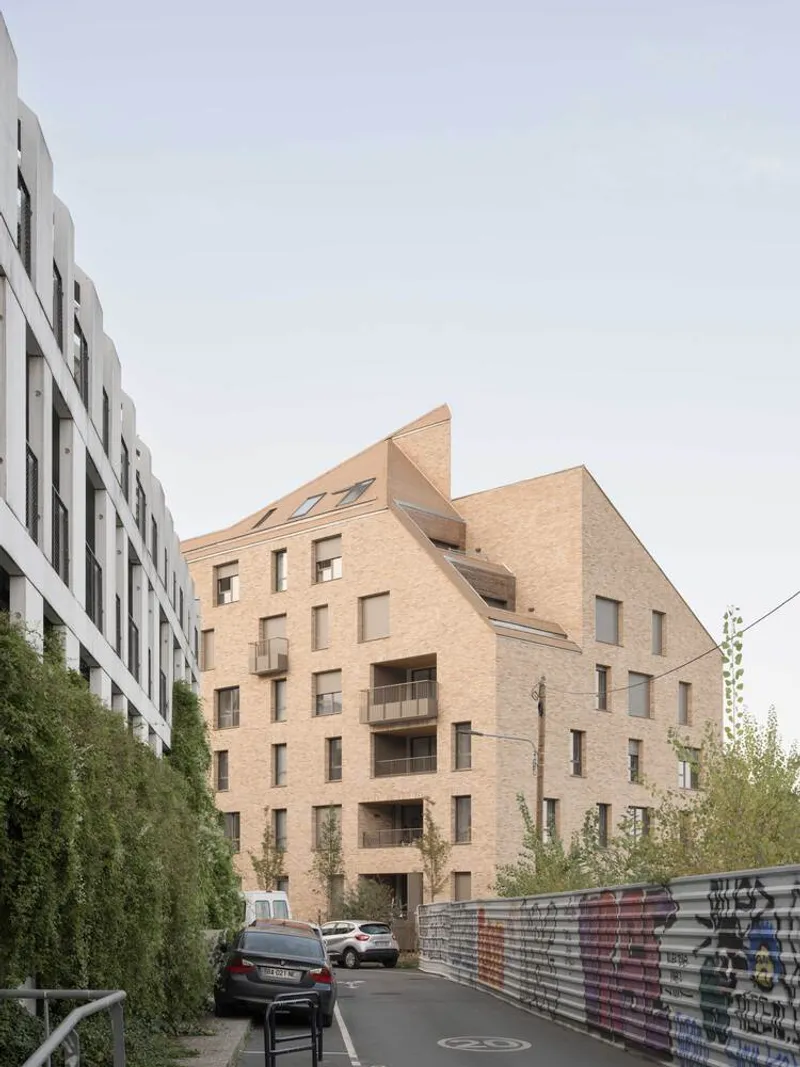
Bordeaux's left bank announces itself in pale limestone, a wall of 18th-century facades that reads as one continuous mineral surface from the river. On the opposite shore, the Bastide-Niel district is filling in 35 hectares of former barracks and rail yards with something deliberately different. B09, a 54-unit social housing block designed by urbanmakers (lead architect) with Selva & Maugin Architectes (associate), takes the old city's material warmth and rethinks its form. Instead of flat neoclassical planes, the building presents a cluster of gabled volumes wrapped in blonde brick that transitions without a seam into tiled roofing, collapsing the distinction between wall and roof into a single, continuous envelope.
What makes B09 worth studying is not the brick itself but the discipline with which the architects used it. The MVRDV masterplan for Bastide-Niel imposed a complex, pre-defined volumetric envelope shaped by heliotropic street orientations. Rather than fighting the sculptural massing, urbanmakers and Selva & Maugin leaned into it, treating every sloped plane as an opportunity to express domestic scale. The result is a building that feels simultaneously monumental from the quay and intimate from the sidewalk, a trick accomplished through material continuity, carefully punched openings, and deep loggias that break the mass into readable, human-sized increments.
A Mineral Silhouette on the Garonne
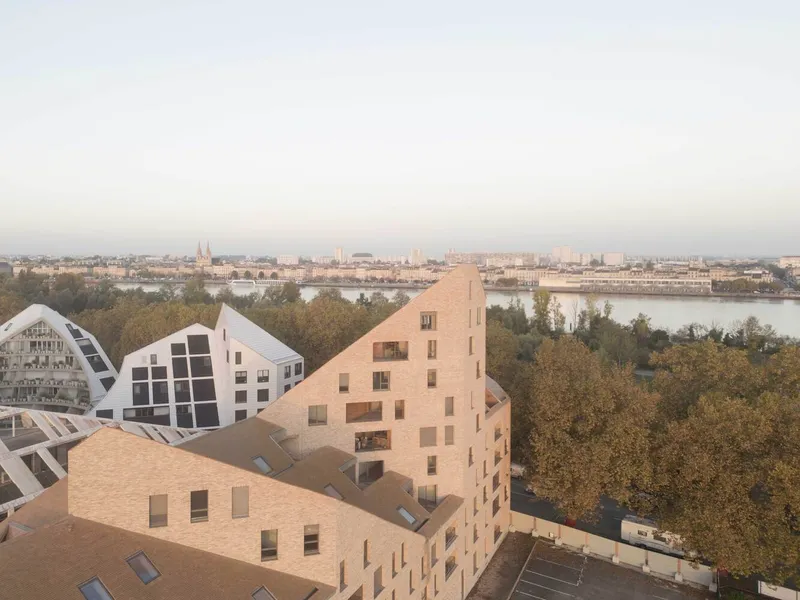
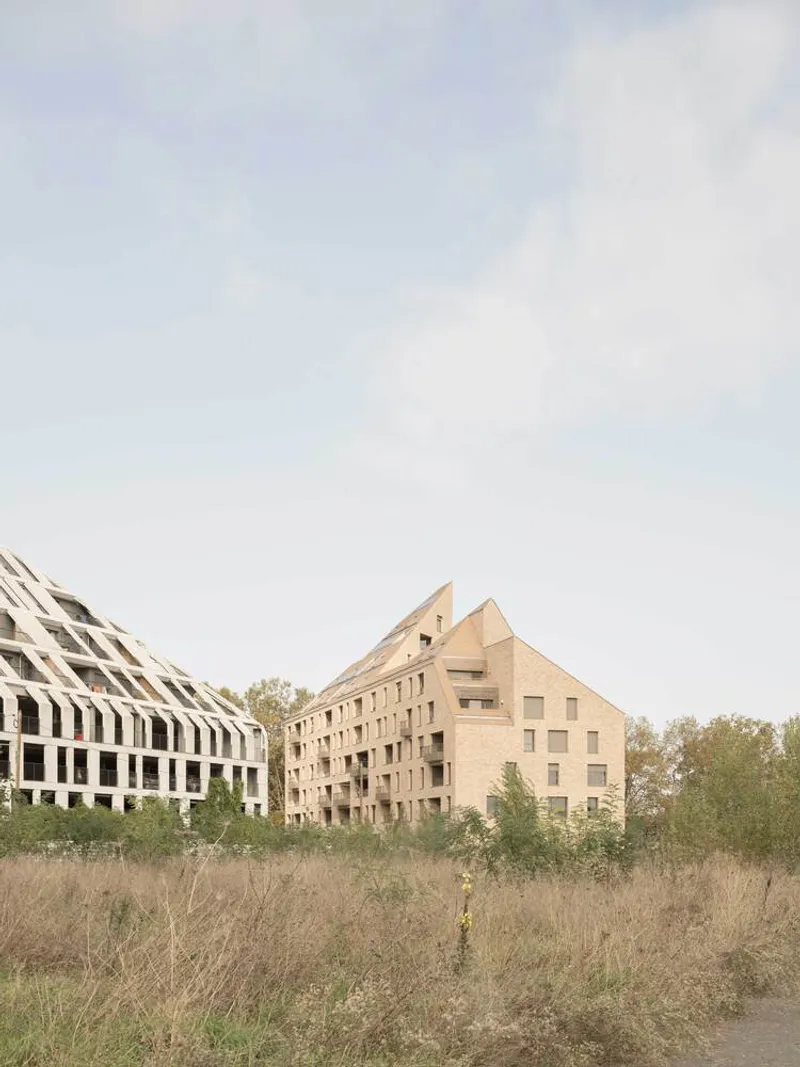
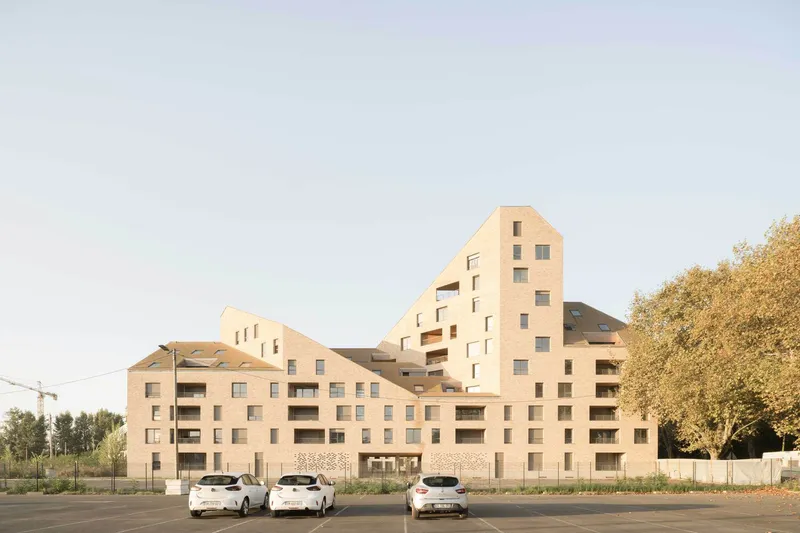
Seen from across the river at dusk, B09 reads as a cluster of peaked roofs rather than a single block. The architects staggered the gabled volumes so that no two ridgelines sit at the same height, creating a silhouette that echoes the varied roofscapes of Bordeaux's historic center without mimicking them. From the aerial view, the building's relationship to the Garonne and to the park along Quai des Queyries becomes clear: it is a threshold object, mediating between the dense new urban fabric behind it and the open landscape of the riverbank.
The sandy, blonde tone of the brick was chosen for its resonance with Bordeaux's limestone palette. But where the old city's stone is carved and ornamented, B09's brick is laid flat and perforated, relying on the play of light across slightly angled surfaces and recessed openings to generate visual depth. The tiled roof, rather than appearing as a separate element, is just the same envelope continuing upward at a steeper pitch. That seamlessness is the building's signature gesture.
Brick as Both Structure and Screen
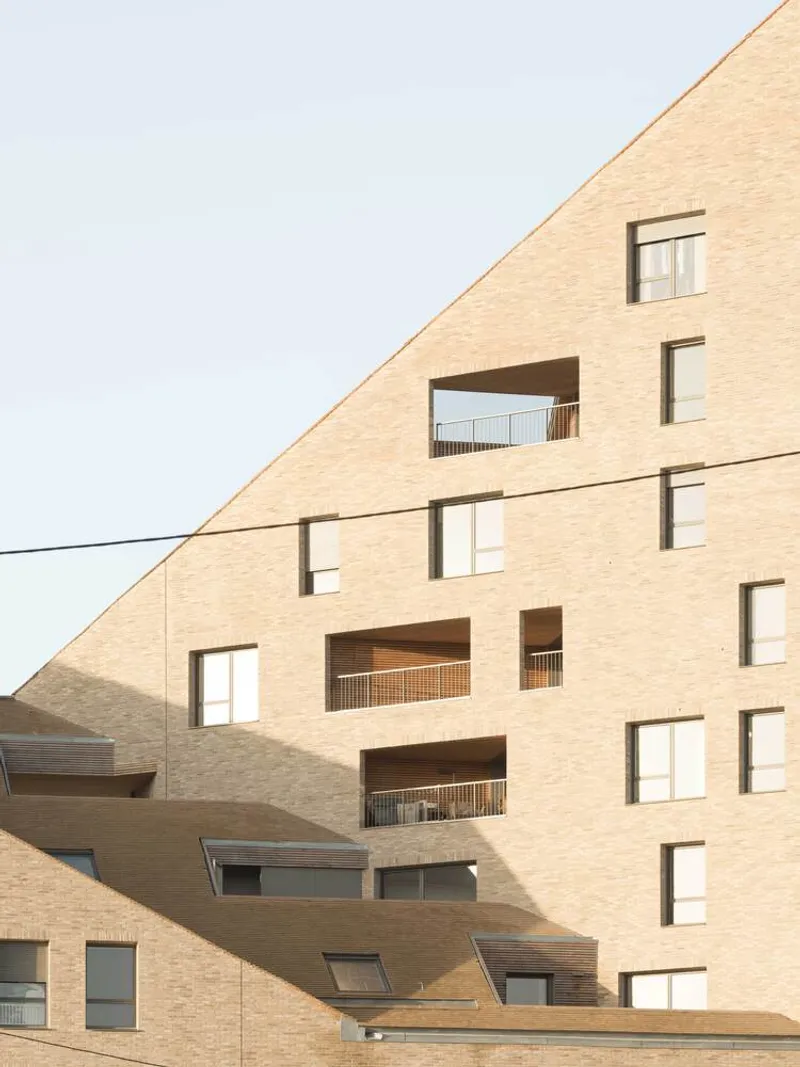
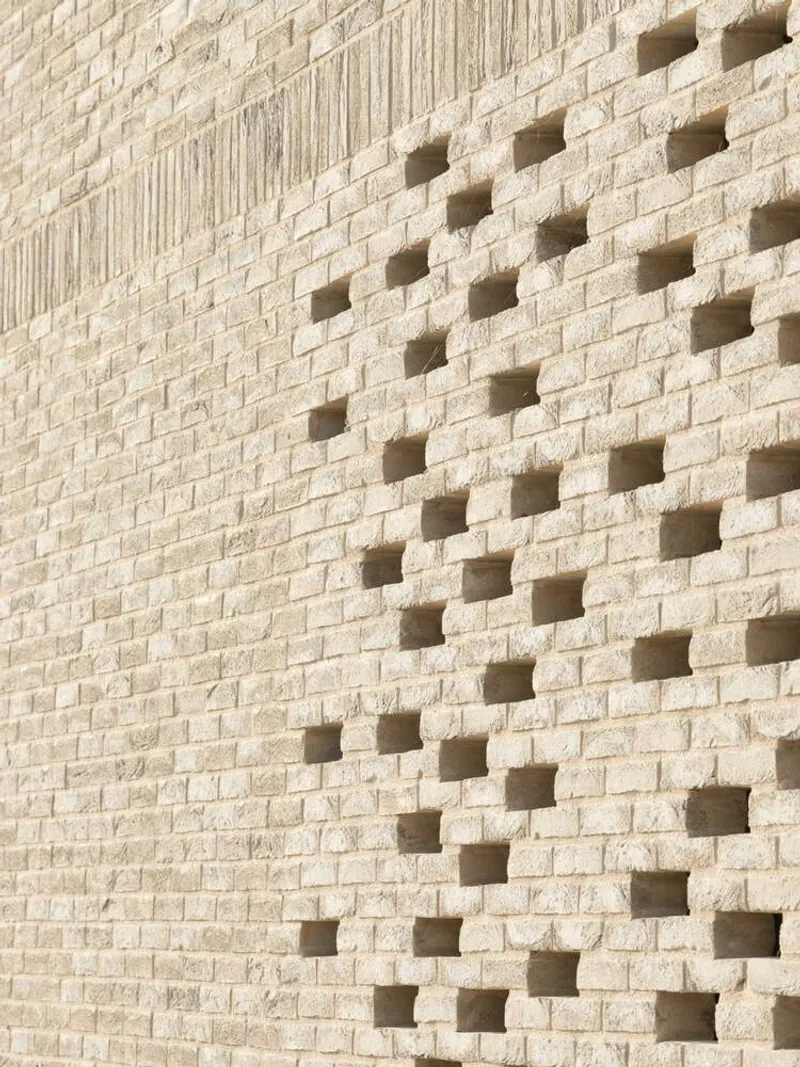
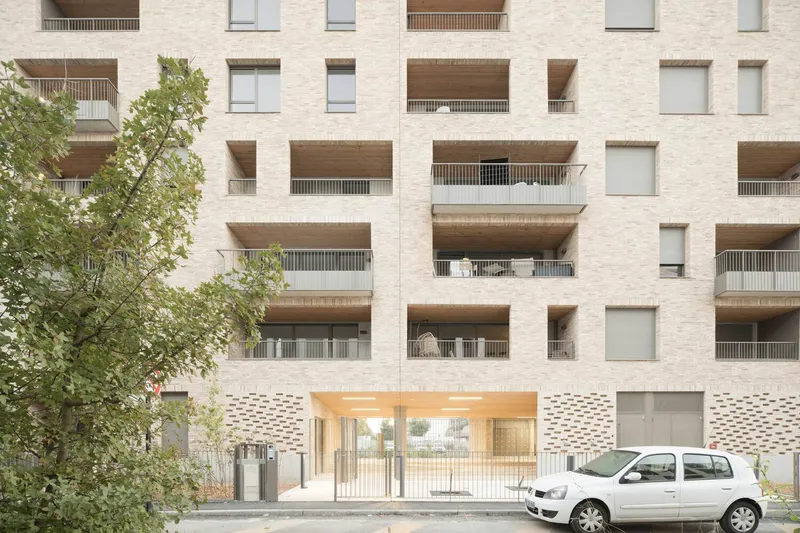
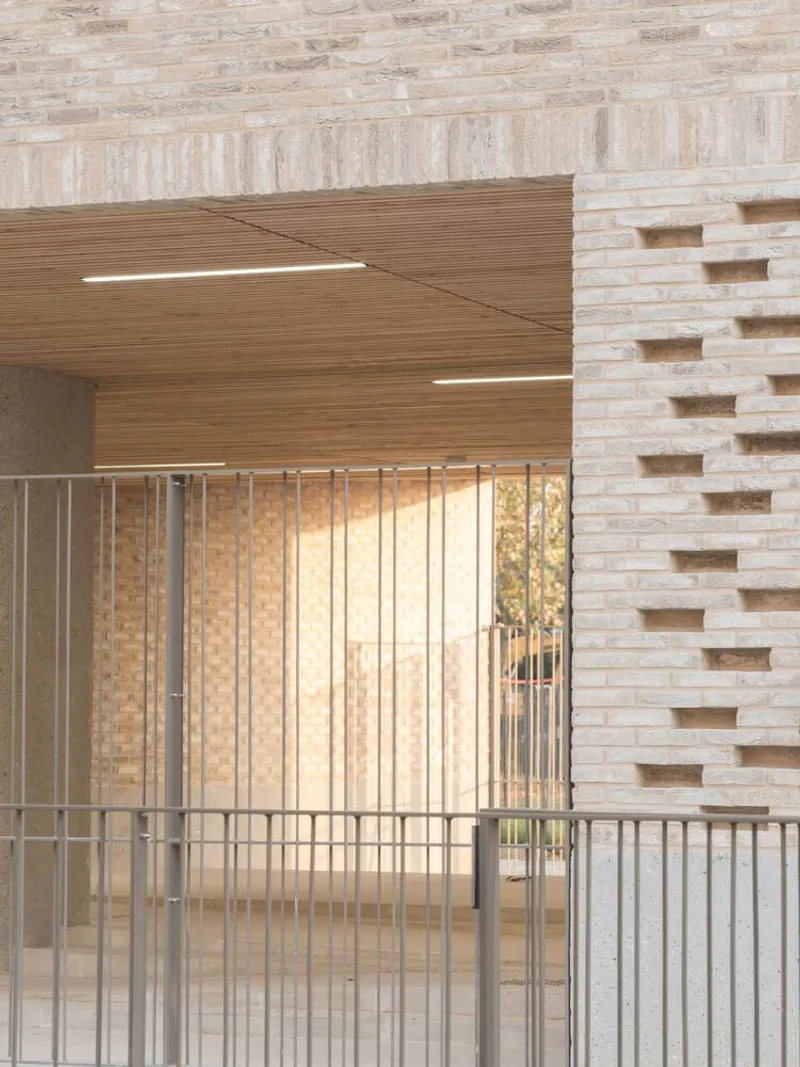
Up close, the brick does more than clad. The facade is punched with a rhythm of window openings that vary in size and grouping, giving each unit a slightly different face to the street. Square perforations scattered across certain wall sections act as a screening device, filtering light and ventilation while maintaining privacy. At the ground level, a perforated brick screen wraps the entrances, creating a semi-transparent threshold between the public sidewalk and the building's interior lobbies.
The choice to keep almost everything in the same material family, brick wall, brick screen, tile roof, is what gives B09 its coherence. Too many residential projects in new districts default to a patchwork of cladding materials that date quickly. Here, the variety comes from geometry and perforation rather than from switching palettes, a more sustainable approach both visually and in terms of long-term maintenance.
Deep Loggias and the Privacy Question
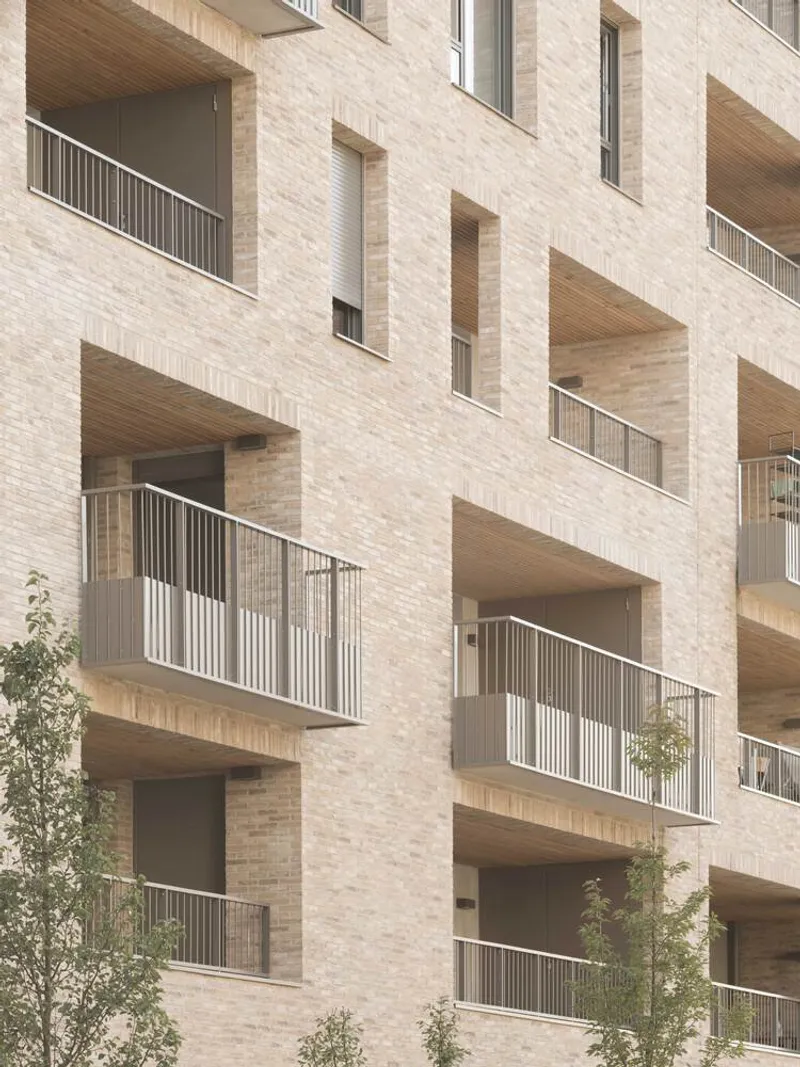
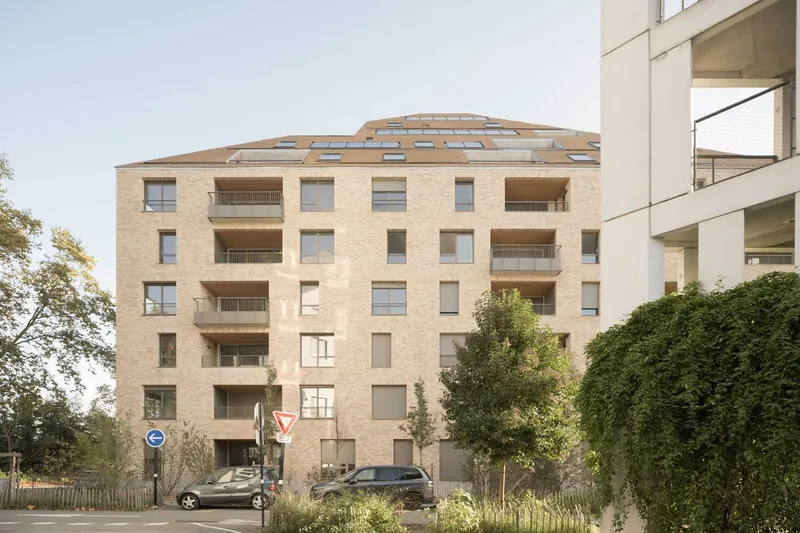
Social housing in dense urban districts has a perennial tension: residents need outdoor space but also need to feel protected from the gaze of neighbors and passersby. B09 resolves this with deep loggias on the southern facade, recessed far enough into the building mass to feel like rooms rather than ledges. Timber soffits line the underside of each balcony, warming the overhead plane and adding acoustic softness. Opaque lower panels on the balustrades shield interiors from the street while keeping views open at eye level.
Each loggia also includes a built-in storage cabinet, a small detail with outsized impact on daily life. In compact apartments, external storage for bicycles, cleaning equipment, or seasonal items is often the difference between a livable home and a cluttered one. The rounded tower element visible from the street stacks these loggias vertically, creating a layered facade that reads as a lantern at night when the recesses are lit from within.
The Vestibule: Public Space Inside a Housing Block
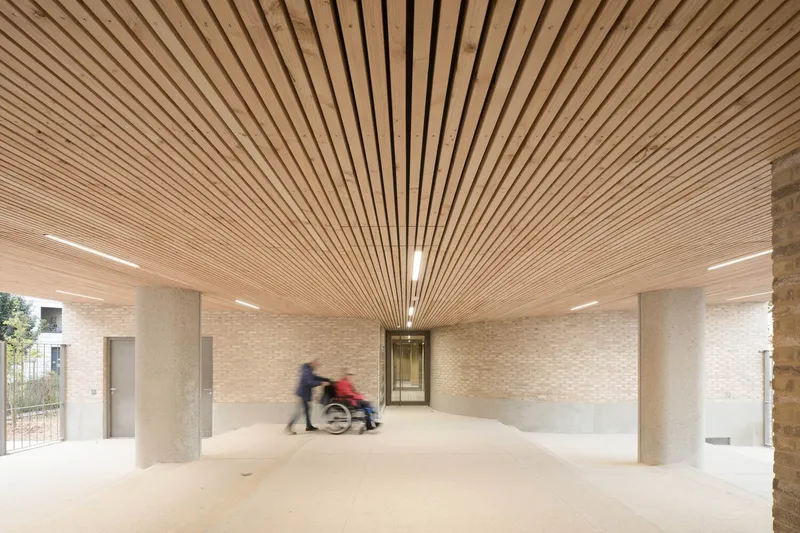
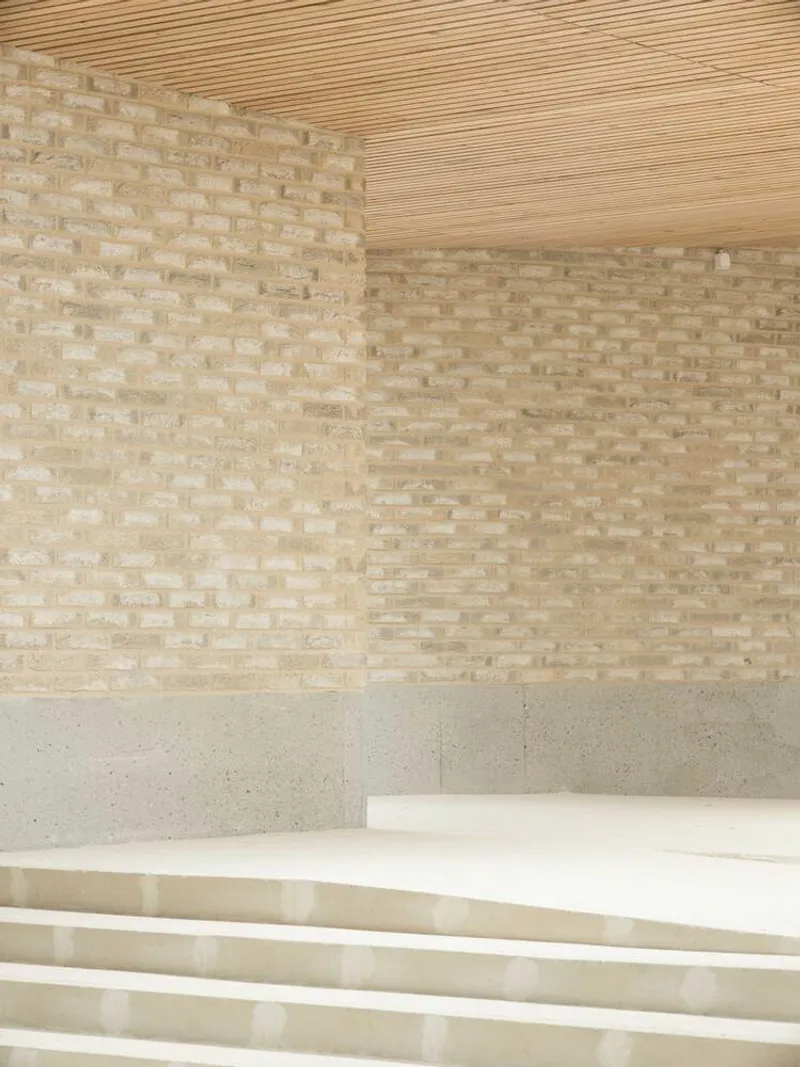
At the center of the plan, a generous open passage, what the architects call the "vestibule," cuts through the building mass and connects the street to an internal courtyard. It is both circulation spine and social space, wide enough to feel like a covered urban lane rather than a corridor. The lobby's radiating timber slat ceiling gives the entrance a sense of occasion that social housing rarely receives, a deliberate signal that collective space deserves the same material care as private rooms.
The interior staircases reinforce that ambition. A floating timber stair ascends alongside a pale brick wall, its metal railings kept minimal so the material textures remain the focus. Terrazzo treads on the lower levels nod to the building's mineral palette. Because the ground floor is elevated on a plinth to comply with floodplain regulations, the vestibule includes a gentle ramp and half-level shifts that make the threshold between exterior grade and interior ground floor feel intentional rather than imposed.
Living Behind the Facade
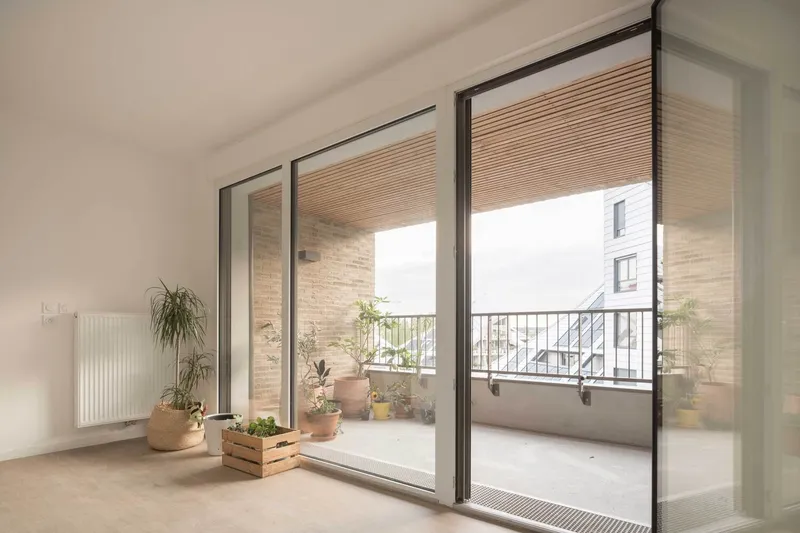
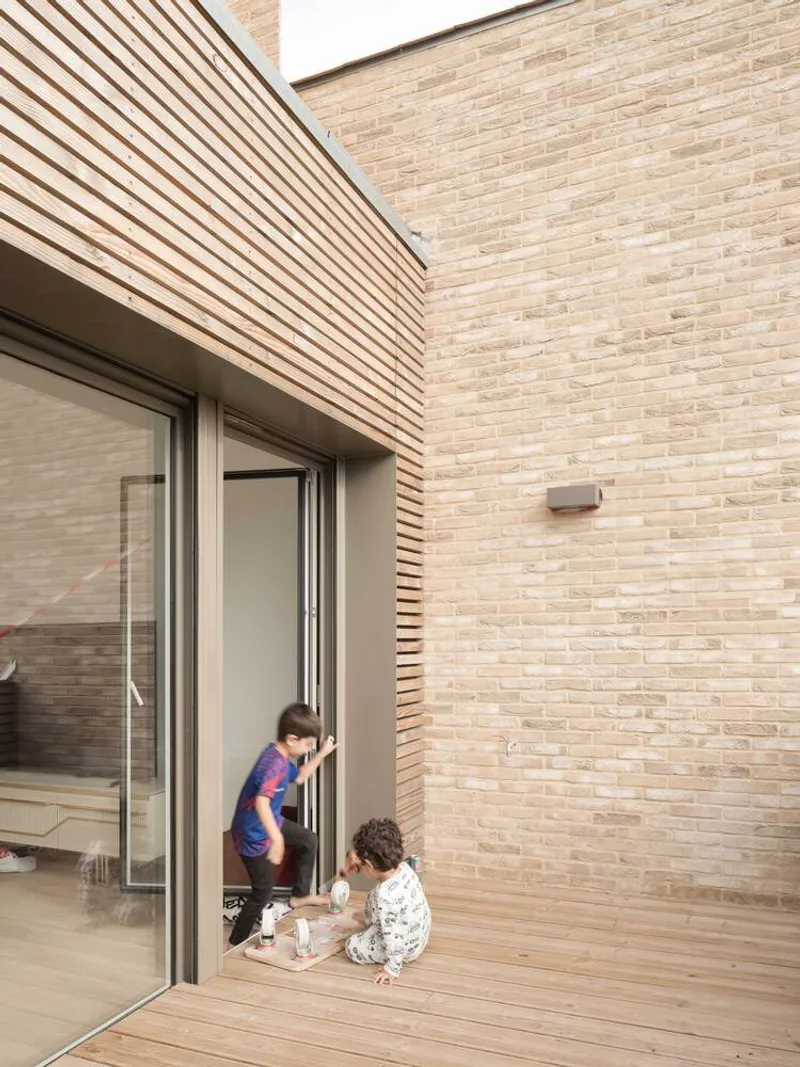
Inside the units, sliding glass doors open fully onto the loggias, effectively extending the living room into the outdoor space. The apartments are compact, as the 3,590 m² of habitable area divided among 54 units suggests, but the proportions feel generous because the loggias add usable depth without adding to the energy-rated envelope. Private rooftop terraces, the tropéziennes, further expand the livable area for upper-floor units, giving residents access to open sky within the building's sculpted roofline.
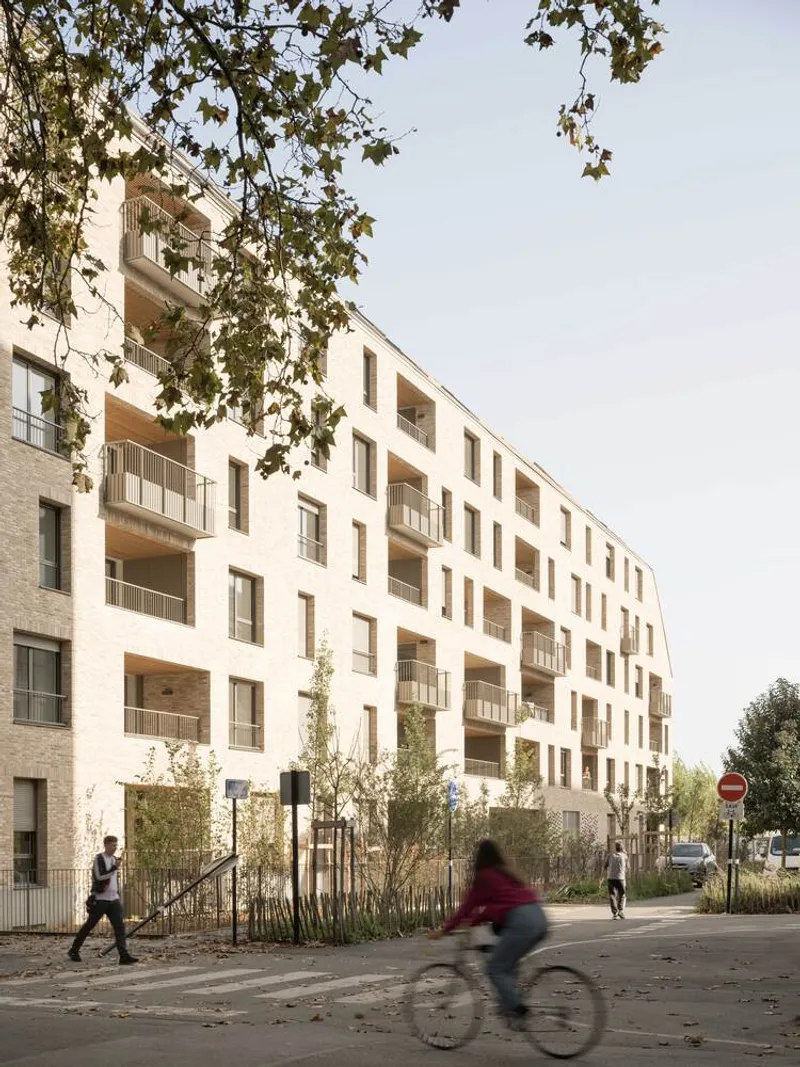
From the street, young trees and a cyclist passing the facade hint at the neighborhood's emerging character. Bastide-Niel is still maturing, its landscape sparse, its ground floors not yet fully activated. B09's success will ultimately depend on how the district fills in around it. But the building itself has been calibrated to age well: brick weathers gracefully, the massing is specific enough to anchor memory, and the domestic details, potted plants on balconies, timber decking on terraces, suggest that residents have already begun to claim the architecture as home.
Street Presence and Urban Fit
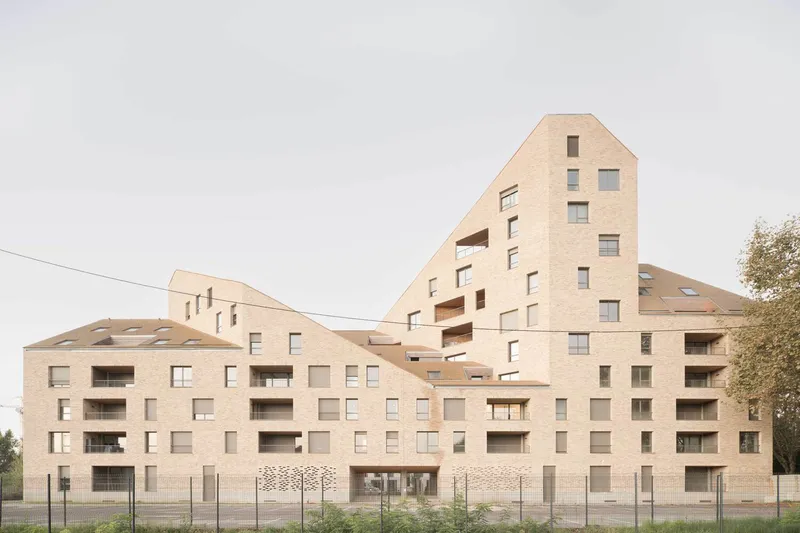
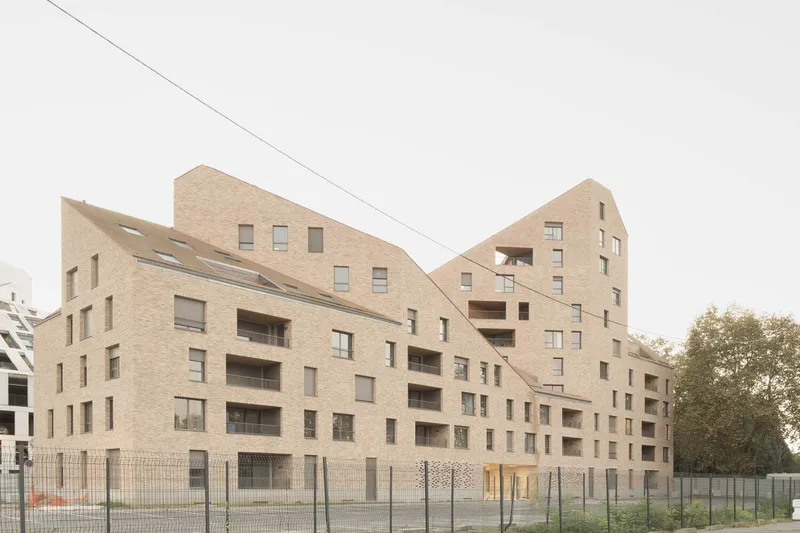
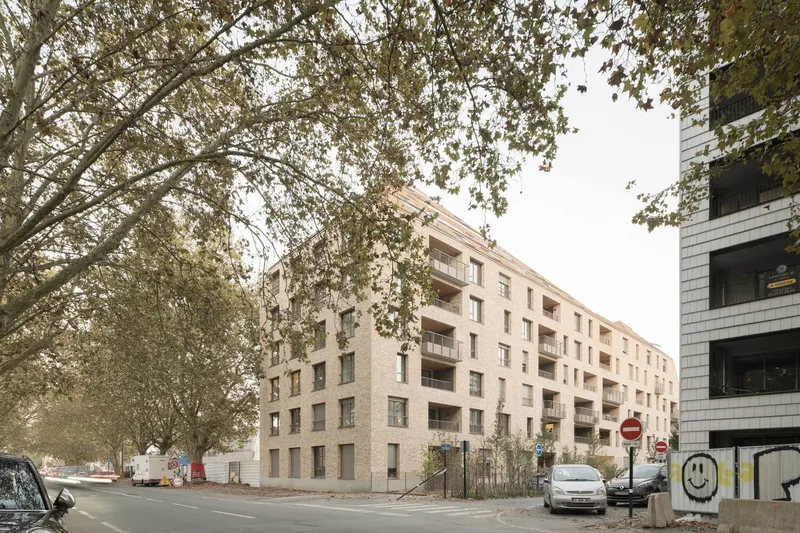
The building reads differently depending on your approach. From the quay, it is a mineral cluster; from the street, it is a neighborhood facade with punched windows, recessed entries, and a rhythm that breaks down a 3,875 m² mass into legible parts. The perimeter fence along one edge is an unfortunate necessity in a district still under construction, but the architects have detailed it to sit low, avoiding the fortress aesthetic that plagues many new residential developments.
Neighboring buildings in the masterplan use white render and flat roofs, which makes B09's brick gables all the more striking. The contrast is productive: it gives the street visual variety while the shared setback lines and similar massing keep the urban wall coherent. MVRDV's heliotropic grid ensures that the angular rooflines are not arbitrary but oriented to maximize solar access for the streets below, a functional rationale that the architects made architectural.
Plans and Drawings
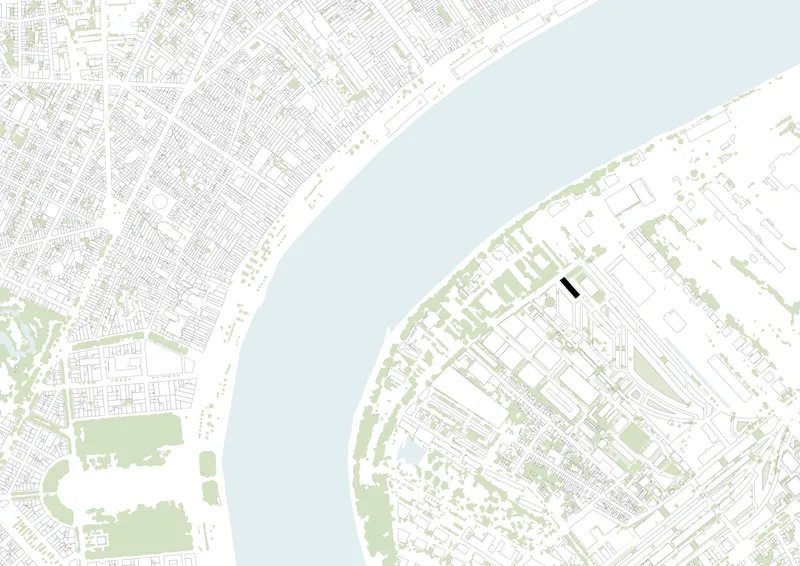
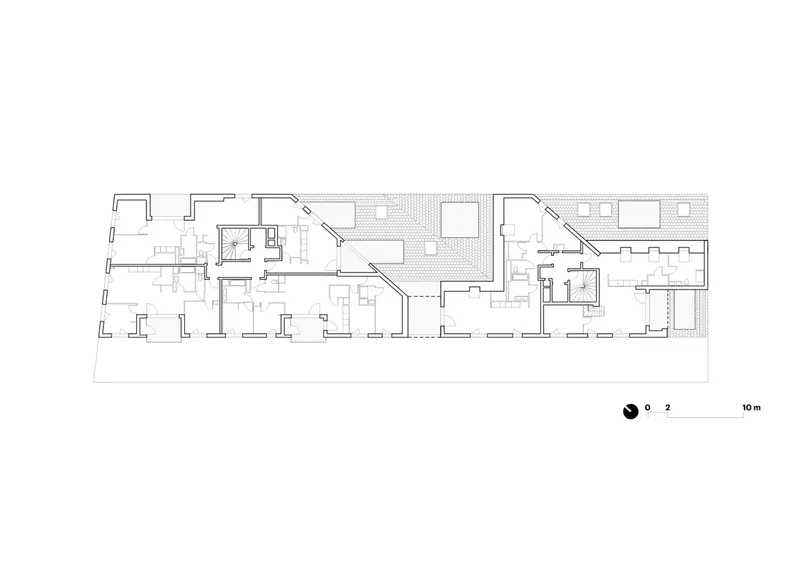
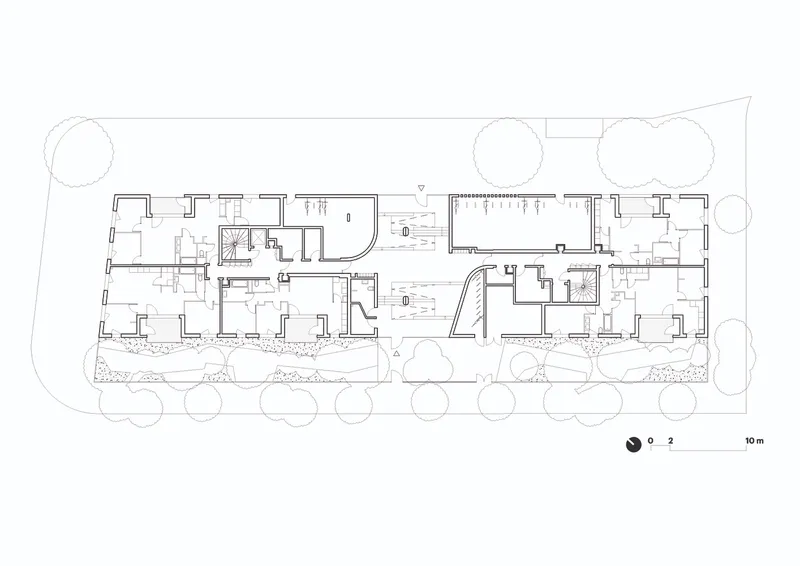
The site plan reveals B09's narrow footprint, squeezed between the dense new urban fabric and the curving waterfront of the Garonne. The ground floor plan shows the central vestibule flanked by two staircases, each serving a wing of residential units that look outward toward the street or inward toward the courtyard. Upper-floor plans make clear how the loggias and terraces are distributed: southern units get deep recessed balconies, while upper units gain access to landscaped rooftop terraces.
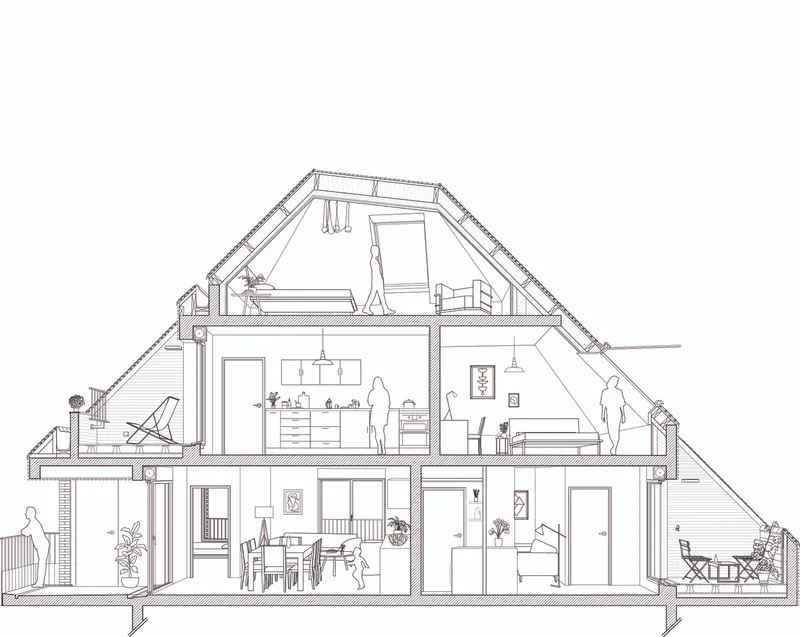
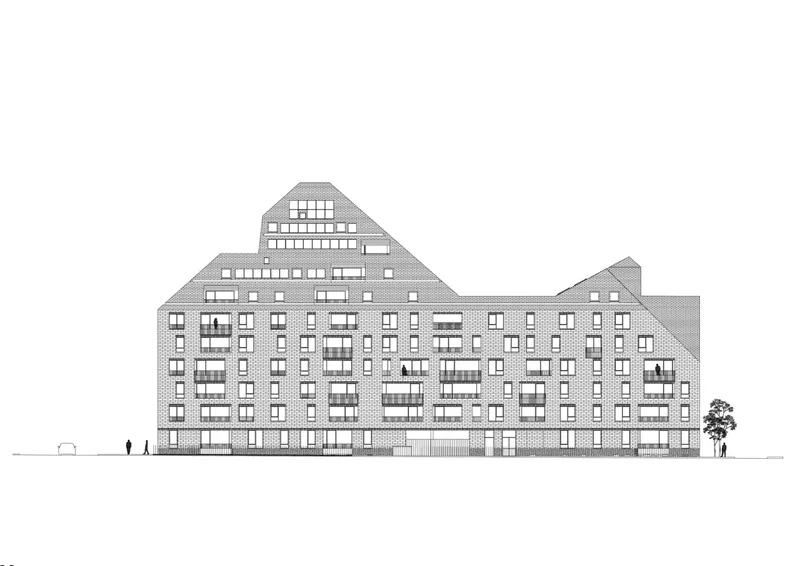
The section drawing is the most revealing. It shows how the pitched roofs create double-height spaces in the uppermost apartments, with tropéziennes cutting into the roof volume to bring light and air deep into the plan. The elevation drawing confirms the disciplined variation of window sizes and groupings, a pattern that looks casual but is carefully calibrated to align with interior room layouts. Together, the drawings make the case that B09's apparent simplicity conceals a high level of compositional control.
Why This Project Matters
Social housing rarely gets this level of material commitment. At a construction cost of €7.38 million for 54 units, B09 is not an extravagant project, yet urbanmakers and Selva & Maugin treated every surface as if the budget had no ceiling. The decision to use real brick and tile rather than composite panels or render is a bet on longevity: these materials will look better in thirty years than they do today, an inversion of the typical trajectory for social housing facades. The Effinergie+ certification and RT2012-30% energy performance confirm that the investment in craft did not come at the expense of environmental targets.
More broadly, B09 offers a model for how new districts can engage with historic cities without resorting to pastiche or provocation. The blonde brick references Bordeaux's limestone tradition without copying it. The gabled volumes recall familiar domestic forms without regressing into nostalgia. And the seamless wall-to-roof envelope demonstrates that even the most constrained volumetric parameters can produce architecture with presence and warmth. In a decade, when the trees along Quai des Queyries have matured and Bastide-Niel has found its footing, this building will likely be cited as the block that set the district's tone.
B09 Building Island, designed by urbanmakers (lead architect) with Selva & Maugin Architectes (associate architect). Bastide-Niel district, Bordeaux, France. 3,875 m². Completed 2024.
About the Studio
Share Your Own Work on uni.xyz
If projects like this are the kind of work you want to make, uni.xyz is a place to publish your own, find collaborators, and enter design competitions.


Popular Articles
Popular articles from the community

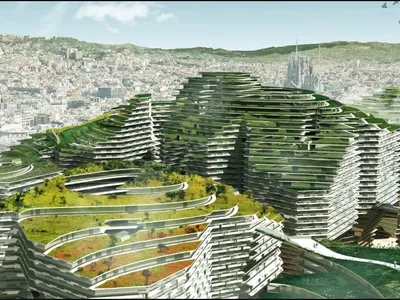
Manzana Morphosis: Stretching Barcelona's Grid into a Living Landscape for 2050
A radical reworking of the Eixample manzana turns density into a tool for generous public space, vertical ecology, and environmental performance.


David Ortega Stacks a Two-Story Mexico City Penthouse Around a Steel Stair and a Pergola-Shaded Roof Terrace
In Colonia Roma, a 300 m² penthouse uses oak joinery, a planted steel stair and a slatted roof pergola to make a new-build apartment feel like a house.

Opera on the Sea: Driftwood Logic Shapes a Timber Opera House on Estonia's Coast
Trevor Orgill's opera house translates the entangled drift of floating timber into a civic building where wood, water, and music converge.

FCC Arquitectura Expands a Portuguese Granite House with a Board-Marked Concrete Wing
In Portugal, JV House pairs a cleaned-up whitewashed and granite dwelling with a timber-shuttered concrete extension, courtyards and a garden pool.

Similar Reads
You might also enjoy these articles


Hodi-Mandai Geram
Project Function: Preservation and revitalization of the Intangible heritage and socio-spatial identity of the Hodi by Housing, Cultural Memory Center, Sacred Grove, landscape, local tourism economy


Olio Towers: A Mid-Rise for Performers That Fuses Housing, Rehearsal, and Stage
Located blocks from Houston's Theater District, this modular tower stacks living units around a central performance atrium.

Oasis: Modular Green Housing Carved into Dhaka's Urban Fabric
A shortlisted Plugin Housing entry reclaims unauthorized settlements in Dhaka with stepped concrete volumes, green roofs, and ventilation-driven design.

Black Hole: A Floating Megastructure for the Post-Physical Era
Emiliano Mazzarotto envisions a spherical, self-scaling arena where e-sports, digital hotels, and holographic stadiums replace traditional public space.

Explore Architecture Competitions
Discover active competitions in this discipline

Challenge to reimagine the Iron Throne

Photograph architecture without architects

Illustrate the lost glory of Angkor Wat - Render Challenge

Design challenge to reuse E-waste
Comments (0)
Please login or sign up to add comments
No comments yet. Be the first to comment!