
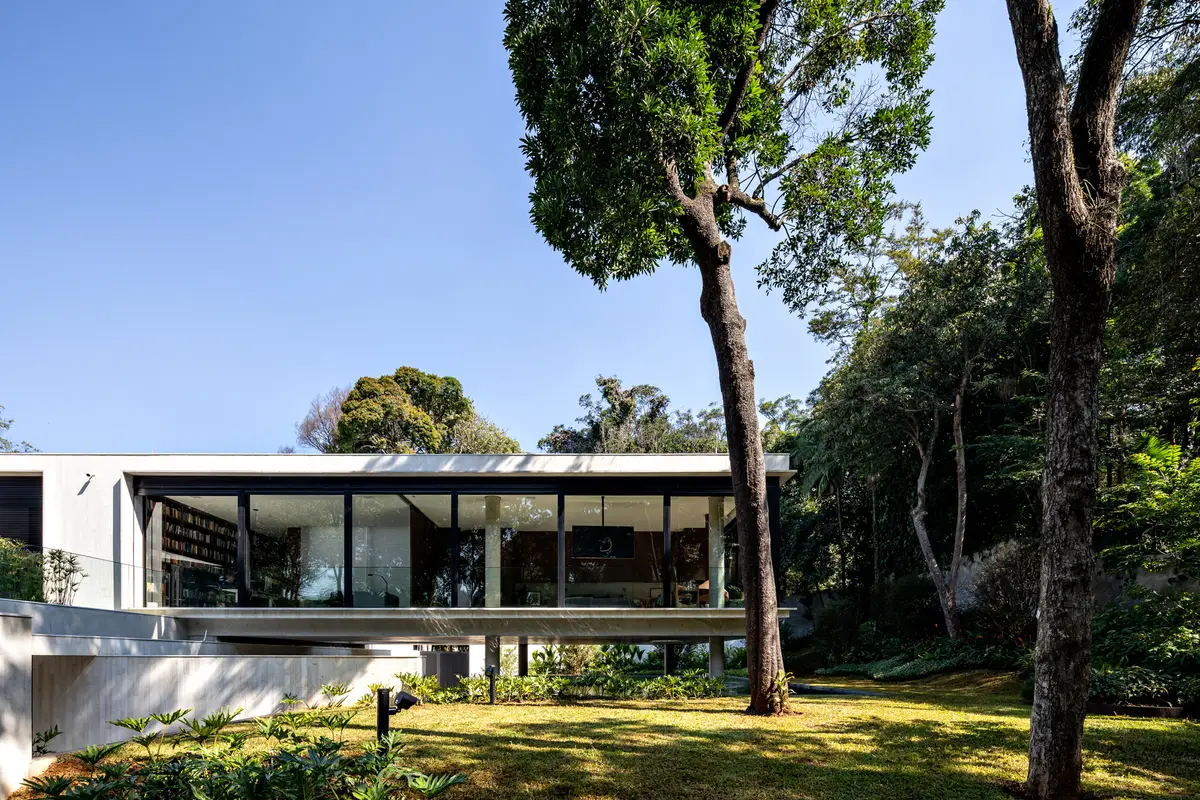
Basiches Arquitetos Threads a 1,746 m² House Through the Trees of a São Paulo Forest
A cantilevered concrete residence in a densely wooded São Paulo complex preserves every mature tree on the site while delivering a generous program.


Building big in a forest means one of two things: you clear the trees, or you build around them. For MF House, Basiches Arquitetos Associados chose the harder path. Set inside a densely wooded residential complex in São Paulo, the project had to accommodate nearly 1,750 square meters of program without sacrificing the mature canopy that gives the site its entire character. The solution was not a single monolithic block but a series of overlapping rectangular volumes, staggered across a sloping terrain, each calibrated to slip between the trunks already in the ground.
What makes MF House genuinely interesting is not the scale but the discipline. Cantilevered upper floors hover above the landscape rather than excavating into it. Reflecting pools stretch beneath the lifted volumes, doubling the forest in still water and pulling filtered light under deep concrete soffits. The house reads as both massive and permeable: board-formed concrete walls anchor it to the hill, while full-height glazing dissolves the boundary between interior rooms and the surrounding planting designed by Alex Hanazaki. The tension between weight and transparency runs through every elevation and every section.
Volumes in the Canopy
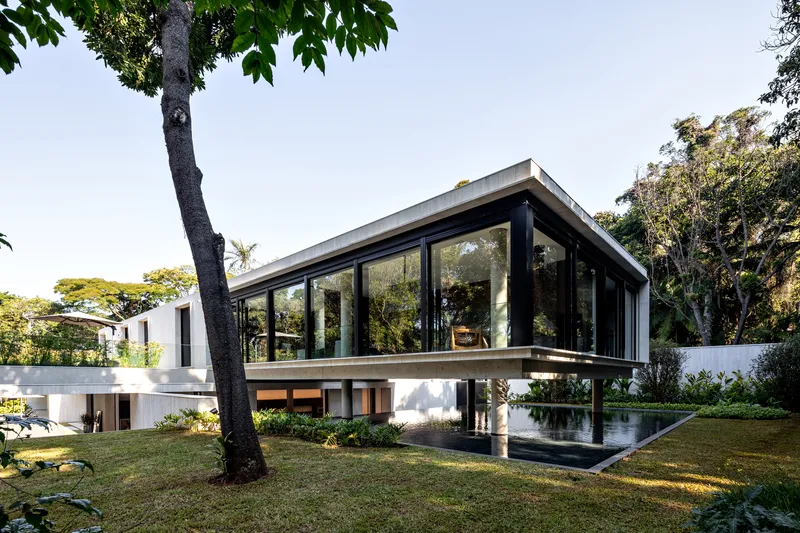
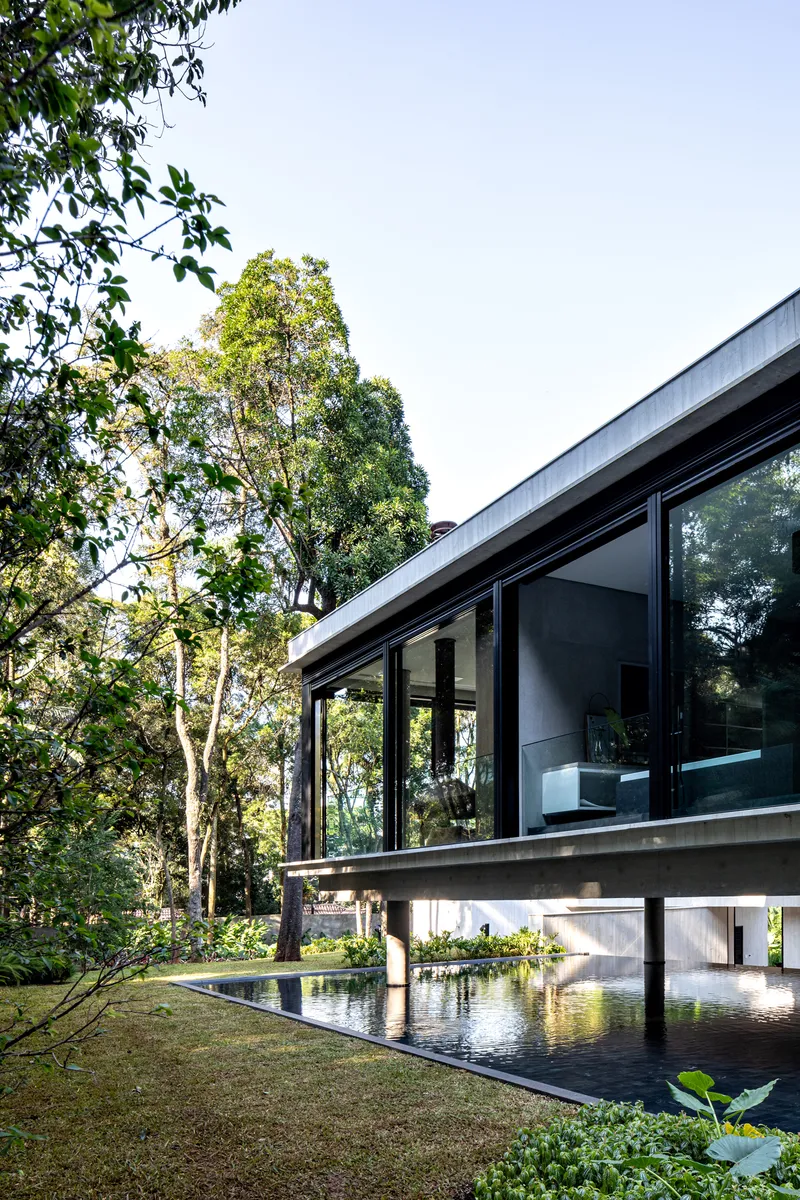

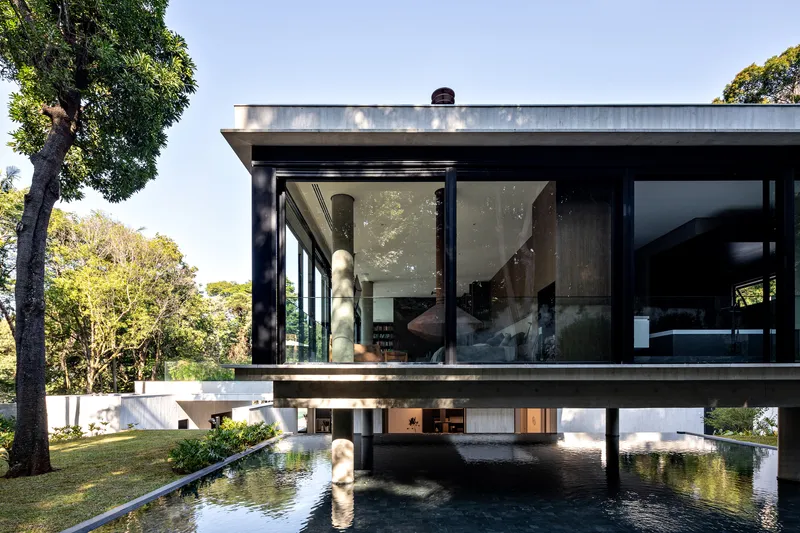
The building's massing reads as a collection of pavilions rather than a single object. An elevated glass-walled volume, carried on slender piloti, floats above a reflecting pool and surrounding forest. Nearby, a single-story pavilion with board-formed concrete walls sits quietly under the shade of existing trees, its broad glazed openings framing the lawn like oversized picture windows. The effect is one of controlled fragmentation: the house distributes its weight across the site so that no single volume dominates the tree line.
This strategy is legible at every angle. From below, the lifted volume appears almost buoyant. From the garden, the lower pavilion reads as a piece of landscape infrastructure. The decision to break the program into distinct pieces, rather than stacking it vertically, preserves sightlines through the site and keeps the canopy intact overhead.
Concrete and Water


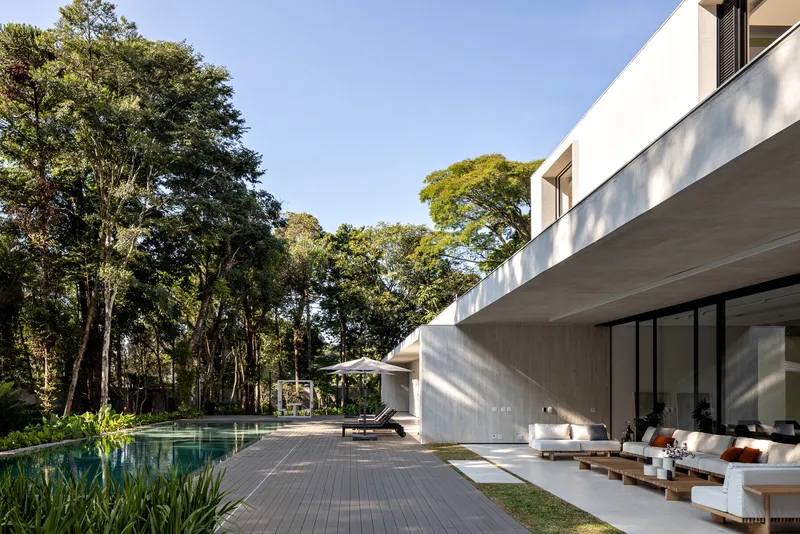
Board-formed concrete is the dominant material language. Its rough, horizontal grain appears on retaining walls, soffits, corridor linings, and the underside of cantilevered floors. Rather than treating the formwork texture as ornament, Basiches uses it structurally and atmospherically: the grain catches dappled sunlight filtering through the trees, and the mass of the concrete anchors the house against the steep grade.
Reflecting pools run beneath the deepest overhangs, creating a reciprocal relationship between the heaviest elements of the building and the lightest material on site, water. The pools are not decorative afterthoughts. They occupy the territory directly below the cantilevers, turning what would otherwise be dark, compressed ground-floor zones into luminous spaces animated by reflected light and the movement of aquatic plants.
Living Between Inside and Out
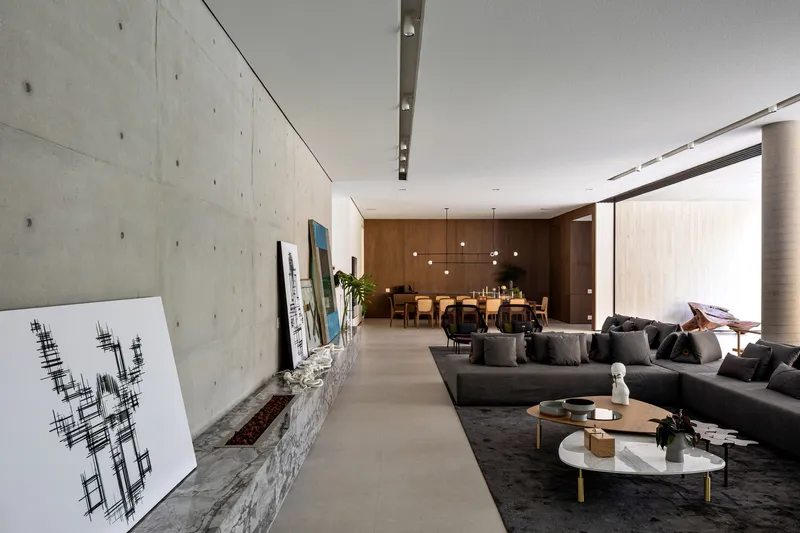


The principal living spaces operate as open-plan zones that dissolve into the landscape on at least two sides. A large sectional sofa anchors the main living room against a concrete accent wall, while floor-to-ceiling glass eliminates the wall opposite, putting the forest within arm's reach. Dining areas pair timber paneling with restrained furniture selections, letting the warmth of the wood offset the coolness of the exposed concrete structure.
The material palette inside is deliberately narrow: timber millwork, concrete, stone, and glass. There is no drywall camouflage. Structure and finish are the same thing. This honesty keeps the interiors from competing with the views and reinforces the sense that the house is an extension of its terrain rather than a container placed upon it.
The Terrace and Pool Edge
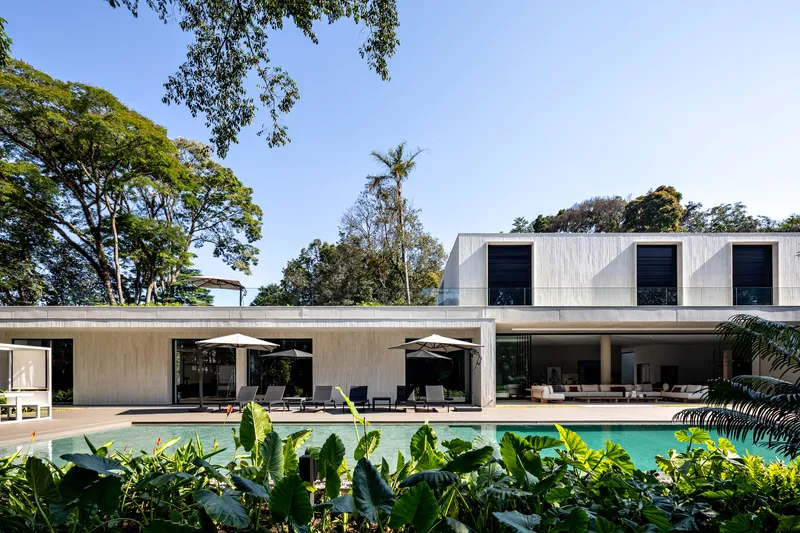
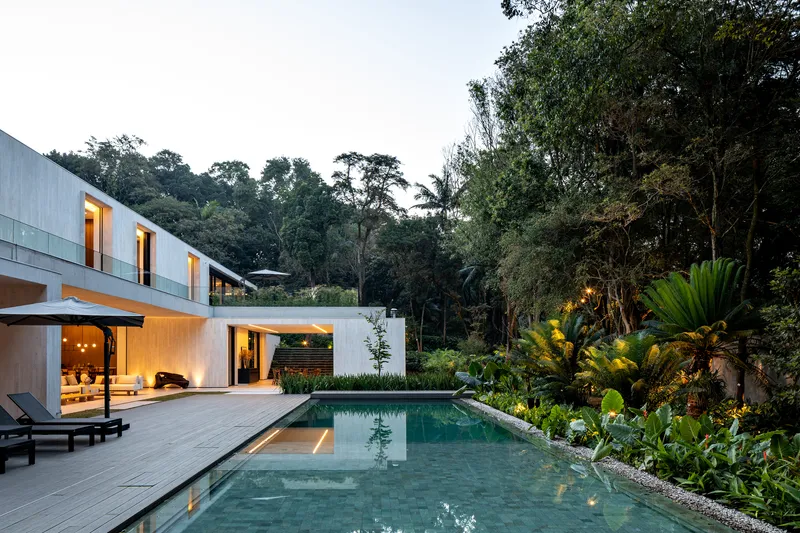
The rear facade resolves into a covered terrace overlooking a swimming pool framed by tropical planting. At dusk, the illuminated interiors glow against the dense forest backdrop, and the pool surface becomes a second mirror. A cantilevered upper floor projects over the water, its reflection stretching the apparent height of the building downward. The dusk shot reveals how the house was designed to be experienced temporally: what reads as heavy concrete by day becomes a lantern at night.
Wide planted steps connect the pool terrace to the upper garden, creating a gentle topographic transition that avoids the feeling of a retaining wall. Timber deck areas, outdoor seating beneath concrete overhangs, and stone-paved paths provide a gradient of formality from full interior to full landscape, with no hard threshold between.
Passages and Thresholds
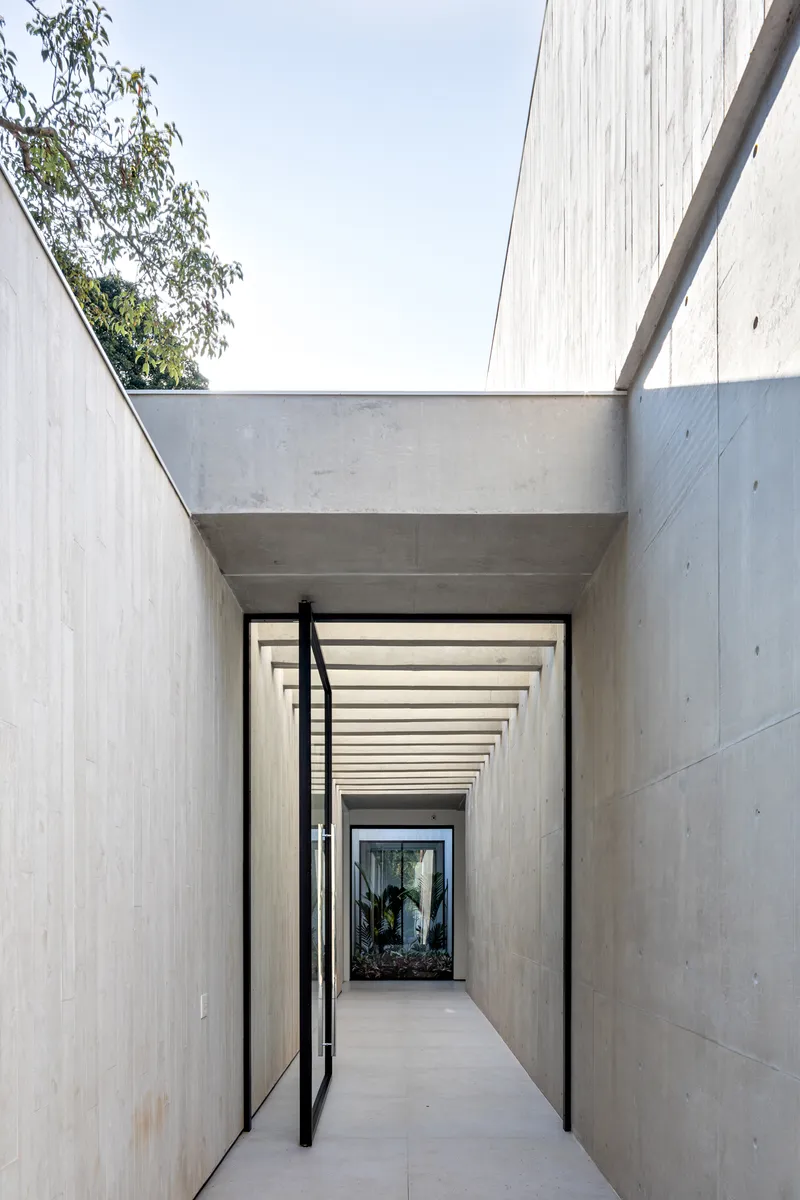


Circulation is treated as architecture, not leftover space. Narrow concrete passageways with open skylights and rhythmic timber beam shadows compress the experience before releasing it into a glazed opening or a garden view. A dark stone staircase ascends beneath a cantilevered soffit with recessed linear lighting, turning a vertical connection into a carefully sequenced spatial event.
These corridors do real atmospheric work. They modulate the transition from one volume to the next, using light, material, and proportion to slow the pace and make each arrival feel intentional. The formwork beams cast parallel shadows that shift through the day, making the corridors function as sundials within the house.
Private Quarters and the Forest Edge
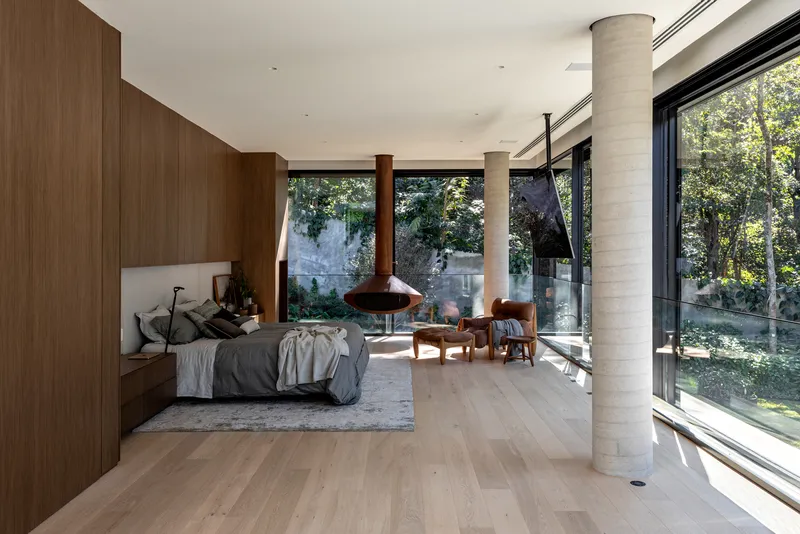


Bedrooms and bathrooms maintain the same material vocabulary as the public spaces, with timber millwork, concrete panels, and generous glazing. A suspended fireplace in the primary bedroom faces a wall of glass overlooking the pool, collapsing the boundary between domestic comfort and landscape. Bathrooms push this further: a freestanding bathtub on a black plinth frames a garden view, while a shower enclosure uses a narrow window slot to bring in a single vertical strip of vegetation.
The planted courtyard visible from the vanity area introduces a controlled pocket of nature into the most intimate rooms. These moments are not accidental. They reflect a consistent design ethos: every room, no matter how private, should have a direct relationship with the forest outside.
Landscape as Infrastructure

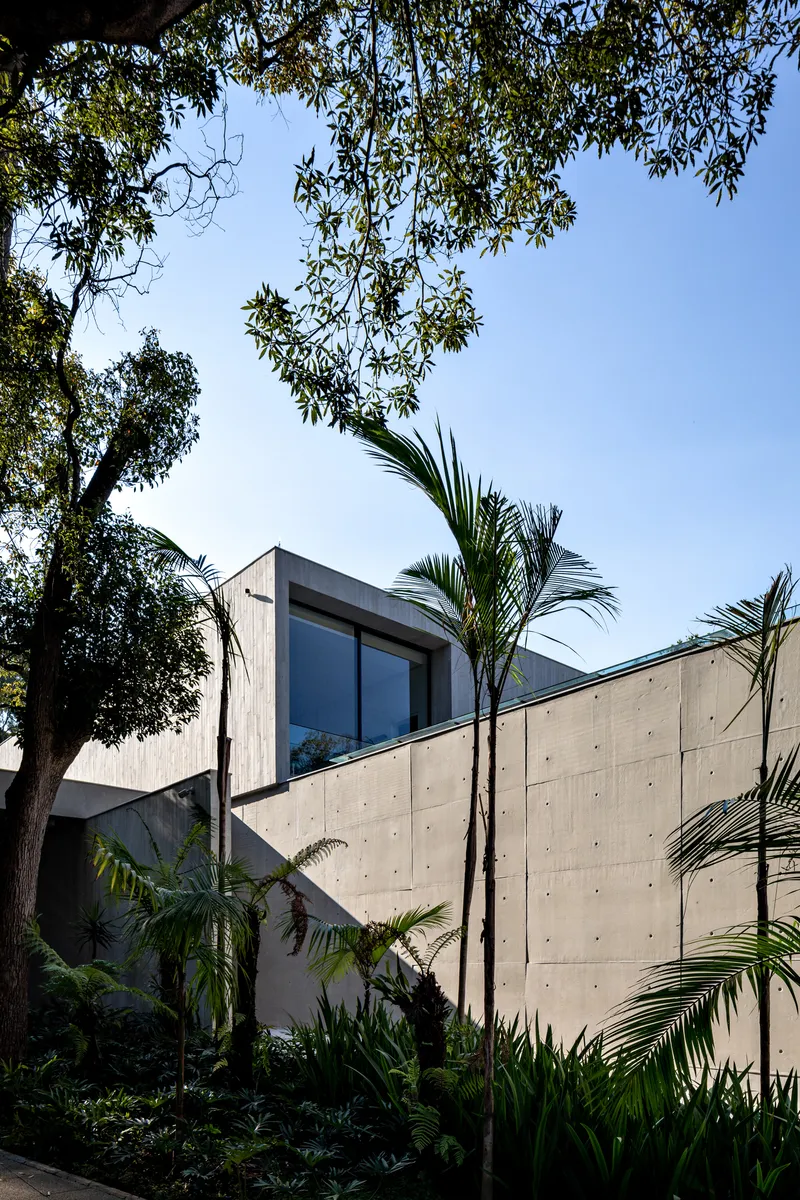

Alex Hanazaki's landscape design is not applied decoration; it is structural to the project's logic. Board-formed concrete retaining walls emerge from palm groves and tropical plantings, blurring the distinction between site work and building. Planted steps ascend through dappled sunlight, replacing formal staircases with a softer topographic connection. Stone-paved pathways flanked by planted beds lead to rectilinear concrete openings, making the approach to the house a slow, curated sequence through the existing vegetation.
The decision to preserve every mature tree on the site forced the architecture to become adaptive. Volumes shift, cantilevers extend, and floor plates notch to accommodate trunks. The result is a house that looks as though it was grown rather than placed, with architecture and landscape locked into mutual dependence.
Plans and Drawings
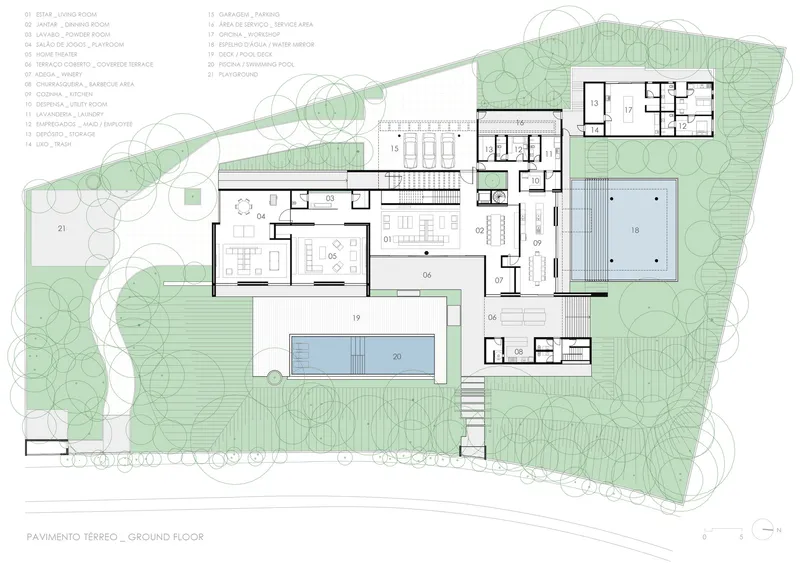
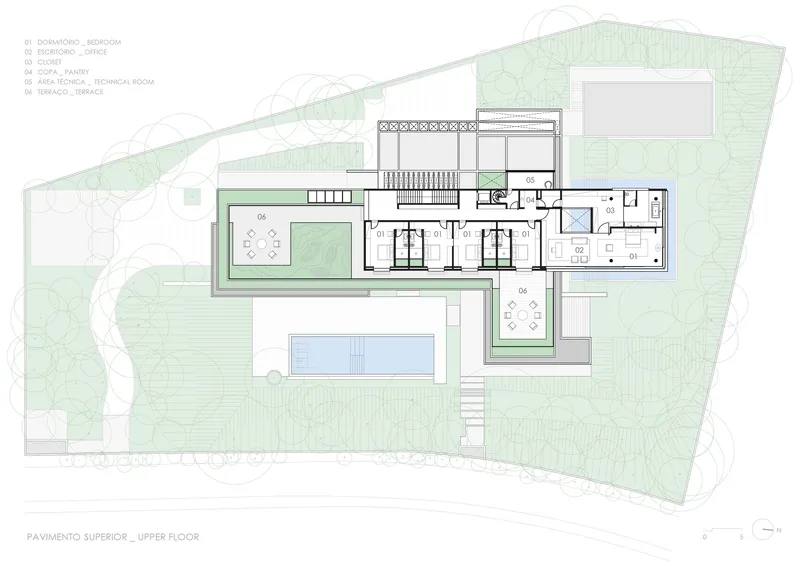
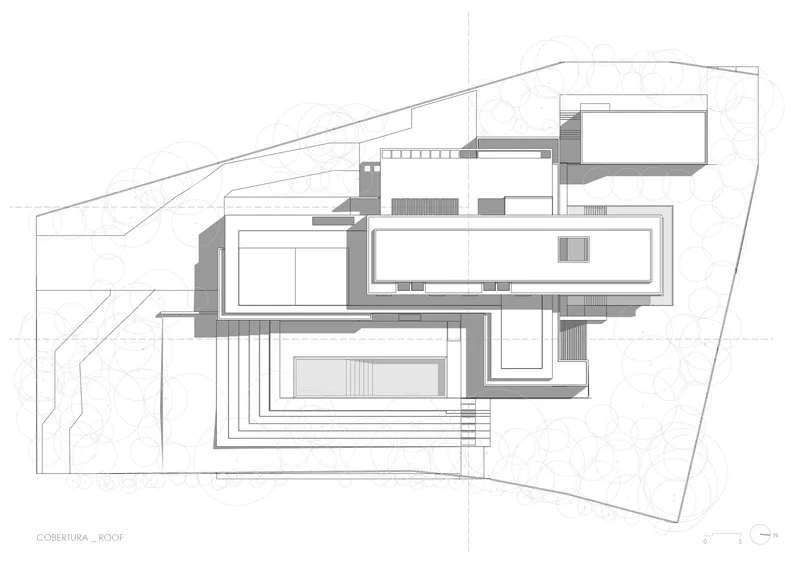
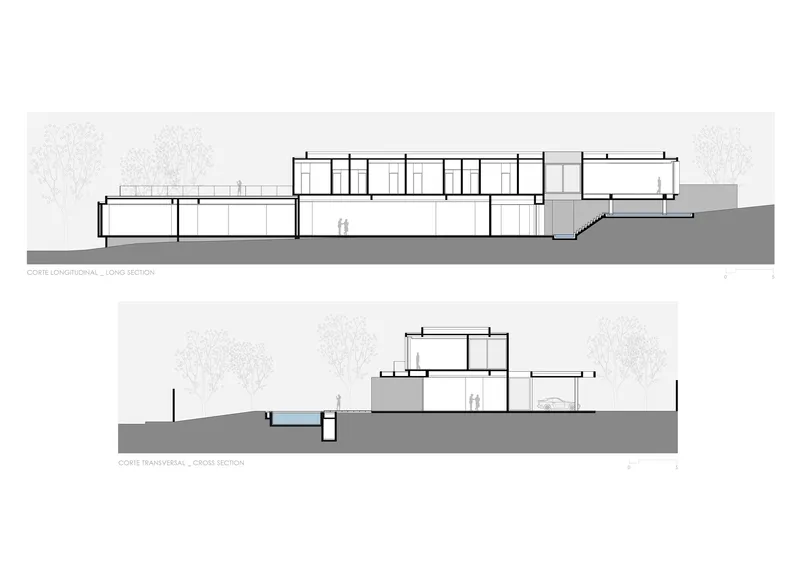


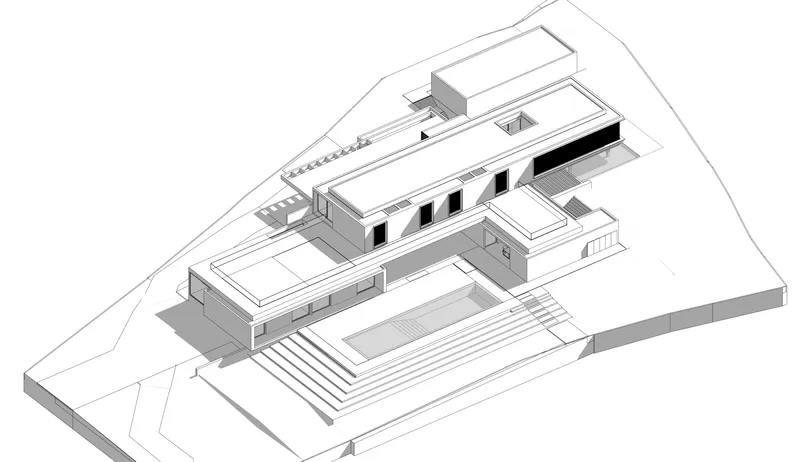

The ground floor plan reveals the spatial logic most clearly: living spaces orbit two pools, with the program fanning outward across the sloped site to maximize frontage on the landscape. The upper floor consolidates bedroom suites and terraces, each oriented to overlook the pool below. Section drawings confirm the deliberate play of cantilever and recess, showing how interior volumes tuck under projecting floors to create shaded outdoor zones.
The axonometric drawing and hand-sketched exploded views are especially revealing. The colored roof volumes, highlighted in orange and yellow, read as a cluster of overlapping rectangles, each rotated slightly to avoid existing trees and to capture different orientations across the site. Contour lines on the roof plan underscore the grade change the project negotiates, a slope that drives the entire stacking strategy.
Why This Project Matters
MF House is a case study in the productive tension between ambition and constraint. Nearly 1,750 square meters of residential program is a lot. Fitting it onto a forested slope without felling a single mature tree is a genuine feat of planning. The project demonstrates that preservation and generosity are not opposites: by distributing mass across the terrain and lifting volumes on piloti, Basiches delivered every room on the program while amplifying the site's existing qualities.
More broadly, the house argues for a mode of residential architecture in which the landscape is not a backdrop but a co-author. Reflecting pools double the forest. Concrete soffits frame the canopy. Corridors borrow light from skylights punched through planted roofs. The discipline is quiet but total. In a city where large residential projects routinely flatten their sites and start from bare earth, MF House offers a compelling counter-narrative: build big, but build around what is already there.
MF House by Basiches Arquitetos Associados, São Paulo, Brazil. 1,746 m². Completed 2020. Landscape design by Alex Hanazaki. Structural engineering by Monteiro Linardi Engenharia. Photography by Fran Parente.
About the Studio
Share Your Own Work on uni.xyz
If projects like this are the kind of work you want to make, uni.xyz is a place to publish your own, find collaborators, and enter design competitions.


Popular Articles
Popular articles from the community


U.GA Architects Wraps an Oval Rooftop Pool in Curved Board-Formed Concrete on Busan's Jeollidan-gil
In Busan's Jeonpo-dong, a 454 m² mixed-use block stacks a neighborhood facility, guest rooms and an oval rooftop pool inside spiraling concrete walls.

Cube Design Draws an Ecological Corridor Between Two Shenzhen Hills with the Nankai Building
Beside Shenzhen's container docks, the Nankai Building pairs stacked balconies with a climbing green screen to connect two hillsides across its height.

David Ortega Stacks a Two-Story Mexico City Penthouse Around a Steel Stair and a Pergola-Shaded Roof Terrace
In Colonia Roma, a 300 m² penthouse uses oak joinery, a planted steel stair and a slatted roof pergola to make a new-build apartment feel like a house.

LT2A and OPEN Architectes Thread a Brick and Glass High School Through a Wooded Belgian Campus
In Braine-l'Alleud, a 3,000 m² wing for Collège Cardinal Mercier pairs pale brick with a glazed colonnade, deferring to a small chapel and a dense wood.

Similar Reads
You might also enjoy these articles


LAVA Architecten Gives Vocational Education a Sawtooth-Roofed Face on a Mechelen School Campus
In Mechelen, Belgium, a 2,053 m² STEM school on a 6×6 m grid turns workshops and classrooms into rooms that can be rearranged as teaching changes.

KEMA Studio Turns a Derelict Marvila Attic into a 60 m² Lighthouse Apartment Above Lisbon
In Lisbon's Marvila district, a rebuilt roof, four skylights and two plywood volumes turn an unlivable attic into a bright home facing the Tagus.

Pixel Gardens: One Repeated Module Stacked Into a Terraced Social Housing Tower for Famagusta
Salem Bader's shortlisted housing tower builds a vertical neighbourhood from one repeated module, offsetting units to carve terraces, light and air.

Bao Huynh Watercolor Atelier: A Serene Art Retreat in Hội An
Bao Huynh Watercolor Atelier in Hội An blends multifunctional art spaces, sustainable design, local materials, and family-friendly living in a serene environment.

Explore Plug-In House Competitions
Discover active competitions in this discipline

Challenge to design a barrier free sports center

Challenge to design an outdoor ice-rink and park

Challenge to design mud housing for contemporary communities
Comments (0)
Please login or sign up to add comments
No comments yet. Be the first to comment!