

BASIL Architecture Weaves a Charred Timber House Between the Oak Trees of a Belgian Garden
A former chalet in Aalter becomes a cluster of gabled volumes shaped by existing trees and drenched in Le Corbusier color.


There is a particular kind of ambition in choosing to keep every oak tree on a site and then designing a house around them. BASIL architecture did exactly that with House WADV in Aalter, Belgium, turning a modest chalet into a 180 m² residence whose plan reads like a diagram of arboricultural diplomacy. The new extension fans out in angled gabled volumes that dodge trunks and canopy lines, producing an irregular silhouette that feels more like a small hamlet than a single dwelling.
What makes the project genuinely interesting, though, is not just the tree choreography. It is the tension between the dark, almost primitive exterior of charred timber cladding and a handful of carefully placed moments of unexpected color: gold anodized panels at the kitchen pavilion, and a system of Bleu Outremer accents on structural columns, staircases, switches, and even faucets. The result is a house that plays a serious game with restraint and exuberance simultaneously.
A Silhouette Negotiated by Trees


The garden-facing facade reveals the logic of the plan most clearly. A continuous band of floor-to-ceiling glazing runs beneath an undulating gabled roofline, the peaks and valleys of which shift in response to the positions of the surrounding oaks. The charred vertical timber cladding above this glass band gives each gable a sense of weight and solidity, while the transparency below dissolves the boundary between interior and garden.
Seen from the lawn in the late afternoon, the house reads as a collection of dark forms floating on light. The decision to keep the ground plane almost entirely glazed while cladding the upper volumes in blackened timber creates a strong visual inversion: the heavier material sits on top, giving the composition a slightly surreal quality that only intensifies at dusk when interior light spills out.
Courtyard Entry and Charred Threshold
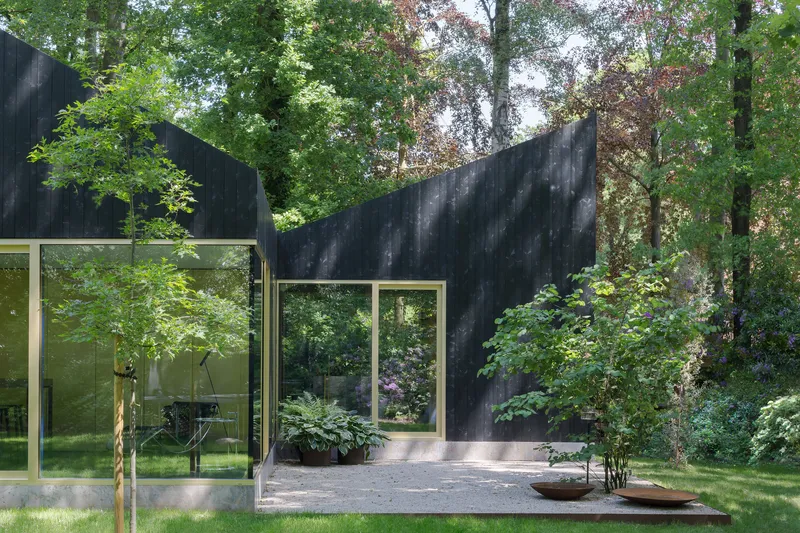
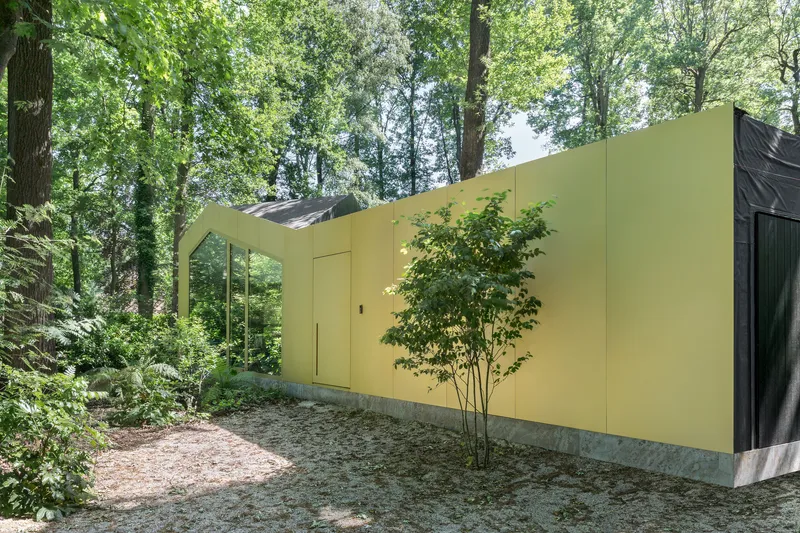

Arrival at House WADV happens through a gravel courtyard formed by the clustering of the gabled volumes. Tall grasses and planted beds line the approach, and a charred timber wall frames the glazed entry threshold. The sequence is cinematic: you move from dappled forest light through a tight, materially dense passage before the house opens up to the garden beyond.
The gold anodized panels appear here for the first time, framing the entry door and projecting into the gravel garden. Against the near-black timber and grey concrete base, this warm metallic surface registers as a deliberate punctuation mark rather than a decorative flourish. It signals that behind the austere exterior, the interior operates with a different palette.
The Kitchen as Hinge
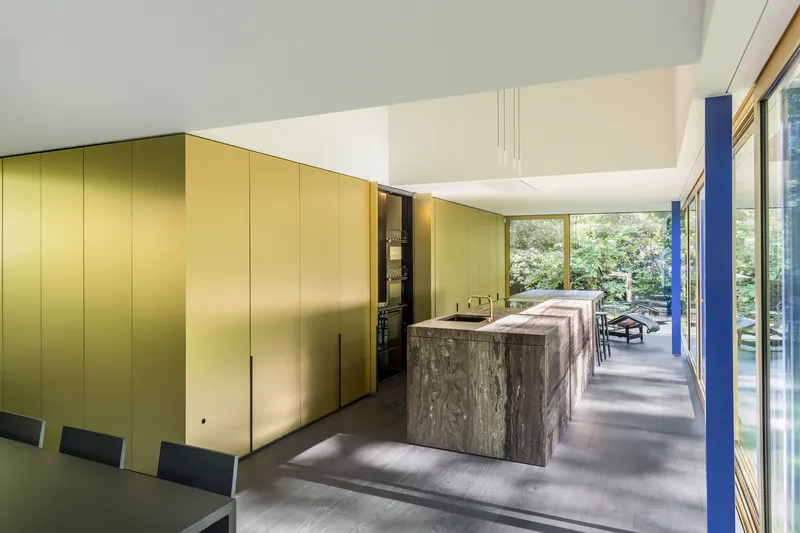

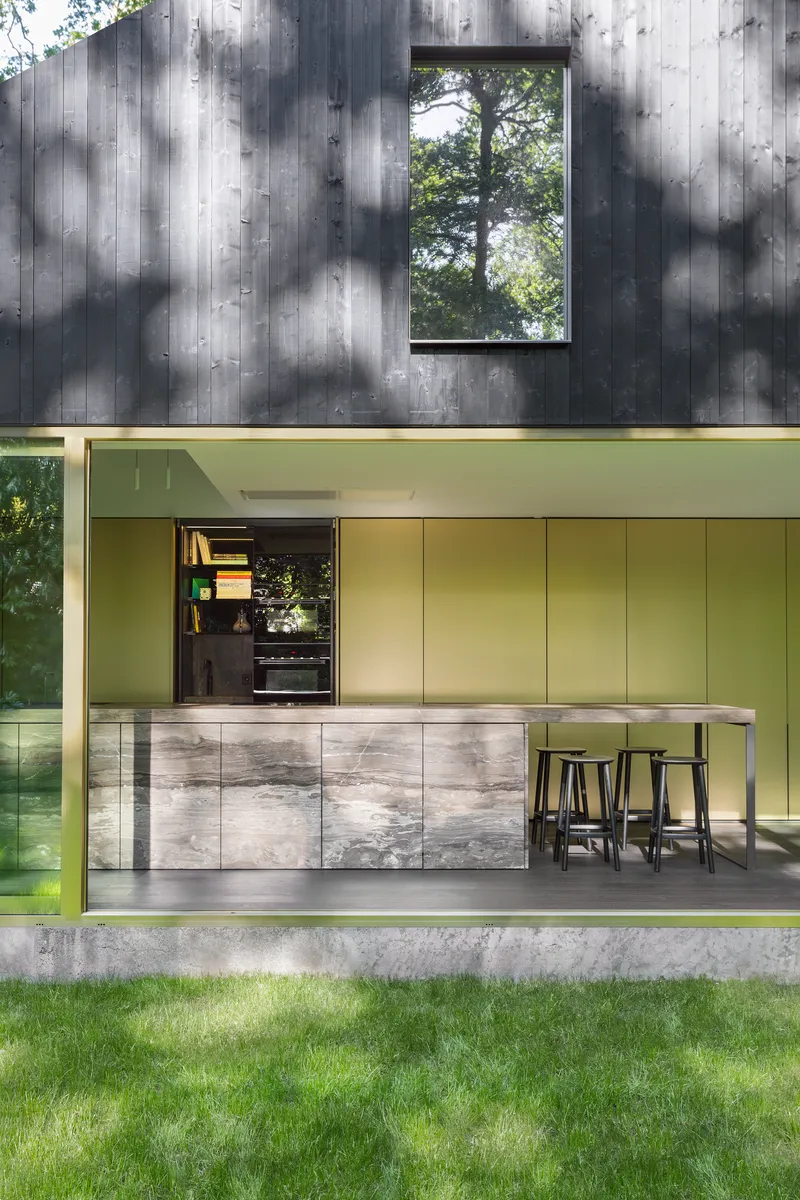
BASIL positions the kitchen between the old chalet and the new extension, turning it into the spatial and programmatic hinge of the house. A spacious stone-clad island sits beneath a clean white ceiling, flanked by a wall of brass storage cabinetry that catches and softens the garden light. The kitchen is not buried in the plan; it is the plan's reason for existing, mediating between the day functions on one side and the night functions on the other.
From the exterior, the kitchen pavilion is the moment where the gold anodized facade panels are most visible, wrapping the lower volume beneath the charred timber gable. The juxtaposition is striking: a warm, reflective material grounded by a heavy, carbonized one. It gives the kitchen an almost civic presence within the domestic cluster, a hearth visible from the lawn.
Living Rooms Open to the Canopy
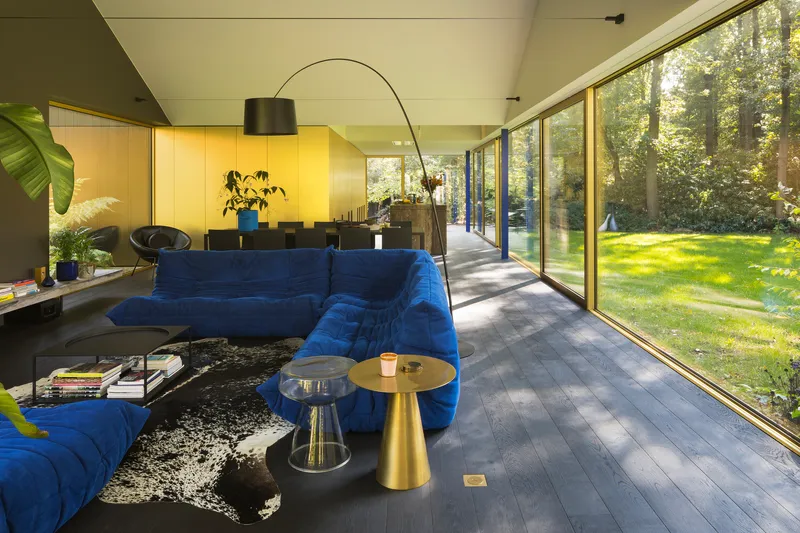
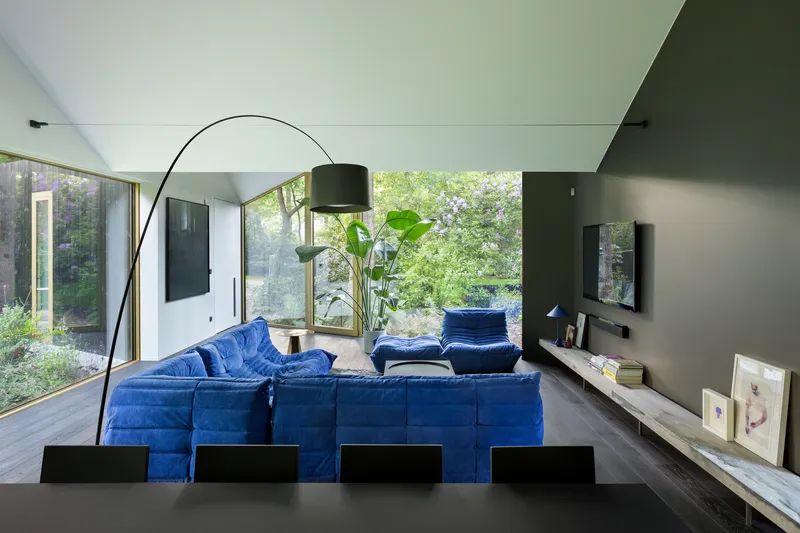

The living spaces commit fully to the garden. Dark timber floors extend to sliding glass doors that retract to erase the wall entirely, letting the lawn and trees become a continuation of the room. The ceiling heights in the existing chalet portions are modest, but the expanding roof geometry of the new extension produces a sense of spaciousness that compensates generously.
A corner detail in the living area reveals one of the Le Corbusier color interventions: a blue steel column at the junction of two glass walls, framing a view of the surrounding woodland. The column does structural work, supporting the steel frame above, but it also does perceptual work, drawing your eye to a specific slice of landscape. It is a small move that punches well above its weight.
A Bathroom That Earns the Word Retreat

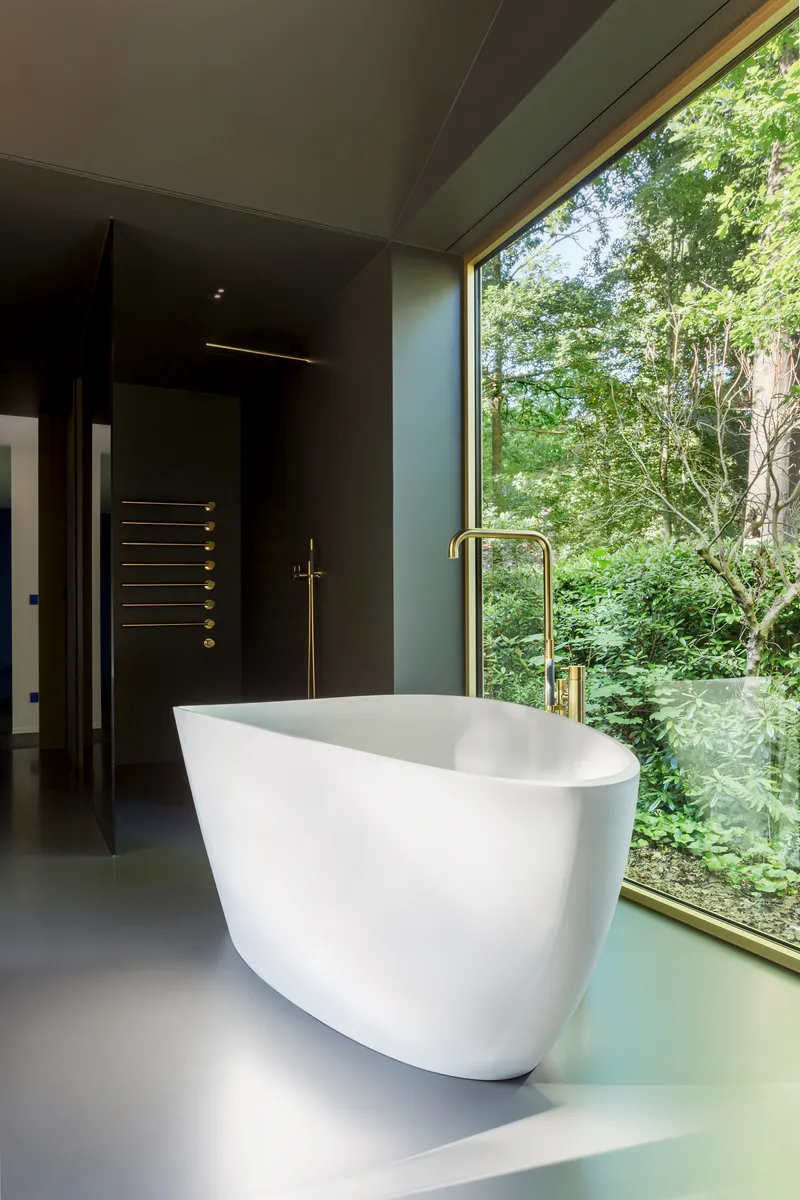

The bathroom is the room that most fully delivers on the project's stated ambition of maintaining a holiday feeling. A freestanding tub sits against floor-to-ceiling glass overlooking dense garden foliage, with brass fixtures and a warm greyish brown finish drawn from Le Corbusier's Ombre Naturelle. A wood-slatted sauna enclosure occupies one corner, reinforcing the spa logic.
What elevates the space beyond the predictable luxury-bath trope is the degree of exposure. The glass walls are unscreened, relying entirely on the density of the garden planting for privacy. The trees that shaped the building's plan also serve as its curtain. It is a circular logic that only works because the landscape strategy was taken as seriously as the architecture.
The Cluster at Dusk


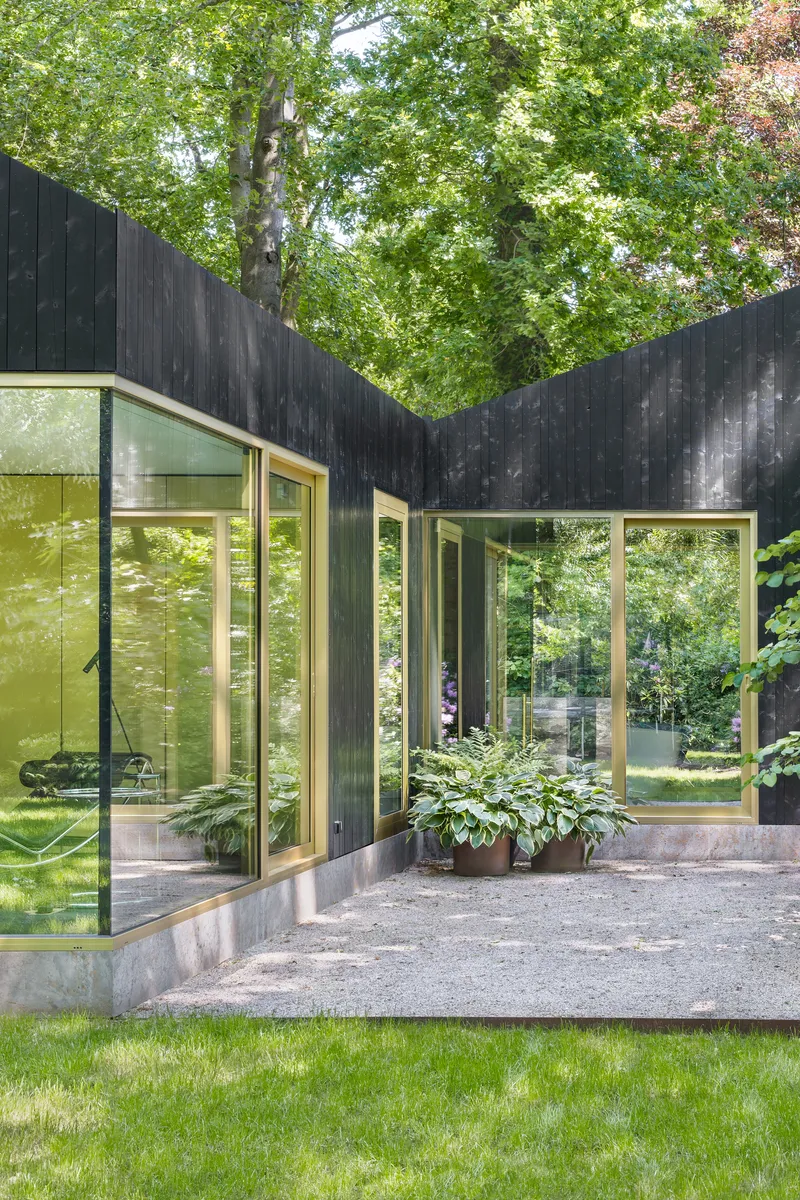
Viewed from a distance, House WADV reads as a small settlement rather than a single house. The detached dining pavilion, the linked gabled volumes, and the interstitial planted courtyards create a grain that is closer to a farmstead than to a suburban villa. The charred timber cladding unifies the disparate parts into a single dark composition, while the square window cutouts punched into the upper walls add a graphic discipline.
At the corner junctions, the concrete plinth and planted beds become visible, grounding the black timber volumes and revealing the careful section work that allows the glass ground floor to sit slightly above grade. Dappled forest light falls across these transitions throughout the day, producing a constantly shifting pattern that no rendering could predict.
Plans and Drawings
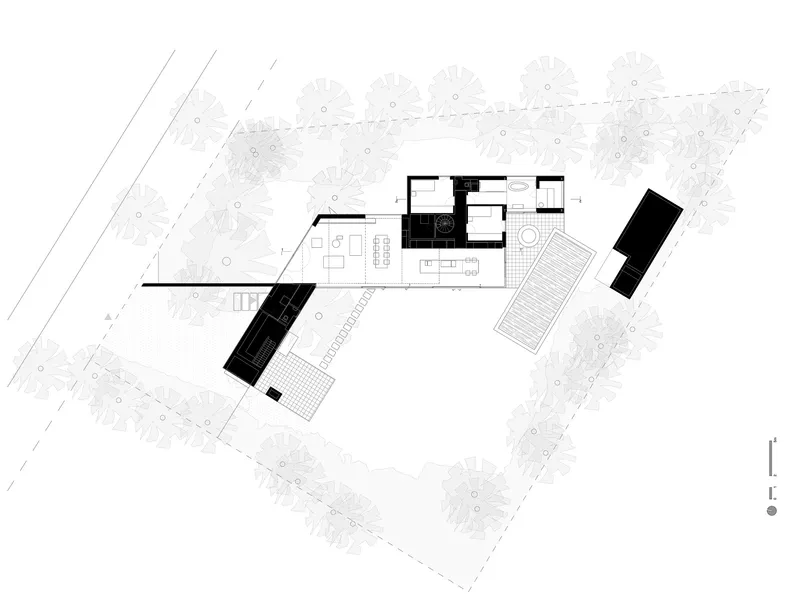
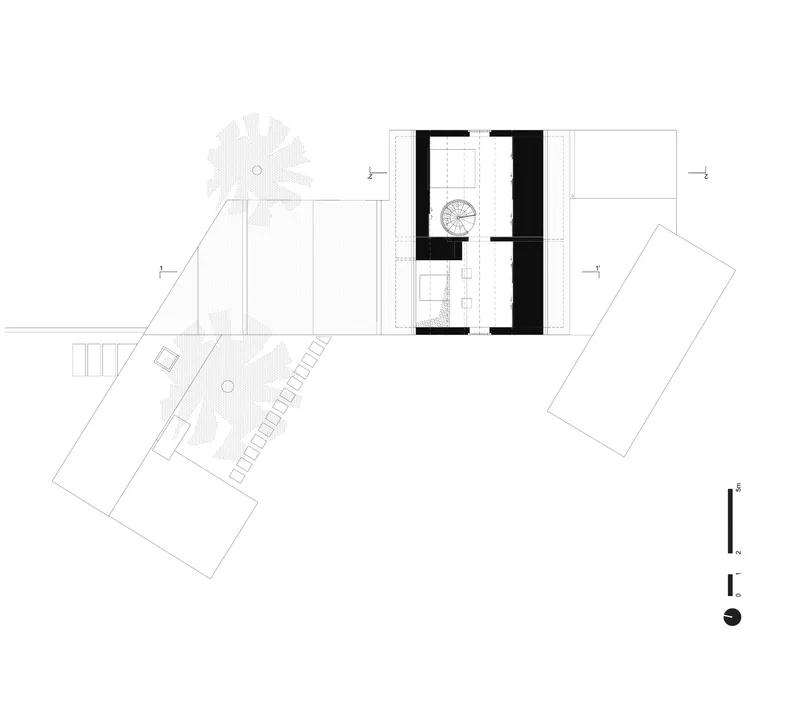

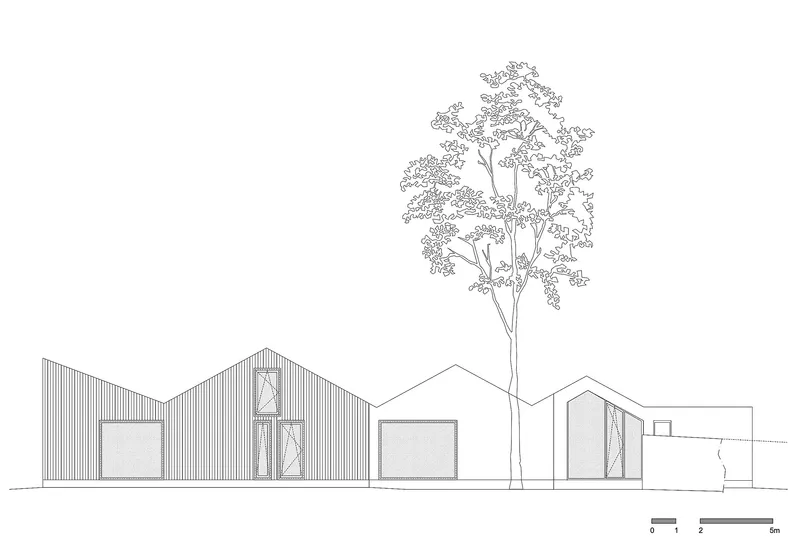
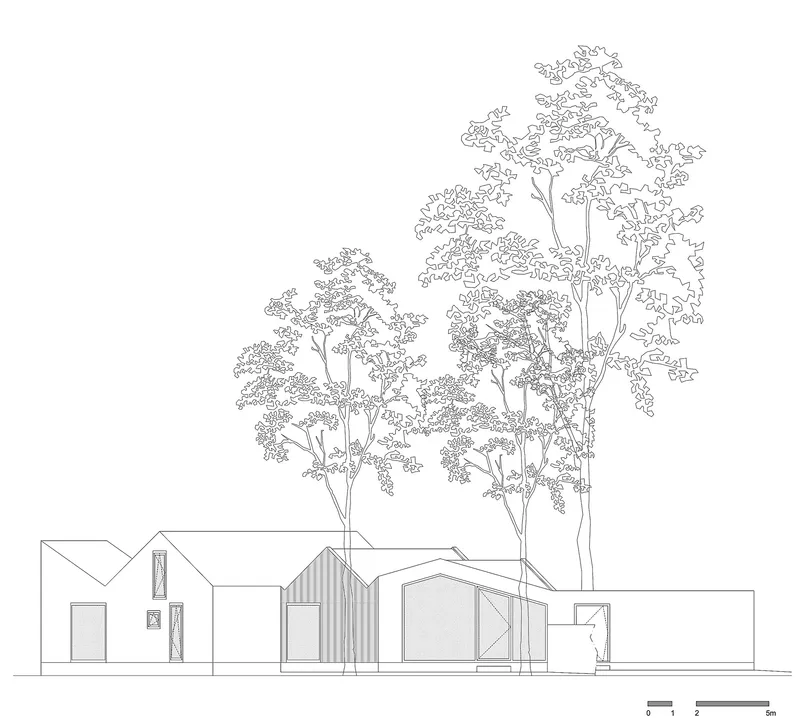
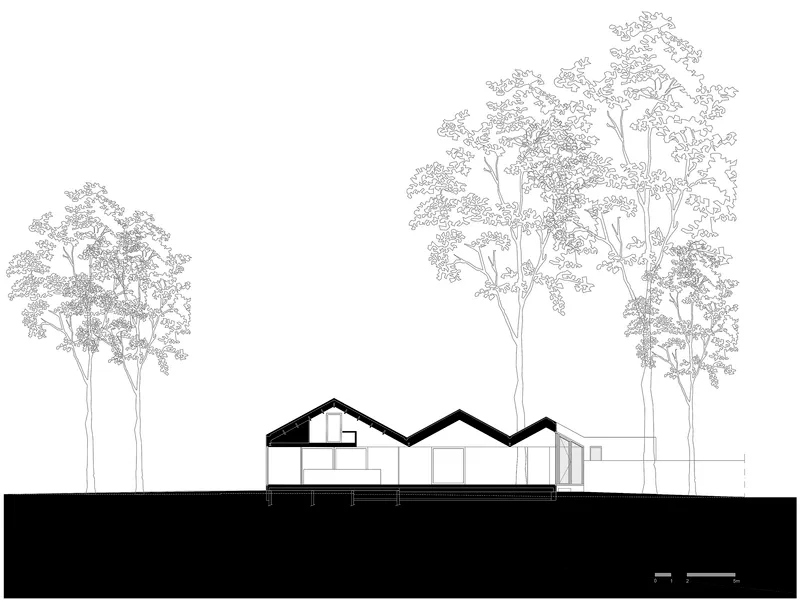
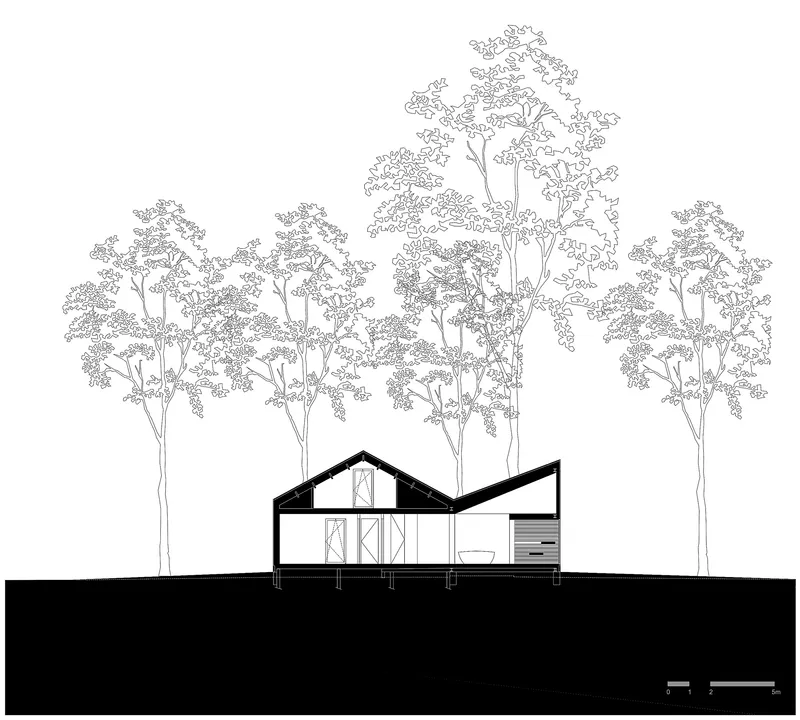
The site plan confirms what the photographs suggest: the building is not a single bar or L-shape but a constellation of angled wings arranged around a courtyard, with the tree canopy given equal graphic weight to the built volumes. The upper-level plan shows a compact layout organized around a central spiral staircase that links the gabled wings. The sections are the most revealing drawings, exposing the zigzagging rooflines and the way the interior ceiling follows the pitch, creating varying spatial conditions room to room.
The elevations, read as a set, show how the vertical charred timber cladding creates a consistent texture across gables of varying heights. Mature trees are drawn in front of and above the building, a reminder that the architecture was always conceived as secondary to the landscape. The sections also reveal the steel structure clearly, with the timber cladding acting as a rain screen around a lightweight frame.
Why This Project Matters
House WADV is a quiet argument against the clean-slate instinct that still drives most residential design. By letting the existing oak trees dictate the plan's geometry, BASIL architecture produced a house that could not exist on any other site. That specificity is its greatest asset. The building does not illustrate an idea about landscape; it is literally shaped by it, from the angled wings to the unscreened bathroom glass to the courtyard entry sequence.
The project also shows how a disciplined material palette, just charred timber, gold anodized panels, and two Le Corbusier colors, can carry a complex composition without resorting to spectacle. Each material does double duty: structural and atmospheric, functional and symbolic. In a market saturated with all-white minimalism and predictable Scandinavian warmth, this dark, tree-threaded house in Aalter offers a more grounded and more interesting alternative.
House WADV by BASIL architecture, Aalter, Belgium. 180 m², completed 2020. Photography by Giulia Frigerio and Liesbet Goetschalckx.
About the Studio
Share Your Own Work on uni.xyz
If projects like this are the kind of work you want to make, uni.xyz is a place to publish your own, find collaborators, and enter design competitions.


Popular Articles
Popular articles from the community


Manzana Morphosis: Stretching Barcelona's Grid into a Living Landscape for 2050
A radical reworking of the Eixample manzana turns density into a tool for generous public space, vertical ecology, and environmental performance.
Temporary Home for Dogs: A Reversed Zoo Rethinks Animal Shelter Architecture
In Bucharest, a sinuous corridor and freed landscape flip the logic of containment, designing a shelter that works to make itself unnecessary.
Faces of the Soviet Avant-Garde: Turning Moscow's Street Names into an Open-Air Museum
A network of sculptural installations across a Moscow residential district transforms forgotten architect names into spatial encounters with cultural memor
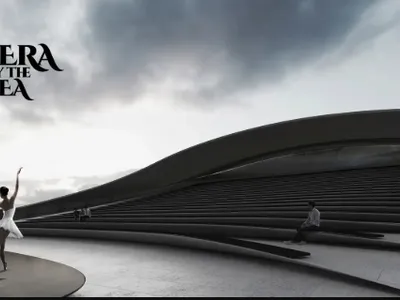
Opera by the Sea Estonia: Three Shells Dissolving Architecture into Tallinn's Coastline
A winning opera house proposal replaces monumental form with interconnected shells that blur the boundary between building, park and Baltic Sea.

Similar Reads
You might also enjoy these articles

Pixel Gardens: One Repeated Module Stacked Into a Terraced Social Housing Tower for Famagusta
Salem Bader's shortlisted housing tower builds a vertical neighbourhood from one repeated module, offsetting units to carve terraces, light and air.

Bao Huynh Watercolor Atelier: A Serene Art Retreat in Hội An
Bao Huynh Watercolor Atelier in Hội An blends multifunctional art spaces, sustainable design, local materials, and family-friendly living in a serene environment.

Atelier Macri Concept Store Interior Design by CASE-REAL
Atelier Macri store features a "ko" counter, walnut wood details, cork displays, blending retail, gallery, and seamless customer experiences.

Manuel Vargas Izquierdo Stadium and High-Performance Sports Center: Architectural Excellence in Jalpa de Méndez
The Manuel Vargas Izquierdo Stadium blends sustainable design, inclusive sports facilities, and cultural-inspired architecture, revitalizing Jalpa de Méndez’s public spaces.

Explore Wind Turbine Competitions
Discover active competitions in this discipline

Challenge to design a portable theatre

Challenge to design a portable music platform

Challenge to design an open learning module for the elderly

Challenge to design mud housing for contemporary communities
Comments (0)
Please login or sign up to add comments
No comments yet. Be the first to comment!