

BAUHAUS.BETA: An Architecture School Rooted in Ecological Urbanism
Sited in Berlin's Hellersdorf district, a timber-framed school integrates vertical gardens, urban farming, and passive design into architectural education.


What if an architecture school practiced what it preached? BAUHAUS.BETA proposes exactly that: a new institution in Berlin where the building itself is a pedagogical tool, its timber frameworks, vertical gardens, and rainwater harvesting systems teaching sustainability not through lectures alone but through the lived experience of occupying a structure that breathes with its environment. The school confronts three converging pressures on the built environment: climate crisis, technological evolution, and social transformation, and attempts to weave all three into a single campus.
Designed by Idil Gümrük, BAUHAUS.BETA was shortlisted in the Bauhaus Neue competition. The project locates an avant-garde architecture school in Hellersdorf, Berlin, a site chosen for its proximity to major transportation hubs, its relationship with surrounding green areas, and its position within Berlin's diverse architectural fabric. The result is a campus that draws on ecological urbanism and passive design strategies to reimagine what architectural education can look like when sustainability is not an elective but the entire curriculum.
A Conceptual Framework Built from Overlapping Disciplines

The opening collage sets the intellectual tone for the project. Overlapping circles hold portraits, botanical illustrations, and an aerial site view, mapping the convergence of human knowledge, ecological systems, and urban territory. It reads less like a design diagram and more like a manifesto: architecture cannot be separated from the biological world it sits within, and education must bridge the gap between these domains. Gümrük positions the school as an inheritor of the original Bauhaus ambition to dissolve boundaries between disciplines, updated here for an era where the most urgent boundary to dissolve is the one between human construction and natural systems.
A Triangular Footprint Inside a Circular Landscape
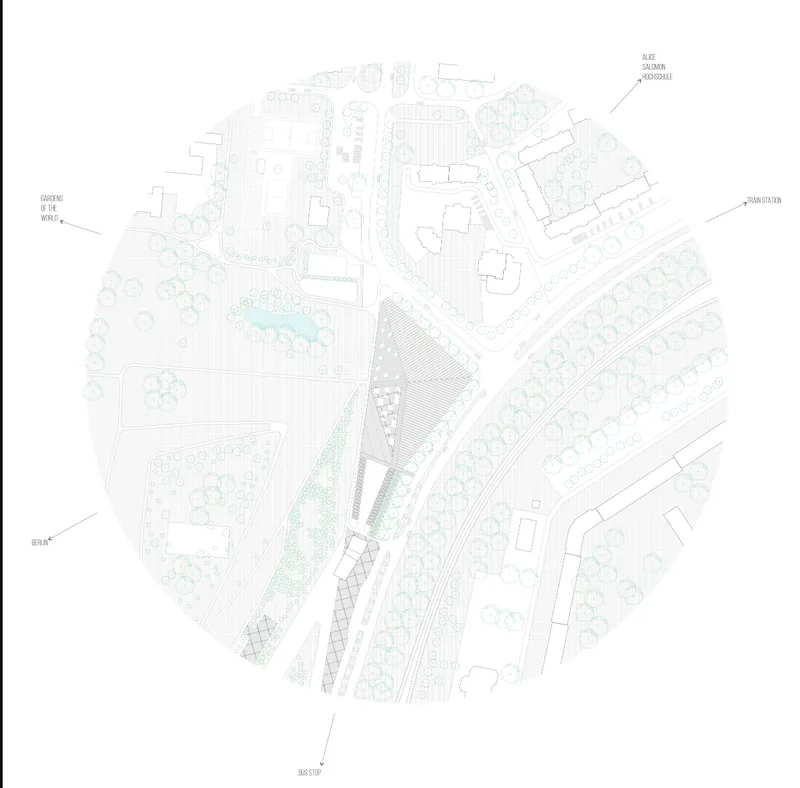
The site plan reveals a distinctive triangular building footprint set within a circular boundary, surrounded by landscaping and pathways that blur the edge between campus and city. Green roofs and urban farming zones wrap around the structure, promoting biodiversity while serving as outdoor laboratories for students and researchers. The geometry is deliberate: the triangular form creates varied spatial conditions along each edge, while the circular landscape boundary suggests a self-contained ecosystem. Pathways connect the school to Hellersdorf's transit infrastructure without sacrificing the intimacy of the green perimeter.
Timber Lattice and Living Interiors
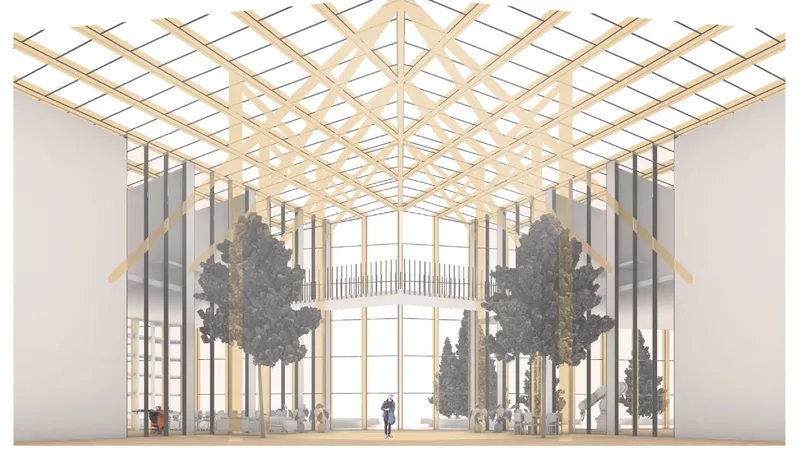
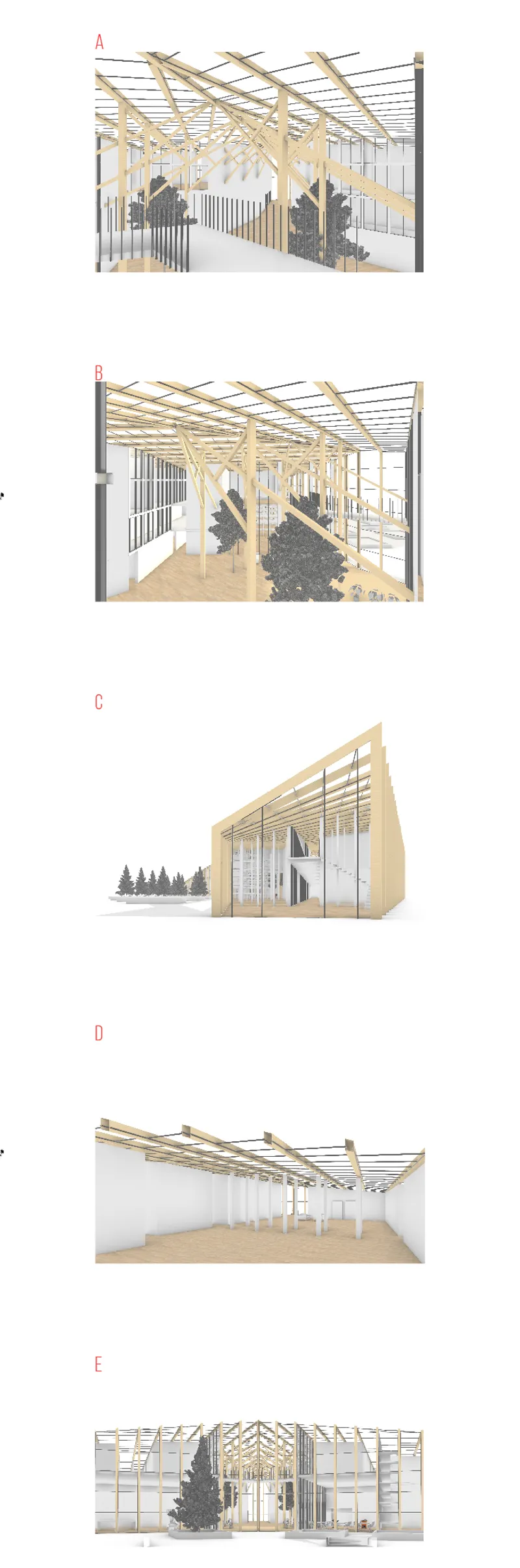
The section drawing cuts through the heart of the proposal. A timber lattice roof spans a generous double-height interior where planted trees grow alongside students. This is not decorative greenery; the vertical gardens and interior vegetation are integral to the passive design strategy, contributing to natural ventilation, humidity regulation, and the psychological well-being of occupants. The timber framework itself signals a commitment to sustainable building materials, reducing the embodied carbon of the structure while exposing its construction logic as a teaching moment.
The series of axonometric and perspective drawings further unpacks the spatial character of the pavilion. Interior views show open, adaptable learning spaces that can shift between seminar, workshop, and exhibition configurations. The timber-framed structure is legible from every angle, its joints and spans forming a visual language that reinforces the school's ethos. Digital fabrication labs and communal areas occupy the ground level, while the large atriums invite daylight deep into the plan, reducing reliance on artificial lighting and reinforcing the passive design approach.
The Full Section: From Truss to Tree Canopy
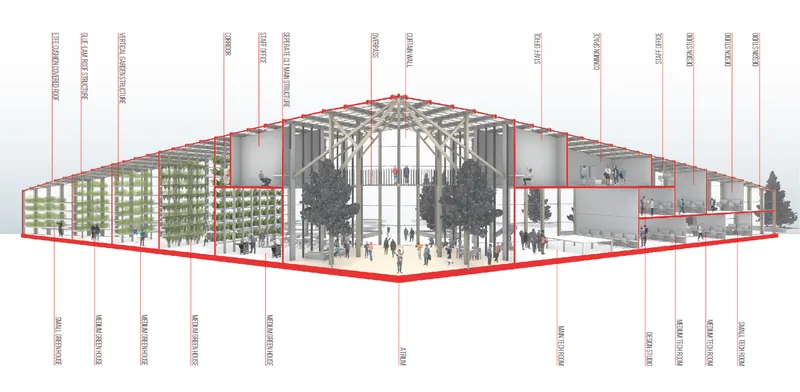
The final sectional perspective, marked by a bold red outline, presents the complete building section from foundation to timber truss roof. Interior vegetation rises through multiple levels, and the truss geometry distributes loads efficiently while creating a rhythmic ceiling plane overhead. Solar panels and rainwater harvesting systems cap the roofline, closing the loop on the building's energy and water cycles. What emerges is a structure that functions as a living diagram of its own principles: every element, from the structural timber to the collected rainwater, is visible, legible, and educational.
Why This Project Matters
Architecture schools have long taught sustainability as theory while operating from buildings that contradict the lesson. BAUHAUS.BETA collapses that distance. By embedding passive ventilation, renewable energy systems, sustainable materials, and living vegetation directly into the school's structure, Gümrük argues that the most effective pedagogy is spatial: students learn ecological design by inhabiting it daily. The Hellersdorf site further grounds the project in reality, connecting the school to Berlin's transit networks and urban fabric rather than retreating into an isolated campus.
As a shortlisted entry in the Bauhaus Neue competition, BAUHAUS.BETA demonstrates that the Bauhaus legacy is still generative when reframed around contemporary urgencies. The original Bauhaus unified art and industry; this iteration unifies education and ecology. It is a proposition worth taking seriously: not as a utopian gesture, but as a practical blueprint for how institutions of design might rebuild themselves, literally, around the environmental challenges they claim to address.
View the Full Project
About the Designers
Designer: Idil Gümrük
Enter a Design Competition on uni.xyz
uni.xyz runs architecture and design competitions year-round that reward proposals with spatial conviction and real site intelligence.
Project credits: BAUHAUS.BETA by Idil Gümrük Bauhaus Neue (uni.xyz).


Popular Articles
Popular articles from the community

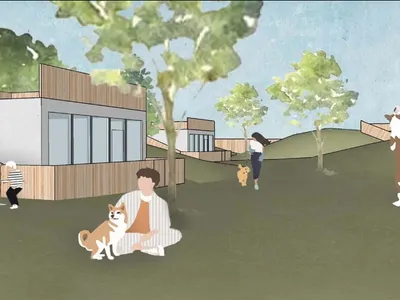
Temporary Home for Dogs: A Reversed Zoo Rethinks Animal Shelter Architecture
In Bucharest, a sinuous corridor and freed landscape flip the logic of containment, designing a shelter that works to make itself unnecessary.

Extended Shell: Retrofitting Kolkata's Balconies as Living Urban Thresholds
A modular retrofit system recovers the social and environmental intelligence of Kolkata's historic verandas for contemporary Park Street residents.

Singing Woman: Contemporary Architecture Inspired by Estonia’s Voice and the Sea
Singing Woman turns Estonia’s song culture into flowing opera house architecture, blending public life, landscape, sea, and national memory.

Opera on the Sea: Driftwood Logic Shapes a Timber Opera House on Estonia's Coast
Trevor Orgill's opera house translates the entangled drift of floating timber into a civic building where wood, water, and music converge.

Similar Reads
You might also enjoy these articles

Bao Huynh Watercolor Atelier: A Serene Art Retreat in Hội An
Bao Huynh Watercolor Atelier in Hội An blends multifunctional art spaces, sustainable design, local materials, and family-friendly living in a serene environment.

Atelier Macri Concept Store Interior Design by CASE-REAL
Atelier Macri store features a "ko" counter, walnut wood details, cork displays, blending retail, gallery, and seamless customer experiences.

Manuel Vargas Izquierdo Stadium and High-Performance Sports Center: Architectural Excellence in Jalpa de Méndez
The Manuel Vargas Izquierdo Stadium blends sustainable design, inclusive sports facilities, and cultural-inspired architecture, revitalizing Jalpa de Méndez’s public spaces.

KAKR Buluh Awar Hall: Revitalizing Community and Ecology Through Bamboo Architecture
Community built bamboo hall revitalizes Buluh Awar village, empowering youth, restoring ecology, celebrating vernacular craftsmanship through sustainable architecture and culture.

Explore New Bauhaus Competitions
Discover active competitions in this discipline

Challenge to design public laboratory

Challenge to reimagine the Iron Throne

Photograph architecture without architects

Illustrate the lost glory of Angkor Wat - Render Challenge
Comments (0)
Please login or sign up to add comments
No comments yet. Be the first to comment!