

Baumschlager Eberle Architekten Builds a Vienna Office Block That Needs No Heating or Cooling
Three brick buildings in Aspern Seestadt maintain year-round comfort between 22 and 26 degrees without any mechanical climate systems.


For over a decade, Baumschlager Eberle Architekten has been refining a provocation disguised as a building method: what if you could eliminate heating, cooling, and mechanical ventilation entirely, and still keep occupants comfortable every day of the year? The 2226 principle, named for the temperature band it promises (22 to 26 degrees Celsius), has already been proven in the firm's own headquarters in Lustenau. Now, with the 2226 Robin Seestadt Office Building in Vienna's Aspern Seestadt district, the concept scales up to an urban mixed-use block containing offices, restaurants, and a private university spread across three volumes and roughly 2,400 square meters.
What makes this project genuinely interesting is not just the headline stat of zero mechanical climate systems, but how the architecture itself becomes the machine. Eighty-centimeter-thick brick walls absorb, store, and release heat in a seasonal rhythm. A proprietary software system, the 2226 Operating System, reads sensors throughout the building and opens or closes air valves to regulate temperature, CO2 levels, and humidity. The result is a building that breathes without ducts, warms without boilers, and cools without compressors. The question is whether the architecture holds up as design, not just as engineering.
Thick Walls, Deep Reveals

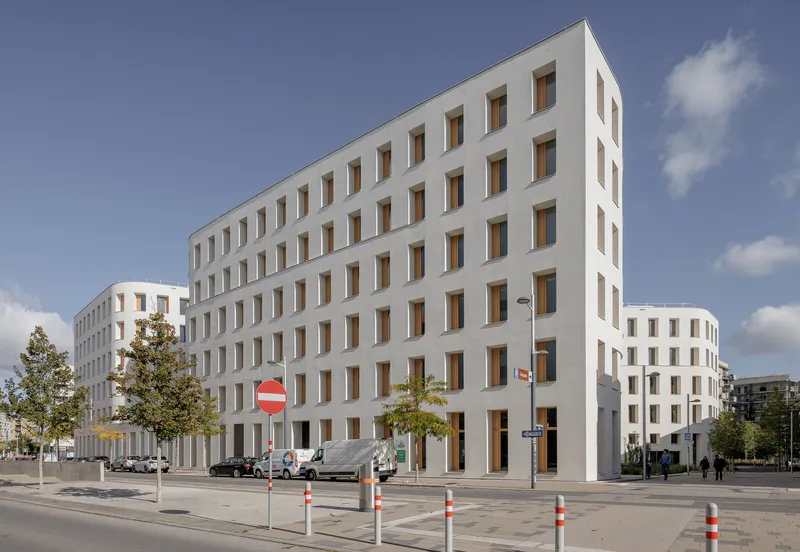
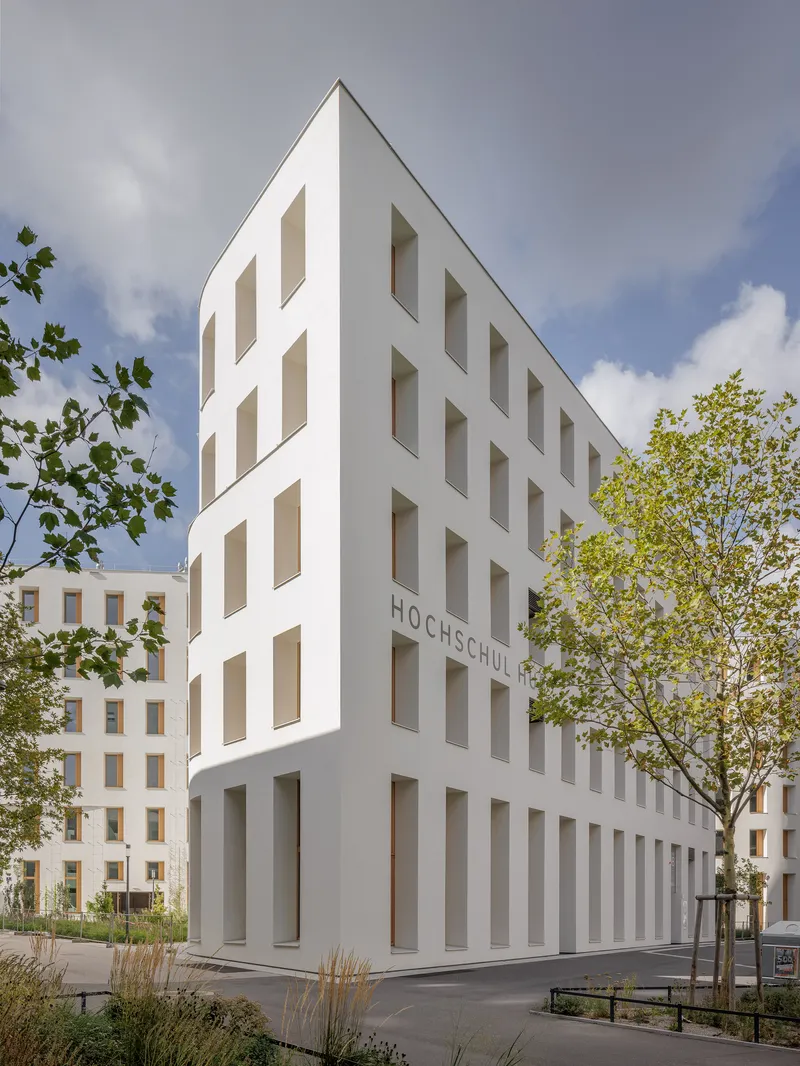
The 80-centimeter brick walls are not hidden behind cladding or rendered invisible. They announce themselves in every window reveal, which plunges deep into the facade and is lined with pale timber frames. The effect is both sculptural and informative: you can read the building's thermal strategy in the depth of every opening. These reveals catch light at steep angles, creating trapezoids of sun on interior floors and sharp shadow lines on the exterior that shift throughout the day.
The white plaster surface keeps things deliberately plain. There is no composite thermal insulation system layered onto the structure. The brick does the insulating, the storing, and the finishing in one integrated move. Baumschlager Eberle call this "high plasticity arising directly from building construction without additional applications," which is a clinical way of saying: the wall is the ornament, and the ornament is the wall.
Urban Block and Courtyard

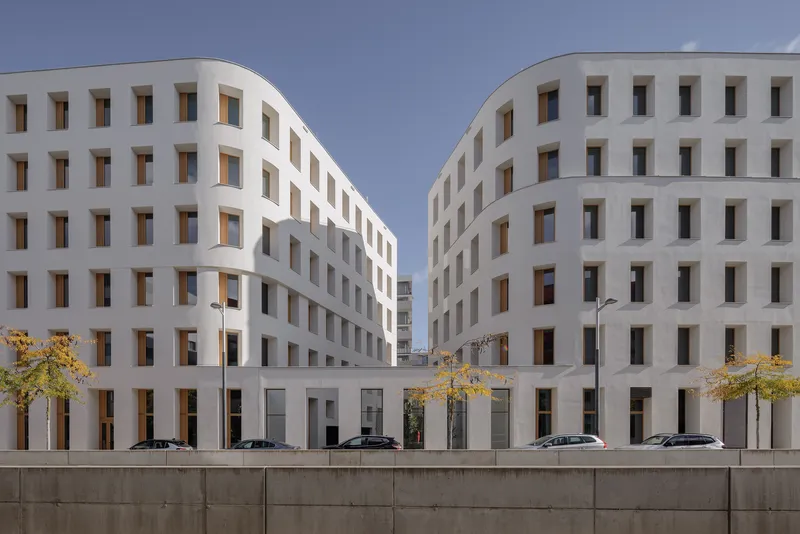

The three irregularly shaped volumes wrap around a central landscaped courtyard, creating a block that is open to the neighborhood's pedestrian side and closed to its main traffic routes. A ground-level colonnade along one edge frames the courtyard and connects two of the buildings with a row of tall columns. Trees are planted behind this colonnade, so the public threshold is filtered rather than barricaded. It is a simple urban gesture that works: the block reads as permeable without surrendering its enclosure.
Aspern Seestadt is still a developing district, and one of the challenges of building here is giving a new neighborhood something that feels like an anchor rather than a placeholder. The courtyard, visible from the street through the colonnade, does that work. At dusk, the identical window grids of the two flanking facades glow symmetrically above parked cars, giving the courtyard the quiet urban formality of a much older quarter.
Corners and Curvature

The corners are where the building's massing becomes most expressive. One volume turns a sharp, almost prow-like edge that rises five stories, its recessed windows stacking up like a vertical column of shadow. Another corner softens into a gentle curve, its rhythmic window openings wrapping smoothly around the bend with yellow autumn trees in the foreground. These are not arbitrary formal moves. They respond to the irregular lot geometry of the Seestadt masterplan, where street grids intersect at odd angles.
The tall ground-floor columns at the curved corner create a sheltered zone beneath the mass of the upper floors. It is a classic European urban detail, the arcade, reinterpreted in a minimal register. The columns are slender enough to keep sightlines open but substantial enough to register as structure, not decoration.
Interior Light and Timber
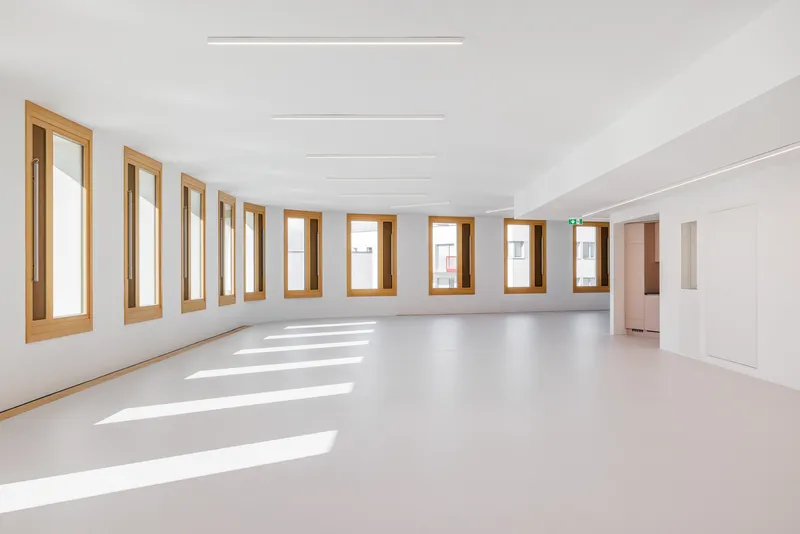
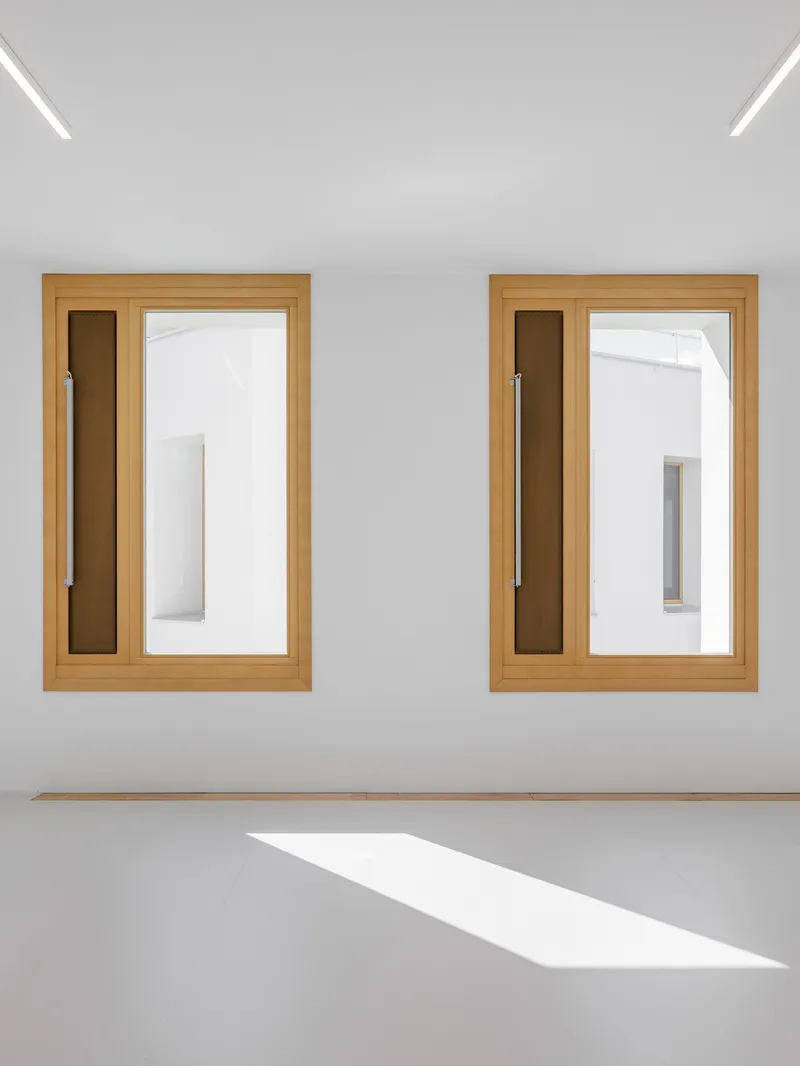

Inside, the depth of the window walls becomes a spatial event. Sunlight enters at low angles and carves bright geometric shapes across pale floors and white walls. The timber-framed windows, with their narrow sidelights, filter daylight into strips and wedges that animate otherwise austere rooms. In an empty white interior, a single trapezoid of sun on the floor is all the decoration the room needs.
The double-height lobby introduces a timber-clad staircase and circular ceiling lights that add warmth and rhythm to the entry sequence. The material palette stays tight: timber, white plaster, polished flooring. There is no visual excess, which makes sense given that the building's entire logic is about doing more with less. The interiors trust light and proportion to carry the atmosphere, and they largely succeed.
Details and Atmosphere

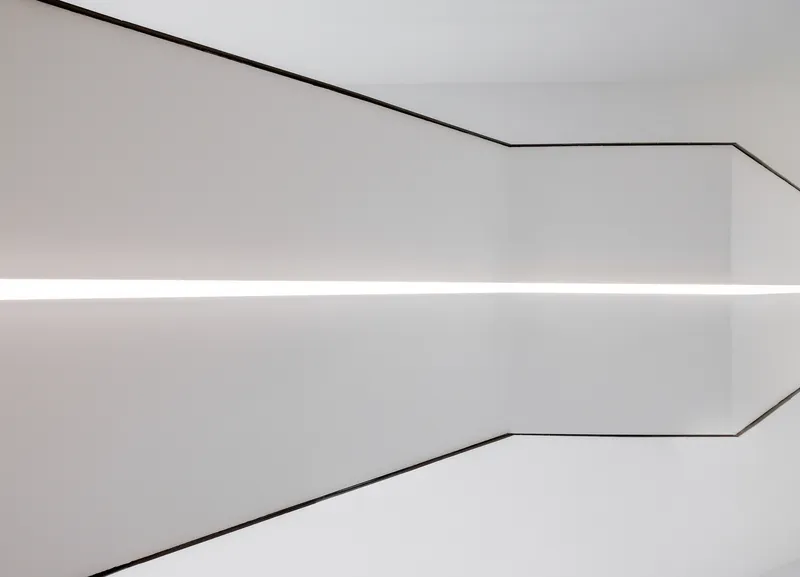
A conference room with black tables and a slatted ceiling shows the building in its programmatic mode: functional, calm, unadorned. The slatted ceiling likely conceals the air valves controlled by the 2226 Operating System, which silently regulates fresh air circulation without any visible ductwork or mechanical grilles. A close-up of a coved ceiling corner reveals continuous linear lighting and thin metal edge trim, the kind of precise, restrained detail that rewards attention without demanding it.
These moments of craft are important because they demonstrate that a building stripped of conventional climate technology does not have to look stripped of care. The absence of HVAC infrastructure frees up ceiling and wall cavities, and the architects use that freedom to keep surfaces clean and junctions sharp.
Construction and Material Logic
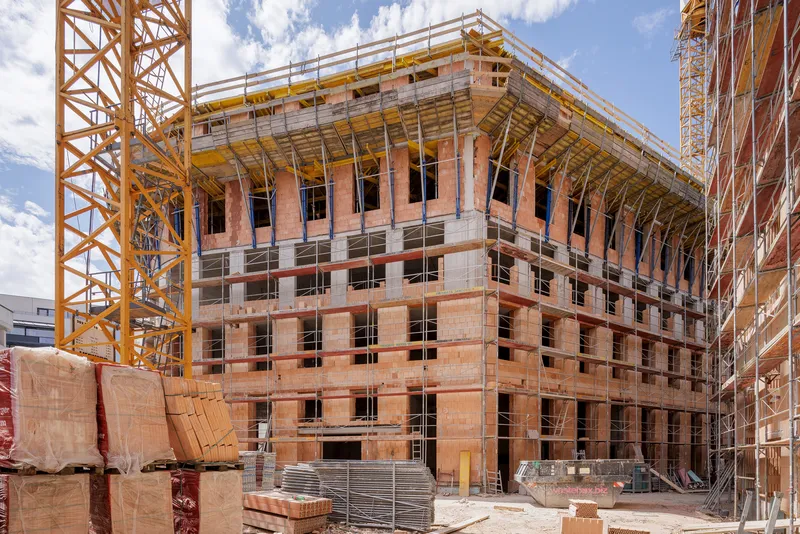
A construction photograph reveals the terracotta block structure mid-assembly, with timber framing visible under yellow tower cranes. The bricks, supplied by Wienerberger, are regionally sourced and laid in a straightforward manner that the firm describes as a "job craftsmen like working with." This is not a minor point. The 2226 system's sustainability argument rests not only on zero operational energy for climate control but also on reduced technological complexity, which should translate to longer service life and simpler maintenance.
Brick combines structural stability with thermal insulation and breathability, eliminating the need for vapor barriers. The wall does three jobs at once: it holds the building up, keeps it warm, and lets moisture move through it. By contrast, a typical insulated wall assembly might involve five or six separate layers, each with its own failure mode and lifespan. The 2226 approach is a bet that simplicity, intelligently applied, outlasts complexity.
Plans and Drawings

The floor plan reveals how the three irregularly shaped volumes interlock around the central courtyard. The geometry is not orthogonal: edges angle and curve to follow the site's boundaries and the Seestadt street grid, producing floor plates that are varied enough to accommodate different programs (office, restaurant, university) without feeling forced. The courtyard landscape anchors the composition and provides a shared outdoor room that all three buildings address.
Why This Project Matters
The 2226 Robin Seestadt building matters because it takes a proven prototype and tests it at urban scale, in a mixed-use program, in a real neighborhood that is still finding its identity. If these three buildings can maintain comfortable temperatures year-round using only thick walls and smart software, the implications for new construction in temperate climates are significant. The energy that a conventional office building spends on heating, cooling, and ventilation simply does not appear on this building's ledger.
But the project also matters as architecture, not just as engineering. Baumschlager Eberle have made the thermal strategy legible in the facade without turning the building into a diagram. The deep reveals, the thick corners, the colonnaded courtyard: these are spatial qualities, not just performance metrics. In an industry that too often treats sustainability as a bolt-on system or a marketing label, this building argues that the greenest technology might be no technology at all, just intelligent construction and 80 centimeters of brick.
2226 Robin Seestadt Office Building by Baumschlager Eberle Architekten. Located in Vienna, Austria. 2,406 m². Completed in 2024. Photography by Maximilian Haidacher.
About the Studio
Share Your Own Work on uni.xyz
If projects like this are the kind of work you want to make, uni.xyz is a place to publish your own, find collaborators, and enter design competitions.


Popular Articles
Popular articles from the community


Tsunami Convergenics: Turning Catastrophic Ocean Forces into Underwater Housing Infrastructure
A speculative underwater settlement off the coast of Onagawa, Japan, treats tsunamis and typhoons as energy sources rather than threats.

Opera on the Sea: Driftwood Logic Shapes a Timber Opera House on Estonia's Coast
Trevor Orgill's opera house translates the entangled drift of floating timber into a civic building where wood, water, and music converge.

The Amber Palace Opera: A Geological Fiction Surfaces on Tallinn's Baltic Waterfront
Pierre Brillard reimagines a Baltic legend as a public landscape, opera house, and waterfront promenade rooted in Tallinn's coastal identity.

Opera by the Sea Estonia: Three Shells Dissolving Architecture into Tallinn's Coastline
A winning opera house proposal replaces monumental form with interconnected shells that blur the boundary between building, park and Baltic Sea.

Similar Reads
You might also enjoy these articles

Bao Huynh Watercolor Atelier: A Serene Art Retreat in Hội An
Bao Huynh Watercolor Atelier in Hội An blends multifunctional art spaces, sustainable design, local materials, and family-friendly living in a serene environment.

Atelier Macri Concept Store Interior Design by CASE-REAL
Atelier Macri store features a "ko" counter, walnut wood details, cork displays, blending retail, gallery, and seamless customer experiences.

Manuel Vargas Izquierdo Stadium and High-Performance Sports Center: Architectural Excellence in Jalpa de Méndez
The Manuel Vargas Izquierdo Stadium blends sustainable design, inclusive sports facilities, and cultural-inspired architecture, revitalizing Jalpa de Méndez’s public spaces.

KAKR Buluh Awar Hall: Revitalizing Community and Ecology Through Bamboo Architecture
Community built bamboo hall revitalizes Buluh Awar village, empowering youth, restoring ecology, celebrating vernacular craftsmanship through sustainable architecture and culture.

Comments (0)
Please login or sign up to add comments
No comments yet. Be the first to comment!