

#Baussin' Baus Stop
“The ultimate goal of art is a building.” - Walter Gropius

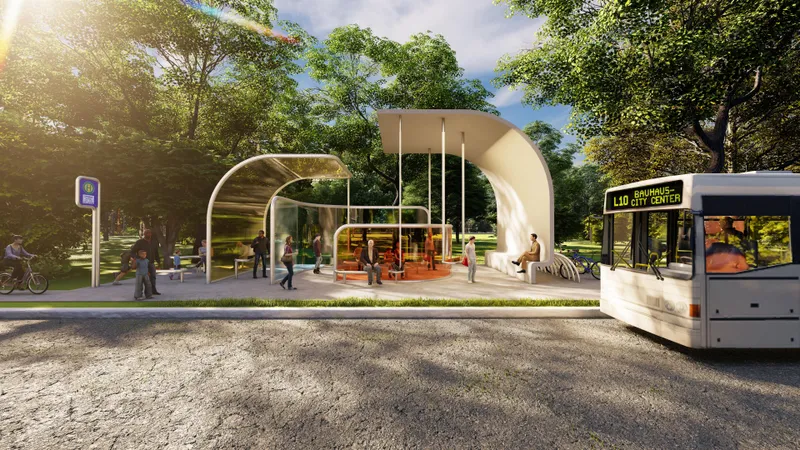
Progression in technology often results in or obliterates traditions in which we argue, is a construct of our identity, however, progress is also a “virtuous” part of our identity that we should seek to possess. Like how Fra Giocondo sees architecture as a whole where, “The humanistic renewal an effect brought about by architecture and the technical knowledge a necessity to translate architecture to a rational structure. Both distinct in nature and part of a great whole.” With changing times there is also a need to rethink the relationship between that of function, in this brief, the bus stop, and the embodiment of traditions, a monument. In addition to embodying the ideals of the Bauhaus-the response to relevance in modernity, perhaps, an update is required to catch up with the needs of the times.
With the advancement in technology, and it shouldn’t come as a surprise that social media has become an integral part of, if not all, most people’s lives. It is quickly becoming a platform where we share our perspective. This has somehow created an interesting relationship between the digital world and places of interests. Where the act of “sharing” encourages others to explore places of interests that have been shared and the act of exploring or visiting creates opportunities to “share” different perspectives. It quickly became clear to us that it was crucial that the space should be visually stimulating and unique from it’s bus stop siblings in order to sate the needs of the times.
 Iterations from Team's Design Process
During our research on the various aspects of Bauhaus design, The Bauhaus-designed Wassily chair soon found itself under our scrutiny. The structure of the design was streamlined, emphasizing on the form of what a chair should be, whilst the layers of planes not only provided surface to rest upon, it added layers of complexity to a simple design. The outcome was one that spoke of both function and most importantly, what we envisioned for our design, timeless. From there, we speculated how we could simplify the bus stop’s elements and form, and what these simple curves and planes could create as furniture, features and shelter for the bus stop.
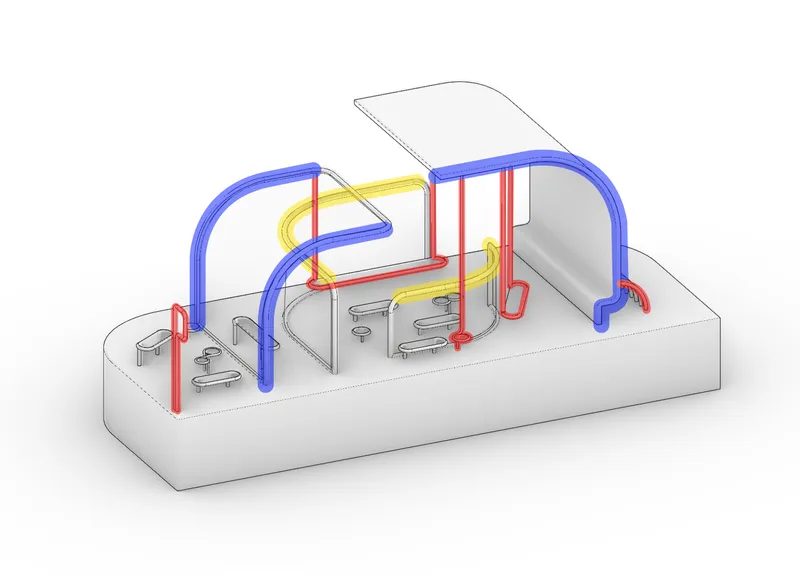 Simple Curves and Streamlining of Elements
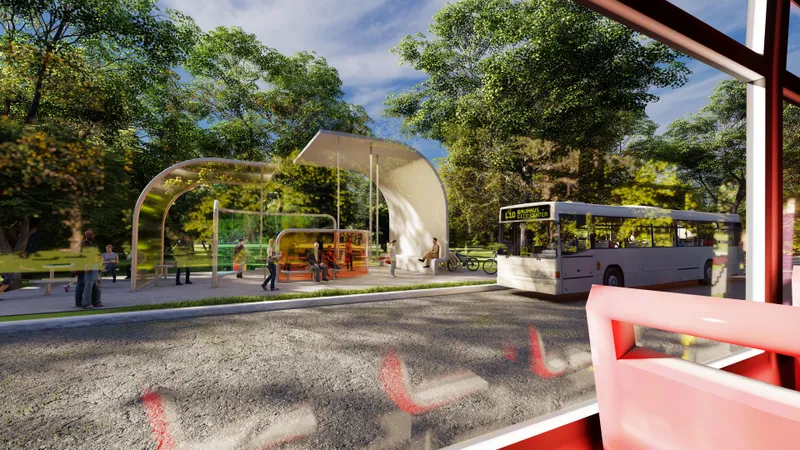
Other than the Bauhaus movements of fondness for streamlining simplicity, it also placed a huge emphasis on function. As Weimar’s climate is predominantly windy and overcast, one of our main concerns was the need for wind protection. Therefore, the largest shelter was placed on the southern side to be able to deflect the predominant wind coming from the south, with minimum resistance, creating a pocket of space protected from the winds. To increase its efficiency, concrete was prioritized as the team’s choice material for the largest shelter. The smaller shelters were then staggered to create more intimate spaces for seating that were protected from the wind.

Due to the overcast nature of the climate in Weimar, we explored the idea of using clear materials, to allow as much light into the space as possible. This also enabled the space to be visually porous allowing passengers to dwell within the layers of structure and still be visually connected to the situation on the roads. The play of transparency also enables us to create a colorful and visually striking bus stop given the versatility of the material. The transparency would also help to create a constantly changing space during the different times of the day when the shadows of the streamlined shapes of the furniture and structures come to play within the layers of colors overlapping each other. For outdoor structures like bus stops, the choice clear material would have been glass, however, we would like to propose the use of recycled plastic instead.
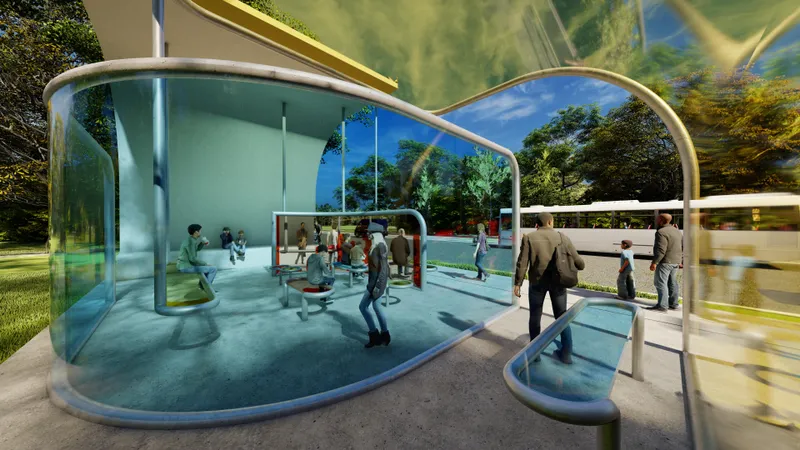 Light and Shadows Injecting Life to the Space
The Bauhaus movement had also placed an emphasis on retaining the integrities of craft materials, industrialization and simplicity of forms constructed. This has resulted in a preference for industrial materials, such as glass, metal and concrete, despite the rise in use of synthetic materials back in the time. However, instead of obstinately focusing on the purity of materials, with changing times, we feel that the emphasis should be placed further on the qualities of the materials, and how to maximize the design’s features and efficiency with their application, instead.
This is why we have consciously chosen to use recycled plastic as part of our project’s material palette. With changing times there is also a shift in attention towards more environmentally friendly approaches in the way we work and the way we live, now that we understand the implications our choices have on the environment, better. We believe that the project should also act as both an example and inspiration of the future of building materials, as a monument, and in fact capitalize on their respective innate qualities to help better environments we live in.
 Non-specific Material Palette
By using a material palette that is not unique to a location or place, and by simplifying the forms such that it does not require specific forms of workmanship, the design can easily be replicated in other regions or countries. By streamlining the design’s main elements, it has been allowed to be adaptable to any other context it’s placed in; simply by shifting the elements around, almost like the graphic designs from the Bauhaus, where simple shapes were simply shifted around to create many impactful visuals.

It is always easier to stand on the side of either traditions or progress, but both are dependent on the other as progress is always the future of the present. Tradition, the present of the passed future. Our treatment of one dictates the fate of the other. It is more important to understand what values traditions are imparting and to apply them to the present, than stubbornly upholding them. The end result is one that we hope answers the needs and wants of the present whilst still upholding the spirit of the Bauhaus.


Popular Articles
Popular articles from the community


The Amber Palace Opera: A Geological Fiction Surfaces on Tallinn's Baltic Waterfront
Pierre Brillard reimagines a Baltic legend as a public landscape, opera house, and waterfront promenade rooted in Tallinn's coastal identity.
Faces of the Soviet Avant-Garde: Turning Moscow's Street Names into an Open-Air Museum
A network of sculptural installations across a Moscow residential district transforms forgotten architect names into spatial encounters with cultural memor

Manzana Morphosis: Stretching Barcelona's Grid into a Living Landscape for 2050
A radical reworking of the Eixample manzana turns density into a tool for generous public space, vertical ecology, and environmental performance.

Singing Woman: Contemporary Architecture Inspired by Estonia’s Voice and the Sea
Singing Woman turns Estonia’s song culture into flowing opera house architecture, blending public life, landscape, sea, and national memory.

Similar Reads
You might also enjoy these articles
The Rhythm of Seasons
A Farmers' Market Connecting Nature and the City

More Than a Building-Designing a Living System
More Than a Building-Designing a Living System
Base Beyond
DESERT COMPOUND ARID: TOURISM OF ABSENCE AND ABUNDANCE

Explore New Bauhaus Competitions
Discover active competitions in this discipline


Challenge to reimagine the Iron Throne

Photograph architecture without architects

Illustrate the lost glory of Angkor Wat - Render Challenge

Design challenge to reuse E-waste
Comments (0)
Please login or sign up to add comments
No comments yet. Be the first to comment!