

BDP, Cox Architecture, and Collage Design Plan a 350-Acre Sports District Around the World's Largest Stadium
On Ahmedabad's Sabarmati Riverfront, three firms weave a mandala grid, jali screens, and passive cooling into India's next great urban park.


India already owns the world's largest cricket stadium, the 132,000-seat Narendra Modi Stadium in Ahmedabad's Motera district. Now BDP, Cox Architecture, and Collage Design have published a masterplan that turns the land around it into something far more ambitious: a 350-acre sports enclave on the Sabarmati Riverfront intended to host the 2030 Commonwealth Games and, after the last medal ceremony, function as the city's newest public park. The Sardar Vallabhbhai Patel Sports Enclave is not a stadium bolt-on. It is a complete urban precinct organized by a central green boulevard, stepped landscaped podiums, and a mandala-based grid that coordinates pedestrian movement across an international tennis centre, an 18,000-seat indoor arena, an aquatics centre, and a National Institute of Sports Excellence.
What makes the project worth watching is its double bet: that a climate-responsive design language rooted in Gujarati building tradition can hold its own at the scale of a megaevent, and that the infrastructure left behind can genuinely serve a city rather than slowly rust. The team explicitly positions its work in dialogue with Le Corbusier and Louis Kahn's seminal Ahmedabad buildings, the same lineage that produced B.V. Doshi and Charles Correa. Whether that lineage survives the pressures of Commonwealth Games delivery timelines is an open question, but the ambition is legible in every render.
A Riverfront Masterplan Built on a Mandala Grid
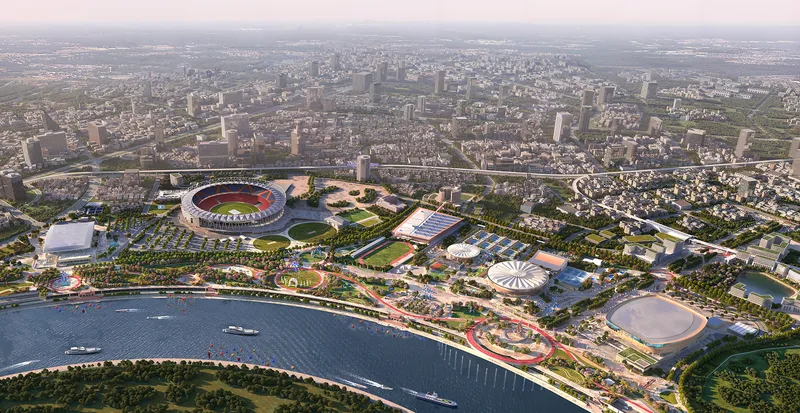
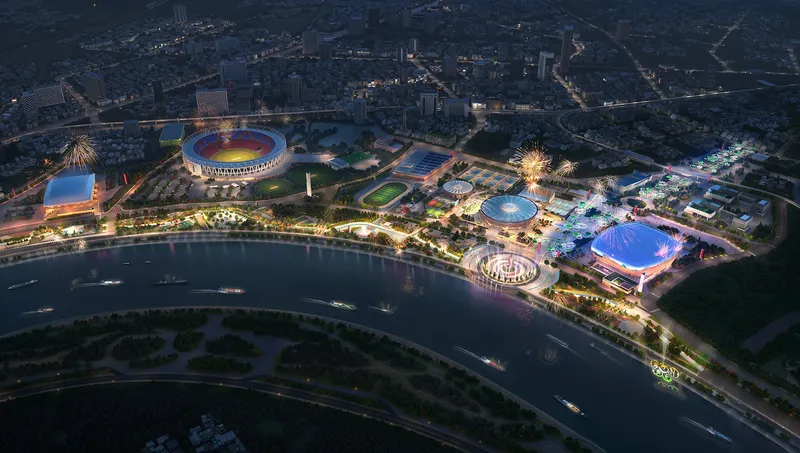
Seen from above, the enclave reads as a landscape first and a collection of buildings second. The masterplan treats the Sabarmati riverfront not as a backdrop but as connective infrastructure, mediating between enormous venue footprints and the existing urban fabric. A central boulevard threads through the site, linking venues on axis while tree-lined corridors and recessed plazas branch off to manage crowd flow on event days and invite casual use the rest of the year. The Sabarmati riverfront itself is reconfigured as a Games Plaza large enough to host ceremonial events, then designed to transition into permanent public parkland.
The mandala-based spatial grid is a quiet but consequential decision. Rather than imposing a standard Cartesian planning module, the team uses a traditional Indian geometric pattern to coordinate pedestrian routes and sight lines. It is the kind of organizational move that reads as abstract in plan but should, if executed well, produce the intuitive wayfinding that makes a precinct feel navigable without signage.
The Indoor Arena: Jali Screens as Climate Device and Cultural Signal
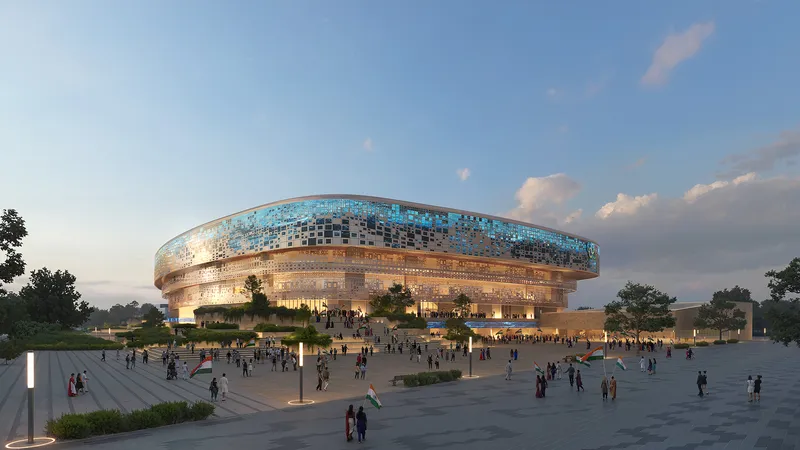
The 18,000-seat indoor arena, set to be the largest of its kind in India at this scale, wraps itself in bronze anodised aluminium jali screens that reference the jharokhas and chhajjas of traditional Gujarati architecture. These are not decorative appliqués. The perforated screens serve as deep shading devices over the building envelope, filtering solar gain while allowing controlled airflow. At dusk, the layered facade transforms: illuminated glazing behind the jali turns the arena into something closer to a lantern, recalling the floating sky lanterns released during Diwali celebrations on the Sabarmati River.
The decision to use aluminium rather than stone for the jali is pragmatic. At this scale, weight and cost would make traditional carved screens impossible, but the bronze anodising gives the panels a warmth that reads as materially serious rather than as cheap mimicry. The real test will be whether the screens perform as promised in Ahmedabad's brutal summers, where temperatures regularly exceed 45°C.
The Tennis Centre: A Floating Roof Over 10,000 Seats
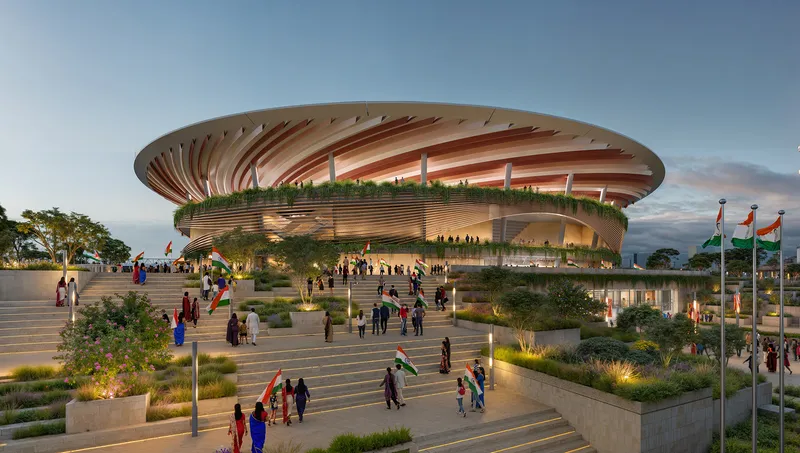
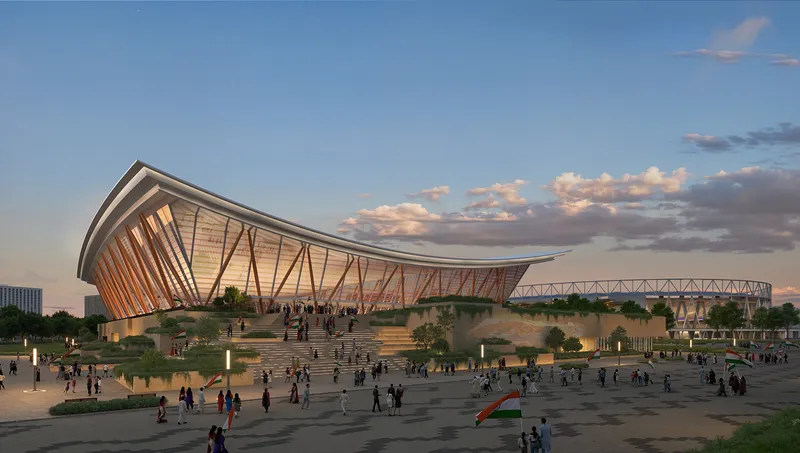
The international tennis centre anchors the southern end of the masterplan with a 10,000-seat main stadium, a pair of 5,000 and 3,000-seat show courts, and eight additional match courts. Its defining architectural move is a lightweight tensile roof that floats above the seating bowl, supported by a suspended soffit system. The horizontal timber louvers visible in renderings wrap the perimeter, creating a gradient of shade that deepens as you move toward the interior. This is passive cooling deployed as spatial character: the terraced plaza around the base doubles as spectator overflow and shaded public seating.
The radiating canopy gives the tennis centre the most distinctive silhouette in the precinct. Where the indoor arena is solid and wrapped, the tennis centre is open and layered, its fabric roof breathing with the wind. The contrast between the two buildings is deliberate and useful. It gives the masterplan visual variety while keeping both venues legible as part of the same design family through shared material palettes and podium landscapes.
Climate as Architecture
The team names four guiding principles: climate responsiveness, integration with nature, architecture that is modern yet authentic, and sustainable legacy for the city. The first two do the heaviest lifting. Every major venue integrates passive cooling measures directly into its building envelope rather than relying on mechanical systems to compensate for poor design. The aquatics centre, for example, pairs a double-glazed curtain wall with an overhanging roof and coloured glass louvres. Its exposed structural exoskeleton is not just aesthetic bravado; it allows the building's mass to be separated from its climate skin, a strategy that improves thermal performance in hot-dry climates.
The landscape strategy reinforces this logic at the precinct scale. Stepped podiums, recessed plazas, and dense tree canopy corridors create microclimatic zones that lower ambient temperatures between buildings. In a city where outdoor comfort is the critical design challenge for roughly eight months of the year, this kind of landscape-first thinking is not a luxury. It is the difference between a district that people actually use and one they drive through with the windows up.
Legacy and the Post-Games Question
The aquatics centre's capacity swing from 12,000 spectators during major tournaments to 4,000 in legacy mode signals that the designers have at least considered the post-Games question that haunts every Olympic and Commonwealth host city. Temporary seating removal is table stakes; the harder problem is whether the surrounding public realm justifies the ongoing maintenance costs. The team's answer is to frame the enclave as both an events precinct and an urban park, banking on the Sabarmati Riverfront's existing momentum as a public amenity to keep foot traffic flowing after the athletes leave.
Gujarat's confirmed role as host of the 2029 World Police and Fire Games adds a secondary catalyst, but the long-term viability will depend on the National Institute of Sports Excellence and the daily programming of the park. If the landscape and public spaces perform as promised, Ahmedabad could end up with an unusually livable sports district. If they don't, it will be one more monument to the gap between render and reality.
Why This Project Matters
The Sardar Vallabhbhai Patel Sports Enclave matters because it represents a serious attempt to reconcile three forces that rarely cooperate: megaevent infrastructure demands, regional architectural identity, and long-term urban usefulness. BDP, Cox Architecture, and Collage Design have designed a precinct where the climate strategy is the architecture, not an afterthought bolted onto a glass box. The mandala grid, jali facades, tensile roofs, and riverfront park are not stylistic choices layered over a generic masterplan. They are structural decisions that shape how the district breathes, shades, and moves people.
Whether this vision survives the compression of a Commonwealth Games delivery schedule is the question that hangs over every detail. Megaevent projects have a dismal track record of delivering on their sustainability and legacy promises. But Ahmedabad has advantages that other host cities lacked: a riverfront revitalization already underway, a deep well of local building tradition to draw from, and a design team that seems to understand that the most important audience for this project is not the athletes who will compete here in 2030 but the citizens who will walk through it in 2040.
Sardar Vallabhbhai Patel Sports Enclave by BDP, Cox Architecture, and Collage Design. Motera, Ahmedabad, India. 350 acres.
About the Studio
Share Your Own Work on uni.xyz
If projects like this are the kind of work you want to make, uni.xyz is a place to publish your own, find collaborators, and enter design competitions.


Popular Articles
Popular articles from the community

Temporary Home for Dogs: A Reversed Zoo Rethinks Animal Shelter Architecture
In Bucharest, a sinuous corridor and freed landscape flip the logic of containment, designing a shelter that works to make itself unnecessary.
Faces of the Soviet Avant-Garde: Turning Moscow's Street Names into an Open-Air Museum
A network of sculptural installations across a Moscow residential district transforms forgotten architect names into spatial encounters with cultural memor
Opera by the Sea Estonia: Three Shells Dissolving Architecture into Tallinn's Coastline
A winning opera house proposal replaces monumental form with interconnected shells that blur the boundary between building, park and Baltic Sea.

Cloaked Colonization: A Mobile Underwater Habitat That Moves Like a Fish
Micah Abaya's shortlisted EHC Pacific entry reimagines ocean settlement as a dispersed network of self-sustaining architectural organisms.

Similar Reads
You might also enjoy these articles

Bao Huynh Watercolor Atelier: A Serene Art Retreat in Hội An
Bao Huynh Watercolor Atelier in Hội An blends multifunctional art spaces, sustainable design, local materials, and family-friendly living in a serene environment.

Atelier Macri Concept Store Interior Design by CASE-REAL
Atelier Macri store features a "ko" counter, walnut wood details, cork displays, blending retail, gallery, and seamless customer experiences.

Manuel Vargas Izquierdo Stadium and High-Performance Sports Center: Architectural Excellence in Jalpa de Méndez
The Manuel Vargas Izquierdo Stadium blends sustainable design, inclusive sports facilities, and cultural-inspired architecture, revitalizing Jalpa de Méndez’s public spaces.
KAKR Buluh Awar Hall: Revitalizing Community and Ecology Through Bamboo Architecture
Community built bamboo hall revitalizes Buluh Awar village, empowering youth, restoring ecology, celebrating vernacular craftsmanship through sustainable architecture and culture.

Explore Sports Architecture Competitions
Discover active competitions in this discipline

Challenge to design a barrier free sports center

Challenge to design an outdoor ice-rink and park
Comments (0)
Please login or sign up to add comments
No comments yet. Be the first to comment!