
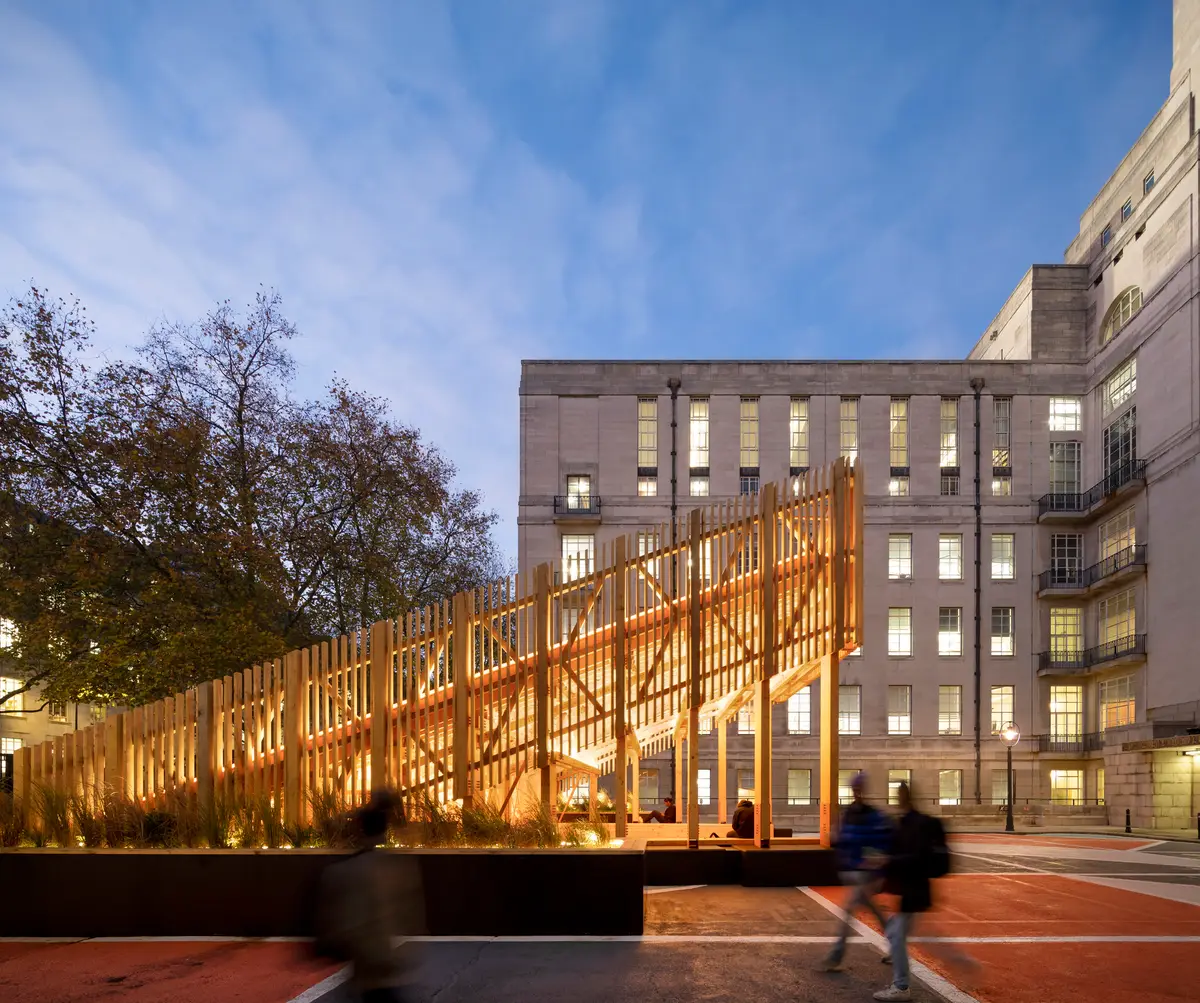
BDP Transforms a Barren London Car Park into a Glowing Timber Staircase to Nowhere and Everywhere
A demountable orange pavilion reclaims a windswept Senate House forecourt as a gathering place for University of London students.


Senate House is one of London's most imposing buildings: a Grade II* listed Art Deco tower designed by Charles Holden in 1929, rising like a limestone cliff above Bloomsbury. Its west side, however, had for years devolved into a windswept car park, a dead zone at odds with the building's civic ambitions. BDP was tasked not with erasing that condition permanently but with interrupting it, and the result is Stepped Pavilion, a 7.3-meter-tall timber and steel staircase that occupies the former parking forecourt with the directness of a stage set and the warmth of a living room.
What makes this project worth studying is its refusal to be precious. It is bright orange. It is temporary, designed to stay for a minimum of three years and then be unbolted, disassembled, and relocated. Its lighting comes entirely from repurposed, discontinued LED stock. And its spatial proposition is fundamentally simple: a broad public staircase you can sit on, walk over, and gather beneath. The pavilion is a counterpoint to Senate House's monumental permanence, a lightweight and deliberate act of impermanence that, paradoxically, gives the site more identity than the tower alone ever did.
A Bright Interruption in Stone and Limestone
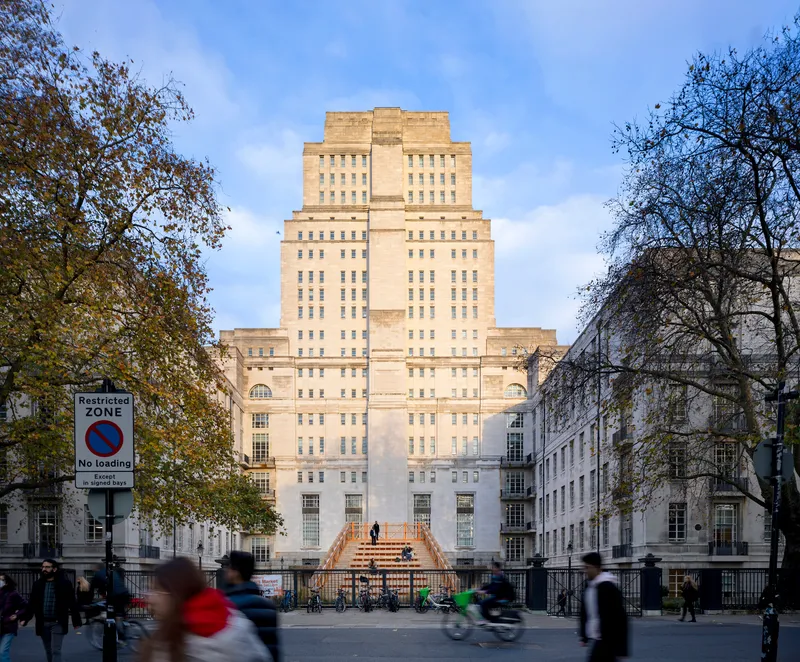
The contrast between Holden's stepped-back stone tower and BDP's timber framework is the project's primary visual tension. Senate House operates through mass, symmetry, and vertical aspiration. The pavilion borrows the idea of the step, that most elementary of architectural moves, but strips it of weight. Seen from Malet Street, the timber lattice reads as a translucent filter laid against the building's limestone bulk, an almost textile quality set against geological permanence.
BDP chose orange as a signature color to signify opportunity, a deliberate break from the grey and cream palette of the institutional campus. It is a bold call, and it works precisely because it does not try to blend in. The pavilion announces itself as something other, something provisional, something that belongs to the students rather than to the institution's history.
Dual Aspect: Space Above and Shelter Below
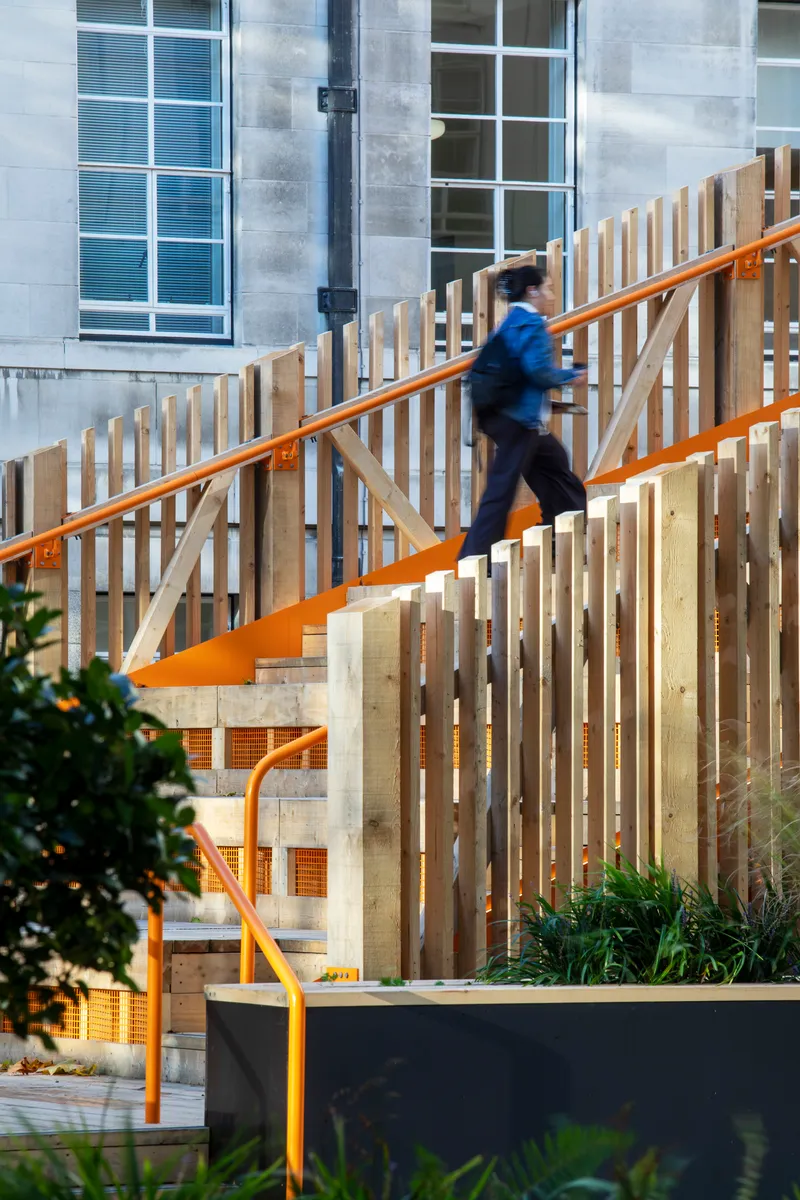
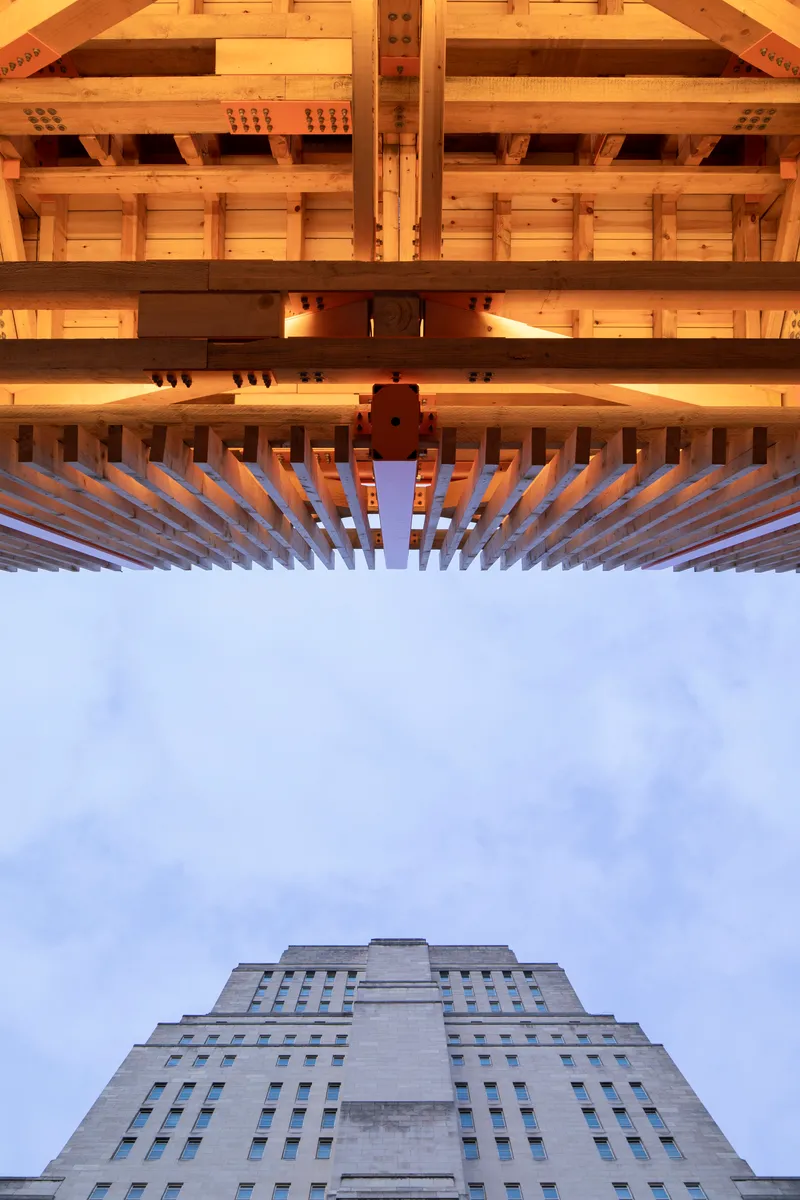
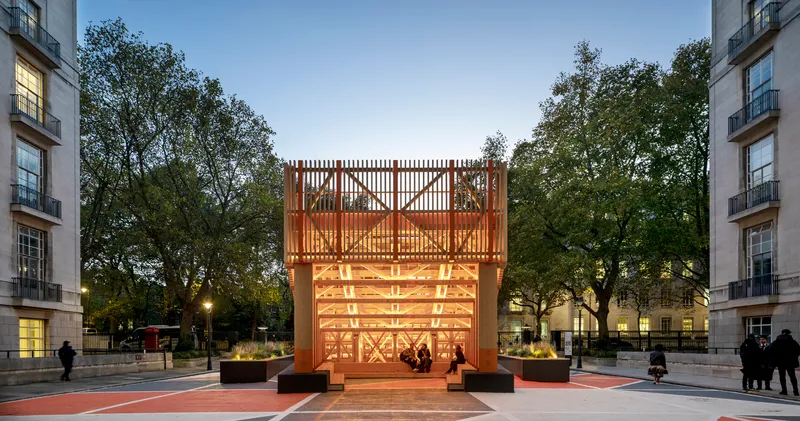
The pavilion's cleverest move is its dual-aspect organization. The Spanish-style steps offer an open, sunlit gathering surface on top, while below them a sheltered zone creates usable space even in London's reliably grey weather. This is not a single-use object. The staircase is seating, lookout, and threshold all at once, while the undercroft provides shade, wind protection, and a more intimate atmosphere. Vertical slatted timber balustrades define the edges without closing them off, and planted beds soften the boundary between structure and ground.
Looking upward through the layered joists and beams, you get a cross-section of the construction logic: C24 softwood and European whitewood spanning between glulam members, connected with steel plates sized for easy disassembly. The structure is honest about its joints and its temporality. Nothing is hidden, and nothing pretends to be monumental.
Timber, Steel, and the Logic of Demountability
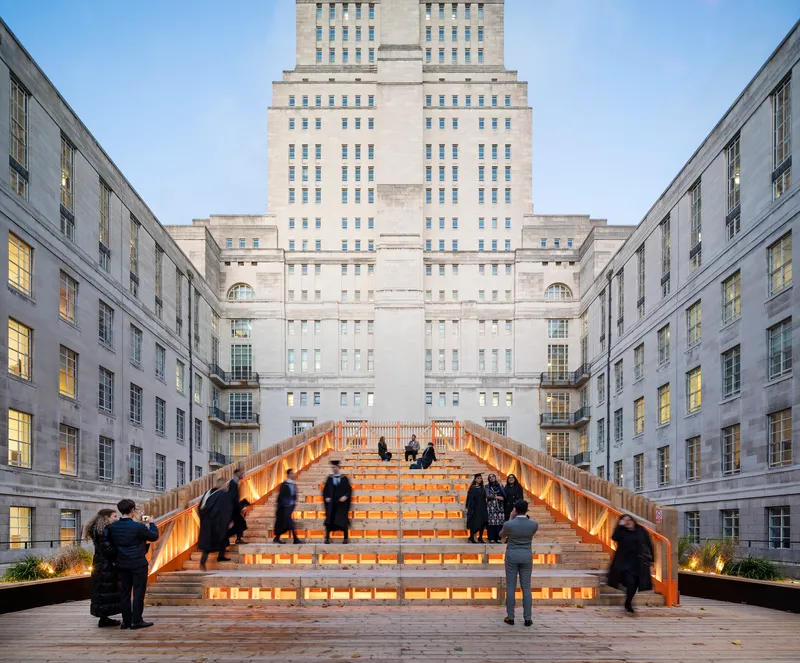
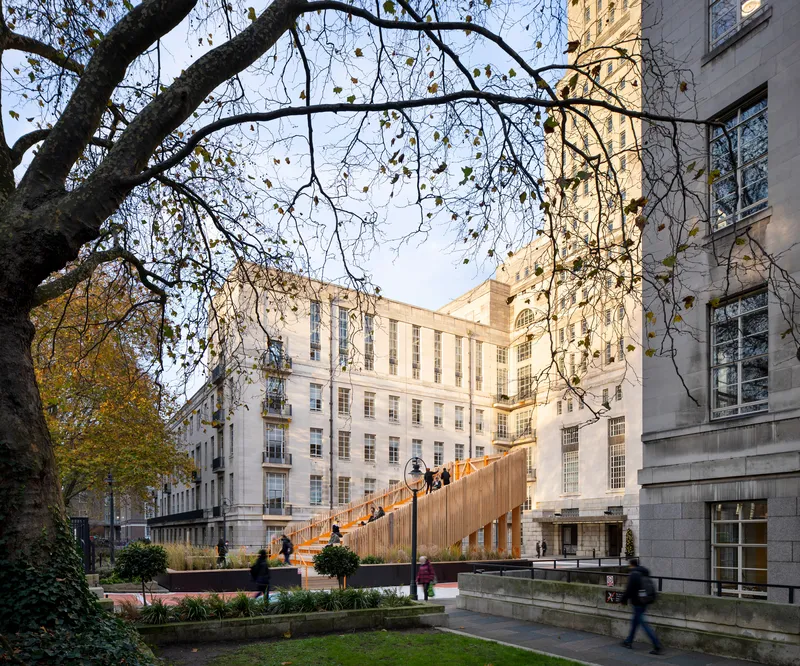
The pavilion sits on a base of steel beams leveling the former car park surface, anchored to concrete blocks. From there, everything is timber and bolted steel connections. The material strategy is driven by the requirement that the entire structure be fully reversible: every component can be unbolted, packed, and reassembled elsewhere. This is architecture designed for a second life, maybe a third, and the detailing reflects that ambition without sacrificing visual warmth.
At dusk, the integrated LED lighting transforms the structure into a lantern. All fittings are repurposed stock, uplighting the timber surfaces to minimize light pollution and cast a warm glow across the courtyard. The effect at twilight, when the timber framework glows against the darkening tower, is genuinely arresting. The pavilion becomes a beacon in a part of the campus that previously had none.
Landscape and the Softening of Institutional Ground
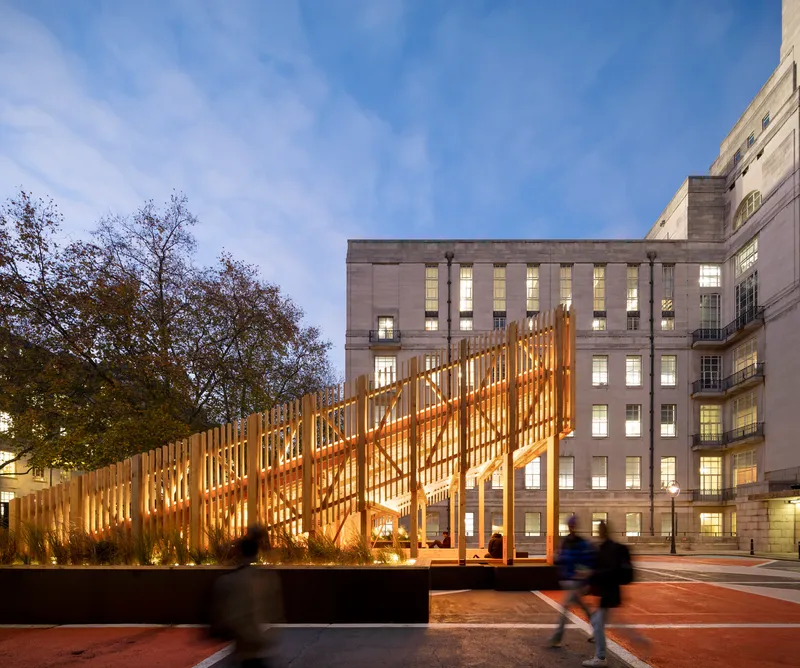
Wildflower gardens and plywood planters ring the structure, establishing a green buffer between the pavilion and the surrounding hardscape. It is a modest landscape intervention, but in a formerly barren car park, the presence of soil and planting matters. The existing concrete surface was retained and painted with a pattern designed by BDP, layering color onto a surface that once had none. Combined with the autumn canopy of existing trees framing views of the timber bridge, the site reads as a deliberate garden rather than a leftover.
The pavilion continues the symmetrical language of Senate House's horseshoe layout, positioning itself along the central axis and respecting the building's formal geometry even as it subverts its material logic. It is a rare example of a temporary structure that actually engages with its host building's compositional rules rather than ignoring them.
Plans and Drawings
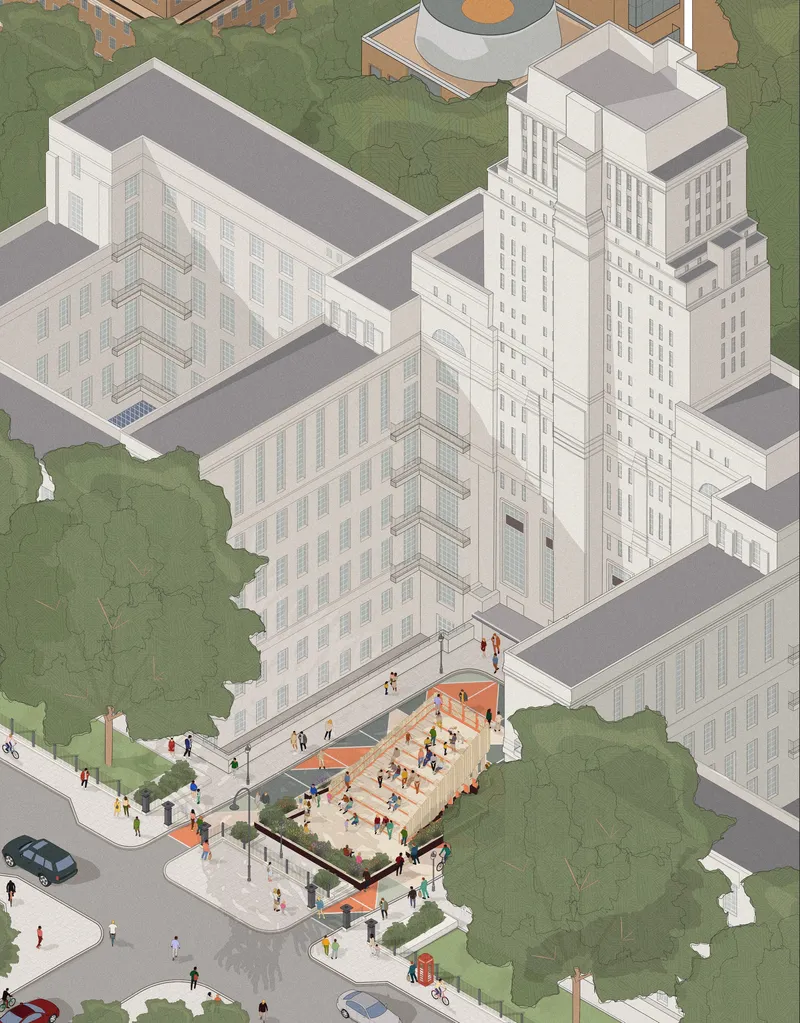
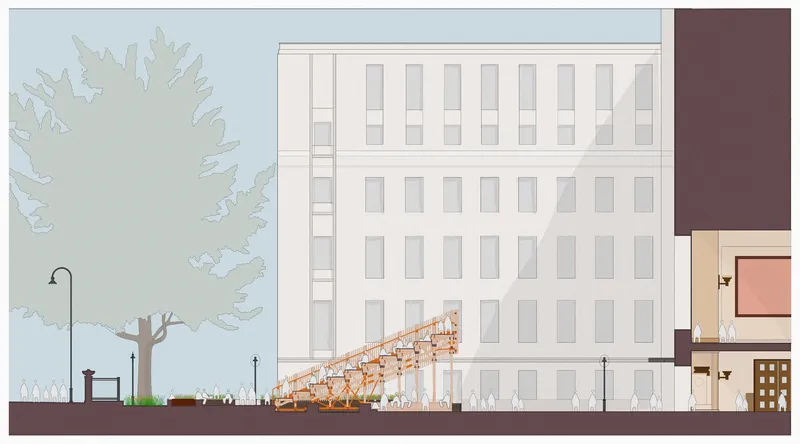
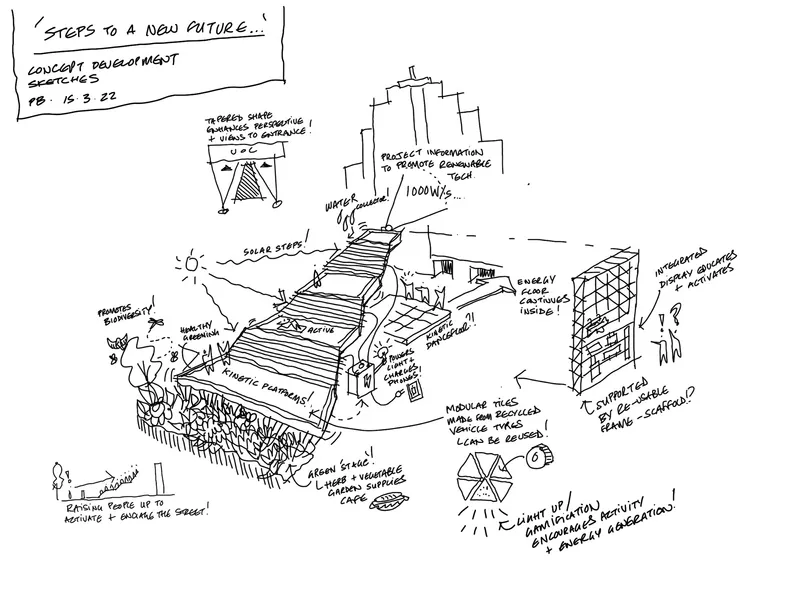
The axonometric drawing reveals the pavilion's relationship to Senate House's courtyard wings, showing how the stepped form locks into the horseshoe plan and creates a public plaza scaled for gathering. The elevation drawing clarifies the angled profile of the street-level structure against the multi-story backdrop, while the concept sketch lays bare the sustainability thinking: annotations about solar potential, demountable connections, and reuse strategies. These drawings make visible the tension between the pavilion's casual, almost improvised appearance and the careful environmental logic underpinning every detail.
Why This Project Matters
Temporary architecture is easy to dismiss as event furniture, but the Stepped Pavilion demonstrates what happens when a temporary structure is given the same design attention as a permanent one. BDP has created an object that is simultaneously lightweight and spatially generous, colorful without being frivolous, and technically sophisticated in its demountability without wearing that sophistication on its sleeve. It takes a dead corner of one of London's most significant buildings and makes it the most active part of the campus.
More broadly, the project poses a useful question for universities everywhere sitting on underused forecourts and parking lots: what if the answer is not a new building but a large, bright, demountable staircase? The best temporary interventions change how people perceive a site permanently, even after the structure is gone. Stepped Pavilion has the character to do exactly that.
Stepped Pavilion, designed by BDP. Located at Senate House, London, United Kingdom. Completed in 2022. Height: 7.3 meters.
About the Studio
Share Your Own Work on uni.xyz
If projects like this are the kind of work you want to make, uni.xyz is a place to publish your own, find collaborators, and enter design competitions.


Popular Articles
Popular articles from the community


Opera on the Sea: Driftwood Logic Shapes a Timber Opera House on Estonia's Coast
Trevor Orgill's opera house translates the entangled drift of floating timber into a civic building where wood, water, and music converge.

Manzana Morphosis: Stretching Barcelona's Grid into a Living Landscape for 2050
A radical reworking of the Eixample manzana turns density into a tool for generous public space, vertical ecology, and environmental performance.

Extended Shell: Retrofitting Kolkata's Balconies as Living Urban Thresholds
A modular retrofit system recovers the social and environmental intelligence of Kolkata's historic verandas for contemporary Park Street residents.
Temporary Home for Dogs: A Reversed Zoo Rethinks Animal Shelter Architecture
In Bucharest, a sinuous corridor and freed landscape flip the logic of containment, designing a shelter that works to make itself unnecessary.

Similar Reads
You might also enjoy these articles

Bao Huynh Watercolor Atelier: A Serene Art Retreat in Hội An
Bao Huynh Watercolor Atelier in Hội An blends multifunctional art spaces, sustainable design, local materials, and family-friendly living in a serene environment.

Atelier Macri Concept Store Interior Design by CASE-REAL
Atelier Macri store features a "ko" counter, walnut wood details, cork displays, blending retail, gallery, and seamless customer experiences.

Manuel Vargas Izquierdo Stadium and High-Performance Sports Center: Architectural Excellence in Jalpa de Méndez
The Manuel Vargas Izquierdo Stadium blends sustainable design, inclusive sports facilities, and cultural-inspired architecture, revitalizing Jalpa de Méndez’s public spaces.

KAKR Buluh Awar Hall: Revitalizing Community and Ecology Through Bamboo Architecture
Community built bamboo hall revitalizes Buluh Awar village, empowering youth, restoring ecology, celebrating vernacular craftsmanship through sustainable architecture and culture.

Explore Pavilion Competitions
Discover active competitions in this discipline

Challenge to design a portable theatre

Challenge to design a portable music platform

Challenge to design an open learning module for the elderly
Comments (0)
Please login or sign up to add comments
No comments yet. Be the first to comment!