
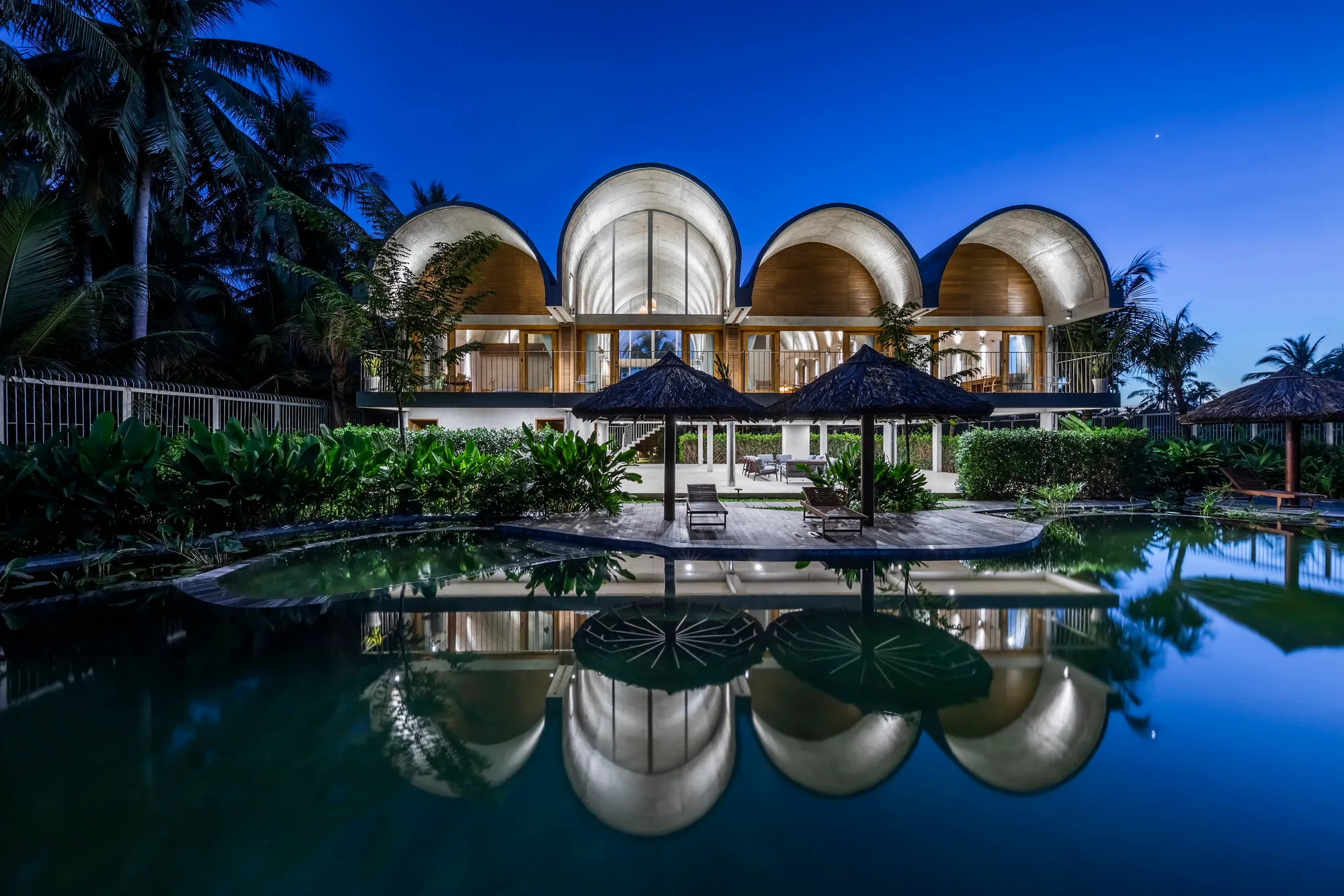
Ben Tre Bungalow: Concrete Vaults in the Mekong Delta
VTN Architects channels the arc of the sky into four barrel vaults that hover above lotus ponds and coconut palms in southern Vietnam.


Bến Tre province sits deep in the Mekong Delta, a place defined by water, laterite soil, and coconut groves that stretch to every horizon. It is not where you expect to find a piece of architecture that reads like a Roman aqueduct turned inside out, yet that is precisely what VTN Architects delivered in 2021. The Ben Tre Bungalow is a 430 square meter retreat organized beneath four parallel barrel vaults of exposed concrete, a form so elemental it feels both ancient and entirely contemporary.
What makes the project genuinely interesting is not just the vaults themselves but the way they orchestrate everything around them: the lotus pond that acts as a thermal buffer, the thatched pavilions that soften the scale, and the vegetable garden that turns the grounds into a working landscape rather than mere scenery. Vo Trong Nghia has long been identified with green buildings and bamboo structures, but here the studio demonstrates that a heavy concrete shell can be just as environmentally embedded as a lightweight one, provided the architect understands the site's climate, hydrology, and culture.
Four Arches on the Water
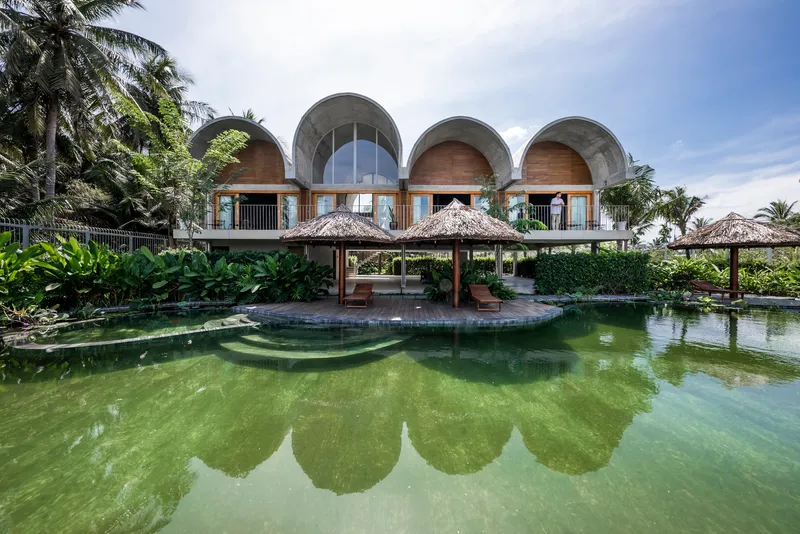
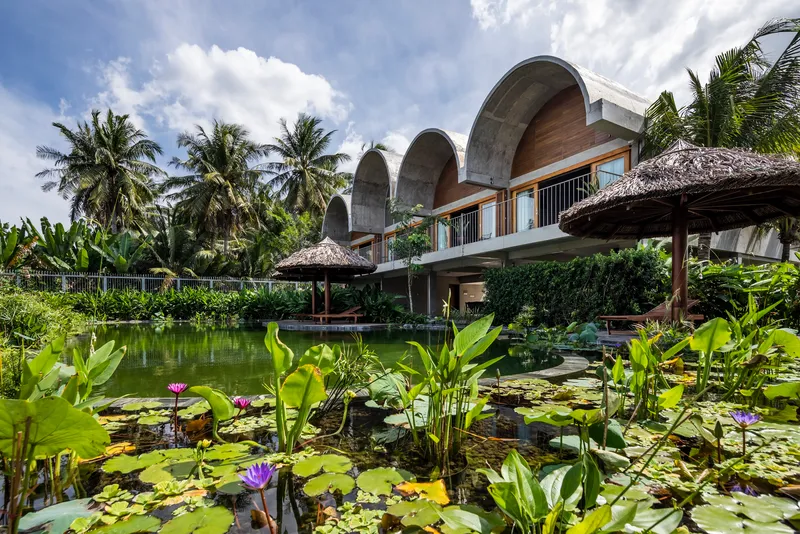
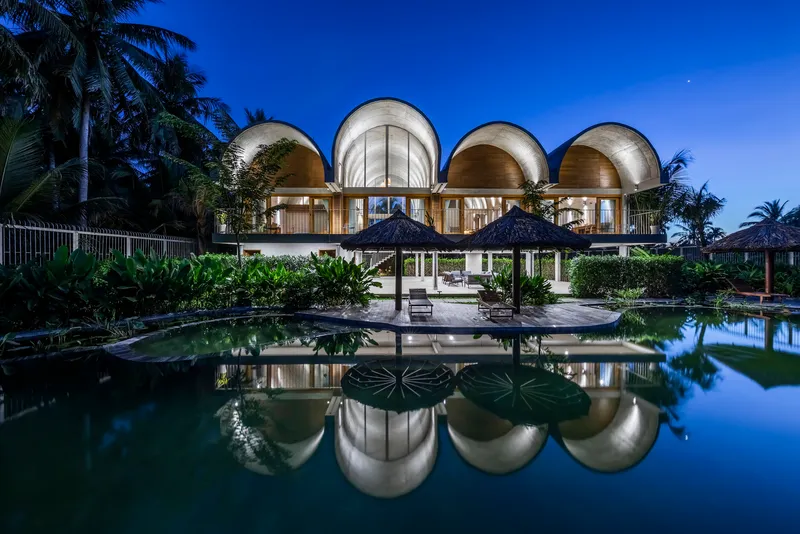
The building presents itself as a rhythmic sequence of four barrel vaults, their curved profiles doubling in the surface of a swimming pool on one side and a lotus pond on the other. The symmetry is deliberate: VTN treats the water not as ornament but as an extension of the architecture, using reflection to complete the geometry and evaporative cooling to temper the tropical air. At dusk, the silhouetted arches against a sky fringed with coconut palms create an image that borders on the surreal.
Thatched shelters sit at the water's edge, mediating between the formal weight of the concrete and the informality of delta life. They are programmatic satellites: shaded spots for reading, eating, or simply watching light move across the pond. By holding the main volume back and placing these lighter structures forward, the architects avoid the trap of making the house a monument in its own garden.
Living Under the Vault
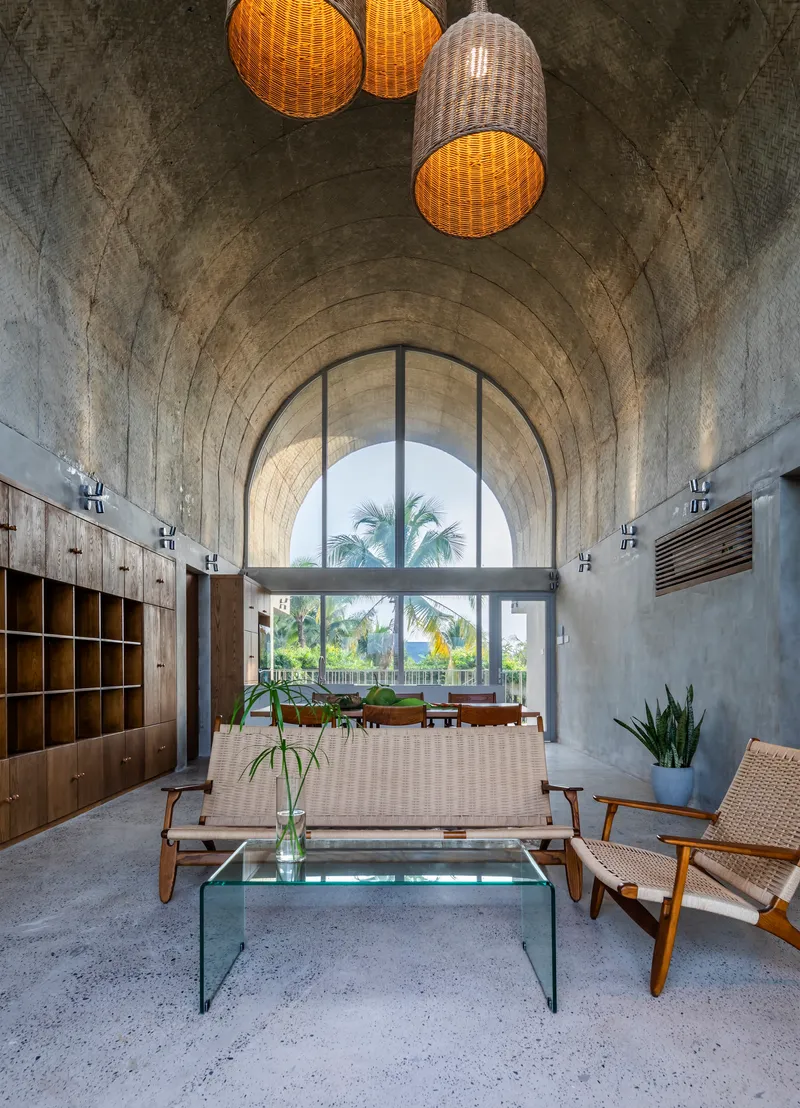
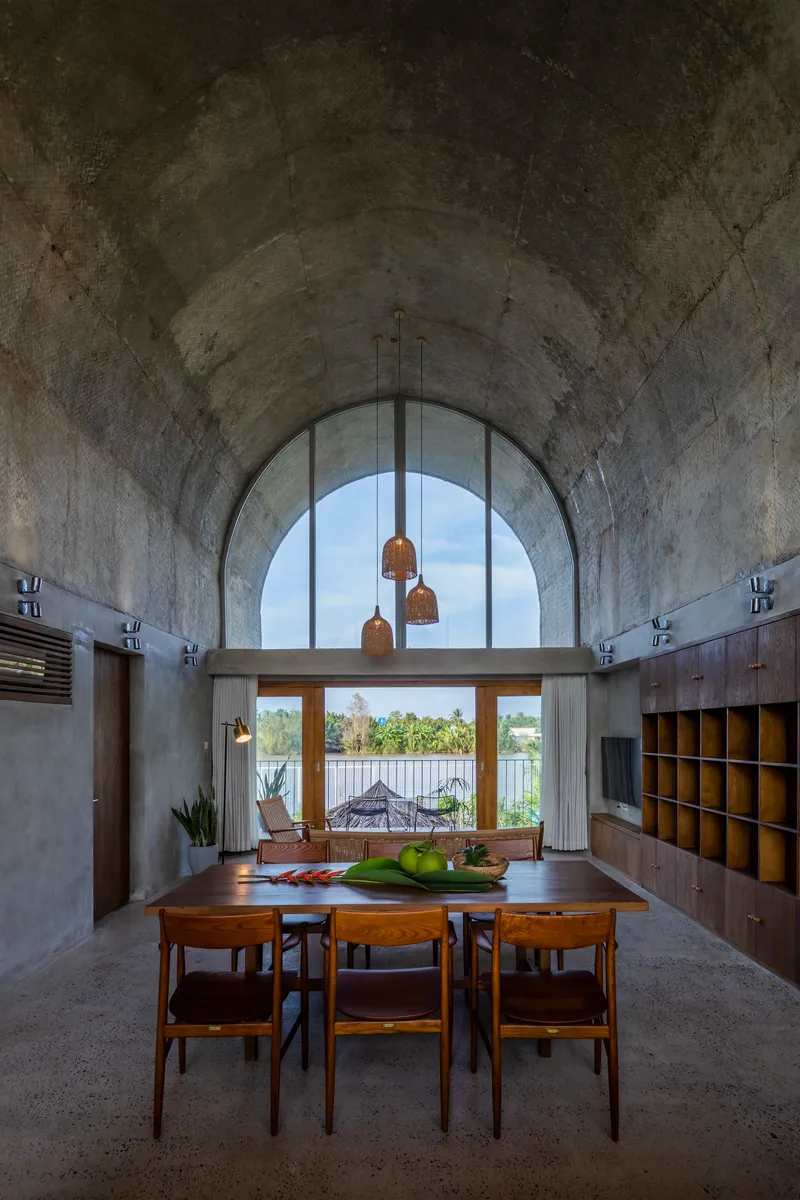
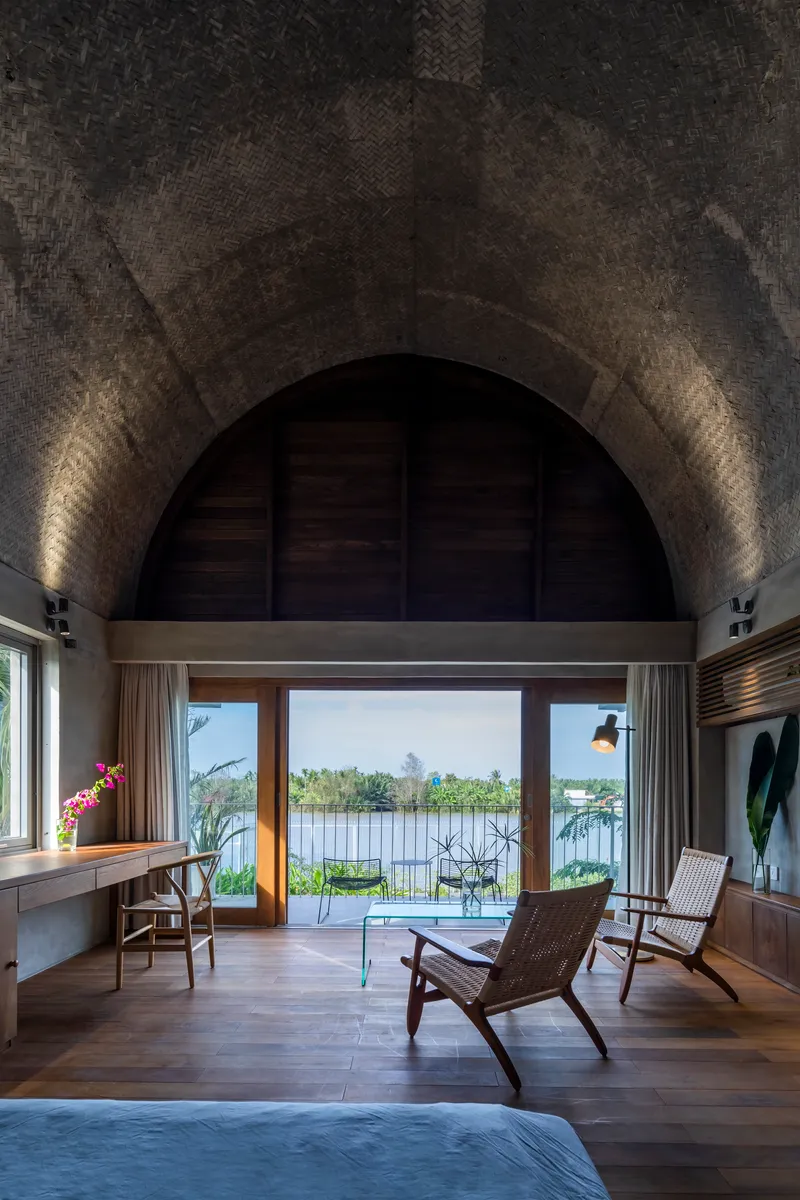
Step inside and the vaulted ceilings assert themselves immediately. The concrete is left unfinished, its formwork grain visible, while terrazzo floors and woven pendant lights introduce texture at a human scale. Arched openings punch through the interior walls, framing views of the water beyond and pulling daylight deep into the plan. The dining area sits beneath one of these arches, its window composed like a painting of the Mekong landscape.
The effect is monastic without being austere. Woven rattan chairs and warm timber tones push back against the rawness of the concrete, and carefully placed uplights wash the curved soffit with a soft glow after dark. VTN understands that a barrel vault is inherently dramatic. Rather than fight for attention, the furnishings and lighting defer to the form, making the ceiling itself the primary interior experience.
Bedrooms as Chapels
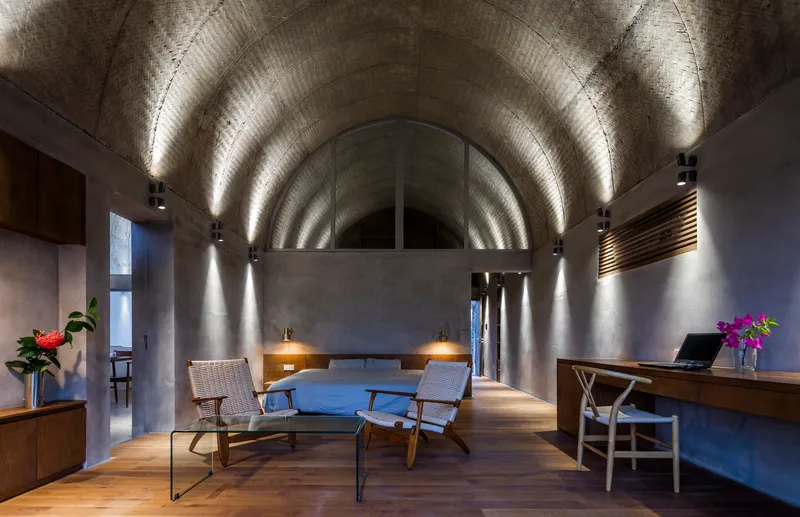
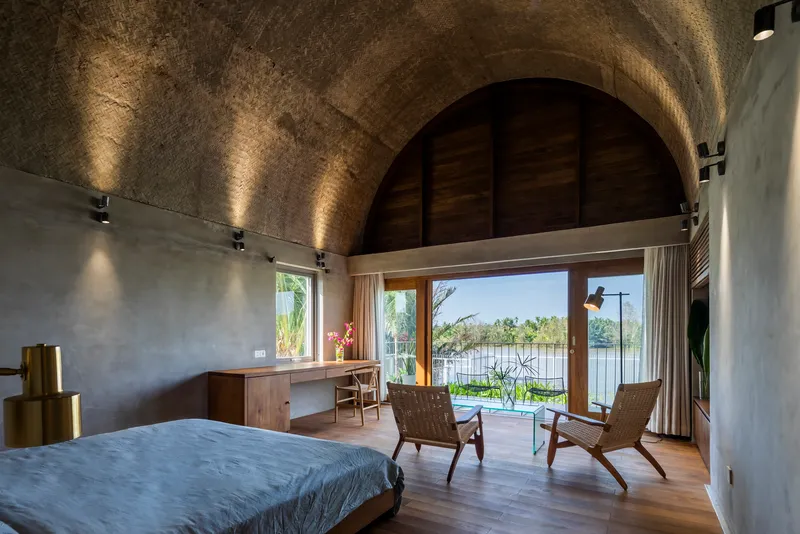
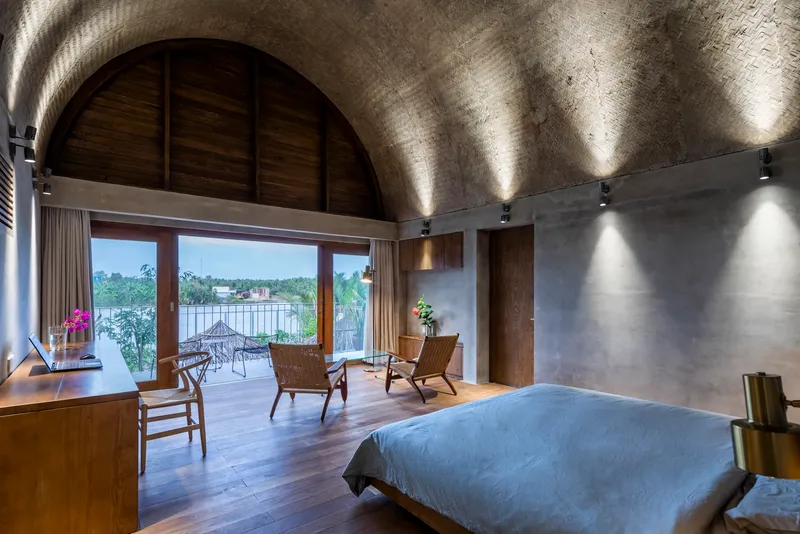
Each of the three bedrooms occupies its own bay beneath the vaults, and each opens through timber-framed glazed doors onto a terrace overlooking the water. The barrel vault overhead gives even a modestly sized room a sense of vertical generosity, the curve drawing the eye upward the way a groin vault does in a medieval chapel. Uplights at the base of the walls intensify this sensation at night, casting shadows that trace the curvature of the concrete.
The comparison to sacred architecture is not accidental. VTN has spoken often about the spiritual dimension of space, and here the sleeping quarters feel genuinely contemplative. Waking to a view of lotus pads and palm fronds through an arched opening is a sensory experience the plan deliberately engineers, aligning the bed axis with the landscape view so that the transition from sleep to wakefulness mirrors the transition from interior to exterior.
Productive Landscape
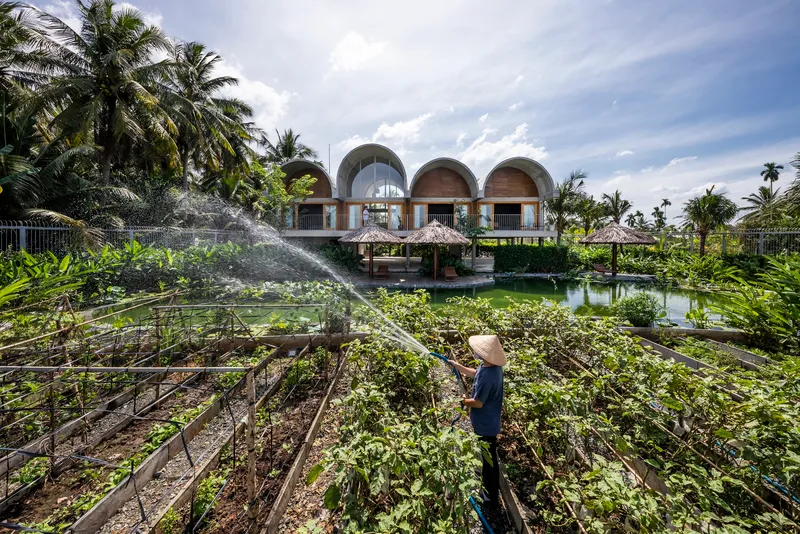
A vegetable garden flanks the approach to the house, tended by hand. It is not a decorative herb bed but a genuine patch of cultivation, with orderly rows of greens and a worker visible among them in at least one frame. The lotus pond, too, is productive in spirit: lotus is harvested throughout the Delta for food, tea, and medicine. By integrating these agricultural elements into the site, VTN roots the bungalow in the economic and ecological realities of Bến Tre rather than importing a resort aesthetic from elsewhere.
The site plan reveals a linear arrangement of structures threaded through an existing grove of coconut palms. Rather than clearing the land, the architects wove the building between the trees, allowing the canopy to provide shade and the root systems to stabilize the soft deltaic soil. The result is a compound that feels as though it has been here for decades, growing alongside the landscape rather than displacing it.
Plans and Drawings
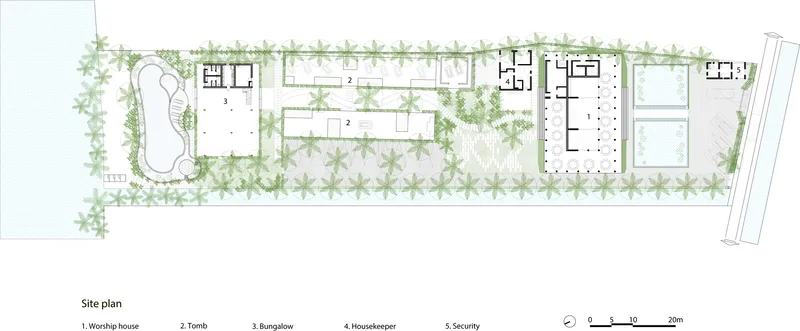
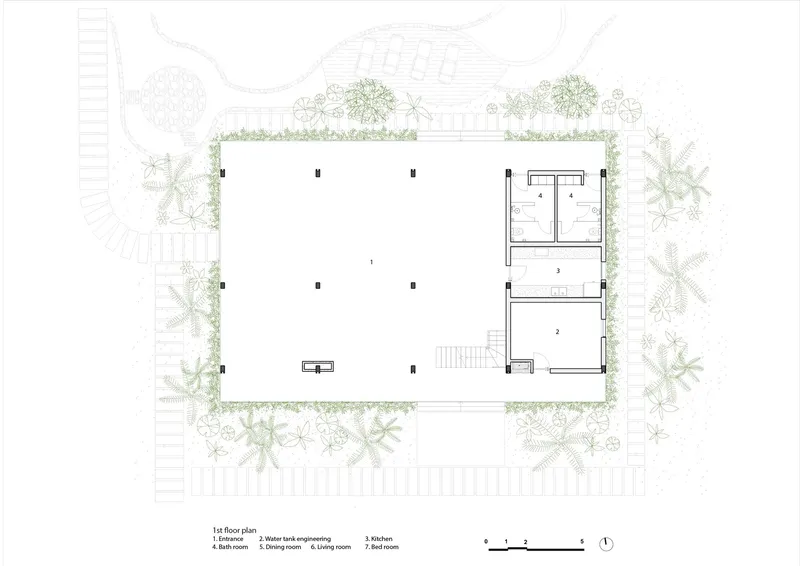
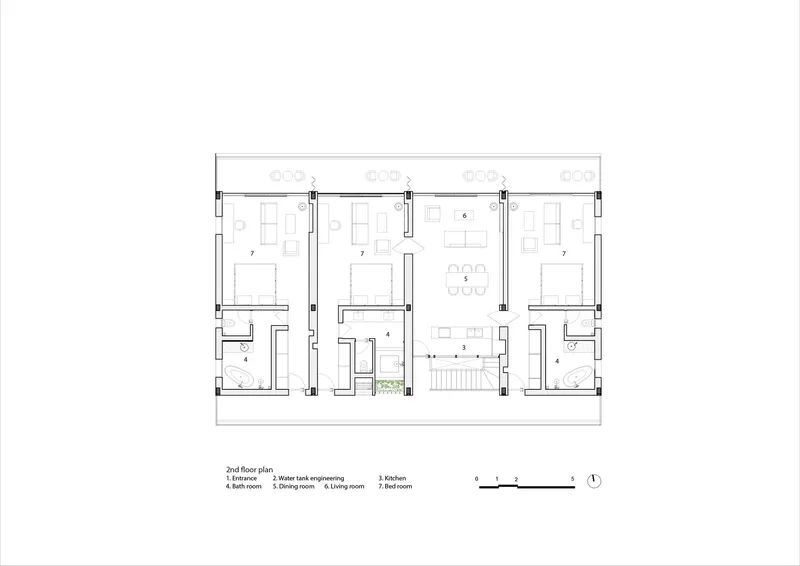
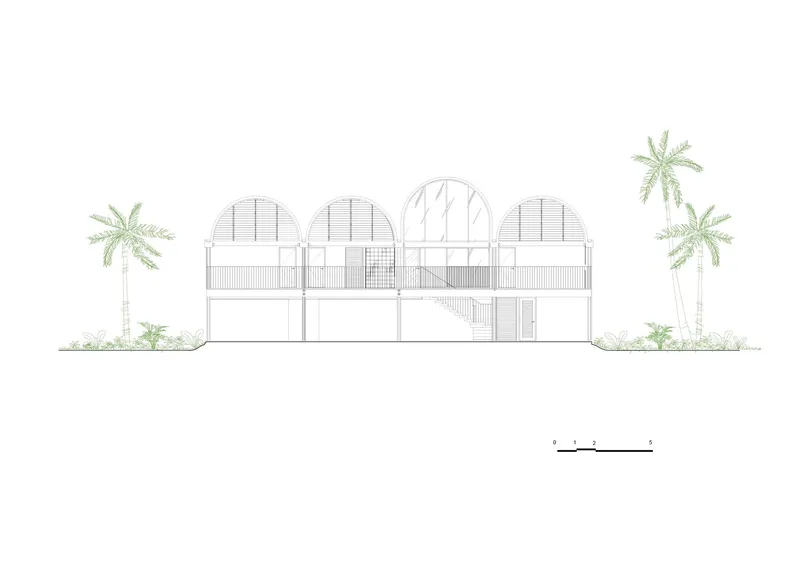
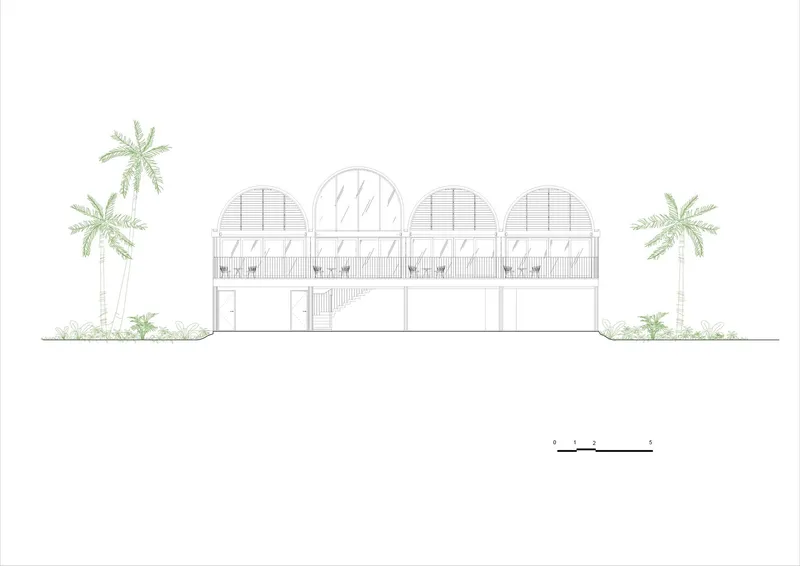
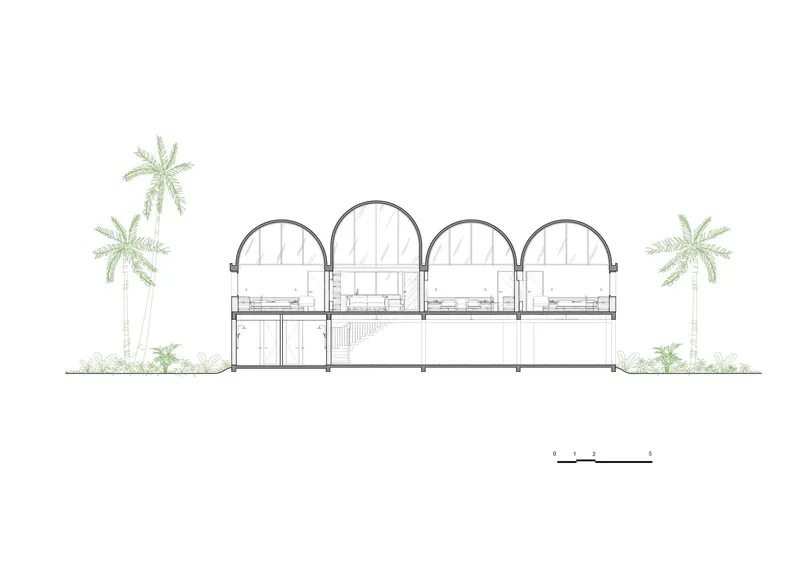
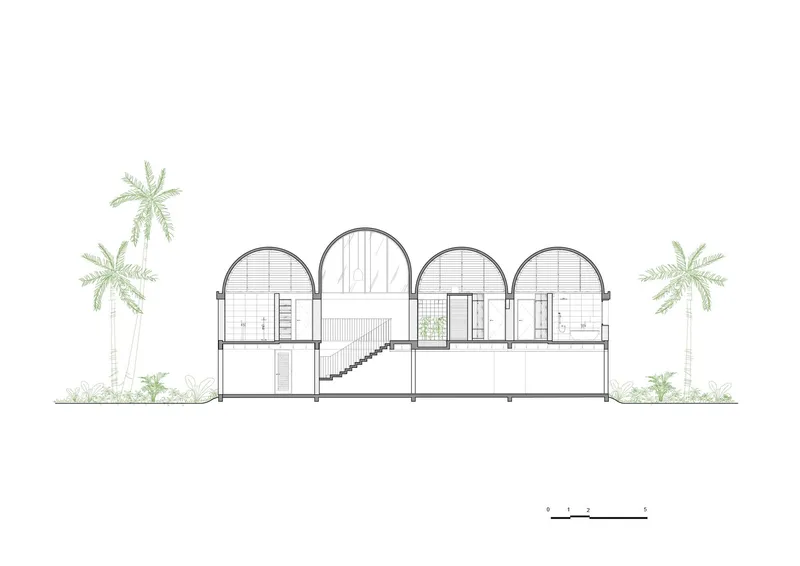
The site plan confirms what the photographs suggest: the bungalow is not a single object but a loose constellation of volumes arranged along a primary axis, with the swimming pool, lotus pond, and garden distributed on either side. The first floor is given over to a large open hall flanked by service rooms, while the second floor accommodates the bedrooms, bathrooms, a central kitchen, and dining area. The sections are the most revealing drawings, cutting through the arched vaults to show how the two-story interior nests within the single-story profile of the roof.
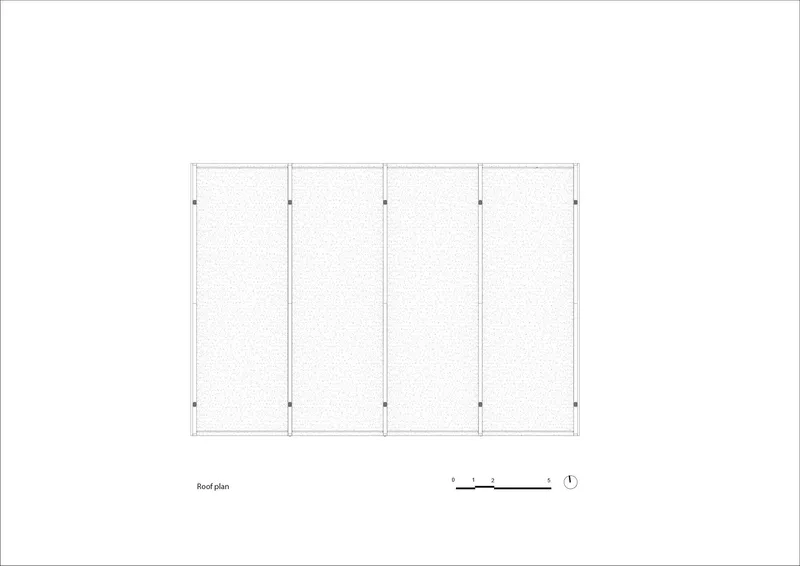
Elevations demonstrate the elegant repetition of the four arches, each bay separated by structural columns visible in the roof plan. Exterior stairs on one side provide access to the upper level without interrupting the ground floor plan. The drawings also make clear how palm trees function as architectural elements in their own right, framing the building at consistent intervals and softening the hard geometry of the concrete.
Why This Project Matters
The barrel vault is one of the oldest structural forms in architecture, and it is easy to dismiss its reappearance as nostalgia. What VTN achieves at Ben Tre is more nuanced. The vault here is not a stylistic quotation but a climatic strategy: its curved profile sheds monsoon rain efficiently, its thermal mass buffers indoor temperatures, and its height encourages the stack ventilation that makes life in the Mekong Delta tolerable without mechanical cooling. Form and performance are, for once, genuinely inseparable.
The bungalow also represents a quiet rebuke to the glass-box resort typology proliferating across Southeast Asia. Instead of hermetically sealed rooms and imported landscaping, VTN offers open terraces, productive gardens, and a material palette drawn from the site itself. At 430 square meters for three bedrooms, it is generous by any standard, yet it sits lightly in its environment, reflecting the delta in its ponds and the sky in its vaults. That kind of calibrated restraint is harder to achieve than spectacle, and far more lasting.
Ben Tre Bungalow by VTN Architects (Vo Trong Nghia Architects). Bến Tre, Vietnam. 430 m². Completed 2021. Photography by Hiroyuki Oki.
About the Studio
Share Your Own Work on uni.xyz
If projects like this are the kind of work you want to make, uni.xyz is a place to publish your own, find collaborators, and enter design competitions.


Popular Articles
Popular articles from the community


The Earth Pod: 3D Printed Homes for Resilient Refugee Communities
The Earth Pod reimagines refugee housing through 3D printed homes made from clay, combining resilience, self-sufficiency, and rapid shelter.

Riyadh For All: Intergenerational Urban Design for Active Aging in Rabat
Riyadh For All reimagines urban design in Rabat with intergenerational co-living, adaptive courtyards, and Moroccan cultural exchange today.

Co-Life: Senior Housing Design That Reconnects Older Adults With the City
Co-Life reimagines senior housing design through healing gardens, shared streets, workshops, and a sustainable community across generations.

The Musturak Paradise: Senior Living Architecture for a Connected Future in Temara, Morocco
The Musturak Paradise reimagines senior living architecture in Temara via private homes, social spaces, culture, community, and shared care.


Similar Reads
You might also enjoy these articles

Bao Huynh Watercolor Atelier: A Serene Art Retreat in Hội An
Bao Huynh Watercolor Atelier in Hội An blends multifunctional art spaces, sustainable design, local materials, and family-friendly living in a serene environment.

Atelier Macri Concept Store Interior Design by CASE-REAL
Atelier Macri store features a "ko" counter, walnut wood details, cork displays, blending retail, gallery, and seamless customer experiences.

Manuel Vargas Izquierdo Stadium and High-Performance Sports Center: Architectural Excellence in Jalpa de Méndez
The Manuel Vargas Izquierdo Stadium blends sustainable design, inclusive sports facilities, and cultural-inspired architecture, revitalizing Jalpa de Méndez’s public spaces.

KAKR Buluh Awar Hall: Revitalizing Community and Ecology Through Bamboo Architecture
Community built bamboo hall revitalizes Buluh Awar village, empowering youth, restoring ecology, celebrating vernacular craftsmanship through sustainable architecture and culture.

Explore Residential Building Competitions
Discover active competitions in this discipline


Challenge to design a barrier free sports center


Challenge to design an outdoor ice-rink and park


Challenge to design mud housing for contemporary communities
Comments (0)
Please login or sign up to add comments
No comments yet. Be the first to comment!