

Bercy Fadel Sculpts Three Glass Pavilions from the Motion of Falling Oak Leaves in Austin
On a ten-acre West Austin wilderness corridor, hyperbolic paraboloid roofs shelter a compound that floats above a private creek.


A house that looks like it was peeled from the hillside and curled into form: that is the conceit behind Falling Leaves House, designed by Bercy Fadel for a young family on the outskirts of Austin, Texas. Led by Thomas Bercy and Bethany Fadel, the studio took a ten-acre parcel of untouched wilderness, a rare corridor of cedars, oaks, mule deer, and the endangered Golden-cheeked Warbler, and placed a compound of three glass pavilions at the very edge of limestone cliffs, twenty feet above a private creek. The resulting 7,500-square-foot residential compound reads not as a single house imposed on a slope but as a series of sheltering forms that emerged from the contour lines themselves.
What makes the project genuinely distinctive is the translation of a natural phenomenon into a structural principle. The curved, dried edges of falling oak leaves gave the architects a formal language for hyperbolic paraboloid roofs, each one shaped by undulating rows of exposed glulam rafters. It is a rare case where biomimetic inspiration produces architecture that is structurally honest rather than merely decorative. The roofs twist. The pavilions step. The whole compound appears to have settled into its site the way debris accumulates at a bend in a stream: inevitably, and with an unapologetic allegiance to gravity.
Perched on the Precipice
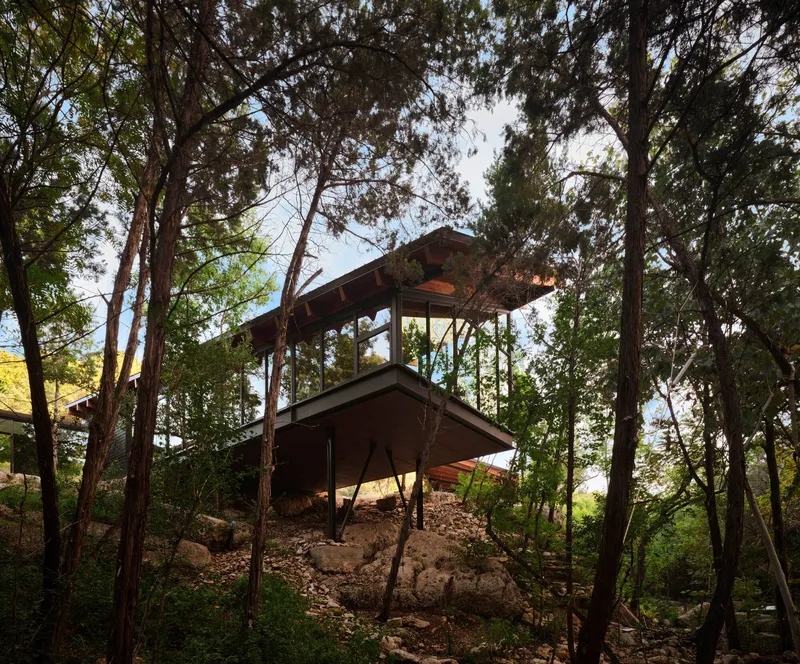
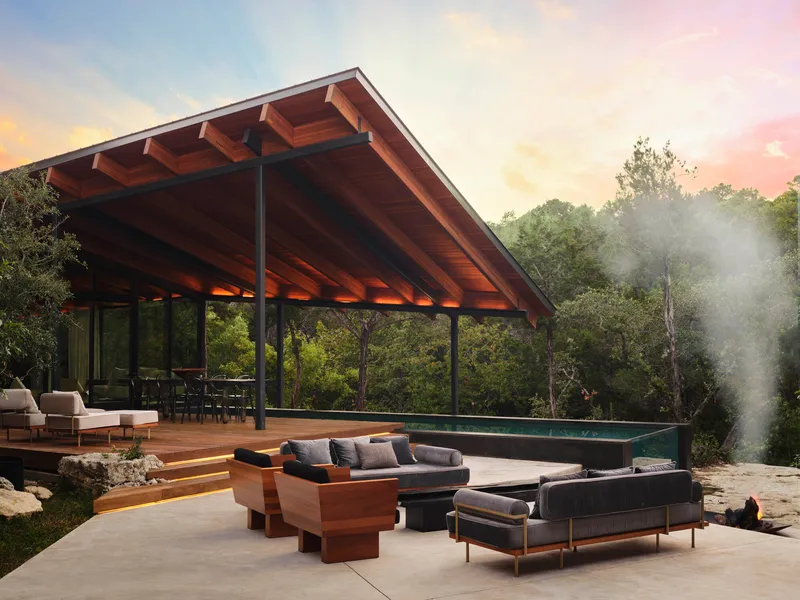
The compound sits in the far corner of the property, on a rimrock ledge above a bend in the creek. A bold cut into the hillside created the building pad, and the architects left the exposed limestone visible, echoing the natural grottos that line the waterway below. The living wing cantilevers into the canopy of trees, floating above the stream, while the pool house and its linear lap pool perch on the cliff's precipice. From the outside at dusk, the structure looks like a campfire lantern set among eucalyptus trunks: warm, glowing, and precariously balanced.
The decision to build at the cliff edge rather than on the flat center of the ten-acre lot is the project's most consequential move. It preserves the vast majority of the site as dedicated nature habitat, a position reinforced by a meandering drive that traces gently across the topography so as not to scar it. The house does not occupy its land. It occupies the margin.
Roofs That Twist Like Leaves
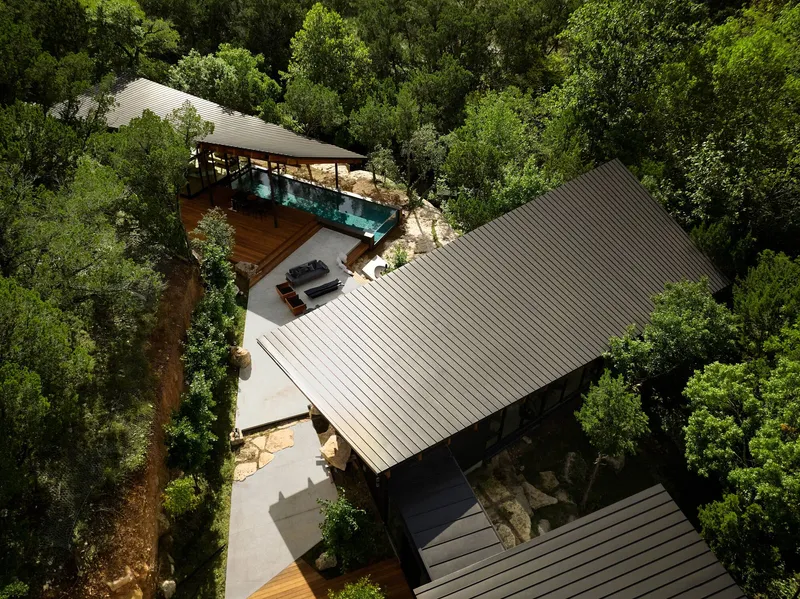
Seen from above, the corrugated metal roofs and their outdoor terraces settle into the green canopy like oversized leaves caught mid-fall. Each pavilion has its own orientation and character, yet the three volumes share a family resemblance: the hyperbolic paraboloid geometry, the exposed glulam rafters, and the interplay of wood and metal overhead. The aerial view reveals how tightly the building volumes track the site's contour lines, stepping down the plateau with the topography rather than fighting it.
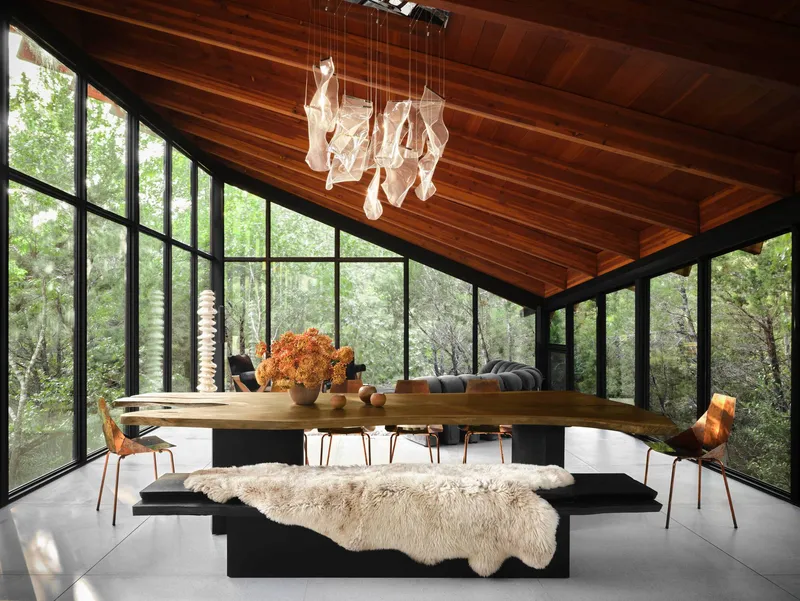
Inside the dining pavilion, the full effect of these warped planes becomes legible. Wood plank ceilings sweep upward and away, pulling the eye toward the forest beyond the floor-to-ceiling glazing. The structure is doing double duty as ornament. Exposed rafters are not decorative appliqué; they are the literal mechanism by which the roof achieves its ruled-surface geometry. The pendant light fixture above the dining table hangs like a single leaf that refused to fall.
Three Pavilions, One Courtyard
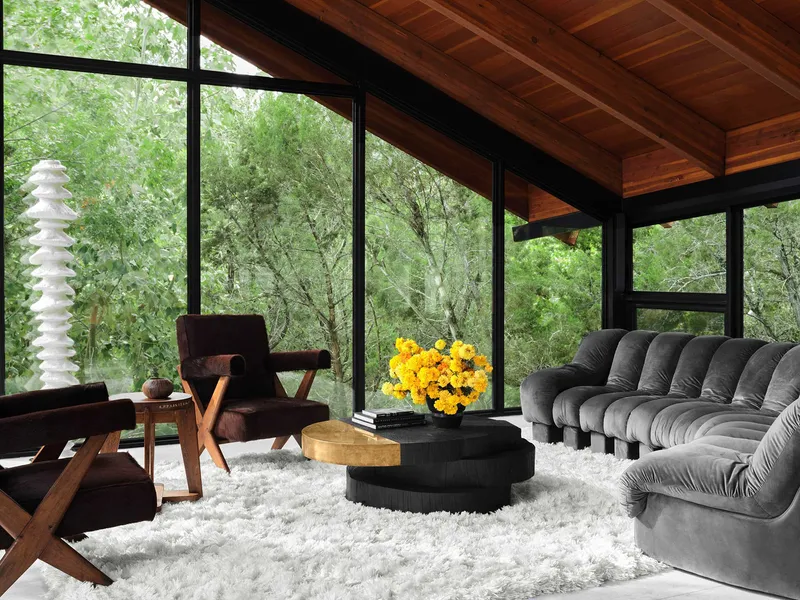
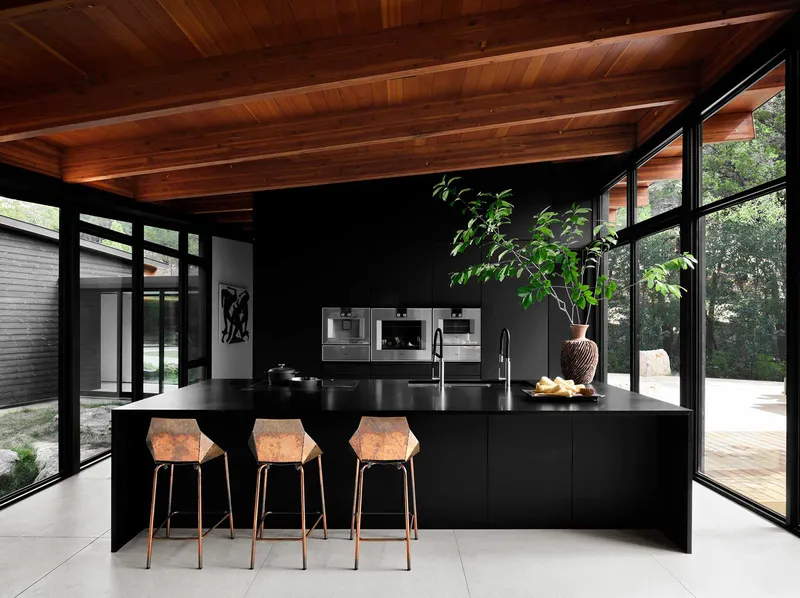
The compound is organized as a deconstructed belvedere: three glass pavilions radiate from an outdoor courtyard and fire pit centered around an existing limestone boulder. The living wing sits perpendicular to the cliff face, opening to views of the forest canopy through black-framed windows. In the kitchen, a monolithic dark island anchors the space beneath that same sloped wood ceiling and full-height glazing. The effect is of a single continuous room that has been folded around the landscape rather than walled off from it.
The bedroom wing introduces a deliberate contrast: an opaque circulation spine runs through it, creating pockets of privacy against which the expansive glass walls feel even more dramatic. This push and pull between enclosure and exposure is one of the project's most accomplished spatial tactics. You are never entirely inside or entirely outside.
Living in the Canopy
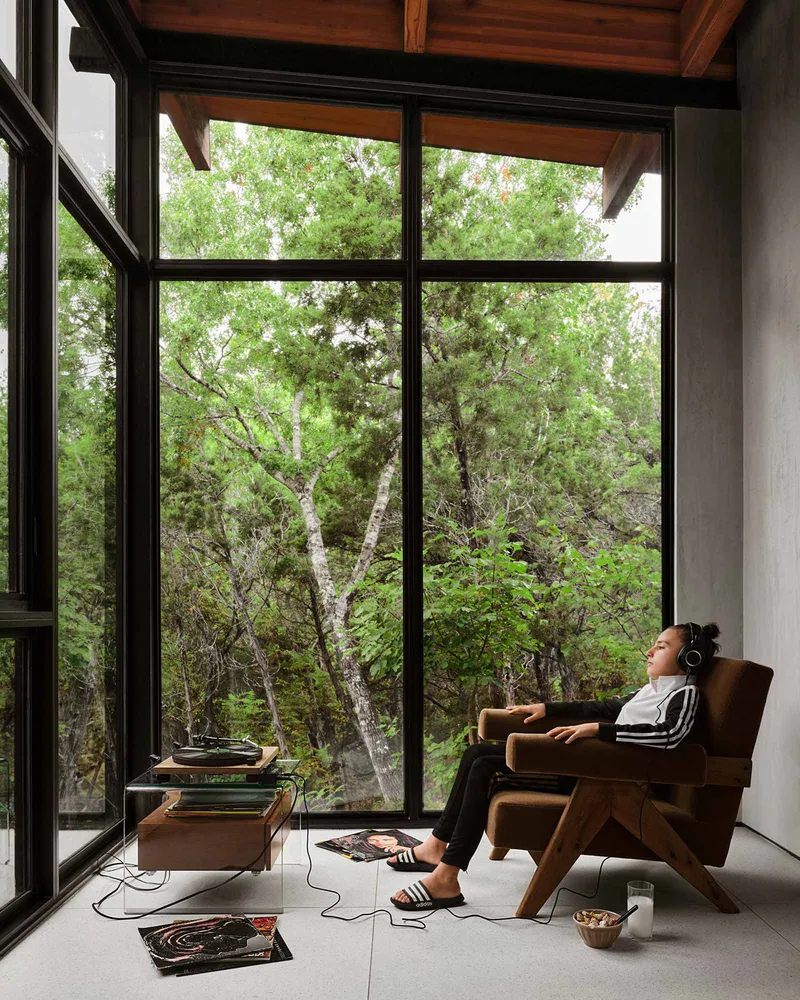
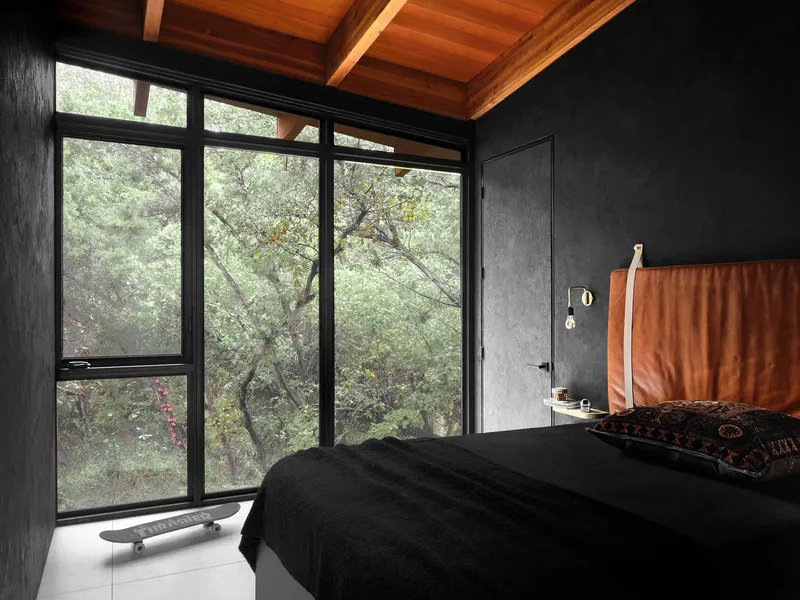
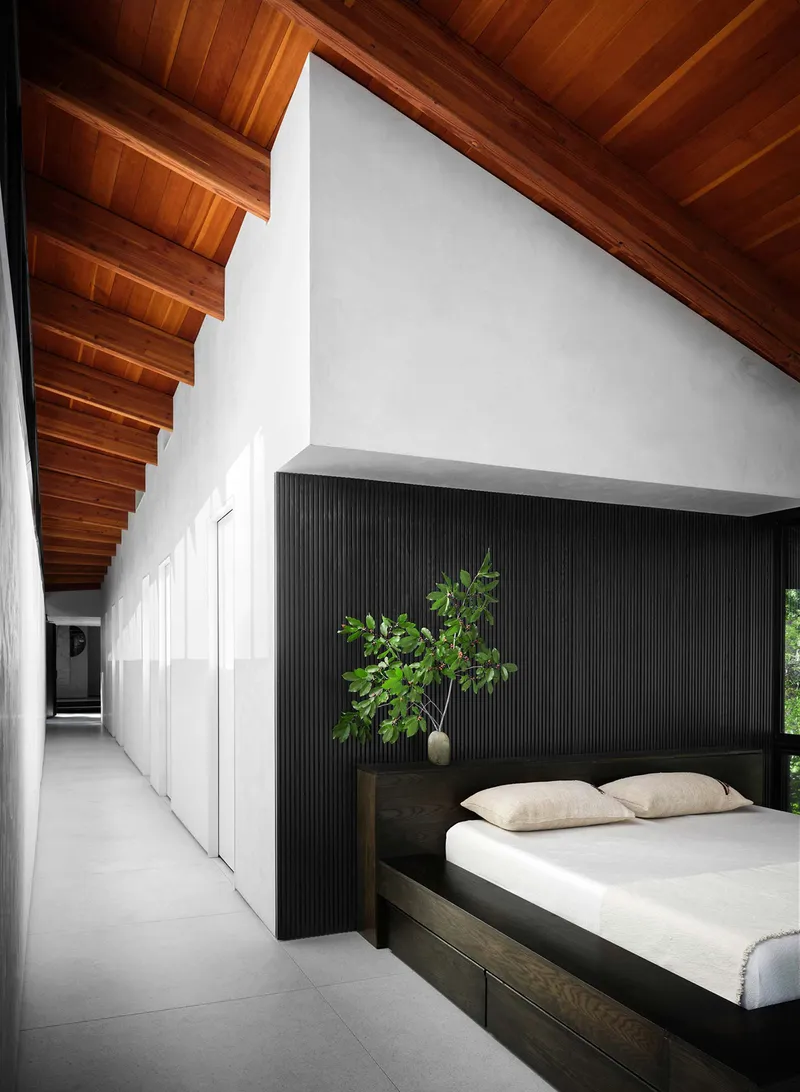
The bedrooms and intimate living spaces demonstrate how deeply the architects committed to the idea of inhabiting the tree canopy. A window seat becomes a listening alcove, framed entirely by floor-to-ceiling glass, where the only backdrop is the tangle of branches outside. In the bedrooms, exposed timber ceiling beams run above polished concrete floors, and dense foliage presses close to black-framed windows. The effect is less "house with views" and more "elevated platform in a forest."
Material choices reinforce this sense of being embedded in the landscape. Lime plaster walls carry a texture that recalls limestone. A ribbed black headboard wall in one bedroom provides the visual weight necessary to anchor a room that might otherwise dissolve entirely into greenery. These are considered, restrained interiors: no surface competes with the trees.
Stone, Water, Light
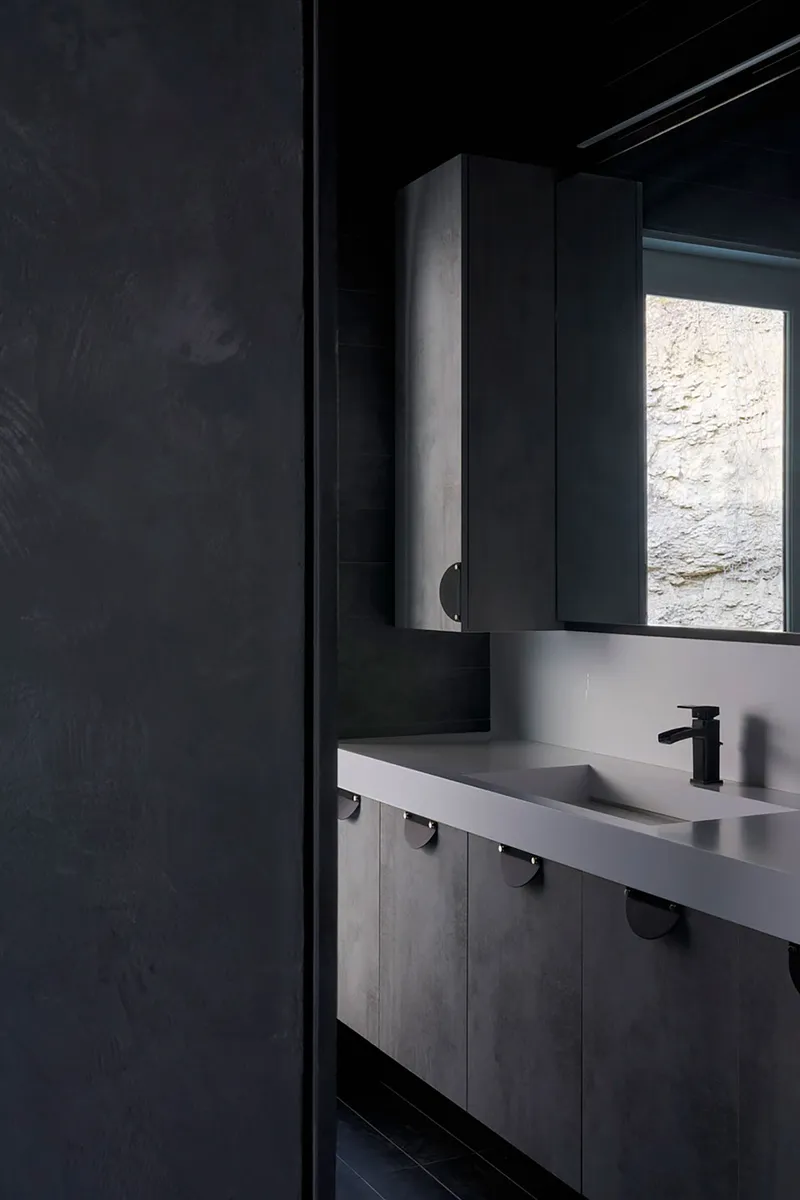
A narrow bathroom window reveals a rough stone exterior wall, a direct encounter with the limestone geology on which the entire compound rests. The concrete vanity counter is heavy and unadorned, allowing the sliver of natural light and the raw rock face to do all the atmospheric work. It is a small moment, but it captures the project's larger ambition: to make the geological fact of the site visible at every scale, from the cliff that supports the pool house down to the stone glimpsed through a bathroom window.
Landscape architect Ciel Williams contributed significantly to the experience, building up hills and berms to heighten the perception of topography and planting additional oaks to complement the hundreds of native trees already on site. The result is a property where the architecture feels like one element in a much larger ecological composition.
Plans and Drawings
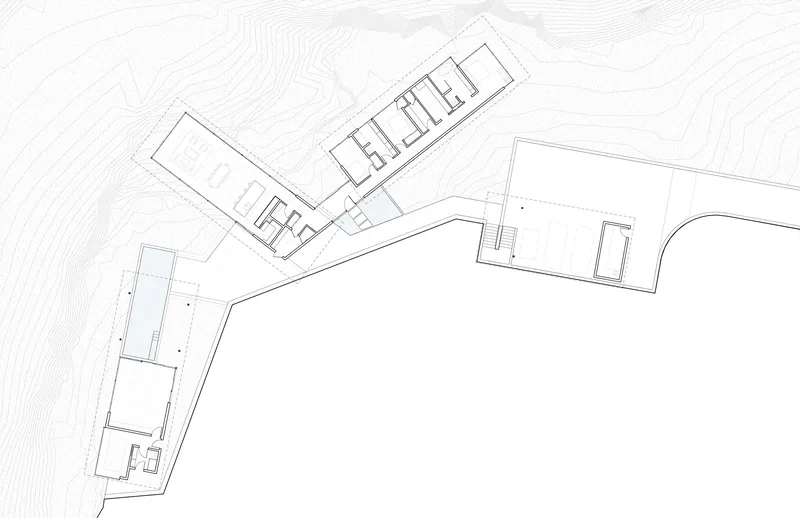
The site plan makes legible what the photographs only suggest: the three building volumes are angled independently, each following a different contour line on the sloped terrain. Their divergent orientations create triangulated outdoor spaces between them, with the courtyard at the nexus. The drawing also reveals how much of the ten-acre site remains untouched. The compound is a compact cluster at the property's edge, connected to the road by a single, winding drive. The architecture occupies perhaps five percent of the land. The rest belongs to the Golden-cheeked Warbler.
Why This Project Matters
Falling Leaves House matters because it demonstrates that a biomimetic concept can produce rigorous architecture rather than gimmickry. The hyperbolic paraboloid roofs are not arbitrary formal gestures; they are the logical structural conclusion of taking the curved edges of an oak leaf and translating them into glulam rafters and ruled surfaces. The house earns its metaphor. That puts it in rare company among residential projects that claim inspiration from nature but deliver only superficial imitation.
It also offers a model for building on ecologically sensitive land. By concentrating the compound at the cliff edge, preserving the vast majority of the site as habitat, and designing a driveway that traces the topography rather than cutting through it, Bercy Fadel produced a house that coexists with its wilderness context rather than colonizing it. In a city where ten-acre lots are increasingly subdivided and cleared, the restraint on display here is itself a kind of architecture.
Falling Leaves House by Bercy Fadel (Thomas Bercy, Bethany Fadel). Austin, Texas, United States. 7,500 sq ft. Completed 2021. Landscape architect: Ciel Williams. Design team: Thomas Bercy, Calvin Chen, Bethany Fadel, Dylan Rinda.
About the Studio
Share Your Own Work on uni.xyz
If projects like this are the kind of work you want to make, uni.xyz is a place to publish your own, find collaborators, and enter design competitions.


Popular Articles
Popular articles from the community


Cube Design Draws an Ecological Corridor Between Two Shenzhen Hills with the Nankai Building
Beside Shenzhen's container docks, the Nankai Building pairs stacked balconies with a climbing green screen to connect two hillsides across its height.

GROUP A Strips a 1969 Rotterdam Harbor Headquarters to Its Frame and Wraps It in Timber Louvers
In Rotterdam's M4H harbor district, Ferro Offices reuses a 1969 frame, adds one timber storey and reaches BREEAM-NL Outstanding.

LT2A and OPEN Architectes Thread a Brick and Glass High School Through a Wooded Belgian Campus
In Braine-l'Alleud, a 3,000 m² wing for Collège Cardinal Mercier pairs pale brick with a glazed colonnade, deferring to a small chapel and a dense wood.

David Macias Steps a Doorless Stone and Plaster House Down a Tropical Colombian Hillside
In the humid hills of Colombia, Threshold House replaces the front door with an open void and terraces its 850 m² down the slope instead of fighting it.

Similar Reads
You might also enjoy these articles


LAVA Architecten Gives Vocational Education a Sawtooth-Roofed Face on a Mechelen School Campus
In Mechelen, Belgium, a 2,053 m² STEM school on a 6×6 m grid turns workshops and classrooms into rooms that can be rearranged as teaching changes.

KEMA Studio Turns a Derelict Marvila Attic into a 60 m² Lighthouse Apartment Above Lisbon
In Lisbon's Marvila district, a rebuilt roof, four skylights and two plywood volumes turn an unlivable attic into a bright home facing the Tagus.

Pixel Gardens: One Repeated Module Stacked Into a Terraced Social Housing Tower for Famagusta
Salem Bader's shortlisted housing tower builds a vertical neighbourhood from one repeated module, offsetting units to carve terraces, light and air.

Bao Huynh Watercolor Atelier: A Serene Art Retreat in Hội An
Bao Huynh Watercolor Atelier in Hội An blends multifunctional art spaces, sustainable design, local materials, and family-friendly living in a serene environment.

Explore Residential Building Competitions
Discover active competitions in this discipline

Comments (0)
Please login or sign up to add comments
No comments yet. Be the first to comment!