
Berd Studio Lines a Barcelona Storefront with Mud Brick and Oak to Build a Social Market
In L'Eixample, a 120 square meter shop made with handcrafted materials from Malaga becomes a gathering place for local products and residents.

A storefront in L'Eixample is not a hard thing to find. The neighborhood's rigid grid, designed by Ildefons Cerdà in the nineteenth century, yields thousands of ground-floor commercial bays, most of them predictable in dimension and ambition. What Berd Studio and lead architect Marcos Gonzalez Mazza have done at La Cofradia is turn one of those bays into something that feels genuinely hand-built, a long, narrow retail space where mud bricks from Malaga, exposed oak beams, and a handmade ceramic mural conspire to make buying olive oil feel like a civic act.
The project's premise is direct: La Cofradia is a social market, a place where local products are sold but also where residents gather. The design needed to support both retail display and communal use, all within a slender 120 square meter footprint stretched along a single axis. The answer was not to fight the proportions but to celebrate them, organizing the plan as a sequence of thresholds, from the arched stone entry through a pair of interior arches and finally into a wine cellar at the rear. Every surface carries the mark of a specific artisan or collaborator, from TODO BARRO's mud bricks to Fusteria Creativa's oak joinery. The result is a store that reads less like a fit-out and more like a building that has always been here.
An Arched Entry That Sets the Terms
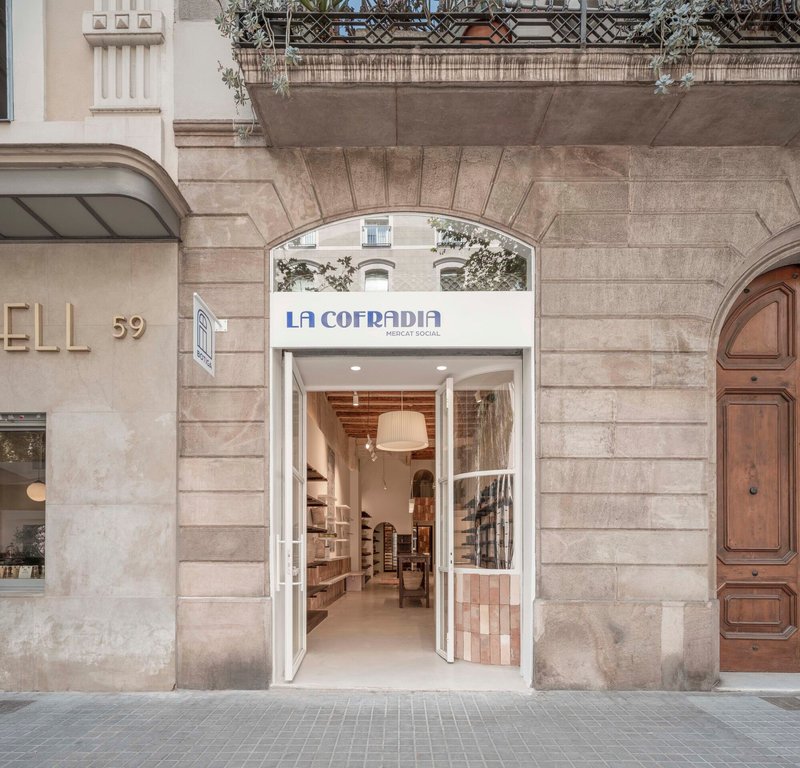
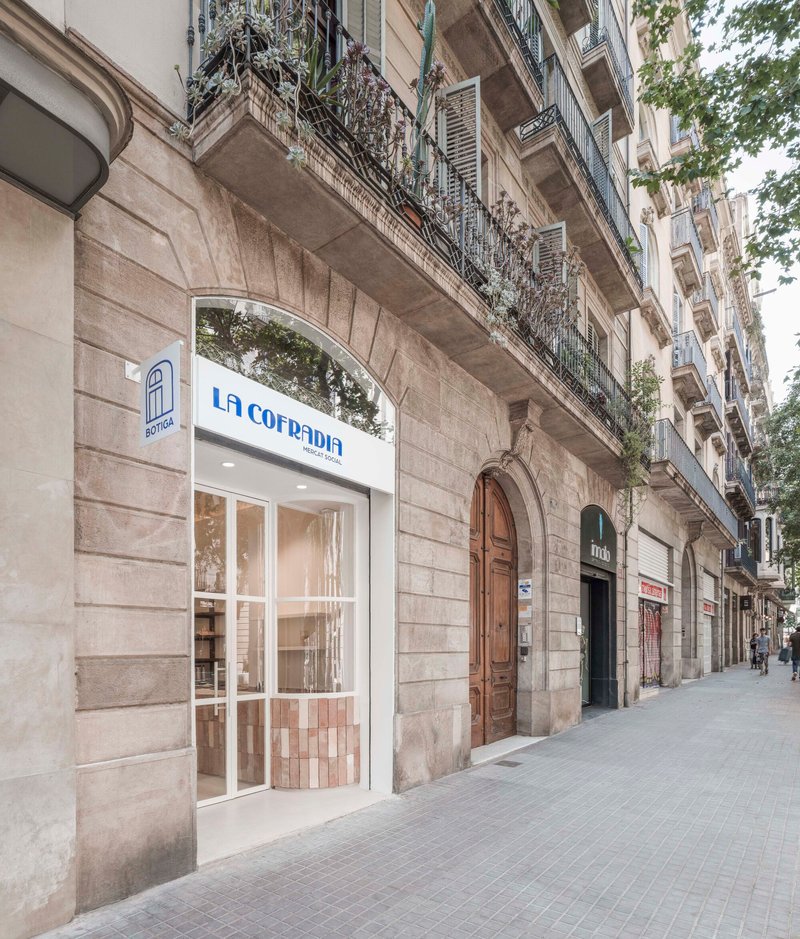
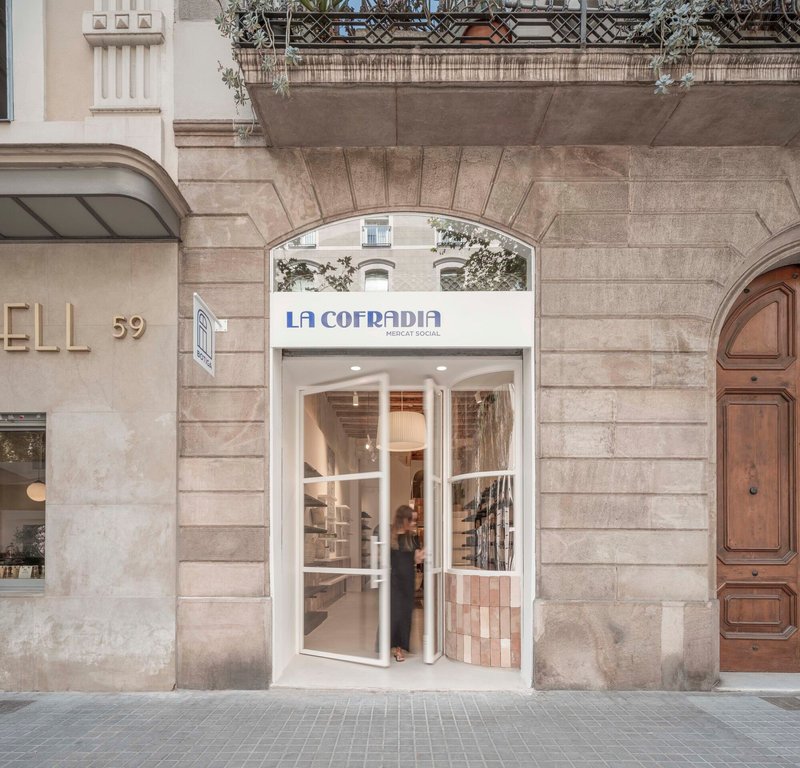
The facade is the first argument. Berd Studio did not invent an entrance; they worked with the existing arched stone bay that the Eixample building already provided. The rusticated base, the fanlight above the glazed doors, the proportions of the opening all belong to the original structure. What the studio added is restraint: white-framed glass panels that fold open entirely, dissolving the boundary between sidewalk and interior. When the doors are pulled back, the shop spills onto the street under the canopy of plane trees, and the threshold between commercial and public life becomes genuinely porous.
There is a smart decision here not to compete with the historic stonework. The signage is minimal, the framing is thin, and the gesture is one of subtraction rather than addition. The curved entry reads as an invitation, not a brand statement.
Preserving What Already Works
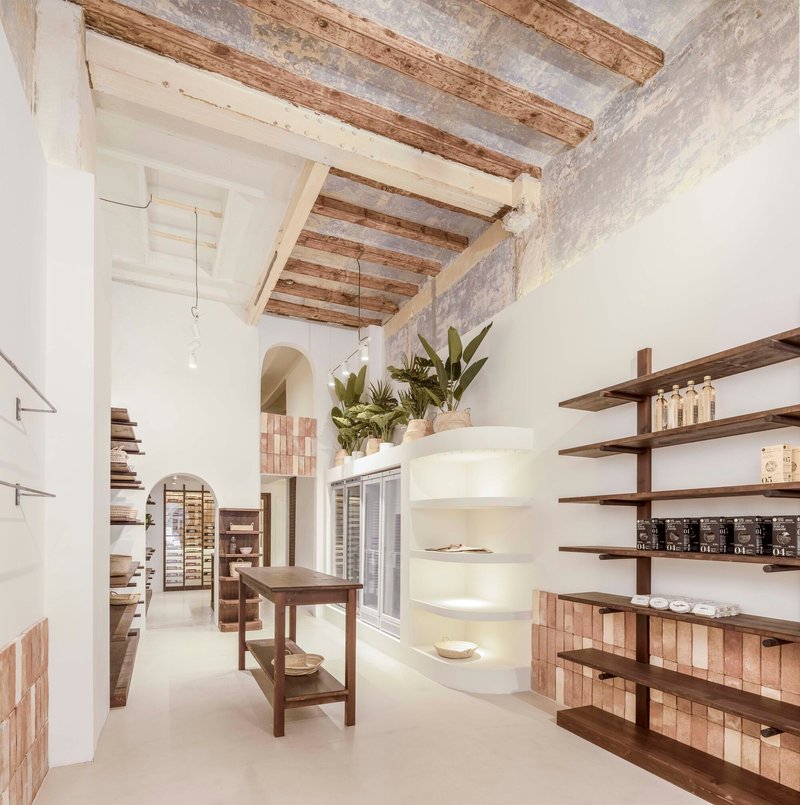
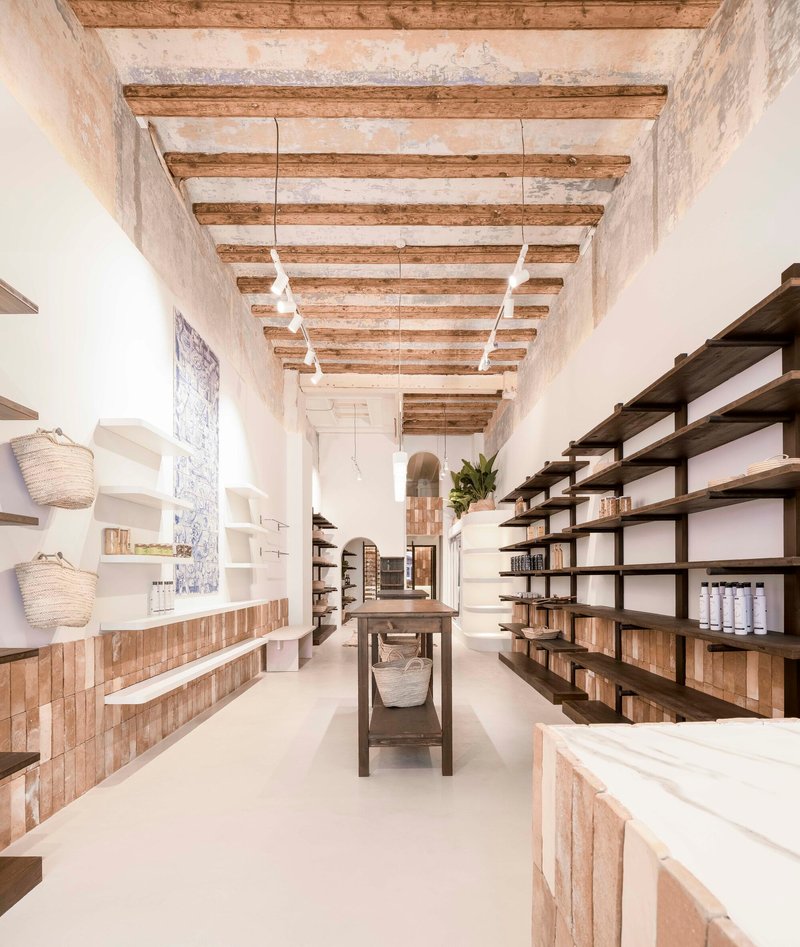
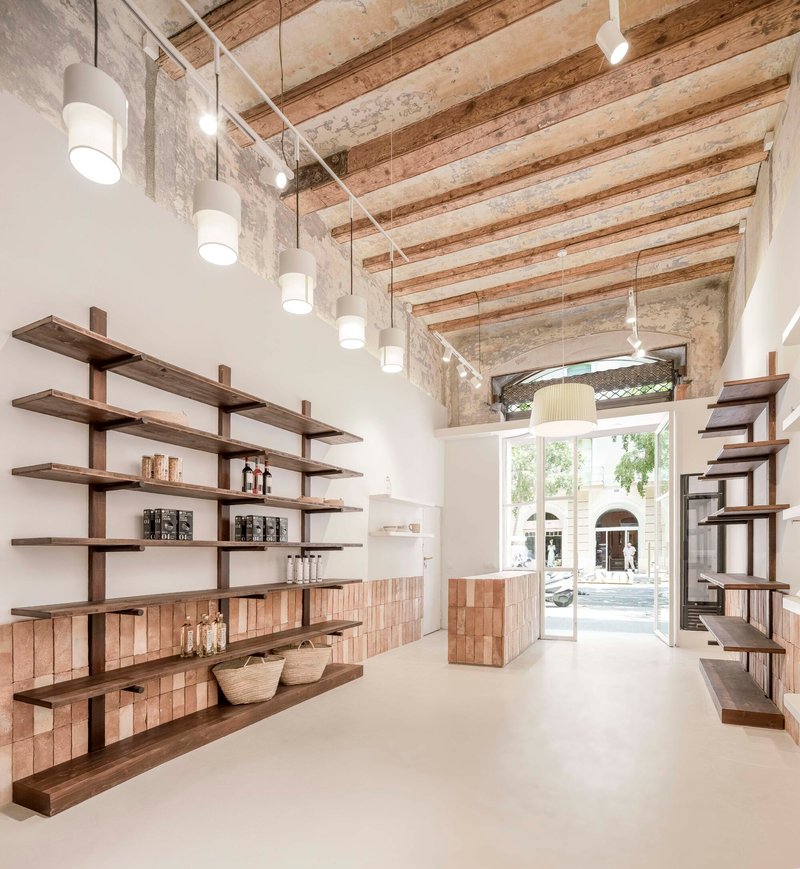
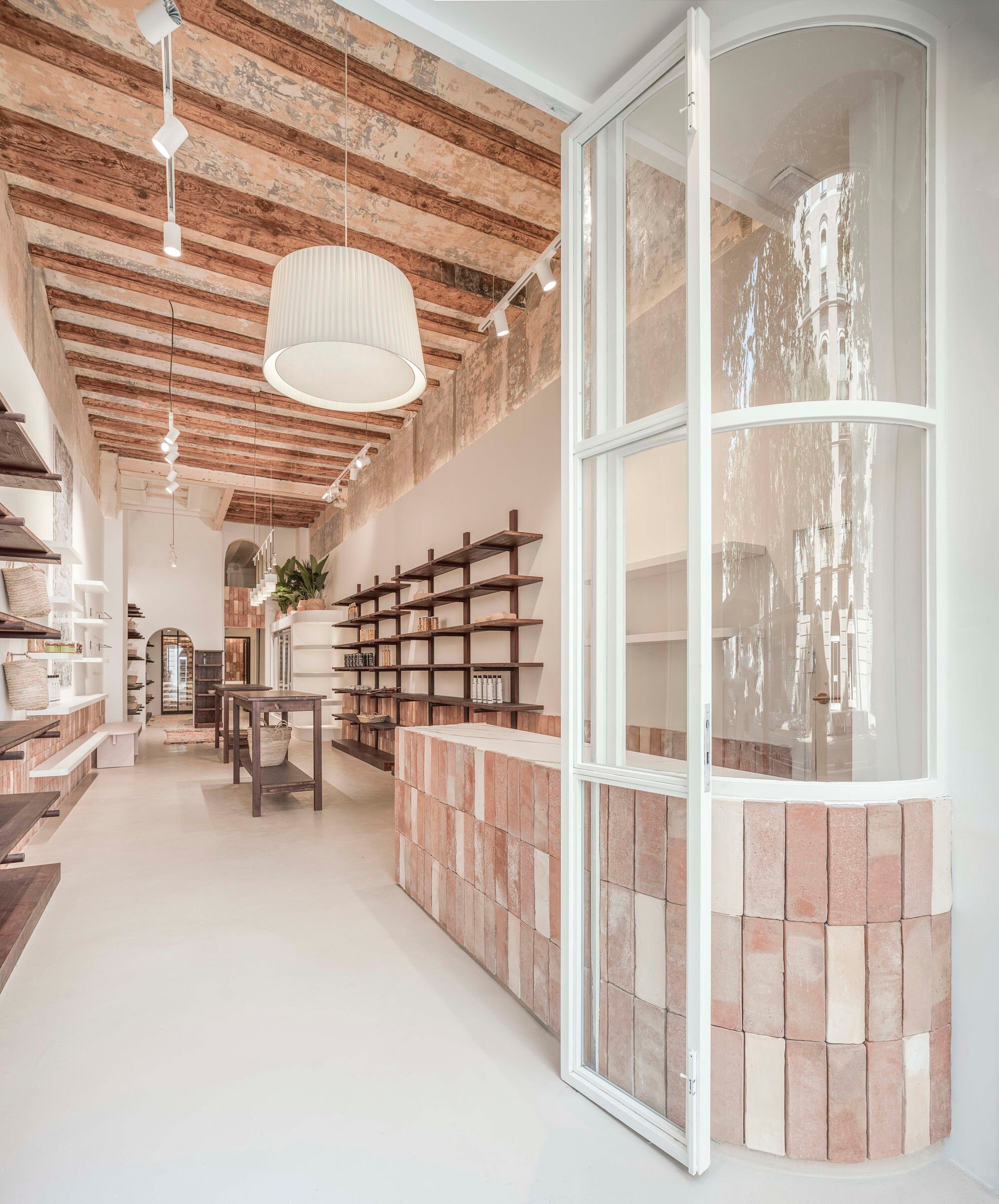
Walk inside and the first thing you register is the ceiling. The original wooden beams, exposed and cleaned but not over-restored, run the full length of the space. They establish a rhythm that the rest of the design follows. Whitewashed render walls, also original, provide a neutral backdrop against which the darker tones of new oak shelving and terracotta brick read clearly. The decision to preserve the existing structure and finishes is not merely nostalgic; it gives the space a material age that no amount of new construction could replicate.
The lighting deserves mention. Pendant fixtures hang at intervals from the joists, calibrated to illuminate products on the shelving without flattening the texture of the old plaster. The beams cast soft shadows across the ceiling plane, and the overall effect is warm without being dim. It is the kind of lighting strategy that works because it was designed around specific surfaces rather than applied generically.
A Curved Glass Wall Divides Without Closing
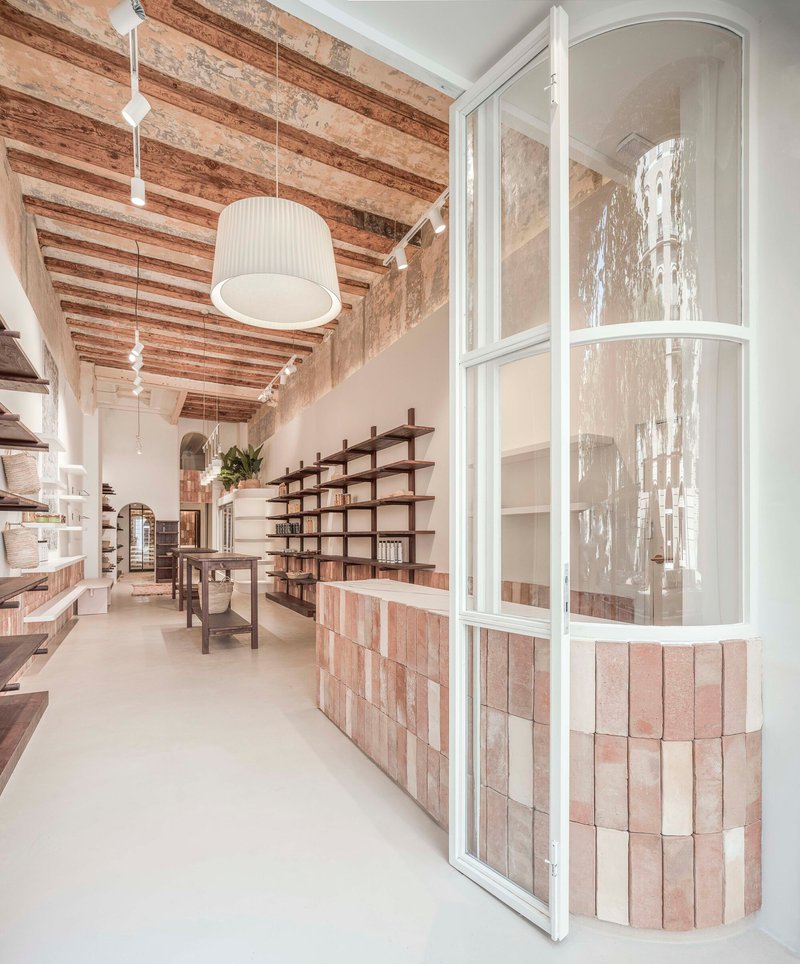
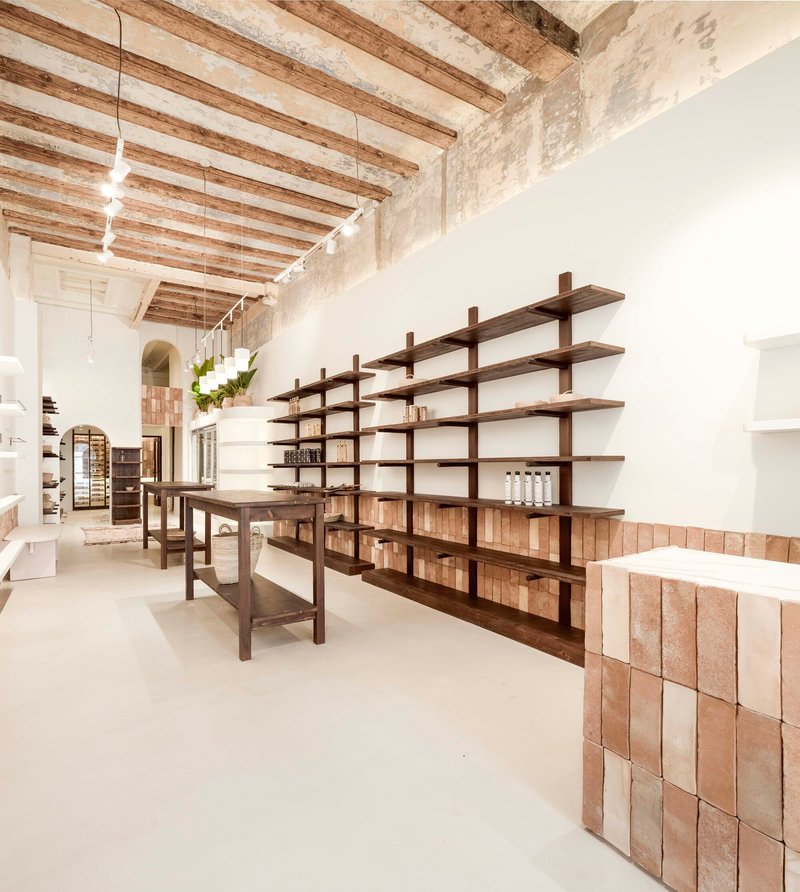
The most striking new element in the plan is a curved glass partition that runs along one side of the main corridor, its base clad in tile. It is simultaneously a space divider, a display backdrop, and a way-finding device. The curve softens the linearity of the narrow plan and creates a moment of compression that makes the spaces beyond feel more generous by contrast. On one side, the main retail area with its multipurpose tables; on the other, a more private exhibition zone accessed after passing through a pair of parallel arches.
The arches themselves are an interior echo of the street facade. They frame views deeper into the store and create a procession that rewards curiosity. You are never shown the entire space at once, which is a powerful trick in a room this small.
Mud Brick and Ceramic: The Artisan Layer
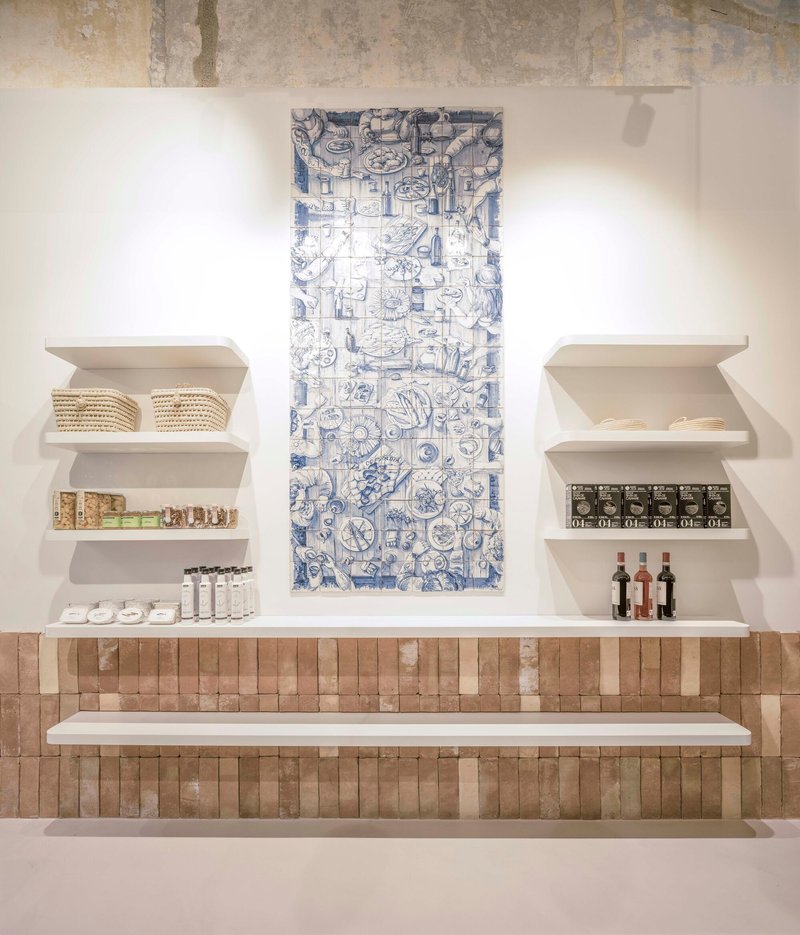
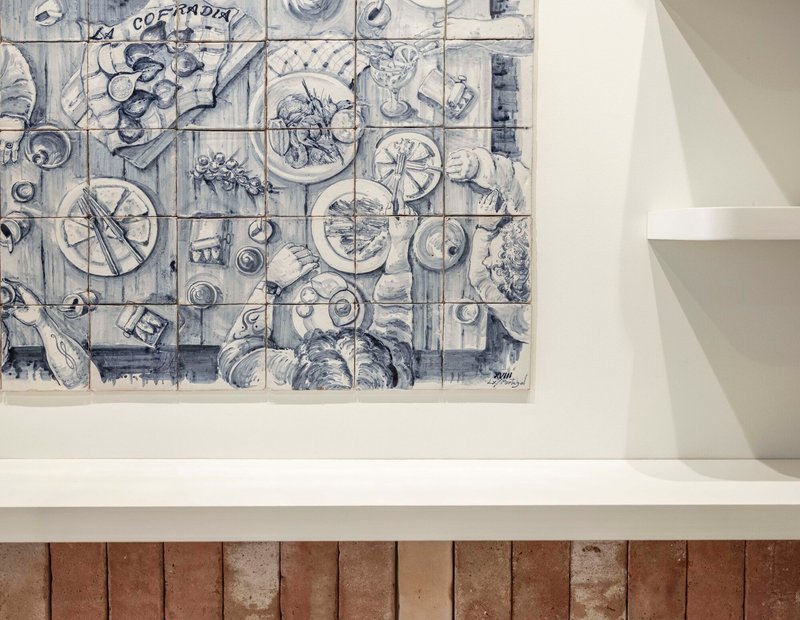
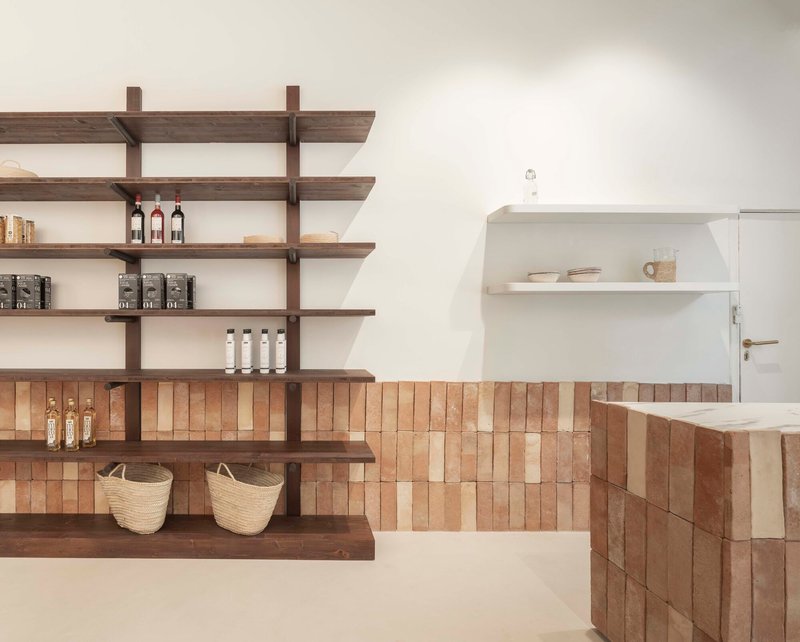
La Cofradia's material palette is deliberately limited, but what it lacks in range it makes up for in specificity. The mud bricks that form the base of several wall sections were made by TODO BARRO in Malaga, a deliberate choice to source from Andalusian craft traditions rather than from industrial suppliers. Above them, a handmade blue-and-white ceramic mural depicting plates and tableware acts as both decoration and narrative, tying the store's visual identity to the food and drink it sells.
The shelving throughout is oak, joined with visible care by Fusteria Creativa. Cork tile surfaces on counters add another natural texture. Woven baskets hang from walls. None of these choices are accidental, and none of them shout. The accumulation of handcrafted details creates a tactile density that invites handling, which is precisely the point in a store that wants you to touch, taste, and stay.
The Wine Cellar and Service Spaces
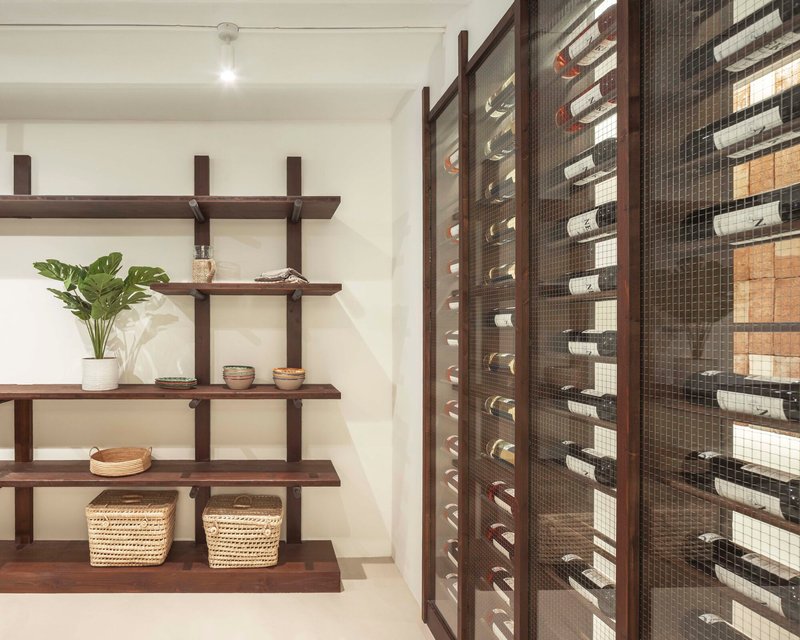
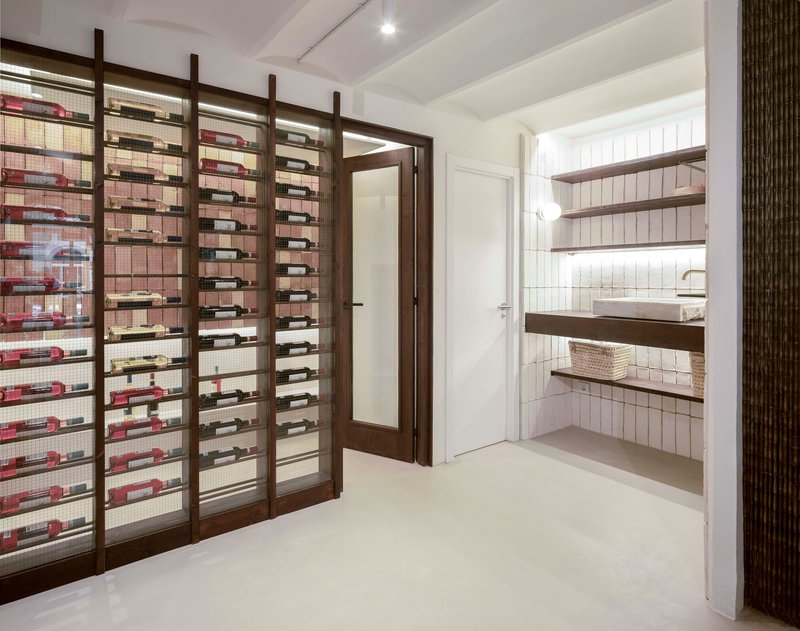
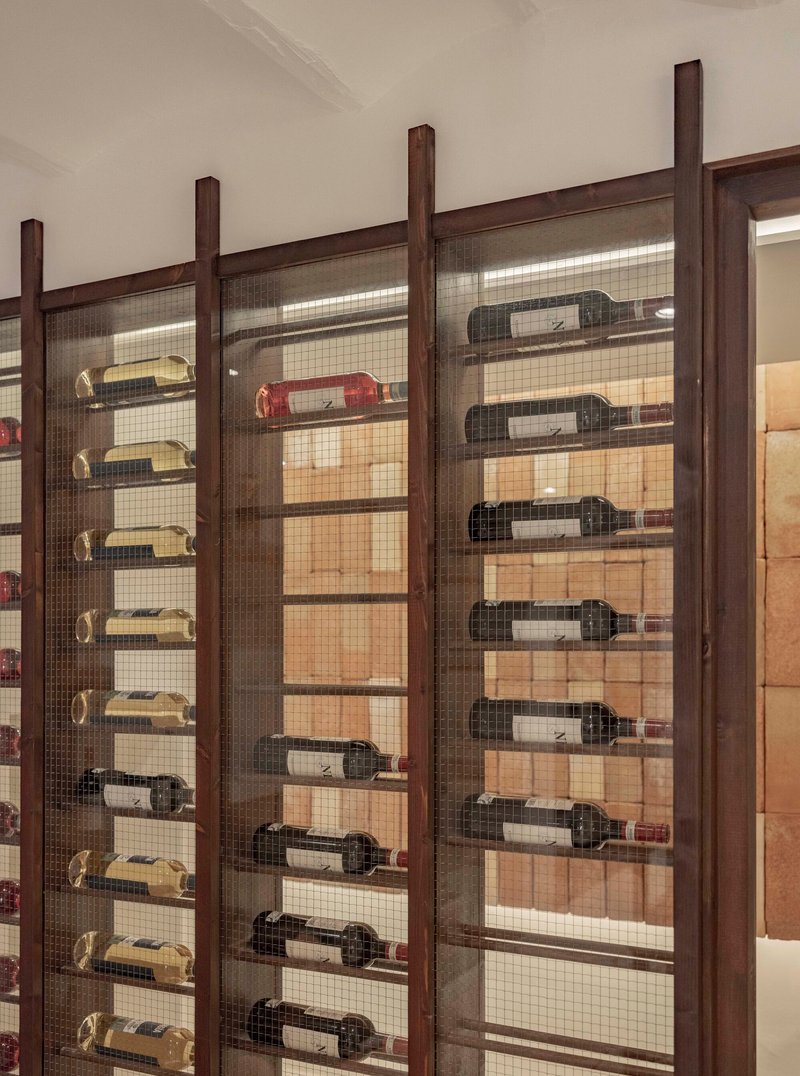
At the far end of the ground floor, past the arches and the exhibition zone, the plan terminates in a wine cellar. Berd Studio built a custom rack from dark timber and wire mesh, a structure that doubles as a room divider. Bottles are displayed horizontally on metal pegs, visible through the mesh from both sides. The effect is part storage, part scenography: wine as architecture.
The mesh screen also frames a doorway through to a compact washroom finished in vertical white tile with a floating timber vanity and stone basin. Even in these service spaces, the material logic holds. There is no point where the design relaxes into generic solutions.
Small Details, Consistent Logic
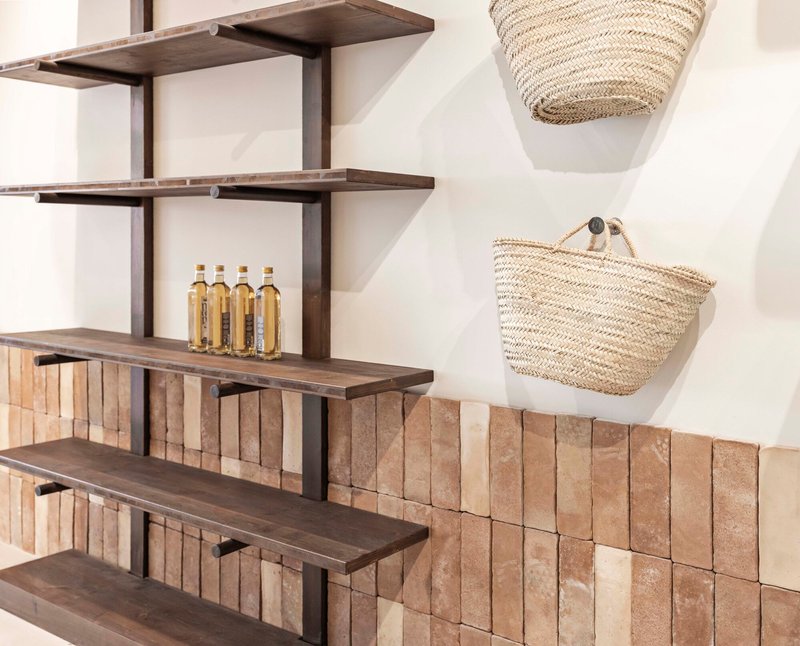
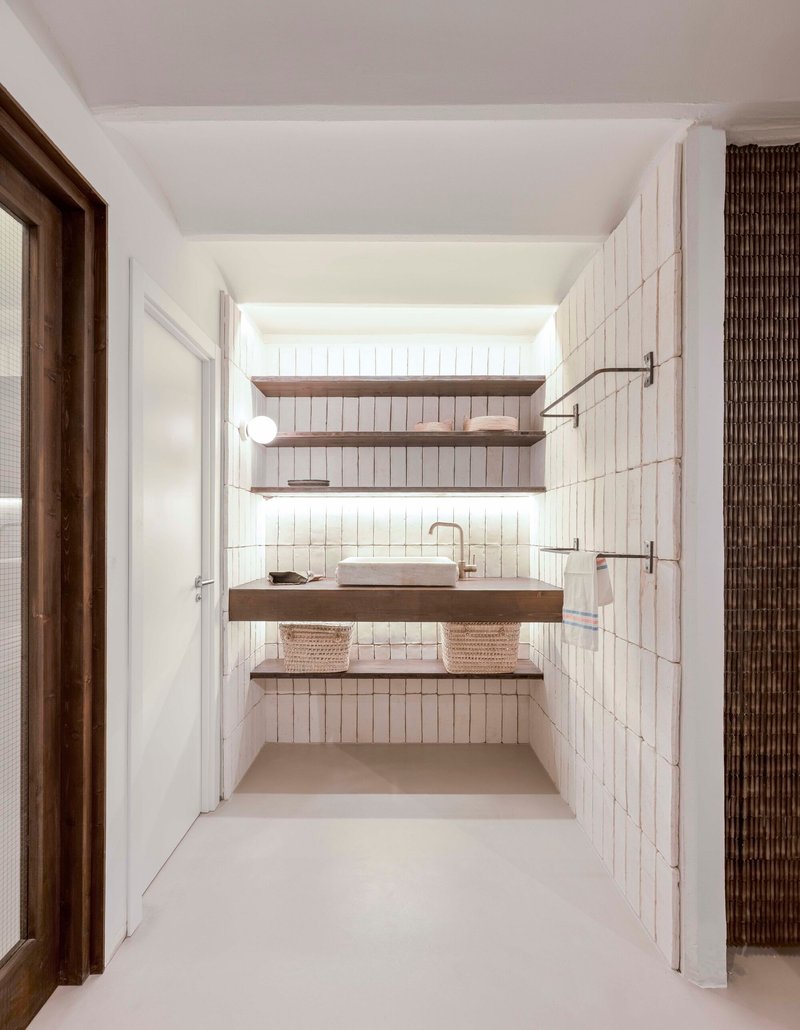
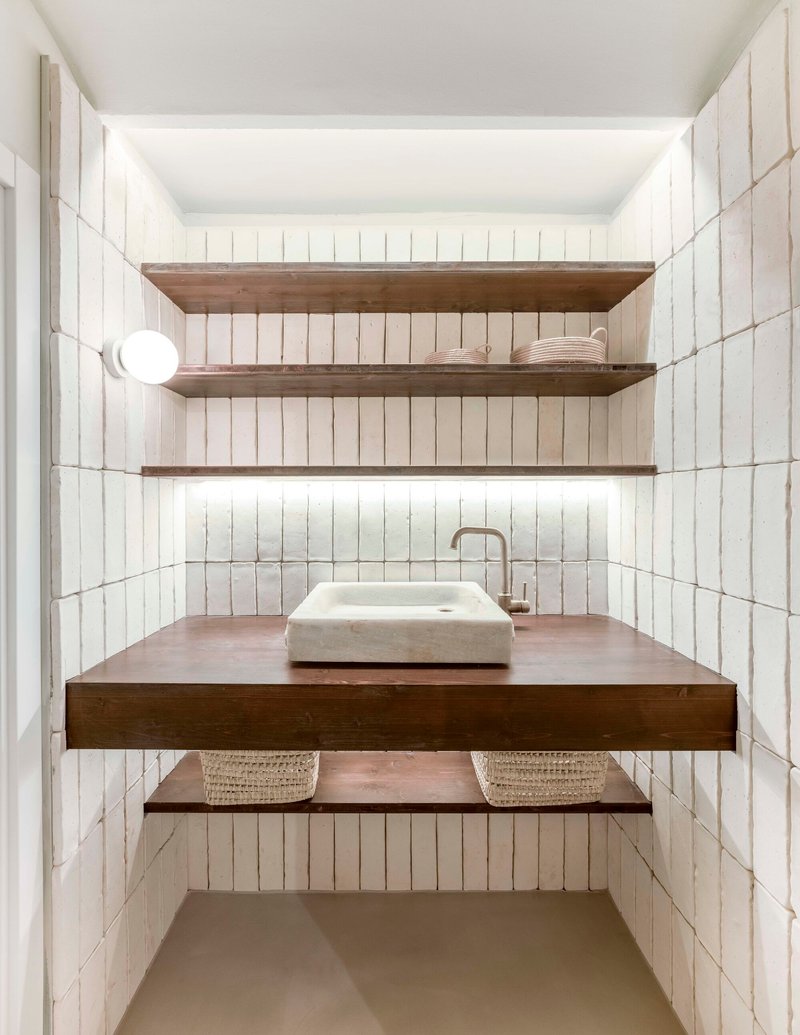
Consistency is the quiet achievement here. Dark timber shelves with vertical tile backsplashes in the retail area use the same material grammar as the bathroom vanity. Pendant lights and skylight apertures distribute natural and artificial light with equal intention. The vertical tile pattern in the washroom echoes the proportions of the oak shelving slats, a subtle but deliberate correspondence that ties secondary rooms back to the primary space.
The cleaning bench, woven basket displays, and potted plants scattered throughout are not styling; they are program. La Cofradia sells these things, and the design accommodates them as part of the architecture rather than as afterthoughts. The boundary between product and interior is deliberately blurred.
Plans and Drawings
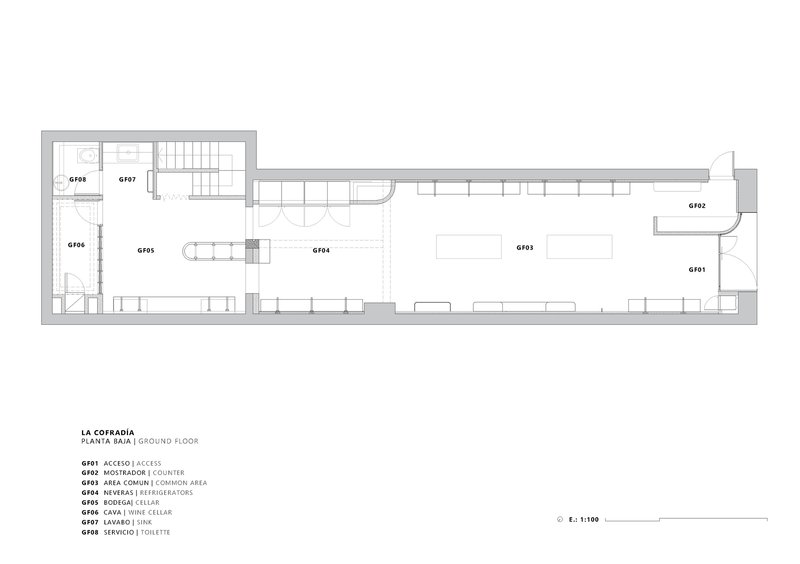
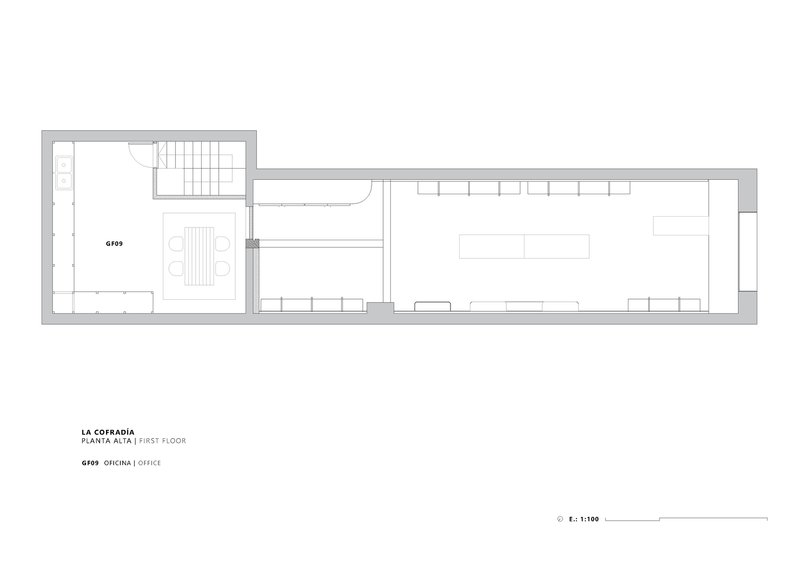
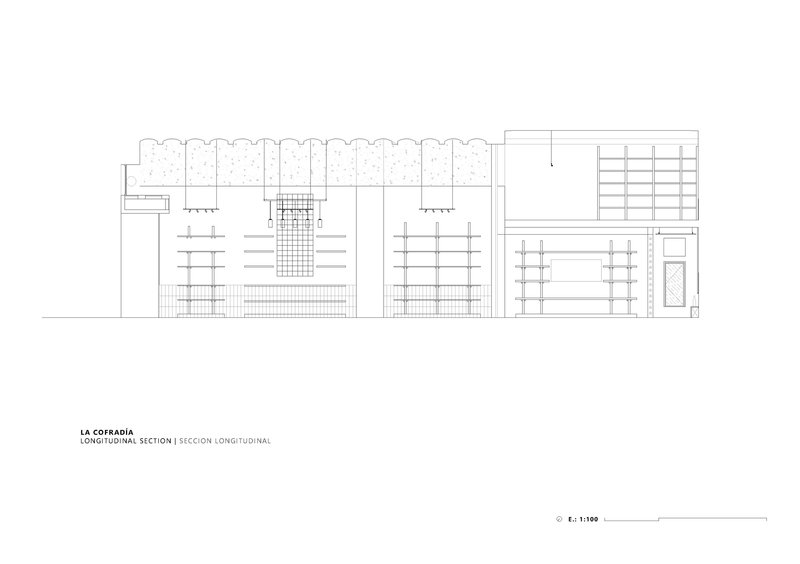
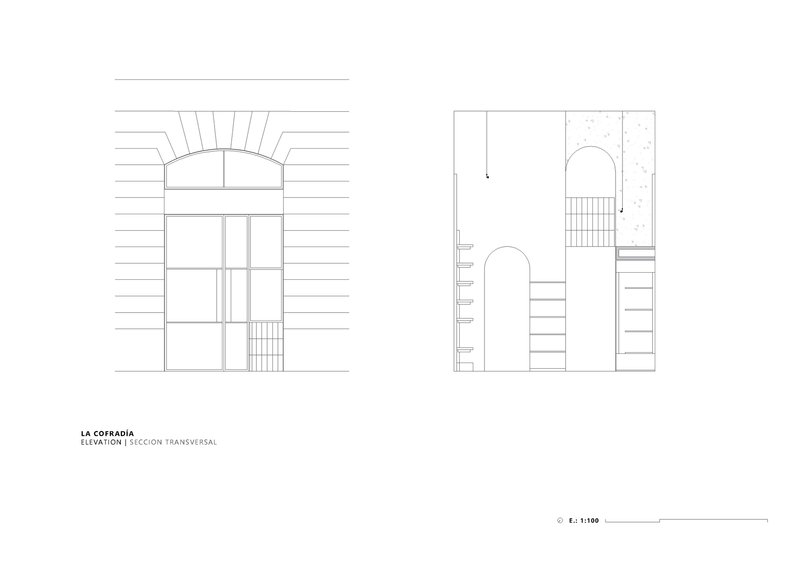
The ground floor plan confirms what the photographs suggest: the shop is a single room stretched to its limit, organized as a linear sequence from street to cellar. A staircase rises to a compact second floor containing an office with a conference table, a program that supports La Cofradia's communal ambitions beyond retail. The longitudinal section reveals the structural grid of existing beams and the careful modulation of ceiling heights along the depth of the space. Elevation and transverse section drawings show the arched storefront in precise detail, including the fanlight and the relationship between old stone and new glass.
Why This Project Matters
Retail design in historic European neighborhoods faces a persistent tension: how to assert a contemporary identity without erasing the building that hosts it. La Cofradia resolves this by refusing to choose. The existing structure, its beams, its plaster, its stone arches, is treated as the primary material of the project. New interventions are legible but deferential, crafted from natural materials sourced from named artisans. The result is a space that feels both old and new, which is exactly the condition of a good neighborhood shop.
More importantly, Berd Studio understood that the brief was not just about selling products. La Cofradia is a social market, and the architecture supports that through its open facade, its multipurpose tables, and its sequential spatial logic that encourages lingering. In a city where commercial ground floors are increasingly dominated by franchise interiors, this project is a small but persuasive argument for craft, locality, and architecture that knows when to step back.
Tienda La Cofradia by Berd Studio, led by Marcos Gonzalez Mazza. Located in the L'Eixample neighborhood, Barcelona, Spain. 120 m², completed in 2022. Photography by Aleson del Villar.
About the Studio
Share Your Own Work on uni.xyz
If projects like this are the kind of work you want to make, uni.xyz is a place to publish your own, find collaborators, and enter design competitions.




Popular Articles
Popular articles from the community

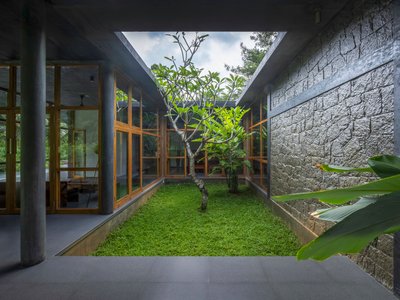
3dor Concepts Wraps a Kerala Home in Mirrored Concrete Arcs Around a Courtyard Tree
In the Western Ghats foothills of Thamarassery, a 270 m² single-story house uses two curved volumes to frame nature as its center.
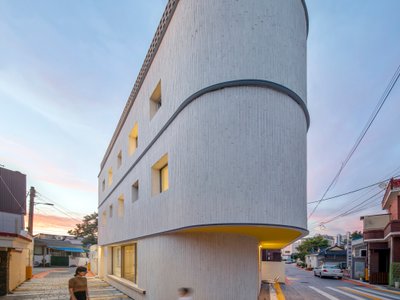
YOAP Architects Round a Corner in Yeongcheon with a Cylindrical Community Hub
A 197-square-meter brick and ribbed-clad tower turns a forgotten alley corner in South Korea into a public garden with a low threshold.
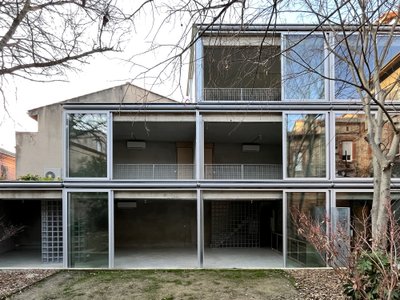
BAST Slots a Four-Story Glass House into a Narrow Gap Between Toulouse Townhouses
In the dense Bonnefoy district, a stepped infill building merges home and office while preserving a majestic hackberry tree.
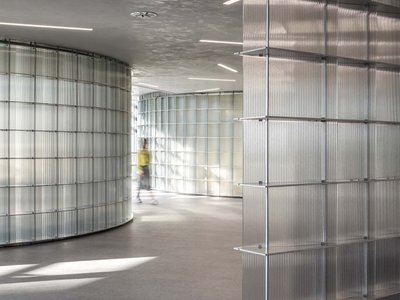
HCCH Studio Wraps a Shanghai High-Rise Office in Curved Walls of Translucent Glass
A 1,000 square meter fit-out in Lujiazui replaces the typical tech-office palette with layered glass, micro-cement, and quiet rigor.


Similar Reads
You might also enjoy these articles

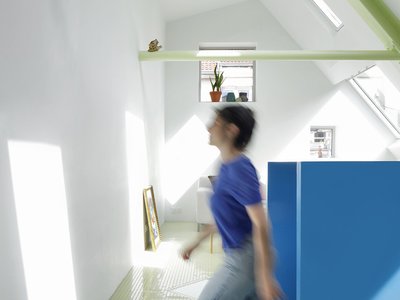
127af Flips a Tiny Bagnolet Rowhouse Upside Down with a Handcrafted Roof Extension
A 55-square-meter terraced house on the edge of Paris gains a luminous upper living floor through lightweight timber and steel.
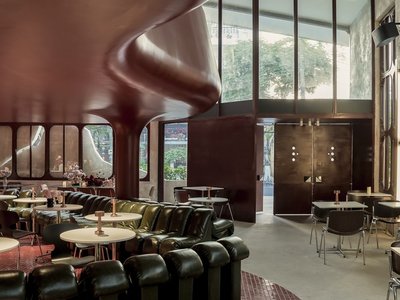
1.61 Design Workshop Wraps a 600-Square-Meter Café in Vietnam in Sculptural Burgundy Drama
Reden Café & Bistro pairs a helical staircase, mosaic floors, and deep red interiors to rethink Vietnamese hospitality space.

The Unbound Brain: A School Shaped by Cognitive Architecture
Cylindrical learning pods radiate like neurons from a central cortex, turning the floor plan into a spatial model of human thought.
Revival Vernacular Architecture: Rammed Earth Settlements for the Sahara
A modular desert community in Mauritania that fuses passive cooling techniques with earthen construction and local craftsmanship.


Explore Commercial Buildings Competitions
Discover active competitions in this discipline




The Global Benchmark for Architecture Dissertation Awards


Challenge to design luxury tourism on rails


VR headsets Storefront design competition

Designing a staircase for a client
Comments (0)
Please login or sign up to add comments
No comments yet. Be the first to comment!