

Beyond Bars: Rethinking Incarceration Through Landscape and Rehabilitation
A Dutch correctional facility replaces fortress walls with moats, rooftop gardens, and a three-step spatial protocol for reintegration.


What if a prison's most effective security measure was a garden? "Beyond Bars" makes that provocation tangible, proposing a correctional facility in the rural Netherlands where a 10-meter-wide water-filled moat replaces razor wire and L-shaped housing blocks dissolve into planted rooftops and sunken gardens. The project reframes incarceration not as containment but as a structured ecological and social contract between inmates and the landscape they inhabit.
Designed by Urva Parmar and Saagarika Dias, this shortlisted entry in the Switching Prisons competition organizes 500 inmates into ten groups across modular building volumes, each tied to a specific tier of rehabilitation activity. Jurors praised the scheme's insight and spatial ambition, with Adrian Iredale of Iredale Pedersen Hook Architects calling it "a strong project" and Michael Spight of TAG Architects noting the scheme "shows insight" while encouraging further loosening of the rigid planning.
Terracotta Volumes That Read as Neighborhood, Not Institution

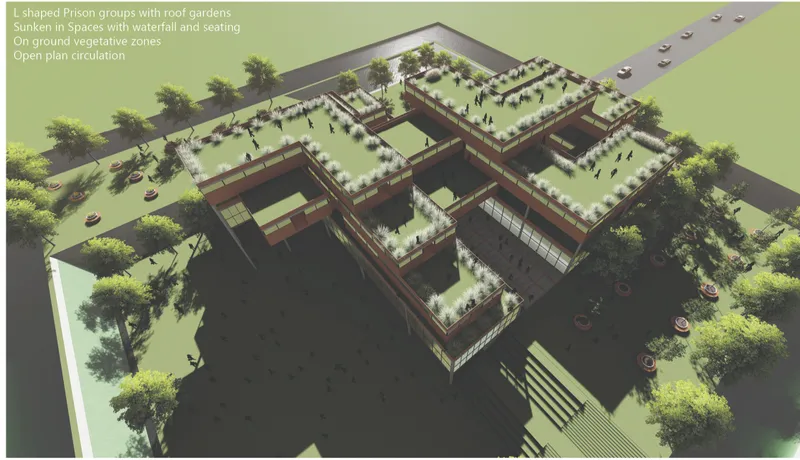
From street level, the facility's tiered terracotta-paneled facade could pass for a mixed-use residential block. Pedestrians walk past without the visual cues of traditional carceral architecture: no watchtowers, no imposing concrete walls. The material palette of locally sourced Dutch brick and reinforced concrete grounds the building in its regional context while providing thermal mass for passive climate control. The aerial view reveals the true organizational logic: L-shaped courtyard buildings float above the green ground plane, their rooftop gardens visible as productive agricultural surfaces rather than decorative afterthoughts.
The decision to use terracotta cladding is deliberate. It ages gracefully in the Dutch climate, weathers to match the surrounding rural palette, and sidesteps the institutional sterility of exposed concrete or metal panel systems. Cost control and thermal efficiency are addressed simultaneously, with the green roofs reducing HVAC dependency and creating microclimates suited to the rehabilitation program's agricultural activities.
Stacked Terraces as a Scaffold for Social Life
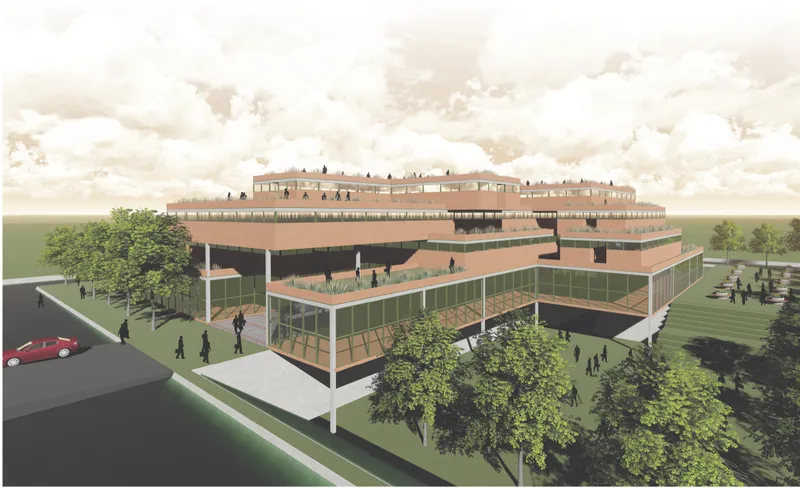

The corner perspective reveals how the stacked volumes create rooftop terraces populated by figures, each level offering outdoor space that is simultaneously visible and contained. These terraces are not balconies for contemplation; they are workspaces tied to the project's three-step rehabilitation protocol. Lower-tier inmate groups engage in tech education or ethical hacking programs, while higher-tier groups collaborate on agriculture, analog repair, or a bug bounty initiative. The architecture literally layers these activities vertically, making social reintegration legible in section.
At ground level, the courtyard space shown beneath the glazed facade operates as a collective gathering zone. Transparent boundaries replace opaque walls, rejecting isolation in favor of what the designers describe as "dialogue and collective healing." Sunken amphitheaters and open-plan communal areas support weekly therapy sessions, mediation programs, and workshops. The glazing floods these spaces with daylight while maintaining visual connection between interior and exterior zones, reinforcing the project's insistence that rehabilitation requires openness, not enclosure.
The Moat as Both Boundary and Ecosystem

The view across the lawn toward the glazed entrance pavilion captures the project's central tension: how do you secure a facility while making it feel permeable? The answer lies in the 10-meter-wide water-filled moat that encircles the site. It functions as a passive security perimeter, eliminating the need for aggressive fencing, while simultaneously contributing to the site's ecological system. Dappled tree shadows on the approach path reinforce the sensation of entering a park rather than a penal institution. The moat merges defense with serenity, a detail that is as pragmatic as it is poetic.
Cultivating Responsibility at Ground Level

The ground-level garden terrace, with its curved planters and figures moving beneath glazed upper floors, illustrates the "cultivating" phase of the rehabilitation protocol. Each inmate group is assigned a rooftop garden as part of their daily routine, and the lower-level planting zones extend this engagement to the ground plane. Waterfall-fed sunken gardens and vegetative courtyards create a continuous green infrastructure that serves double duty: ecological performance and therapeutic engagement. The designers frame gardening not as recreation but as a structured exercise in responsibility and stewardship.
The modular structure is designed with a long-term exit strategy. As crime rates decrease, the building's standardized L-shaped volumes can be adapted into an urban farm or educational campus, a pragmatic acknowledgment that the best prison is one that eventually makes itself unnecessary. The green roofs, open-air zones, and agricultural programs are already halfway to a post-correctional use case, requiring minimal intervention to pivot from rehabilitation facility to community resource.
Why This Project Matters
"Beyond Bars" succeeds because it refuses the false binary between security and humanity. The moat secures without intimidating. The terracotta ages without degrading. The gardens rehabilitate without sentimentality. Every architectural decision carries both a practical justification and a philosophical stance about what incarceration could become when it prioritizes spatial healing over spatial punishment. The three-step protocol of cultivating, collaborating, and conditioning is not grafted onto the architecture; it generates it.
Parmar and Dias have produced a scheme that takes the competition brief seriously without surrendering to utopian abstraction. The jurors' feedback points to real opportunities for development, particularly in loosening the rigid planning to allow for more informal, less programmed spaces. But the core proposition is sound and significant: that a prison rooted in its landscape, designed for adaptive reuse, and organized around productive social activity is not idealism but a viable model for a more intelligent correctional architecture.
View the Full Project
About the Designers
Designers: Urva Parmar, Saagarika Dias
Enter a Design Competition on uni.xyz
uni.xyz runs architecture and design competitions year-round that reward proposals with spatial conviction and real site intelligence.
Project credits: Beyond Bars by Urva Parmar, Saagarika Dias Switching Prisons (uni.xyz).


Popular Articles
Popular articles from the community


FCC Arquitectura Expands a Portuguese Granite House with a Board-Marked Concrete Wing
In Portugal, JV House pairs a cleaned-up whitewashed and granite dwelling with a timber-shuttered concrete extension, courtyards and a garden pool.

ETEH Reworks the Shared Spaces of São Domingos School in Brazil Around Timber, Color and Hanging Plants
At São Domingos School in Brazil, 436 m² of hall, refectory and library are recast with timber joinery, a yellow and blue code and trailing greenery.

Cube Design Draws an Ecological Corridor Between Two Shenzhen Hills with the Nankai Building
Beside Shenzhen's container docks, the Nankai Building pairs stacked balconies with a climbing green screen to connect two hillsides across its height.

graciastudio Turns a Viewless Tijuana Lot Inward Around a Courtyard of Concrete, Timber and Trees
In Tijuana, Jorge Gracia's GA2 House stacks a timber-clad private floor over exposed concrete and replaces a missing view with a planted interior patio.

Similar Reads
You might also enjoy these articles


Vereda Arquitetos Renovates a 40-Square-Meter Apartment Inside Niemeyer's Copan Building
A compact unit in São Paulo's most iconic residential tower gets a material overhaul that pairs exposed concrete with bold blue Formica.

Shakur's House: Exposed Brick as an Interior Organiser in a 168 m² Mashhad Residence
Brick moves indoors in this Mashhad residence, where masonry walls, glass partitions and teal planes sequence a compact home without closing it off.

Day and Night Park: A Time-Based Urban Newsstand in Beijing
A temporary urban newsstand in Beijing blending travel, light, and reading through poetic colors, compact form, and community-focused design.

Modernist Patio Renovation in El Masnou, Barcelona by Oliver Segura Arquitectura + Cebrià Arquitectura
Modernist patio renovation blending tradition and innovation with a movable pool, leveled floors, and Catalan materials in El Masnou.


Comments (0)
Please login or sign up to add comments
No comments yet. Be the first to comment!