
BHA Studio Sculpts Light and Air into a Single-Shell Concrete House in Central Vietnam
A 7-by-17-meter concrete volume in Hue's expanding suburbs channels skylight, greenery, and cross-ventilation through staggered levels.


Hue sits in one of Vietnam's most climatically punishing corridors: scorching summers, monsoon rains, and humidity that rarely lets up. Ten kilometers south of the city center, the town of Phu Bai is swelling with new construction as arable land gives way to narrow residential lots. The 7x17 House by BHA studio, designed by lead architect Nguyen Xuan Minh, takes a plot defined entirely by its constraints, seven meters wide and seventeen meters deep, and treats the resulting tube shape not as a liability but as an instrument for directing light and air through the entire section.
What makes the house genuinely interesting is its single-shell concrete structure. Rather than stacking independent floor plates inside a conventional envelope, BHA wraps every room, void, and mezzanine in one continuous concrete skin that rises eleven meters. The result is a building whose interior reads as a carved-out monolith, with staggered half-levels, open atriums, and linear skylights that turn the roof into a calibrated light filter. It is a house that refuses to behave like the typical tube dwelling, even though it occupies exactly that footprint.
A Facade of Controlled Porosity
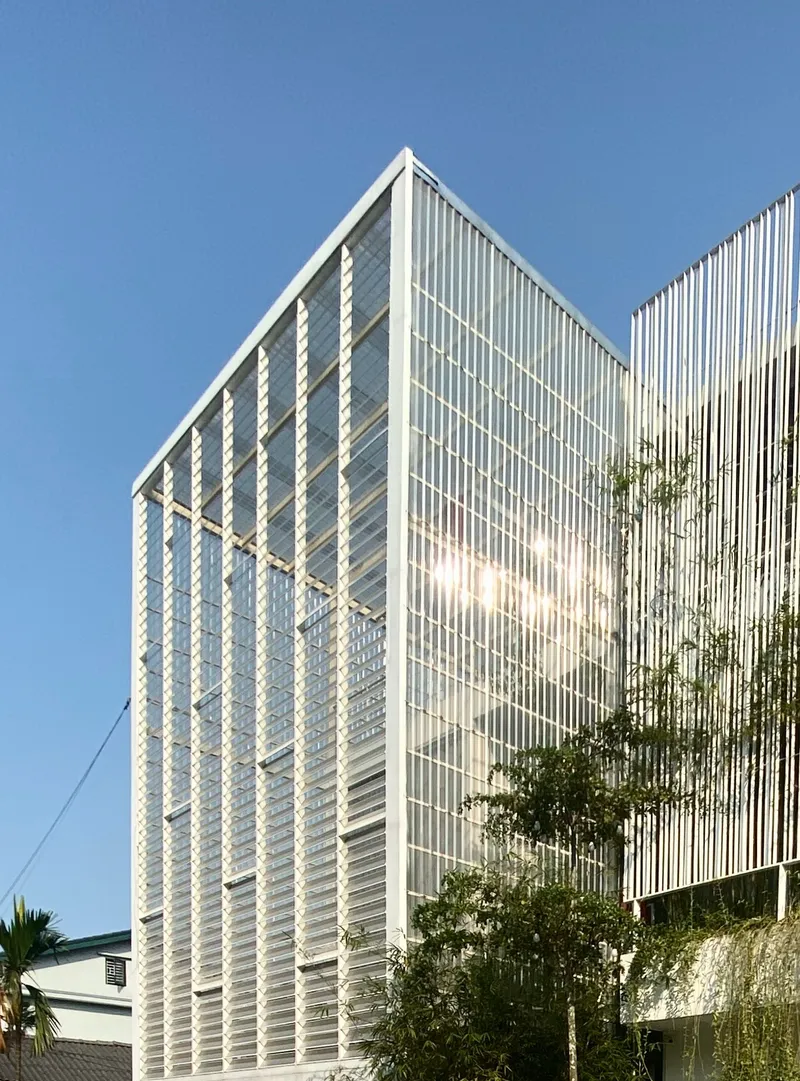
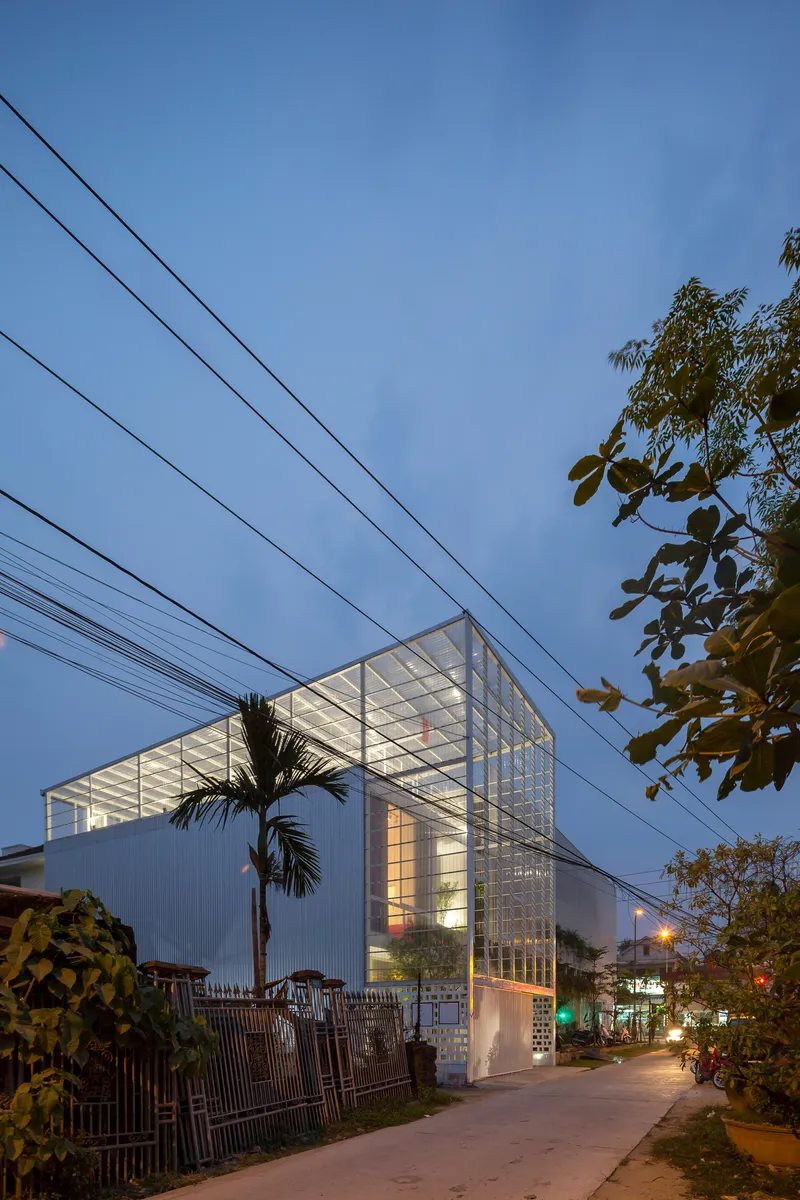
From the street, the house presents a layered screen of white vertical louvers below a horizontal brise-soleil, with a glass-enclosed upper volume cantilevering above. The louvers do not simply decorate; they graduate the privacy gradient from public sidewalk to private interior while still admitting breeze. Bamboo plantings flanking the facade soften the boundary further, creating a transitional green buffer between the lot line and the living spaces behind.
At dusk the upper glazed volume glows, making legible the split between the solid, shaded lower register and the transparent inhabited zone above. The composition is modest in palette, all white metal and concrete, but the proportional discipline of the louver spacing gives the elevation a visual rhythm that holds up at close range and from across the street.
Skylight as Architecture
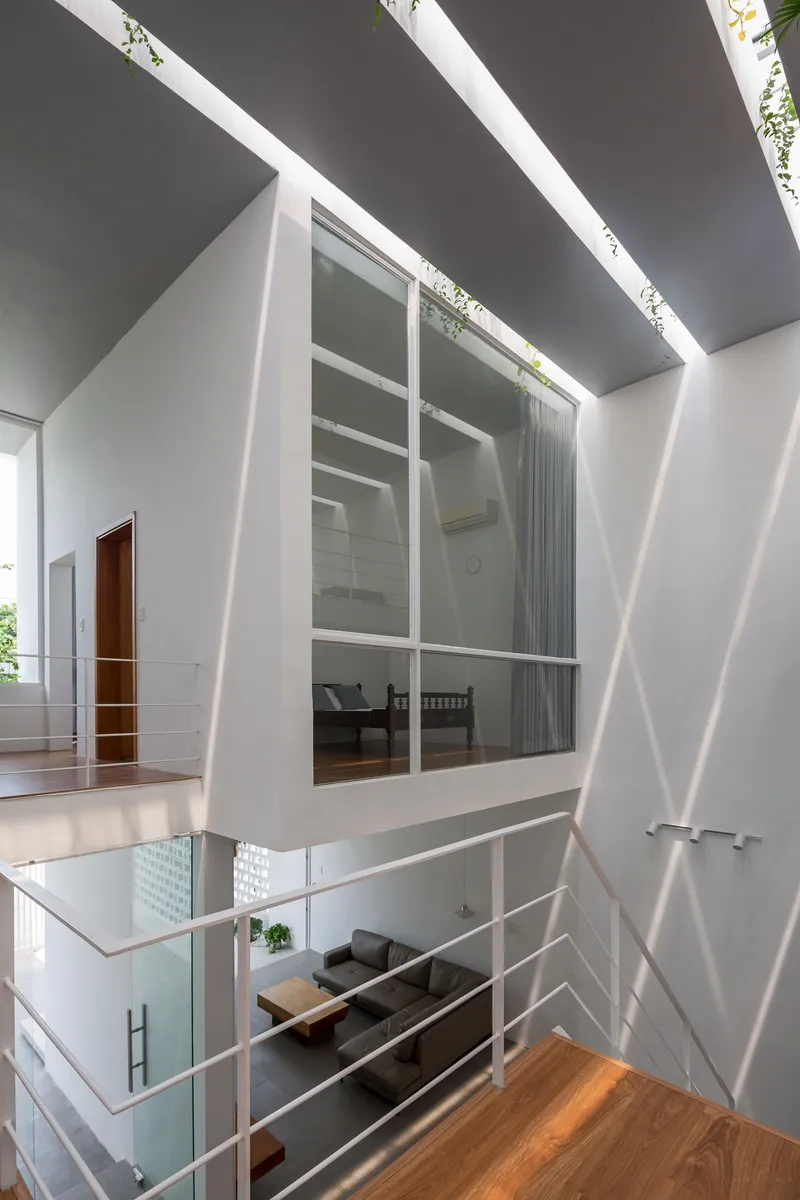
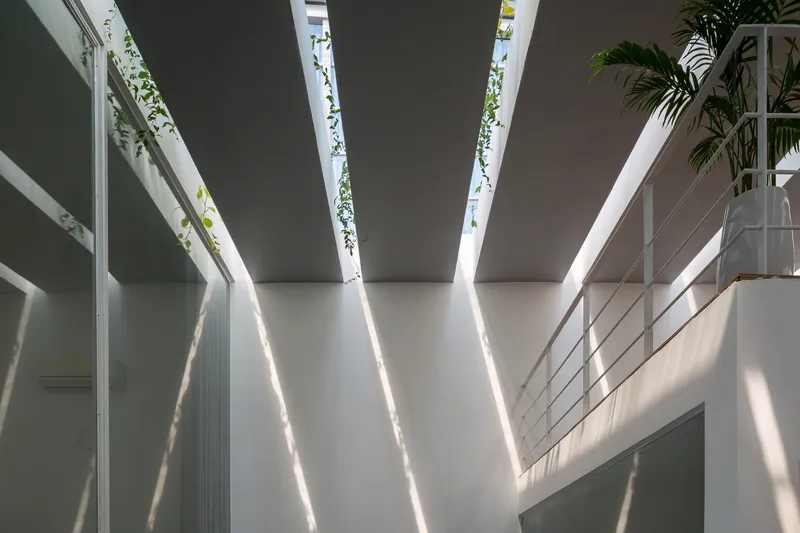
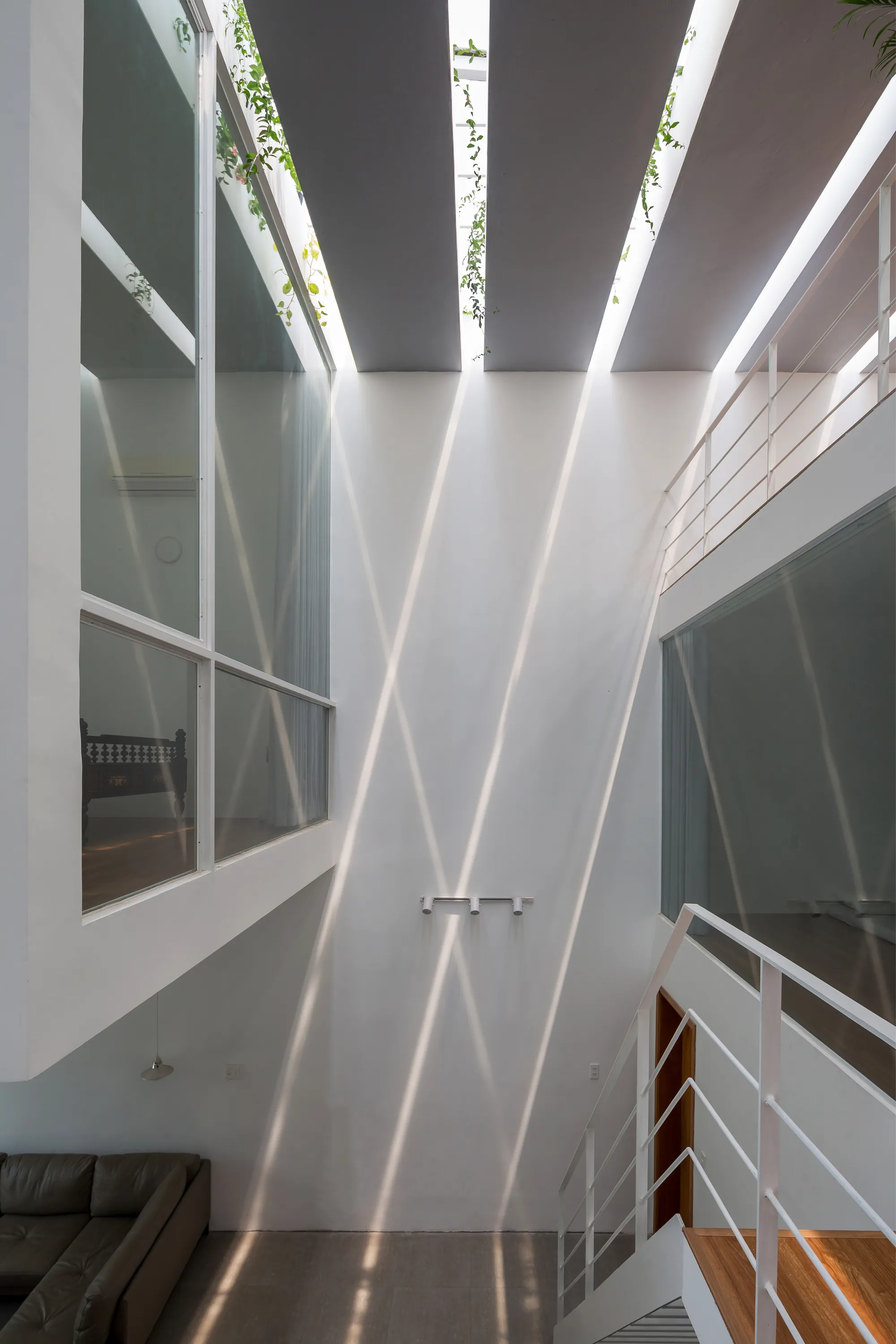
The most striking spatial move in the house is the series of recessed linear skylights cut into the roof slab. These openings run perpendicular to the long axis of the plan, casting parallel bands of light that migrate across the white walls as the sun tracks overhead. The effect is almost sundial-like: the interior condition changes hour by hour, and you can read the time of day in the angle of the shadow stripes.
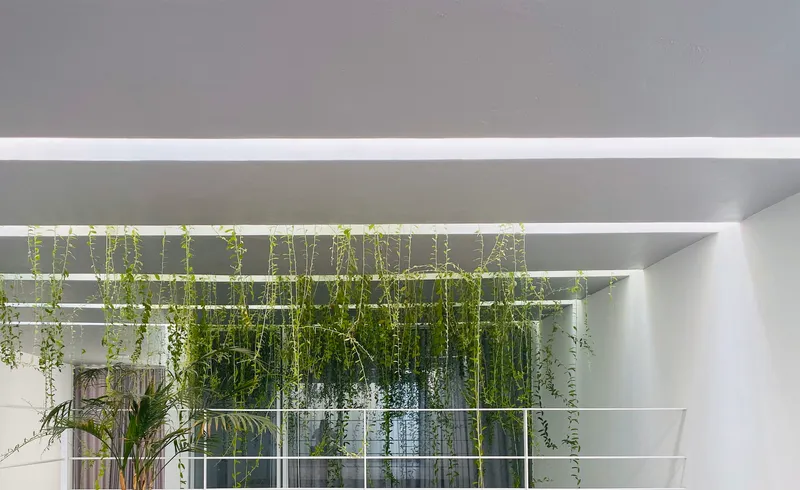
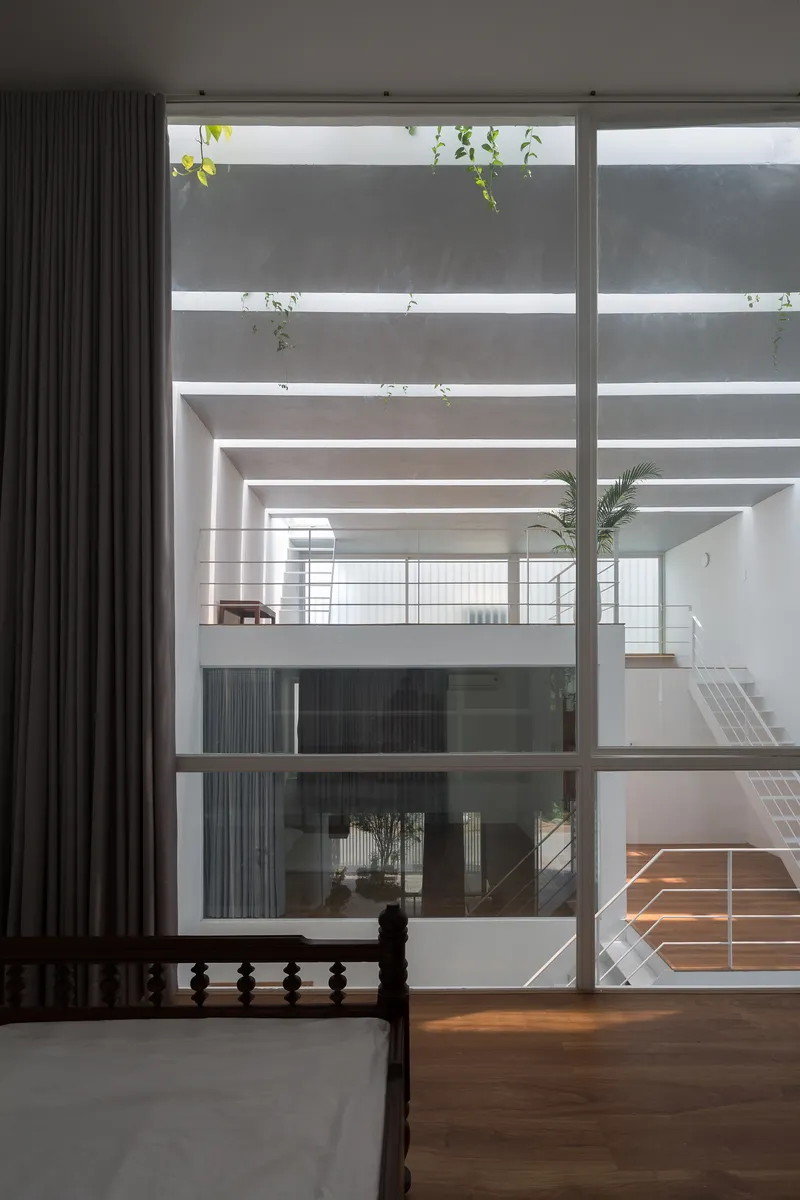
From the upper-level bridge that crosses the central void, you look down through a vertical section illuminated by these diagonal light beams. Trailing vines descend through the skylight openings, blurring the line between structure and planting. It is a simple detail, a concrete beam with a gap alongside it, but it does an enormous amount of atmospheric work, turning what could be a dark, deep plan into something luminous and breathing.
Staggered Levels and the Open Section
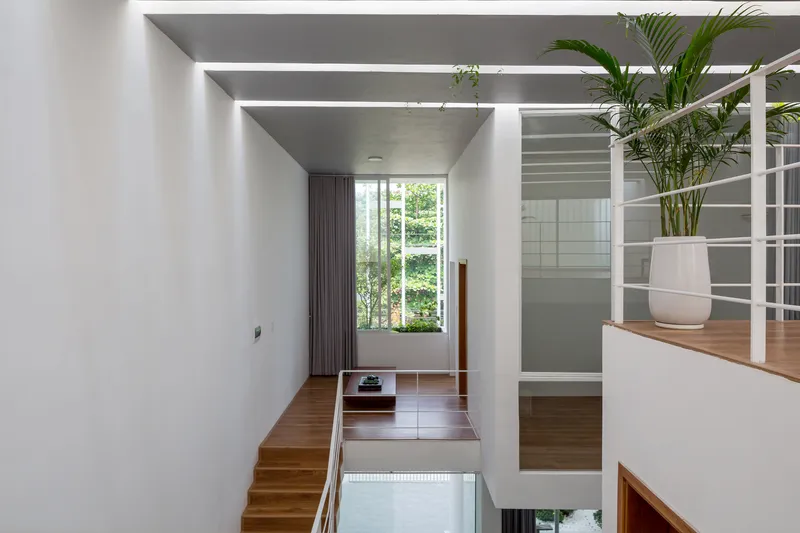
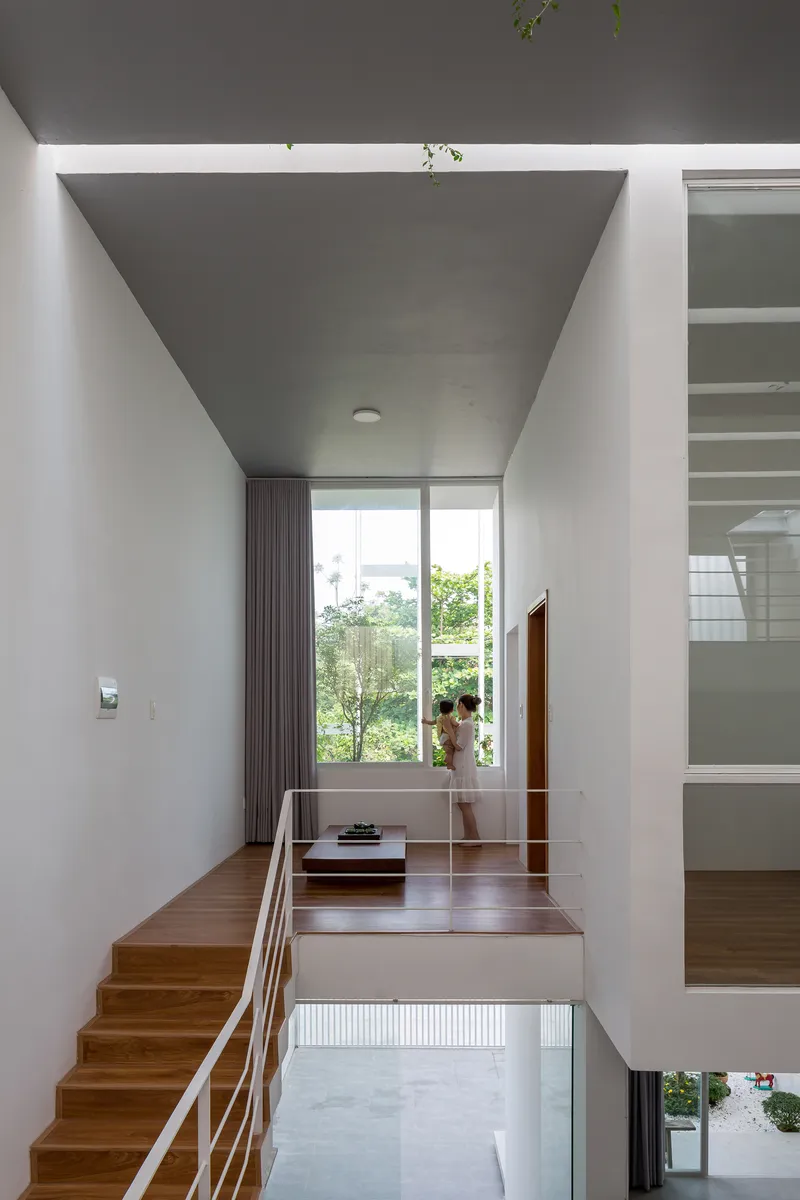
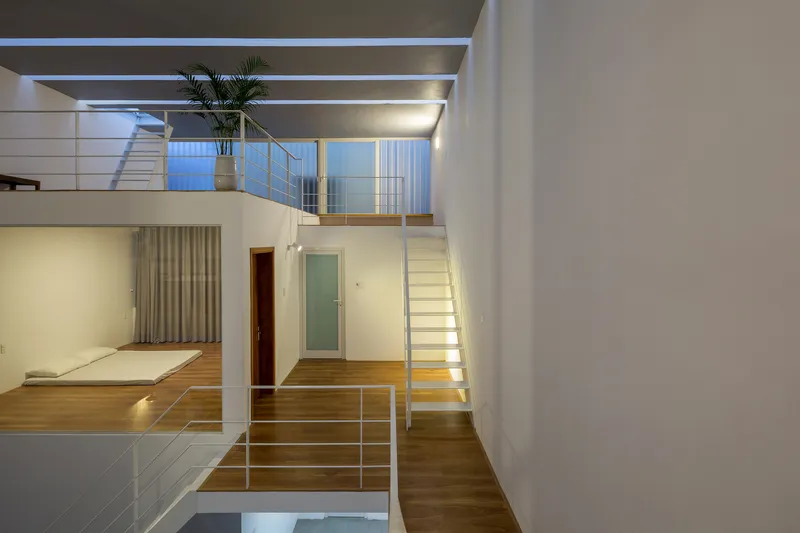
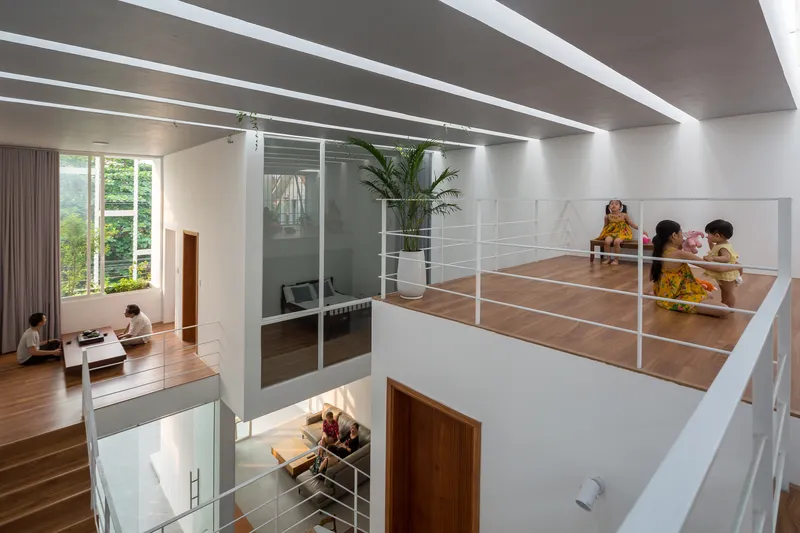
Rather than stacking full-width floor plates, BHA splits the section into half-levels connected by timber staircases with slim metal railings. Bedrooms sit a half-story above living areas; study spaces hover at intermediate landings. The staggering opens up continuous vertical sightlines through the house, so you are never enclosed in a single-height box. Even from a private room, you can glimpse the courtyard, the atrium, or the skylit ceiling above.
The split-level strategy also multiplies usable floor area within a tight 120 square meter footprint. Where a conventional two-story house would give you two horizons, this one gives you four or five, each with its own character of light and enclosure. The timber stair treads and warm wood flooring tie the levels together materially, preventing the white concrete shell from feeling clinical.
Courtyards and Interior Landscape
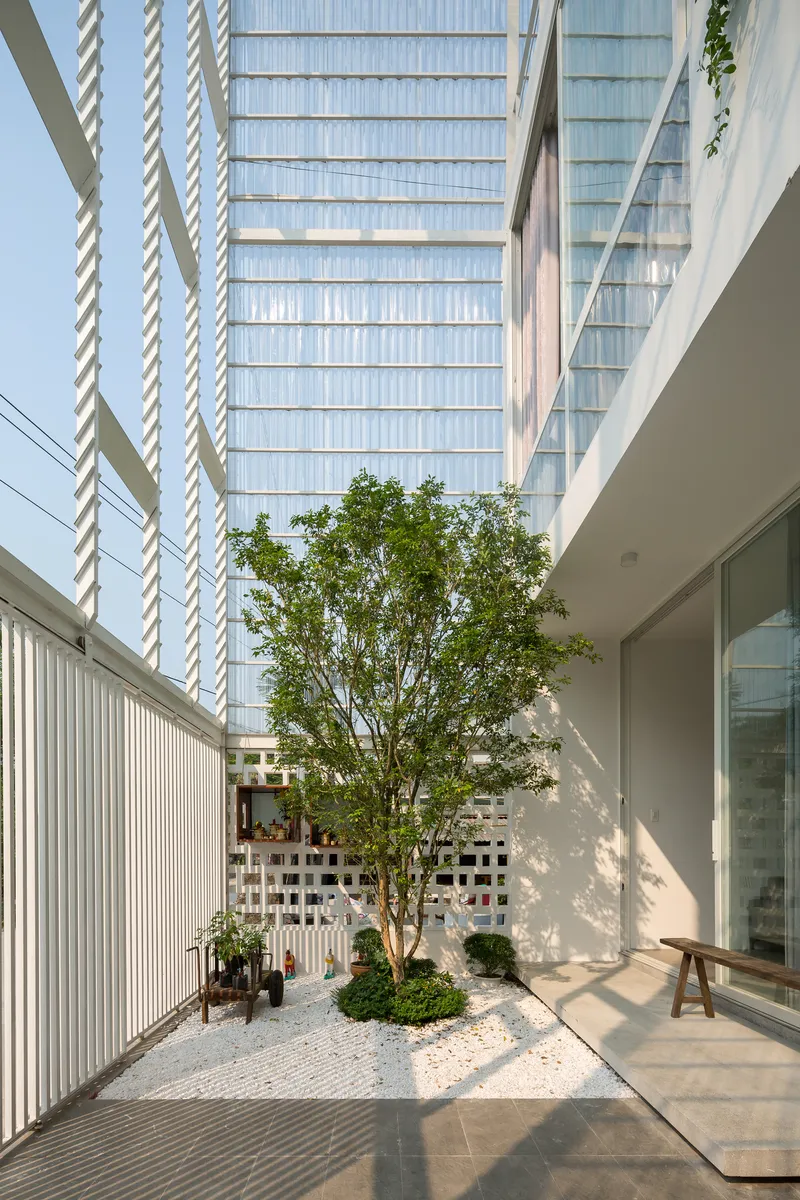
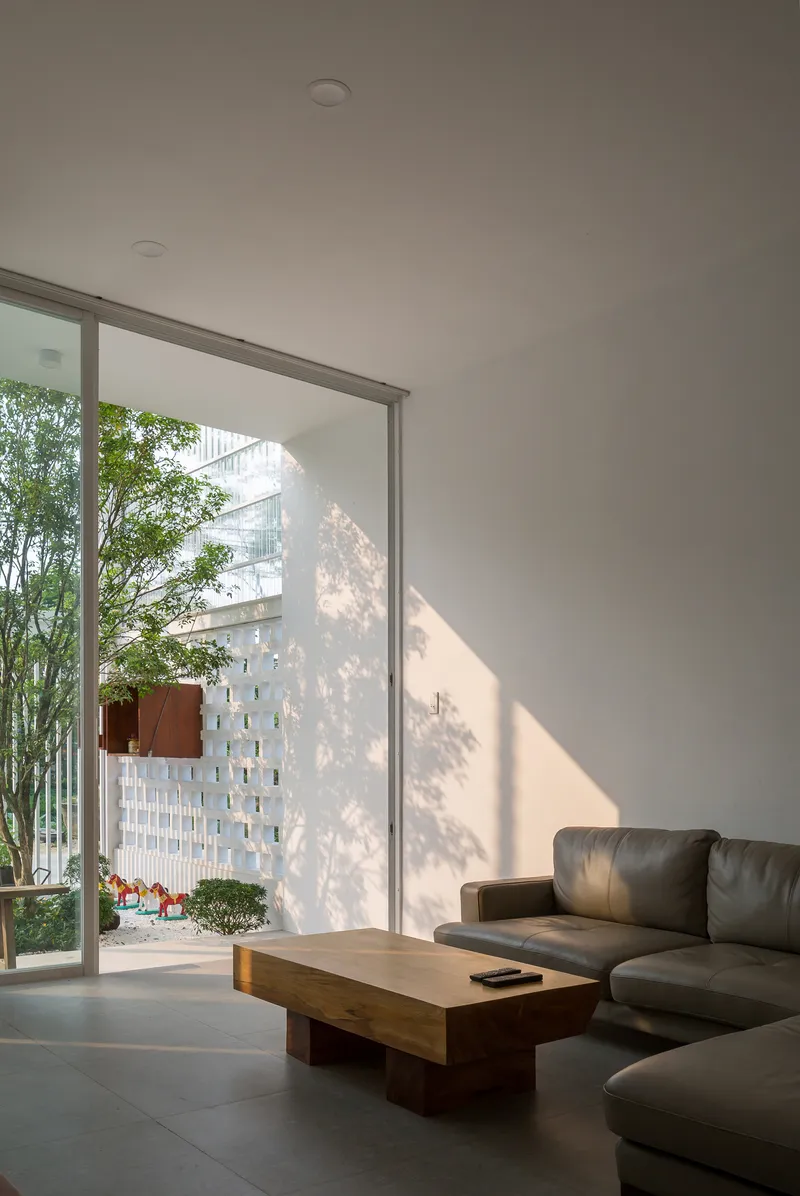
On a seven-meter-wide lot, dedicating area to an open courtyard is a real sacrifice. BHA makes the case that it pays for itself in ventilation and psychological spaciousness. The courtyard garden, a simple composition of white gravel, a planted tree, and corrugated metal walls, functions as a light well that throws reflected daylight deep into the ground floor living room. Floor-to-ceiling glazing and a perforated white screen wall mediate between the planted zone and the occupied interior.
Vines cascading through roof openings and potted palms on mezzanine landings continue the green thread vertically. In Hue's climate, where the air itself often feels heavy, this interweaving of planting and architecture is more than decorative. It is functional cooling infrastructure, introducing shade and evapotranspiration exactly where the section is most exposed to solar gain.
Living with Light Stripes
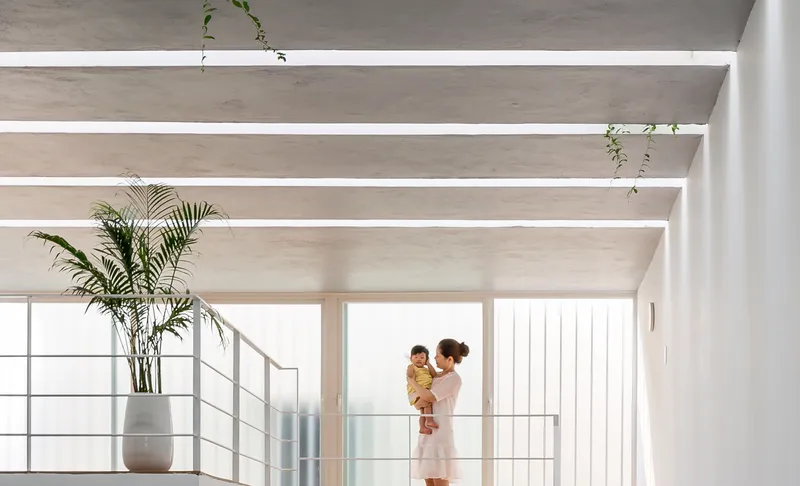
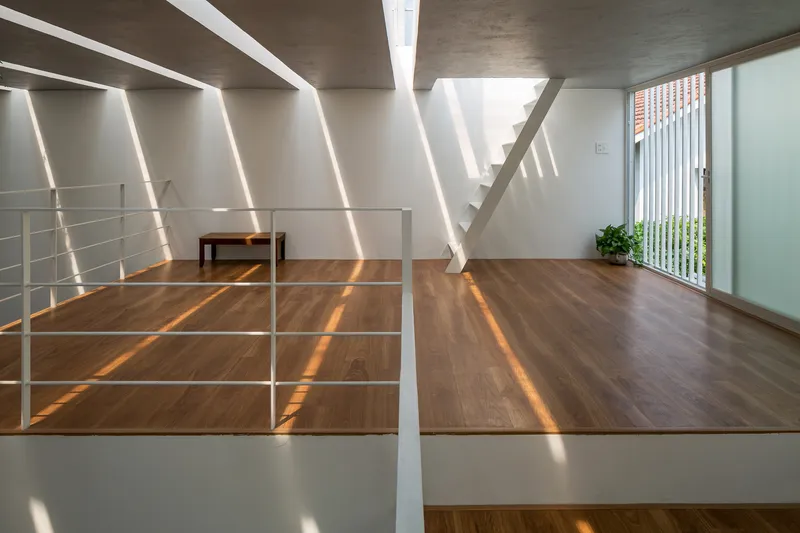
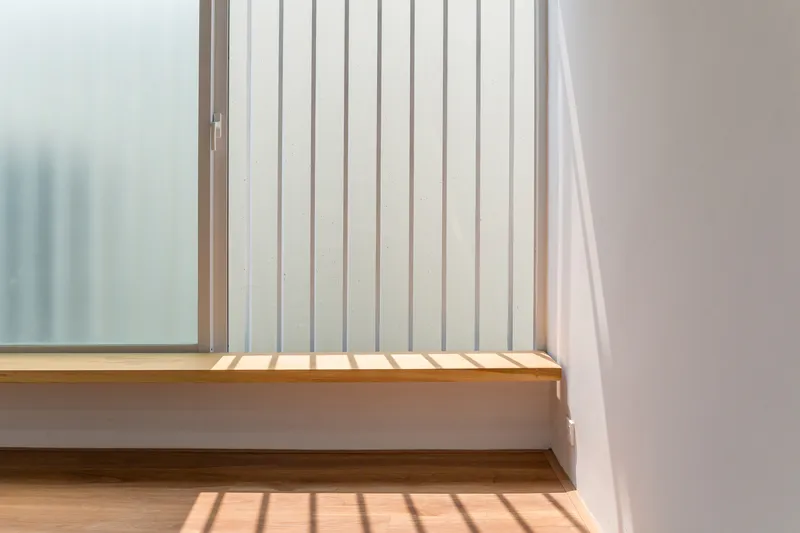
The interplay between the skylight beams and the vertical screen elements creates a layered shadow language inside the house. On the upper mezzanine, diagonal stripes from the roof openings wash across white railings and timber floors. At the window sills, vertical metal screens cast their own fine shadow grids over the wood. The two systems interact throughout the day, producing complex interference patterns that shift constantly.
There is a quiet discipline in committing to this effect. BHA could have used operable louvers or frosted glass to even out the light; instead, the architects let the shadows be legible and dramatic. The occupants live inside a drawing that the sun renders anew every morning. It takes confidence to leave the interior this exposed to the sky.
Material Restraint
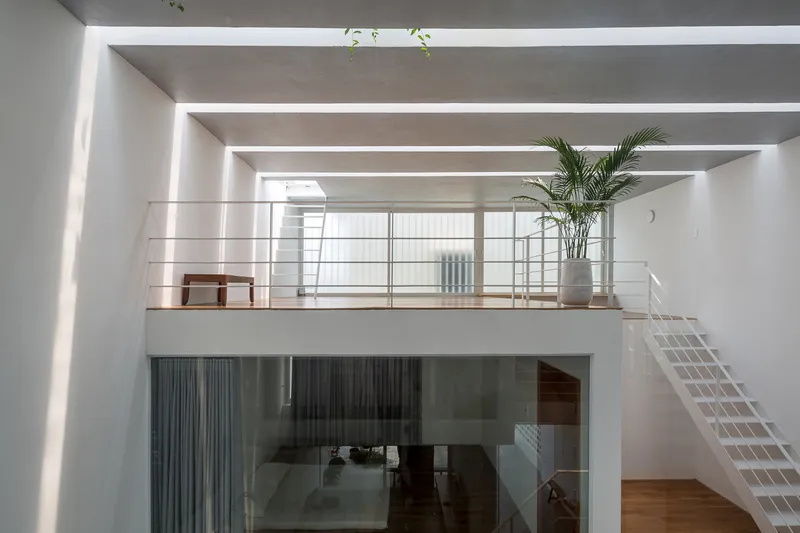
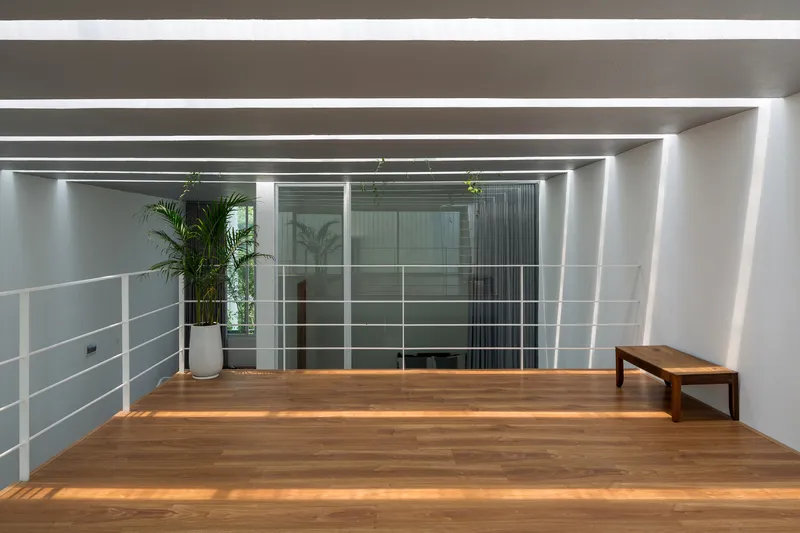
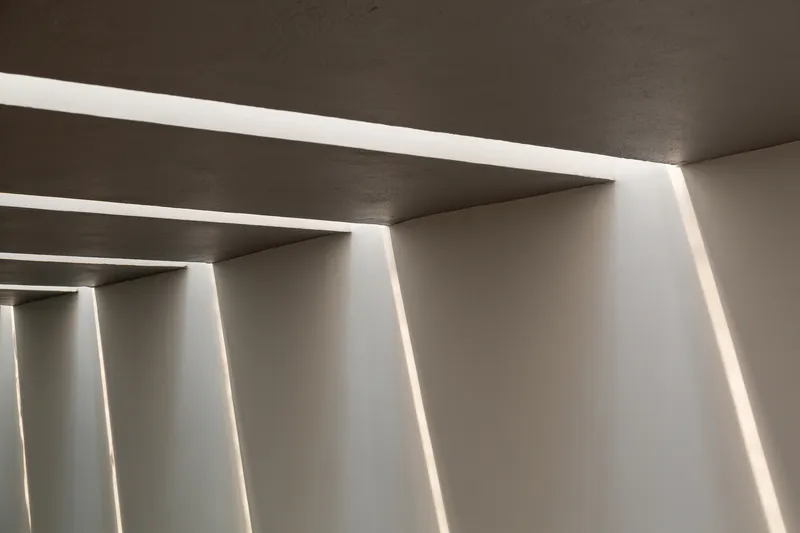
The palette is deliberately narrow: exposed concrete for the structural shell, warm timber for floors and stair treads, white-painted tube steel for railings and screens. The recessed linear ceiling lights echo the skylight slots, maintaining the ruled-line geometry even after dark. There are no accent colors, no decorative tile, no stone cladding. Everything you see is either structure or finish in its most direct form.
This restraint puts the emphasis exactly where BHA wants it: on the spatial section and the quality of light. When the material vocabulary is this quiet, every vine, every shadow stripe, every glimpse through a void registers with amplified intensity. It is an approach that risks severity, but the warmth of the timber and the organic softness of the plantings keep the balance.
Plans and Drawings
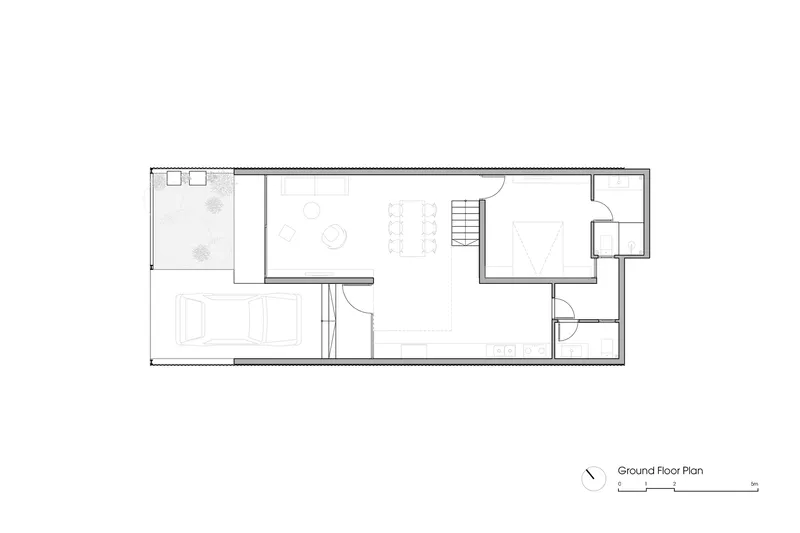
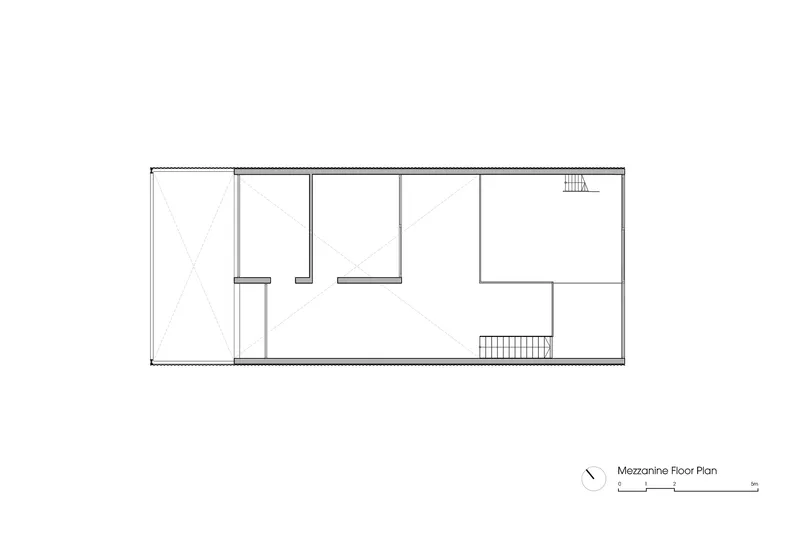
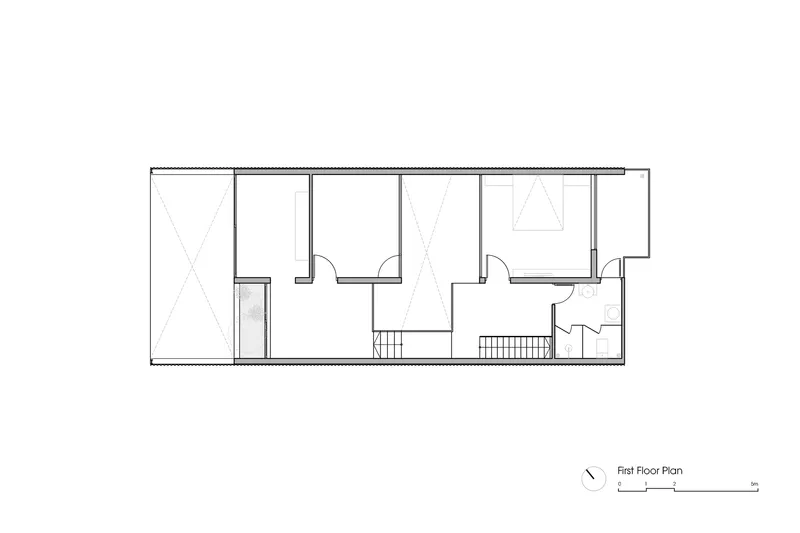
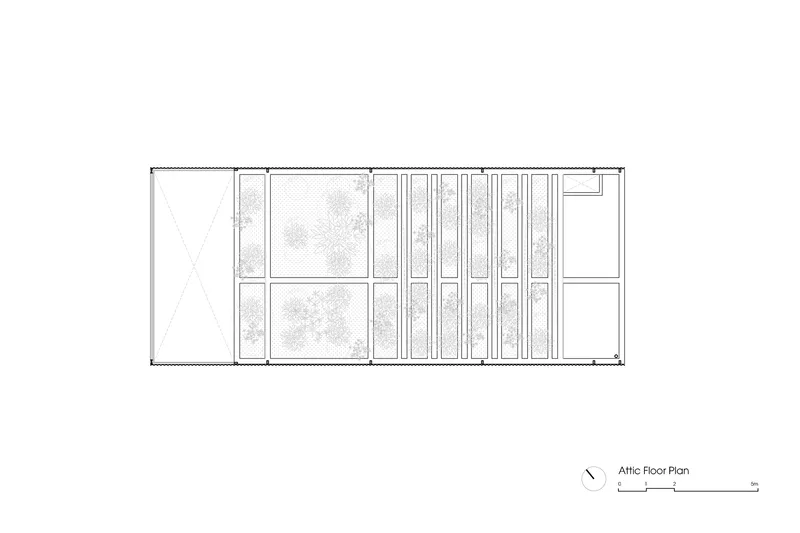
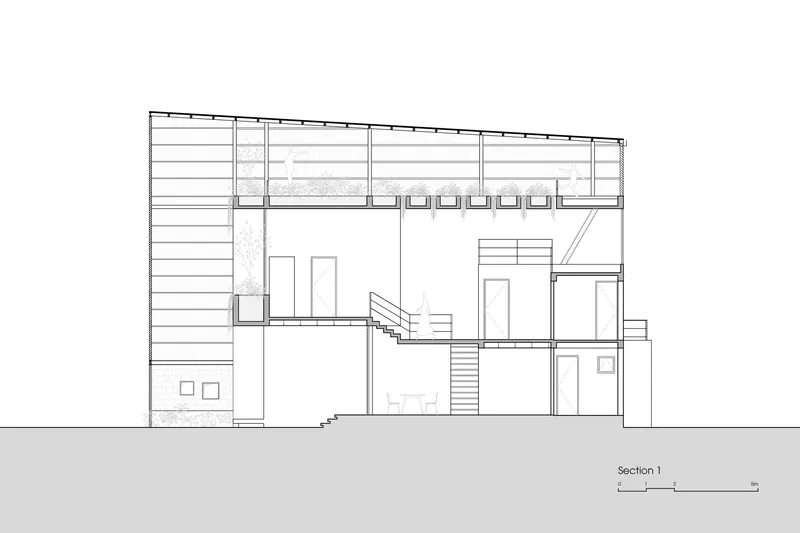
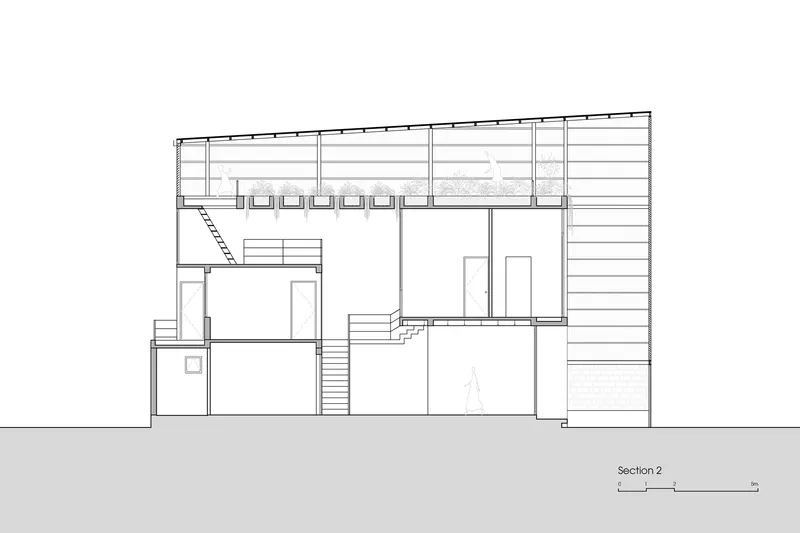
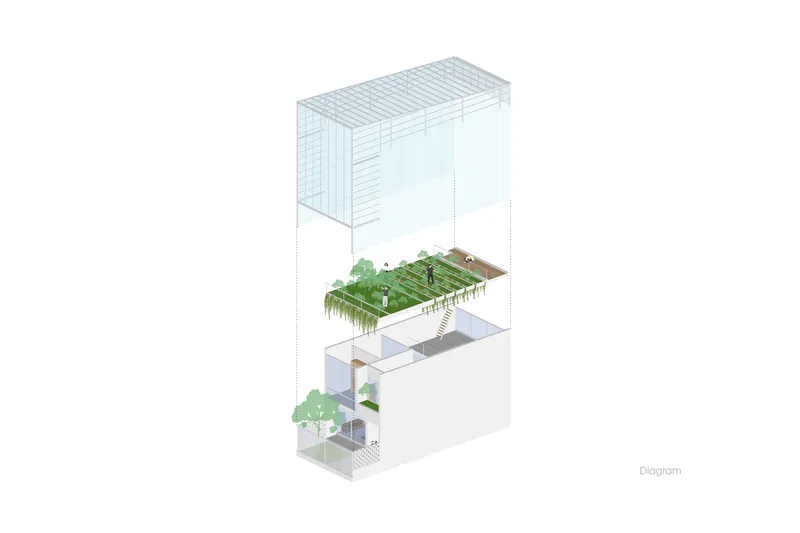
The floor plans reveal how tightly the program is packed into the 7x17 envelope. The ground floor sequences a carport, entry, living and dining areas, and a bedroom along the long axis, with the courtyard acting as a hinge between public and private zones. The mezzanine inserts study rooms at the half-level, while the first floor above resolves into a bedroom suite with en suite. The attic plan shows rooftop terraces and timber decking, giving the family outdoor space that the lot cannot provide at grade.
The longitudinal section is the most telling drawing. It makes clear how the staggered levels create a continuous interior landscape rather than a stack of isolated rooms. Planting beds sit atop the flat roof, adding thermal mass and greenery to the uppermost surface, the one most exposed to Hue's relentless sun. The axonometric diagram confirms what the photographs suggest: every floor plate is punctuated by voids, stairs, or tree wells, so that air and light can migrate freely from roof to ground.
Why This Project Matters
The narrow tube house is one of Southeast Asia's most common residential typologies, a consequence of land subdivision practices that prize street frontage over depth. Architects across Vietnam have been rethinking the type for decades, but the 7x17 House earns its place in that conversation by committing so fully to the sectional strategy. The single-shell structure, the staggered half-levels, and the calibrated roof openings work as an integrated system, not as isolated gestures. The result is a 120 square meter house that feels several times its size.
More broadly, BHA studio demonstrates that climate-responsive design does not require elaborate technology or exotic materials. Concrete, openings, plants, and an intelligent section can do most of the work. In a rapidly urbanizing town like Phu Bai, where lot sizes are shrinking and air conditioning bills are climbing, that lesson carries real urgency. The 7x17 House is a compact proof of concept: even on the tightest sites, architecture can still make room for air, light, and greenery if the section is designed with enough care.
7x17 House by BHA studio, lead architect Nguyen Xuan Minh. Located in Hue, Vietnam. 120 m², completed 2020. Photography by Hoang Le.
About the Studio
Share Your Own Work on uni.xyz
If projects like this are the kind of work you want to make, uni.xyz is a place to publish your own, find collaborators, and enter design competitions.



Popular Articles
Popular articles from the community


Riyadh For All: Intergenerational Urban Design for Active Aging in Rabat
Riyadh For All reimagines urban design in Rabat with intergenerational co-living, adaptive courtyards, and Moroccan cultural exchange today.

The Earth Pod: 3D Printed Homes for Resilient Refugee Communities
The Earth Pod reimagines refugee housing through 3D printed homes made from clay, combining resilience, self-sufficiency, and rapid shelter.

Co-Life: Senior Housing Design That Reconnects Older Adults With the City
Co-Life reimagines senior housing design through healing gardens, shared streets, workshops, and a sustainable community across generations.

Hill & Cross Opera: Sculptural Opera House Architecture Shaped by Tallinn’s Landscape and Identity
Hill & Cross Opera reimagines opera house architecture in Tallinn through its sculptural hill, civic plaza, glass wave and a luminous cross.


Similar Reads
You might also enjoy these articles

Bao Huynh Watercolor Atelier: A Serene Art Retreat in Hội An
Bao Huynh Watercolor Atelier in Hội An blends multifunctional art spaces, sustainable design, local materials, and family-friendly living in a serene environment.

Atelier Macri Concept Store Interior Design by CASE-REAL
Atelier Macri store features a "ko" counter, walnut wood details, cork displays, blending retail, gallery, and seamless customer experiences.

Manuel Vargas Izquierdo Stadium and High-Performance Sports Center: Architectural Excellence in Jalpa de Méndez
The Manuel Vargas Izquierdo Stadium blends sustainable design, inclusive sports facilities, and cultural-inspired architecture, revitalizing Jalpa de Méndez’s public spaces.

KAKR Buluh Awar Hall: Revitalizing Community and Ecology Through Bamboo Architecture
Community built bamboo hall revitalizes Buluh Awar village, empowering youth, restoring ecology, celebrating vernacular craftsmanship through sustainable architecture and culture.


Explore Residential Building Competitions
Discover active competitions in this discipline


Challenge to design mud housing for contemporary communities


Challenge to reimagine the Iron Throne


Photograph architecture without architects


Illustrate the lost glory of Angkor Wat - Render Challenge
Comments (0)
Please login or sign up to add comments
No comments yet. Be the first to comment!