
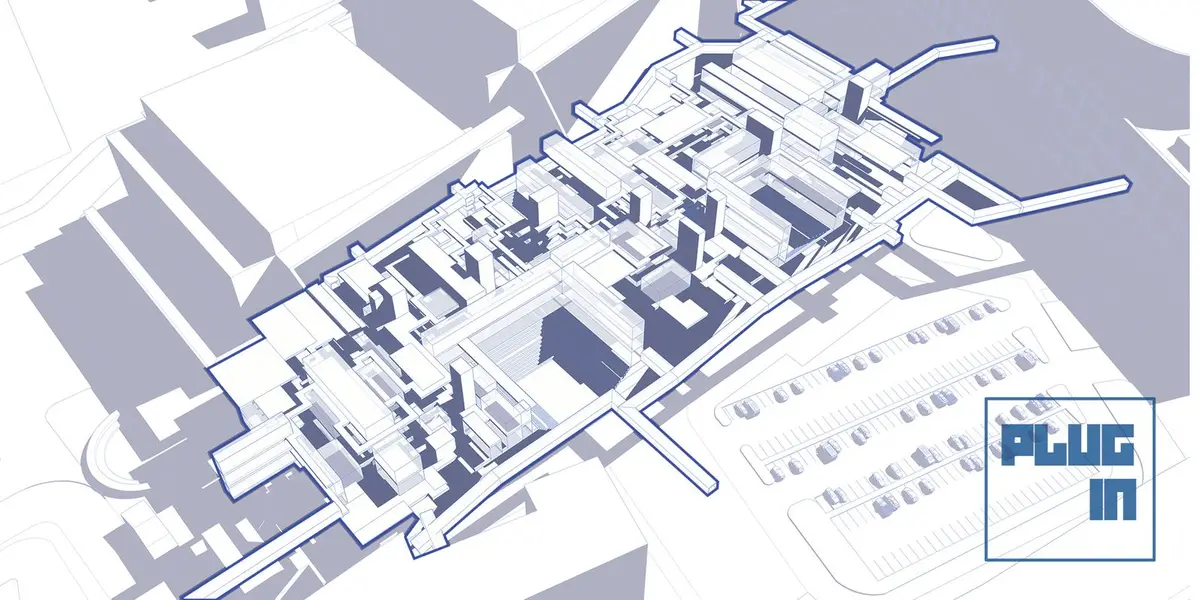
Plug-In: Bharat Bhavan 2.0 Rewires Cultural Infrastructure for India's Satellite Cities
A river-inspired cultural ecosystem plugs into Gurugram's Cyberhub, treating circulation as ceremony and courtyard as commons.


India's satellite cities have everything except cultural roots. Built on global capital and tech-sector ambition, places like Gurugram, Noida, and Faridabad developed powerful economic identities while severing the link between cultural expression and daily public life. Bharat Bhavan 2.0 takes that disconnect as its starting brief. Rather than proposing a monumental arts center dropped onto a site, the project imagines a "plug-in" system: a continuous cultural terrain that weaves itself into existing pedestrian flows, metro connectivity, and corporate networks, making art and heritage inseparable from the act of moving through the city.
Designed by Rana Sarkar, Amit, and Shridhar Rao, the project received the People's Choice Award in the Bharat Bhavan 2020 competition. Sited within a dense mixed-use zone at Cyberhub in Gurugram, the proposal confronts a city often described as carrying no "baggage" of the past, treating that blankness not as a deficit but as fertile ground for a new kind of cultural insertion.
Rivers as Organizational DNA
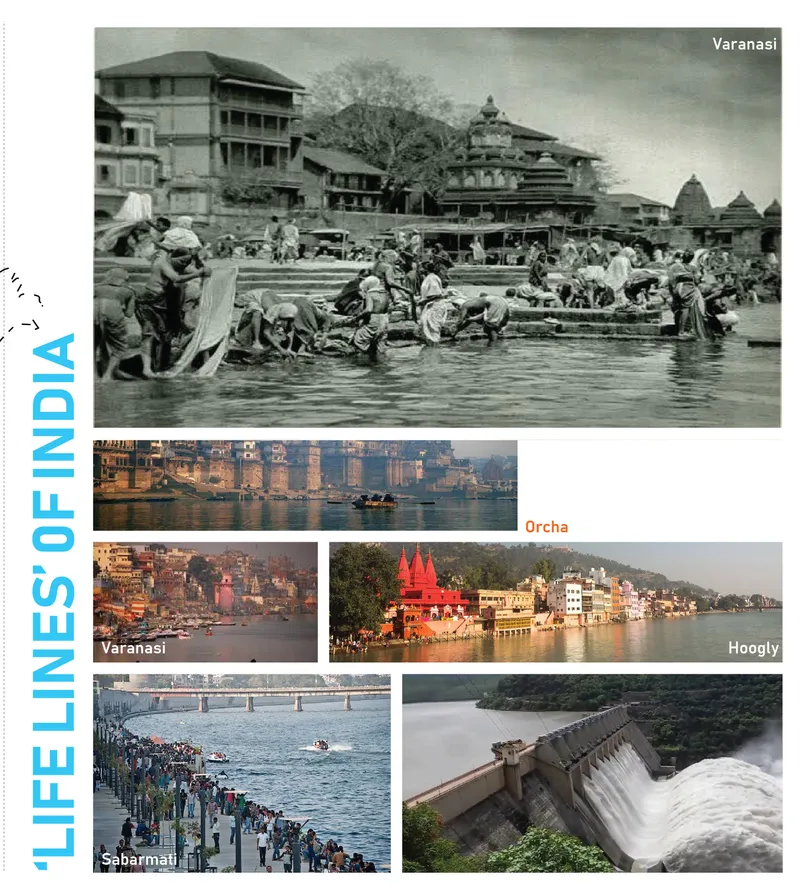
The conceptual engine of the project is disarmingly simple: India's civilization was shaped by rivers, so its cultural architecture should be too. The Indus, Ganga, Yamuna, Narmada, Godavari, Krishna, and Kaveri are not treated as nostalgic symbols but as operational models. The designers translate them into two architectural systems. "River Lines" become linear circulation corridors, arterial paths that pull visitors through the building the way a current pulls a boat. "River Plains" become spatial voids, courtyards, and platforms that anchor program clusters, functioning as the floodplains where people gather, pause, and interact. The collage of riverfront ghats above makes the analogy explicit: bathing steps, temple edges, and crowded gathering points along the water become the spatial precedent for a building where movement and congregation are the same act.
From Sketch Line to Inhabited Volume
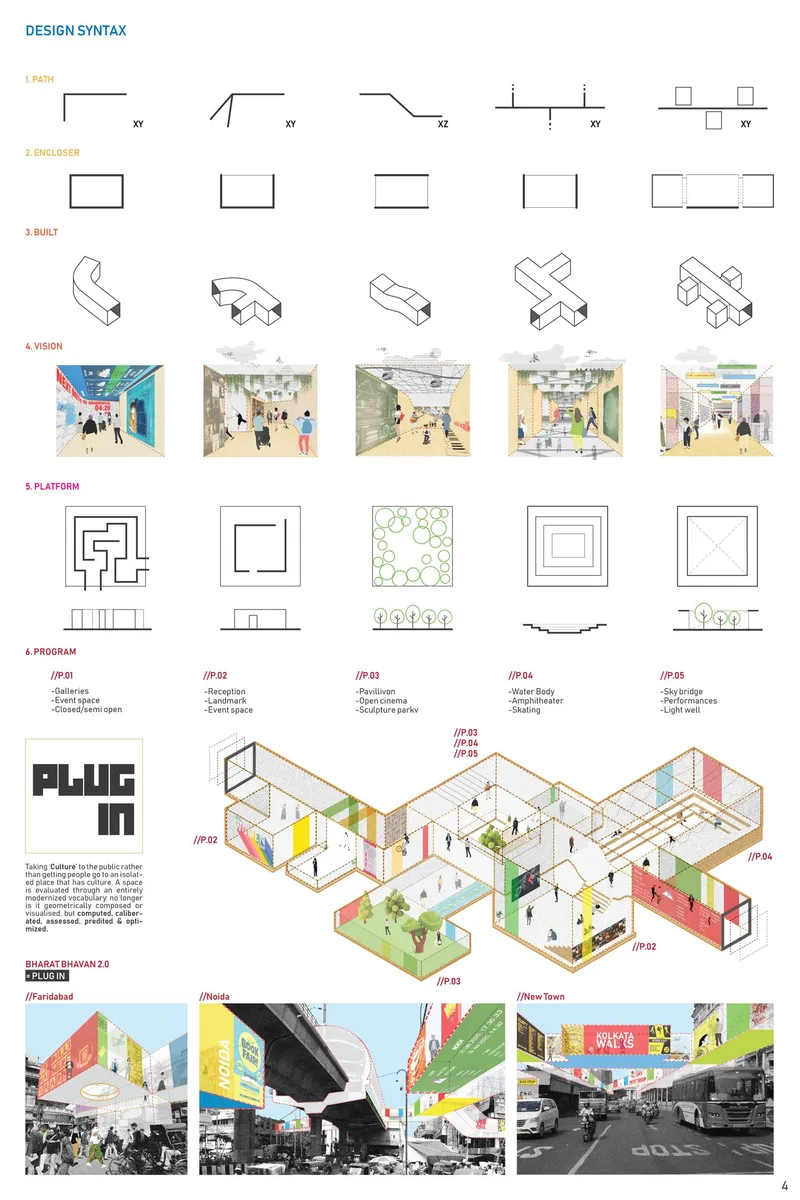
The design syntax diagram reveals the disciplined logic beneath the project's apparent fluidity. Initial sketch lines, clearly derived from river-path geometries, are extruded into volumetric studies and then resolved into rendered interior perspectives. It is a legible sequence: concept to form to experience, each step accountable to the one before it. What makes this compelling is the refusal to let the river metaphor remain metaphorical. The lines literally become corridors; the voids literally become courts.
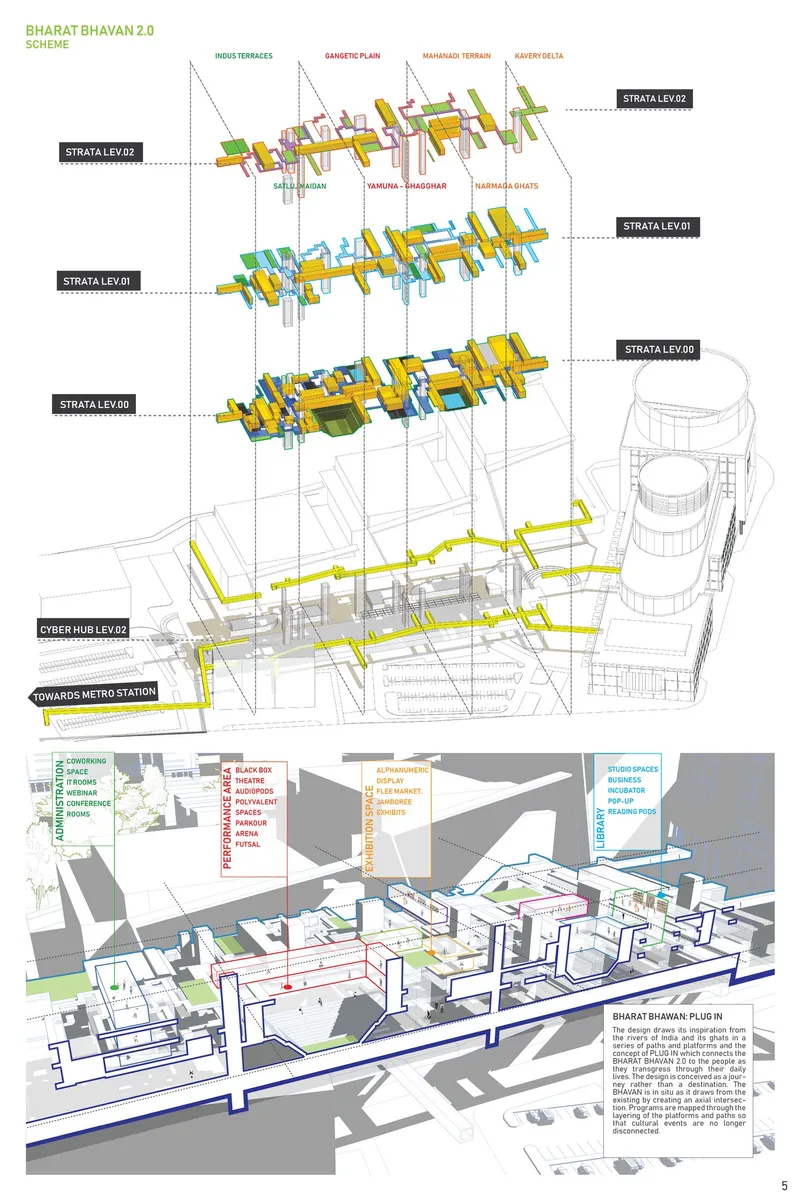
The axonometric circulation drawing amplifies this legibility. Color-coded pedestrian bridges span multiple levels, connecting program zones vertically and horizontally in a way that dissolves the conventional floor-by-floor organization. Vertical connections punctuate the scheme at intervals, offering shortcuts between strata. The result reads less like a building with floors and more like a landscape with topography, which is precisely the point. In a city defined by grade-separated highways and sealed office lobbies, this multi-level network proposes a radical alternative: infrastructure that you inhabit rather than merely traverse.
Layered Interiors Beneath the City Surface
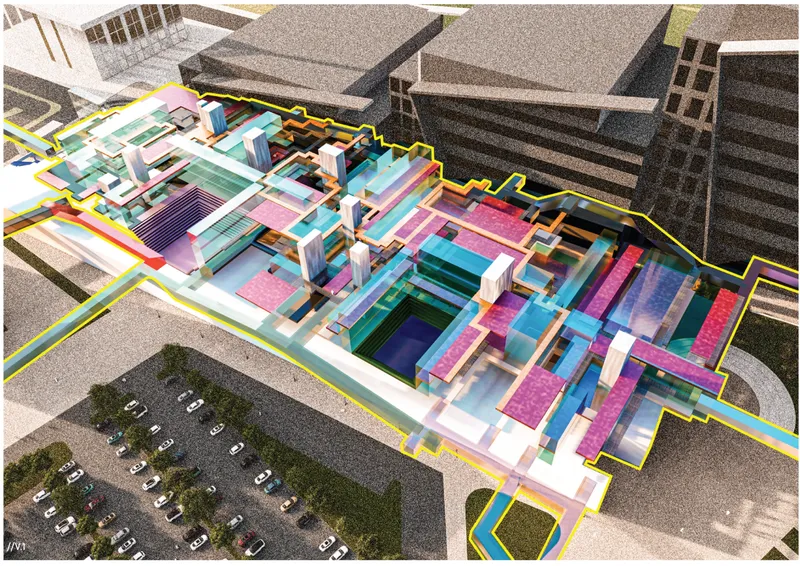
The aerial sectional model is one of the most revealing images in the set. Surrounding buildings frame the intervention on all sides, and the multi-colored sectional cut exposes layered interior spaces that descend below the existing ground plane. The project doesn't compete with Cyberhub's skyline; it burrows into its interstices. Cultural program is stacked and interleaved, creating sight lines between levels that allow a visitor on one floor to glimpse activity two stories below. This vertical porosity echoes the stepped ghats of the river metaphor, where every terrace offers a different vantage point onto collective life.
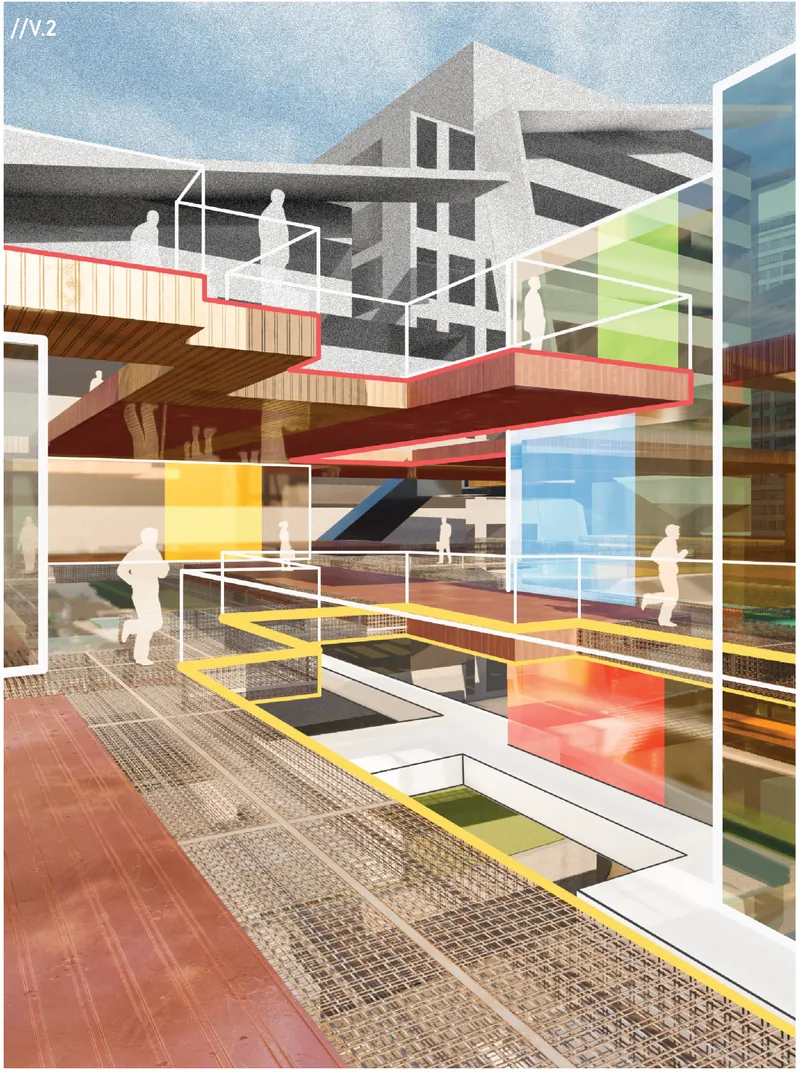
The sectional rendering with overlapping transparent planes reinforces the spatial ambition. Silhouetted figures move through stacked floors whose boundaries are deliberately ambiguous, defined more by shifts in light and level than by walls. Transparency is not decorative here; it is programmatic. By making each layer visible to the others, the designers ensure that cultural activity is always on display, always inviting participation. The building becomes its own advertisement.
A Courtyard Where Canopy Replaces Ceiling
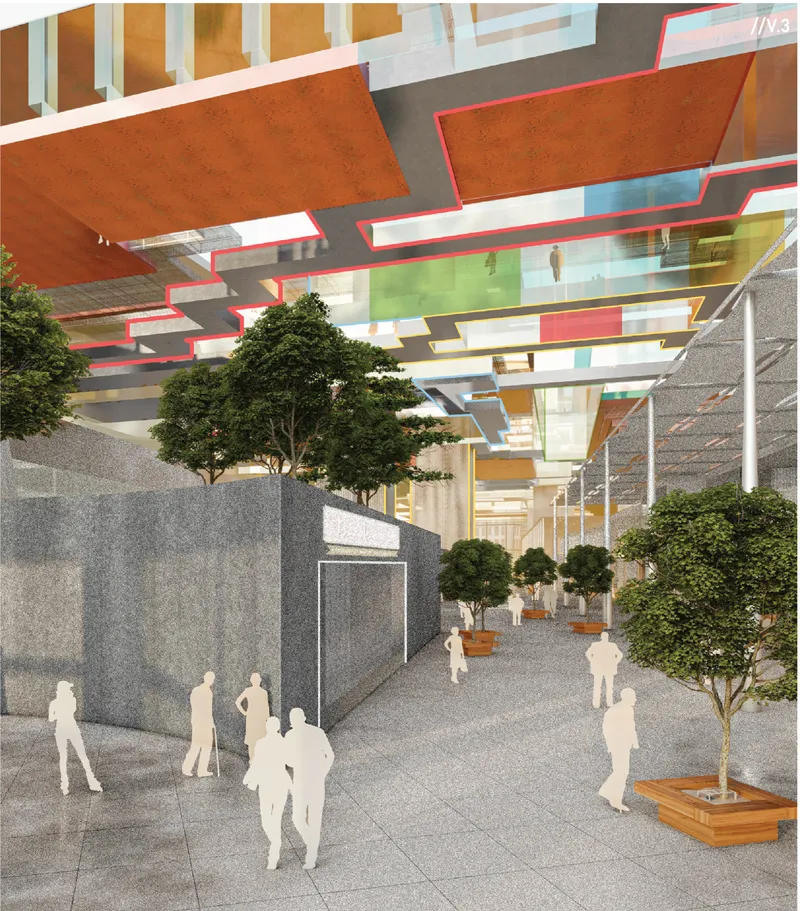
The final rendering brings the user down to eye level, and the effect is immediate. Trees in planters rise through a covered courtyard sheltered by an overhead canopy of colored horizontal planes. These planes filter light in a way that recalls the dappled shade beneath a banyan tree or the layered cloth awnings of a bazaar street. It is the River Plain concept at its most intimate: a court where people can sit, talk, perform, or simply be present. In a city where public space is often limited to air-conditioned malls, this semi-open gathering ground offers something Gurugram conspicuously lacks: a commons.
Why This Project Matters
Bharat Bhavan 2.0 is not really about architecture as object. It is about architecture as system. The original Bharat Bhavan of 1982 was conceived as a cultural repository, a container for heritage. Over decades, that model proved too rigid to absorb the social flux of Indian cities. The plug-in concept proposed here inverts the logic: instead of asking people to visit culture, it threads culture into the paths they already walk. Circulation corridors double as gallery spines. Courtyards double as performance grounds. The metro station is not adjacent to the building; it is conceptually part of it.
For Gurugram, a city that grew faster than its cultural institutions could keep pace, this kind of intervention carries real urgency. Sarkar, Amit, and Rao demonstrate that cultural architecture in India's newest cities need not be retrospective or monumental. It can be connective, adaptive, and woven so tightly into the urban fabric that separating building from city becomes impossible. That is the promise of the plug-in, and it earned the People's Choice for good reason.
View the Full Project
About the Designers
Designers: Rana Sarkar, AMIT, Shridhar Rao
Enter a Design Competition on uni.xyz
uni.xyz runs architecture and design competitions year-round that reward proposals with spatial conviction and real site intelligence.
Project credits: plug‑in by Rana Sarkar, AMIT, Shridhar Rao Bharat Bhavan 2020 (uni.xyz).


Popular Articles
Popular articles from the community


Lunar Spiral: Space Architecture Shaped by the Mathematics of the Universe
Lunar Spiral reimagines space architecture through Fibonacci geometry, lunar regolith, levitating habitats, and self-sustaining Moon living.

Co-life: Sustainable Architecture for Age-Friendly Community Living
Co-life reimagines sustainable architecture for seniors through courtyards, rammed earth, shared gardens, and spaces designed for belonging.

Conexión: Biophilic Design Reimagines High-Rise Living in Hong Kong
Conexión reimagines high-rise living in Hong Kong through biophilic design, green facades, shared spaces, daylight, water and nature within.

ALGAL REALM: A Bio-Integrated Lunar Habitat Design for Life Beyond Earth
ALGAL REALM reimagines lunar habitat design with algae-powered life support, 3D-printed regolith, and vertical living for a lunar future.

Similar Reads
You might also enjoy these articles
ALGAL REALM: A Bio-Integrated Lunar Habitat Design for Life Beyond Earth
ALGAL REALM reimagines lunar habitat design with algae-powered life support, 3D-printed regolith, and vertical living for a lunar future.

Cinema Futurismo: Futuristic Architecture Reimagining the Future of Cinema
Cinema Futurismo merges futuristic architecture, holographic projection, intimate seating, and landscape into a new social cinema.

Little Red Riding Hood: Architectural Design as a Journey Through Fear, Light, and Storytelling
Little Red Riding Hood reimagines the fairy tale through architectural design shaped by fear, light, scale, memory, uncertainty, and choice.
Playducation: Modular Architecture That Turns Play Into a Space for Learning
Playducation transforms modular architecture into a flexible world of play, learning, and healing for children in refugee settlements.

Explore Urban Design Competitions
Discover active competitions in this discipline

Challenge to design a portable theatre

Challenge to design a portable music platform

Challenge to design an open learning module for the elderly
Comments (0)
Please login or sign up to add comments
No comments yet. Be the first to comment!