

Bharat Bhavan 2020: Rangoli Geometry as the Blueprint for a Cultural Hub
A centralized courtyard plan derived from traditional Indian Rangoli patterns transforms five acres in Bangalore into a community cultural complex.


What happens when you peel a Rangoli off the floor and let it organize an entire building? You get Bharat Bhavan 2020, a cultural complex whose plan reads like a symmetrical pattern radiating outward from a single courtyard core. The project takes one of India's most ubiquitous folk art forms and treats it not as decoration but as a genuine generative diagram for architecture: galleries, studios, amphitheatre, administrative block, and performance areas all lock into a rhythmic geometry that feels both ancient and entirely contemporary.
Designed by Sahana Shetty and published on uni.xyz, the project is sited on nearly five acres in Bangalore, a city whose expanding creative economy and temperate climate make it a natural fit for open-air cultural programming. The site's connectivity to major transport nodes and vistas toward the iconic Nandi Hills give the building an urban anchor and a scenic horizon in equal measure.
A Five-Acre Rangoli: Courtyard Plan as Cultural Diagram
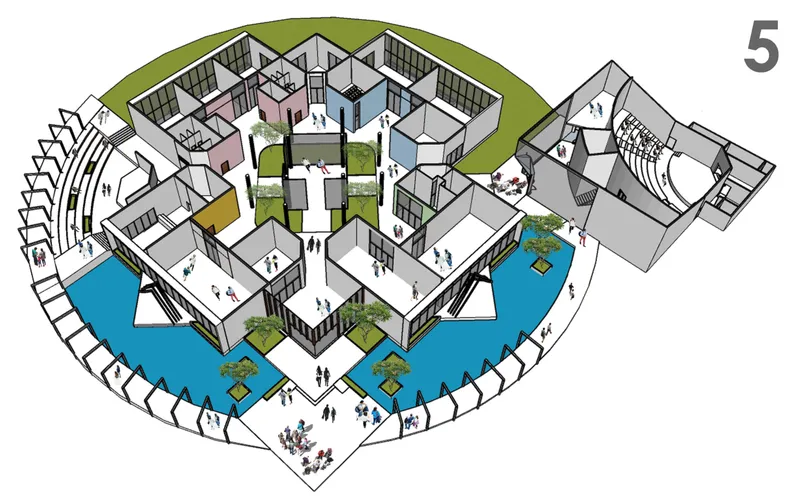
The axonometric drawing reveals the project's governing logic with unusual clarity. Clustered room volumes group tightly around a central courtyard, their green roofs stepping outward in a pattern that mirrors the concentric rings of a Rangoli motif. A continuous water moat defines the perimeter, establishing a physical and symbolic threshold between the city and the cultural precinct within. The centralized clustering is not merely aesthetic: it ensures that every program space, from dance studios to exhibition galleries, remains within a short walk of the communal heart.
What makes the plan disciplined rather than rigid is how landscape elements soften its geometry. Reflective water bodies, strategic plantation zones providing shaded walkways, and sculpture decks extending the cultural narrative outdoors all work to break the axial symmetry into a sequence of intimate, human-scale moments. The architecture breathes because the landscape lets it.
Timber Portals and Water Channels Frame the Approach
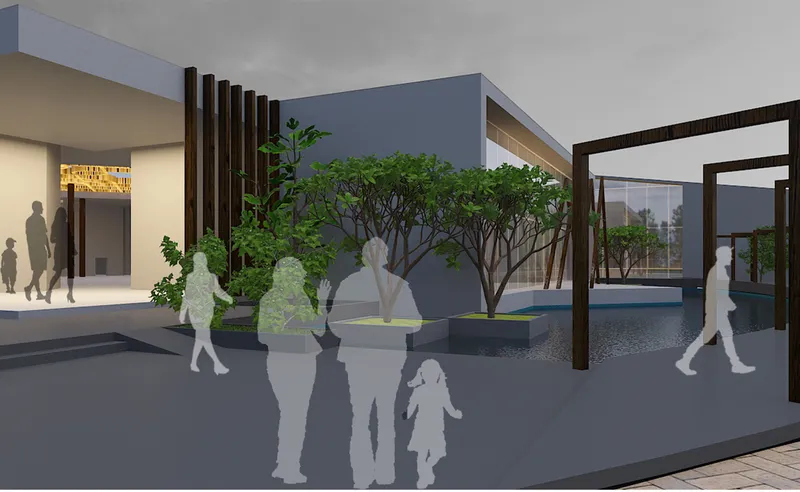
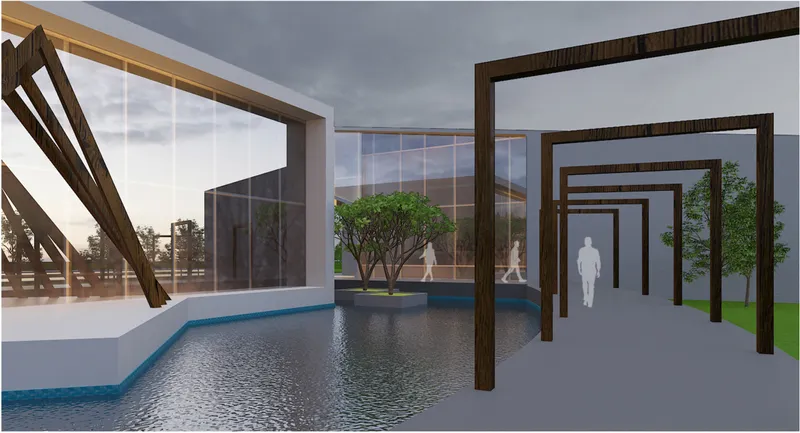
The rendered courtyard views introduce the project's primary material language: repeating timber portal frames that establish rhythm along pedestrian routes. In the first image, visitors pass beneath planted trees flanking a reflective water channel, the portals acting as a pergola that mediates between full enclosure and open sky. The second view moves deeper inside, where the same timber frames line a glass-enclosed corridor beside a narrow water feature. The repetition creates a visual cadence that guides movement without dictating it.
The transparent edges Shetty describes in her design rationale are fully legible here. Glass walls maximize natural light and maintain visual connectivity across spaces, so a person walking through the circulation corridor can see into exhibition galleries on one side and out to the water landscape on the other. The effect is one of constant orientation: you always know where you are relative to the courtyard core.
Structure as Landscape: Angled Timber and Teal Water
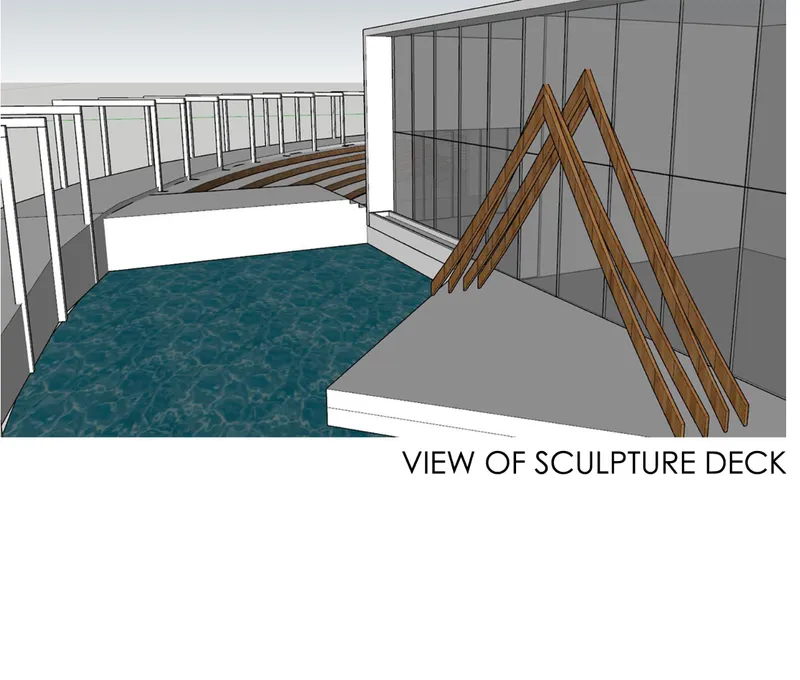
The section perspective isolates one of the project's most striking spatial conditions: an outdoor deck cantilevered beside a teal water feature, its angled timber structural elements tilting like reeds at the water's edge. The drawing makes clear that structure here is not hidden inside walls; it is expressive, directional, and part of the landscape composition. The angled members cast shifting shadows on the deck surface, producing the same kind of dynamic light-and-shade interplay that the courtyard trellis creates at the building's center.
The Courtyard Core: A Curved Timber Ceiling Over a Circular Garden
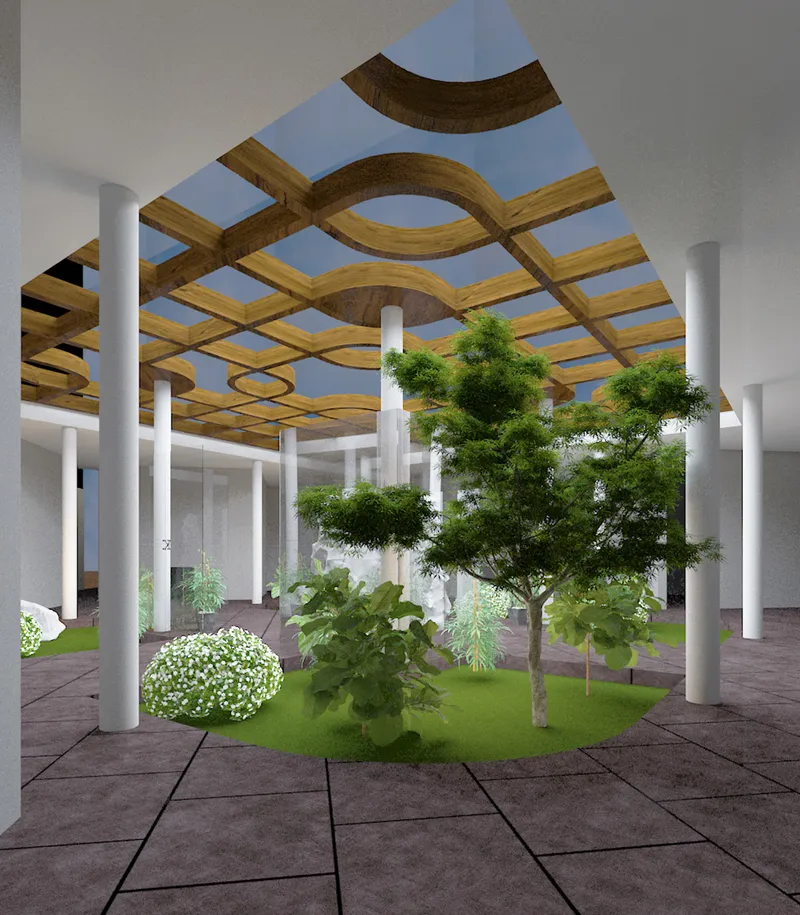
At the heart of the complex, the courtyard finally reveals itself in full. A circular planted garden sits beneath a curved timber ceiling grid, its organic form contrasting with the white structural columns that support it. The sky-lit trellis Shetty describes filters daylight into dappled patterns on the floor below, and the bright interior palette ensures the space reads as welcoming rather than monumental. Studios for dance, music, and group activities, along with exhibition galleries and the public lobby, ring the perimeter, turning the courtyard into a stage for everyday cultural life.
The spatial logic is clear: arrive at the edge, move inward, and the building rewards you with its most generous space at the center. It is a reversal of the typical institutional sequence, where grand lobbies give way to increasingly compressed corridors. Here, compression comes first, and release comes at the core.
Why This Project Matters
Bharat Bhavan 2020 takes a position that many cultural projects gesture toward but rarely commit to: that tradition can function as a structural principle, not just a surface treatment. By deriving the entire plan from a Rangoli diagram, Shetty avoids the common trap of pasting vernacular motifs onto a generic floor plate. The geometry is the heritage, and every spatial decision, from the centralized courtyard to the radiating program clusters, follows from it.
The project also demonstrates a mature understanding of how landscape and architecture can share authorship. Water moats, trellis walkways, sculpture decks, and plantation zones are not afterthoughts; they carry as much programmatic and experiential weight as the enclosed rooms. For a five-acre site in a city like Bangalore, where the climate invites outdoor occupation for much of the year, that balance is not just elegant. It is essential.
View the Full Project
About the Designers
Designer: Sahana Shetty
Enter a Design Competition on uni.xyz
uni.xyz runs architecture and design competitions year-round that reward proposals with spatial conviction and real site intelligence.
Project credits: Bharat Bhavan 2020 by Sahana Shetty.


Popular Articles
Popular articles from the community


Manzana Morphosis: Stretching Barcelona's Grid into a Living Landscape for 2050
A radical reworking of the Eixample manzana turns density into a tool for generous public space, vertical ecology, and environmental performance.

Faces of the Soviet Avant-Garde: Turning Moscow's Street Names into an Open-Air Museum
A network of sculptural installations across a Moscow residential district transforms forgotten architect names into spatial encounters with cultural memor

The Amber Palace Opera: A Geological Fiction Surfaces on Tallinn's Baltic Waterfront
Pierre Brillard reimagines a Baltic legend as a public landscape, opera house, and waterfront promenade rooted in Tallinn's coastal identity.

Temporary Home for Dogs: A Reversed Zoo Rethinks Animal Shelter Architecture
In Bucharest, a sinuous corridor and freed landscape flip the logic of containment, designing a shelter that works to make itself unnecessary.

Similar Reads
You might also enjoy these articles

Play: Fragments of Their World: Remembered Architecture Rebuilt as a Modular Playground for Refugee Camps
Tom Gardner abstracts domes, arches and towers from the homelands of displaced families into a kit of child-scaled play parts for camp settlements.
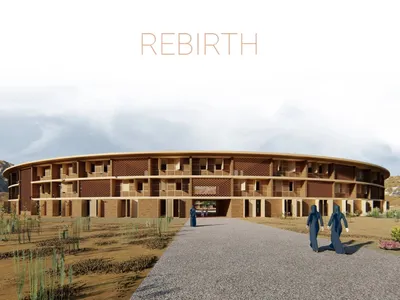
REBIRTH: A Circular Settlement Where Afghan Widows and Their Children Rebuild Life Together
A shortlisted Resile entry turns the circle into a protective ring of timber and brick, gathering homes, classrooms and gardens around a shared landscape.
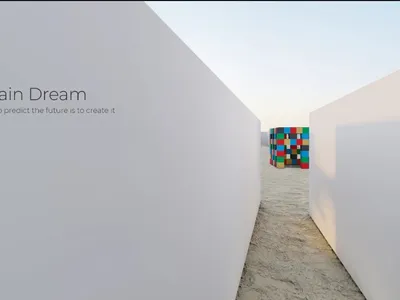
The Main Dream: A Recycled Plastic Kit That Lets Refugee Children Build Their Own Playground
Thirty-centimetre interlocking cubes that connect on three axes turn play into construction, letting children author the spaces they occupy.

Lunar Spiral: A Fibonacci-Driven Moon Settlement Rising from Shackleton Crater
Golden-spiral geometry organises buried infrastructure and orbiting habitable spheres into a lunar base designed to grow as life on the Moon expands.


Comments (0)
Please login or sign up to add comments
No comments yet. Be the first to comment!