

Bharat Bhavan Chandigarh: A Monumental Room of Culture Suspended Over Public Life
Elevated galleries and open plazas split the museum into two coexisting realms, reinterpreting Chandigarh's modernist legacy for contemporary civic culture


Lift the museum off the ground and give the city back its floor. That is the core architectural wager of this Bharat Bhavan proposal for Chandigarh: a building that separates formal gallery enclosures from the public life they serve by stacking one above the other, creating a monumental interior courtyard where culture is simultaneously produced, displayed, and lived. The designers call it the "Room of Culture," a single spatial reading that exposes the full spectrum of activity inside the institution without relying on enclosed galleries alone. Controlled boundaries formed by walls and gates define the enclosure, while suspended gallery volumes overhead cast shifting shadows onto the ground plane, activating it as a civic landscape of plazas, amphitheatres, shaded podiums, and informal gathering areas.
Designed by Rajat Arora, Navin Gupta, Darshit Nakrani, and Gautam Bhatia for the Bharat Bhavan 2020 competition, the project occupies a four-acre site near Panchkula within the broader Chandigarh capital region. The site sits at a transition zone between Chandigarh's original sectors and its expanding metropolitan edges, adjacent to the Kalagram Arts and Craft Centre, a venue that already draws artisans and performers during annual fairs. The designers leverage this context to propose a building that can either merge with its surroundings during large public events or operate independently as a formal museum institution.
Two Realms in One Enclosure: Ground Plane and Roofscape

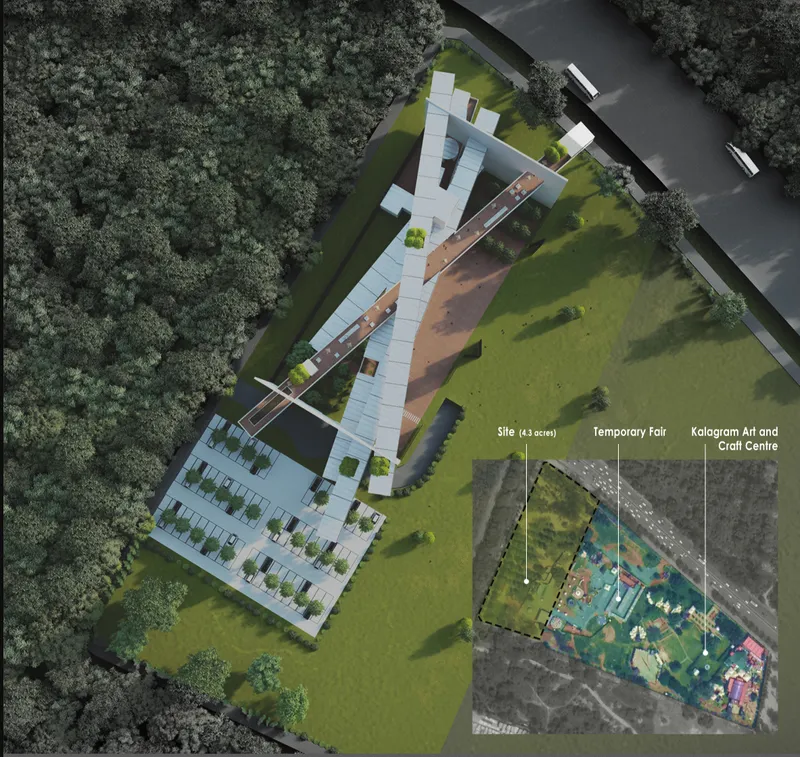
The axonometric view reveals the project's essential logic. Angular gallery volumes, clad and framed in white, hover above a ground surface of red brick paving punctuated by courtyards and circulation routes. The composition is not symmetrical; collisions, overlaps, and asymmetries between the elevated volumes generate a dramatic roofscape that reads as a constructed landscape in its own right. Below, the flat plane of the ground remains largely unobstructed, allowing pedestrian movement to flow freely between open plazas and shaded zones created by the cantilevers overhead.
The aerial site plan confirms the scale of the gesture. White volumes are distributed around green lawns and mature trees, maintaining generous distances that prevent the building from reading as a single monolithic mass. Instead, Bharat Bhavan registers as a campus of intersecting forms, each housing distinct programmatic functions while remaining visually and spatially connected through the open ground level. The proximity to Kalagram is evident: the site is positioned to absorb the overflow of cultural activity from the existing arts centre during peak events.
Cantilevered Volumes and the Weight of Air


From the exterior, the stacked horizontal volumes project outward with deep cantilevers that create covered zones at ground level without walls or columns obstructing the view. The rendering shows figures walking across a lawn beneath these overhangs, a deliberate image of the building as shelter rather than barrier. Light enters the spaces between the slabs at oblique angles, and the resulting shadows shift throughout the day, reinforcing the designers' claim that light and shadow are not decorative effects but structural elements of the spatial experience.
The red brick plaza is perhaps the most evocative image of the proposal's public ambitions. Wide steps with white inset treads rise gently beneath the cantilevered volumes, forming an outdoor amphitheatre that doubles as a casual seating area. The material palette is restrained: red brick on the ground, white surfaces above, and deep shadow in between. This tripartite reading, earth, air, and the cultural program suspended between them, is what gives Bharat Bhavan its spatial tension. The ground level embraces the spontaneity of Indian public life, from craft demonstrations to impromptu performances, while the galleries above maintain an introspective, curated atmosphere.
Section and Program: How Culture Stacks

The section drawing is where the project's programmatic clarity becomes most legible. Stacked galleries step back and forward across multiple levels, connected by circulation routes that allow visitors to move between exhibition spaces while catching glimpses of the plaza below through openings and terraces. Callout vignettes along the edges of the drawing detail specific conditions: gallery interiors with controlled lighting, terraced outdoor platforms for informal gathering, and the shaded undercroft that functions as an extension of the public ground plane. The vertical separation between the open base and the enclosed upper galleries is not merely conceptual; it is the organizing principle that distributes every function within the building.
Floor Plans: From Basement Parking to the Third-Floor Gallery Circuit

The multi-level floor plans trace the building's organization from basement parking through the third floor, accompanied by interior and exterior vignettes that illustrate the character of each level. The basement absorbs vehicular infrastructure, keeping the ground plane free from cars and service access. Above, the plans show how the linear gallery enclosures house exhibitions, archives, and curated displays, while the spaces between them serve as light wells, terraces, and visual connections back to the ground. Each floor shifts slightly in its footprint, producing the asymmetric roofscape visible in the exterior renderings and ensuring that no two gallery sequences feel identical.
The accompanying views confirm that the interior experience reinforces the exterior promise. Gallery spaces are tightly controlled in terms of light and proportion, offering focused encounters with art and artifacts. But the moments between galleries, the bridges, open corridors, and terraces, are where the building's dual identity as bazaar and institution becomes most palpable. Visitors are never more than a few steps from a view of the public life unfolding below.
Why This Project Matters
Bharat Bhavan Chandigarh makes a case that the most productive thing a cultural building can do is get out of the way. By elevating its formal program and liberating the ground, the design creates a civic precinct that is genuinely public: accessible, shaded, and adaptable to the unpredictable rhythms of Indian cultural life. The building does not ask visitors to choose between spectacle and contemplation; it provides both simultaneously, layered vertically so that one energizes the other. The duality of the open ground level and the introspective galleries above is not a compromise but a synthesis.
Equally significant is the project's relationship to Chandigarh's modernist lineage. Rather than mimicking Le Corbusier's formal vocabulary, the designers extend the city's underlying principles of spatial discipline, planes, and volumes into a framework that prioritizes participation and openness. The result is a building that honors the original Bharat Bhavan's aspiration to be more than a museum, functioning instead as a civic institution where art, craft, performance, and intellectual exchange are not just housed but made visible to anyone passing through.
View the Full Project
About the Designers
Designers: Rajat Arora, Navin Gupta, Darshit Nakrani, Gautam Bhatia
Enter a Design Competition on uni.xyz
uni.xyz runs architecture and design competitions year-round that reward proposals with spatial conviction and real site intelligence.
Project credits: Bharat Bhavan by Rajat Arora, Navin Gupta, Darshit Nakrani, Gautam Bhatia Bharat Bhavan 2020 (uni.xyz).


Popular Articles
Popular articles from the community


Jaramillo Van Sluys Arquitectura and Urbanismo Turn a Demolished Registry Lot in Quito into an Orchard Plaza
In Quito's Centro Histórico, a 2,800 m² plaza exposes the San Agustín convent wall and redraws its lost Augustinian orchard in volcanic stone.

David Macias Steps a Doorless Stone and Plaster House Down a Tropical Colombian Hillside
In the humid hills of Colombia, Threshold House replaces the front door with an open void and terraces its 850 m² down the slope instead of fighting it.

Cube Design Draws an Ecological Corridor Between Two Shenzhen Hills with the Nankai Building
Beside Shenzhen's container docks, the Nankai Building pairs stacked balconies with a climbing green screen to connect two hillsides across its height.

longwave studio Reorganizes a 112 m² Tainan Apartment Around the Daily Routines of a Family and Two Cats
In Tainan, Taiwan, birch plywood, rust-red furniture and a freestanding plaster wall link arrival, storage, work and family life in one apartment.

Similar Reads
You might also enjoy these articles


Aquadapt: An Underwater Habitat That Rewrites Its Rooms by the Hour
Curved modules ring the seabed while one shell shifts from breakfast room to cinema, farm and football pitch as residents' needs change.

Play: Fragments of Their World: Remembered Architecture Rebuilt as a Modular Playground for Refugee Camps
Tom Gardner abstracts domes, arches and towers from the homelands of displaced families into a kit of child-scaled play parts for camp settlements.
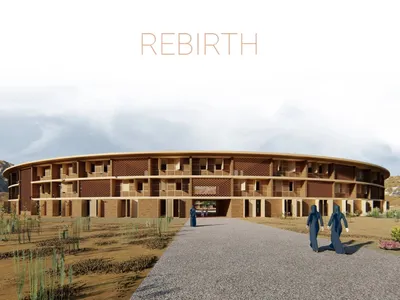
REBIRTH: A Circular Settlement Where Afghan Widows and Their Children Rebuild Life Together
A shortlisted Resile entry turns the circle into a protective ring of timber and brick, gathering homes, classrooms and gardens around a shared landscape.
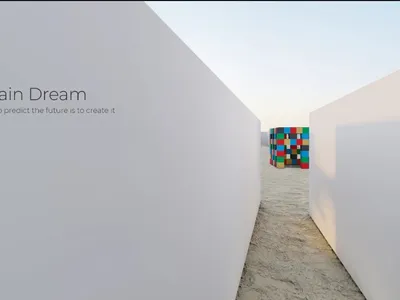
The Main Dream: A Recycled Plastic Kit That Lets Refugee Children Build Their Own Playground
Thirty-centimetre interlocking cubes that connect on three axes turn play into construction, letting children author the spaces they occupy.

Explore Bharat Bhavan Competitions
Discover active competitions in this discipline

Challenge to reimagine the Iron Throne

Photograph architecture without architects

Illustrate the lost glory of Angkor Wat - Render Challenge

Design challenge to reuse E-waste
Comments (0)
Please login or sign up to add comments
No comments yet. Be the first to comment!