
Bharat Bhavan Ranchi: Where Scaffolding Becomes Art on Tagore Hill
A cultural campus on Ranchi's iconic hilltop dissolves the boundary between architecture and landscape through fluid circulation and open artistic zones.


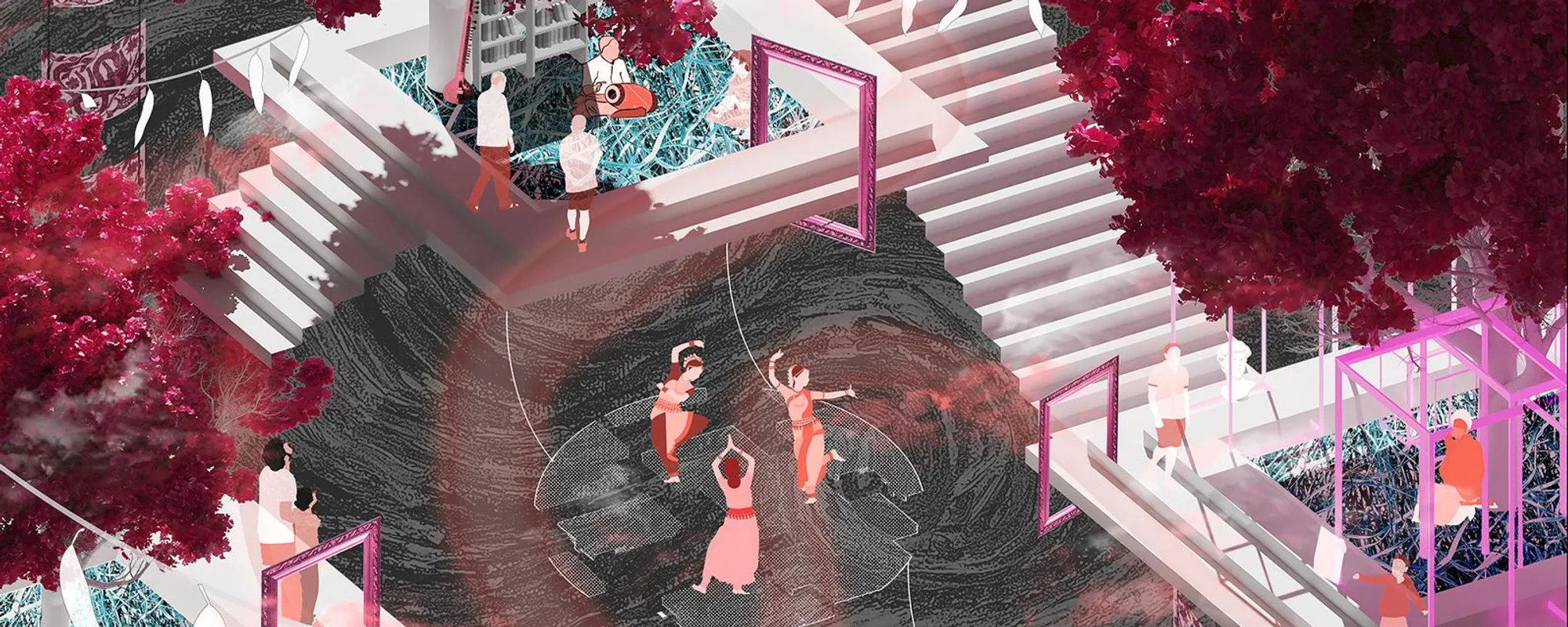
What if the building frame itself were the sculpture? At Bharat Bhavan Ranchi, skeletal pink scaffolding structures rise alongside white gallery volumes, and stepped terraces carve into a hillside already loaded with mythological significance. The architecture refuses to treat art as cargo to be housed. Instead, it treats structural elements, voids, and circulation paths as expressive acts in their own right, collapsing the distinction between creator and observer, between built form and the landscape it occupies.
Designed by Pranjal Maheshwari, Eish Ahlawat, Soumyadeep Das, and Ipsita Choudhury, this shortlisted entry for Bharat Bhavan 2020 sits on Tagore Hill in Ranchi, a site known for its panoramic views, the Ramakrishna Mission presence, and steady public footfall. The campus responds to Jharkhand's deep artistic traditions: Sohrai painting, Jhumur and Chhau dance, Dokra craft, pottery, and bamboo art. Every design decision channels those traditions through a contemporary architectural language of openness, adaptability, and fluid movement.
A Courtyard Framed by Towers and Performance
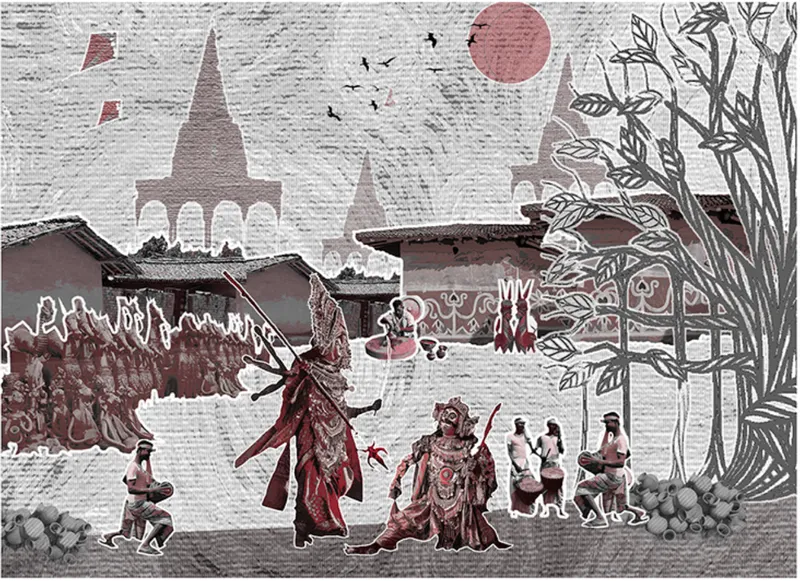
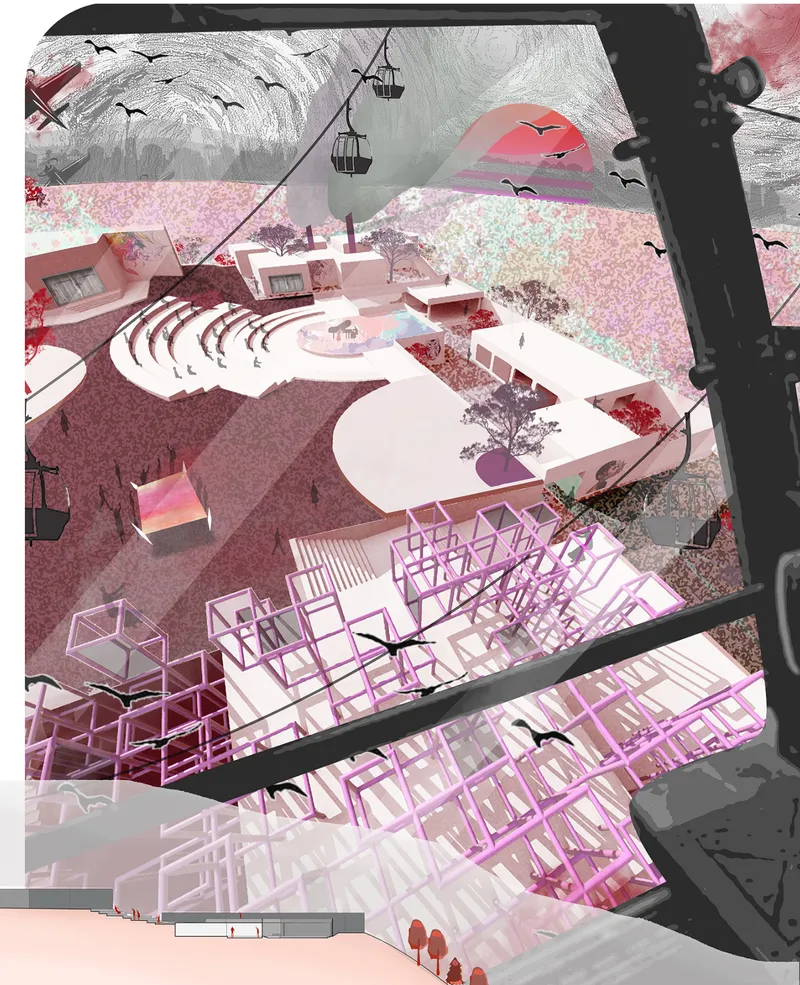
The opening illustration sets the project's emotional register immediately: pagoda-like towers flank a courtyard alive with performers and spectators beneath a red sun and circling birds. It signals a campus where cultural exchange is not sequestered inside white-box galleries but happens outdoors, at grade, in the thick of daily life. The aerial axonometric drawing pulls back to reveal the full campus, showing how a curved amphitheatre, white gallery volumes, and those distinctive pink skeletal frameworks are knit together by organic pathways. Cable cars glide overhead, connecting Tagore Hill's topography to the broader city below.
The amphitheatre sits at the core of the circulation system, anchoring the campus as a community-centred space for public gatherings, rehearsals, and casual interaction. Around it, semi-open courtyards and stepped arenas encourage spontaneous performances and discussion. The design principle is clear: freedom of circulation through organic, intuitive pathways that let visitors navigate without prescribed routes.
Terraced Sections That Read the Hillside
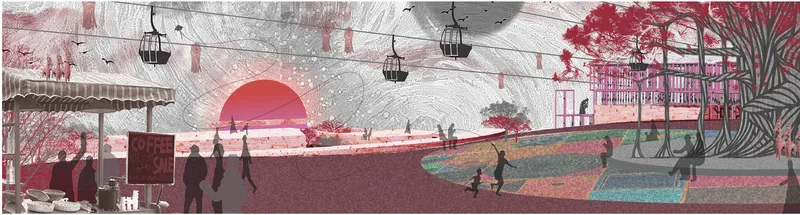
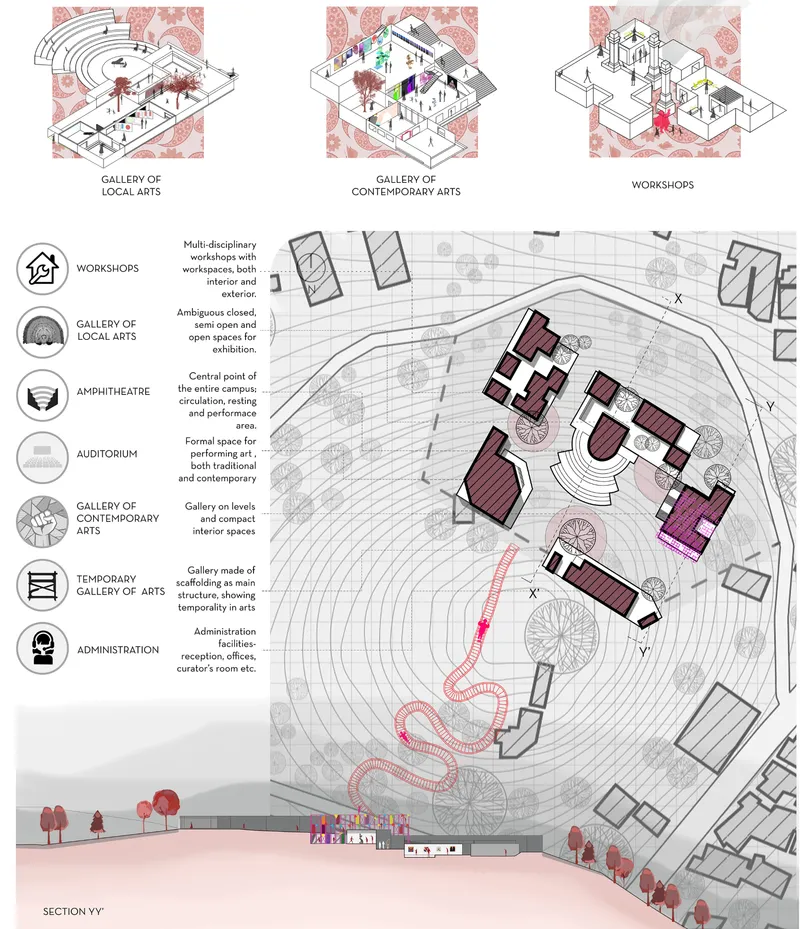
A long section drawing through the campus reveals how the designers read Tagore Hill's contours as a design generator rather than an obstacle. Pavilions step down the terraced landscape, connected by ramps and platforms that double as shaded rest areas and informal performance zones. Cable cars trace a line across the sky, reinforcing the project's ambition to make the hilltop site accessible and visually connected to Ranchi's urban fabric. Figures walk toward a red-lit horizon, placing the visitor's body at the centre of every spatial decision.
The accompanying site plan breaks down the programme into clustered volumes with striped roofs, arranged along a curved pathway and annotated with programme icons. Workshops, galleries, and the amphitheatre are interlinked rather than isolated, promoting fluid movement between learning, observing, creating, and performing. Multi-disciplinary workshops occupy both interior and exterior workspaces, while the Gallery of Local Arts dedicates itself to Jharkhand's indigenous heritage through displays, live demonstrations, and immersive exhibits. The Gallery of Contemporary Arts offers controlled lighting and compact volumes for installations, digital works, and experimental media.
The Gallery Interior: Clouds, Red Geometry, and Curated Light
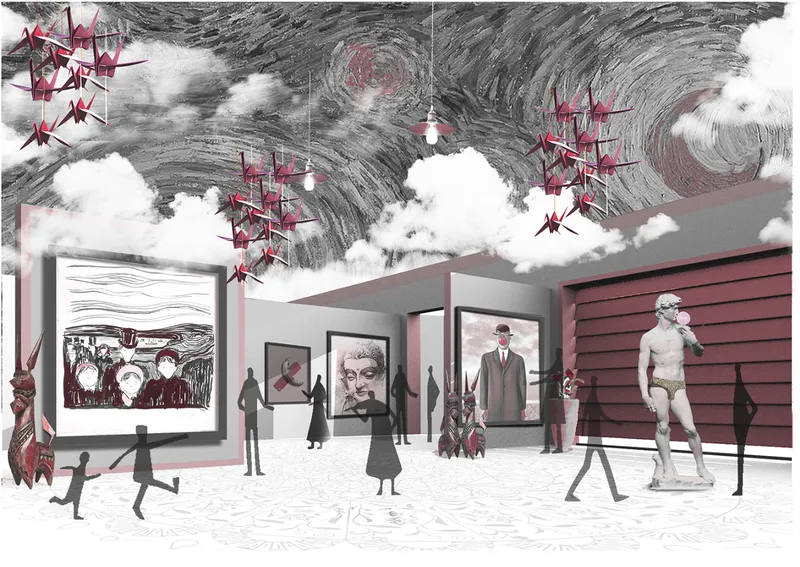
Inside the contemporary arts gallery, the rendering shows white walls framing artworks and sculpture while a ceiling punctuated by angular red forms admits filtered light and, surreally, glimpses of sky and clouds. The controlled lighting strategy is evident: openings and partial enclosures allow the landscape to permeate the built form even in the most curated spaces. Visitors move through levels and compact volumes, encountering art at different scales and heights. The ceiling's red angular geometry echoes the external scaffolding language, maintaining material and formal continuity between inside and outside.
Pink Scaffolding as Architectural Identity
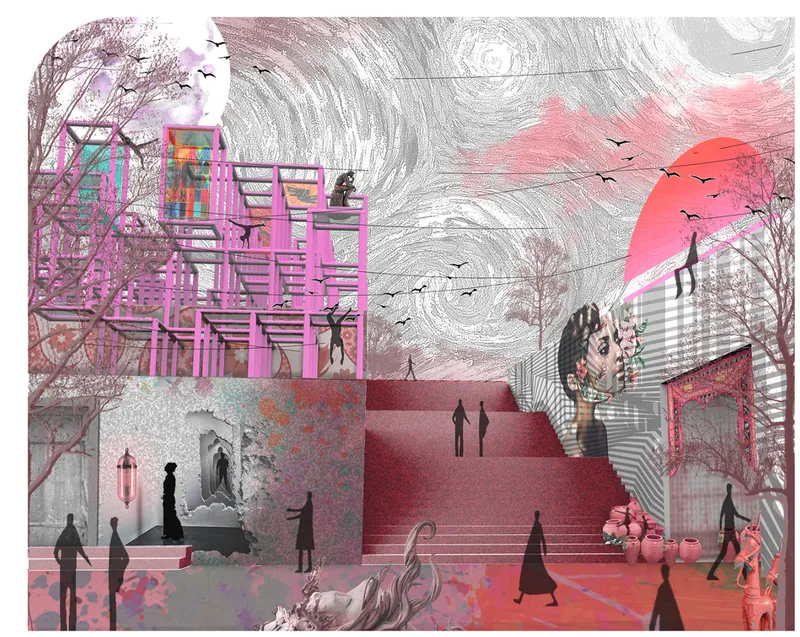
The most striking formal gesture across the campus is the recurring pink scaffolding: open frameworks that function simultaneously as structure, shading device, and artistic expression. In one collage view, grand staircases ascend through these frameworks beneath a swirling sky, with striped volumes and birds adding kinetic energy to the composition. The scaffolding operates as a literal manifestation of the project's core design principle, that structural elements themselves become art rather than merely supporting it.
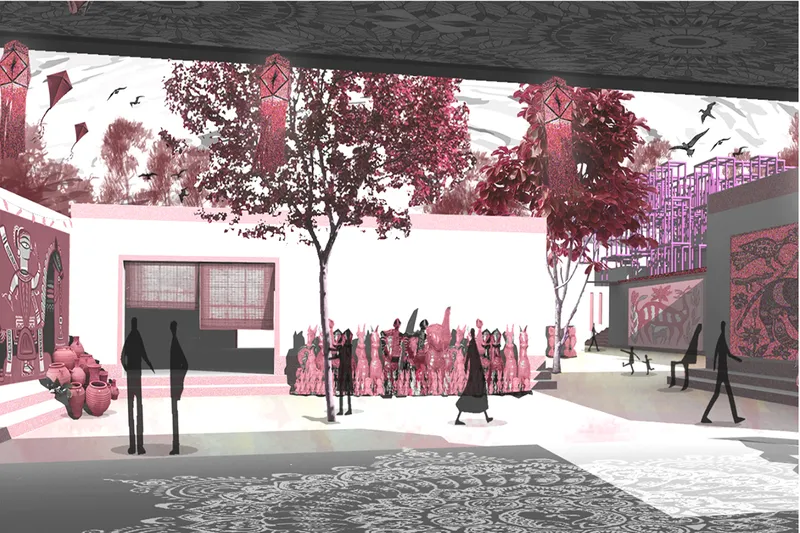
A quieter rendering of a timber-clad courtyard reinforces the other half of the material palette: warm, grounded surfaces that complement the airy scaffolding. Pink-toned trees, silhouetted figures, and white volumes create a meditative outdoor room. Here, the interplay of solid and void is at its most effective. Visual connectivity links every courtyard to the surrounding landscape, and shaded greens invite the kind of spontaneous gathering the designers prioritize throughout their scheme.
Why This Project Matters
Bharat Bhavan Ranchi succeeds because it treats a cultural centre not as a container for artefacts but as an ecosystem for artistic life. The campus is organised around movement, visibility, and encounter. Workshops open onto courtyards. Galleries breathe through their ceilings. The amphitheatre anchors circulation rather than sitting at its periphery. By rooting these spatial decisions in Tagore Hill's topography and Jharkhand's artistic traditions, the designers avoid the trap of producing a generic cultural institution dropped onto any available site.
The pink scaffolding motif deserves particular attention. It signals a willingness to leave architecture visibly unfinished, to frame the sky and the hillside rather than wall them off. That openness mirrors the project's social ambition: dissolving the hierarchy between artist and audience, between curated interior and public landscape. For a competition entry by young designers, it demonstrates a mature understanding that cultural architecture works best when it gets out of its own way and lets people and art occupy the foreground.
View the Full Project
About the Designers
Designers: Pranjal Maheshwari, Eish Ahlawat, Soumyadeep Das, Ipsita Choudhury
Enter a Design Competition on uni.xyz
uni.xyz runs architecture and design competitions year-round that reward proposals with spatial conviction and real site intelligence.
Project credits: Bharat Bhavan Ranchi by Pranjal Maheshwari, Eish Ahlawat, Soumyadeep Das, Ipsita Choudhury Bharat Bhavan 2020 (uni.xyz).



Popular Articles
Popular articles from the community


Conexión: Biophilic Design Reimagines High-Rise Living in Hong Kong
Conexión reimagines high-rise living in Hong Kong through biophilic design, green facades, shared spaces, daylight, water and nature within.

Co-Life: Senior Housing Design That Reconnects Older Adults With the City
Co-Life reimagines senior housing design through healing gardens, shared streets, workshops, and a sustainable community across generations.

The Earth Pod: 3D Printed Homes for Resilient Refugee Communities
The Earth Pod reimagines refugee housing through 3D printed homes made from clay, combining resilience, self-sufficiency, and rapid shelter.

Riyadh For All: Intergenerational Urban Design for Active Aging in Rabat
Riyadh For All reimagines urban design in Rabat with intergenerational co-living, adaptive courtyards, and Moroccan cultural exchange today.


Similar Reads
You might also enjoy these articles
Sustainable Architecture Design: Embracing Nature and Modernity at Villa Solsidan
The article explores Villa Solsidan by AndrénFogelström, showcasing its sustainable architecture design and integration with the natural surroundings in Saltsjöbaden, Sweden.
Scientific and Educational Monitoring Center of the Yenisei, Krasnoyarsk
Architecture as an instrument for ecological research, education, and environmental awareness along Russia’s largest river.
Development of Andretta Artist’s Village, Palampur, Himachal Pradesh, India
Reimagining Andretta as a living cultural landscape where art, architecture, and community converge to shape a global creative village.
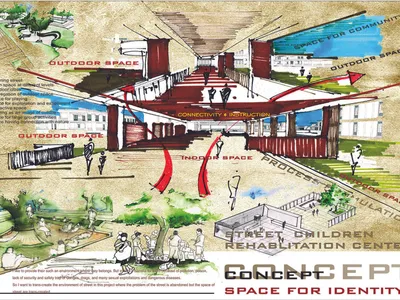
Street Children Rehabilitation Center: A Model of Social Architecture for Community Rehabilitation
An inclusive social architecture project that transforms streets into nurturing environments, restoring dignity, identity, and opportunity for vulnerable children.


Explore Bharat Bhavan Competitions
Discover active competitions in this discipline



Challenge to reimagine the Iron Throne


Photograph architecture without architects


Illustrate the lost glory of Angkor Wat - Render Challenge


Design challenge to reuse E-waste
Comments (0)
Please login or sign up to add comments
No comments yet. Be the first to comment!