
GRAT Renovates a Catalan Farmhouse with Diagonal Geometry and Lime Mortar
Biaix House sits on a pine-clad hill near Barcelona, preserving a masia's silhouette while rethinking its interior logic entirely.


In the municipality of Sant Martí de Tous, west of Barcelona province, a traditional Catalan farmhouse sits on a small hill surrounded by pine forest, olive groves, and one of the area's oldest oak trees. The Aubareda Path winds past it through fields of wheat and rapeseed, through Mediterranean woodland still recovering from a recent wildfire. GRAT was tasked with renovating this masia, and the studio's response was precise: keep the exterior silhouette intact, then completely rewrite the interior with a rotated geometry, traditional lime mortar, and a spatial logic that pulls the regenerating landscape into every room.
What makes Biaix House genuinely interesting is not the preservation itself but the tension between what it preserves and what it invents. The farmhouse reads from the outside as an unremarkable rural building, its stone walls and clay tile roof continuous with the Noya region's vernacular. Step inside, and a diagonal hallway on the upper floor rotates the plan against the perimeter walls, carving out unexpected room shapes and service pockets. The name "Biaix," Catalan for oblique or slant, is literal. The interior doesn't just sit inside the shell; it argues with it.
A Shell That Tells One Story, an Interior That Tells Another
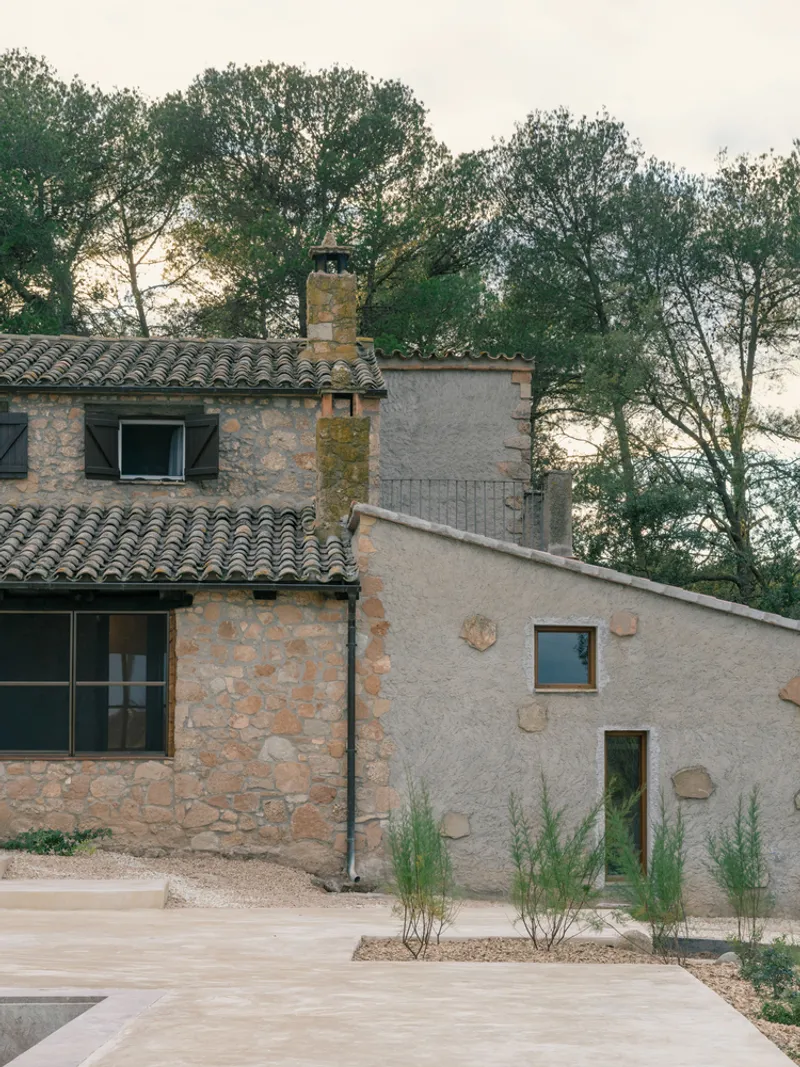
The exterior is deliberately understated. Stone walls, a pitched clay tile roof, and young grasses planted at the base: nothing signals a contemporary renovation. GRAT understands that in a landscape this specific, the building's job is to recede. The recently fire-scarred surroundings are fragile, and the masia's familiar form acts as an anchor of continuity rather than a declaration of novelty.
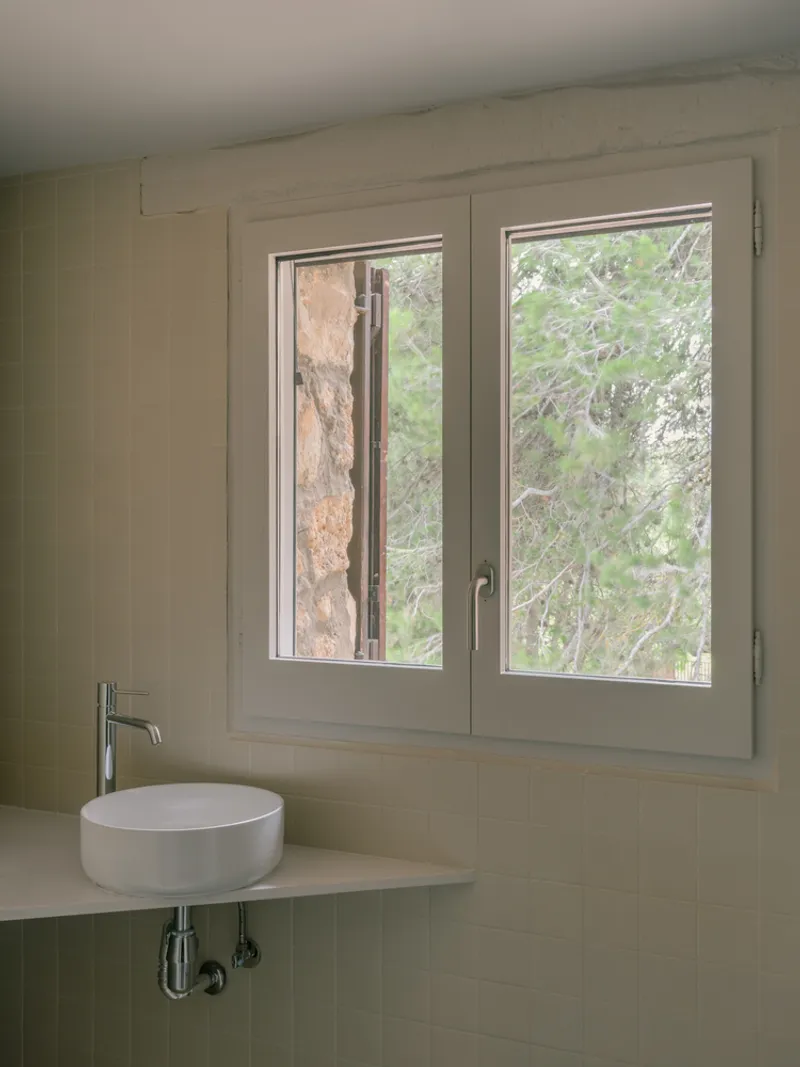
Where the building does speak is through its openings. A bathroom window frames a close view of a rough stone wall and the branches of a nearby tree, turning a utilitarian room into a portrait of its own context. The rear facade opens up substantially, making the ground floor almost entirely exposed to the elements and the seasonal shifts of the landscape. These are not picture windows for scenery; they are calibrated apertures that bind the house to a particular place at a particular time.
Lime, Limestone, and the Argument for Material Continuity
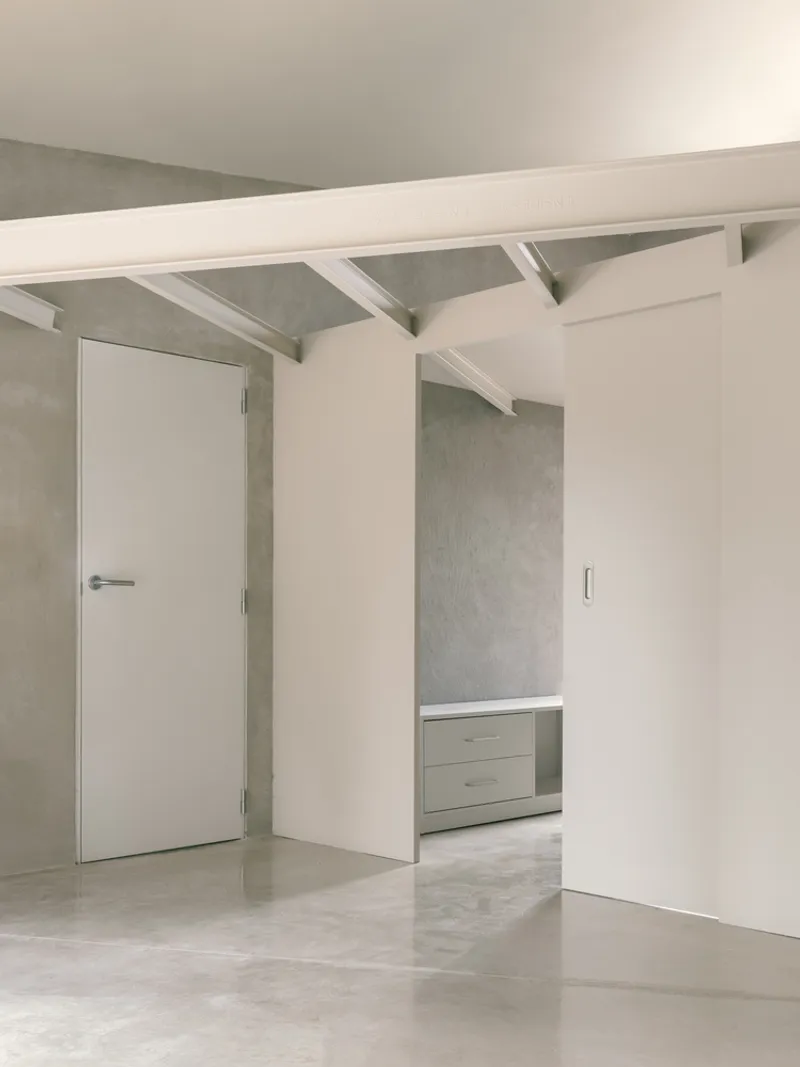
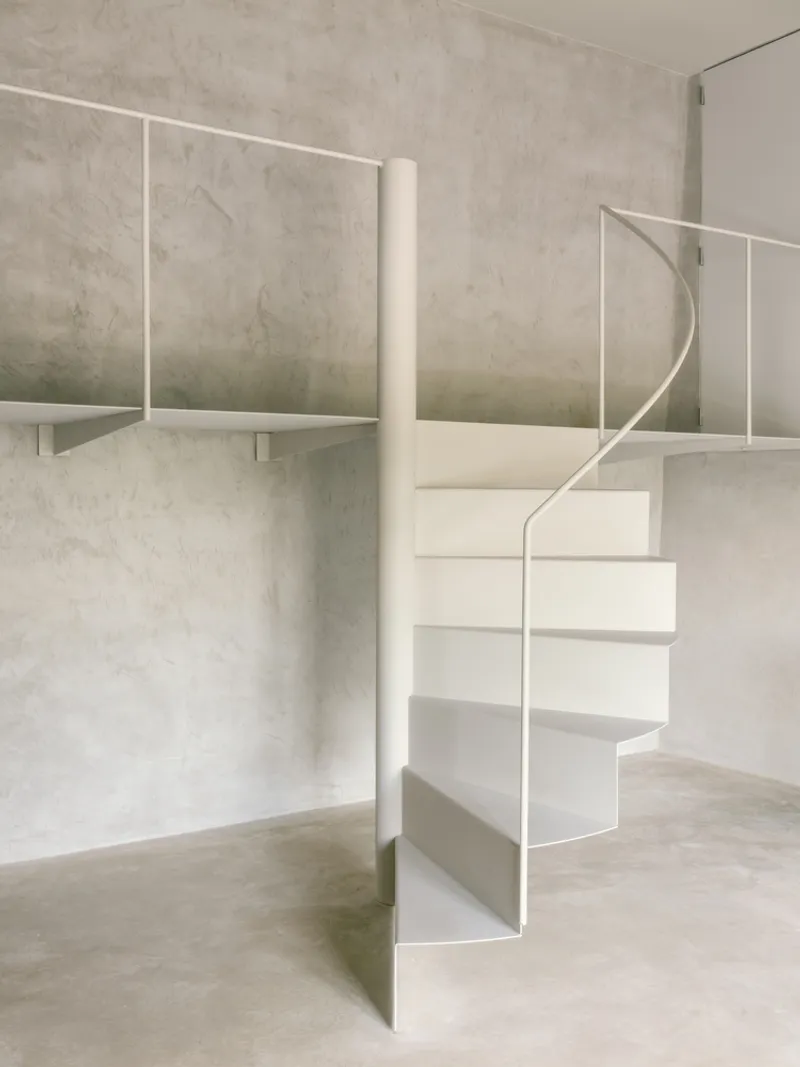
GRAT's material palette is narrow by choice. Lime mortar, once standard in Catalan rural construction, covers the interior walls with a textured grey surface that reads as both old and new. Local limestone, characteristic of inland Catalonia, reinforces the sense that the house was built from its own ground. The polished concrete flooring in the upper hallway catches soft daylight through exposed rafters, creating a measured contrast between smooth and rough, modern finish and traditional structure.
Reintroducing lime mortar is not a nostalgic gesture. It is a technical decision with thermal and breathability advantages well suited to Mediterranean renovation. The material lets moisture pass through stone walls rather than trapping it, a critical factor when working with centuries-old masonry. GRAT treats it as both a practical system and a formal surface, letting its imperfections carry the character that paint would erase.
Color and Warmth Against Austere Surfaces
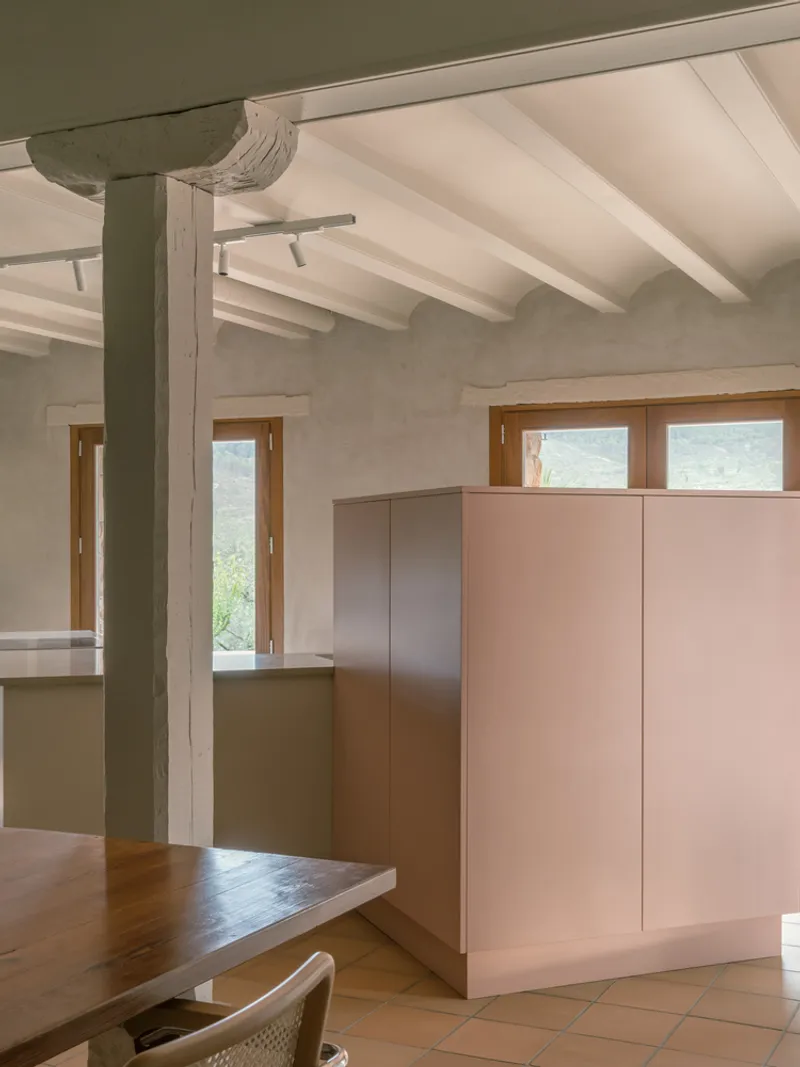
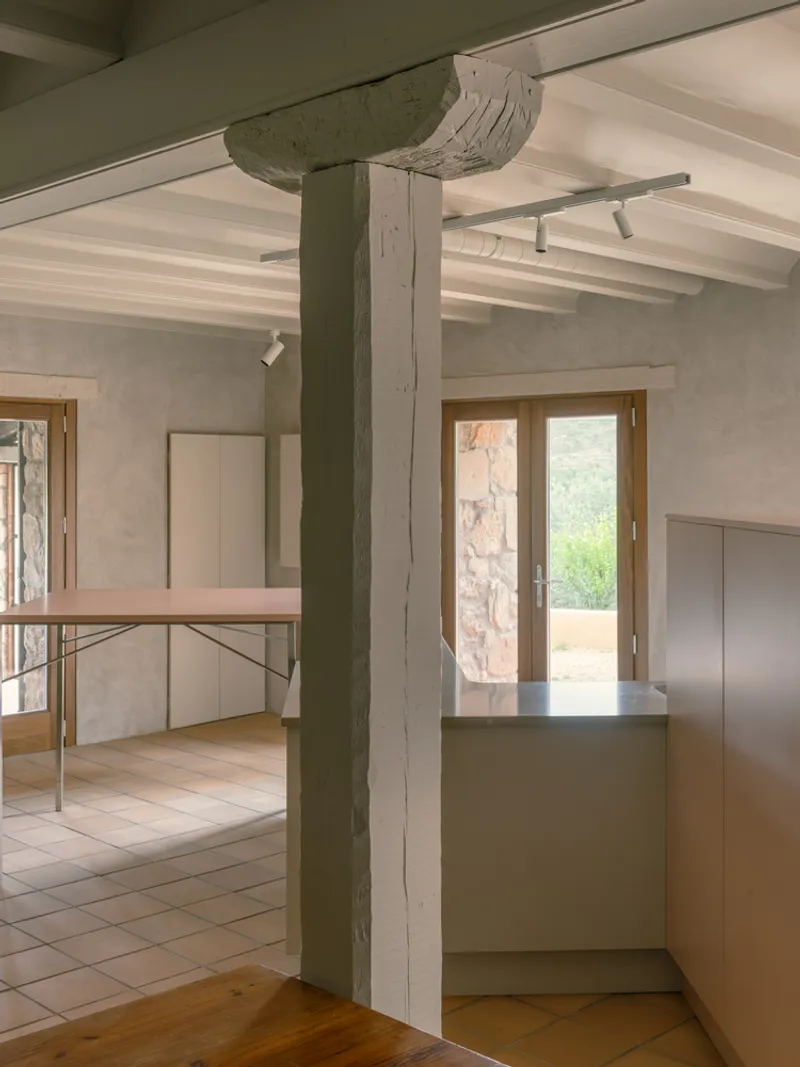
The kitchen is the project's warmest room, and its most surprising. Pink cabinetry sits beneath exposed timber beams and terracotta floor tiles, anchored by a load-bearing timber column that GRAT left visible rather than boxing in. The color choice is deliberate and unapologetic: against the earthy greys of lime mortar and stone, the pink registers as contemporary without being aggressive. A matching pink table extends the palette into the adjacent living space, establishing a domestic identity distinct from the farmhouse's austere exterior.
The timber column, painted white but clearly structural, does double duty. It divides the kitchen from the dining area while reminding you that this is a renovated building with its own skeletal logic. GRAT resists the urge to hide the old structure or to fetishize it. It simply remains, participating in a new composition.
The Spiral Staircase as Hinge
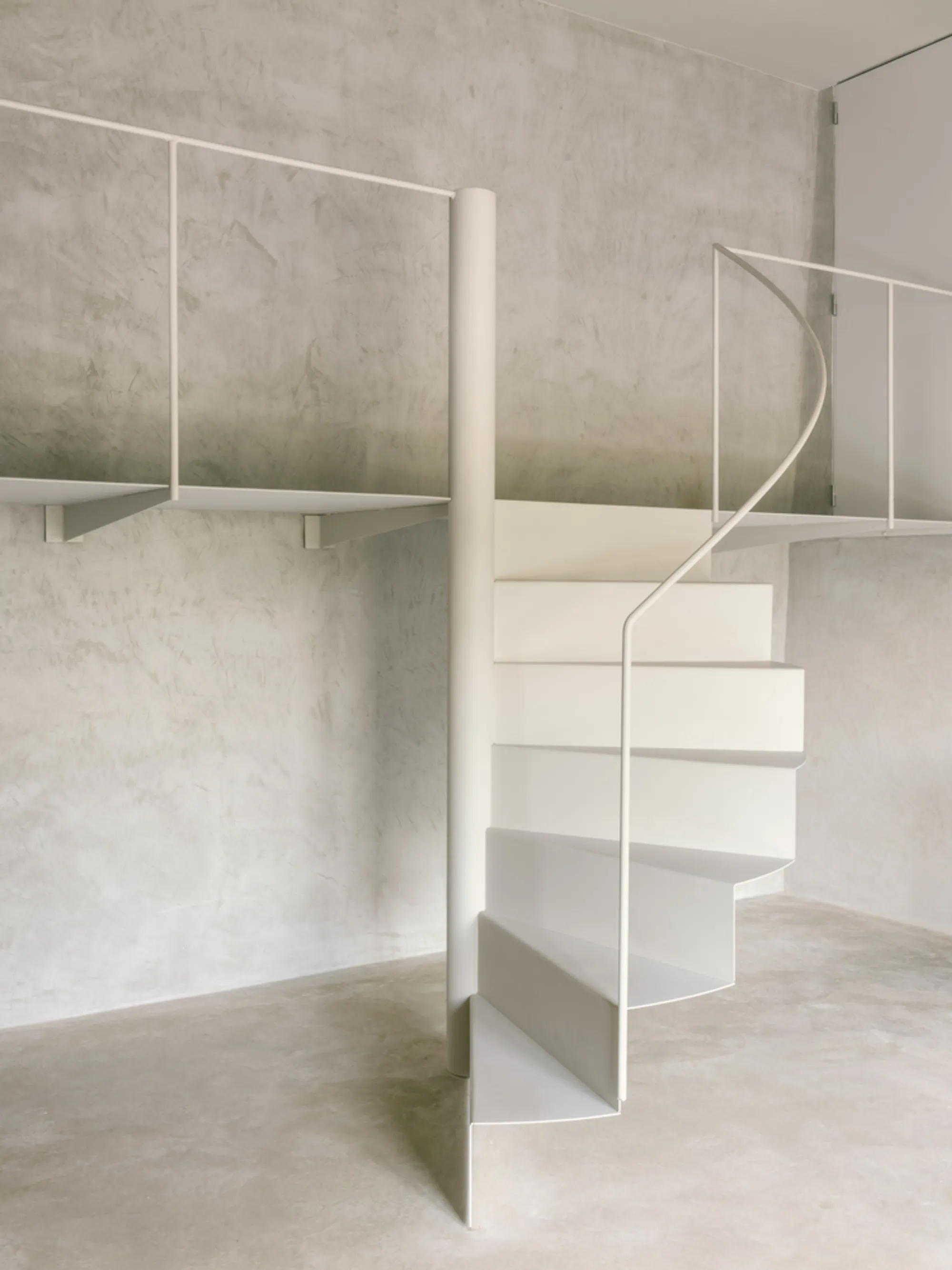
The white metal spiral staircase is the single most overtly modern element in the house, and it earns its prominence. It connects the main farmhouse to an adjacent annex that GRAT converted into additional living space, functioning as a vertical hinge between two volumes that were never originally designed to communicate. Its metallic finish and tight geometry contrast sharply with the textured plaster wall behind it, a collision that feels intentional rather than jarring.
From the mezzanine railing, the staircase reads almost as sculpture. But its real contribution is spatial: it solves the practical problem of linking two independent structures without demolishing walls or adding a corridor. The annex gains autonomy while remaining physically connected to the main house, a useful arrangement for a family that might need flexible boundaries between communal and private life.
Why This Project Matters
Biaix House is a reminder that renovation does not have to mean reverence. GRAT kept the farmhouse's silhouette, respected its materials, and then introduced a rotated interior geometry that no one looking at the building from the Aubareda Path would suspect. The diagonal hallway on the upper floor is not ornamental; it generates extra room where the original plan could not, turning an orthogonal shell into something spatially richer than it was designed to be.
In a landscape still recovering from wildfire, where oak trees and wheat fields are reasserting themselves, the decision to build quietly matters. GRAT's project argues that the most powerful architectural interventions in rural contexts are the ones that save their ambition for the inside, letting the exterior participate in the slow, collective recovery of a place. The name says it all: the slant is hidden, but it changes everything.
Biaix House by GRAT, Sant Martí de Tous, Barcelona, Spain. Photography by Simone Marcolin.
About the Studio
Share Your Own Work on uni.xyz
If projects like this are the kind of work you want to make, uni.xyz is a place to publish your own, find collaborators, and enter design competitions.



Popular Articles
Popular articles from the community


Co-Life: Senior Housing Design That Reconnects Older Adults With the City
Co-Life reimagines senior housing design through healing gardens, shared streets, workshops, and a sustainable community across generations.

Lunar Spiral: Space Architecture Shaped by the Mathematics of the Universe
Lunar Spiral reimagines space architecture through Fibonacci geometry, lunar regolith, levitating habitats, and self-sustaining Moon living.

Co-life: Sustainable Architecture for Age-Friendly Community Living
Co-life reimagines sustainable architecture for seniors through courtyards, rammed earth, shared gardens, and spaces designed for belonging.

Play: Fragments of Their World
Familiar architecture becomes modular playground design, creating safe spaces where displaced children can learn, connect, imagine and play.

Similar Reads
You might also enjoy these articles


Hodi-Mandai Geram
Project Function: Preservation and revitalization of the Intangible heritage and socio-spatial identity of the Hodi by Housing, Cultural Memory Center, Sacred Grove, landscape, local tourism economy


Olio Towers: A Mid-Rise for Performers That Fuses Housing, Rehearsal, and Stage
Located blocks from Houston's Theater District, this modular tower stacks living units around a central performance atrium.

Oasis: Modular Green Housing Carved into Dhaka's Urban Fabric
A shortlisted Plugin Housing entry reclaims unauthorized settlements in Dhaka with stepped concrete volumes, green roofs, and ventilation-driven design.

Black Hole: A Floating Megastructure for the Post-Physical Era
Emiliano Mazzarotto envisions a spherical, self-scaling arena where e-sports, digital hotels, and holographic stadiums replace traditional public space.


Explore Romanian Architecture Competitions
Discover active competitions in this discipline



Challenge to reimagine the Iron Throne


Photograph architecture without architects


Illustrate the lost glory of Angkor Wat - Render Challenge


Design challenge to reuse E-waste
Comments (0)
Please login or sign up to add comments
No comments yet. Be the first to comment!