
BIG-Designed Integrated Sciences Center in California Begins Construction
Innovative Design Promises Cutting-Edge Research and Collaboration for Scientists

Claremont McKenna College is embarking on a new chapter with the launch of the Robert Day Sciences Center, a series of campus improvements set to be finished in 2024. This building, designed by the renowned BIG | Bjarke Ingels Group, pays tribute to CMC alumnus Robert Day '65 P'12, who served as a 52-year trustee and Chairman of the W.M. Keck Foundation. With the aim of achieving LEED Gold certification, this state-of-the-art facility will be a hub for a community of 1,400 students.
“Transformational programs inspire path-breaking architecture. The iconic Robert Day Sciences Center will be home to the College’s next-generation Kravis Department of Integrated Sciences, a powerful, multi-disciplinary, computational approach to the grand socio-scientific challenges and opportunities of our time—gene, brain, and climate,” says Hiram E. Chodosh, President, Claremont McKenna College Robert Day Sciences Center.
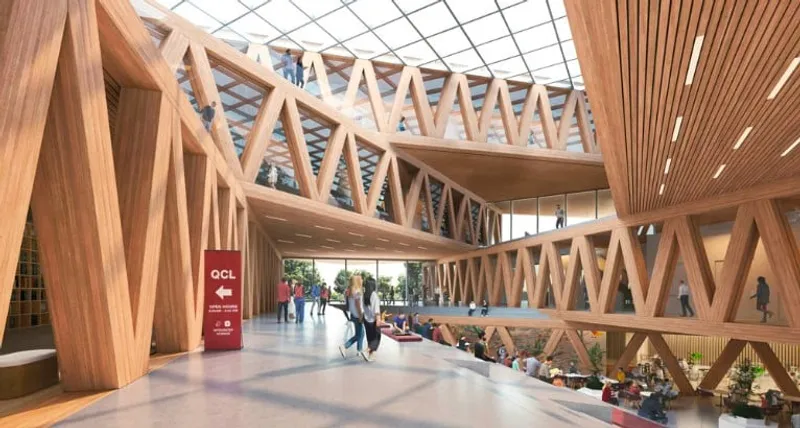
“More than ever, we are seeing the confluence of previously distinct disciplines: breakthroughs in computer and data science lead to breakthroughs in the natural and life sciences. As a consequence, we need to provide spaces for the integration of these previously siloed sciences. The architecture for the new Robert Day Sciences Center’s seeks to maximize this integration and interaction. The labs and classrooms are stacked in a Jenga-like composition framing a column-free, open internal space with the freedom and flexibility to adapt the ever-evolving demands of technology and science. Each level of the building is oriented towards a different direction of the campus, channeling the flow of people and ideas internally between the labs and the classrooms as well as externally between the integrated sciences and the rest of the campus. It is our hope that the building will not only provoke new conversations between scientists but that it may also stimulate the rest of the liberal arts students to take a deeper interest in the sciences and vice versa. The analytical embracing the experimental – rationality intersecting with creativity,” says Bjarke Ingels, Founder and Creative Director, BIG-Bjarke Ingels Group.
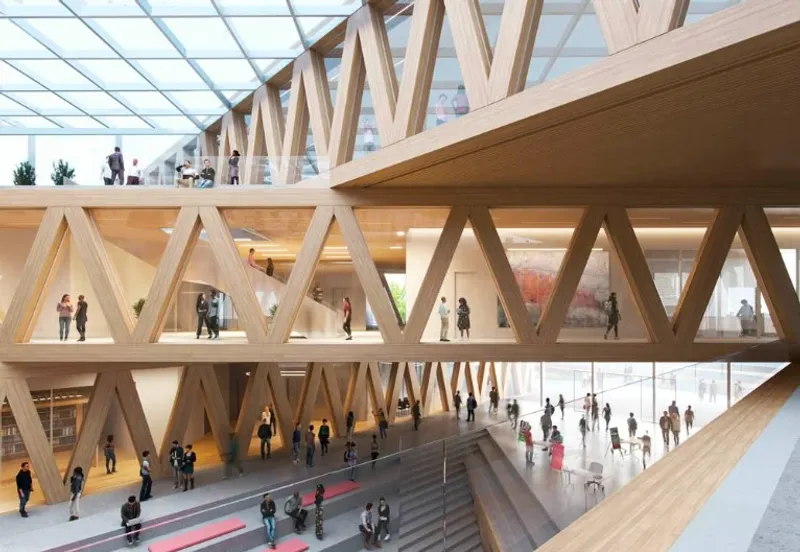
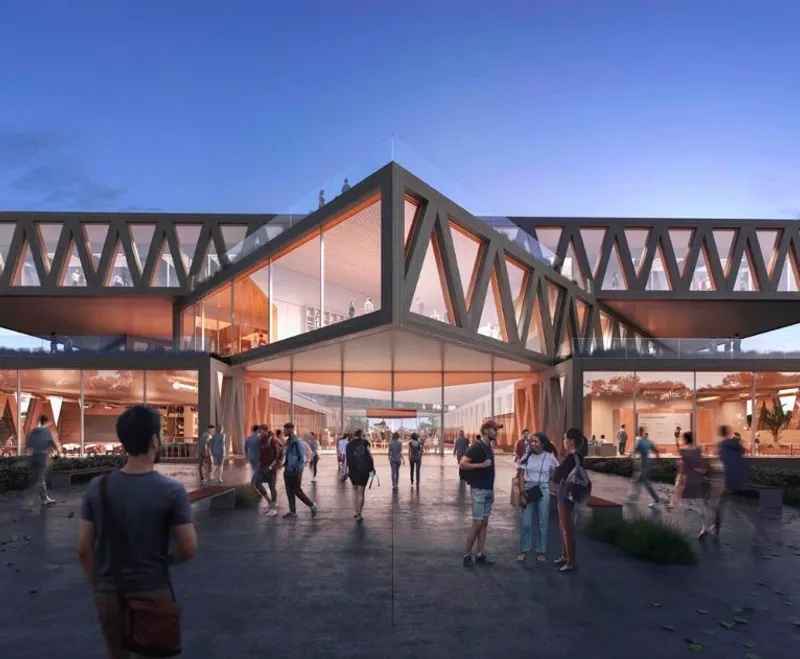
The Robert Day Sciences Center and Kravis Department of Integrated Sciences mark a major milestone in the College's approach to education, bringing together the sciences, computation, humanities and social sciences to tackle important scientific themes and challenges. Located on the eastern edge of Claremont McKenna College, with stunning views of Mt. Baldy, the building serves as a prominent entrance to the campus and fosters strong connections with other academic departments.

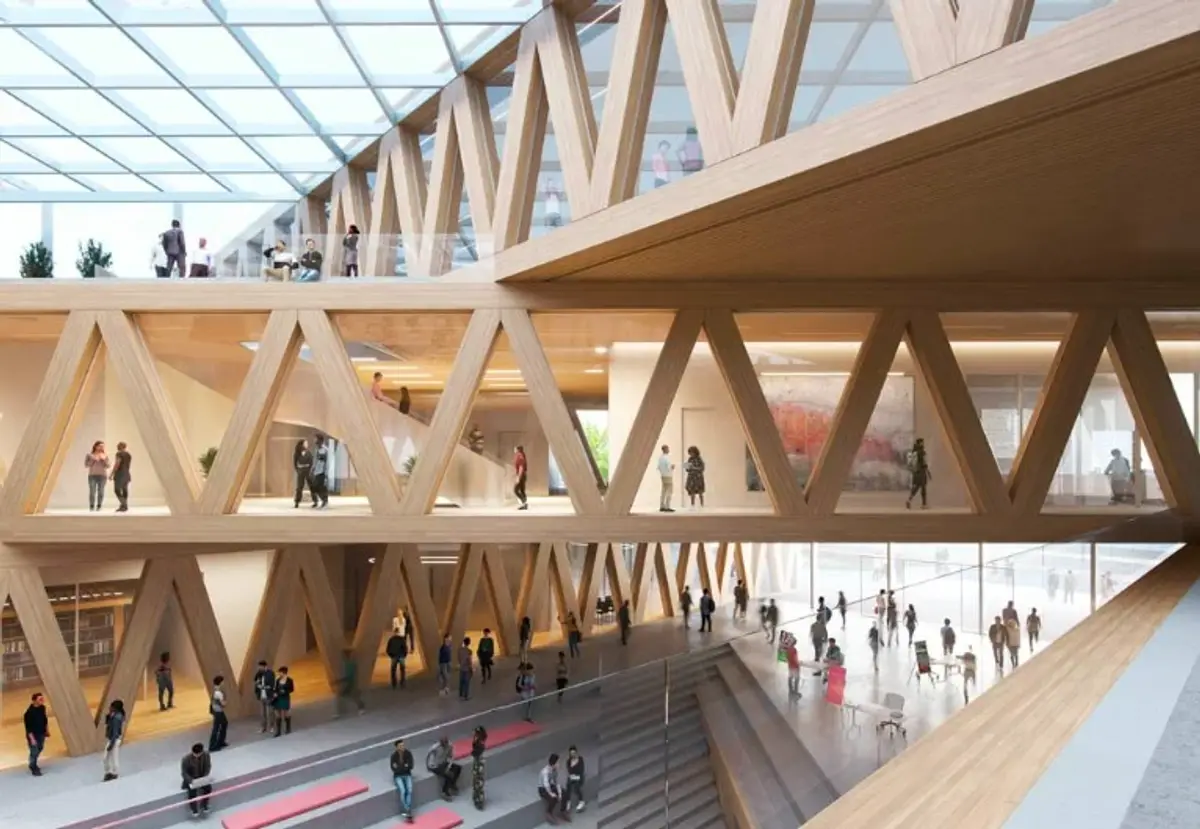
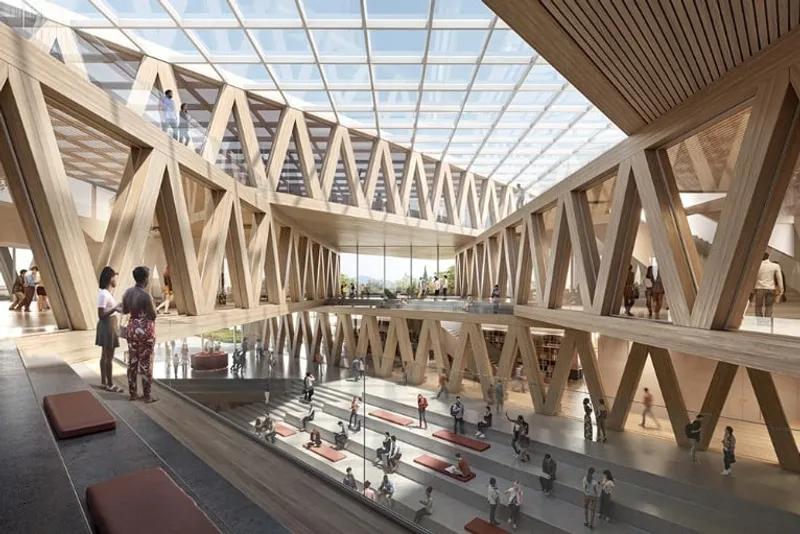
Designed as two stacked rectangular blocks, each floor's pair is rotated 45 degrees from the previous, resulting in a central, sky-lit atrium that provides a glimpse into the classrooms and research spaces from all levels. The interior features a combination of wood-clad trusses on the long edges and floor-to-ceiling glass facades on the shorter sides.
Upon entering the building, students are greeted by a full-height atrium filled with open spaces for collaboration, reflecting both the architectural and educational philosophy of the centre.
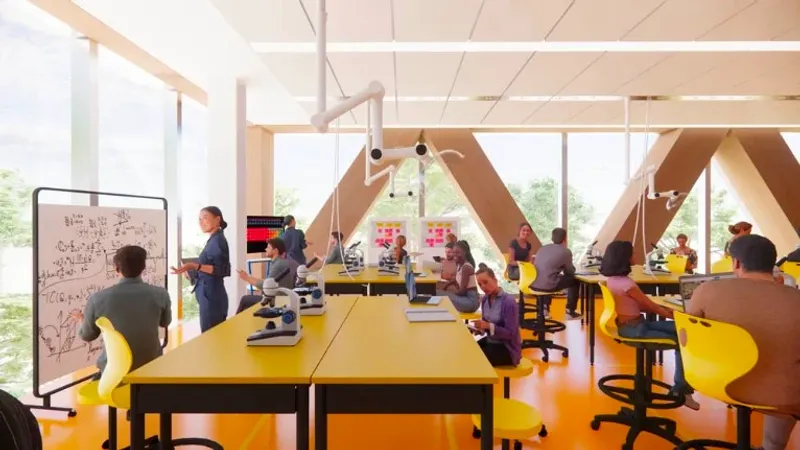
“Today more than ever, an interdisciplinary approach to the sciences is vital to tackling the world's biggest challenges such as health, climate, and misinformation. By literally stacking disciplines together, the building becomes an expression of collaboration and a crossroads for scientific thought. The parallel wings extend the historical framework of the campus mall, then pivot diagonally to face the future of the CMC campus expansion,” says Leon Rost, Partner, BIG.
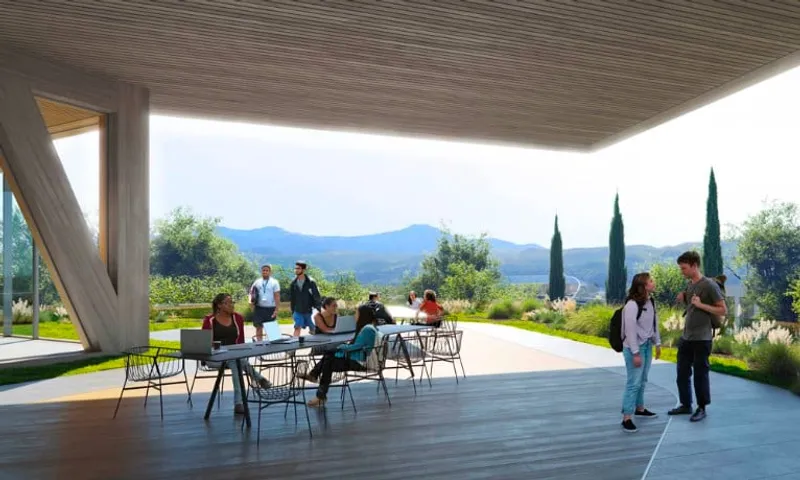
Press release courtesy of BIG | Bjarke Ingels Group
Images ©BIG | Bjarke Ingels Group

Popular Articles
Popular articles from the community


Jaramillo Van Sluys Arquitectura and Urbanismo Turn a Demolished Registry Lot in Quito into an Orchard Plaza
In Quito's Centro Histórico, a 2,800 m² plaza exposes the San Agustín convent wall and redraws its lost Augustinian orchard in volcanic stone.

David Ortega Stacks a Two-Story Mexico City Penthouse Around a Steel Stair and a Pergola-Shaded Roof Terrace
In Colonia Roma, a 300 m² penthouse uses oak joinery, a planted steel stair and a slatted roof pergola to make a new-build apartment feel like a house.

U.GA Architects Wraps an Oval Rooftop Pool in Curved Board-Formed Concrete on Busan's Jeollidan-gil
In Busan's Jeonpo-dong, a 454 m² mixed-use block stacks a neighborhood facility, guest rooms and an oval rooftop pool inside spiraling concrete walls.

Cube Design Draws an Ecological Corridor Between Two Shenzhen Hills with the Nankai Building
Beside Shenzhen's container docks, the Nankai Building pairs stacked balconies with a climbing green screen to connect two hillsides across its height.

Similar Reads
You might also enjoy these articles


Rede Arquitetos Turns Circulation into Civic Space at the Educar II SESC School in Fortaleza
In Fortaleza, Brazil, Educar II SESC-CE trades a signature form for mesh screens, yellow thresholds and courtyard walkways built for equatorial heat.
116 Rokeby Building, Collingwood
Sustainable Collingwood office building featuring double-skin façade, natural ventilation, rooftop amenities, and carbon-neutral design focused on wellbeing and longevity.
Contemporary Apartment Renovation in Spain: RV House by BIAN Opens Up to the Sea
A minimalist 1930s apartment in Santander is transformed into a flexible, sea-facing home through contemporary Spanish renovation.
3 Marías House: A Contemporary Mediterranean Courtyard Retreat by Bajet Giramé + Burckhardt
Mediterranean courtyard home blending traditional architecture with modern design, terracotta flooring, flexible interiors, sustainable climate strategies, and garden integration.

Explore Architectural Science Competitions
Discover active competitions in this discipline


Challenge to reimagine the Iron Throne

Photograph architecture without architects

Illustrate the lost glory of Angkor Wat - Render Challenge

Bring back Drive In's
Comments (0)
Please login or sign up to add comments
No comments yet. Be the first to comment!