
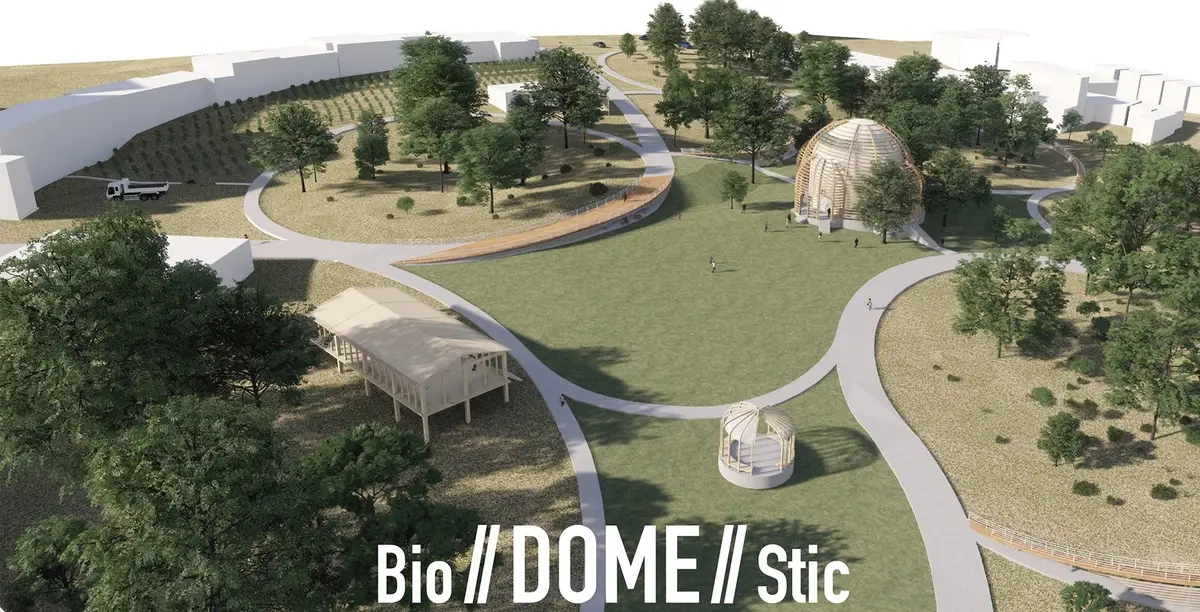
Bio // DOME // Stic: Seven Living Domes Turn an Ethiopian Chapel Site into a Growing Forest
An Honorable Mention at Eco-Chapel, this proposal plants seven vegetal domes around a timber chapel, letting native forest carry the sacred story.


Most chapel proposals spend their energy on the building. Bio // DOME // Stic spends it on the ground around the building. The chapel still sits at the centre, but the real argument is made in the soil: seven planted 'Eco-Domes' and a scatter of circular Tree Islands that, over years, are meant to grow into dense clusters of native forest. The dome becomes a figure that architecture and vegetation share, and the sacred is spread across the landscape instead of being locked inside four walls.
Designed by Jeremy Chan, Wai Ching Lo and KaCheong Chan, the project received an Honorable Mention in the Eco-Chapel competition. It is set in Ethiopia and starts from a specific problem: urban populations are losing touch with indigenous landscapes. The team's response is to use religion as a cultural anchor, a reason for people to come back to the land, while the architecture serves as a catalyst for regeneration, education and community life.
A Masterplan Organised by Tree Islands, Not Axes
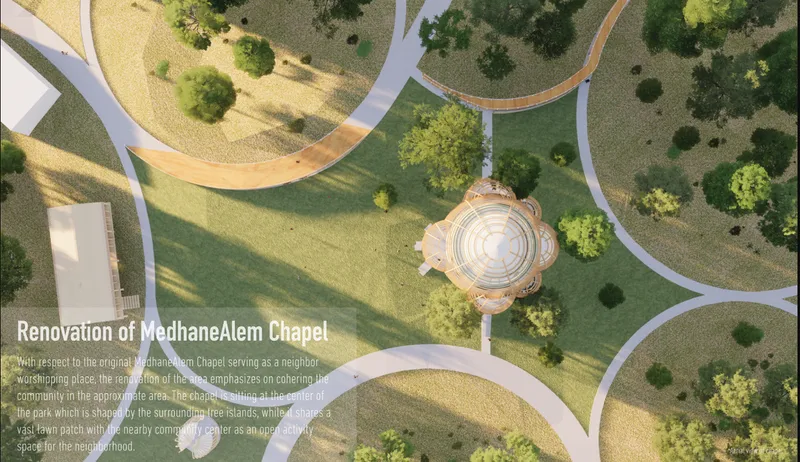
The aerial plan shows the logic plainly. The domed chapel sits in an open lawn, and curving paths and ringed clusters of trees spread outward from it. The designers keep the existing vegetation and add circular Tree Islands that organise the site both spatially and ecologically. Circulation threads between these islands and follows the natural topography rather than imposing a ceremonial axis. Arrival becomes a gradual unfolding, with the chapel appearing and disappearing between canopies.
This is a confident departure from the processional route that sacred architecture usually relies on. With no single approach, the landscape has to do the work of building anticipation, and that makes the planting a matter of experience as much as of ecology. The plan describes a ground that is calm at the centre and active at the edges, with room for both contemplation and everyday use.
Seven Domes, Built and Grown
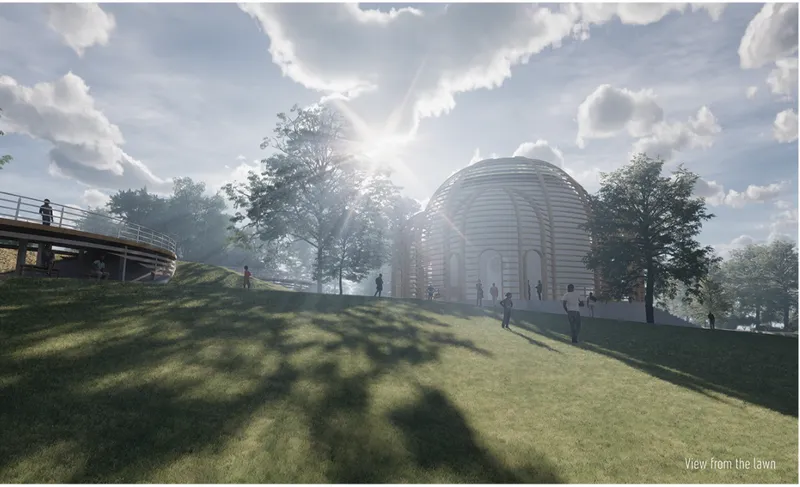
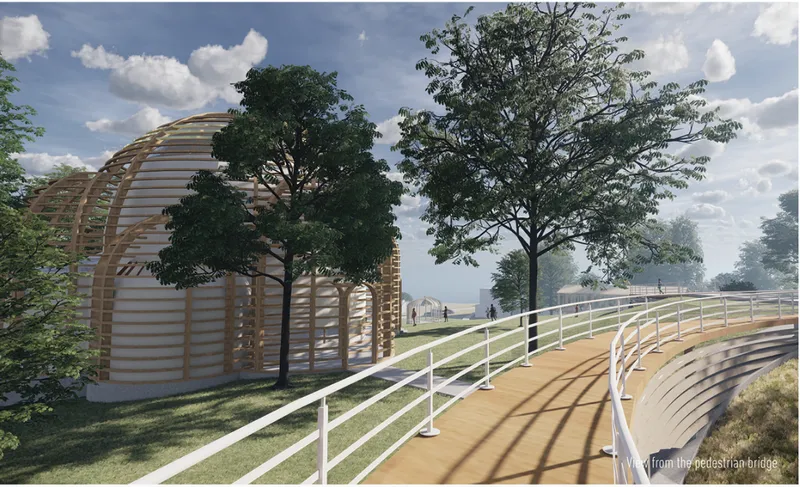
The chapel follows traditional Orthodox principles and is assembled from three elements: base, domes and frame. It uses a seven-dome configuration in which the main dome anchors the composition and secondary domes mark entrances and circulation. The renderings show a ribbed timber dome on a sloping lawn, its structure legible against the sky, and then the same form beside a curving wooden bridge under tall trees. Inside, the plan is circular to support collective gathering, and an opening at the apex brings in light that shifts across the room through the day.
The project becomes properly interesting when that number seven leaves the building. Seven Eco-Domes, plantation zones that reproduce the dome in vegetation, are placed across the site in reference to the Orthodox symbolism of the Seven Heavens. The built dome and the planted dome speak the same language, so a visitor walking the paths sees the chapel's geometry repeated in living form. The symbol works on two levels at once, as a reading of theology and as a habitat structure.
Pavilions That Keep the Community on Site
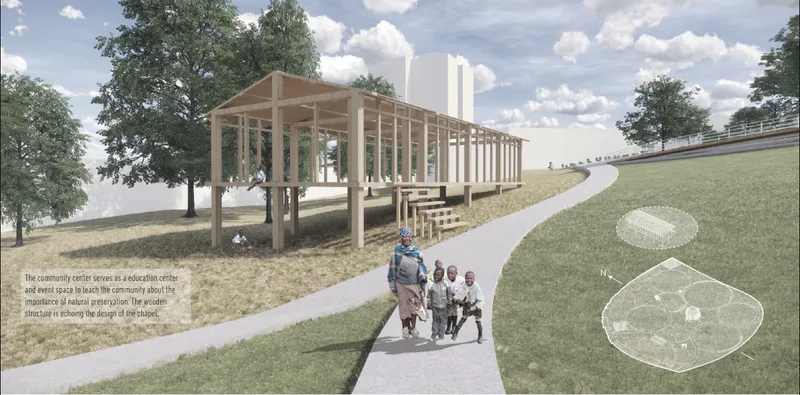
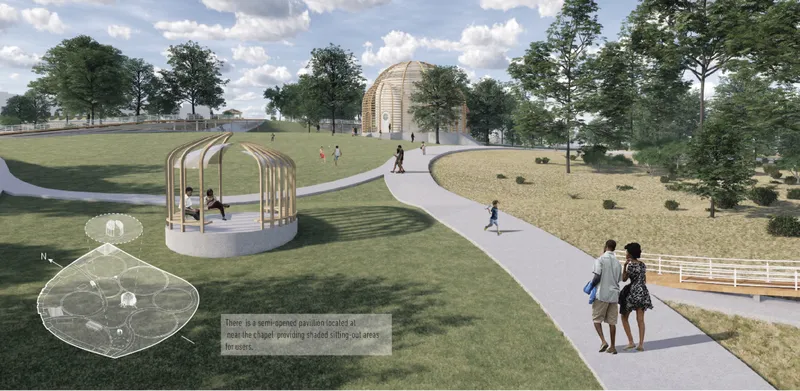
Smaller structures are scattered along the paths, and they matter more than their size suggests. One render shows a raised timber community pavilion on stilts with a family passing below. Another shows a small arched timber pavilion on a round concrete base, set so that its frame points toward the distant dome. These are the places where the project's ambitions for education and communal engagement actually happen, out among the planting rather than inside the chapel.
The arched pavilion is a modest but effective move. Because it repeats the curved profile of the chapel at a much smaller scale, it ties the outer edges of the site back to the centre. Lifting the larger pavilion on stilts keeps it light on the ground, which suits a scheme so attentive to what grows beneath it.
A Walkway Layered Over the Slope
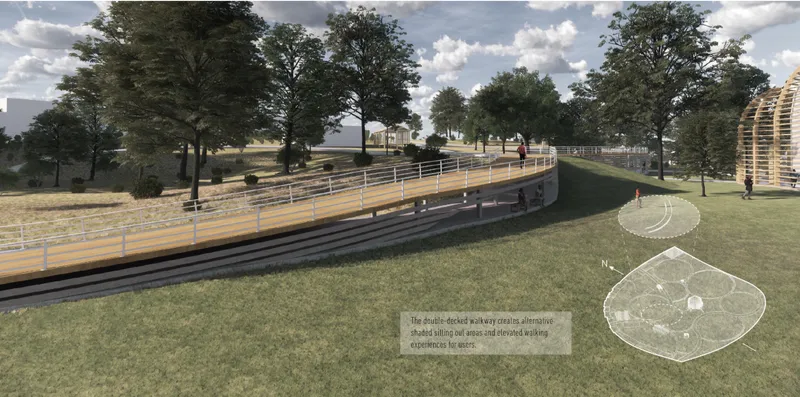
The double-decked walkway carries the topographic strategy into section. A timber deck with white railings curves above a grass slope, and trees run along its upper level. Splitting movement across two heights lets people experience the landscape at different elevations, sometimes among the canopy and sometimes looking across the lawn, without cutting the slope or levelling the ground. Here the non-linear circulation described in the plan becomes a spatial experience you can walk.
Planting as Infrastructure, Measured in Years
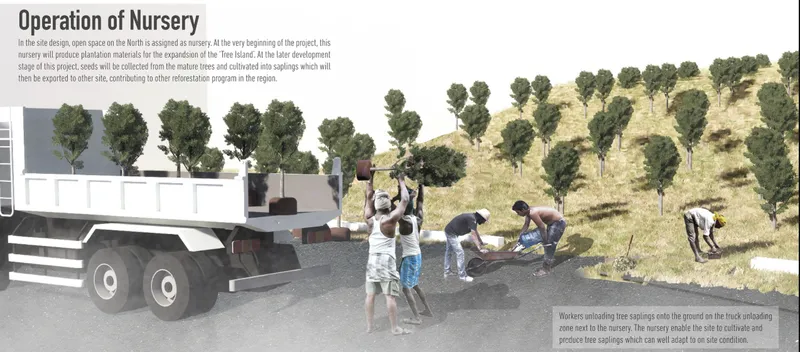
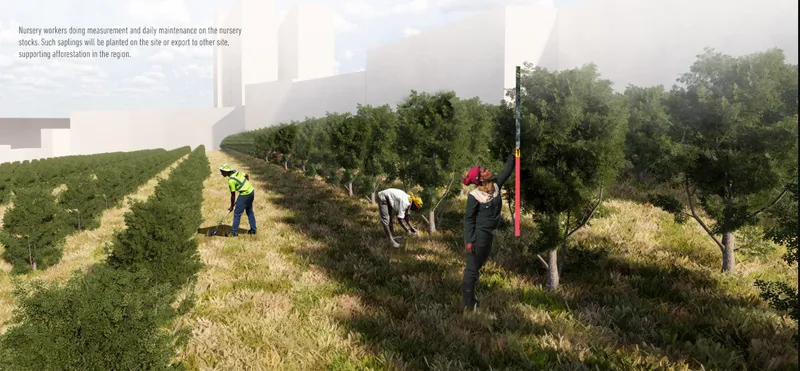
The final renderings leave out finished architecture entirely and show labour instead: workers unloading saplings from a truck onto gravel, and nursery staff measuring rows of young trees with a red pole. That choice is deliberate. The team treats landscape as primary infrastructure, with a planting strategy modelled on Ethiopia's native forest types, in particular the Dry Evergreen Afromontane Forest. Species are chosen for low maintenance and high ecological performance.
A growth timeline sets out how the site should develop, with the Eco-Domes thickening over time into dense ecological clusters. The chapel is ready on opening day, but the project as a whole is not, and the designers accept that openly. What they are proposing is a long-term environmental intervention in which the most important material arrives as a seedling.
Why This Project Matters
Bio // DOME // Stic shows how a symbol can be put to work. The Seven Heavens could easily have stayed a decorative reference, but here they set the number and placement of planted zones that restore native forest. The religious programme gives the ecological programme a cultural reason to exist, and the ecology in turn gives the chapel a landscape worth gathering in. Each makes the other stronger.
The proposal also takes on something most competition entries avoid: time. By putting saplings and nursery workers in the same set of images as the finished dome, the team admits that the site's character depends on decades of growth and care. That honesty is its strongest quality. The project describes a sacred place that is gradually grown and tended rather than simply built and handed over, and it gives the community an ongoing role in that process.
View the Full Project
About the Designers
Designers: Jeremy Chan, Wai Ching Lo, KaCheong Chan
Enter a Design Competition on uni.xyz
uni.xyz runs architecture and design competitions year-round that reward proposals with spatial conviction and real site intelligence.
Project credits: Bio // DOME // Stic by Jeremy Chan, Wai Ching Lo, KaCheong Chan Eco-Chapel (uni.xyz).


Popular Articles
Popular articles from the community


Juan García Correa, John González and Claudia Rueda Sink a Circular Amphitheater into a Manizales Engineering Building
On the La Nubia campus in Manizales, Colombia, the S1 Building folds labs and offices into a hillside of ramped lawns that double as a campus route.

David Macias Steps a Doorless Stone and Plaster House Down a Tropical Colombian Hillside
In the humid hills of Colombia, Threshold House replaces the front door with an open void and terraces its 850 m² down the slope instead of fighting it.

Architekt Andreas Gruber Scatters 23 Dark Timber Chalets Across a South Tyrolean Forest Edge
In Molini di Tures, Amonti Chalets breaks a resort into a hamlet of gabled timber houses, with parking, storage and services pushed into the slope.

GROUP A Strips a 1969 Rotterdam Harbor Headquarters to Its Frame and Wraps It in Timber Louvers
In Rotterdam's M4H harbor district, Ferro Offices reuses a 1969 frame, adds one timber storey and reaches BREEAM-NL Outstanding.

Similar Reads
You might also enjoy these articles
Healing Façade: A Modular Chapel System That Restores Ethiopia's Sacred Forests
Winner of the Eco-Chapel competition, this circular timber façade collects water from air to rebuild soil and reforest degraded Ethiopian landscapes.
Kaffeebühnen: Where Coffee Shop Architecture Becomes a Civic Stage in Vienna
A linear sequence of timber boxes, transparent shells, and open yards turns the Viennese café tradition into a public performance space.
Eco Chapel: A Modular Forest Pavilion That Grows Like the Landscape It Protects
Hexagonal timber modules weave through existing trees, turning a chapel into a living system for prayer, education, and reforestation.


Urban Forest: A Vertical Ecosystem for 5,000 Workers in Singapore's Changi Business Park
Radially stacked pods and layered green decks turn a 7-acre plot into 47 acres of ecological workspace projected for 2040.

Explore Pyht - Bio Architects Competitions
Discover active competitions in this discipline

Design Challenge - Contemporary interpretation of a religious complex

Design challenge to equip cities with modern furniture

Challenge to reimagine the Iron Throne

Photograph architecture without architects
Comments (0)
Please login or sign up to add comments
No comments yet. Be the first to comment!