

Sailing of Serenity: A Forest School Where Architecture Dissolves into the Canopy
Shortlisted for Bauhaus Neue, this biophilic learning environment nests curved timber and concrete pavilions among dense conifers.


What if the most radical thing a school building could do is disappear? In Sailing of Serenity, the architecture barely registers above the tree line. Curved white roofs slip between conifers, floor-to-ceiling glass walls let the forest walk straight inside, and timber slat enclosures echo the rhythm of surrounding trunks. The proposition is direct: students cannot thrive in spaces that ignore their bodies and minds, so the building itself becomes a therapeutic instrument, calibrated to light, air, and the living canopy.
Designed by Manon Vancaeyzeele and shortlisted for the Bauhaus Neue competition, the project draws on the Man-Nature report to argue that biophilic architecture is not a stylistic choice but a public health strategy. Rooted in Bauhaus ideals of sparking global transformation through design, the scheme reimagines the educational campus as a holistic environment where sustainable materials, organic forms, and open spatial organization work together to counter stress-induced insomnia, neglected hygiene, and the general disconnection that characterizes many contemporary academic settings.
Timber Screens and Concrete Ceilings: An Interior Vocabulary of Warmth and Weight
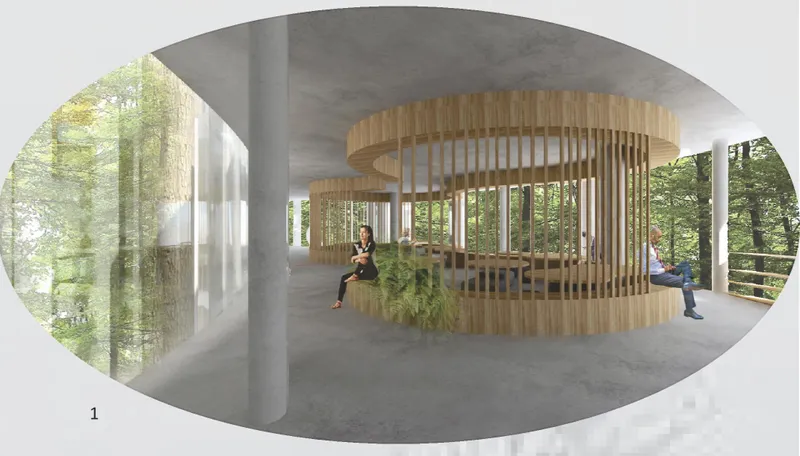

The interior rendering reveals the project's core material dialogue. Curved timber slats form a warm, semi-porous enclosure beneath a heavy concrete ceiling, creating a tension between lightness and mass that keeps the space from feeling either flimsy or oppressive. Beyond the glazing, the forest is not scenery; it is structure, providing visual depth and regulating the quality of daylight that reaches study areas. The aerial view confirms how restrained the footprint is: a single curved white roof emerges from dense fog and coniferous canopy, suggesting a building that defers to its site rather than dominating it.
Fluid Ground Planes: Where Steps Become Seating and Circulation Becomes Pause
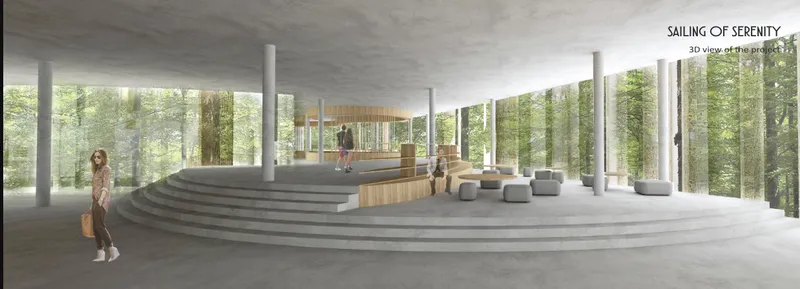
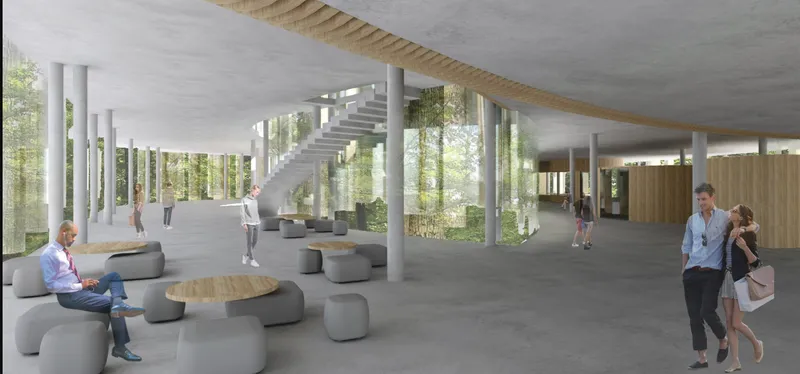
One of the scheme's strongest moves is the refusal to separate circulation from inhabitation. Curved concrete steps cascade through an open interior wrapped in floor-to-ceiling glass, doubling as informal seating and carving out zones for gathering without walls. The column-supported concrete ceiling hovers above an open floor where a helical staircase and lounge seating sit among preserved trees, collapsing the boundary between landscape and interior. Students do not pass through these spaces on the way to somewhere else; the spaces themselves are the destination, designed to slow movement and encourage lingering.
Glass Pavilions at the Forest Edge: Dissolving the Envelope
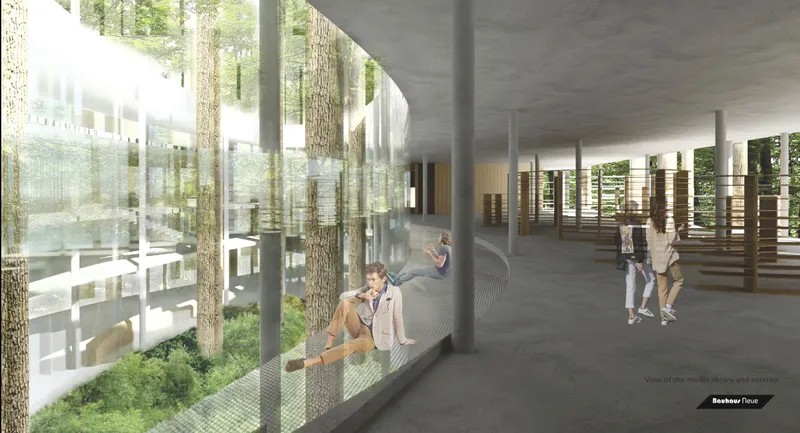
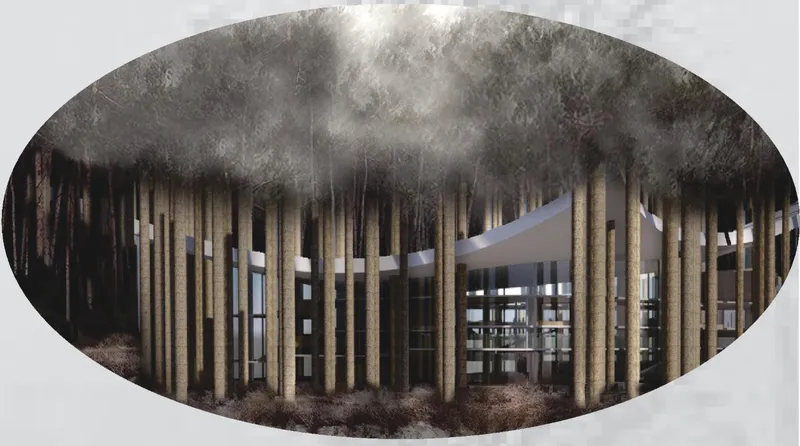
Seen from within, the glass walls frame preserved tree trunks and a curved timber screen that mediates between occupied space and deep forest. The exterior rendering makes the strategy even clearer: the pavilion reads as a glass volume threaded among vertical trunks in heavy mist, its transparency turning the building envelope into little more than a climate membrane. Natural lighting floods every corner without the harshness of conventional classroom fluorescents, and the persistent visual connection to the forest is intended as a low-effort restorative mechanism, the kind of passive wellness intervention that biophilic research consistently supports.
An Oval Auditorium Opens to the Canopy
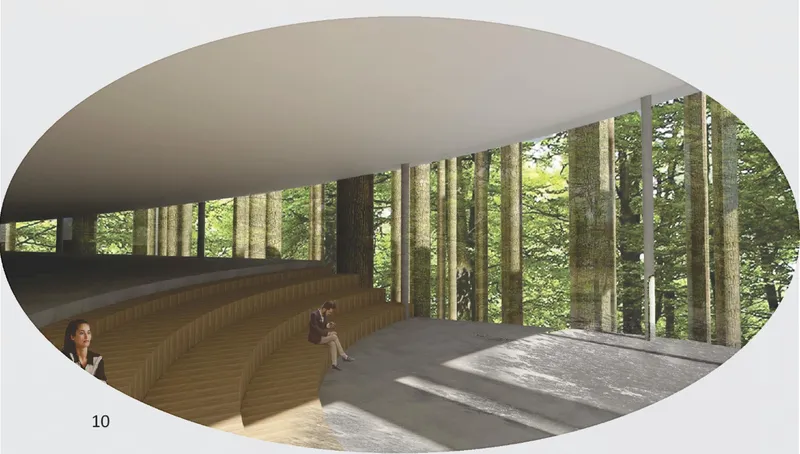
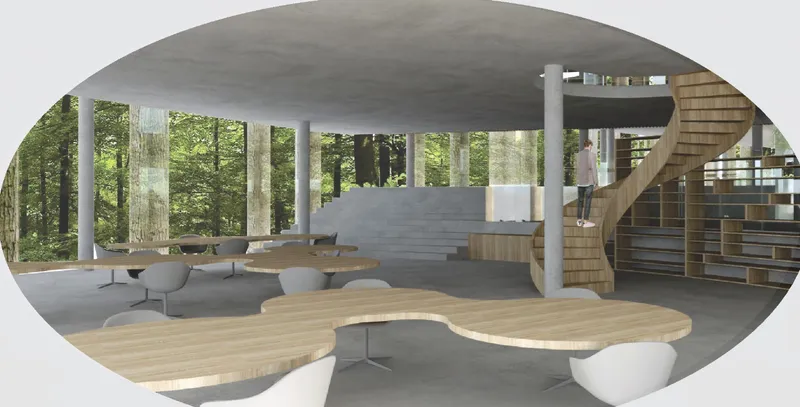
The project's programmatic ambition is most visible in the oval auditorium. Tiered seating faces a tall glass wall that offers a panoramic view into the forest, turning every lecture into a spatial experience that connects intellectual focus with environmental awareness. Below a domed ceiling supported by cylindrical columns, curved timber seating wraps the audience in a warm, enveloping geometry. The effect is communal without being claustrophobic: students sit together in a shared bowl of wood and light, oriented outward toward the living world rather than inward toward a blank screen.
Why This Project Matters
The language of student well-being in architecture often stops at adding a green wall or widening a corridor. Sailing of Serenity pushes further by making the forest itself a co-designer, allowing tree positions to dictate structural grids and letting fog, canopy density, and seasonal light shifts become active ingredients in the spatial experience. The result is a campus where well-being is not an add-on program but the organizing logic of every plan decision.
Vancaeyzeele's shortlisted entry for Bauhaus Neue demonstrates that the Bauhaus call for design to reshape society still has teeth when applied to the most fundamental civic program: education. By grounding biophilic principles in concrete, timber, and glass rather than in abstract rhetoric, the project offers a credible prototype for learning environments that treat mental health, physical comfort, and ecological sensitivity as inseparable priorities.
View the Full Project
About the Designers
Designer: Manon Vancaeyzeele
Enter a Design Competition on uni.xyz
uni.xyz runs architecture and design competitions year-round that reward proposals with spatial conviction and real site intelligence.
Project credits: Sailing of Serenity by Manon Vancaeyzeele Bauhaus Neue (uni.xyz).


Popular Articles
Popular articles from the community


Tsunami Convergenics: Turning Catastrophic Ocean Forces into Underwater Housing Infrastructure
A speculative underwater settlement off the coast of Onagawa, Japan, treats tsunamis and typhoons as energy sources rather than threats.

Singing Woman: Contemporary Architecture Inspired by Estonia’s Voice and the Sea
Singing Woman turns Estonia’s song culture into flowing opera house architecture, blending public life, landscape, sea, and national memory.

The Amber Palace Opera: A Geological Fiction Surfaces on Tallinn's Baltic Waterfront
Pierre Brillard reimagines a Baltic legend as a public landscape, opera house, and waterfront promenade rooted in Tallinn's coastal identity.

Cloaked Colonization: A Mobile Underwater Habitat That Moves Like a Fish
Micah Abaya's shortlisted EHC Pacific entry reimagines ocean settlement as a dispersed network of self-sustaining architectural organisms.

Similar Reads
You might also enjoy these articles

Day and Night Park: A Time-Based Urban Newsstand in Beijing
A temporary urban newsstand in Beijing blending travel, light, and reading through poetic colors, compact form, and community-focused design.

Modernist Patio Renovation in El Masnou, Barcelona by Oliver Segura Arquitectura + Cebrià Arquitectura
Modernist patio renovation blending tradition and innovation with a movable pool, leveled floors, and Catalan materials in El Masnou.

Alto Residencial Coop: Cooperative Housing Development in Santiago de Compostela by Carbajo Barrios Arquitectos
A linear cooperative housing complex blending white volumes and perforated metal façades, enhancing community living, natural light, privacy, and urban integration.

Vil Genis School by BPA ARCHITECTURE – Massy, France
Vil Genis School in Massy, France, features sustainable design, south-facing classrooms, community integration, accessible spaces, and modern educational architecture.

Explore Biophilic Competitions
Discover active competitions in this discipline

Challenge to design public laboratory

Challenge to reimagine the Iron Throne

Photograph architecture without architects

Illustrate the lost glory of Angkor Wat - Render Challenge
Comments (0)
Please login or sign up to add comments
No comments yet. Be the first to comment!