
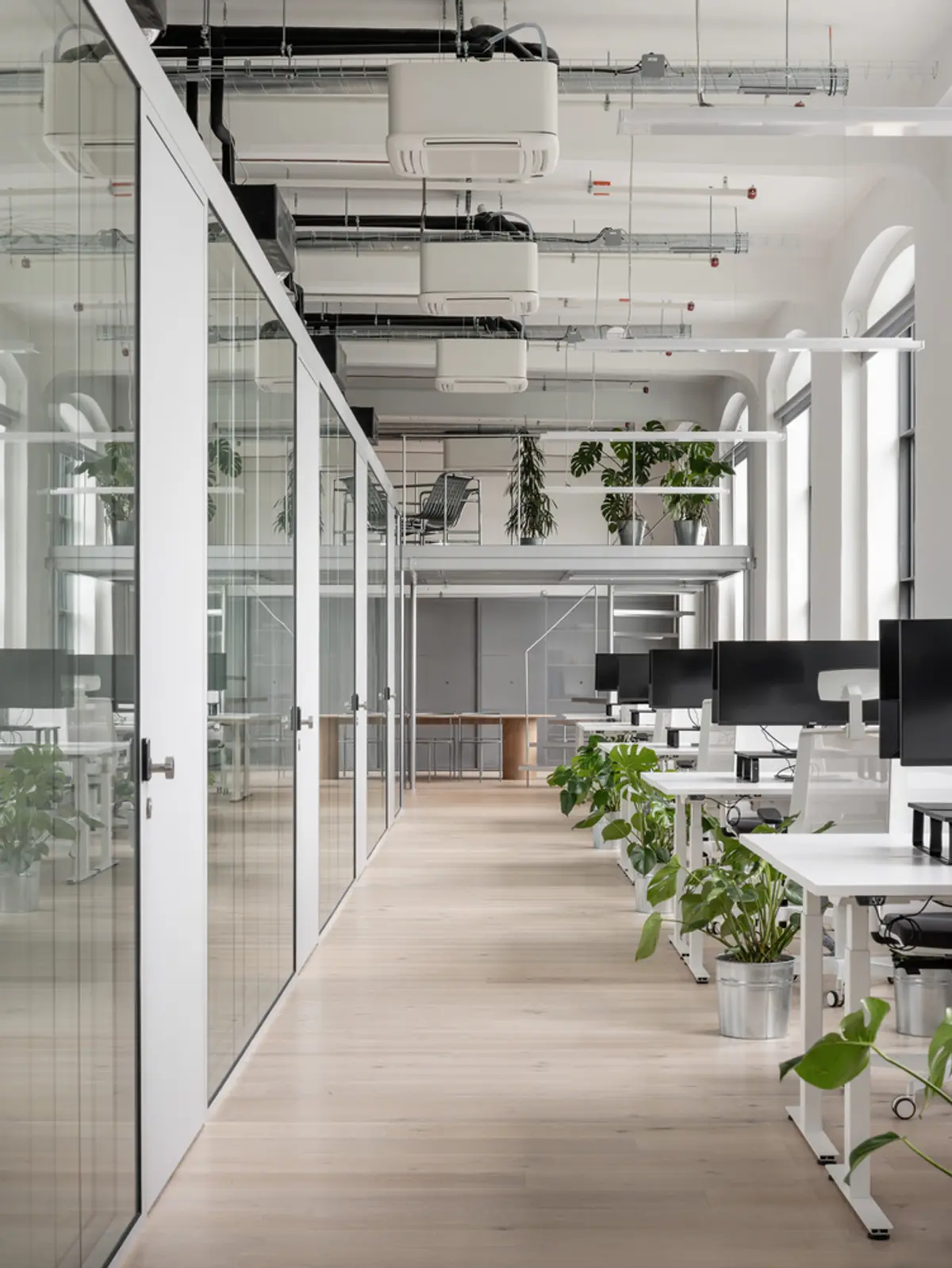
Kuklica Smerek Architekti Inserts an Office-Machine into a 1900 Bratislava Thread Factory
A 195-square-meter workspace in the Pradiareň building treats exposed infrastructure as design, not defect, across two interlocked zones.


The Pradiareň building in Bratislava was once the Hungarian thread factory, founded in 1900 by Salcher & Richter and J. & P. Coats, and designed by Viennese architects D. V. Junk and K. K. Baurath. By 1910 it had become the largest industrial enterprise in the city. Its cast-iron columns, arched windows, and oak floors supported rows of weaving machines. Now, more than a century later, Kuklica Smerek Architekti has carved a 195-square-meter office into one of its bays, and the result is less a renovation than a precise mechanical insertion.
The architects call it an "office-machine," and the label is earned. Rather than concealing ductwork, wiring, and structural logic behind plasterboard, the project puts all of it on display: spiral ducts snake below vaulted ceilings, black steel columns stand unclad, and glazed partitions let you see straight through one zone into the next. What makes BK II genuinely interesting is not the exposure itself, which has become commonplace, but the way it contrasts with the Art Nouveau shell. The original building envelope stays untouched while a mezzanine, a joinery box, and five glass-walled office cells are slotted in as discrete objects, each legible as something added rather than something original.
The Entrance Zone and the Mezzanine Bridge
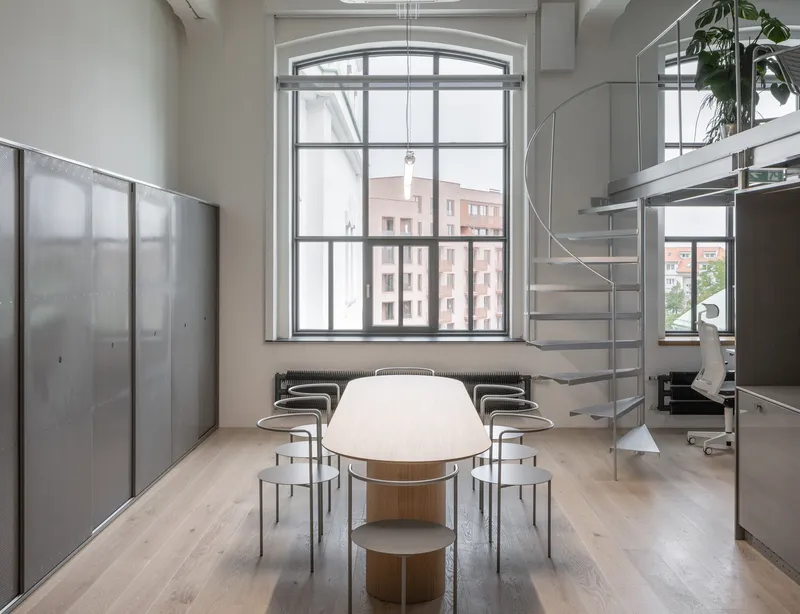
The layout splits the 195 square meters into two entities. The first, beginning at the entrance, contains a communal dining table, a meeting room, and a cloakroom. Tall arched windows with their original divisions flood this zone with daylight, and the 4.5-meter clear height makes the double-height dining area feel generous despite modest floor area. A spiral metal staircase leads up to a relaxing mezzanine that acts as the conceptual hinge between social and working spaces.
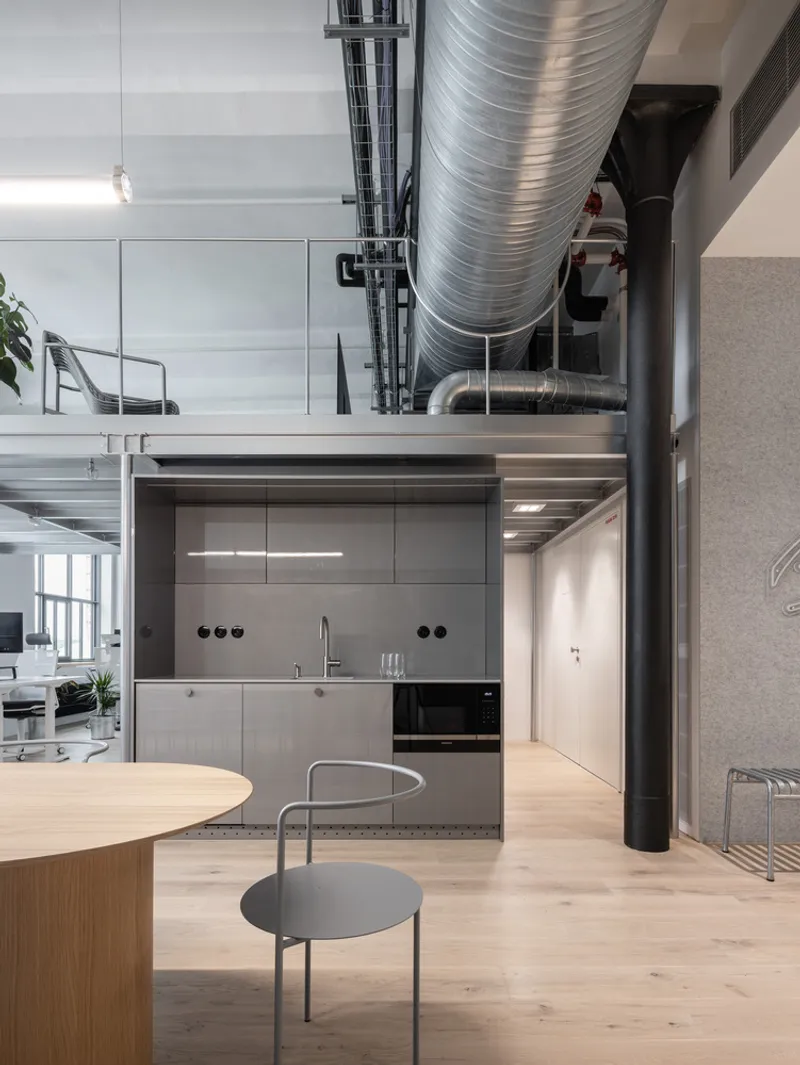
Beneath the mezzanine sits the multifunctional box: a kitchenette on its outer face, compact gray cabinetry under exposed spiral ductwork, and a fully enclosed technical room on the inner side. The move is economical. One piece of joinery absorbs the messiest program elements so that everything around it can stay open and visually clean. The original cast-iron columns, 250 millimeters in diameter and rising to 5,100 millimeters, punctuate the space like structural punctuation marks, their regular grid a reminder that this was once a factory floor.
Open Desks and Glass Office Cells
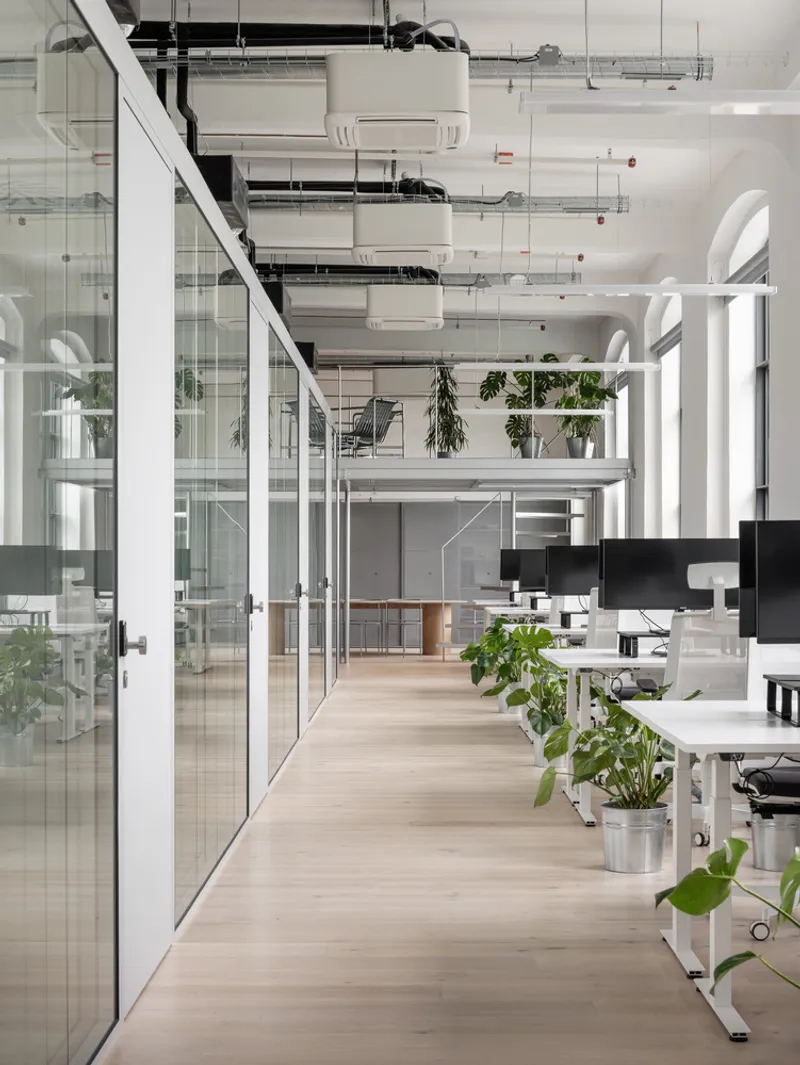
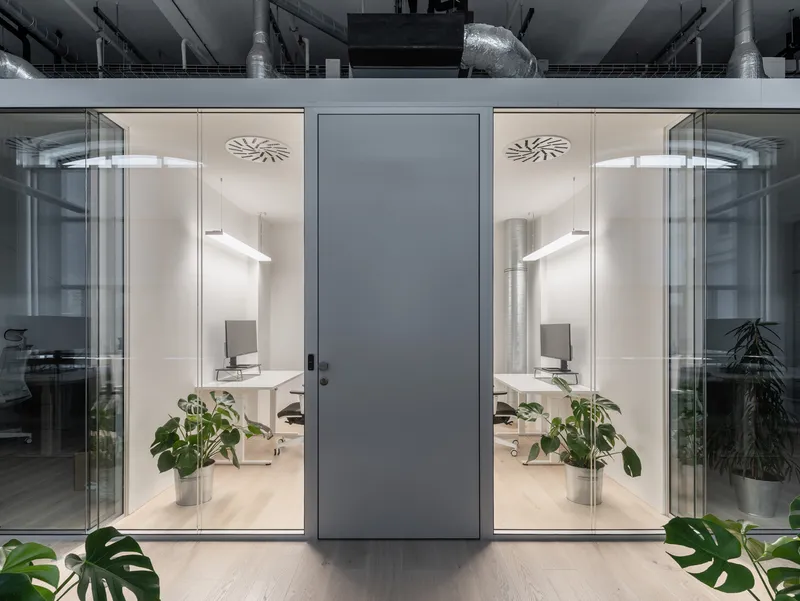
Beyond the mezzanine, the workspace shifts to a more regimented configuration. Rows of desks line the window wall, positioned to catch as much natural light as possible through the high arched openings. Against the opposite wall, five closed office cells sit in a compact block. Their glazed partitions and nearly three-meter ceiling heights keep them from feeling like boxes, and the transparency means that a glance down the central corridor reveals the full depth of the plan.
The tension between open-plan desking and enclosed cells is deliberate. BK II serves employees who spend most of their time in the field; when they return to base, they need both focused privacy and quick collaborative contact. Potted plants scattered along the desk runs and in front of the office cells soften the metallic palette without undermining the industrial character. It is a workspace designed for intermittent occupation, not for permanent residency, and that brief-stay logic shapes every decision about how much enclosure is enough.
Material Logic: Oak, Metal, and Glass
The material palette reads as a conversation between the 1900 building and the 2023 insertion. Wooden parquet flooring runs throughout, a deliberate reference to the original oak surfaces that once bore the weight of weaving machines. Against this warm base, the inserted elements speak a different language: metal surfaces, glazed partitions, black steel columns, and gray joinery. Infrastructure stays deliberately uncovered. Ducts, conduit, and ceiling structure are treated as part of the aesthetic rather than as problems to be hidden.
The cast-iron columns deserve special mention. Found only in Art Nouveau industrial buildings of this era, they carry a specific structural logic: rail beams span between them, and vaults were built into the resulting bays. Kuklica Smerek leave this system entirely legible. No column is wrapped, no beam is boxed. The new glass walls of the office cells stop short of the columns, leaving a visible gap that registers the difference between old structure and new partition. It is a small detail, but it tells you everything about the architects' attitude toward the building: respect through separation, not imitation.
Why This Project Matters
Adaptive reuse projects in industrial buildings often lean on one of two clichés: either they overpolish the heritage into a showroom, or they leave everything raw and call it "authentic." BK II does neither. The Pradiareň shell is left alone, its arched windows, cast-iron columns, and vaulted ceilings intact and unadorned. The office program is inserted as a legible machine, complete with its own material logic, its own structural independence, and its own spatial rules. The two systems coexist without pretending to be one thing.
At 195 square meters, the project is small. That is part of its value. Kuklica Smerek demonstrate that the discipline of working within a constrained footprint and a significant historic structure does not require large budgets or grand gestures. It requires clarity of concept, which in this case is the office-machine, and the restraint to let the old building do what it already does well. The result is a workspace that feels both precise and generous, a rare combination at any scale.
BK II Office by Kuklica Smerek Architekti (Peter Kuklica, Martin Smerek, Erik Hornáček, Radovan Szabó). Svätoplukova 2A, Bratislava, Slovakia. 195 m². Completed 2023. Photography by Matej Hakár.
About the Studio
Share Your Own Work on uni.xyz
If projects like this are the kind of work you want to make, uni.xyz is a place to publish your own, find collaborators, and enter design competitions.


Popular Articles
Popular articles from the community


ALGAL REALM: A Bio-Integrated Lunar Habitat Design for Life Beyond Earth
ALGAL REALM reimagines lunar habitat design with algae-powered life support, 3D-printed regolith, and vertical living for a lunar future.

Co-Life: Senior Housing Design That Reconnects Older Adults With the City
Co-Life reimagines senior housing design through healing gardens, shared streets, workshops, and a sustainable community across generations.

Conexión: Biophilic Design Reimagines High-Rise Living in Hong Kong
Conexión reimagines high-rise living in Hong Kong through biophilic design, green facades, shared spaces, daylight, water and nature within.

Little Red Riding Hood: Architectural Design as a Journey Through Fear, Light, and Storytelling
Little Red Riding Hood reimagines the fairy tale through architectural design shaped by fear, light, scale, memory, uncertainty, and choice.

Similar Reads
You might also enjoy these articles


Hodi-Mandai Geram
Project Function: Preservation and revitalization of the Intangible heritage and socio-spatial identity of the Hodi by Housing, Cultural Memory Center, Sacred Grove, landscape, local tourism economy


Olio Towers: A Mid-Rise for Performers That Fuses Housing, Rehearsal, and Stage
Located blocks from Houston's Theater District, this modular tower stacks living units around a central performance atrium.

Oasis: Modular Green Housing Carved into Dhaka's Urban Fabric
A shortlisted Plugin Housing entry reclaims unauthorized settlements in Dhaka with stepped concrete volumes, green roofs, and ventilation-driven design.

Black Hole: A Floating Megastructure for the Post-Physical Era
Emiliano Mazzarotto envisions a spherical, self-scaling arena where e-sports, digital hotels, and holographic stadiums replace traditional public space.

Explore Built Environment Interiors Competitions
Discover active competitions in this discipline

Challenge to reimagine the Iron Throne

Photograph architecture without architects

Illustrate the lost glory of Angkor Wat - Render Challenge

Design challenge to reuse E-waste
Comments (0)
Please login or sign up to add comments
No comments yet. Be the first to comment!