
Blaanc Threads Color and Craft Through a 1950s Lisbon Apartment Across Two Floors
A 154 m² duplex in Lisbon's urban core uses red frames, sage green joinery, and terrazzo to revive mid-century bones with quiet confidence.


Lisbon's mid-century residential stock is generous in bones but often stingy in light and flow. Blaanc, led by Ana Morgado and Carmo Caldeira, understood this when they took on the Infante House, a 154 m² duplex set across two floors of a 1950s apartment building. The rehabilitation had to do more than restore: it needed to reorganize, to open up a circulation logic that the original plan never imagined, while treating the existing fabric with the respect it deserves.
What makes this project worth studying is its disciplined use of color and custom joinery as architectural tools rather than decorative afterthoughts. Red-framed glass partitions, sage green cabinetry, orange bathroom tiles, and terrazzo surfaces each claim a specific territory within the plan. None of these choices are loud, but together they form a legible system: you can almost navigate the apartment by color alone. That kind of coherence, across a modest area and a tight budget of materials, is harder to pull off than a monochrome palette and far more rewarding to inhabit.
Red Frames as Thresholds
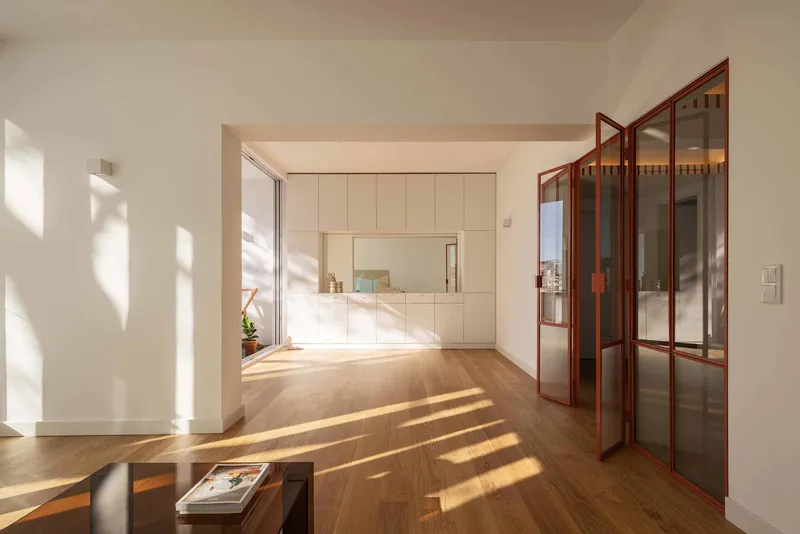

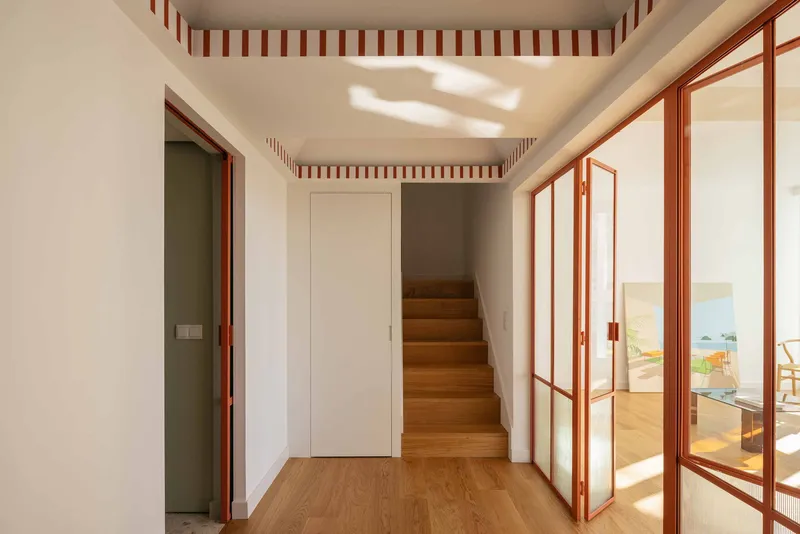
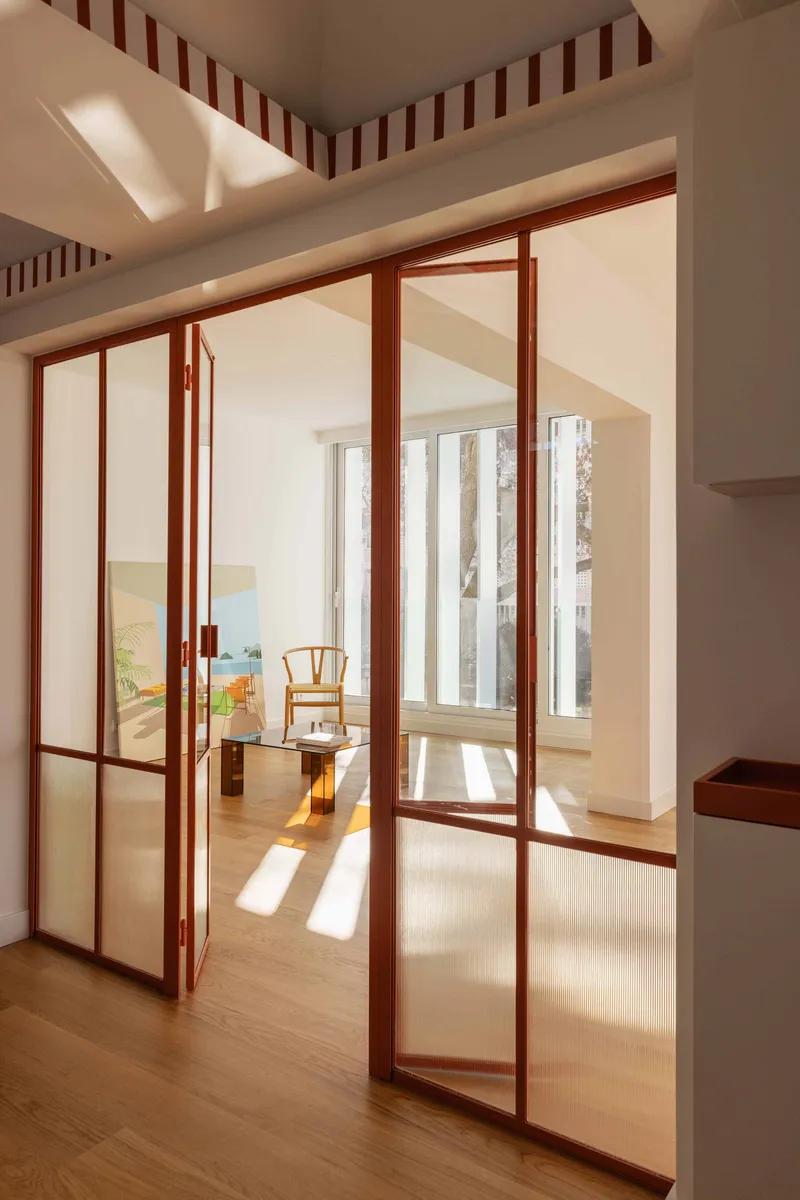
The most immediately recognizable gesture in the Infante House is the use of red-painted steel or timber frames on the folding glass partition doors. These are not accent walls or feature moments; they are thresholds. Each red frame signals a transition between rooms or between inside and outside, giving spatial depth to what could otherwise read as a simple open plan. The color draws the eye through the depth of the apartment, framing views like a camera pulling focus.
Paired with the warm oak flooring and white walls, the red reads as confident without being aggressive. It recalls a certain Portuguese tradition of painting window and door frames in saturated hues, updated here into a clean, contemporary language. The folding mechanism of several of these partitions also means the rooms can be fused or separated at will, which is critical for a two-floor home of this scale.
A Staircase That Earns Its Keep


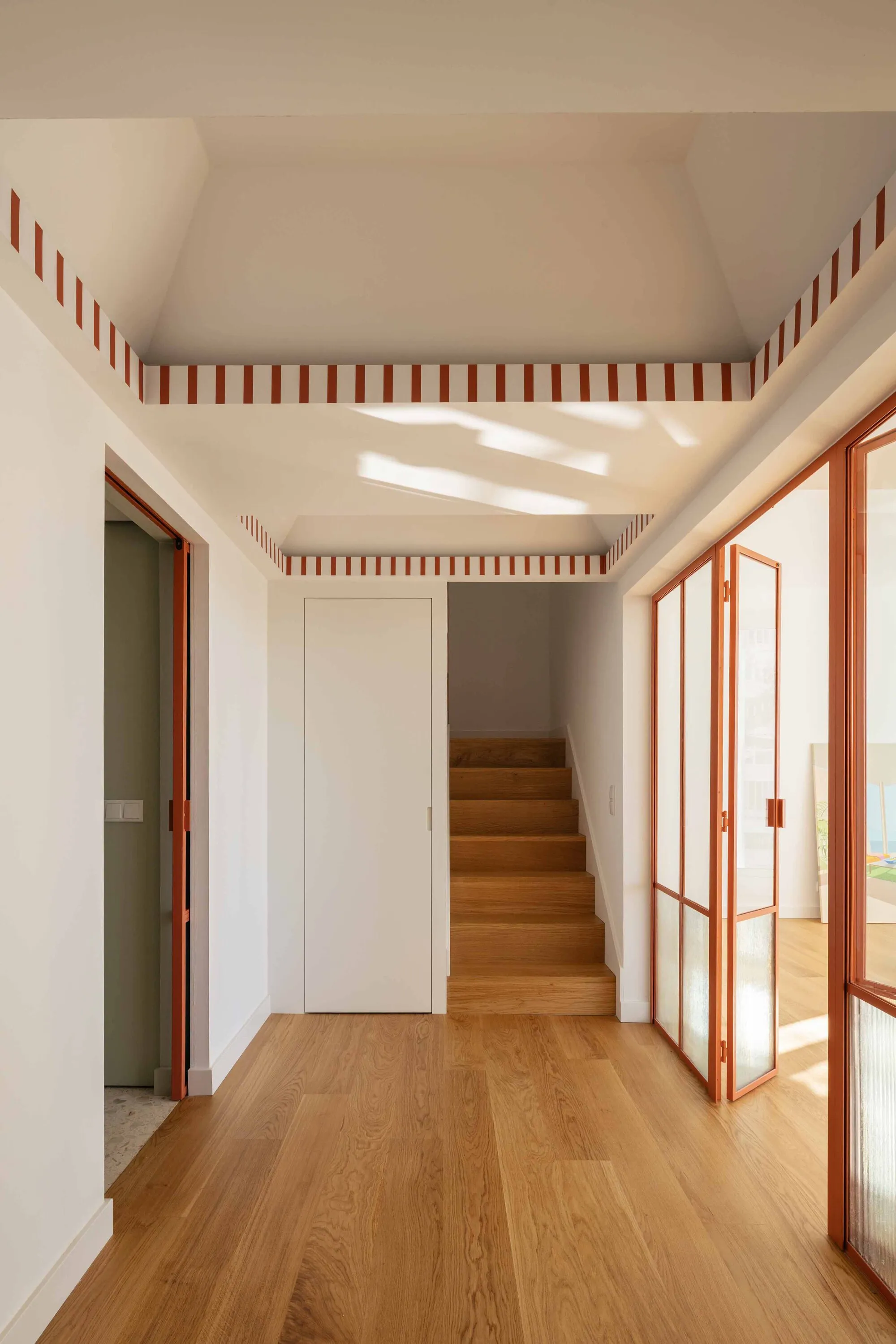
In a 154 m² duplex, the internal staircase is either the heart of the project or a liability. Blaanc made it the heart. The timber stair ascends beside a flush white door, capped with red and white striped trim at the ceiling that belongs to a broader language of banding visible in hallways and soffits. The vertical balustrade is slender enough to let light pass through without sacrificing safety, and from the upper landing, sunlight pours in from what appears to be a generous overhead opening.
The striped ceiling detail running along the hallway and into the stairwell zone is a subtle move that pays off in spatial orientation. It gives the corridor a directional logic, pulling you forward and upward, while also adding graphic interest to an otherwise plain white soffit. It is the kind of detail that takes five minutes to notice and then becomes impossible to unsee.
Storage as Surface


A full-height white storage wall on the main living level absorbs the domestic clutter that small homes cannot afford to display. Its grid of flush panel doors transforms storage into architecture: the wall reads as a single plane punctuated only by the recessed mirror and a sliding door that opens to the terrace. There is no hardware visible, no grooves or pulls breaking the surface. The effect is almost sculptural.
A gridded sliding door in the upper level performs a similar trick, separating bedroom from living space without the visual weight of a solid partition. The translucent or perforated panel filters light while maintaining privacy, reinforcing Blaanc's consistent interest in partitions that do more than one thing at a time.
Terrace Life and the Indoor-Outdoor Seam
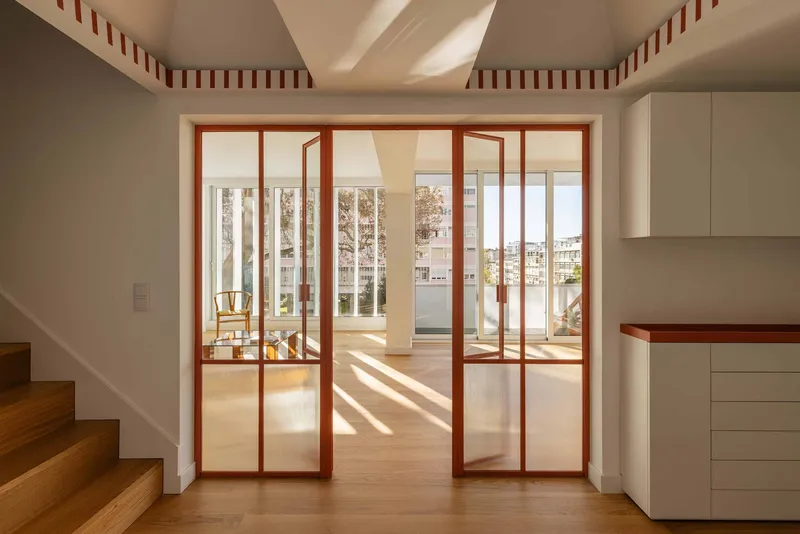
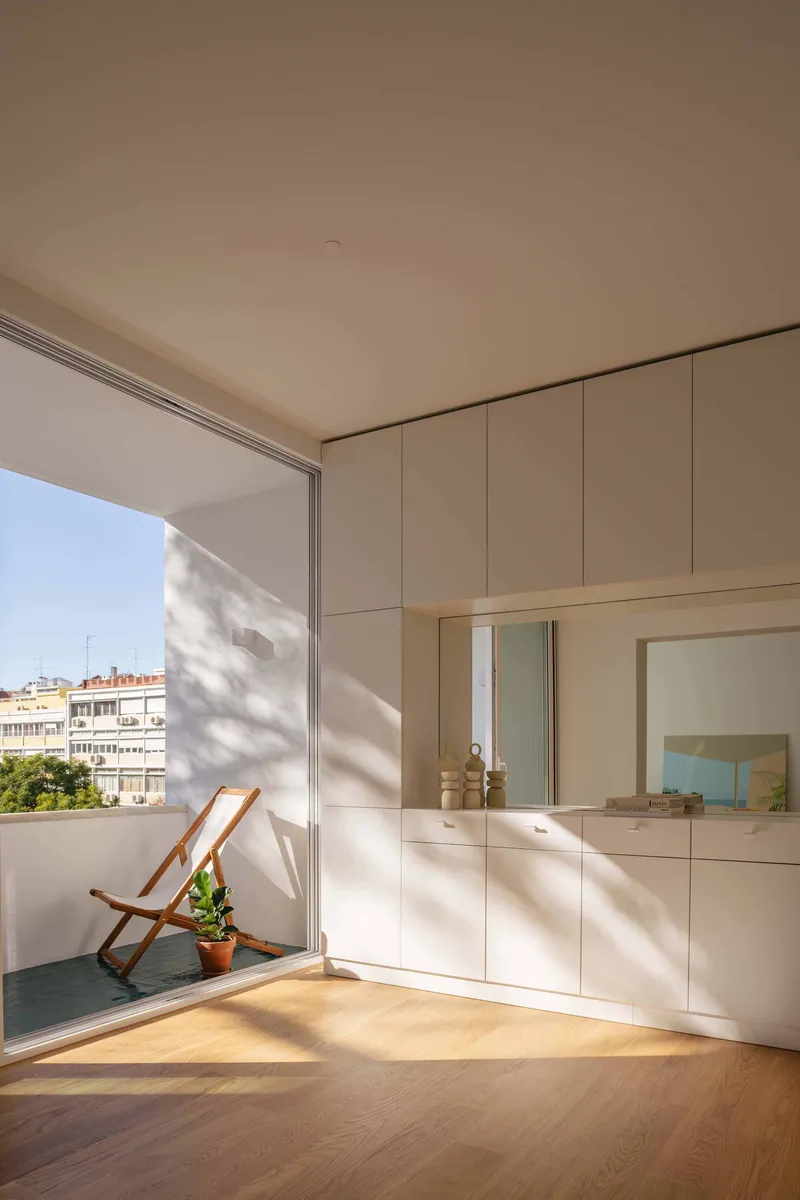

Lisbon's climate demands that any serious residential project address the terrace as more than a leftover balcony. Here, the folding glass doors open the living room fully to an outdoor deck, collapsing the boundary between the two. A deck chair sits where a sofa might, and the afternoon sun casts sharp diagonal shadows across the oak floor, marking time like a sundial. The striped ceiling trim continues to the terrace edge, stitching inside and outside together.
The timber-framed glass doors throughout the apartment reinforce this porosity. Several of them fold or slide, which means the occupants can modulate the degree of openness depending on the season, the light, or the desire for solitude. In a city where summer heat and winter dampness are equally real, that flexibility is not a luxury but a necessity.
Color-Coded Kitchens and Bathrooms


The sage green cabinetry in the kitchen is the second major color statement after the red frames. Paired with white countertops and a terrazzo floor, it anchors the cooking area with an identity distinct from the living zones. Built-in wardrobes in the same green line the hallway beyond, so the color becomes wayfinding: green means service, storage, preparation. It is a simple code, but it prevents the small apartment from feeling like a single homogeneous box.
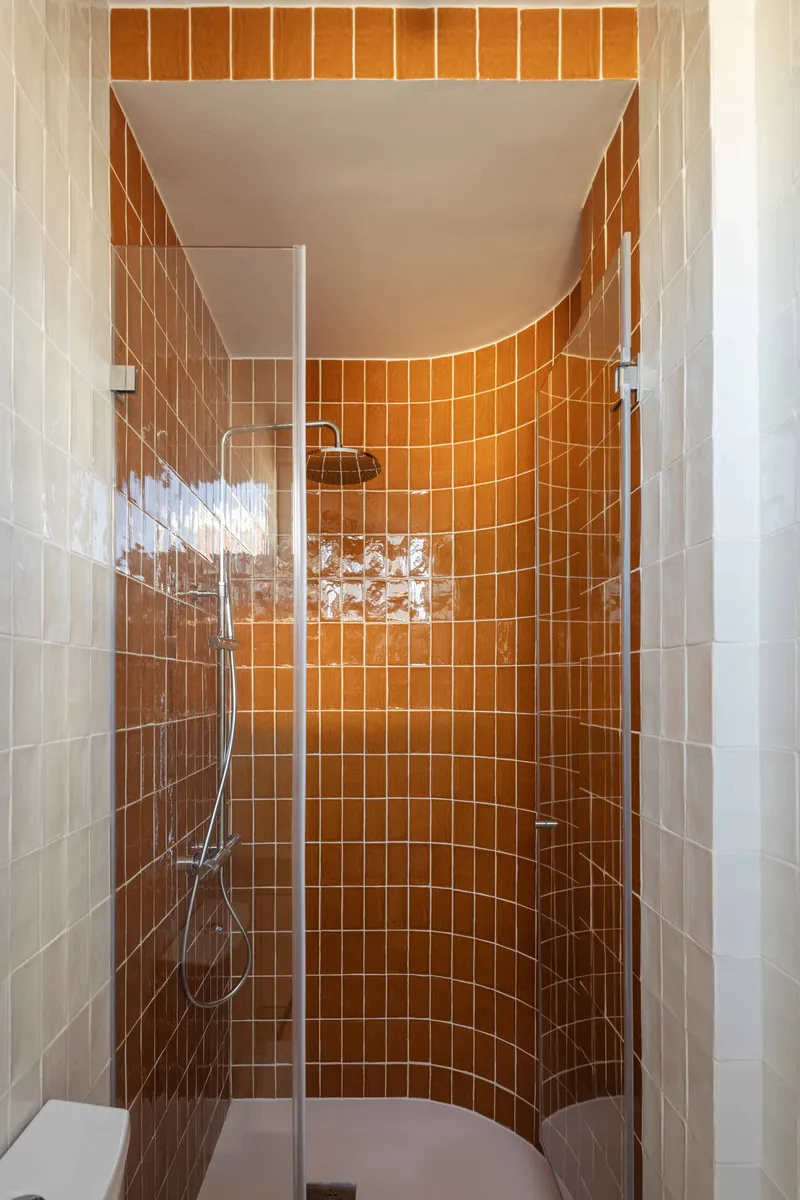


The bathrooms receive their own palette entirely. A curved shower stall is lined in vivid orange square tiles, visible in reflection from the vanity mirror. A separate powder room features a red terrazzo basin with an integrated counter and polished brass faucet, compressed into a narrow volume that wastes nothing. Each wet room is treated as a small, self-contained world of color and material, giving the apartment a richness that belies its compact footprint.
Curves Against the Grid
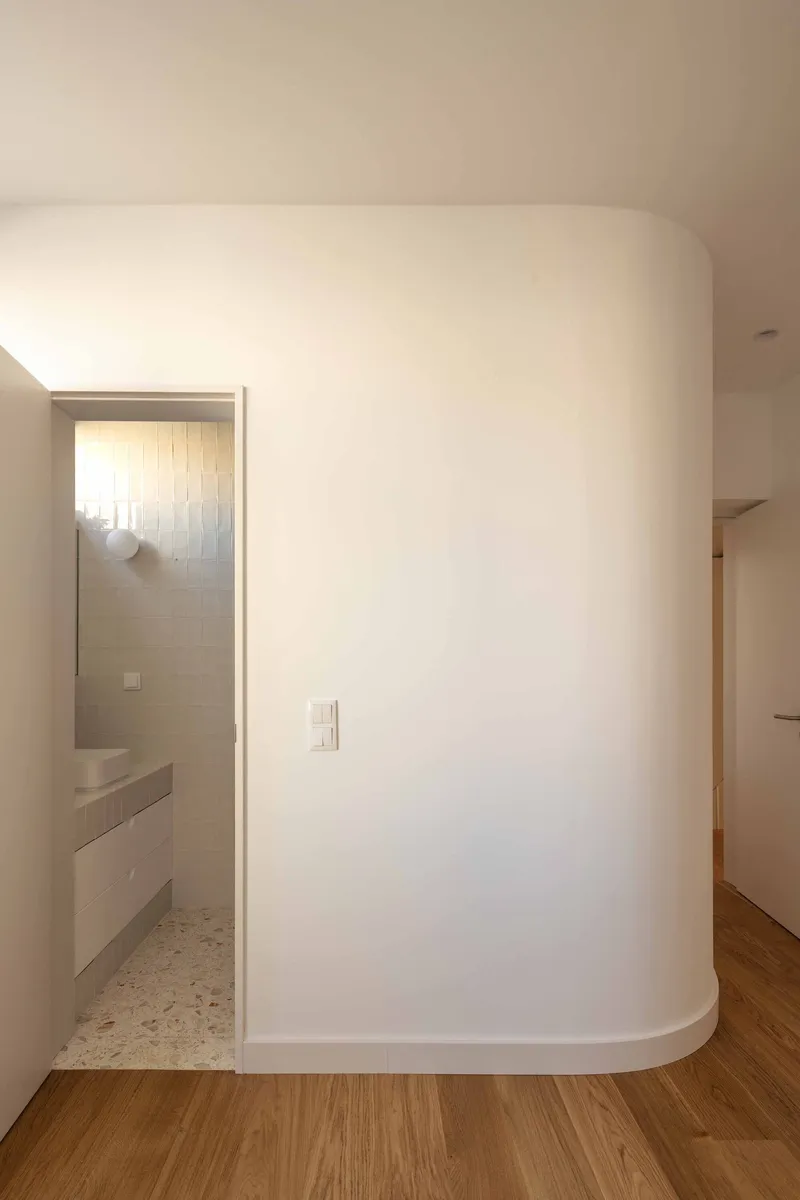
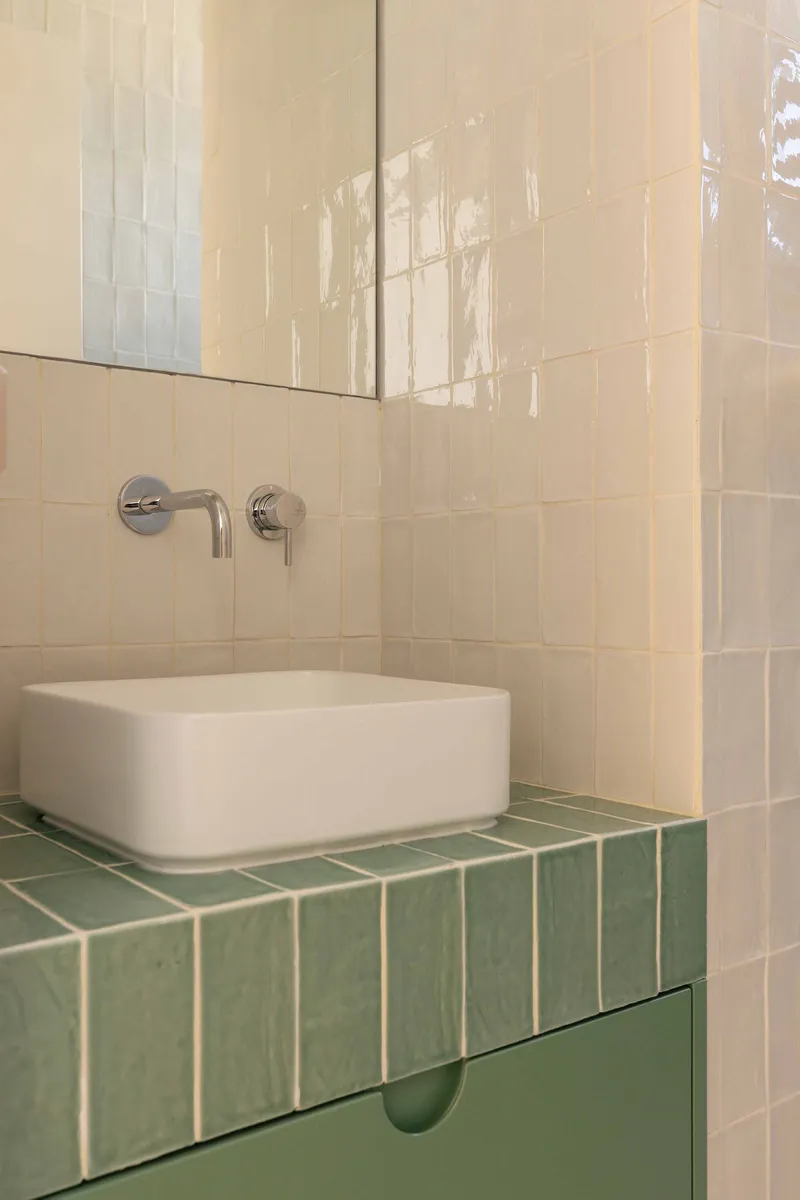
While the plan is largely orthogonal, Blaanc introduces curved partition walls at key moments, particularly around the bathrooms. A white curved wall with a low doorway leads into the tiled bathroom, softening the transition and compressing the sense of passage. The curved shower enclosure does the same thing in three dimensions. These gestures are not decorative flourishes; they manage sight lines and create a sense of compression and release in spaces too small for grand spatial moves.
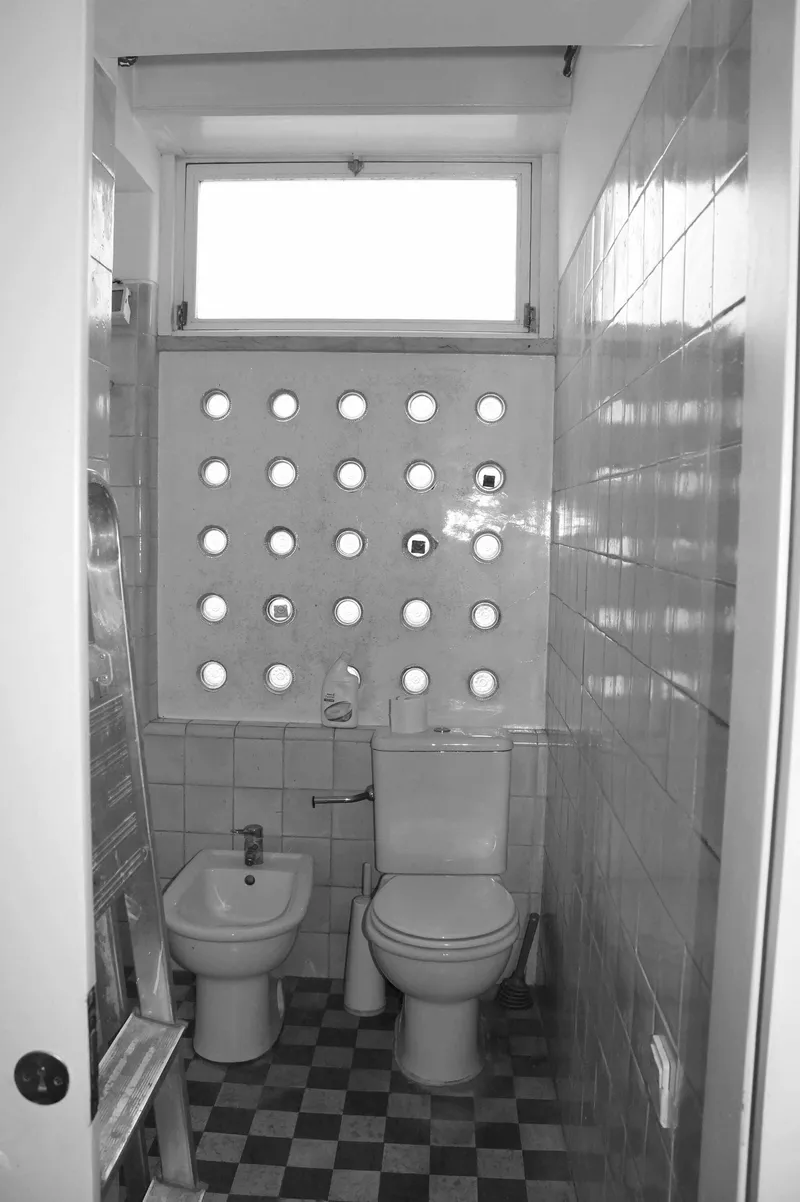
A circular perforated panel above the toilet in another bathroom nods to the same formal interest, filtering light and ventilation through a precise geometric opening. It is a small detail, but it demonstrates a level of care that extends to every corner of the apartment.
Before and After


The black and white photographs of the apartment's previous state reveal the raw material Blaanc was working with: heavy curtains, dark sideboards, herringbone parquet, and compartmentalized rooms typical of mid-century Lisbon apartments. The herringbone flooring in one shot of the earlier kitchen, with its roller shutters and cramped layout, makes clear just how much spatial reorganization was required. What Blaanc preserved (the proportions, the window rhythms, a respect for the building's era) matters as much as what they replaced.
Plans and Drawings
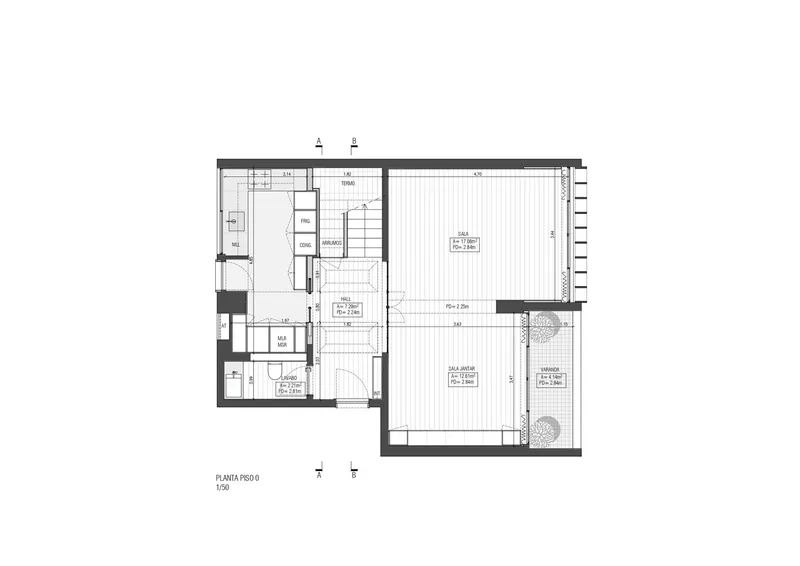
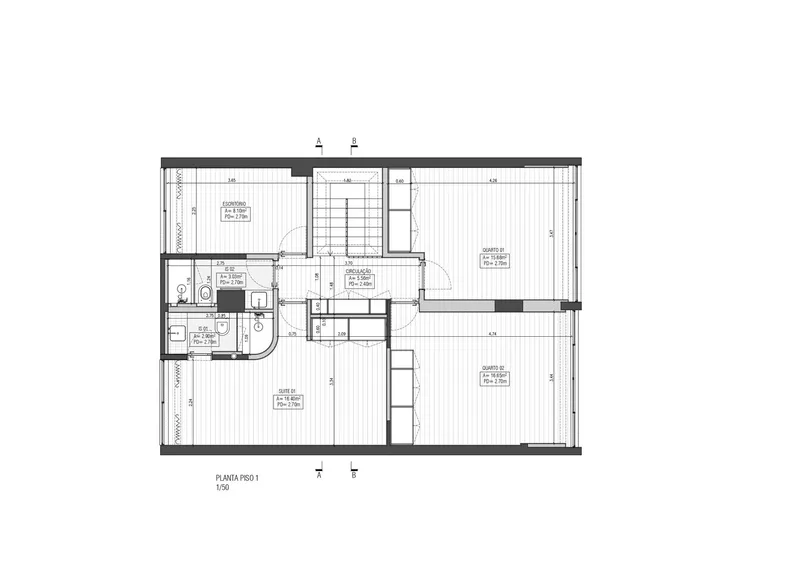

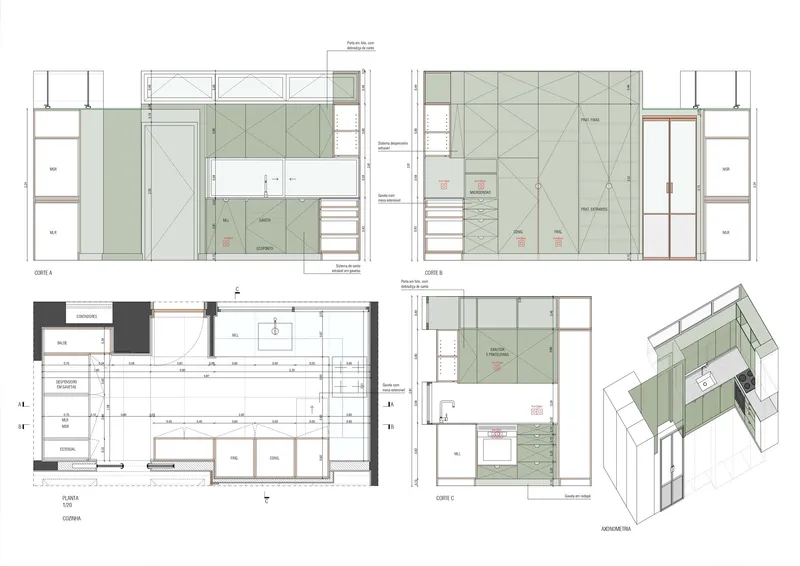



The floor plans confirm the duplex logic: the lower level houses the living area, kitchen, and terrace, while the upper level accommodates two bedrooms and a bathroom organized around the central staircase. The section drawings reveal the split-level relationship between the two floors, with generous ceiling heights that the 1950s building provides. Most revealing are the composite millwork drawings, which detail every piece of built-in joinery with color-coded panels, showing the level of custom fabrication behind what reads as effortless simplicity. Bathroom plans and elevations are equally precise, mapping every tile, fixture, and surface finish.
Why This Project Matters
The Infante House is a lesson in restraint that never feels restrained. In 154 square meters, Blaanc managed to create distinct zones with individual identities, all unified by a consistent attitude toward materiality and color. The red frames, the sage green joinery, the orange tiles, and the terrazzo surfaces are not a mood board exercise. They are a spatial strategy, each color assigned to a function and a zone, giving a compact home the legibility and richness of a much larger one.
Lisbon is in the middle of a rehabilitation boom that too often produces generic white boxes with subway tile and industrial pendant lights. Blaanc's approach here is a reminder that working within an existing building demands specificity, not formula. The 1950s bones of this apartment are honored not by mimicry but by a contemporary language that understands proportion, light, and the power of a well-placed color. That is the kind of rehabilitation that actually adds something to a city.
Infante House by Blaanc (Ana Morgado, Carmo Caldeira), Lisbon, Portugal. 154 m², completed 2020. Photography by Luis Nobre Guedes.
About the Studio
Share Your Own Work on uni.xyz
If projects like this are the kind of work you want to make, uni.xyz is a place to publish your own, find collaborators, and enter design competitions.



Popular Articles
Popular articles from the community


The Musturak Paradise: Senior Living Architecture for a Connected Future in Temara, Morocco
The Musturak Paradise reimagines senior living architecture in Temara via private homes, social spaces, culture, community, and shared care.

Co-Life: Senior Housing Design That Reconnects Older Adults With the City
Co-Life reimagines senior housing design through healing gardens, shared streets, workshops, and a sustainable community across generations.

Conexión: Biophilic Design Reimagines High-Rise Living in Hong Kong
Conexión reimagines high-rise living in Hong Kong through biophilic design, green facades, shared spaces, daylight, water and nature within.
EW PARK: Sustainable Architecture Reimagines the Future of Urban Parking
EW PARK reimagines city parking as a modular wooden tower combining automation, solar energy, electric mobility, and adaptable urban design.


Similar Reads
You might also enjoy these articles

Bao Huynh Watercolor Atelier: A Serene Art Retreat in Hội An
Bao Huynh Watercolor Atelier in Hội An blends multifunctional art spaces, sustainable design, local materials, and family-friendly living in a serene environment.

Atelier Macri Concept Store Interior Design by CASE-REAL
Atelier Macri store features a "ko" counter, walnut wood details, cork displays, blending retail, gallery, and seamless customer experiences.

Manuel Vargas Izquierdo Stadium and High-Performance Sports Center: Architectural Excellence in Jalpa de Méndez
The Manuel Vargas Izquierdo Stadium blends sustainable design, inclusive sports facilities, and cultural-inspired architecture, revitalizing Jalpa de Méndez’s public spaces.

KAKR Buluh Awar Hall: Revitalizing Community and Ecology Through Bamboo Architecture
Community built bamboo hall revitalizes Buluh Awar village, empowering youth, restoring ecology, celebrating vernacular craftsmanship through sustainable architecture and culture.




Comments (0)
Please login or sign up to add comments
No comments yet. Be the first to comment!