
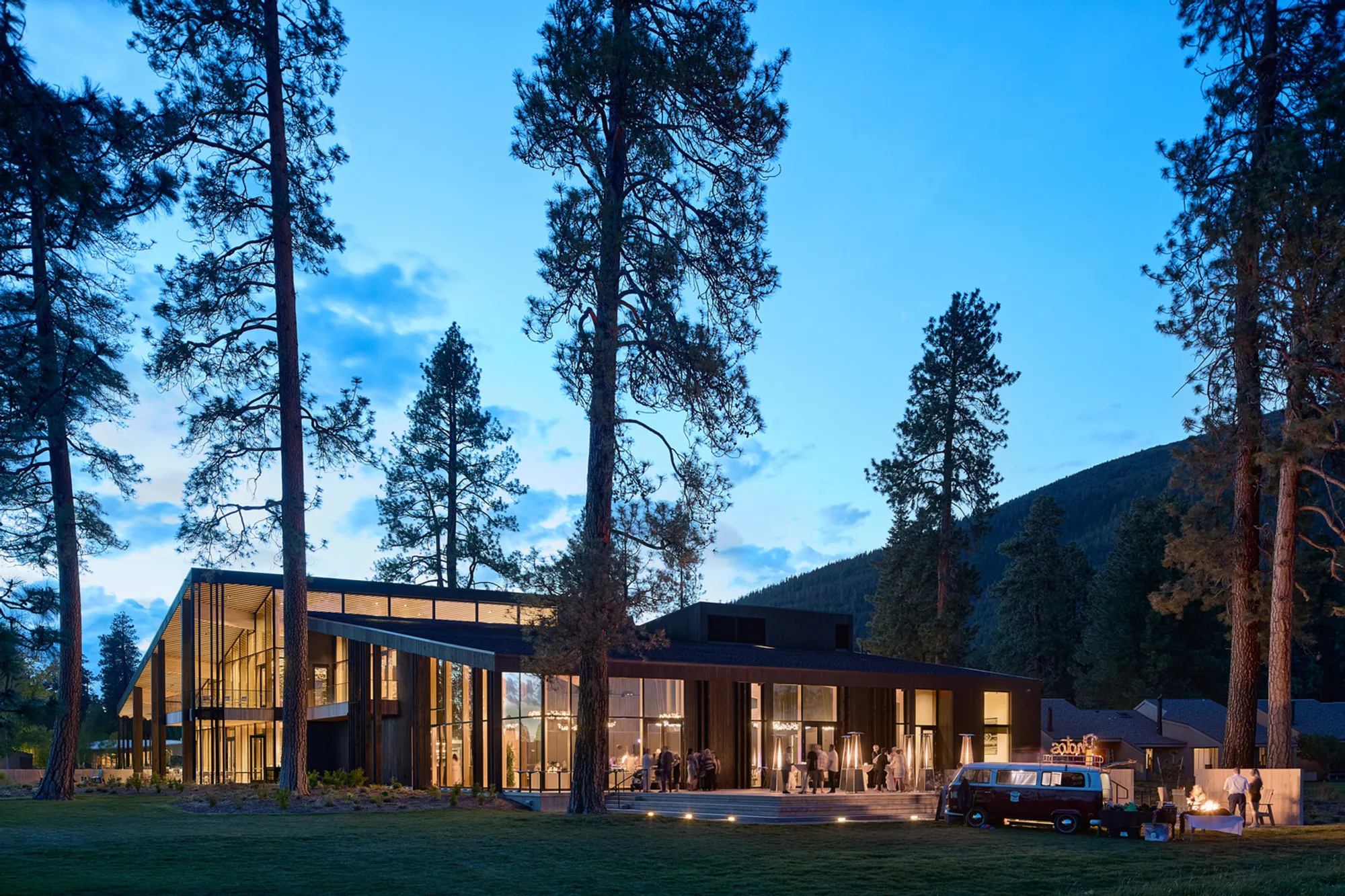
Hacker Architects Rebuilds the Black Butte Ranch Lodge with Charred Cedar, Salvaged Timber, and Volcanic Memory
A 27,000-square-foot lodge in Oregon's Central Cascades replaces its aging predecessor with mass timber, regional stone, and deep community roots.


Black Butte Ranch sits on 1,800 acres at the base of the Three Sisters mountains in Oregon's Central Cascades, a landscape defined by ponderosa pines, lava flows, and the ever-present threat of wildfire. Its original lodge, built in the early 1970s, had served the ranch's year-round residents and seasonal visitors for half a century before accessibility problems, failing mechanical systems, and an outdated floor plan made renovation impractical. Starting in 2013, the community began planning its replacement. Hacker Architects spent a full year in conversation with residents before drawing a single line, and the result is a 27,000-square-foot building that doubles the old lodge's footprint while keeping its profile low enough to disappear among the trees.
What makes this project worth studying is the precision of its material logic. Shou Sugi Ban charred cedar wraps the exterior, a traditional treatment that happens to evoke the wildfire ecology of the region. Wood salvaged from the demolished lodge reappears as guardrails, screens, and furniture. A pine tree that could not be saved during construction was milled into custom tabletops for the restaurant and bar. These are not decorative gestures. They are structural commitments to the idea that a building should be made, as far as possible, from the place it occupies.
A Dark Profile Beneath the Canopy
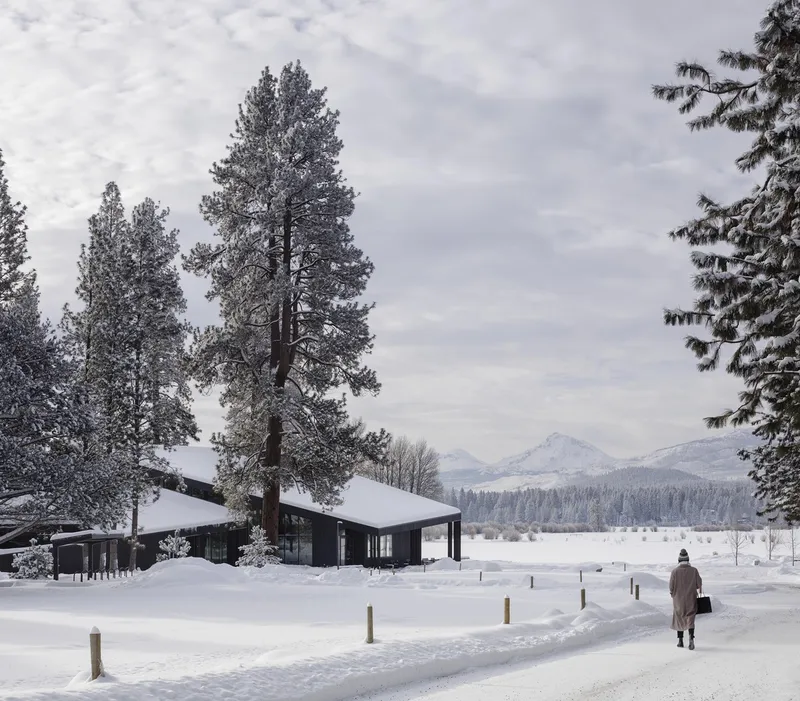
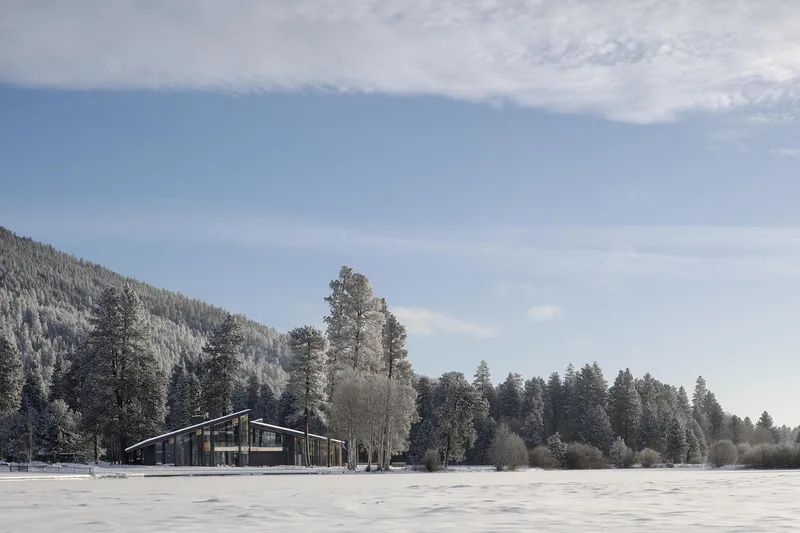
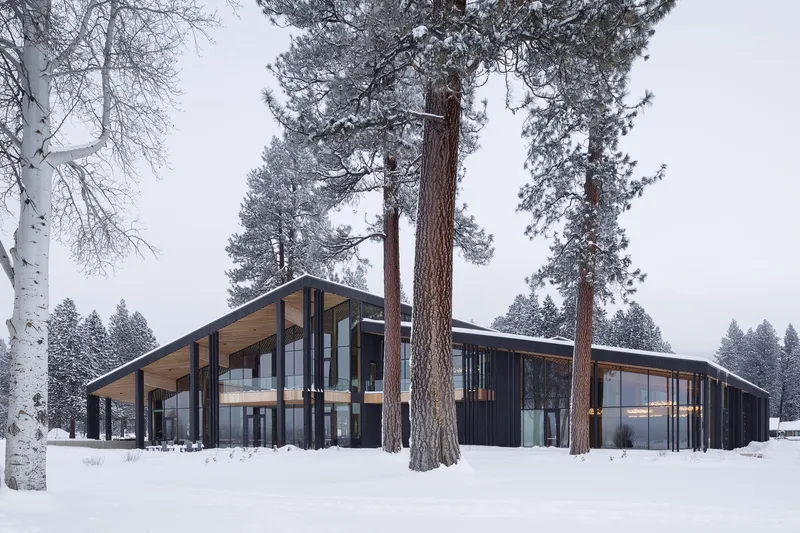
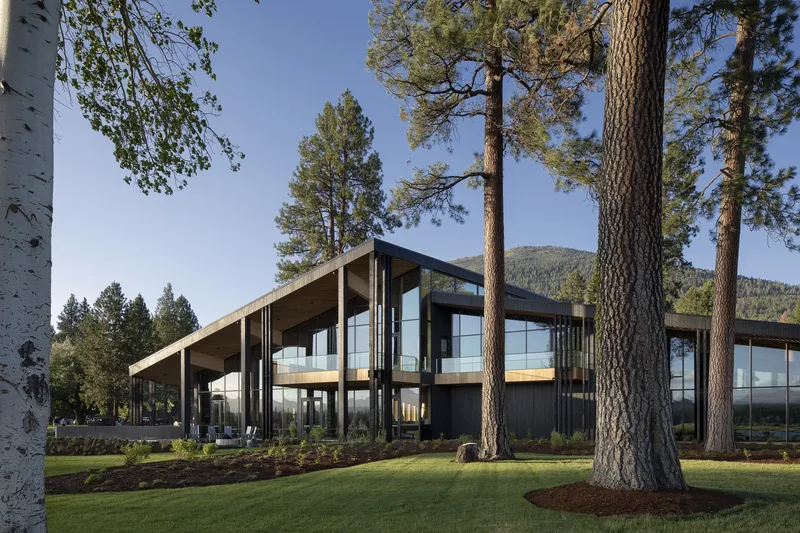
Seen from across the snow-covered fields that surround the ranch, the lodge reads as a long, dark, horizontal bar, barely rising above the treeline. The shallow-pitched metal roofs and Shou Sugi Ban cladding give the building a charcoal tone that recedes against the dark trunks of the ponderosa pines. It is a deliberate strategy of deference: even at 27,000 square feet, the building does not compete with the peaks behind it.
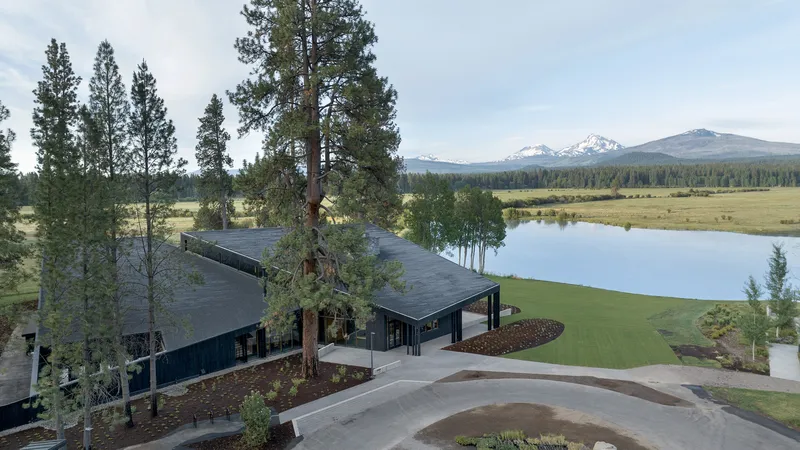
The plan splits the program into two angled volumes, allowing the massing to wrap around existing trees rather than requiring their removal. Deep roof overhangs shelter the glazed walls from snow load and solar gain while extending the visual line of the building into the landscape. The effect is of a structure that was slid into a clearing, not stamped onto it.
Charred Cedar and the Logic of Fire
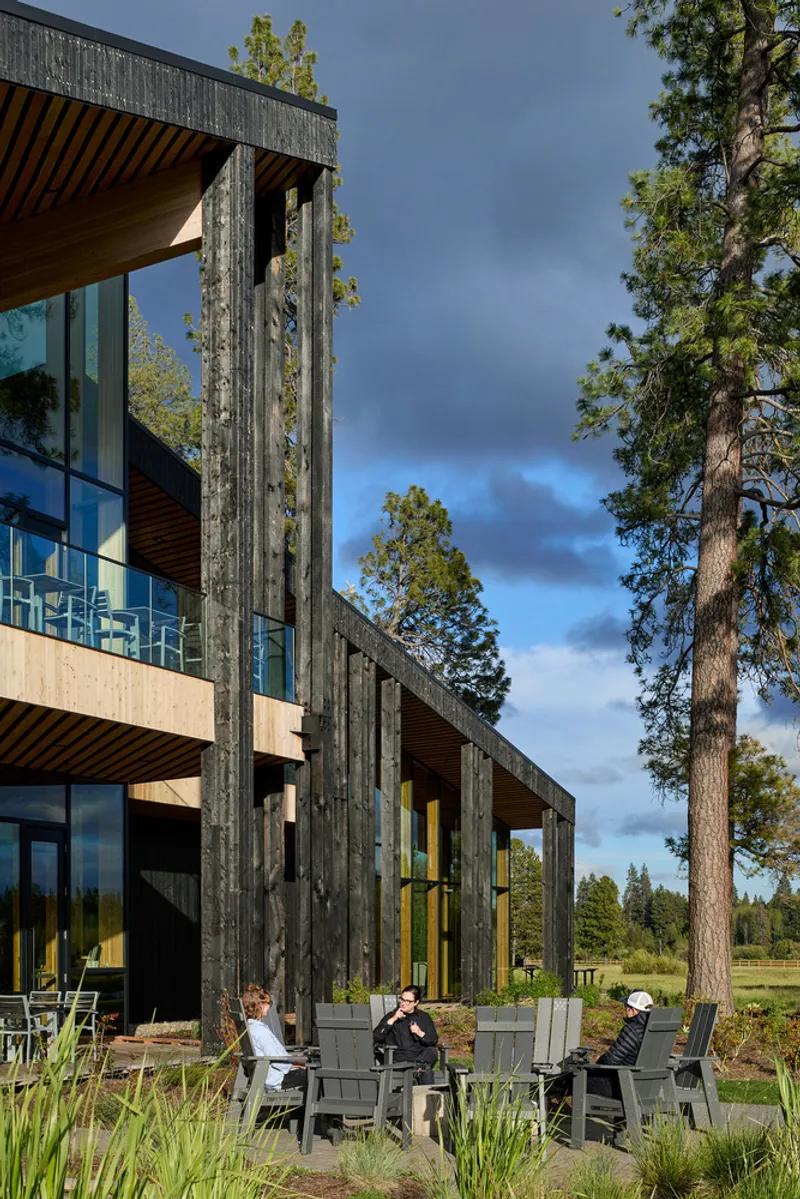
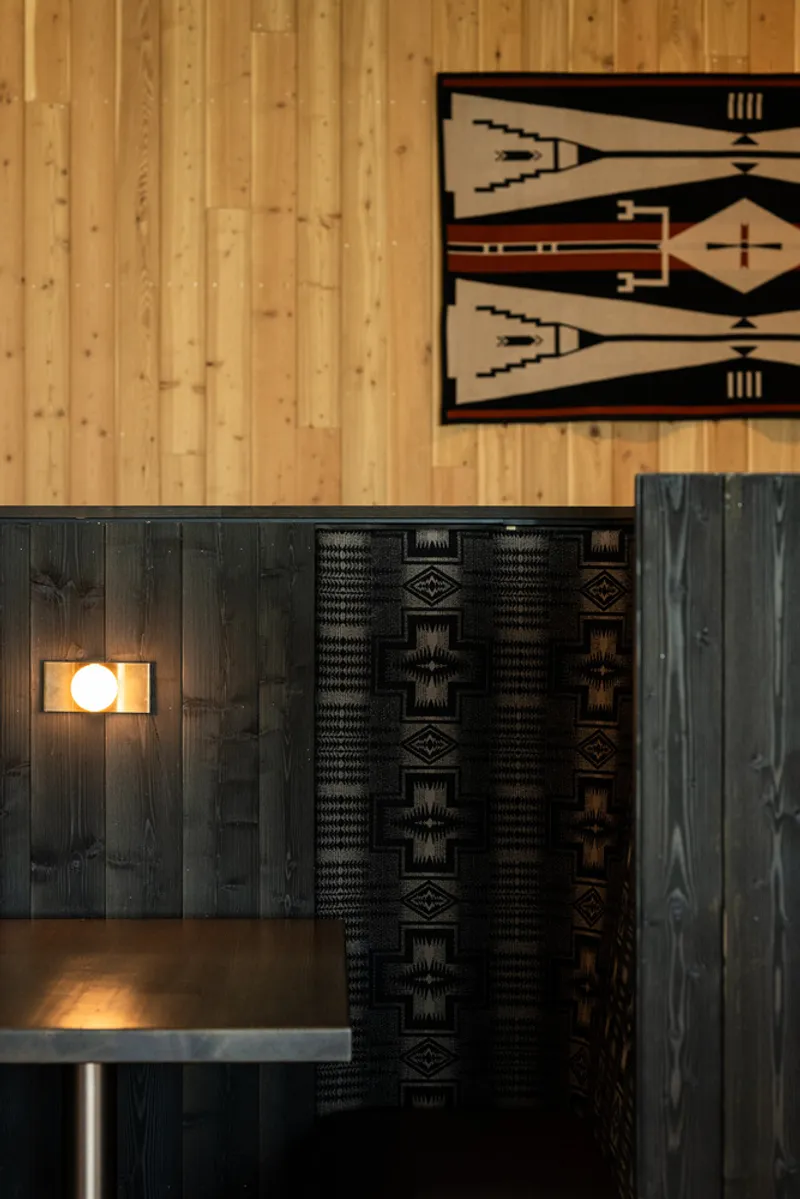
Shou Sugi Ban is frequently deployed in contemporary architecture as a fashionable surface finish, but at Black Butte Ranch the choice carries genuine regional meaning. Central Oregon's forests are shaped by fire cycles, and the charred cedar cladding registers that fact without romanticizing it. The material is also practically superior in this context: the carbonized surface resists rot, insects, and UV degradation, reducing long-term maintenance in a harsh mountain climate.
Close detailing reinforces the commitment. The charred panels are punctuated by mounted sconces and paired with patterned textile hangings, creating a layered texture that avoids the monotony that large expanses of dark cladding can produce. The cantilevered balconies break the facade plane and let the interior glow escape at dusk, so the building oscillates between opacity and transparency depending on the hour.
Glass Walls and the Framing of Landscape
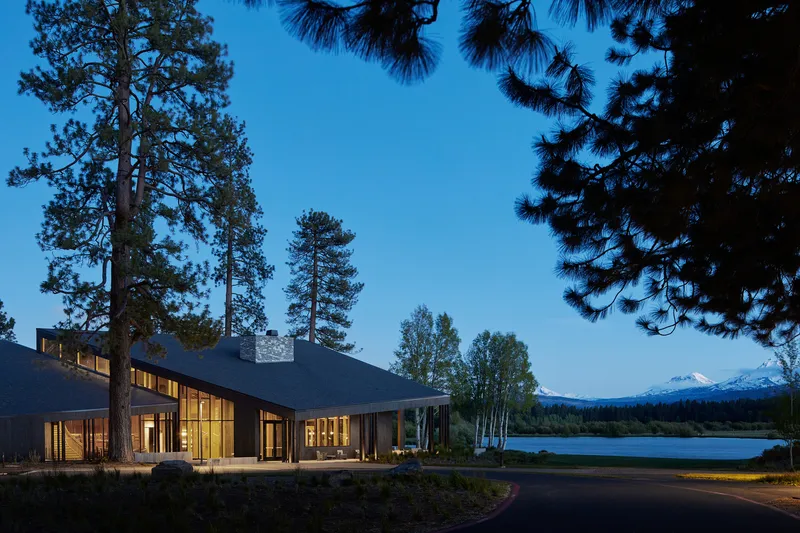
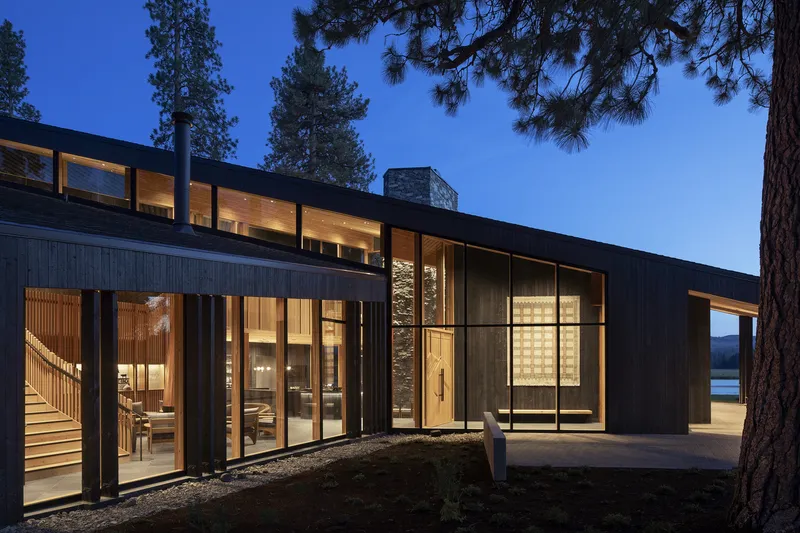
The south and lakeside facades are almost entirely glass, structured with Sierra Pacific timber curtain wall and direct-glaze systems supported by structural steel. At twilight, the building becomes a lantern, its interior timber ceiling and stone fireplace visible from across the lake. During the day, the relationship reverses: diners and guests look out through floor-to-ceiling glazing at snow-capped peaks, wetland meadows, and the calm surface of the water.
Hacker describes the design intent as "elevating the experience of surrounding landscape through careful framing and layering of views," and the sections bear this out. Double-height spaces stack views vertically, with the mezzanine lounge offering a wider panorama than the ground-floor restaurant. Clerestory glazing above the timber slat ceiling pulls light deep into the plan even when snow buries the lower panes.
The Stone Fireplace as Memory and Anchor
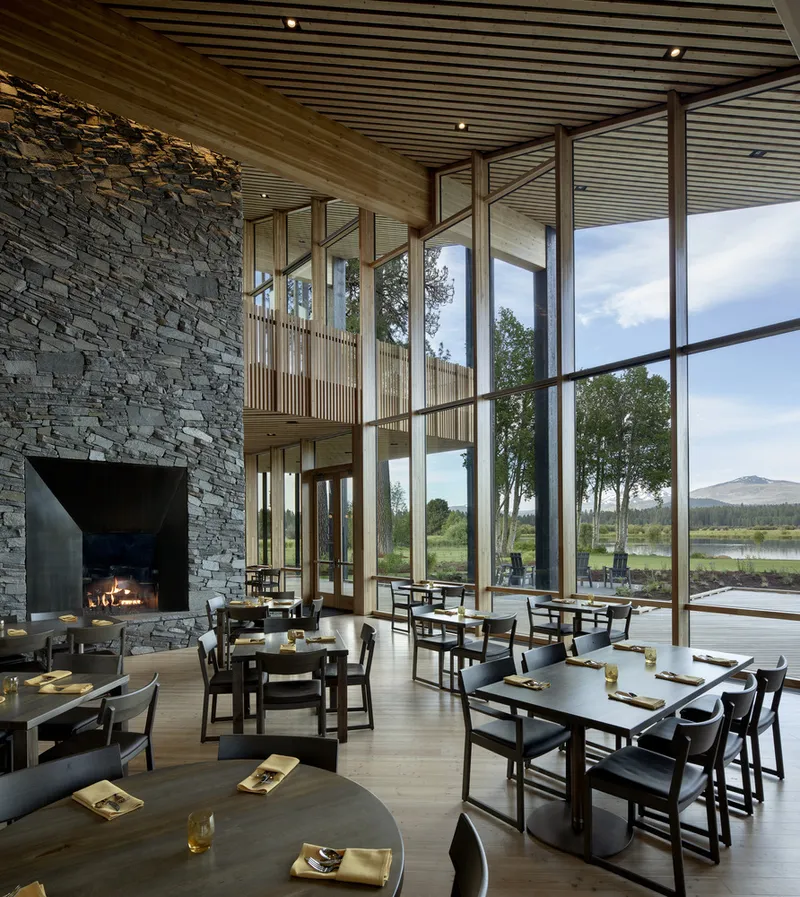
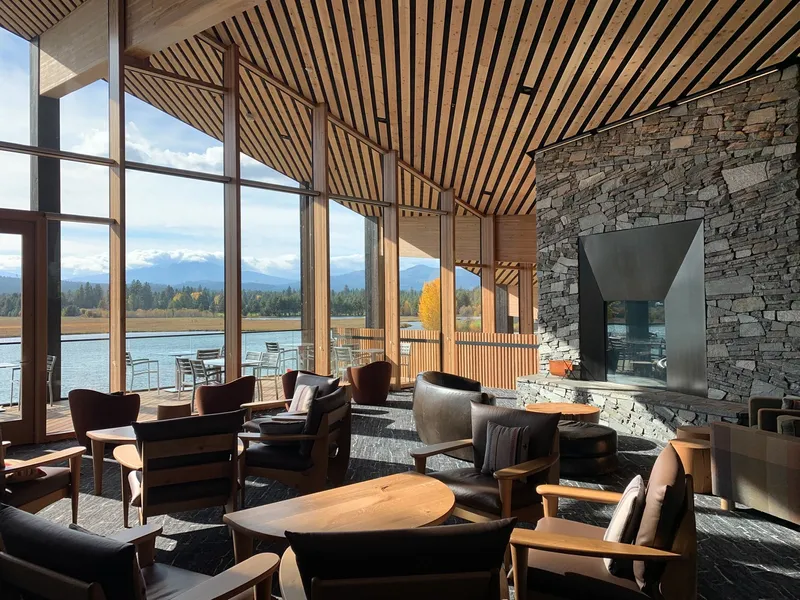
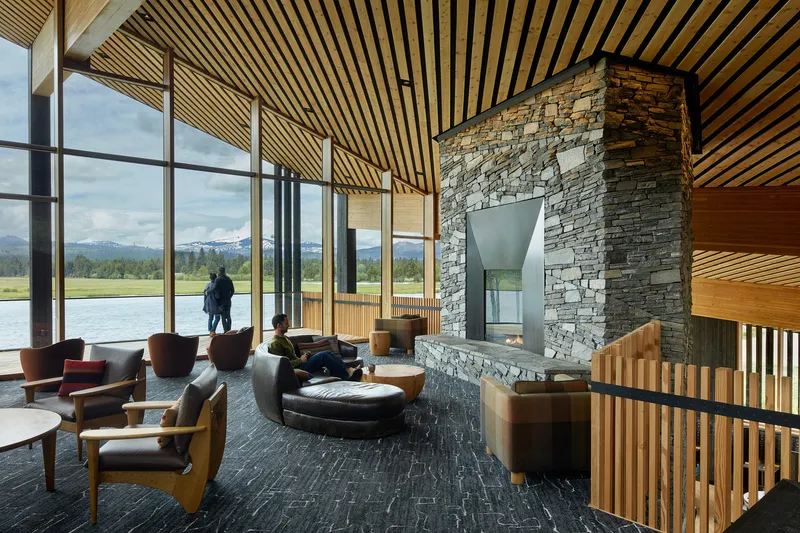
The original lodge had a fireplace at its heart, and residents made it clear during the community outreach process that any replacement needed one too. Hacker responded with a double-height stacked-stone column in Cowboy Coffee ledgestone that rises through the center of the plan, anchoring the dining hall, fireside lounge, and upper-level Aspen lounge around a single vertical axis. The stone is heavy, warm, and deliberately analog in a building otherwise defined by glass and timber.
The fireplace does more than provide heat. It stitches the nostalgia of the old lodge back into the new one, giving returning visitors a spatial landmark they recognize even though everything around it has changed. Layered stone surfaces wrap corners and extend into adjacent walls, blurring the line between structure and furniture.
Timber Ceilings, Salvaged Wood, and the Interior Atmosphere
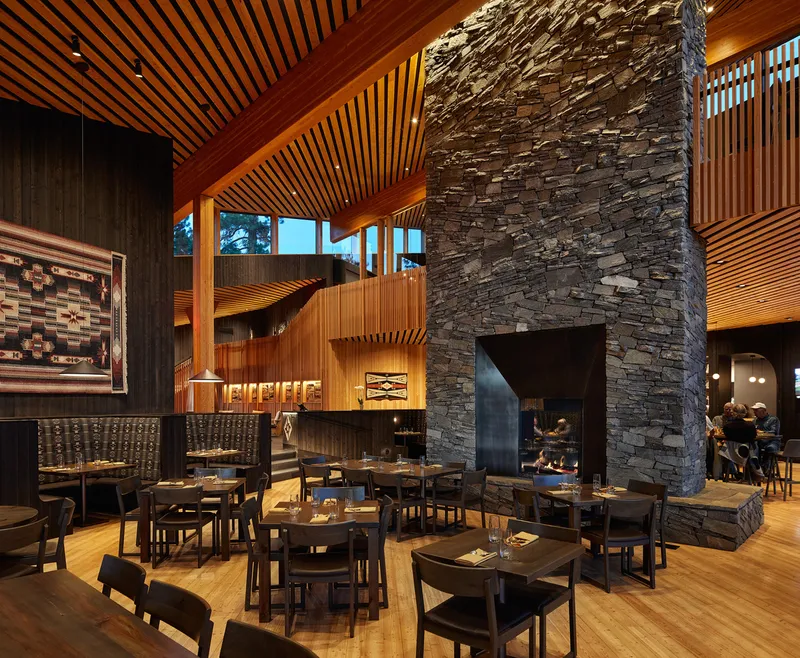
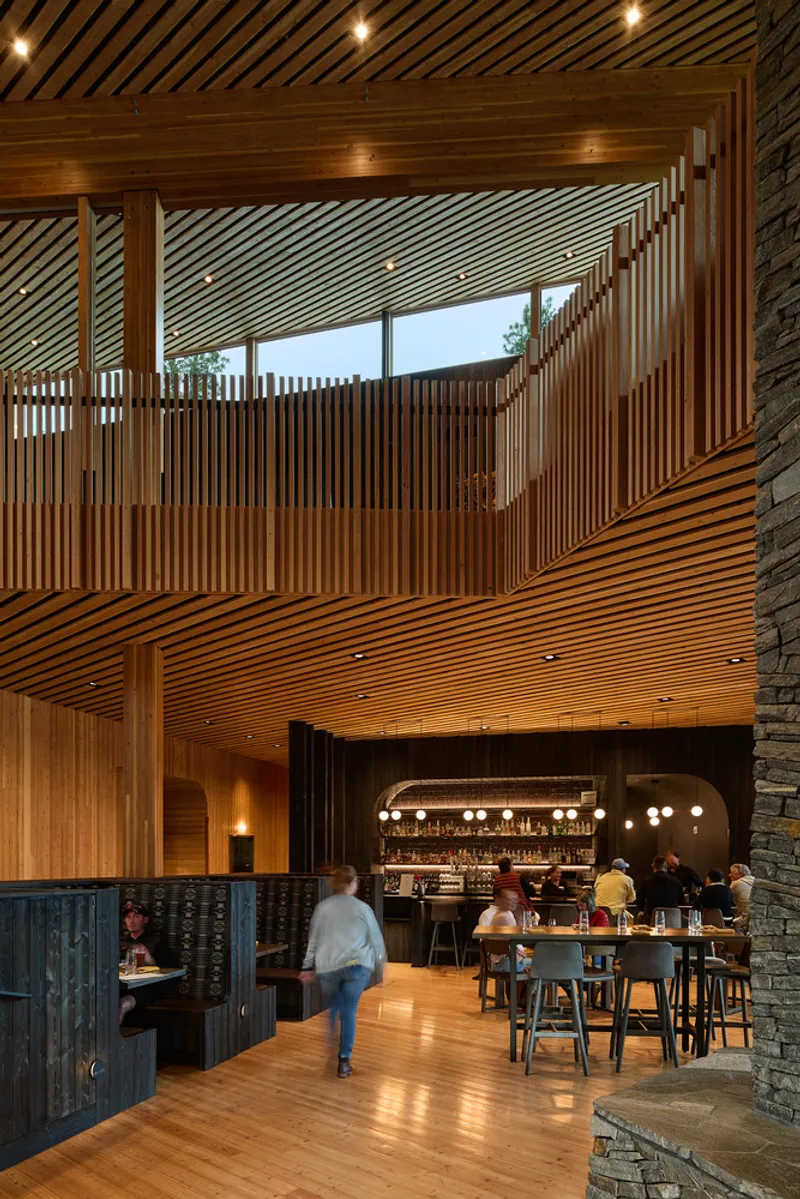
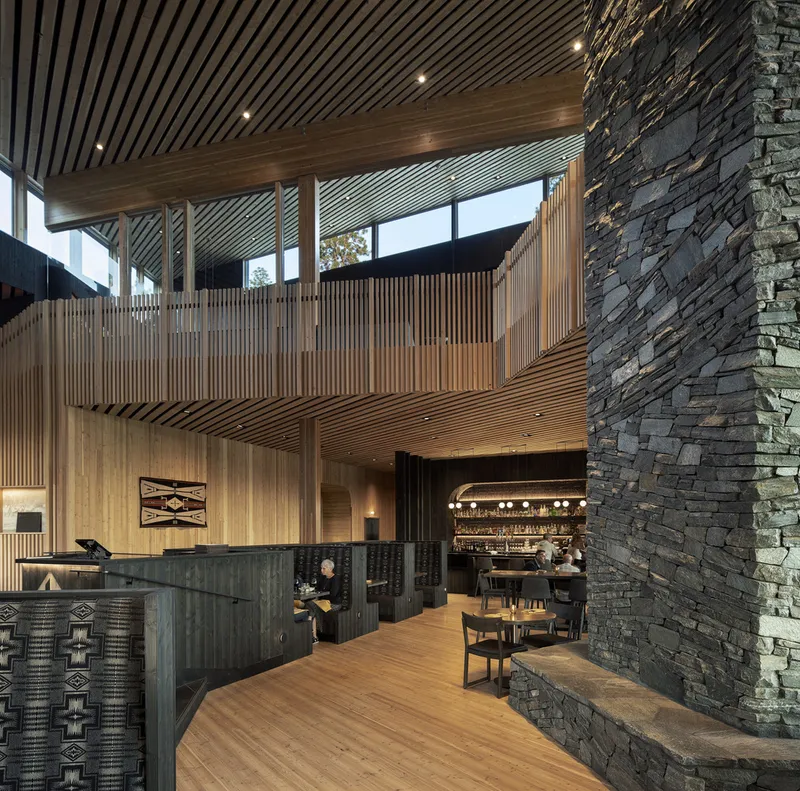
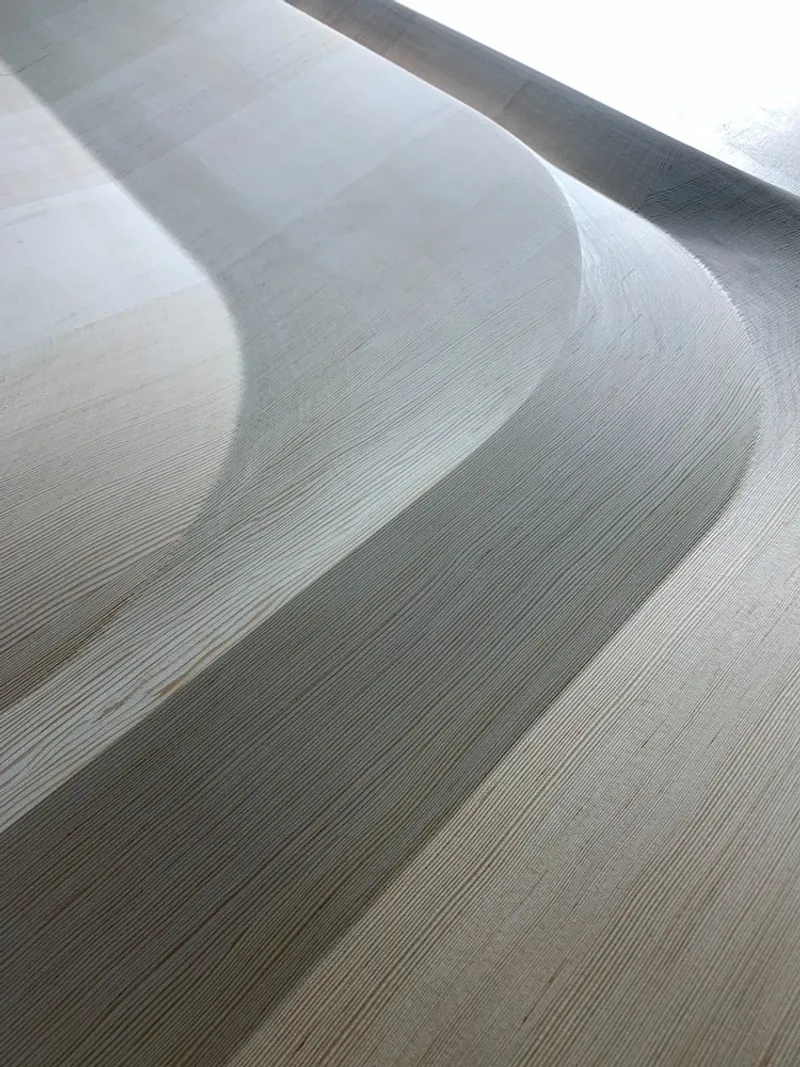
The interior is dominated by slatted timber ceilings that run in long, rhythmic planes across the dining hall, bar, and lobby. The slats modulate acoustics, filter clerestory light, and give the large spaces a directional grain that draws the eye toward the landscape beyond the glass. Pioneer Millworks supplied the interior wood siding, flooring, and ceiling material, maintaining a palette of native species in contrasting tones.
Salvaged wood from the original lodge appears throughout: in the mezzanine screens that look down over the bar, in guardrails and wall finishes, and in custom furniture fabricated by Straight Edge Designs. A ponderosa pine felled on site was milled into tabletops for the restaurant. These reuse moves are quiet but visible when you know to look. Brazilian black slate flooring anchors the warm wood above with a cool, dark ground plane.
Dining, Events, and the Central Kitchen
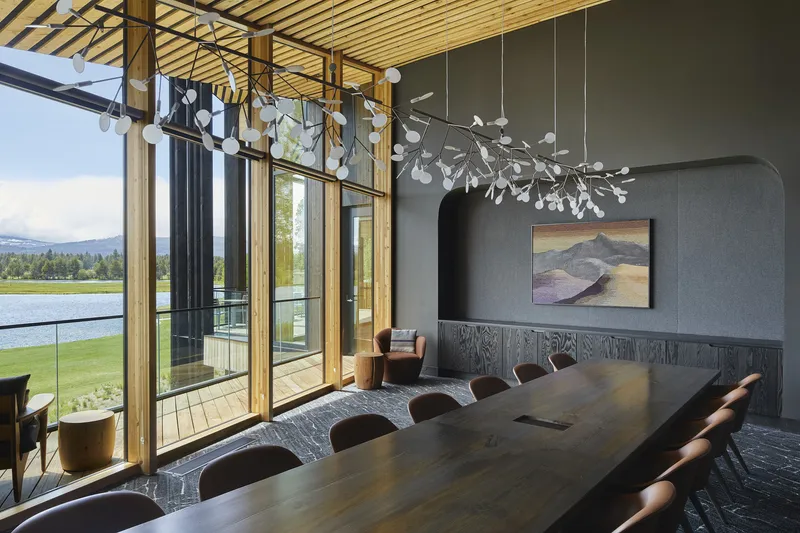
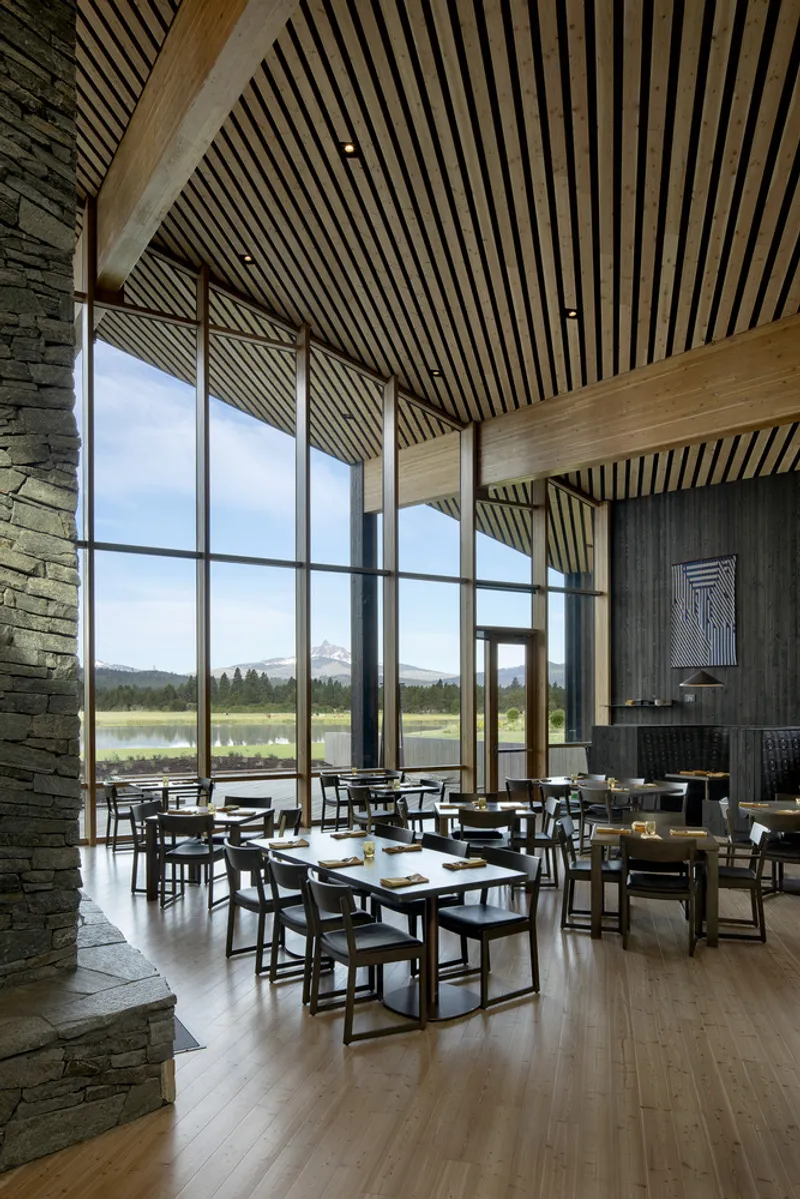
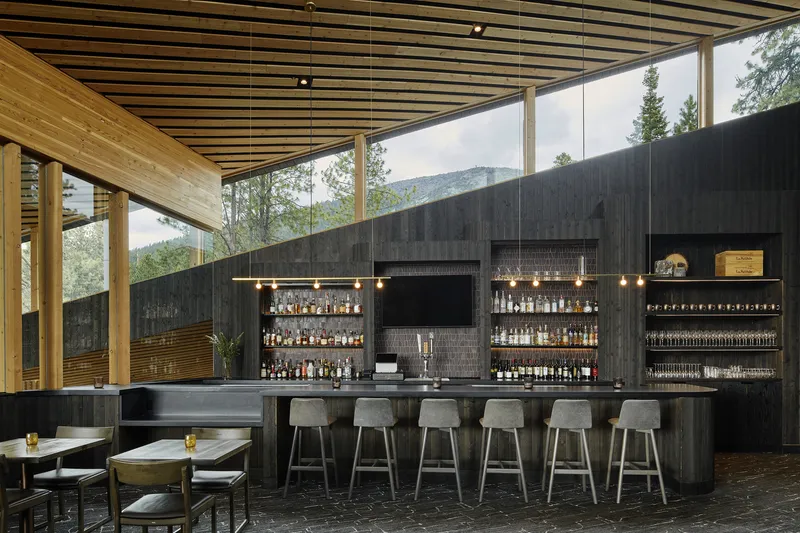
The program is organized around a central kitchen that can serve the 70-seat restaurant and bar, the 12-seat fireside lounge, the 50-seat second-floor Aspen lounge, the 16-seat Ponderosa private dining room, and a 210-seat event space called The Three Sisters, which is divisible into two rooms named Faith and Hope. That kitchen placement is not just about efficiency: it turns the back-of-house into the literal spine of the building, with dining venues radiating outward toward views and daylight.
Restaurant booths were designed to evoke the way the nearby Metolius River has carved pools into underlying lava flows, a geological metaphor that plays out in curved forms and dark upholstery set against the timber grid. The bar area, with its dark tile backdrop and tap system framed by slatted ceiling and clerestory glazing, manages to be both intimate and connected to the larger double-height volume.
Craft in the Details
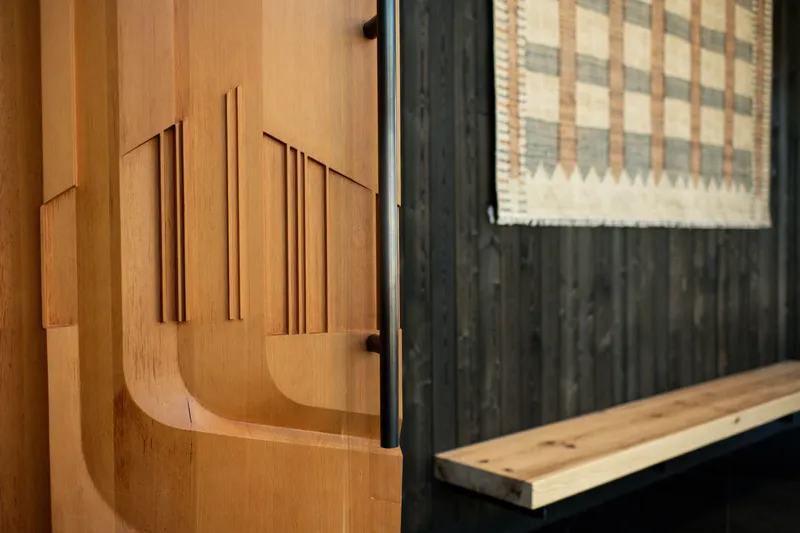
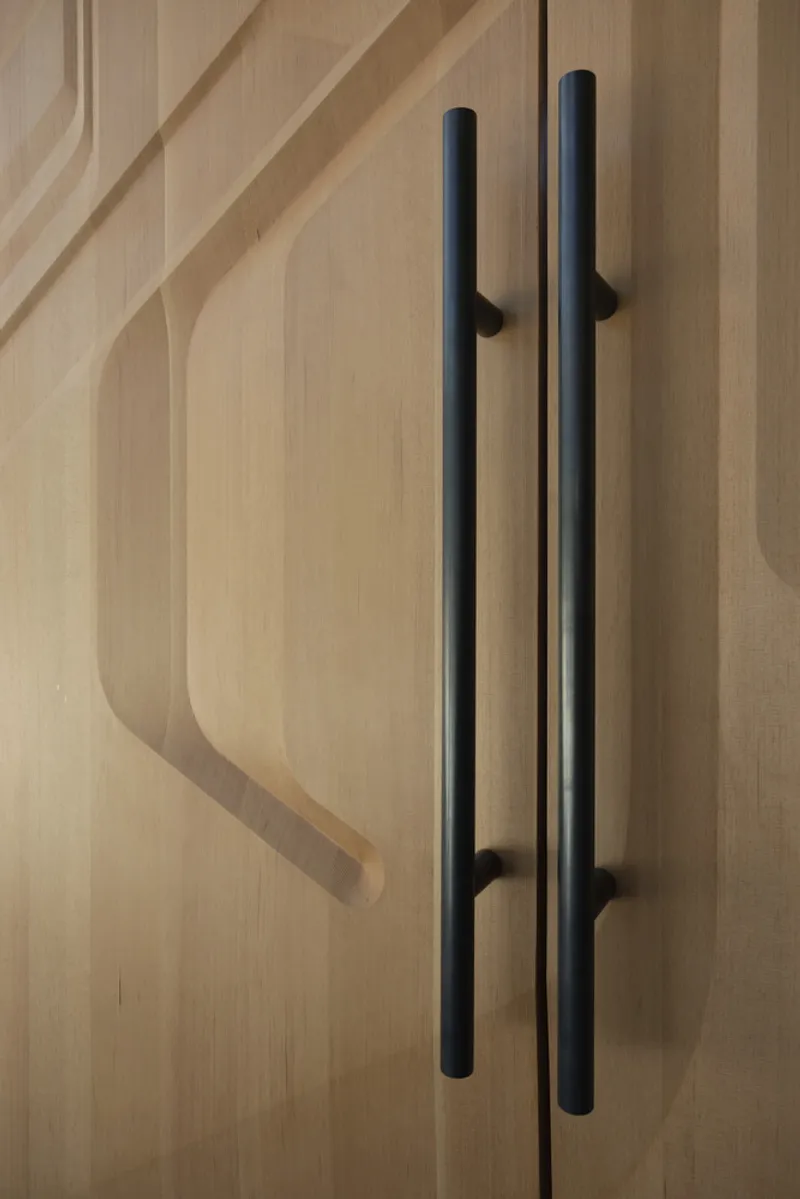
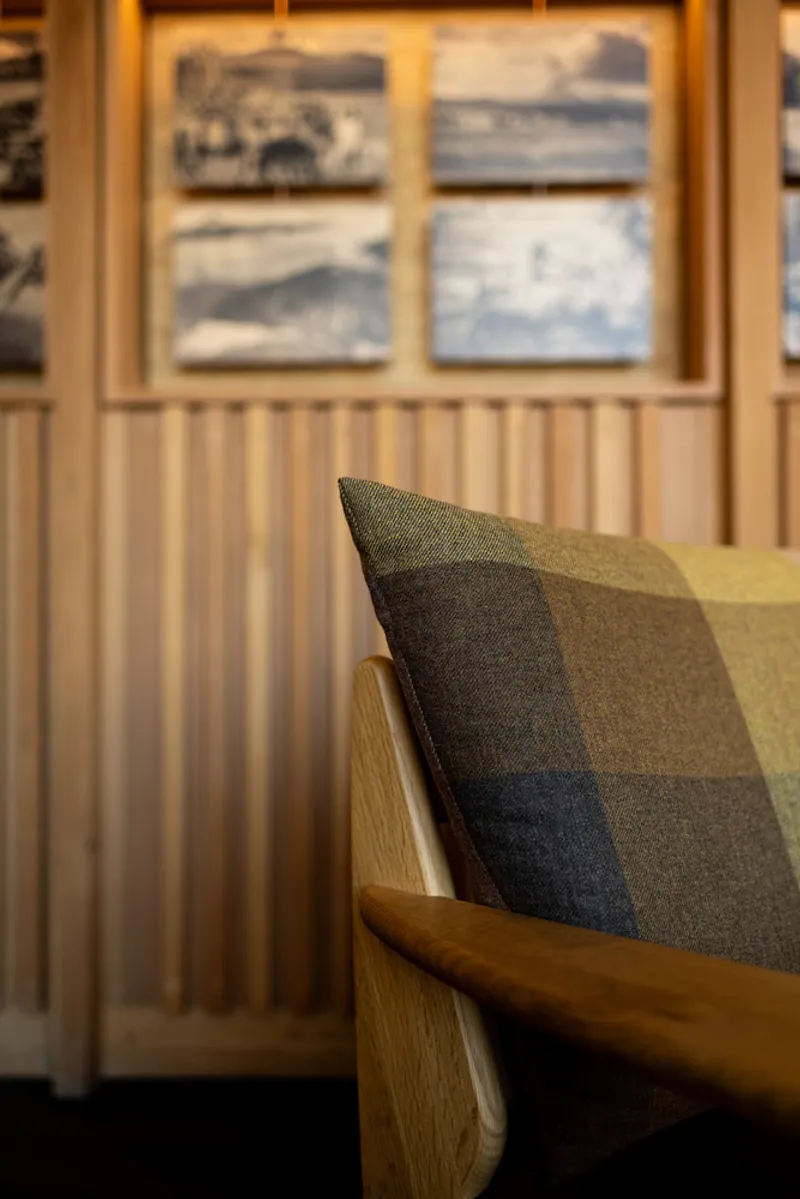
The quality of a lodge is ultimately measured at arm's length. Relief-carved timber wall panels with geometric motifs appear beside darkened door frames. Black cylindrical pulls sit on light timber cabinetry. An oak bench with a checkered wool cushion rests against vertical timber slat wainscoting. These details are not precious: they are robust enough for a building that hosts hundreds of visitors, but they reward close attention.
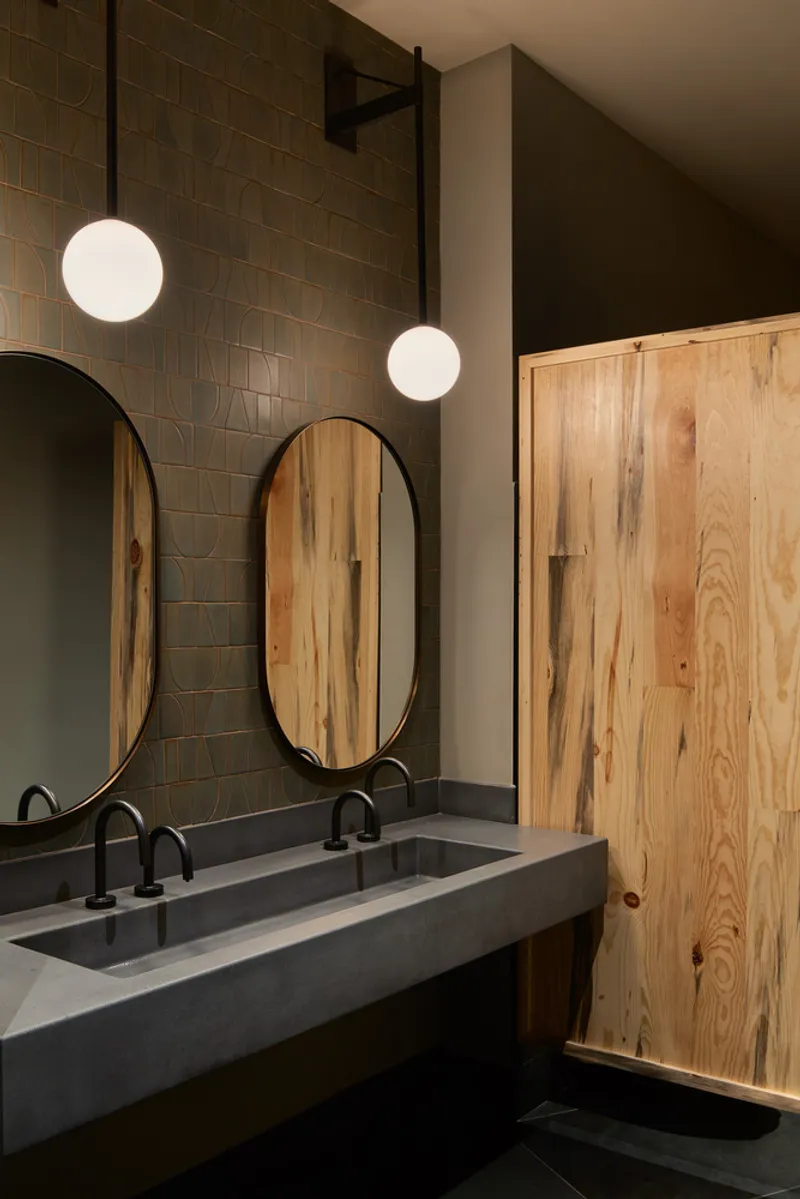
The washroom, with its concrete trough sink, oval mirrors, and knotted timber partition under globe pendants, is a case study in how to make a utilitarian space feel generous without resorting to luxury finishes. The materials are hard-wearing and honest, consistent with the rest of the building.
Arrival and Threshold
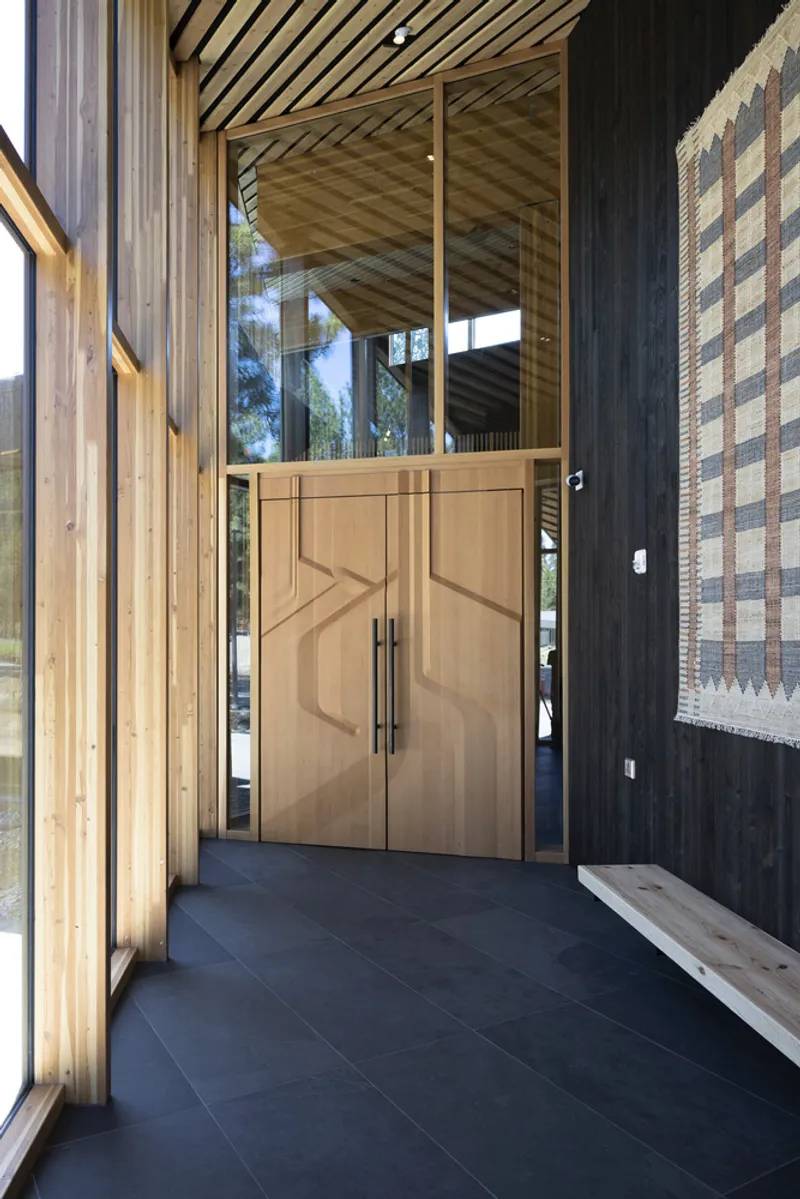
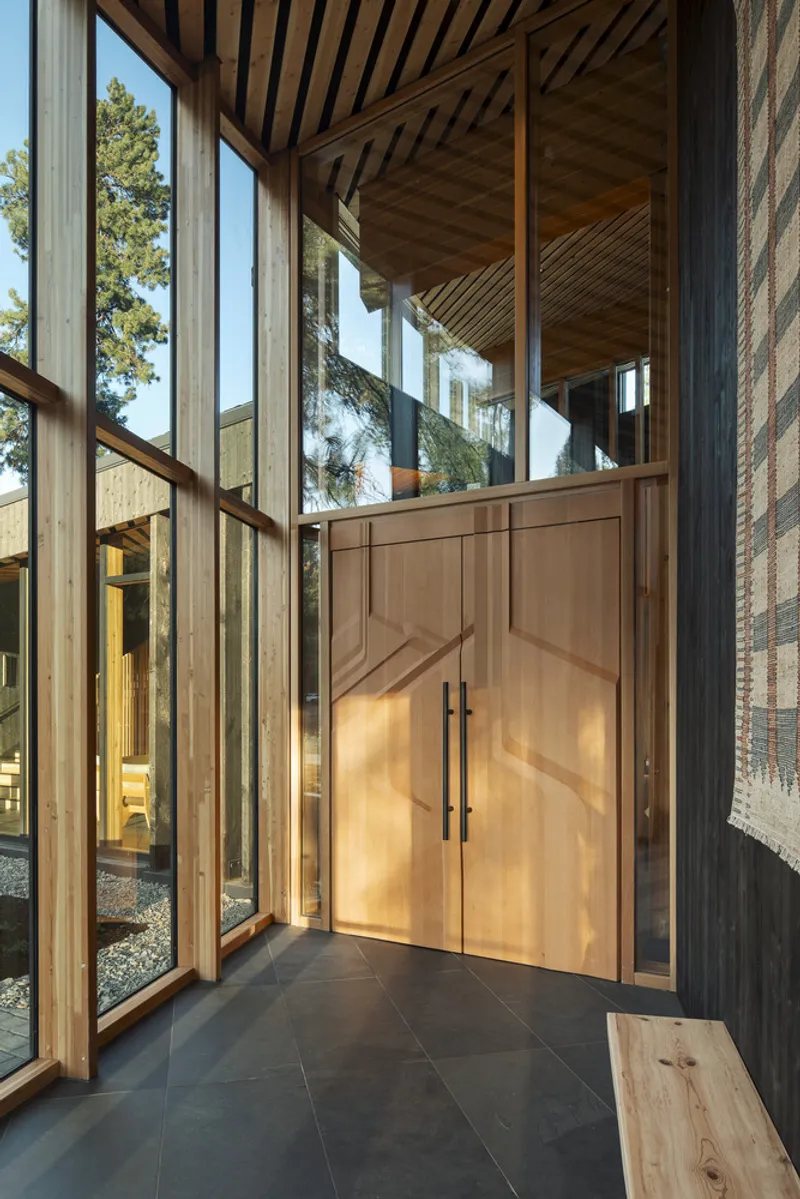
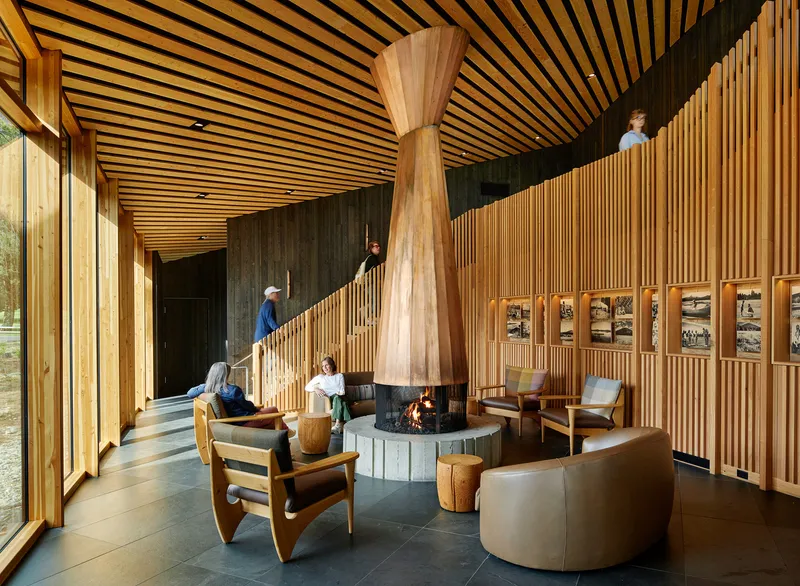
The entry sequence compresses visitors through a covered approach with exposed wood ceiling rafters and blackened steel cladding before releasing them into the double-height lobby. Paired timber doors and a glass-enclosed vestibule create an airlock against the mountain cold while framing the first glimpse of the stone fireplace beyond. The stair, clad in vertical slats that rhyme with the ceiling above, rises beside a sculptural fireplace column, pulling visitors upward to the mezzanine lounges.
Lakeside and Terrace Life
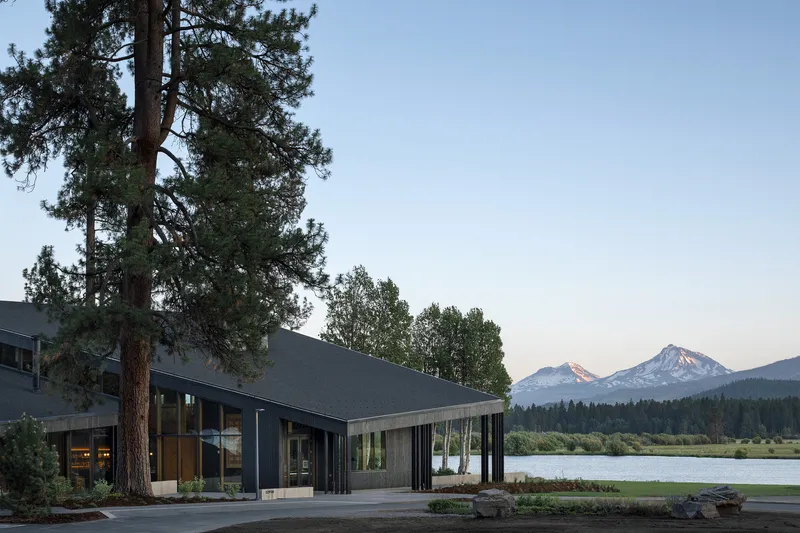
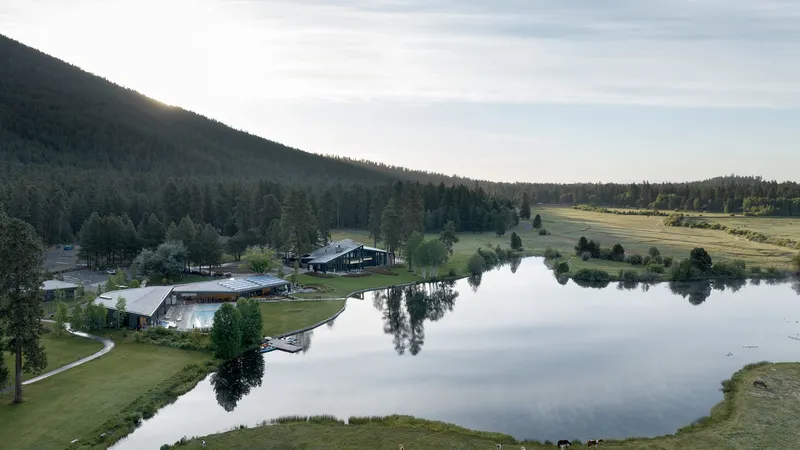
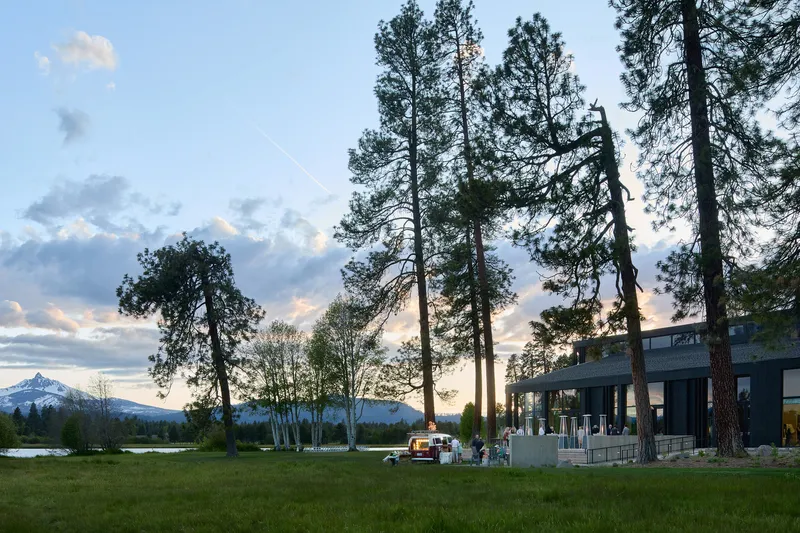
The lodge's relationship to water is as important as its relationship to forest. Viewed from across the lake at sunset, the dark pavilion and its reflection form a single composition with the snow-capped peaks behind it. At ground level, glass doors open directly onto a timber deck that extends the dining room outdoors. The terrace, scattered with seating beneath towering pines, functions as an outdoor lounge during the long summer evenings when the Cascades stay lit until nearly ten o'clock.
Drought-tolerant native plants in the landscape design reduce water consumption and encourage habitat creation, completing a site strategy that prioritizes ecological stewardship over ornamental planting.
Plans and Drawings
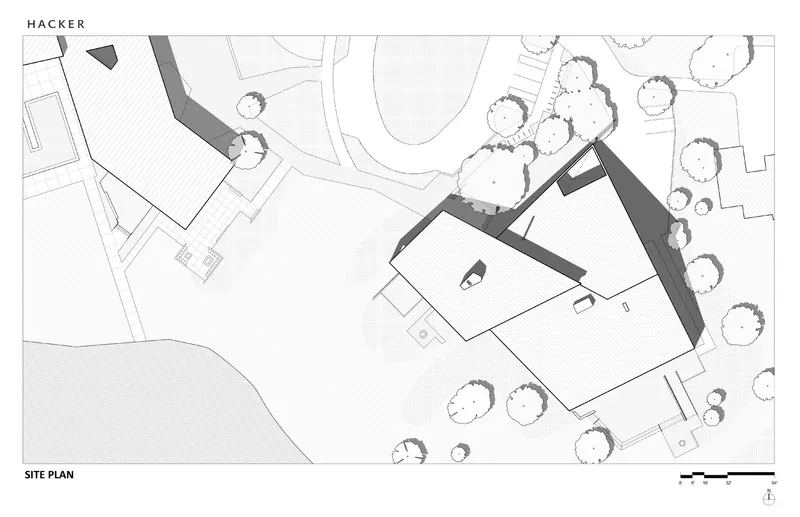
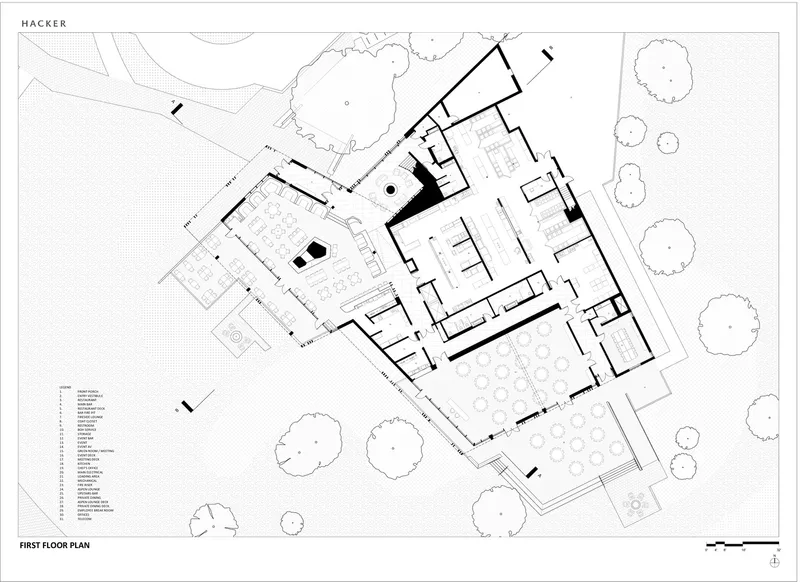
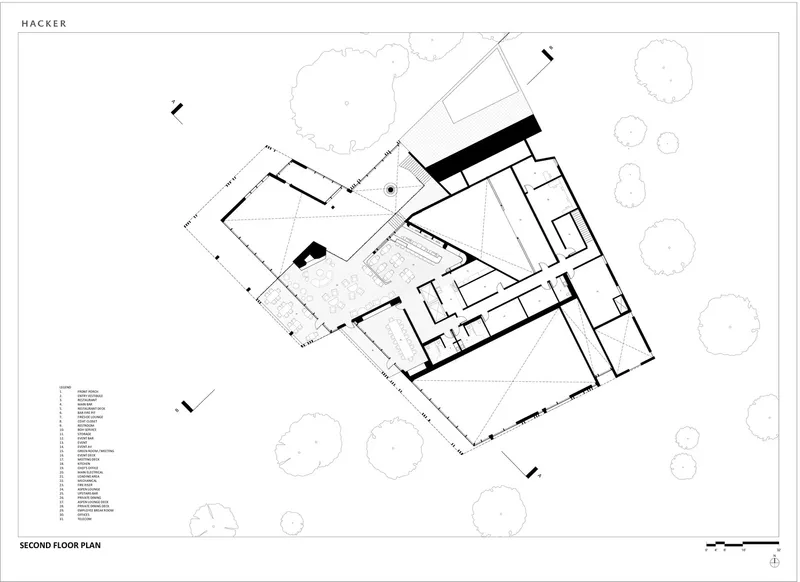
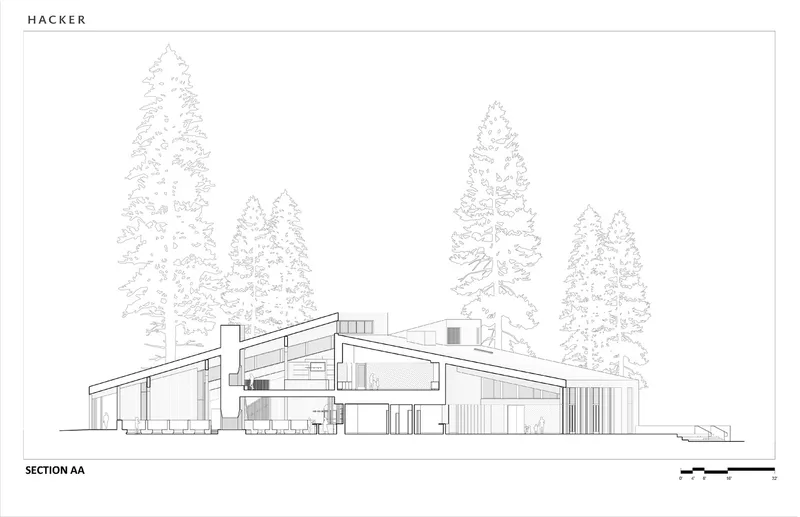
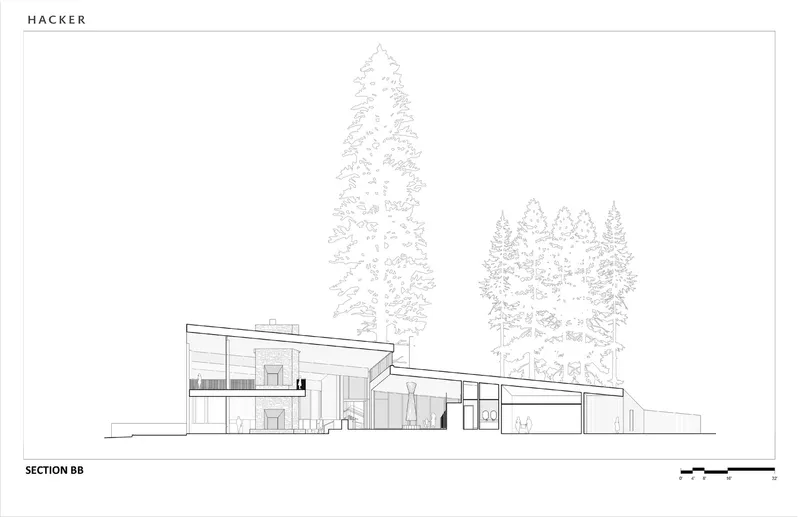
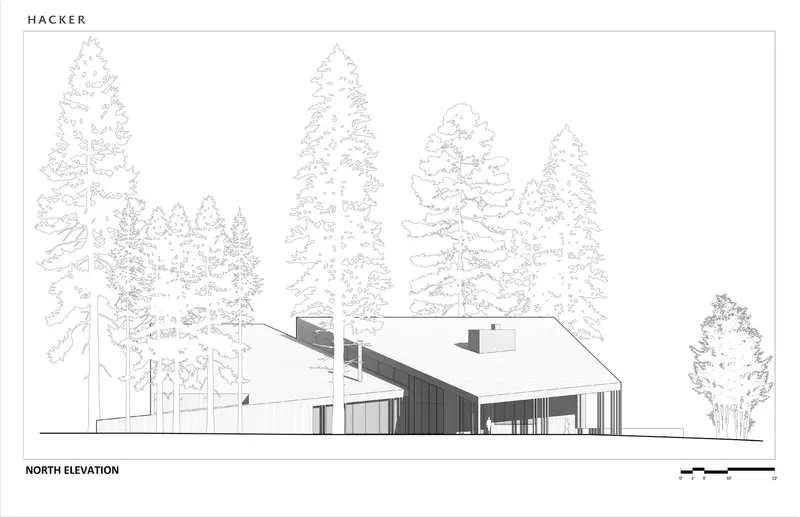
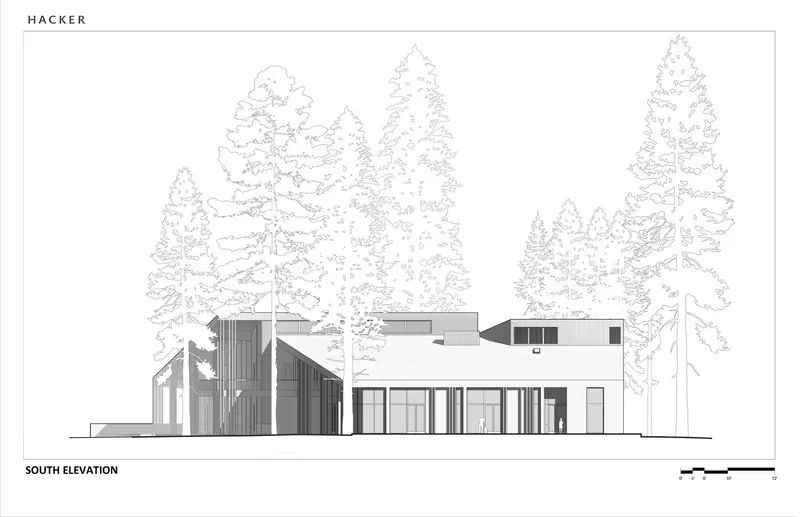
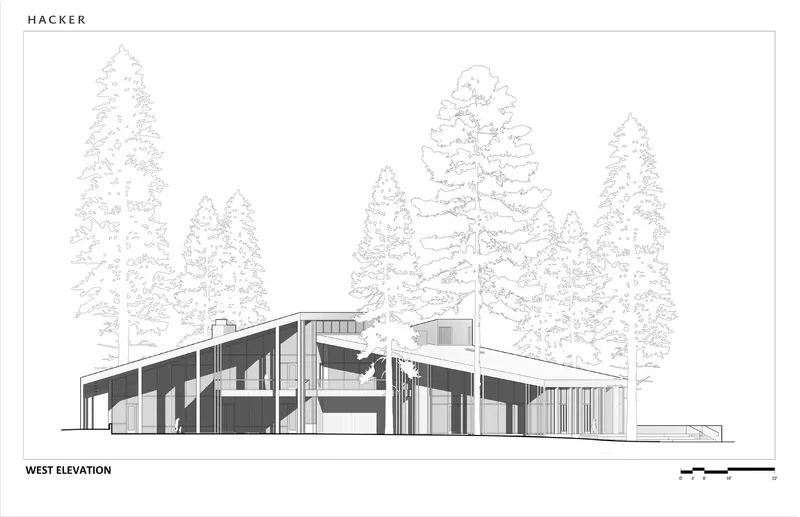
The site plan reveals how the two angled volumes navigate between existing trees, preserving the canopy while creating sheltered outdoor zones between the wings. The first-floor plan confirms the central stone core around which the restaurant, lounge, and event spaces radiate. On the second floor, mezzanine spaces overlook the double-height volumes below, and the Aspen lounge commands the widest view. Sections cut through the sloped roofs show how the building steps down with the terrain, keeping the ridge below the surrounding treetops. The north and south elevations illustrate the contrast between the opaque charred-cedar walls and the fully glazed lakeside facade, a duality that defines the building's character.
Why This Project Matters
The Black Butte Ranch Lodge is a case study in how to replace a beloved building without betraying it. Hacker Architects did not try to replicate the 1970s original. Instead, they identified what the community actually valued: the fireplace, the relationship to the landscape, the warmth of wood, the sense of gathering. Those values were translated into a contemporary building with a rigorous material logic, from the charred cedar that acknowledges wildfire to the salvaged timber that preserves the memory of the original structure.
More broadly, the project demonstrates that sustainability in a remote mountain setting is not about technology alone. It is about sourcing materials regionally, reusing what you can, designing with the climate rather than against it, and treating the existing landscape as a constraint worth respecting. At a moment when many resort and hospitality projects default to spectacle, the lodge at Black Butte Ranch makes an argument for restraint, specificity, and long-term thinking. That argument is convincing.
Black Butte Ranch Lodge by Hacker Architects. Black Butte Ranch, Oregon, United States. 27,000 square feet. Photography by Jeremy Bittermann.
About the Studio
Share Your Own Work on uni.xyz
If projects like this are the kind of work you want to make, uni.xyz is a place to publish your own, find collaborators, and enter design competitions.




Popular Articles
Popular articles from the community


Co-life: Sustainable Architecture for Age-Friendly Community Living
Co-life reimagines sustainable architecture for seniors through courtyards, rammed earth, shared gardens, and spaces designed for belonging.

The Musturak Paradise: Senior Living Architecture for a Connected Future in Temara, Morocco
The Musturak Paradise reimagines senior living architecture in Temara via private homes, social spaces, culture, community, and shared care.

Co-Life: Senior Housing Design That Reconnects Older Adults With the City
Co-Life reimagines senior housing design through healing gardens, shared streets, workshops, and a sustainable community across generations.

Play: Fragments of Their World
Familiar architecture becomes modular playground design, creating safe spaces where displaced children can learn, connect, imagine and play.


Similar Reads
You might also enjoy these articles


Hodi-Mandai Geram
Project Function: Preservation and revitalization of the Intangible heritage and socio-spatial identity of the Hodi by Housing, Cultural Memory Center, Sacred Grove, landscape, local tourism economy


Olio Towers: A Mid-Rise for Performers That Fuses Housing, Rehearsal, and Stage
Located blocks from Houston's Theater District, this modular tower stacks living units around a central performance atrium.

Oasis: Modular Green Housing Carved into Dhaka's Urban Fabric
A shortlisted Plugin Housing entry reclaims unauthorized settlements in Dhaka with stepped concrete volumes, green roofs, and ventilation-driven design.

Black Hole: A Floating Megastructure for the Post-Physical Era
Emiliano Mazzarotto envisions a spherical, self-scaling arena where e-sports, digital hotels, and holographic stadiums replace traditional public space.

Explore Architecture Competitions
Discover active competitions in this discipline



Challenge to reimagine the Iron Throne


Photograph architecture without architects


Illustrate the lost glory of Angkor Wat - Render Challenge


Design challenge to reuse E-waste
Comments (0)
Please login or sign up to add comments
No comments yet. Be the first to comment!