
BLDUS Revives the DC Alley House with Poplar, Bamboo, and Reclaimed Marble
A Capitol Hill residence on a former junk lot channels Roman spatial logic and farm-to-shelter materiality in Washington D.C.

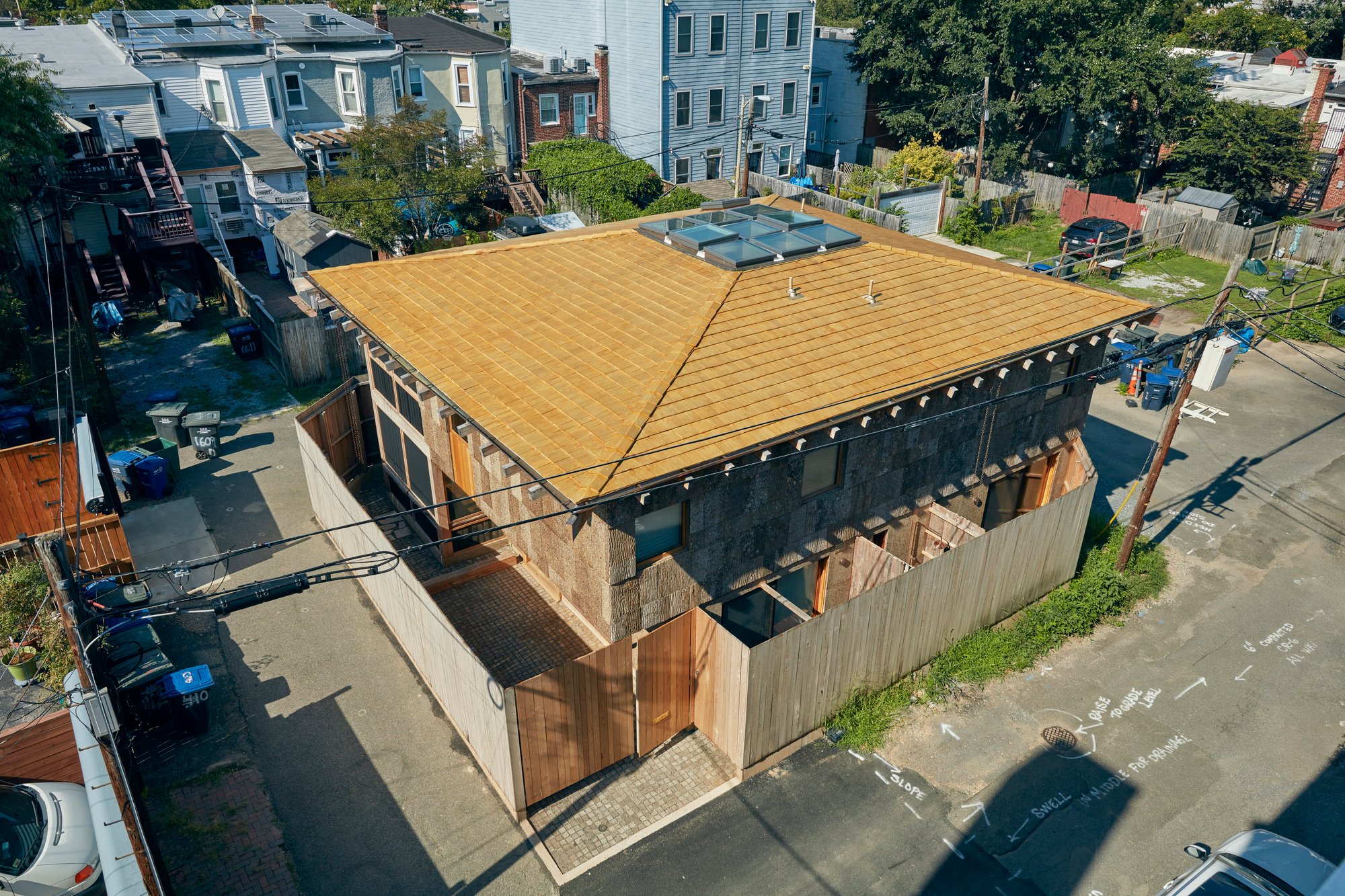
Adelaide Alley in Capitol Hill was, until recently, an unnamed strip of asphalt given over to broken-down cars, weeds, and litter. When Washington D.C. rewrote its zoning code in 2016 to permit alley housing for the first time, BLDUS seized the opening and built Poplar Grove, a 2,500 square foot residence that became the first project to navigate the city's brand-new alley regulations. The result is not a polite infill gesture. It is a materially aggressive, spatially inventive house that treats its constraints as generators.
What makes Poplar Grove worth studying is not just the novelty of building in a D.C. alley. It is the degree to which the architects committed to a coherent material and spatial thesis. The house is organized on a Roman nine-square grid, lit by a central atrium that collects sunlight the way an impluvium would collect rain. Its walls are built from BamCore bamboo panels that eliminate conventional studs entirely, creating continuous cavities packed with sheep's wool insulation. Trees were felled and milled on site. Reclaimed Tennessee pink marble pavers salvaged from the National Air and Space Museum surface the courtyards. Every specification points back to a "farm-to-shelter" philosophy that BLDUS pursued with unusual rigor.
An Alley Presence Built from Bark and Timber
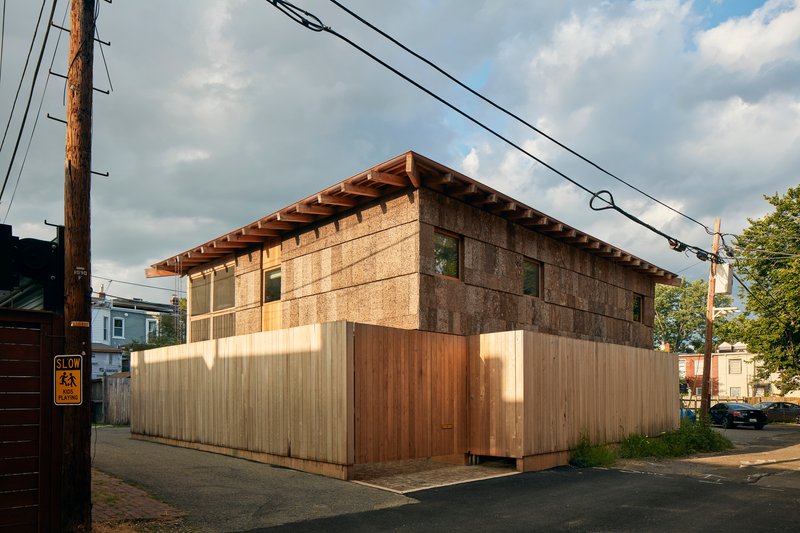
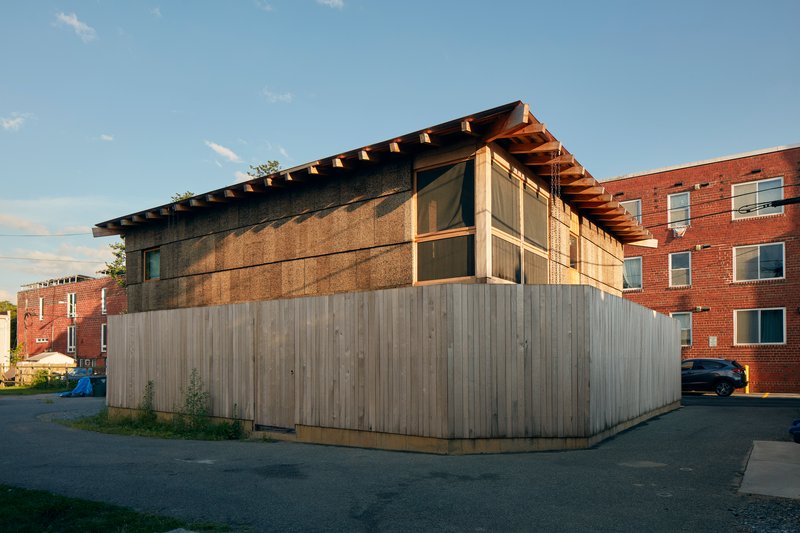
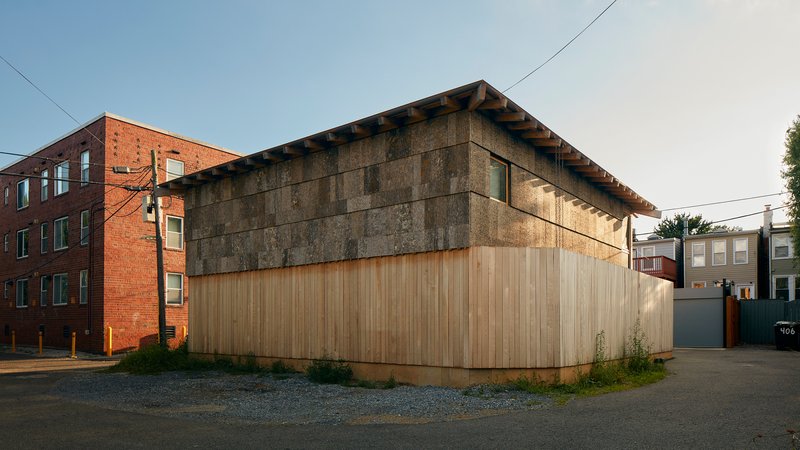
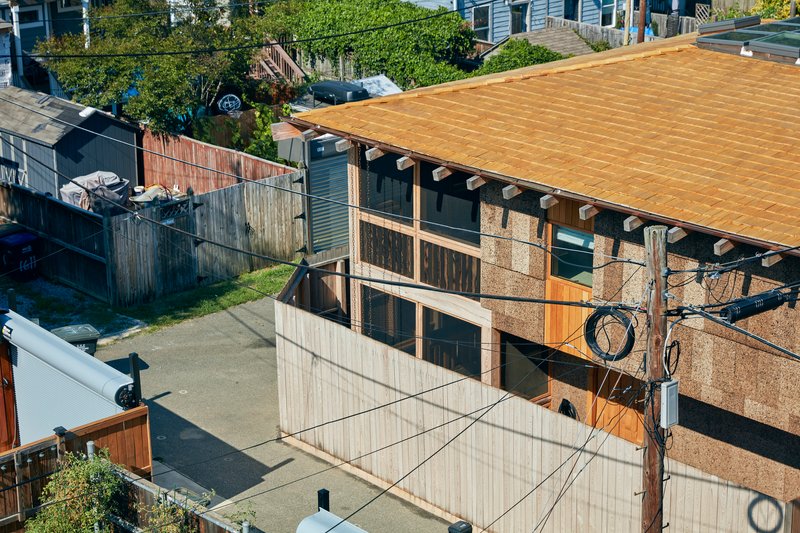
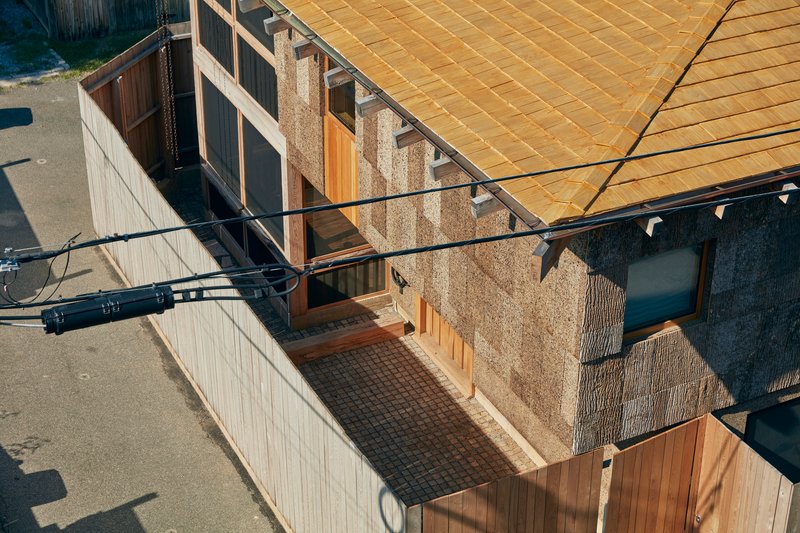
The street-facing elevations layer vertical timber cladding below panels of tulip poplar bark and cork, producing a facade that reads as both rough and deliberate. Exposed rafter tails project beyond the building line, casting deep shadows that protect the cladding and give the house an almost agrarian profile against its brick neighbors. An eight-foot sassafras palisade fence wraps the ground level, providing privacy without sacrificing light, and in places the fence material transitions seamlessly into wall cladding.
Black locust eaves extend well past the facade, shielding the softer materials below from weather and prolonging the lifespan of the bark and cork layers. The material palette is unusual for any city, let alone the capital, yet it is rooted in a local precedent that most Washingtonians have forgotten: the wooden alley houses that once populated these back streets before twentieth-century building codes and neglect erased them.
Corner Conditions and the Cantilevered Volume
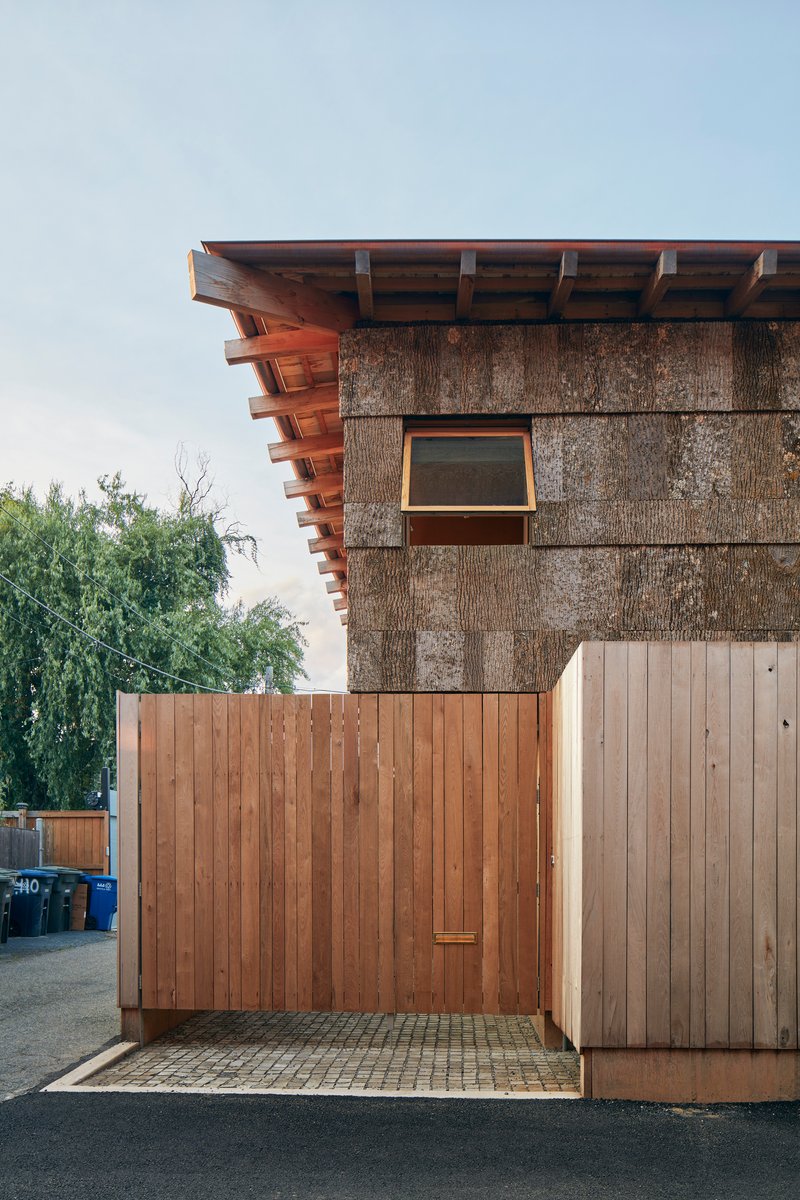
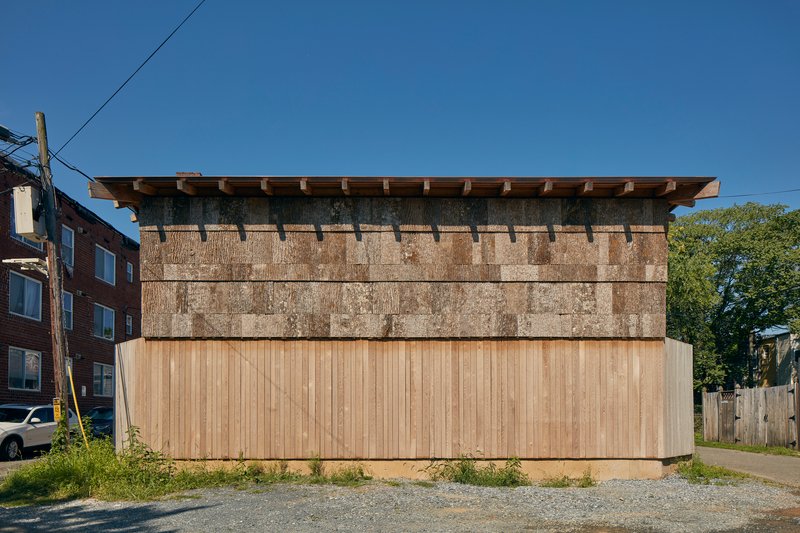
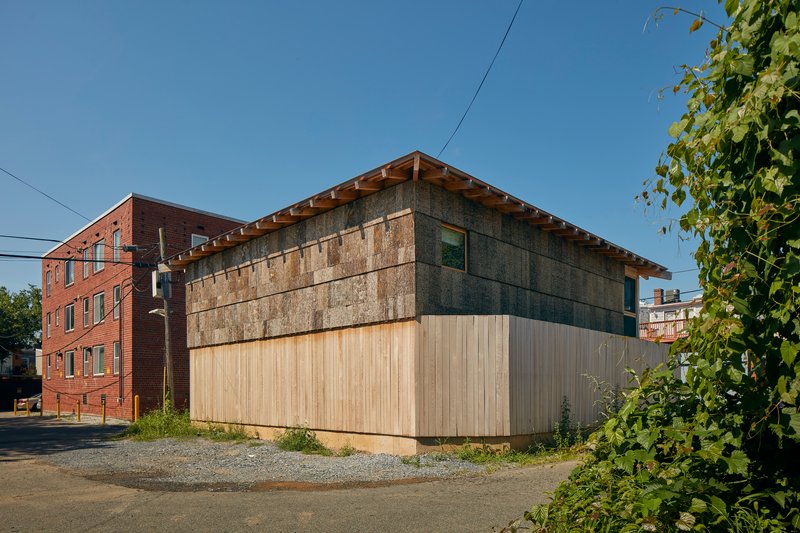
BLDUS treats corners as moments of material transition. The cantilevered second floor projects over the west side of the lot, creating a protected carport below while expressing structural ambition above. Where the timber gate enclosure meets the upper volume, you can read exactly how the building's weight is being transferred: poplar posts mark the inside corners of the nine-square grid, and the cantilever makes that logic legible from the street.
The side elevation against the neighboring brick buildings is particularly telling. The glazed upper level floats above the heavy timber base, and the contrast between Poplar Grove's warm, textured skin and the flat red brick next door clarifies what the architects were after. They were not trying to blend in. They were trying to demonstrate that an alley lot could support architecture with real ambition, not just a code-minimum accessory dwelling unit.
The Atrium as Light Collector
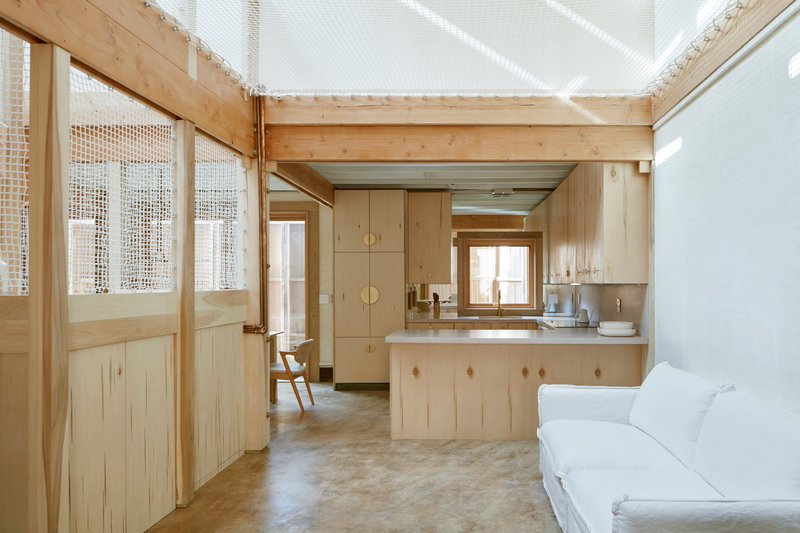
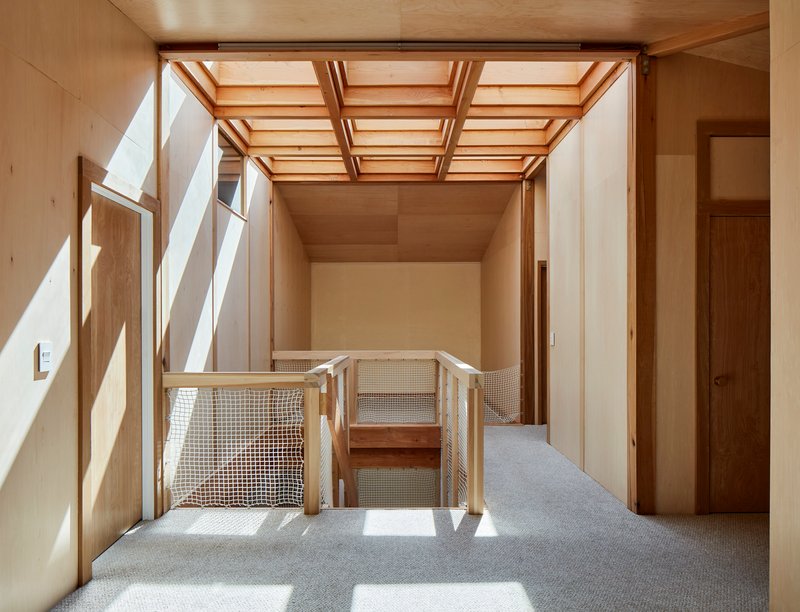
At the center of the house, a nine-square grid of skylights fills the role of the Roman atrium. Instead of collecting rainwater, this impluvium collects daylight, distributing it down through a central stairwell and into the rooms that surround it. The translucent skylight over the kitchen area washes the timber framing in diffuse light, and mesh-panel doors allow that light to travel laterally without obstruction.
The upper landing captures this strategy at its best: sunlight from the timber-framed skylight falls across the floor in clean, shifting rectangles, and mesh balustrades keep the visual field open between levels. On a tight urban lot with neighbors pressing in on multiple sides, this inward-looking approach to daylighting is not merely poetic. It is practical. BLDUS found a way to fill a house with light without relying on large windows that would compromise privacy or thermal performance.
The Net, the Frame, and Living in Between
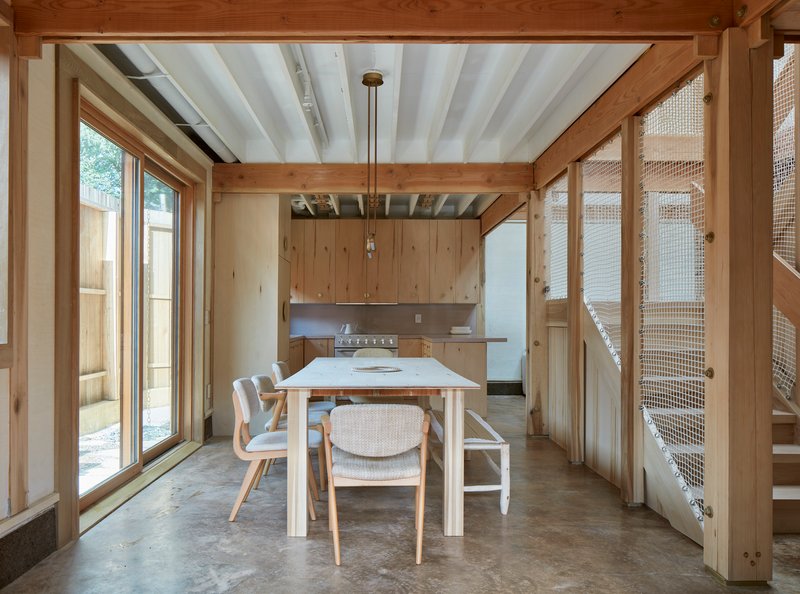
The most unexpected element inside Poplar Grove is the netted mezzanine suspended above the double-height living room. Architectural white netting stretches across the structural framing, creating a reading nook and play zone that hovers over the dining area below. It promotes light penetration through the section while offering a genuinely unusual domestic space: somewhere between a hammock and a room.
The dining area below reveals the structural logic in full. Poplar timber posts and beams are left exposed, painted ceiling beams contrast with the raw wood of the frame, and the mesh-panel stair enclosure keeps sightlines continuous. Generic LED strips set within the structural members provide ambient lighting without visible fixtures, reinforcing the impression that the frame itself is the architecture, and everything else is infill. The upper terrace, where stone columns support the overhanging timber roof, extends this legibility outdoors.
Roof Geometry from Above
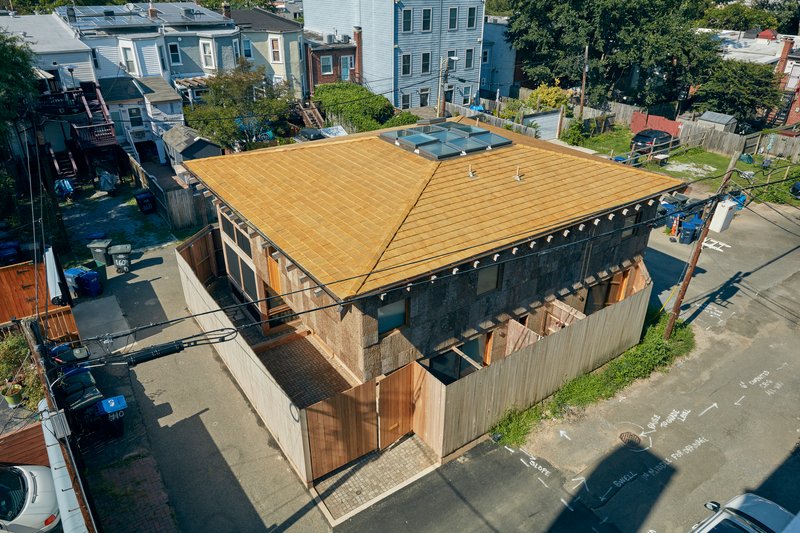
The aerial view confirms what the street elevations suggest: the roof is a carefully shaped element, not an afterthought. Exposed timber joists span between volumes, and the butterfly geometry channels views and light into the atrium while managing rainwater runoff. Seen from above, the house reads as a compact timber organism inserted into the alley grid, its footprint modest but its spatial ambitions extending vertically through the section.
Plans and Drawings
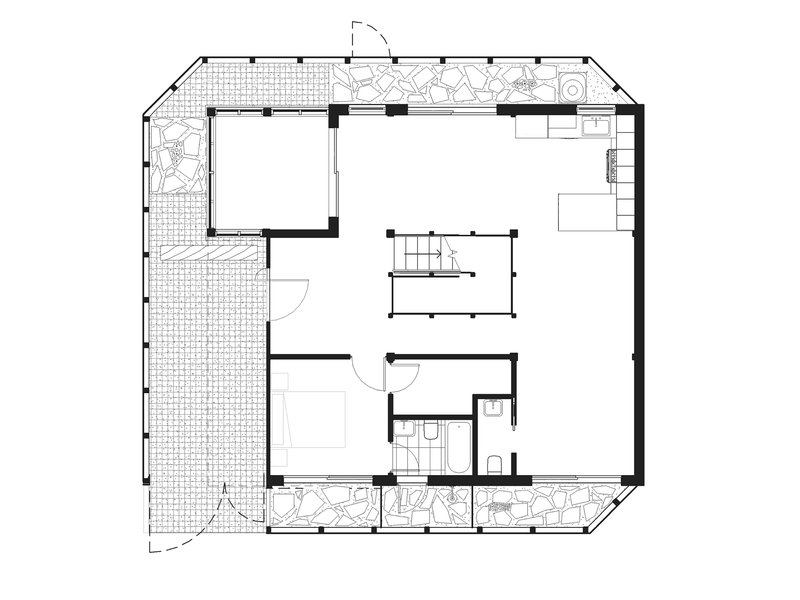
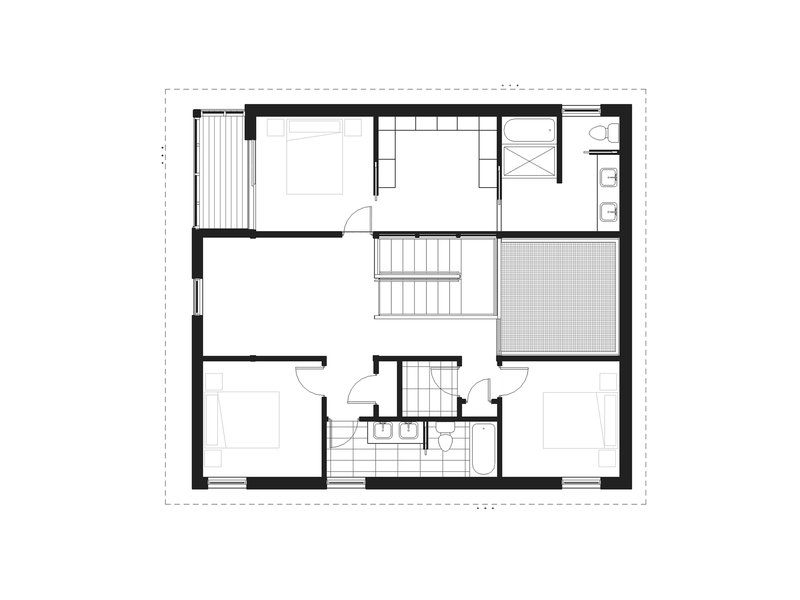
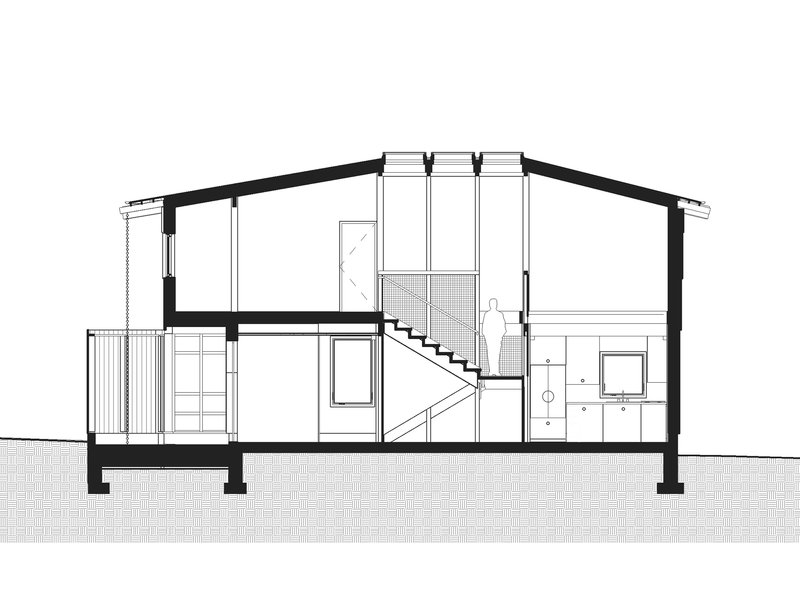
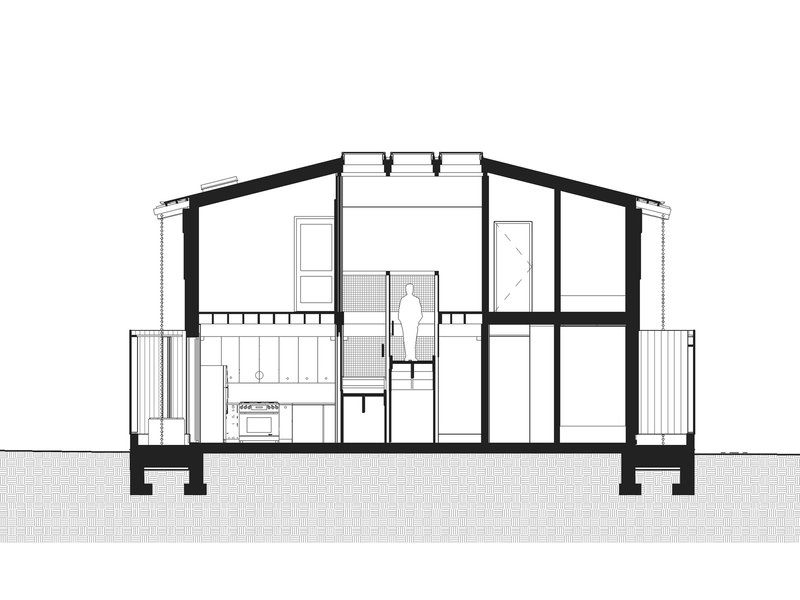
The floor plans reveal an L-shaped courtyard wrapping the ground level, with the central staircase anchoring the nine-square grid. Three bedrooms occupy the upper floor, arranged around a central bathroom and stair core in a compact, efficient layout that squeezes four bedrooms and three-and-a-half baths into roughly 2,500 square feet. The sections are where the project's spatial ambition becomes fully legible: sloped roof structures and roof monitors channel light deep into the plan, and the double-height living space registers as the heart of the house. The figure for scale in the section drawing is a useful reminder of how tall these spaces actually are.
Why This Project Matters
Poplar Grove matters because it proves that alley housing does not have to mean miniaturized, compromised architecture. On a 1,900 square foot site that was literally a dumping ground, BLDUS produced a house with a clear spatial idea, a rigorous material philosophy, and genuine environmental ambition. The BamCore bamboo wall system, the sheep's wool insulation, the triple-glazed windows, and the passive daylighting strategy add up to a building that performs as well as it looks, and it looks unlike anything else in Washington D.C.
More broadly, the project is a test case for urban density done right. As cities across the United States revisit zoning codes to permit accessory dwelling units and alley housing, Poplar Grove sets a high bar. It shows that working within extreme constraints, navigating brand-new regulations, and building with unusual materials does not require sacrificing architectural quality. If anything, the constraints sharpened the design. D.C. gave BLDUS an unnamed alley and a set of untested rules. They gave the city back a prototype.
Poplar Grove by BLDUS, located in Washington D.C., United States. 2,500 m². Completed in 2021. Photography by Ty Cole.
About the Studio
Share Your Own Work on uni.xyz
If projects like this are the kind of work you want to make, uni.xyz is a place to publish your own, find collaborators, and enter design competitions.




Popular Articles
Popular articles from the community

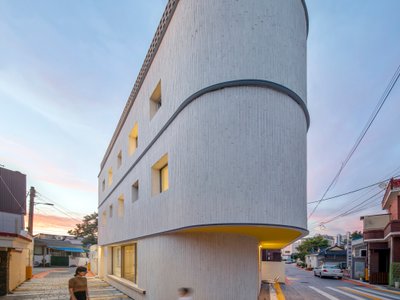
YOAP Architects Round a Corner in Yeongcheon with a Cylindrical Community Hub
A 197-square-meter brick and ribbed-clad tower turns a forgotten alley corner in South Korea into a public garden with a low threshold.
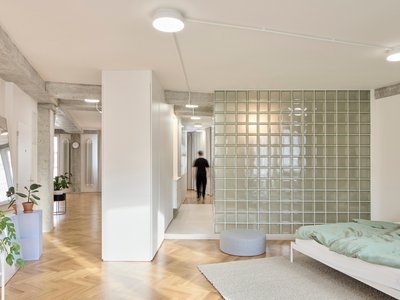
RDTH architekti Rips Out Nearly Every Wall in a Prague Apartment and Replaces Them with Furniture
A 101-square-meter post-war flat in Prague trades rigid partitions for a single rotated furniture block, curtains, and glass concrete.
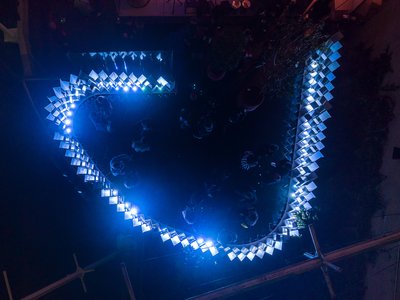
Rojkind Arquitectos and Think Parametric Build a Glueless Pavilion from 67 Interlocking Panels
A serpentine fiber-cement installation in Chapultepec Park celebrates a decade of architectural media in Mexico City.
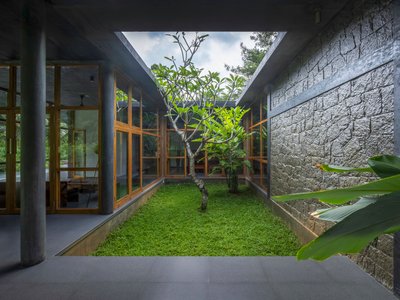
3dor Concepts Wraps a Kerala Home in Mirrored Concrete Arcs Around a Courtyard Tree
In the Western Ghats foothills of Thamarassery, a 270 m² single-story house uses two curved volumes to frame nature as its center.


Similar Reads
You might also enjoy these articles

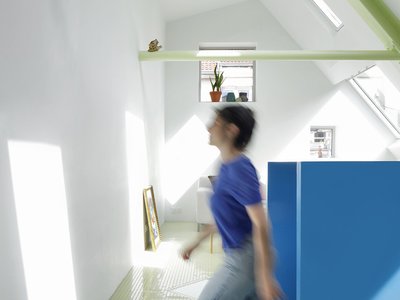
127af Flips a Tiny Bagnolet Rowhouse Upside Down with a Handcrafted Roof Extension
A 55-square-meter terraced house on the edge of Paris gains a luminous upper living floor through lightweight timber and steel.
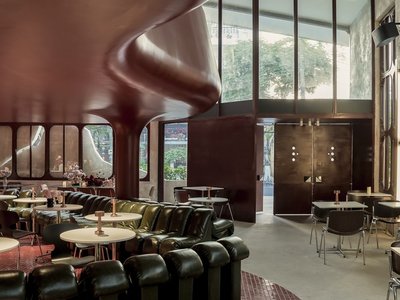
1.61 Design Workshop Wraps a 600-Square-Meter Café in Vietnam in Sculptural Burgundy Drama
Reden Café & Bistro pairs a helical staircase, mosaic floors, and deep red interiors to rethink Vietnamese hospitality space.

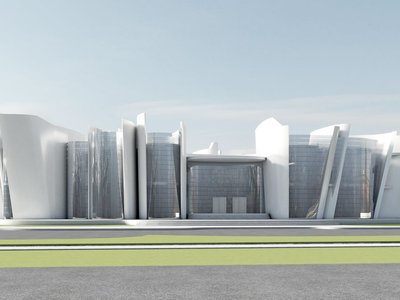
The Unbound Brain: A School Shaped by Cognitive Architecture
Cylindrical learning pods radiate like neurons from a central cortex, turning the floor plan into a spatial model of human thought.
Revival Vernacular Architecture: Rammed Earth Settlements for the Sahara
A modular desert community in Mauritania that fuses passive cooling techniques with earthen construction and local craftsmanship.
Explore Architecture Competitions
Discover active competitions in this discipline




The International Standard for Design Portfolios


The Global Benchmark for Architecture Dissertation Awards


The Global Benchmark for Graduation Excellence


Challenge to reimagine the Iron Throne
Comments (0)
Please login or sign up to add comments
No comments yet. Be the first to comment!