
Blight Rayner and Snøhetta Wrap Brisbane's New 1,500-Seat Theater in a Rippling Glass Curtain
The Glasshouse Theater completes a decades-old cultural precinct in South Bank with river-inspired facades and ironbark-lined interiors.

For over forty years, a corner of Brisbane's Queensland Performing Arts Centre sat unbuilt. Robin Gibson's brutalist cultural district always anticipated a seventh stage, but the constrained site seemed too small for a 1,500-seat venue. Blight Rayner Architecture and Snøhetta, winners of a 2019 international design competition, found the answer not by retreating inward but by pushing outward: a six-metre cantilever on two street frontages, a concrete core wrapped in a four-layer glass veil, and 90 tonnes of Queensland ironbark timber shaping the acoustic interior. The result, completed in January 2026 at a cost of AUD 184 million, is a theater that treats its own transparency as a kind of performance.
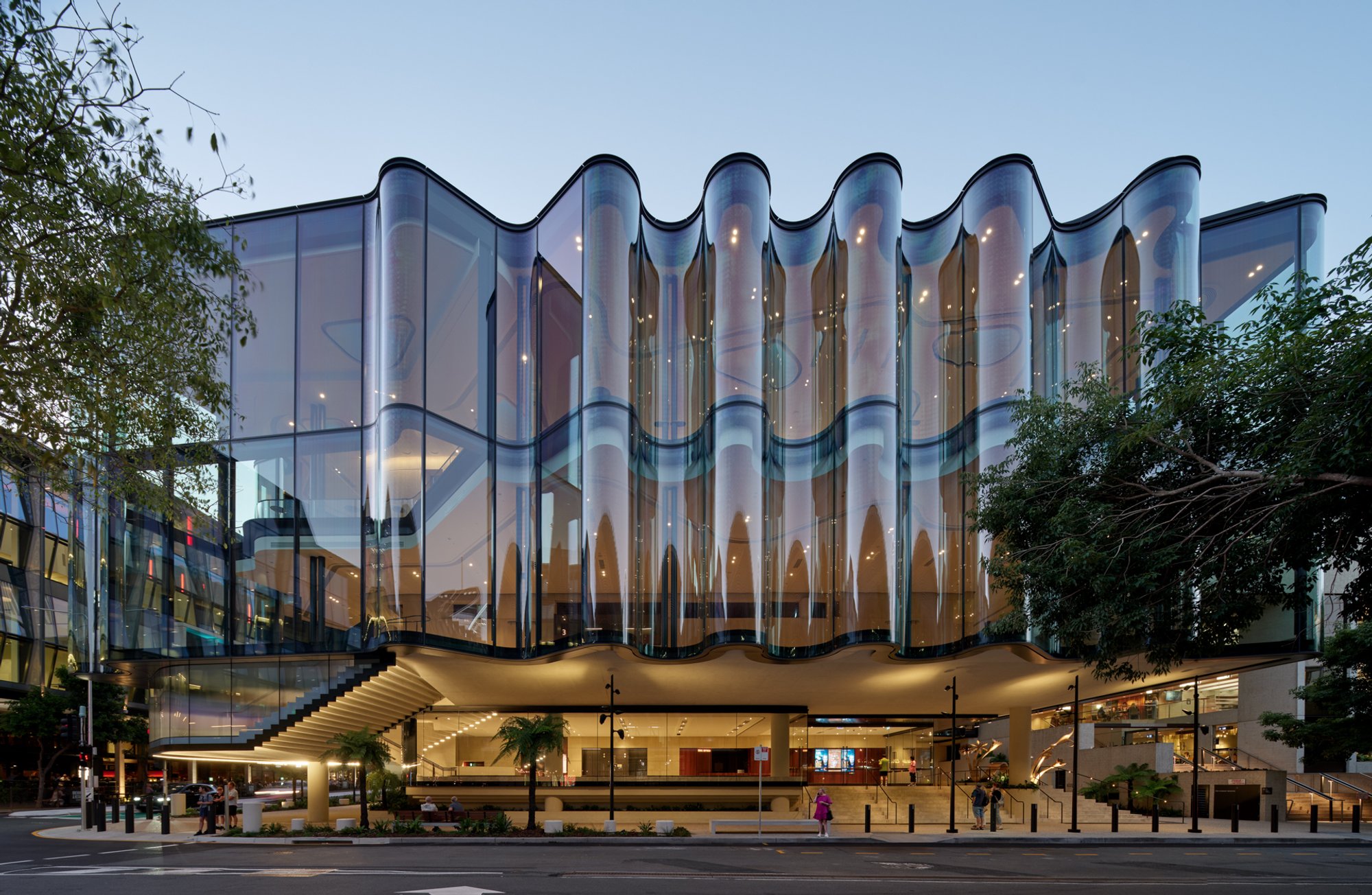
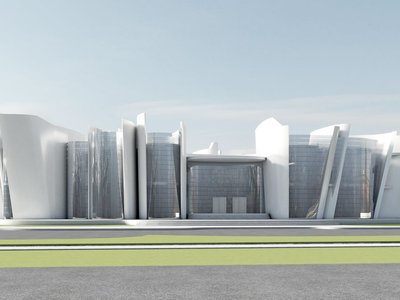
What makes the Glasshouse genuinely interesting is the way it collapses the boundary between street life and stage life. The undulating facade, 217 unique glass panels manufactured by Austrian specialist Seele, draws its geometry from a prose-poem by Aboriginal Elder and artist Lilla Watson about the Brisbane River: ripples on the water, fish moving beneath the surface. From outside, pedestrians see the foyer crowd through distorted glass, an abstraction of a stage curtain that turns every intermission into a public spectacle. From inside, the city becomes the backdrop. That reciprocity, between audience and passerby, is the building's most potent idea.
A Glass Curtain on Two Fronts
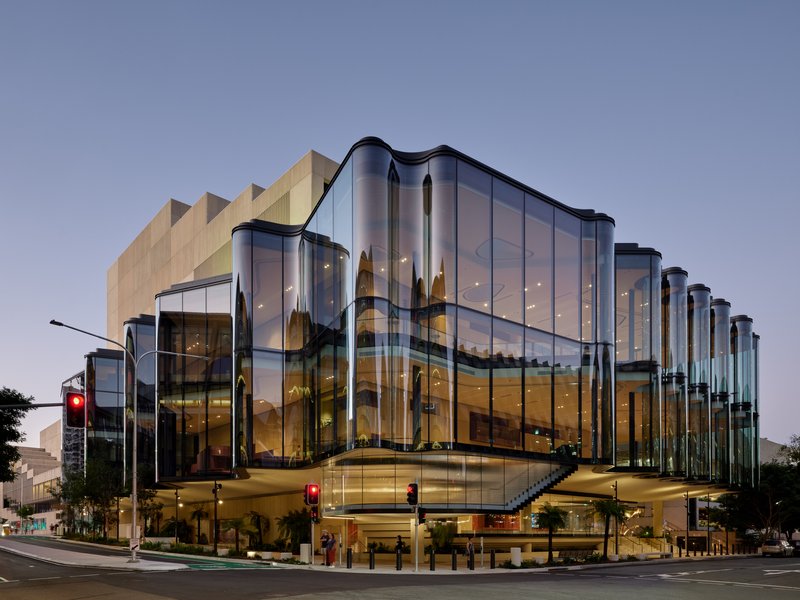
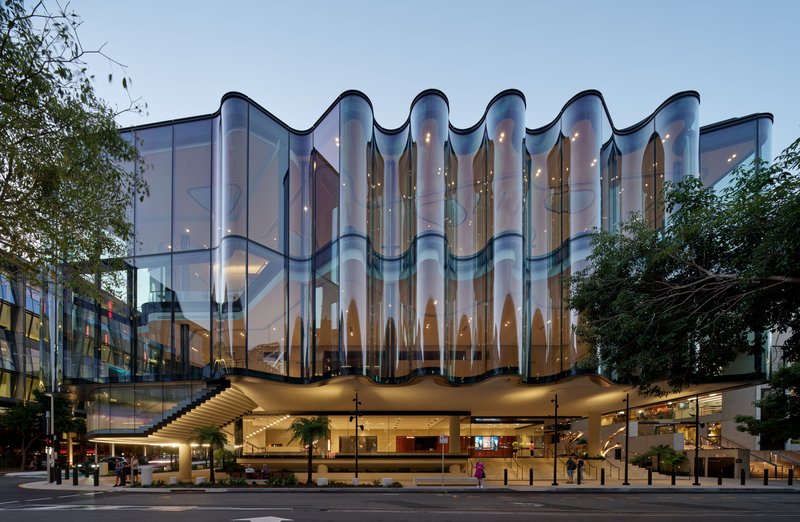
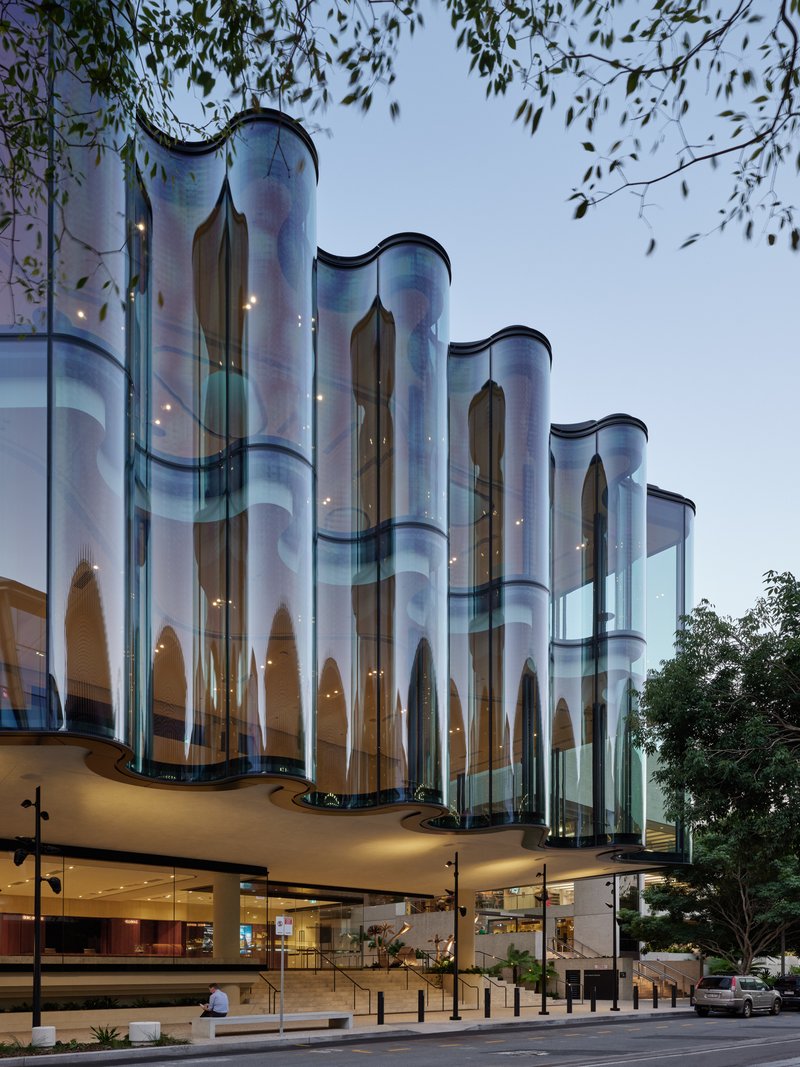
The facade is constructed in two tiers of seven-metre-high panels, reaching an overall height of 14.28 metres. Each cylindrical glass tube is unique in profile, manufactured off-site and assembled to produce a scalloped wall that reads differently at every angle. At dusk, interior lighting turns the tubes into glowing columns, while by day they scatter and refract sunlight across the foyer floors. The highly transparent edge of the cantilever is deliberate: it minimizes the visual weight of a structure that projects six metres over the pavement on two frontages, making the heavy concrete above appear to float.
There is a strategic respect for Gibson's brutalist QPAC buildings at work here. Rather than mimicking their rough concrete surfaces, Blight Rayner and Snøhetta chose contrast. Sand-coloured precast concrete anchors the base and the fly tower, nodding to the existing palette, while the glass veil announces the new building as unmistakably contemporary. The 24-metre fly tower, the tallest volume on the block, is treated simply, letting the scalloped glass do the talking at pedestrian scale.
Foyers as Public Theater
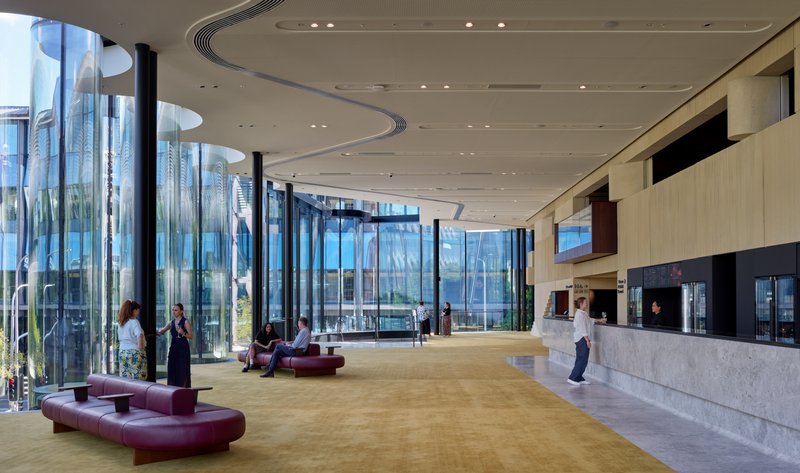
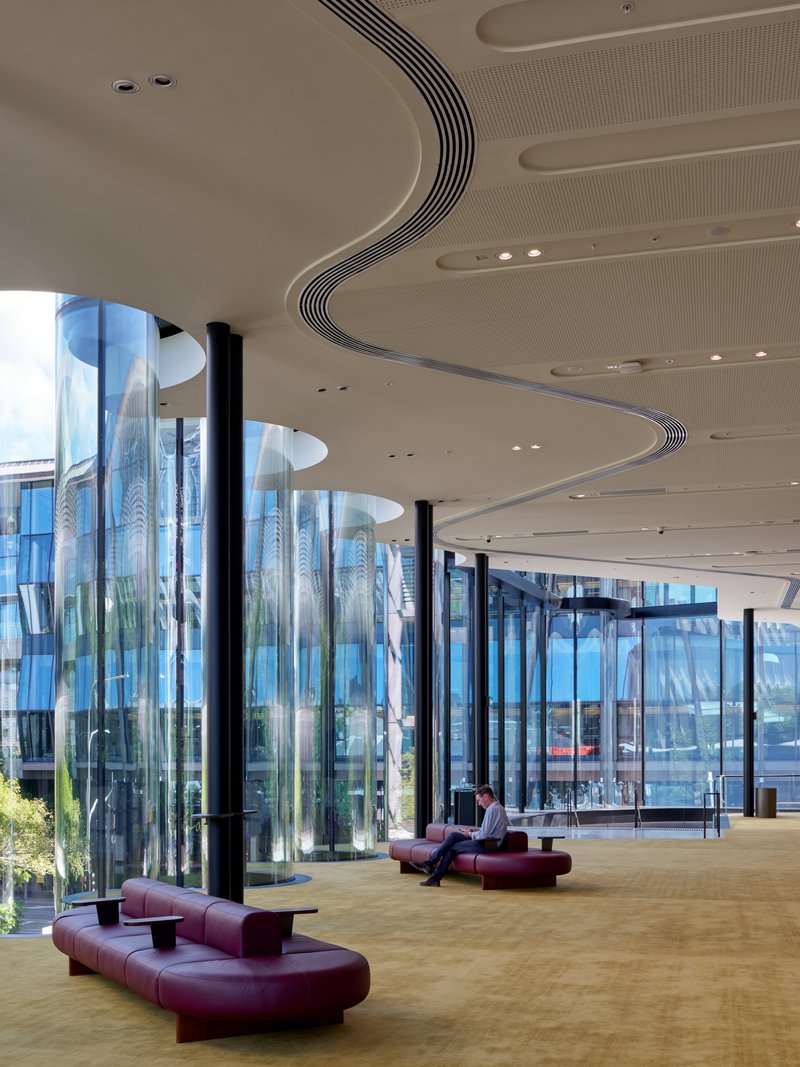
Step inside and the four-layer glass construction reveals a second function: insulation. Brisbane's subtropical climate demands serious thermal management, and the multi-layered envelope reduces solar heat gain while allowing natural light to flood the foyer. Seven skylights embedded in the roof represent the seven watersheds of Queensland, casting circles of daylight onto the circulation spaces below. The ribbed ceiling detail, visible alongside the cylindrical glass columns, organizes both light and acoustics in the transitional zones between exterior and auditorium.
The material palette in these public areas tells a geographic story. Gold carpet lines the foyer floors, evoking Queensland's beaches. The sweeping staircase and spacious bars use warm timber tones that anticipate the ironbark interior of the main hall. The intent is clear: arrival is not a corridor but a sequence of atmospheres, each one drawing you deeper into the building's logic.
Ironbark and Acoustics
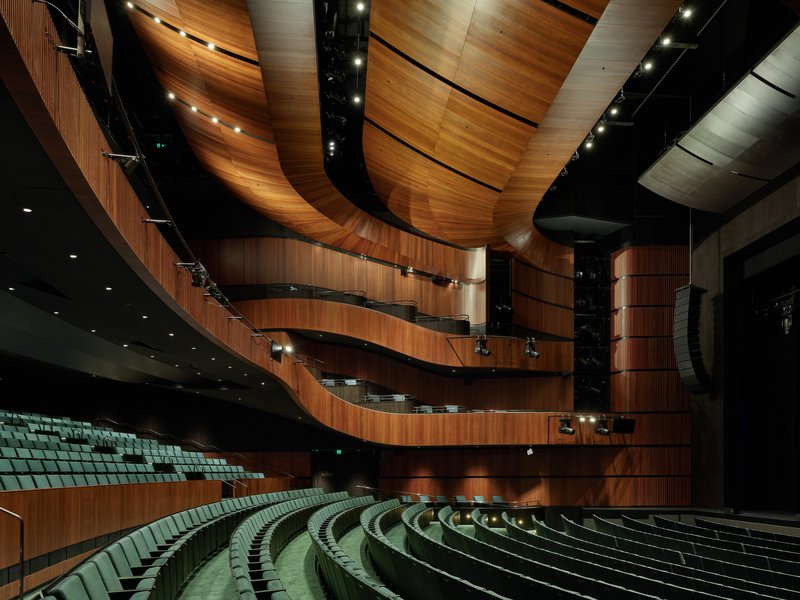
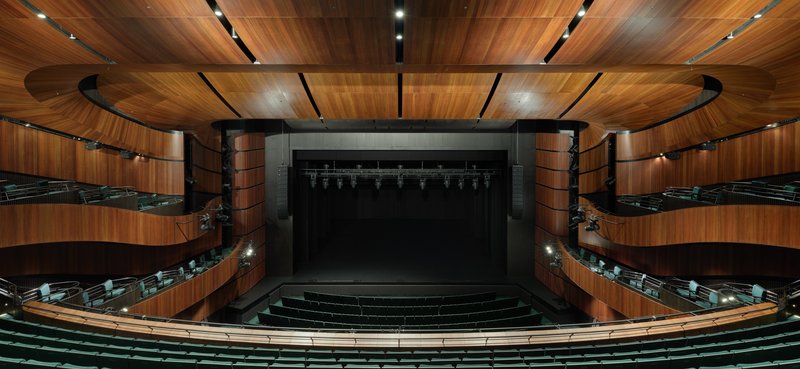
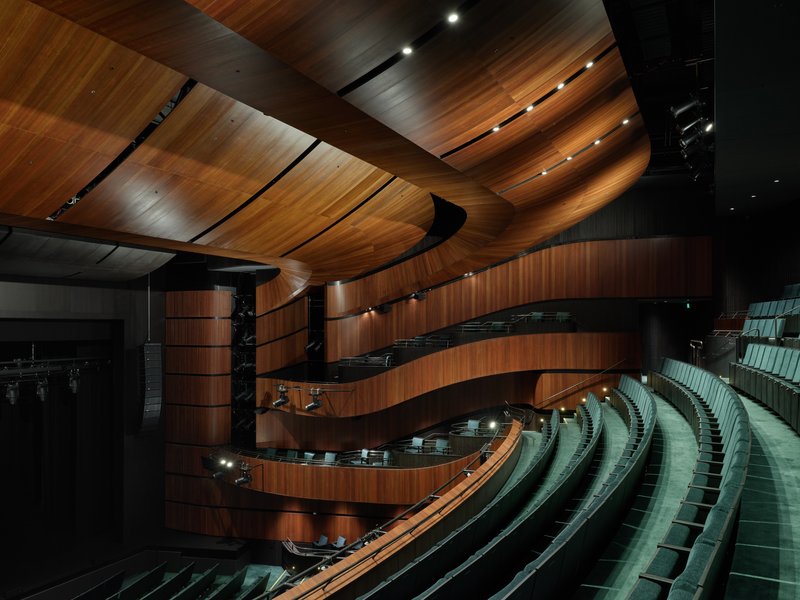
The auditorium is where Blight Rayner's stated ethos of Structure, Craft, Art, and Nature converges most forcefully. Ninety tonnes of sustainable Queensland grey ironbark timber line the walls and wrap the balconies in layered ribbons, their varied profiles calculated to scatter sound across frequencies. The architects drew inspiration from the qualities of stringed instruments, seeking to combine technical precision with atmospheric intimacy. Specially shaped walls prevent problematic reflections, while the textured batten profiles provide the acoustic scattering that a multipurpose venue demands.
The seating plan is equally considered. One thousand stall seats and 500 balcony seats are arranged so that the furthest audience member sits only 28 metres from the stage. Wrap-around balconies push their front edges close to the proscenium, creating the kind of compressed energy that performers thrive on. Continental seating fills the front of both stalls and balcony, with aisles at approximately 25, 50, and 25 percent distribution toward the rear. Three thousand square metres of rainforest-green carpet underfoot and deep-green upholstery on the seats complete a palette that references Queensland's lush forests.
Behind the proscenium, the technical infrastructure is formidable. The fly system contains 100 fully automated fly bars, 107 hoists, and 29 kilometres of steel wire, moving scenery, lighting rails, and bars at up to 1.8 metres per second. The orchestra pit features three independently operable floor sections with four different configurations. This is not a single-purpose concert hall; it is a machine for live performance in all its forms.
Grounding Art in Country
The decision to root the building's formal language in Lilla Watson's writing about the Brisbane River is not decorative. It structures the entire design narrative, from the rippling facade to the watershed skylights. At the entry forecourt, a four-metre-high bronze sculpture by Torres Strait Islander artist Brian Robinson, titled Floriate and inspired by Queensland's native flora, establishes the cultural ground before you cross the threshold. The collaboration between Indigenous storytelling and architectural form gives the Glasshouse a specificity that generic parametric facades rarely achieve.
The under-seat air conditioning system reinforces this sense of place-conscious design. Rather than cooling from the 24-metre-high ceiling, the system delivers conditioned air from below the seats, dramatically reducing the energy required to maintain comfort for 1,500 people. It is a pragmatic choice, but also a philosophical one: the building's climate strategy, like its form, works from the human body outward.
Why This Project Matters
The Glasshouse Theater matters because it demonstrates that a performing arts venue can be genuinely civic without surrendering technical rigor. Too many contemporary theaters treat transparency as a cosmetic gesture, wrapping a sealed box in glass to signal openness. Here, the glass is the argument. Its undulating form, its four-layer thermal performance, and its roots in Indigenous narrative about the adjacent river all serve the same proposition: that what happens inside a theater is continuous with the life of its city.
It also matters as a model for heritage-adjacent design. Blight Rayner and Snøhetta did not imitate Robin Gibson's brutalism, nor did they ignore it. They completed the precinct by articulating a clear contrast, heavy concrete meeting rippled glass, that sharpens the identity of both old and new. After decades of waiting, Brisbane's cultural district finally has its missing corner, and the result is a building that rewards every scale of attention, from the city skyline down to the grain of the ironbark.
The Glasshouse Theater, designed by Blight Rayner Architecture and Snøhetta, is located in South Bank, Brisbane City, Australia. Completed in 2026, the 1,500-seat performing arts venue was built at a cost of AUD 184 million. Photography by Christopher Frederick Jones.
About the Studio
Share Your Own Work on uni.xyz
If projects like this are the kind of work you want to make, uni.xyz is a place to publish your own, find collaborators, and enter design competitions.




Popular Articles
Popular articles from the community

Eco Chapel: A Green Architecture Pavilion Designed in Symbiosis with the Forest
Eco Chapel uses green architecture to weave prayer, learning and reuse into a forest pavilion shaped by modular hexagonal canopies for life.

Milan Crossover: Sustainable Architecture for a New Fashion Culture in Milan
Milan Crossover transforms fashion culture through sustainable architecture, linking material libraries, remake studios, and public runways.
PLATAFORMArq Folds a Concrete Roof Over the Portuguese Mountains in House #474
A 220-square-meter residence in Teixoso, Portugal, wraps board-formed concrete into an angular canopy that frames the Serra da Estrela foothills.
Kerry Kounnapis Packs 800 Daily Coffees into a 43-Square-Metre Melbourne Laneway Bar
Palace Coffee channels Pellegrini's and European standing bars through oxide-red steel and spotted gum timber in a Ridgway Place sliver.


Similar Reads
You might also enjoy these articles
Freebird Residence by Alexis Dornier: A Tropical Modernist Sanctuary in Bali
Floating living pavilion above pool anchors H-shaped tropical villa, blending Japanese minimalism, sustainable strategies, lush landscape, and sculptural interiors.
127af Flips a Tiny Bagnolet Rowhouse Upside Down with a Handcrafted Roof Extension
A 55-square-meter terraced house on the edge of Paris gains a luminous upper living floor through lightweight timber and steel.
1.61 Design Workshop Wraps a 600-Square-Meter Café in Vietnam in Sculptural Burgundy Drama
Reden Café & Bistro pairs a helical staircase, mosaic floors, and deep red interiors to rethink Vietnamese hospitality space.

The Unbound Brain: A School Shaped by Cognitive Architecture
Cylindrical learning pods radiate like neurons from a central cortex, turning the floor plan into a spatial model of human thought.


Explore Urban Design Competitions
Discover active competitions in this discipline




The Global Benchmark for Architecture Dissertation Awards


The Global Benchmark for Graduation Excellence


Bring back Drive In's
Comments (0)
Please login or sign up to add comments
No comments yet. Be the first to comment!