

Blind School
Designing for the visually impaired


In Russia, around 8 million people suffer from visual impairment, that is approximately 5% of the population of Russia. Many of these people are blind since birth. Education for these children has become a major problem in Russia, only 2% of all the schools accept students with disabilities.
Moreover, there are very less buildings and public spaces designed keeping in mind the disabled population. It is high time we start coming up with inclusive solutions and design comfortable spaces for everyone.
So, to design this blind school a great amount of time was spent coming up with outcomes which would be best suited for the blind children. People with ‘normal’ vision perceive first the totality of the room and then the individual elements within it. For the visually impaired, the process is the opposite: individual elements are perceived first, and then a perception is formed of how the individual elements are linked together. Keeping in mind their heightened sense of smell, touch, hearing, the circulation of this building was designed.
The major objective of this school was to prepare these children to face the outside world, preparing them to sense emergencies like fire, gas leak, smoke, etc, teaching them how to use computers, learn braille, be proficient in sports and different arts and be just as active as the ‘normal’ children.
Instead of the typical notion of a school, where a student sits in his allotted class all day to learn different things, our design encourages children to move around in the building to reach the designated areas for different classes. This will improve their sense of direction, their ability to navigate a space and in the long run, boost their confidence. Another advantage is that these specialised classes will be very well equipped to help the students understand the subject.
The entrance to the school is on the eastern side, where there is lesser vehicular traffic, making it easier for these little children to find their way inside. The form of the building is such that it forms two central zones, which bring in a lot of natural light to stimulate and exercise vision in low vision children and make a lovely space for the children to run around and play. The curved walls of the building protect the children from getting hurt.

The projection of the first-floor casts shadows the entrance of the building, and along with the sound of the fountains and the fragrance of the flowers, this clearly highlights the entrance for the students. The staircases and lifts are also surrounded by flowering shrubs, and the railings are engraved with braille letters. The corridors around the central zones are very well-lit. The sound of the water channels running through them help the children to navigate the space. The patterned tiles, braille and maps printed on walls guide them through the building. The hydrotherapy and the horticulture therapy areas go a long way to boost mental health.
There is a mobility training area on the eastern side of the building where students will be prepared to move through different landscapes. The sports grounds, indoor and outdoor, keep the students active. The canteen and dining area is a huge, open plan, well lit space opening towards the two open to sky zones.

On the first- floor, the building is divided into 3 wings, consisting of different classes. These wings have different coloured tinted glasses to set them apart. The classrooms are placed alternately on either side of the corridor, making a pattern of light and shadows helping the visually-impaired to navigate the space. All of these classes have an outdoor balcony to allow outdoor learning when the weather permits. The ceiling of the classrooms and labs are lower creating a different acoustic feel. The classroom floors have braille tactile letter tile for basic introduction to braille, the walls are replaced with an interactive façade, perforated with light holes where learning pins of different shapes and textures can be inserted.
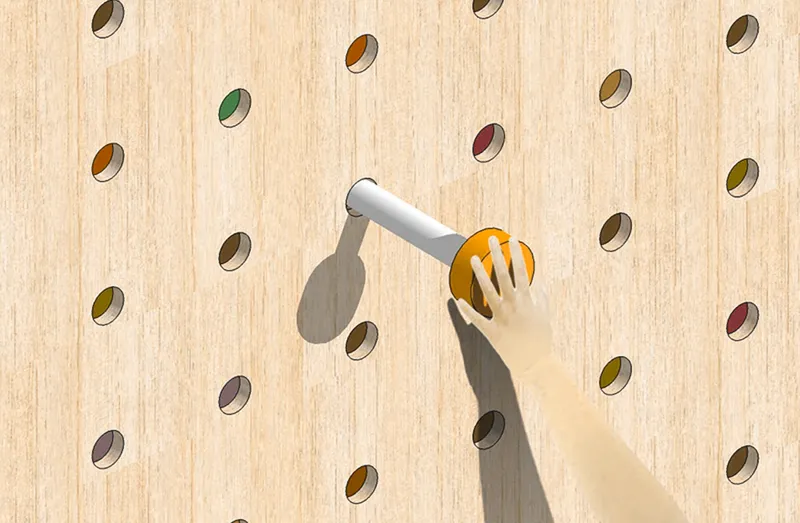
The first floor also has a library with a huge collection of audio books. There is also an open-plan work area which promotes collaborative learning. Apart from these there are two green terraces on the first floor.
Different wooden textures are used on the walls and the floors, cork finished interiors ensure acoustic insulation, double-glass units help in thermal insulation, pergolas on the first-floor help to exercise vision and contrasting colours help the children to distinguish objects.

Designing this school, for the visually impaired children has made us more sensitive towards people with disabilities.
When we design for disability first, we stumble upon solutions that are better from the normal.


Popular Articles
Popular articles from the community


The Amber Palace Opera: A Geological Fiction Surfaces on Tallinn's Baltic Waterfront
Pierre Brillard reimagines a Baltic legend as a public landscape, opera house, and waterfront promenade rooted in Tallinn's coastal identity.

Singing Woman: An Opera House That Performs Before the Curtain Rises
Ovidiu Cristian Pavel's conceptual opera house translates Estonia's choral identity into a sculpted waterfront landmark facing the Baltic Sea.

Manzana Morphosis: Stretching Barcelona's Grid into a Living Landscape for 2050
A radical reworking of the Eixample manzana turns density into a tool for generous public space, vertical ecology, and environmental performance.

Cloaked Colonization: A Mobile Underwater Habitat That Moves Like a Fish
Micah Abaya's shortlisted EHC Pacific entry reimagines ocean settlement as a dispersed network of self-sustaining architectural organisms.

Similar Reads
You might also enjoy these articles


Open letter to community of UNI
A set of important news for our existing participants and community of UNI worldwide.

Slum Autonomy - A Paradox: A Balcony That Gives Rehoused Slum Dwellers Back Their Own Way of Using Space
A bamboo-railed balcony for rehabilitated slum housing in India turns loose wooden planks into seats, beds, shelves and a corner for worship.

Overseas Oasis: A Sloped Green Roof That Lets the Park Climb Onto a Community Center
An Amsterdam community center pairs a walkable lawn roof with mesh-clad mobile rooms where students from abroad can meet local residents.

Tallinn New Opera: A Layered Metallic Roof Hovering Over an Oval Stage on the Waterfront
Florian Jesch turns transparency, lightness and freedom into a cantilevered roof, a glazed base and an oval auditorium core facing a marina.

Comments (0)
Please login or sign up to add comments
No comments yet. Be the first to comment!