

Atelier ITCH Wraps a Seoul Alley House in Corrugated Steel to Steal Back the Sky
In Seongbuk-gu's dense residential grid, Bomun House trades red brick conformity for a luminous steel shell and a fourth-floor open-air bath.


Seoul's Seongbuk-gu district is a wall-to-wall carpet of three- and four-story red brick apartment buildings, each one nearly identical to its neighbor, separated by alleys barely wide enough for a car to pass. In the middle of one such alley, Atelier ITCH has pulled off a small act of defiance: Bomun House, a 97 square meter residence clad entirely in corrugated steel and translucent polycarbonate that looks nothing like the buildings pressing in from one meter away on either side. The project, completed in 2024, transforms a formerly cluttered multi-family structure into a compact owner-occupied home with rental units below, all organized around one non-negotiable demand: an open-air bathroom on the fourth-floor terrace where you can look straight up at the sky.
What makes Bomun House genuinely interesting is not just the material swap from brick to steel. It is the logic behind it. The original building's south-facing facade was almost entirely consumed by an external staircase, blocking the one orientation that could deliver sunlight. Neighbors hemmed in the east and west walls. So the architects stripped the street elevation down to a nearly windowless surface, choosing a lightweight corrugated skin that could be installed cheaply and quickly while creating an immediate visual break from the surrounding context. The result is a building that reads as a lantern at dusk and a clean geometric interruption by day, a house that earns its presence through restraint rather than excess.
A Facade That Refuses to Blend In

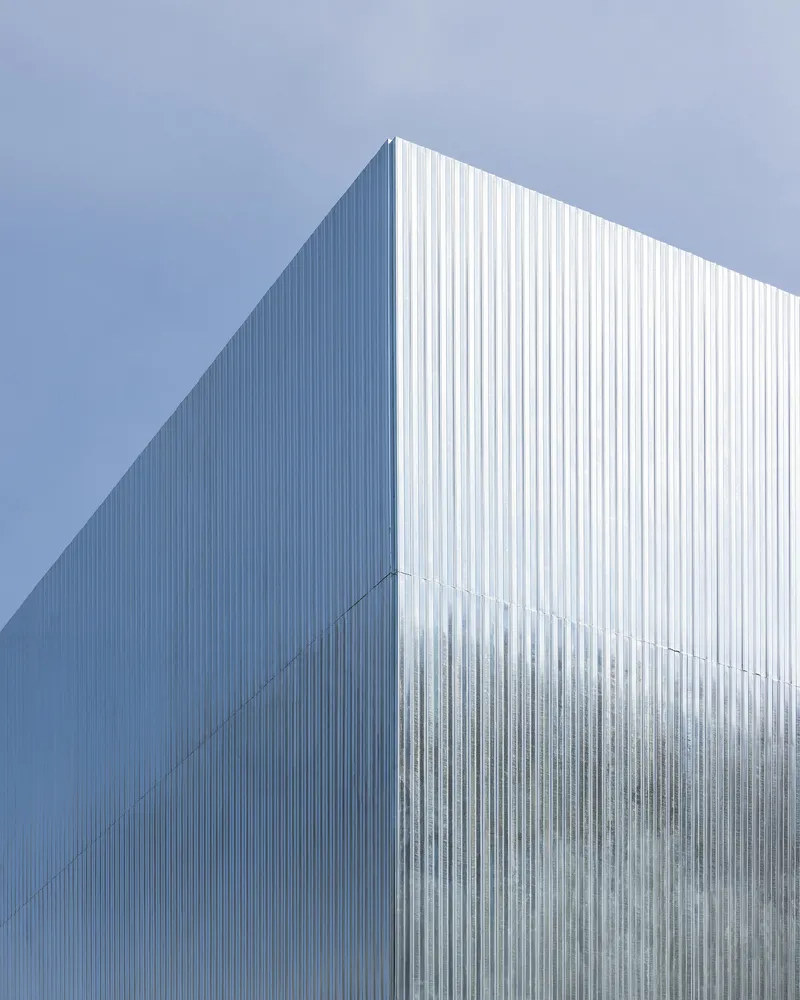
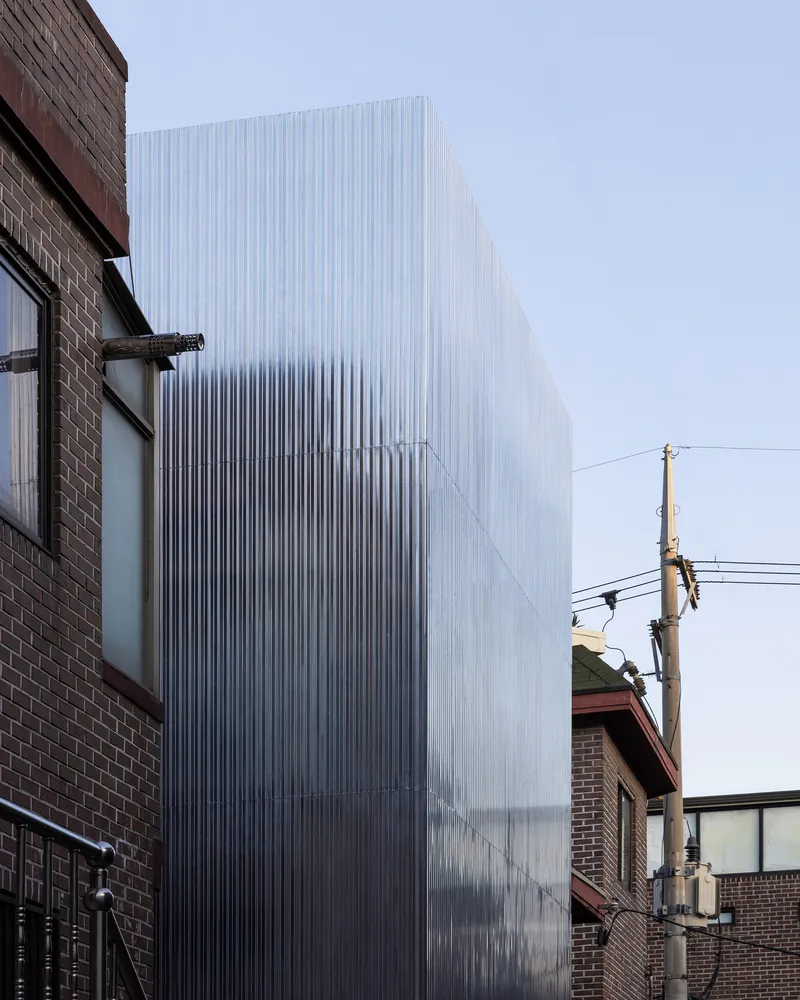
Walk down the alley and Bomun House announces itself immediately. The corrugated panels, a mix of opaque steel and translucent polycarbonate, rise as a flat, unadorned plane between the ruddy brick volumes on either side. There are no windows on the street facade. No balconies, no ledges, no visual noise. The decision was deliberate: in a context where every building shares the same cluttered elevation of stairwells, condenser units, and laundry racks, the cleanest possible surface becomes the loudest statement.
Budget drove material choices as much as aesthetics did. Corrugated steel is cheap, fast to install, and lightweight enough to avoid structural overhaul on a constrained site. But the architects understood that cost-effective does not have to mean forgettable. By extending the same cladding material up to the terrace railing, they created a continuous vertical surface that blocks sightlines to neighboring rooftops while keeping the sky open overhead. At dusk, the translucent polycarbonate sections glow softly, turning the building into something closer to a signal than a box.
Vertical Living, Split Program

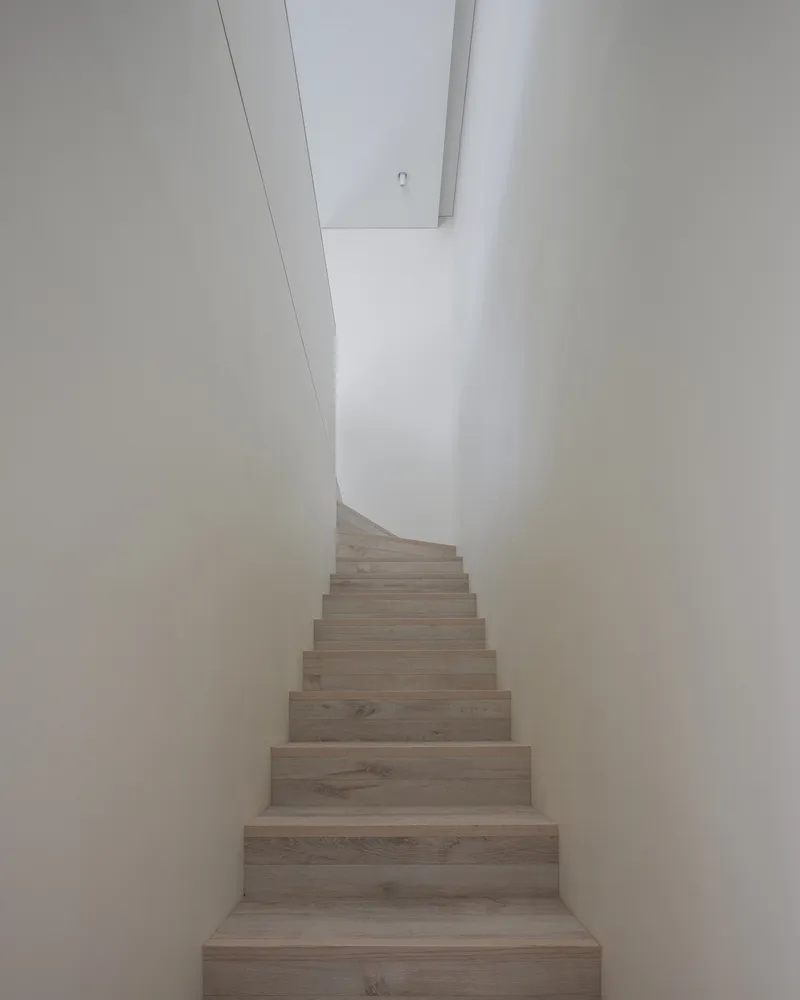

The program splits cleanly along a horizontal line. Floors one and two are rental units, providing income for the owner. Floors three and four are private living space. The external staircase, relocated from its original position blocking the south facade, now serves as a shared access route on the road-facing side, freeing interior square meters for actual habitation. Inside, narrow corridors and pale timber staircases thread between white walls, each flight ascending toward more light.
The stairwell is worth examining closely. Curved plaster walls soften what could have been a claustrophobic vertical tube, and a recessed ceiling slot pulls daylight down from the upper floors. The timber treads are warm against the white surfaces, offering a tactile counterpoint to the industrial exterior. Atelier ITCH initially explored an atrium-like void on the third floor to improve ventilation, but abandoned the idea when it consumed too much of the already limited floor area. Instead, they concentrated their spatial generosity at the top of the building, where it matters most.
The Fourth Floor as Outdoor Room

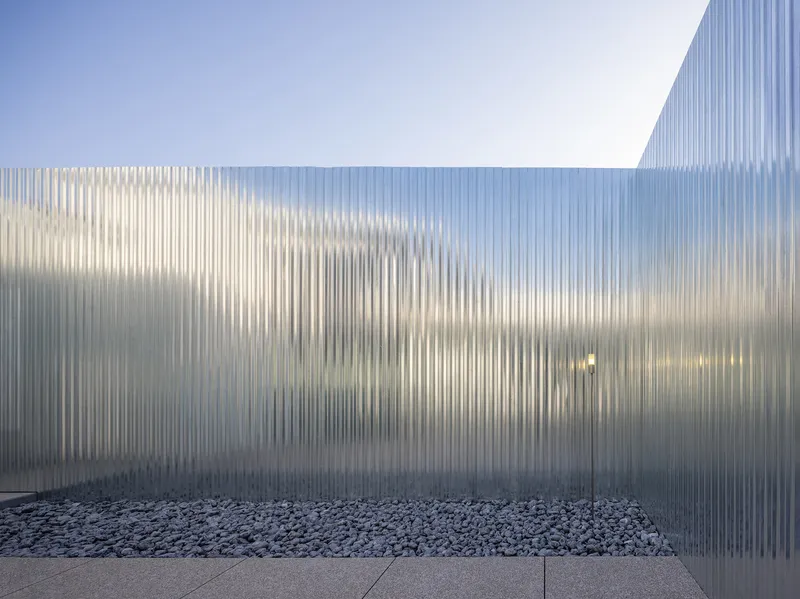
The fourth floor is where Bomun House makes its boldest move. Rather than capping the building with another enclosed room, the architects created a fluid threshold between interior and exterior. A glass-walled courtyard sits at the center, floored in gravel with a concrete bathing platform and a single circular column. Corrugated walls rise on all sides, tall enough to screen out neighboring buildings but open at the top. The effect is a private outdoor room in the middle of one of Seoul's densest residential neighborhoods.
The gravel bed at the base of the corrugated enclosure does more than look good. It provides drainage for rainwater and a soft visual ground plane that contrasts with the hard surfaces elsewhere. Plants introduced along the terrace edge bring green into a context where gardens are essentially nonexistent. The owner's insistence on this level of openness was, by the architects' account, non-negotiable from the start. Everything else in the design served this one ambition: to look up and see nothing but sky.
Bathing as Architecture
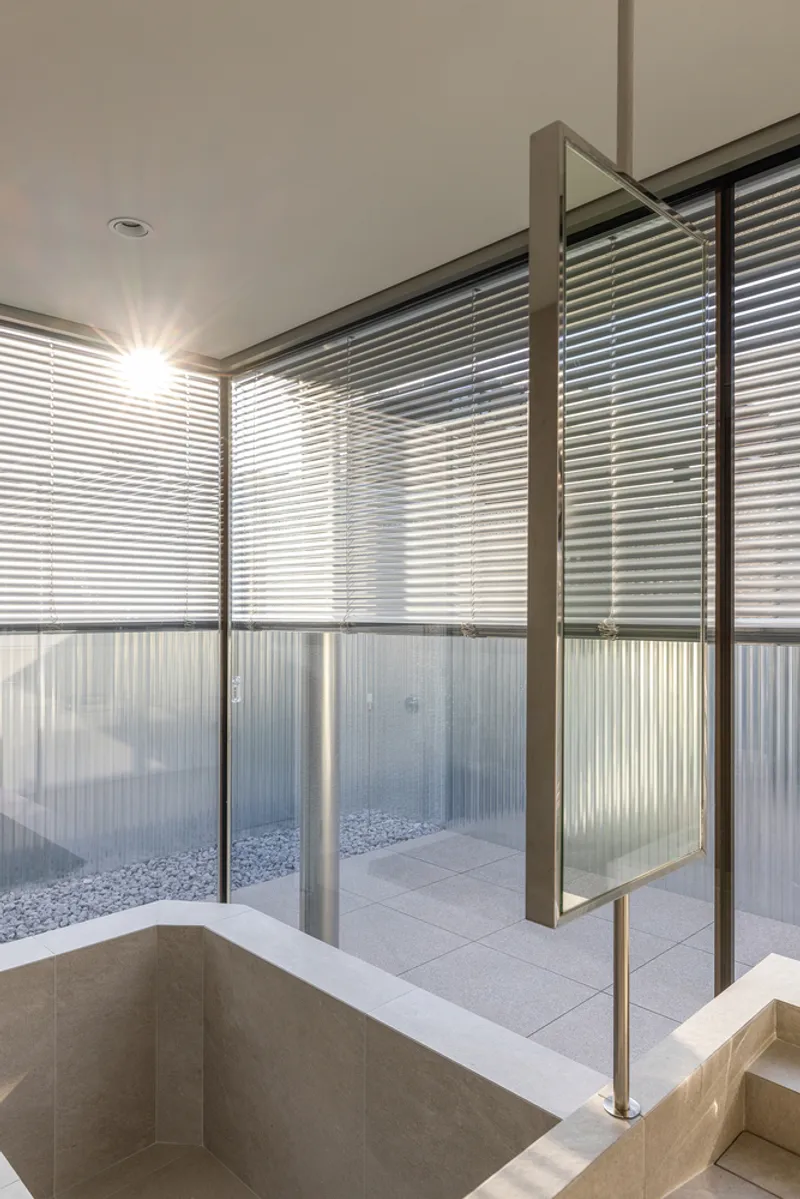

The bathroom is not an afterthought here. It is arguably the centerpiece of the entire project. Adjacent to the fourth-floor terrace, the space features a sunken bath set beside floor-to-ceiling louvered glass panels that open onto the gravel courtyard. At sunset, light filters through the corrugated walls and washes across the limestone surfaces. A separate shower enclosure uses a narrow vertical window to borrow light from the courtyard while maintaining privacy.
There is something subversive about making a bathroom the most architecturally resolved room in a house this small. In most compact urban residences, bathrooms are squeezed into leftover corners, their dimensions dictated by plumbing runs rather than spatial ambition. Here, the act of bathing is elevated to something closer to a ritual, framed by sky and greenery in a neighborhood where most residents see only the backs of other buildings from their windows. It is a quiet luxury that costs almost nothing in material terms but everything in design intelligence.
Interior Calibration

Inside the owner's living floors, the palette stays deliberately restrained: white walls, pale timber, built-in cabinetry that absorbs storage into the wall plane. A hallway on the third floor is lined with flush millwork, its surface broken only by recessed handles, leading the eye toward the glazed courtyard at the far end. In a 97 square meter building split across four floors, every centimeter of wall is either structural, storage, or light source. There is no room for decorative indulgence, and the house is better for it.
The architects use daylight strategically to make the interiors feel larger than they are. Corridors that could read as tunnels are punctuated by windows at their termination points, and the transition from enclosed hallway to open courtyard on the fourth floor creates a dramatic compression-and-release sequence that is one of the oldest spatial tricks in architecture, deployed here with real skill.
Plans and Drawings

The first-floor plan reveals the tight rectangular footprint and the way program is packed with surgical precision. Living room, bedroom, and bathroom are arranged in sequence along the narrow lot, with circulation pushed to one edge. The plan makes visible what the photographs only suggest: how little room there actually is, and how much the architects managed to extract from it.
Why This Project Matters
Bomun House is a reminder that architectural ambition does not require a generous site or an unlimited budget. In a neighborhood where conformity is the default and red brick is the only dialect, Atelier ITCH introduced a building that speaks a different language without shouting. The corrugated steel and polycarbonate facade is cheap, practical, and visually striking precisely because it refuses to pretend it is something fancier than it is. There is no stone veneer, no composite panel system, no imported cladding. Just honest industrial material, well proportioned.
More importantly, the project demonstrates that even at 97 square meters across four floors, a house can prioritize experience over efficiency. The open-air bath, the sky-facing terrace, the gravel courtyard ringed by corrugated walls: these are not features you expect in a compact rental-income building wedged into a Seoul alley. They exist because the architect and the client agreed that the quality of a single moment, standing in your own bathroom and looking straight up at open sky, was worth organizing an entire building around. That conviction, more than any material or technique, is what makes Bomun House worth studying.
Bomun House by Atelier ITCH, Seongbuk-gu, Seoul, South Korea. 97 m². Completed 2024. Photography by Joel Moritz.
About the Studio
Share Your Own Work on uni.xyz
If projects like this are the kind of work you want to make, uni.xyz is a place to publish your own, find collaborators, and enter design competitions.


Popular Articles
Popular articles from the community


David Macias Steps a Doorless Stone and Plaster House Down a Tropical Colombian Hillside
In the humid hills of Colombia, Threshold House replaces the front door with an open void and terraces its 850 m² down the slope instead of fighting it.

GROUP A Strips a 1969 Rotterdam Harbor Headquarters to Its Frame and Wraps It in Timber Louvers
In Rotterdam's M4H harbor district, Ferro Offices reuses a 1969 frame, adds one timber storey and reaches BREEAM-NL Outstanding.

LT2A and OPEN Architectes Thread a Brick and Glass High School Through a Wooded Belgian Campus
In Braine-l'Alleud, a 3,000 m² wing for Collège Cardinal Mercier pairs pale brick with a glazed colonnade, deferring to a small chapel and a dense wood.

Jaramillo Van Sluys Arquitectura and Urbanismo Turn a Demolished Registry Lot in Quito into an Orchard Plaza
In Quito's Centro Histórico, a 2,800 m² plaza exposes the San Agustín convent wall and redraws its lost Augustinian orchard in volcanic stone.

Similar Reads
You might also enjoy these articles


Hodi-Mandai Geram
Project Function: Preservation and revitalization of the Intangible heritage and socio-spatial identity of the Hodi by Housing, Cultural Memory Center, Sacred Grove, landscape, local tourism economy


Olio Towers: A Mid-Rise for Performers That Fuses Housing, Rehearsal, and Stage
Located blocks from Houston's Theater District, this modular tower stacks living units around a central performance atrium.

Oasis: Modular Green Housing Carved into Dhaka's Urban Fabric
A shortlisted Plugin Housing entry reclaims unauthorized settlements in Dhaka with stepped concrete volumes, green roofs, and ventilation-driven design.

Black Hole: A Floating Megastructure for the Post-Physical Era
Emiliano Mazzarotto envisions a spherical, self-scaling arena where e-sports, digital hotels, and holographic stadiums replace traditional public space.

Explore Housing Competitions
Discover active competitions in this discipline

Challenge to reimagine the Iron Throne

Photograph architecture without architects

Illustrate the lost glory of Angkor Wat - Render Challenge

Design challenge to reuse E-waste
Comments (0)
Please login or sign up to add comments
No comments yet. Be the first to comment!