

Meyer & Associates Roots a Winelands Guesthouse in Cape Dutch Memory and Mountain Light
At Bosjes in South Africa's Wachshoekberge valley, timber arches and white gables frame a hospitality retreat shaped by the land it occupies.


The Cape Winelands carry a specific architectural DNA: white lime-washed walls, symmetrical gables, deep stoeps, and a confident relationship between built form and agricultural terrain. At Bosjes, an estate already known for its sculptural chapel by Steyn Studio, Meyer & Associates Architects and Urban Designers has completed a guesthouse and spa that engages this DNA without mimicking it. The buildings sit low and horizontal against the Wachshoekberge mountains, organized as a series of white volumes connected by covered walkways, courtyards, and landscaped thresholds. From a distance the composition reads as a small hamlet, its gabled rooflines registering as descendants of the region's 18th-century farmsteads.
What makes the project worth examining is not the stylistic nod to Cape Dutch architecture but the way the architects have used that tradition as a spatial strategy. The plan is linear and additive: clusters of rooms branch off a central circulation spine, each cluster framing its own outdoor space. Walls are thick and plastered white, but the sections behind them are unexpectedly generous, with exposed timber trusses, vaulted ceilings, and tall glazed openings that pull the valley light deep into each room. The result is a hospitality building that feels rooted without being nostalgic, and contemporary without being imported.
Landscape as Organizing Principle

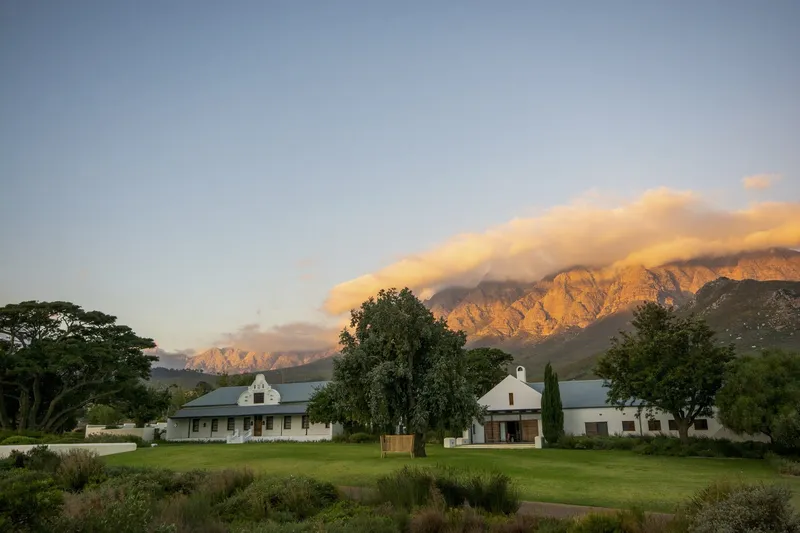
Seen from the air, the guesthouse reads less as a single building and more as a curated landscape that happens to contain rooms. White volumes are scattered across a broad lawn, their placement calibrated to frame specific views of the surrounding vineyards and mountain ridges. The architects have avoided a monolithic footprint, opting instead for a disaggregated plan that lets the estate's existing oaks, flowerbeds, and irrigation channels flow between structures. At sunset the low-slung forms glow against the dark mountain mass, their proportions deliberately modest so that the valley remains the dominant presence.
White Walls, Timber Warmth

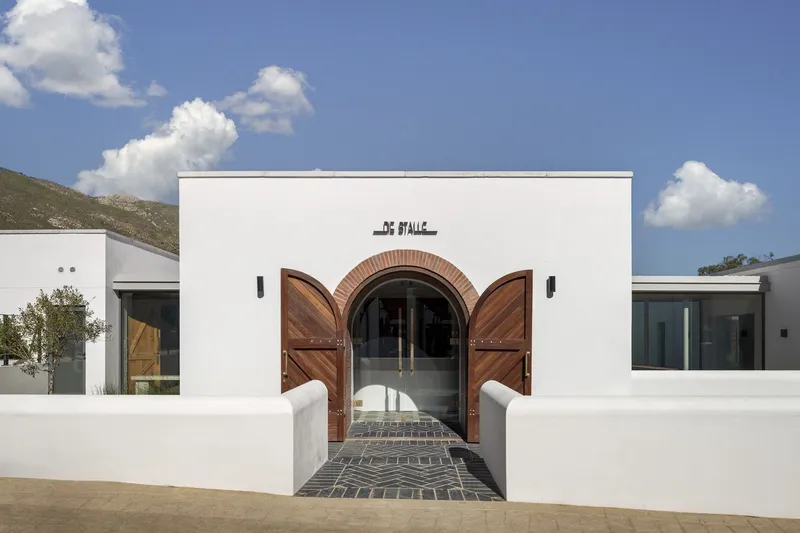
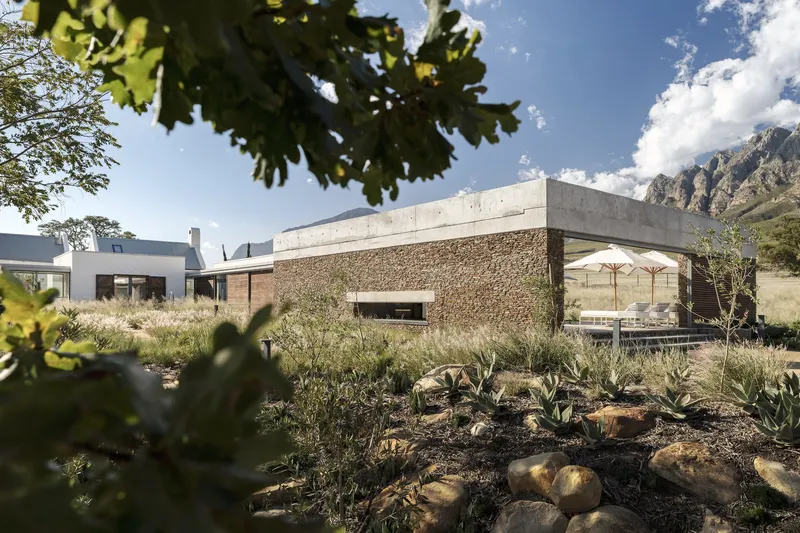
The facade language balances two material registers: white lime-washed plaster and natural timber. The plaster walls are thick and largely opaque, punctuated by arched timber doors and occasional tall glazed slots. Where the building needs to breathe, timber cladding takes over, warming the composition and signaling transitional spaces like entrances, covered walkways, and service wings. A third element, stacked stone cladding set within a concrete frame, appears at the spa volume, grounding that part of the complex in the geological character of the site.
The arched openings deserve attention. They are not decorative quotations but functional devices that mediate between the thick wall and the valley beyond, creating deep thresholds where shade, light, and breeze interact. Brick paving at the base of these openings extends the interior floor plane outward, dissolving the boundary between room and courtyard in a way that recalls the traditional stoep without replicating its form.
Courtyards and Interior Atmosphere
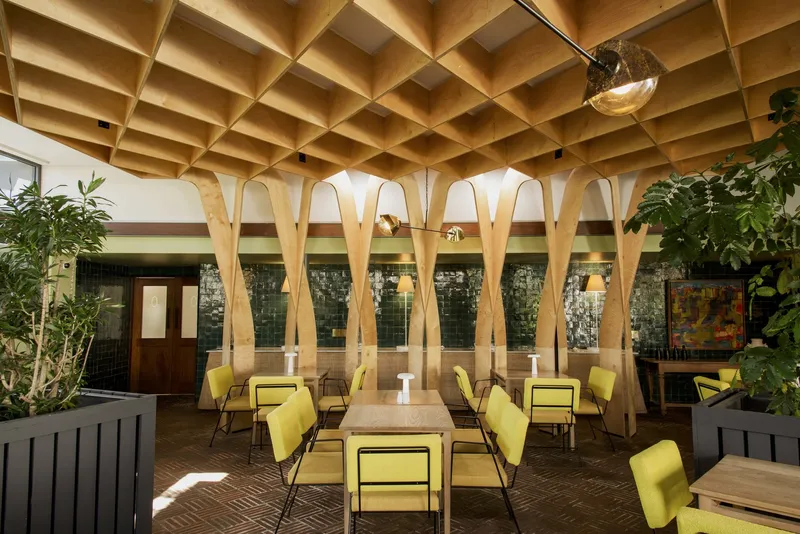
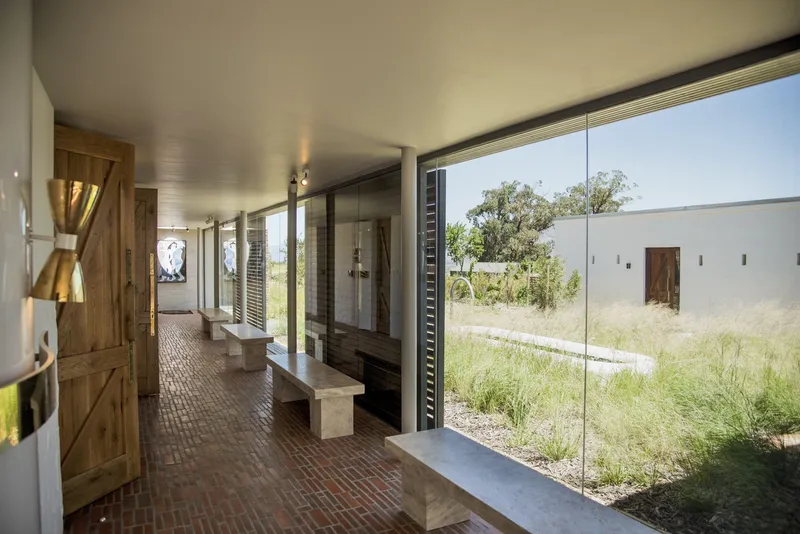
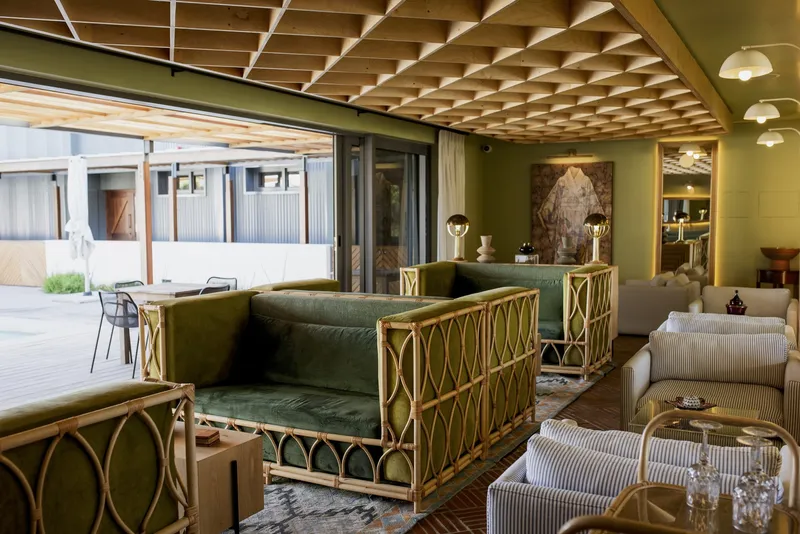
The interior courtyards are where the architecture is most convincing. Laminated timber arches span an interior gathering space, their geometry supporting a deep coffered ceiling that modulates light and acoustics simultaneously. Bright yellow seating beneath these arches introduces a boldness that the exterior restraint might not suggest. Elsewhere, brick-paved corridors lined with timber benches open through full-height glazed doors to planted courtyards, creating a processional sequence that rewards slow movement.
Living areas deploy a timber lattice ceiling grid and rattan-framed furniture to achieve a layered warmth. Sliding glass panels retract fully so that the room becomes an extension of the courtyard, a move that aligns with both the regional climate and the hospitality brief. Throughout, the palette stays disciplined: white walls, natural timber, woven textures, and the occasional brass or stone accent. The restraint keeps attention on the spatial experience rather than the surface decoration.
Guest Suites Under Vaulted Trusses
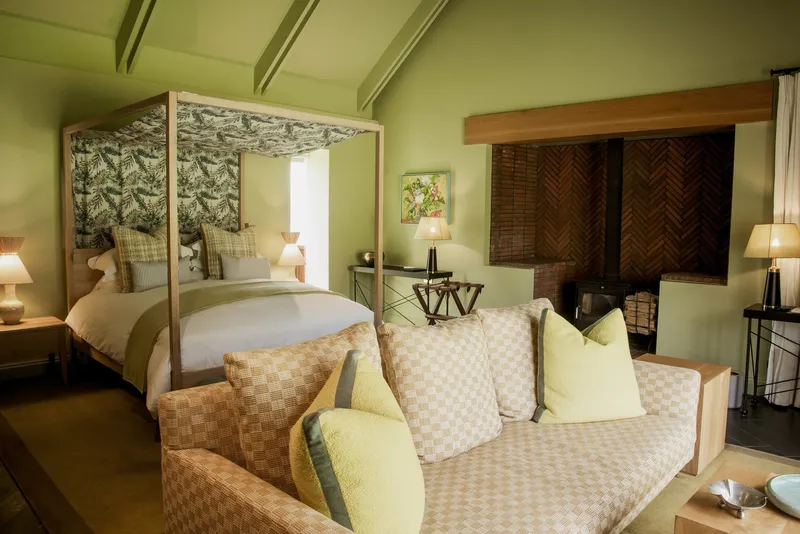
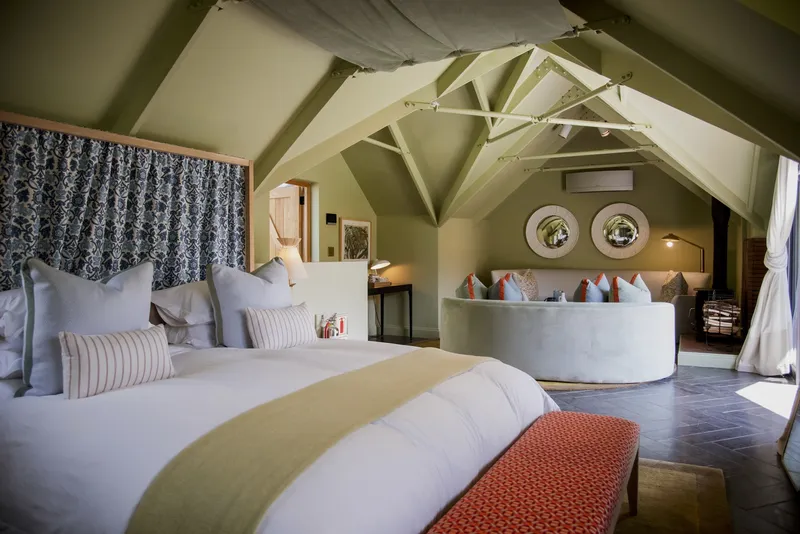
The guest suites are the project's most refined spaces. Exposed painted trusses span above vaulted ceilings, their structural rhythm establishing the proportions of each room. One suite places a freestanding bathtub at the center of the vault, directly below the apex, transforming a functional element into an almost ceremonial experience. Another suite pairs a four-poster bed with herringbone timber paneling, layering texture without clutter.
The strategy is consistent: let the roof structure do the architectural heavy lifting, then furnish simply beneath it. Ceiling heights are generous enough to feel expansive, but the warm timber overhead keeps the rooms intimate. Natural light enters from carefully positioned openings that prevent glare while maintaining views. It is a formula that hotels often attempt and rarely execute this cleanly.
Water, Shade, and the Outdoor Rooms
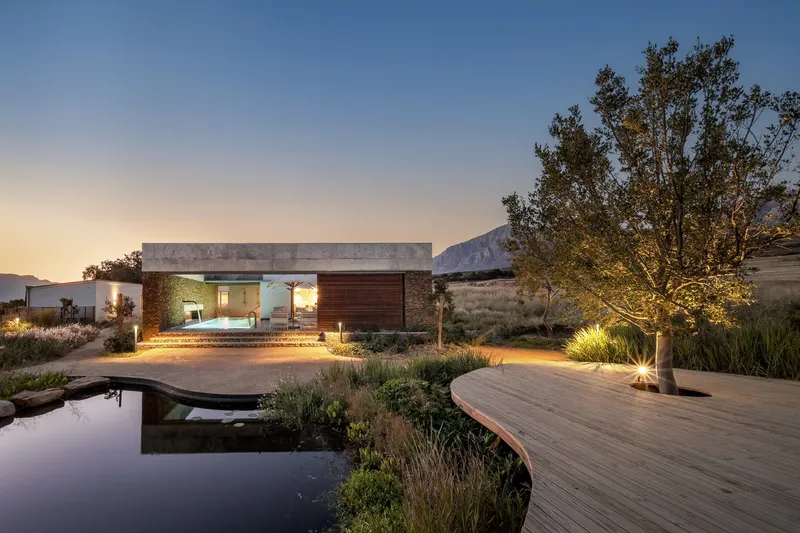
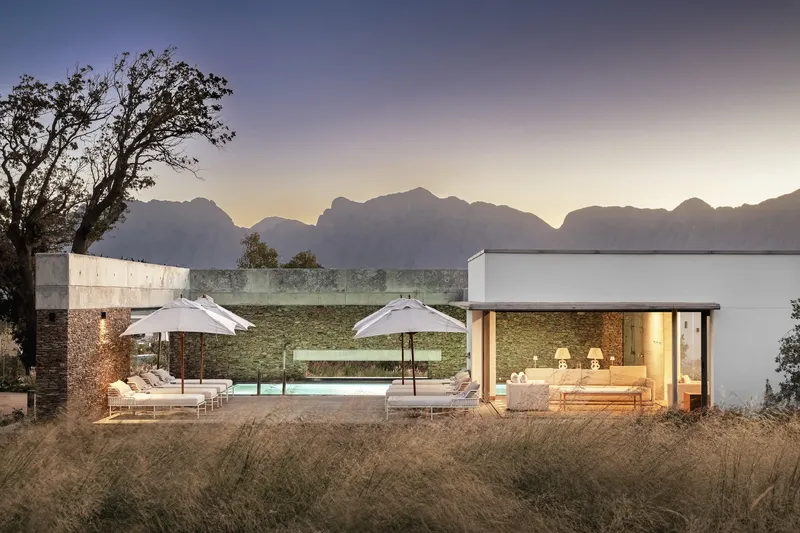
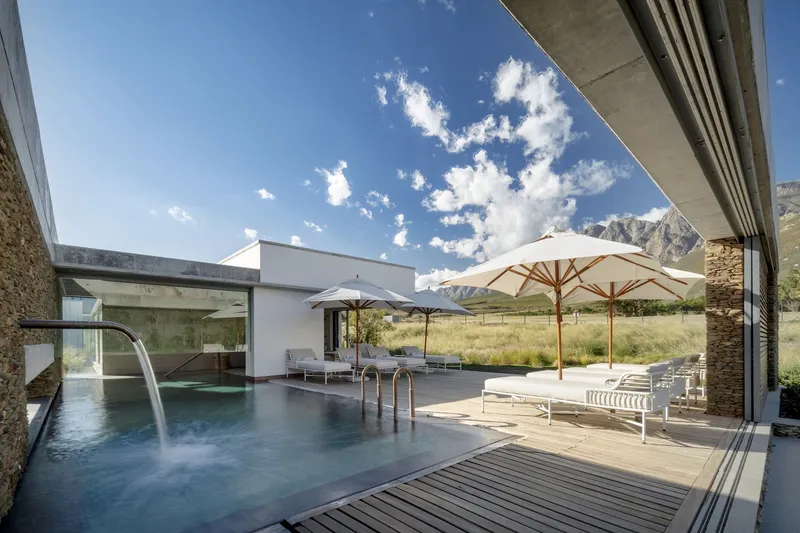
Water is treated as architecture here, not amenity. A curved timber deck wraps around a reflecting pool at one end of the complex, its smooth surface doubling the twilight sky and anchoring the landscape composition. The main pool terrace is oriented due west toward the mountain range, with white umbrellas arranged on timber decking to create a series of shaded micro-environments. At the covered terrace above, the pool becomes a foreground element in a layered panorama: deck, water, lawn, vineyard, mountain.
These outdoor spaces are as carefully resolved as the interiors. The deck materials, furniture placement, and planting choices are all calibrated to extend the building's spatial logic into the open air. The effect is that the guesthouse never really ends; it just becomes progressively more porous until you are standing in the garden.
Garden Edge and Material Transition

From the garden's edge, beneath the canopy of a mature oak, the guesthouse reveals its most domestic face. A low-slung volume with a flat roof sits behind flowering beds, its horizontal emphasis a deliberate counterpoint to the pitched gables elsewhere. This is where the contemporary and the traditional registers of the project coexist most openly, neither dominating the other. The garden acts as mediator, its organic informality softening the geometric discipline of the built forms.
Plans and Drawings


The ground floor plan reveals the organizational logic that the exterior photographs only hint at. A linear circulation spine connects multiple room clusters, each branching off to frame its own outdoor space. The plan is additive rather than hierarchical: there is no grand central hall, only a sequence of thresholds and courtyards that accumulate into a complex spatial experience. The section drawing confirms the interior generosity of the pitched roof volumes, showing how the exposed trusses create varied ceiling heights within a consistent exterior silhouette. Across the horizontal site, the buildings maintain a disciplined roofline that defers to the mountain profile behind.
Why This Project Matters
Regionalism in hospitality architecture is a minefield. The temptation to produce either a theme park of local clichés or a placeless luxury box is enormous, and most projects fall into one trap or the other. What Meyer & Associates has achieved at Bosjes is a genuine engagement with the spatial and material traditions of the Cape Winelands, pursued through contemporary construction and planning techniques. The result is a building that could only exist in this valley, shaped by its climate, its agricultural rhythms, and its deep architectural memory.
The project also offers a model for how hospitality buildings can occupy landscape without consuming it. By disaggregating the program into smaller volumes and weaving courtyards, gardens, and water features between them, the architects have created a complex that amplifies the qualities of its site rather than competing with them. In a region where tourism development is intensifying, that kind of disciplined generosity toward the land is not just good design. It is good stewardship.
Bosjes Guesthouse and Spa, designed by Meyer & Associates Architects and Urban Designers, Bosjes Estate, Wachshoekberge Valley, Western Cape, South Africa. Photography by Paris Brummer and Claire Gunn.
About the Studio
Share Your Own Work on uni.xyz
If projects like this are the kind of work you want to make, uni.xyz is a place to publish your own, find collaborators, and enter design competitions.


Popular Articles
Popular articles from the community


GROUP A Strips a 1969 Rotterdam Harbor Headquarters to Its Frame and Wraps It in Timber Louvers
In Rotterdam's M4H harbor district, Ferro Offices reuses a 1969 frame, adds one timber storey and reaches BREEAM-NL Outstanding.

U.GA Architects Wraps an Oval Rooftop Pool in Curved Board-Formed Concrete on Busan's Jeollidan-gil
In Busan's Jeonpo-dong, a 454 m² mixed-use block stacks a neighborhood facility, guest rooms and an oval rooftop pool inside spiraling concrete walls.

Cube Design Draws an Ecological Corridor Between Two Shenzhen Hills with the Nankai Building
Beside Shenzhen's container docks, the Nankai Building pairs stacked balconies with a climbing green screen to connect two hillsides across its height.

LT2A and OPEN Architectes Thread a Brick and Glass High School Through a Wooded Belgian Campus
In Braine-l'Alleud, a 3,000 m² wing for Collège Cardinal Mercier pairs pale brick with a glazed colonnade, deferring to a small chapel and a dense wood.

Similar Reads
You might also enjoy these articles


Hodi-Mandai Geram
Project Function: Preservation and revitalization of the Intangible heritage and socio-spatial identity of the Hodi by Housing, Cultural Memory Center, Sacred Grove, landscape, local tourism economy


Olio Towers: A Mid-Rise for Performers That Fuses Housing, Rehearsal, and Stage
Located blocks from Houston's Theater District, this modular tower stacks living units around a central performance atrium.

Oasis: Modular Green Housing Carved into Dhaka's Urban Fabric
A shortlisted Plugin Housing entry reclaims unauthorized settlements in Dhaka with stepped concrete volumes, green roofs, and ventilation-driven design.

Black Hole: A Floating Megastructure for the Post-Physical Era
Emiliano Mazzarotto envisions a spherical, self-scaling arena where e-sports, digital hotels, and holographic stadiums replace traditional public space.

Explore Architecture Competitions
Discover active competitions in this discipline

Challenge to reimagine the Iron Throne

Photograph architecture without architects

Illustrate the lost glory of Angkor Wat - Render Challenge

Design challenge to reuse E-waste
Comments (0)
Please login or sign up to add comments
No comments yet. Be the first to comment!