
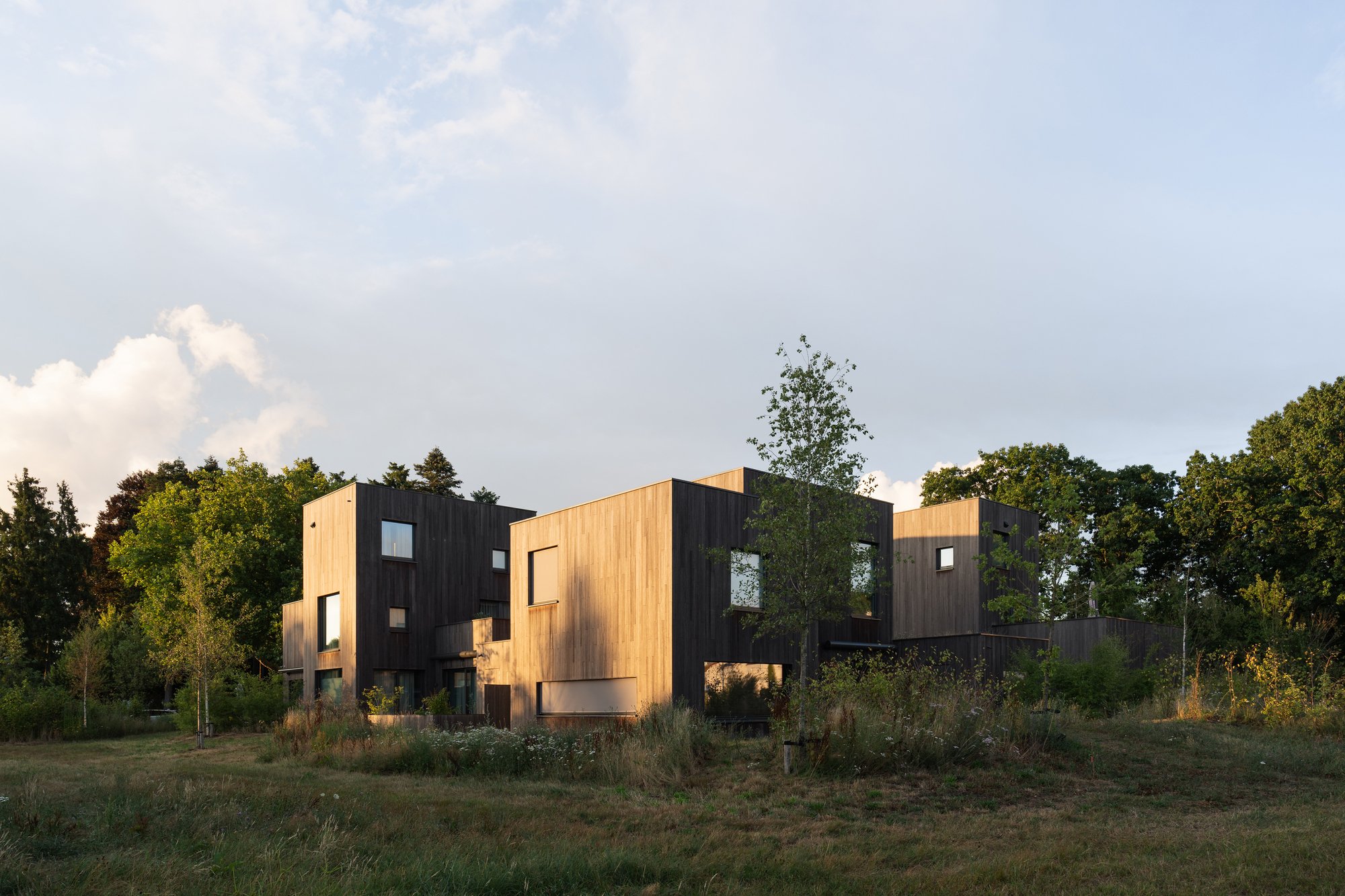
Bosrijk Houses: Timber Sculptures in Eindhoven
Marcel Lok_Architect clusters timber-clad volumes on a former military site, dissolving boundaries between dwelling and landscape.

West of Eindhoven, on land once reserved for military defense, a different kind of occupation is taking shape. Bosrijk is a residential district where houses are conceived not as background fabric but as sculptural objects placed within a landscape that is slowly rewilding itself. Marcel Lok_Architect takes that premise seriously with a cluster of five dwellings that read less like a housing row and more like a small landform: stacked, rotated, and offset timber volumes that negotiate privacy, views, and shared outdoor space without resorting to fences or hedges.
What makes the project genuinely interesting is the refusal to settle for one reading. From a distance the cluster appears monolithic, a dark mass among birch and wildflower. Up close, each volume reveals itself as a distinct room or function that has been given its own roof, its own orientation, its own relationship to the sky. The result is a kind of domestic topography where courtyards, roof terraces, and passages between units do the work that corridors and hallways typically perform inside a conventional house.
Landscape as Organizing Principle
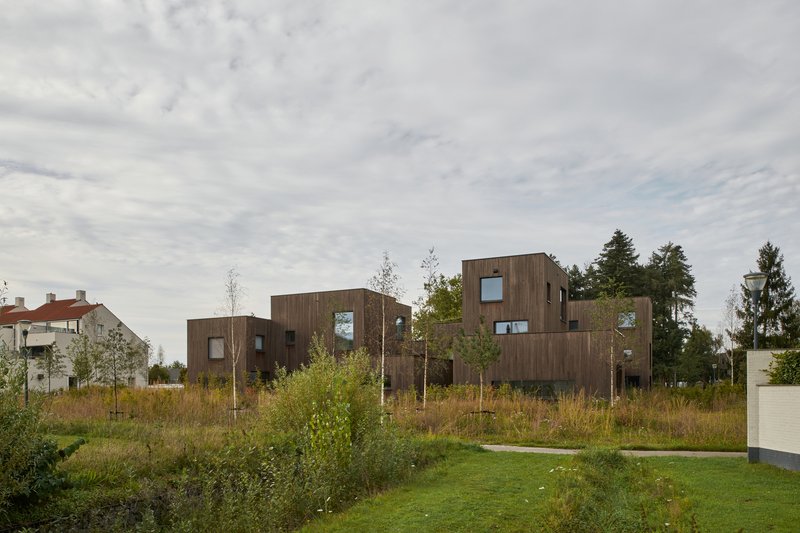
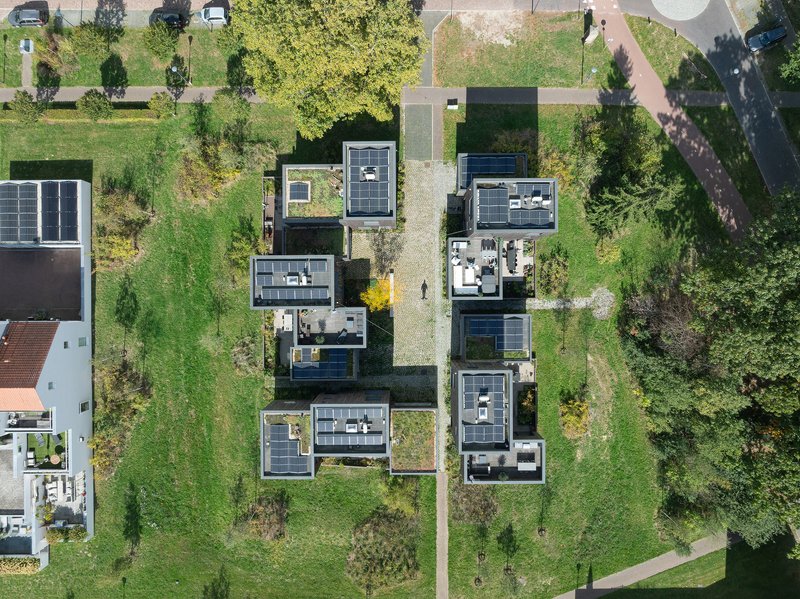
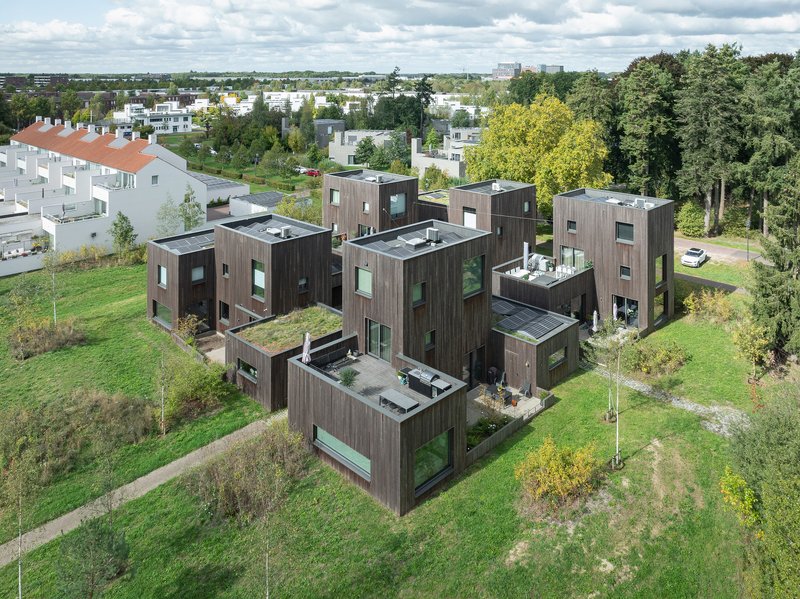
Aerial views make the strategy legible. The five dwellings are arranged along a central pathway, their staggered footprints carving out pockets of communal green and private garden. Photovoltaic panels crown the rooftops, while the gaps between volumes allow mature trees and wild grasses to penetrate the cluster rather than surround it at a polite distance. The architecture does not sit on the landscape; it participates in it.
The former defense site gives the project a particular character. The soil is sandy, the existing planting sparse but tenacious, and the neighborhood plan encourages a loose, almost rural grain. Marcel Lok exploits this by treating each lot as a clearing rather than a plot, positioning the house clusters to preserve sightlines to the tree canopy and the horizon.
Massing and the Art of the Offset
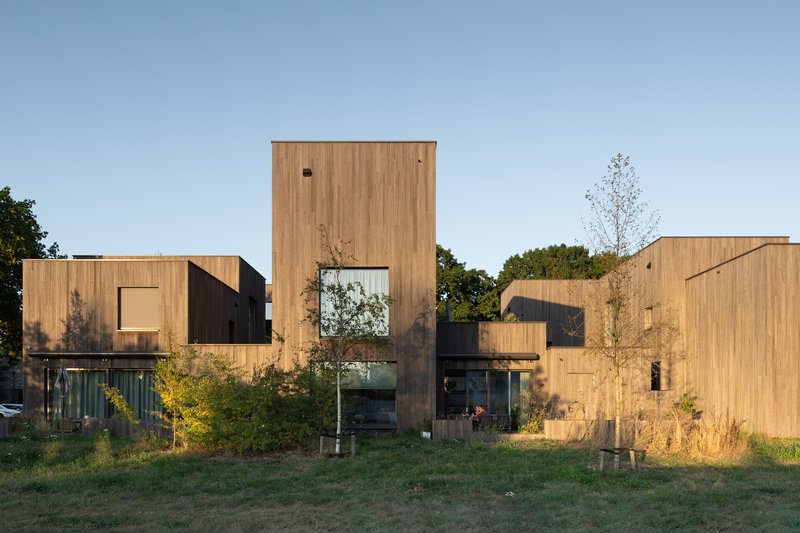
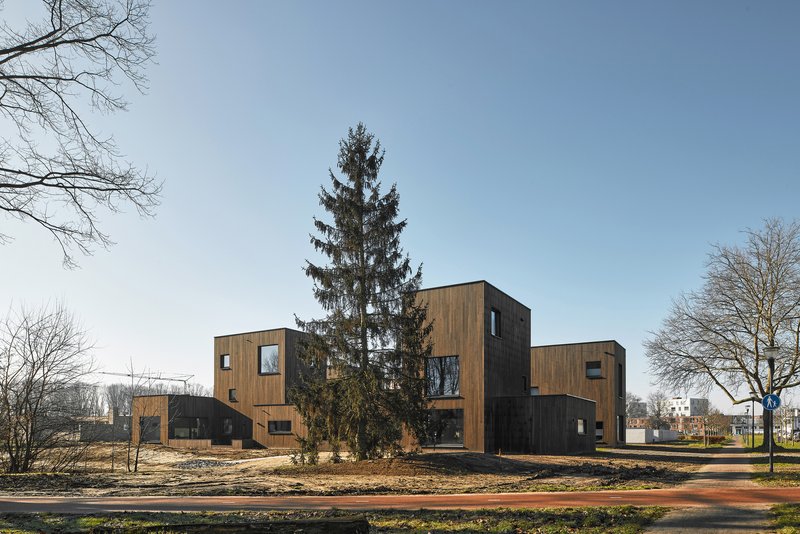
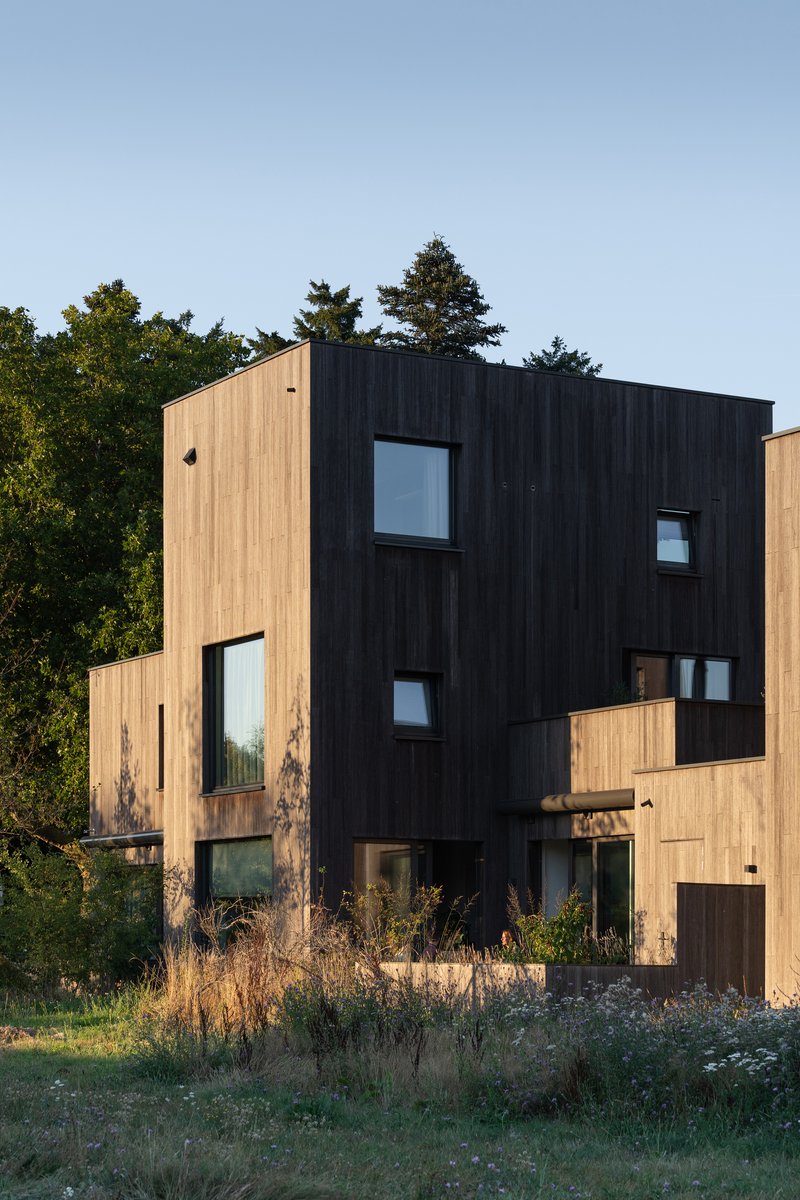
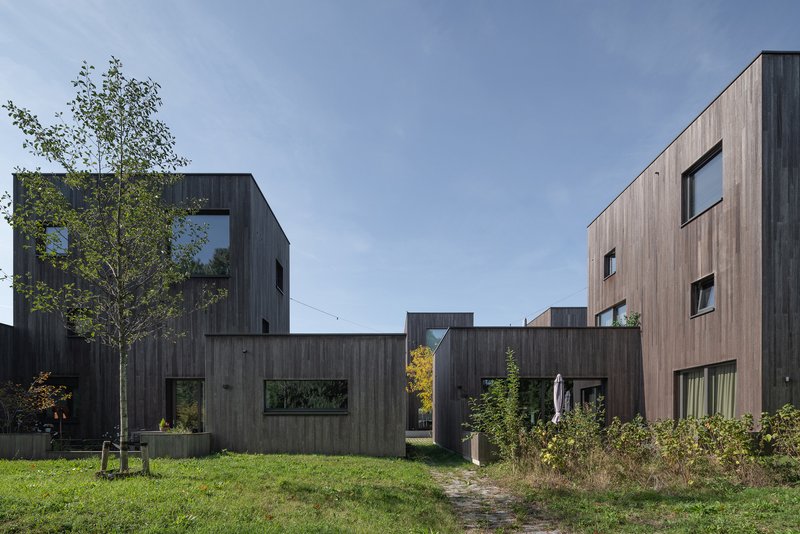
The compositional logic is straightforward: box stacks on box, each shifted just enough to create a terrace, a shaded overhang, or a framed view. No two units present the same silhouette to the street. Seen from the meadow at golden hour, the cluster appears to grow taller and more complex as light rakes across the vertical timber cladding, catching every offset and recess.
Contrasts in wood tone, from near-black carbonized surfaces to lighter natural finishes, reinforce the reading of individual volumes. A tall conifer becomes the pivot around which the winter composition orbits, its dark green echoing the darkest facades. The massing avoids symmetry without becoming chaotic; it is disciplined informality.
Courtyards and the Space Between
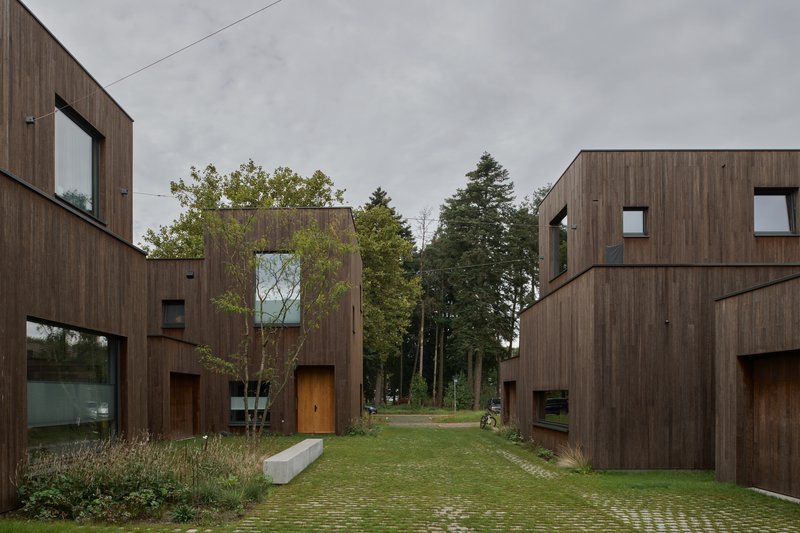
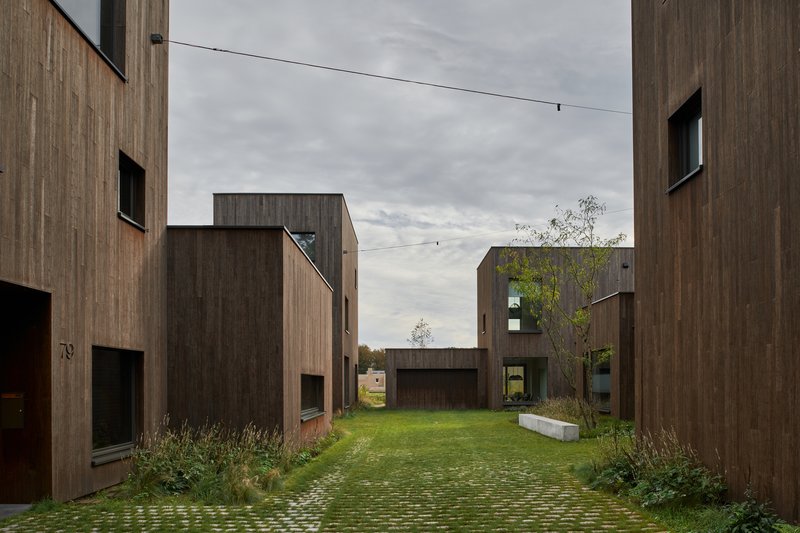
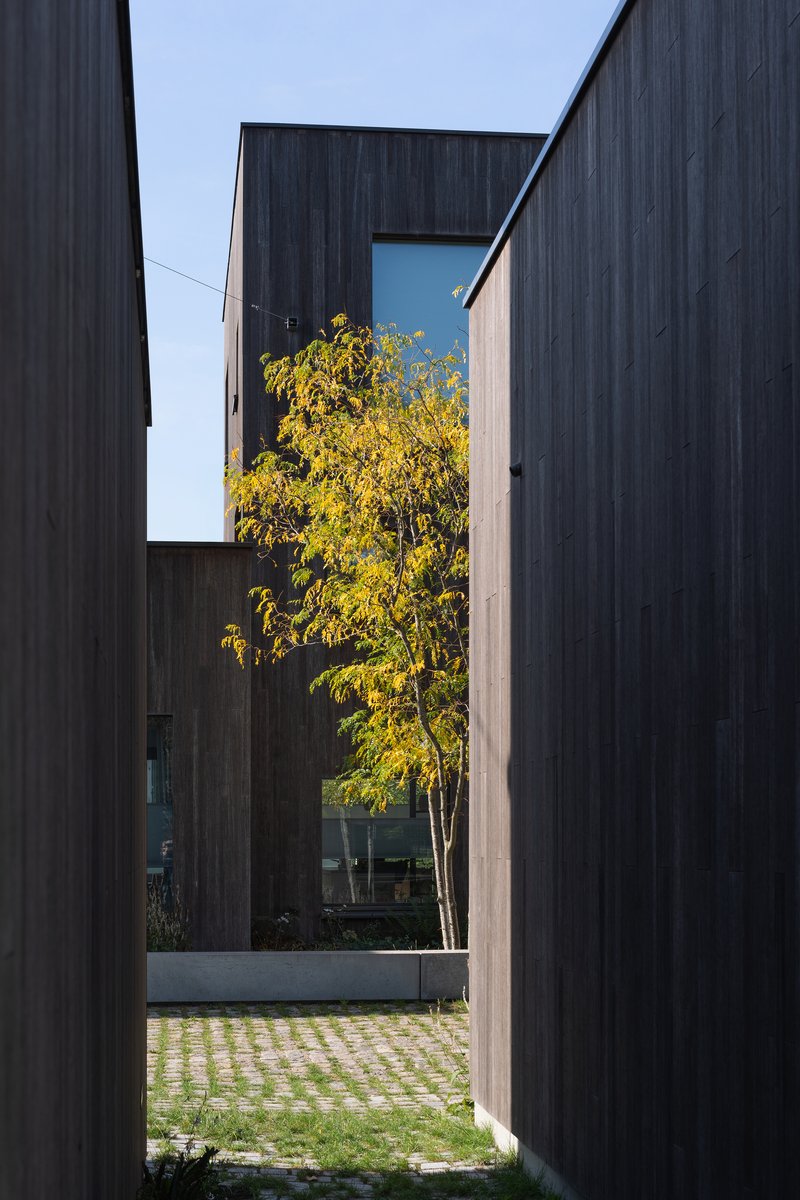
The shared courtyards are the social heart of the project. Permeable paving replaces asphalt, planted grasses soften the ground plane, and punched window openings ensure a measured degree of mutual visibility. These are not residual spaces left over after the buildings were placed; they are designed rooms without ceilings, calibrated to balance neighborly contact with domestic retreat.
A narrow passage between two dark timber volumes (image 12) is one of the project's most evocative moments: a compression point that heightens the release into the courtyard beyond, where a single young tree in autumn foliage occupies the frame like a painting. Architecture here works cinematically, sequencing views and moods as you move through.
Threshold and Entry
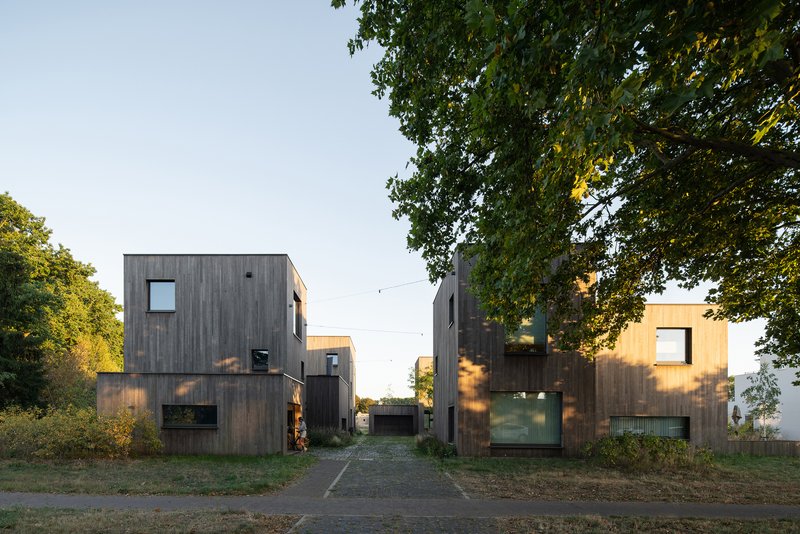
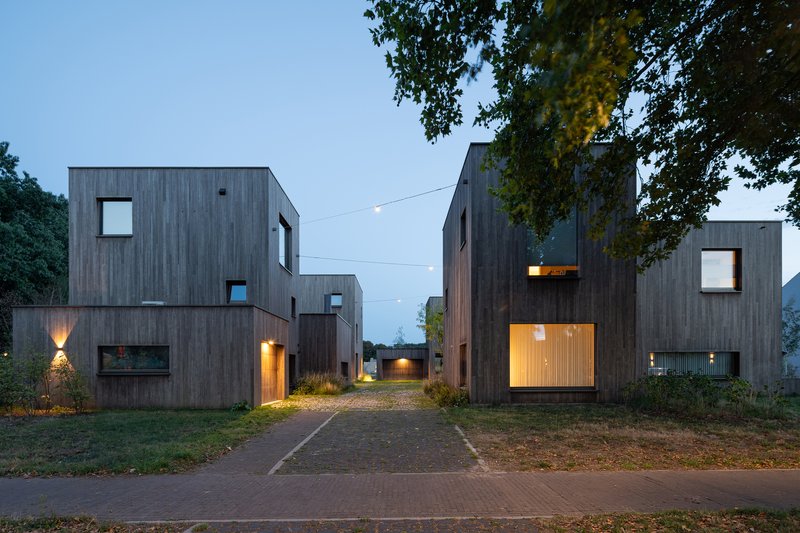
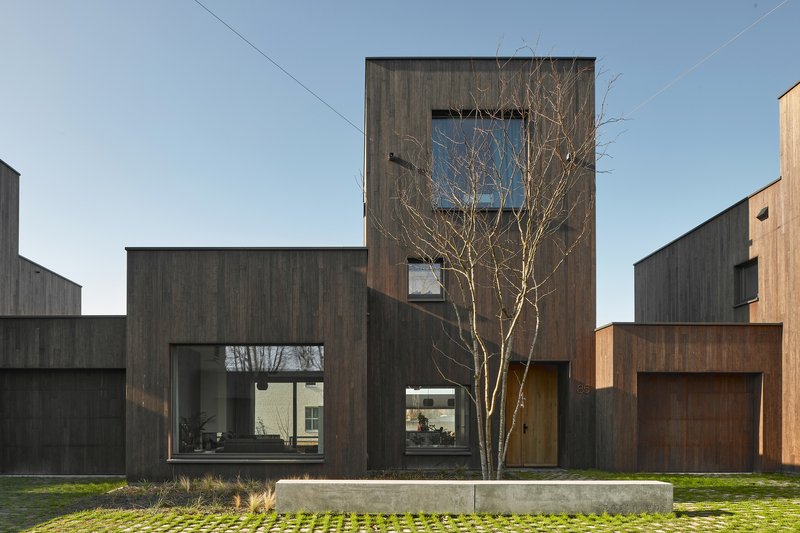
The entry lanes between volumes shift character dramatically between day and night. In late afternoon, mature trees cast long shadows across the timber walls, and the passage feels informal, almost rural. At dusk, illuminated windows and doorways turn the same lane into a lantern corridor, warm light spilling across the cladding and the ground.
Shared outdoor space is handled with restraint. Mown grass and dirt paths replace the manicured lawns and brick pavers typical of Dutch suburbia. The message is clear: this is a landscape that will be shaped by its residents over time, not frozen by the architect at handover.
Facade and Materiality
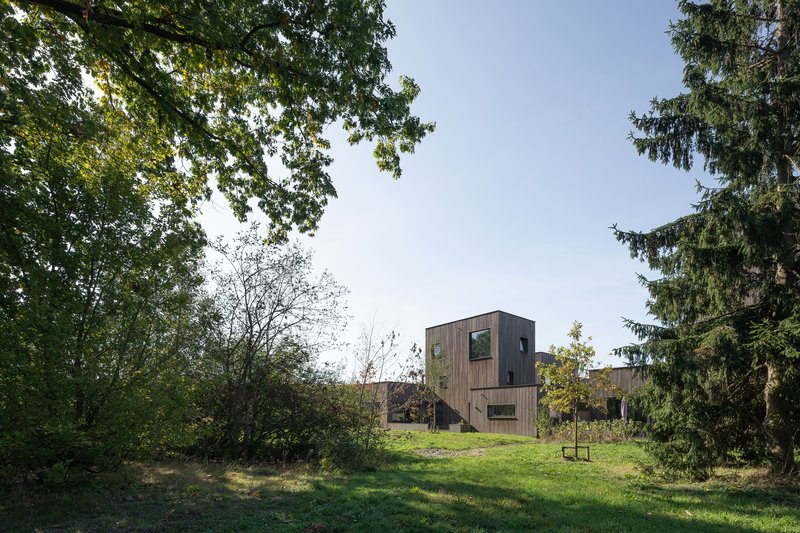
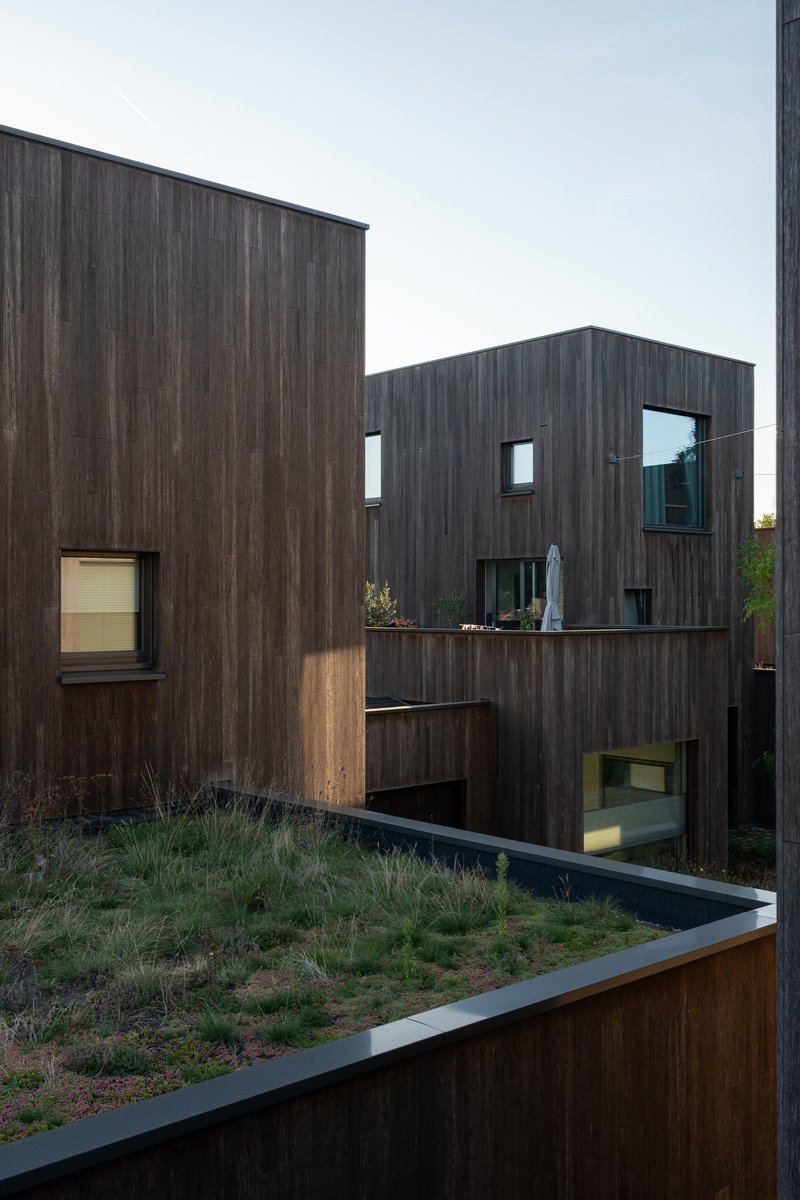
Timber is the unifying material, but it is deployed in several registers. Vertical board cladding in darkened tones absorbs light and recedes into the tree canopy, while lighter panels catch it and announce the presence of a specific room or terrace. Green roofs soften the tops of the lower volumes, visible from the upper decks and from the air, blurring the line between built form and planted ground.
Large framed windows are placed with surgical precision. One oversized opening on the darkened facade (image 9) overlooks a concrete bench and a young birch, composing a miniature landscape that belongs entirely to a single room. It is a strategy of selective generosity: small overall window area, but each aperture earns its place by framing something worth looking at.
Interior Calibration
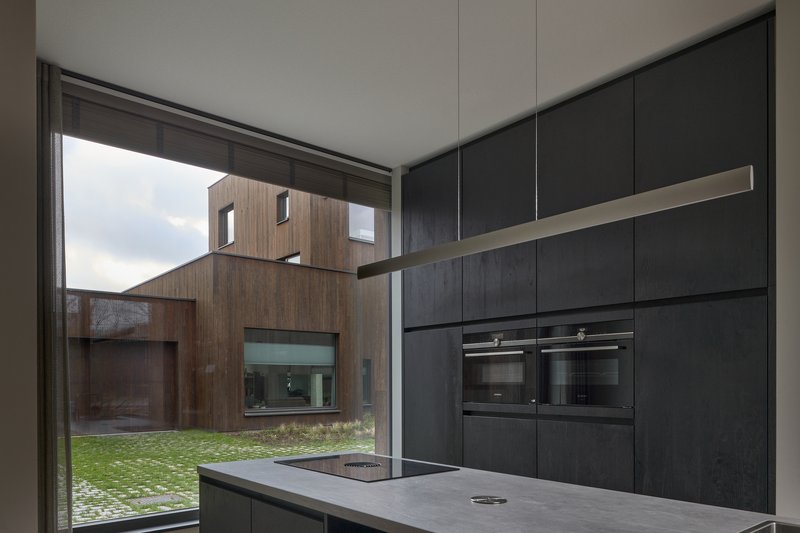
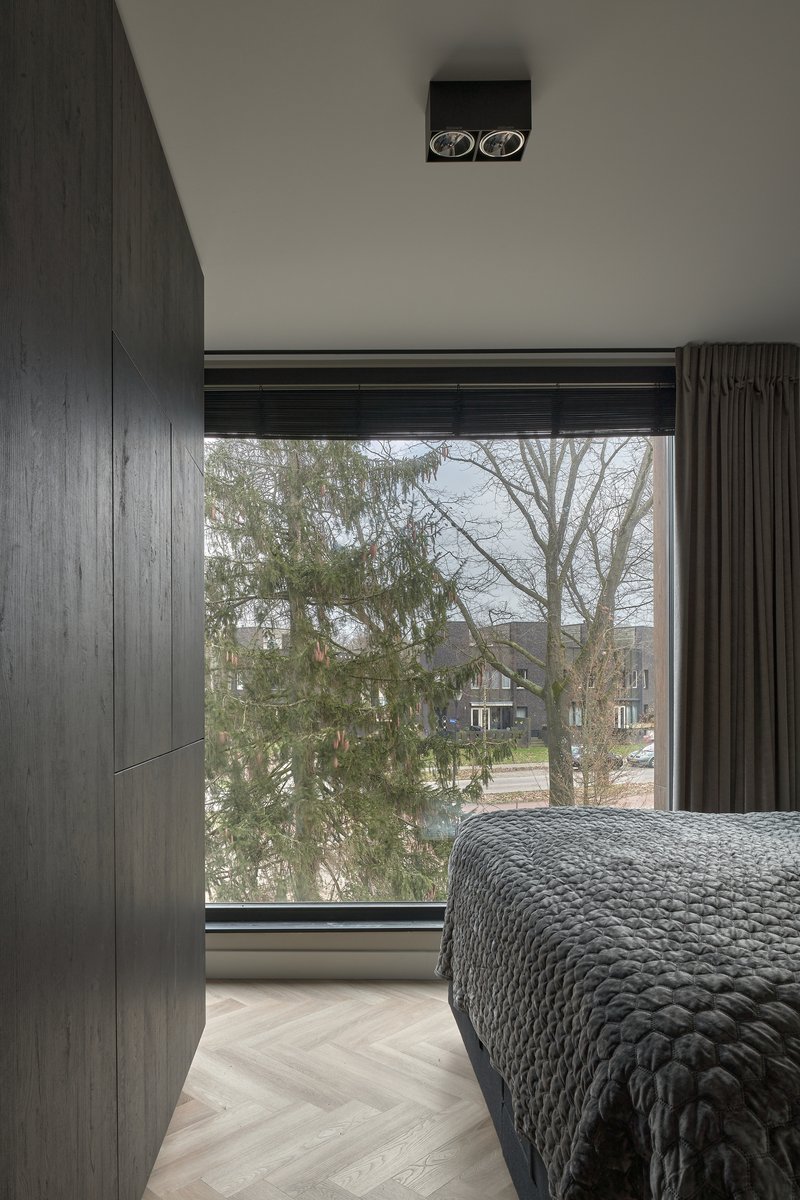
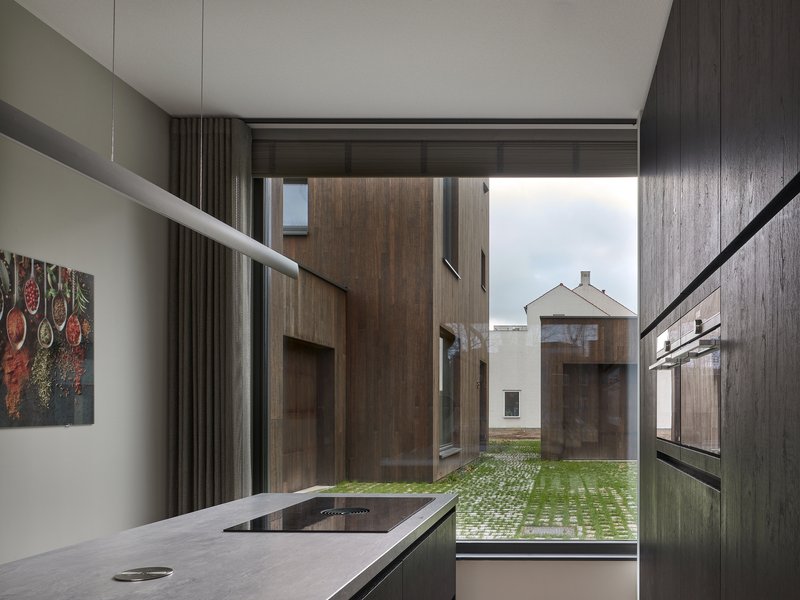
Inside, the palette stays dark and matte. Black cabinetry in the kitchen meets corner glazing that dissolves the room into the courtyard beyond. The kitchen island becomes a vantage point for watching the life of the cluster, a domestic periscope. In the bedroom, dark timber paneling wraps walls and ceiling while a full-height window frames a composition of bare winter trees, collapsing the distance between interior and forest.
The interiors demonstrate a principle that the exteriors already suggest: every surface is a frame. Walls, ceilings, and floors are finished to recede, pushing your attention outward to the trees, the sky, and the neighboring volumes. The architecture is most present where it meets the landscape, at the window reveal, the terrace edge, the threshold.
Plans and Drawings
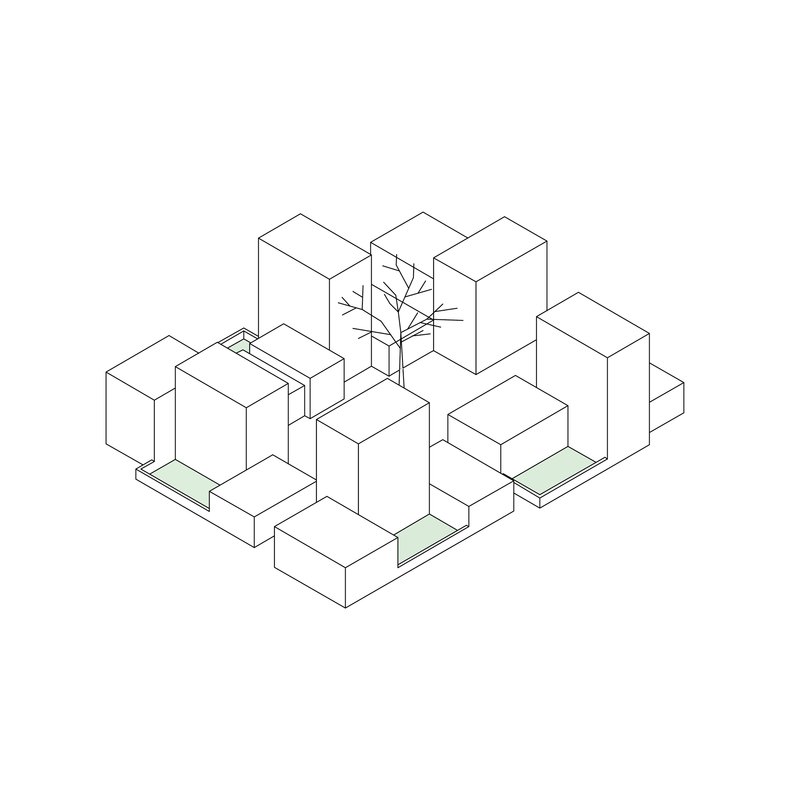
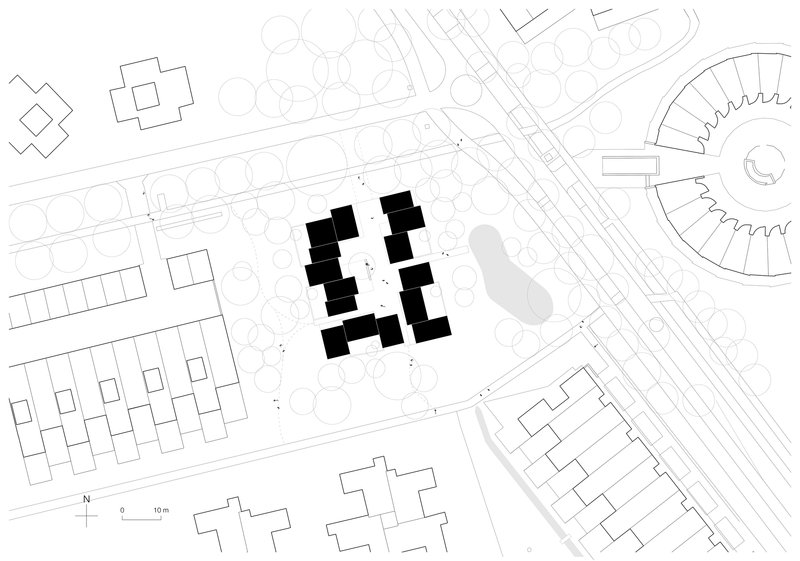
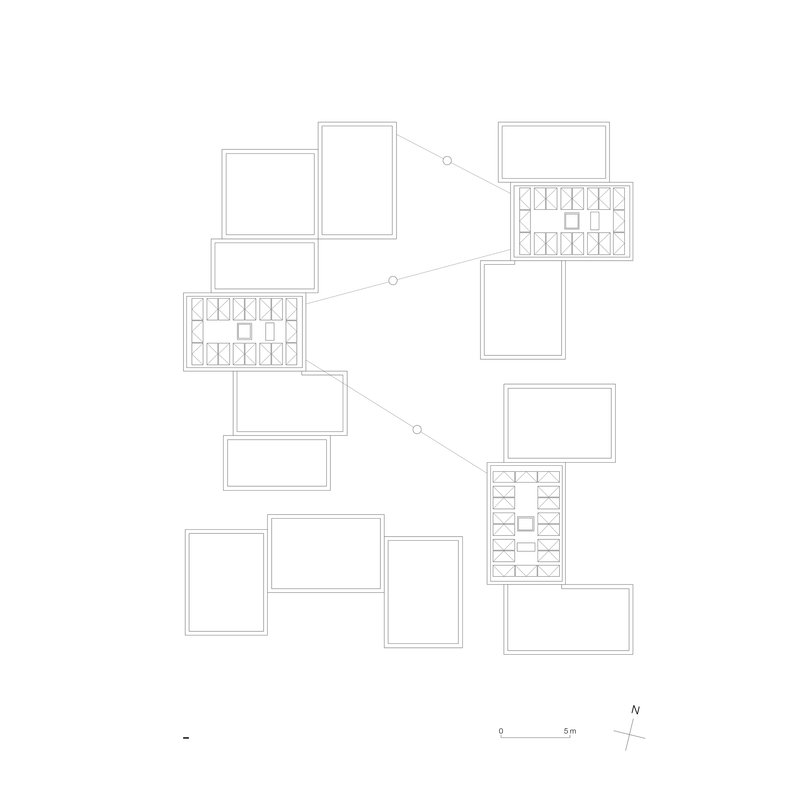
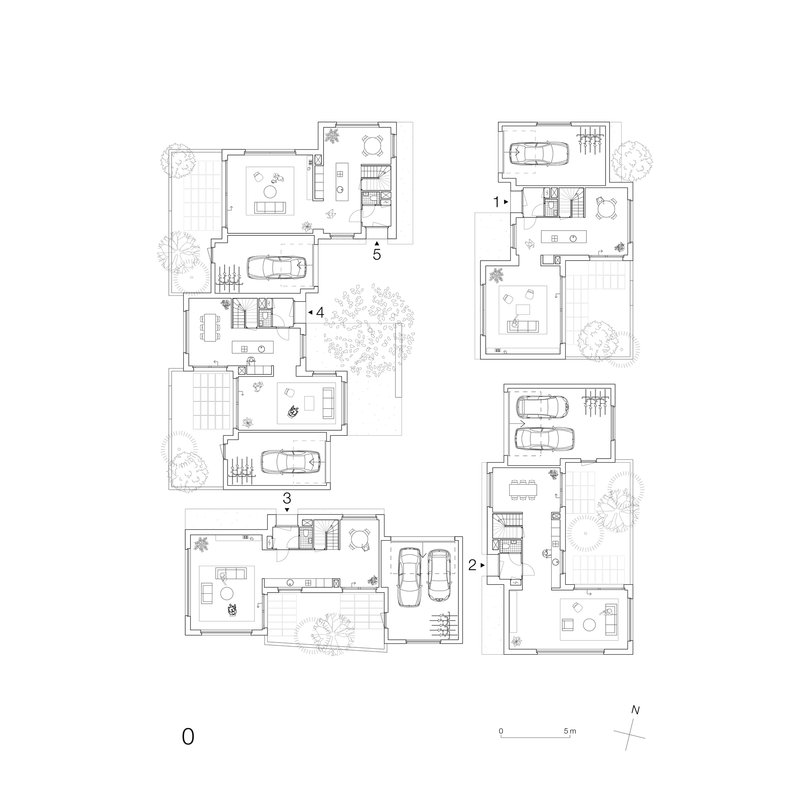
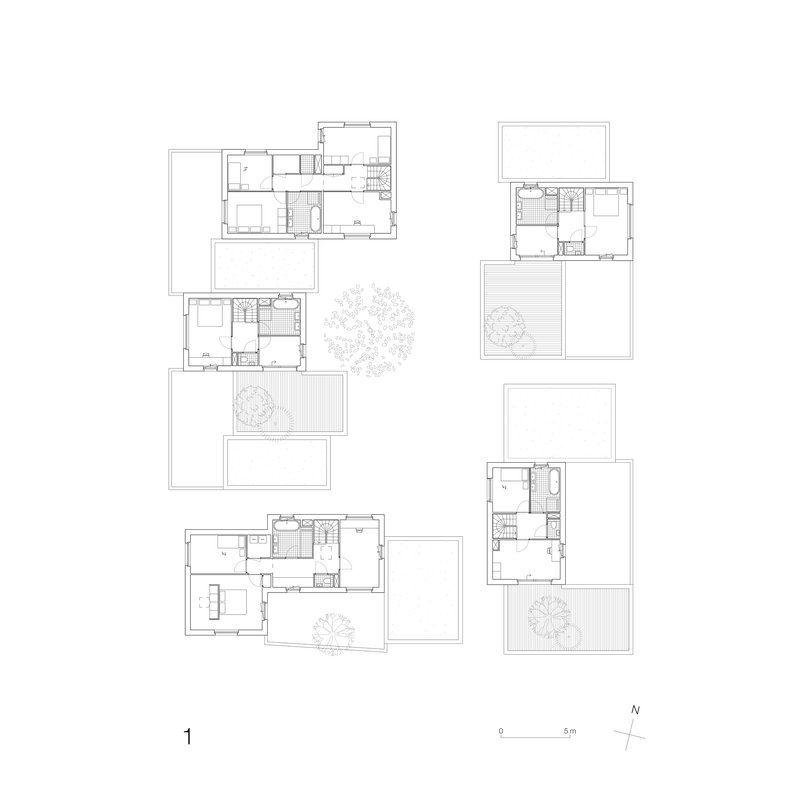
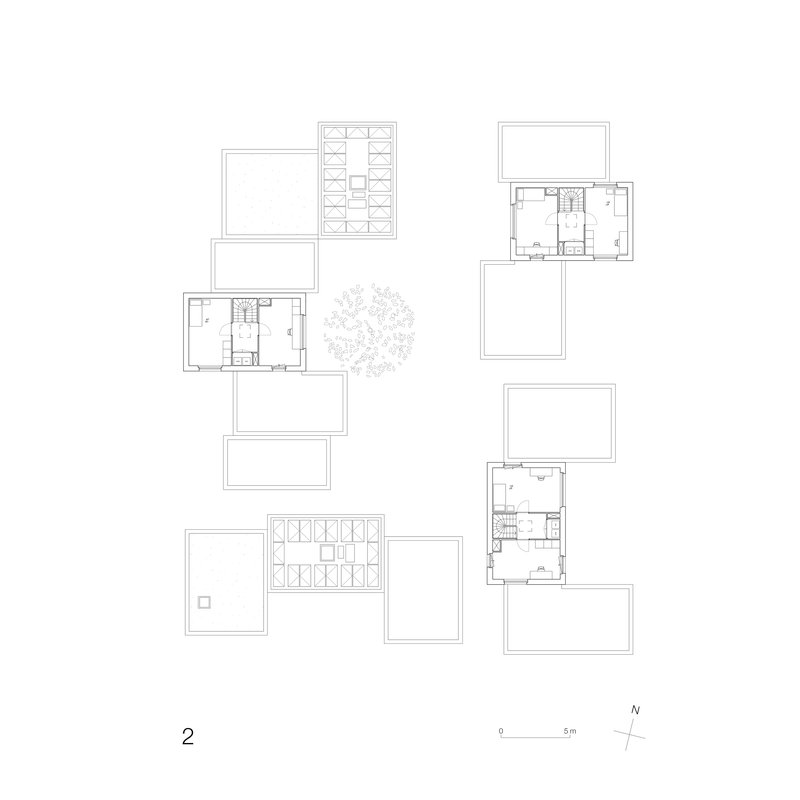
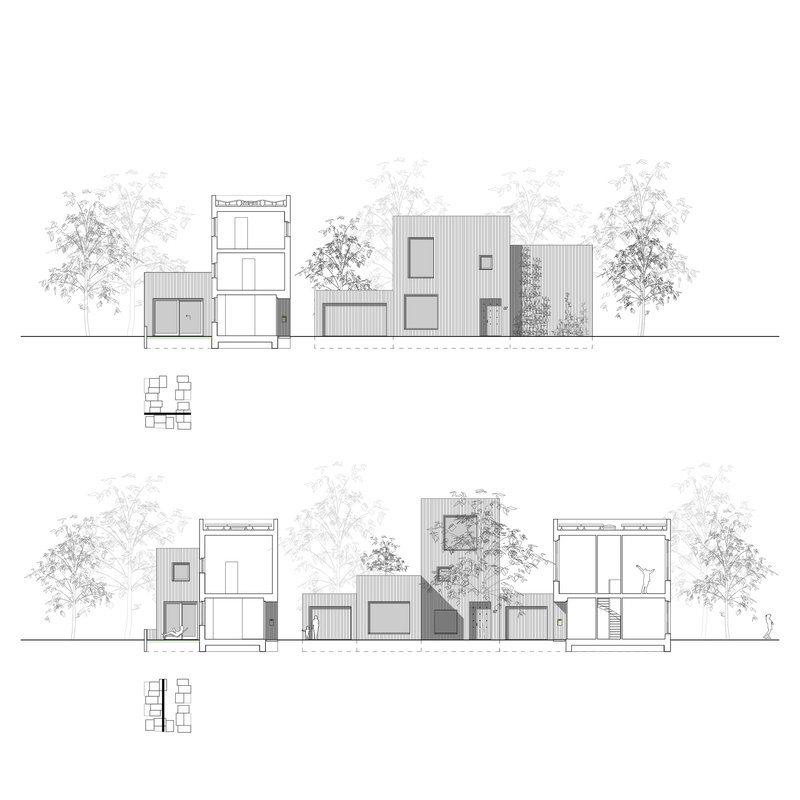
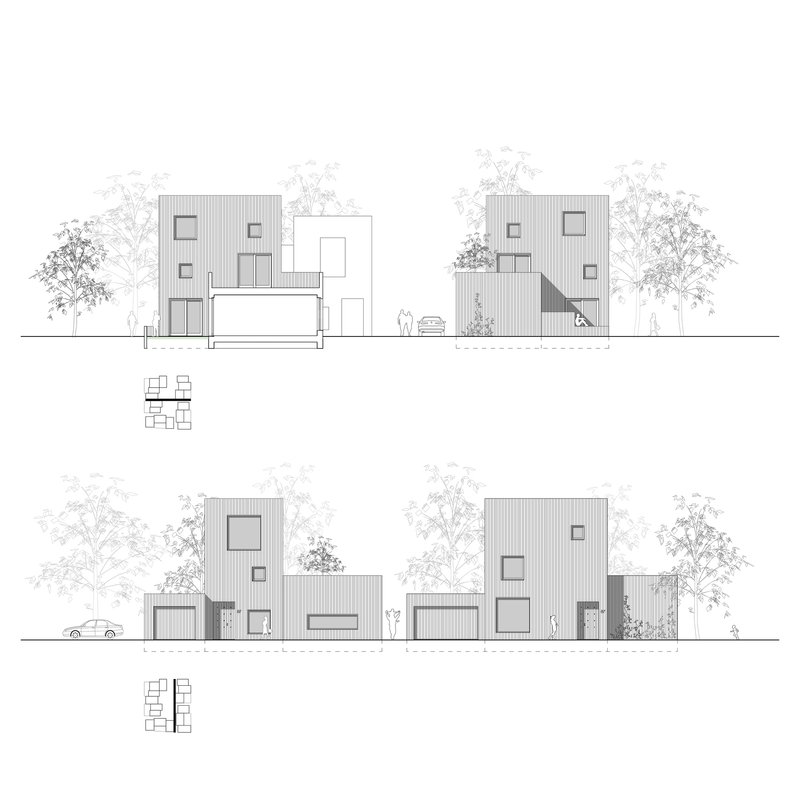
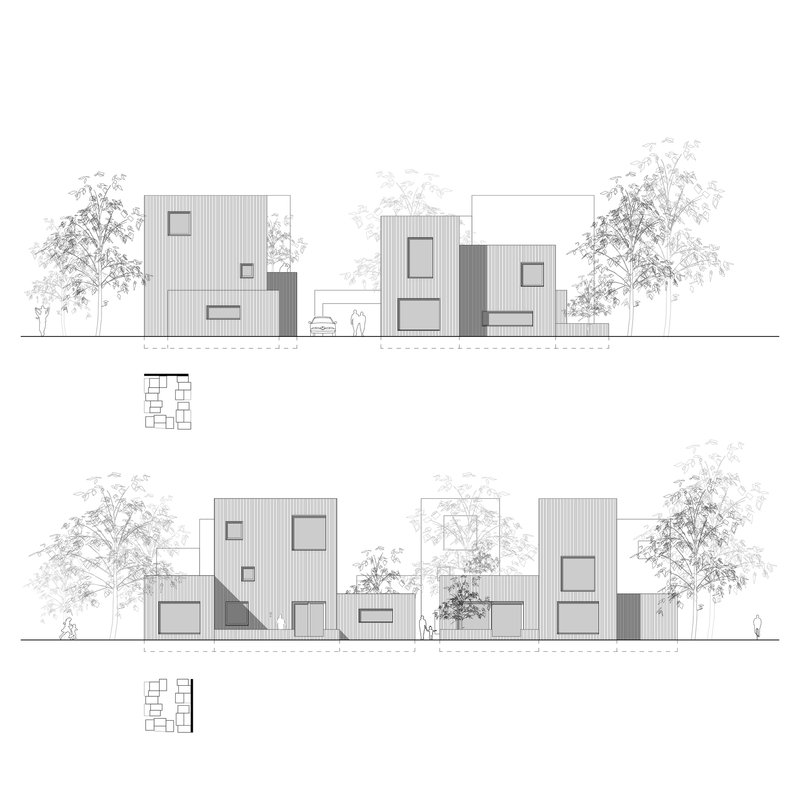
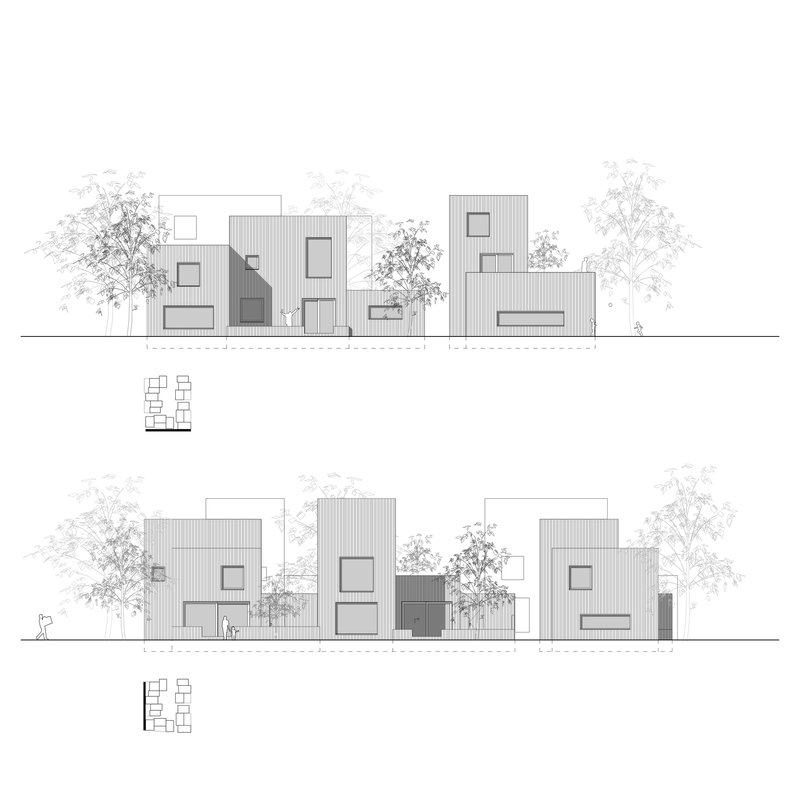
The isometric drawing reveals the full spatial ambition: five units interlocked around a central tree, their roof terraces stepping up like a ziggurat. Ground floor plans show living spaces opening onto private outdoor terraces, with garages tucked below. Upper levels allocate bedrooms to quieter elevations and place decks where they catch the best light. The site plan locates the cluster within a network of diagonal circulation paths, emphasizing that the project is not an isolated object but a node in a larger landscape strategy.
Elevation drawings are particularly instructive. Stacked and offset volumes read clearly, corrugated and vertical siding alternate across facades, and the courtyard tree appears in almost every view, reminding us that the landscape is not decoration but co-author. The mixed cladding materials register differently at each elevation, ensuring the cluster never offers the same face twice.
Why This Project Matters
Bosrijk Houses makes a case for density without uniformity. Five families share a footprint barely larger than two conventional Dutch detached houses, yet each dwelling has its own silhouette, its own garden, its own relationship to the sky. The project proves that clustering does not have to mean compromise; it can mean richer spatial variety, more landscape, and a stronger sense of collective identity.
More broadly, Marcel Lok's approach offers a model for the many former military and institutional sites being converted to housing across the Netherlands and beyond. Instead of filling the land with repetitive rows, the architect treats the site as a garden first and a neighborhood second, letting the existing trees, soil, and topography set the rules. The houses then arrive as guests, not colonizers: carefully placed, materially restrained, and open enough to let the landscape do the talking.
Bosrijk Houses by Marcel Lok_Architect, Eindhoven, The Netherlands. 1,080 m², completed 2023. Photography by Max Hart Nibbrig and Mitchell van Eijk.
About the Studio
Share Your Own Work on uni.xyz
If projects like this are the kind of work you want to make, uni.xyz is a place to publish your own, find collaborators, and enter design competitions.




Popular Articles
Popular articles from the community

PLATAFORMArq Folds a Concrete Roof Over the Portuguese Mountains in House #474
A 220-square-meter residence in Teixoso, Portugal, wraps board-formed concrete into an angular canopy that frames the Serra da Estrela foothills.

Milan Crossover: Sustainable Architecture for a New Fashion Culture in Milan
Milan Crossover transforms fashion culture through sustainable architecture, linking material libraries, remake studios, and public runways.
Eco Chapel: A Green Architecture Pavilion Designed in Symbiosis with the Forest
Eco Chapel uses green architecture to weave prayer, learning and reuse into a forest pavilion shaped by modular hexagonal canopies for life.
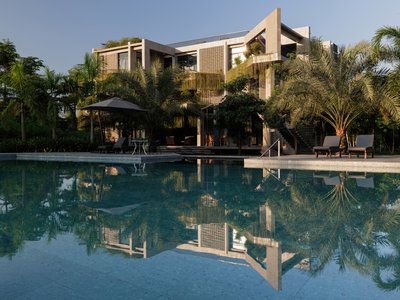
Reincarnation Weaves a Three-Story Retreat into the Green Landscape of Rural Bangladesh
Ara Manor in Narsingdi dissolves the line between domestic architecture and its lush surroundings through screens, courtyards, and planted rooftops.

Similar Reads
You might also enjoy these articles
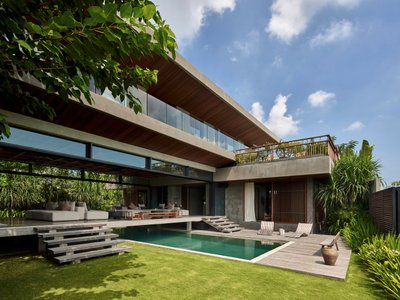
Freebird Residence by Alexis Dornier: A Tropical Modernist Sanctuary in Bali
Floating living pavilion above pool anchors H-shaped tropical villa, blending Japanese minimalism, sustainable strategies, lush landscape, and sculptural interiors.
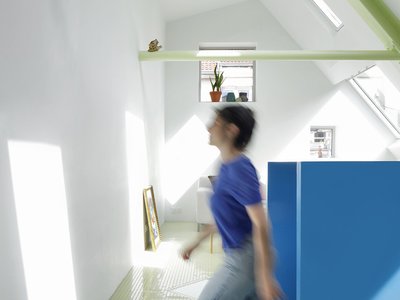
127af Flips a Tiny Bagnolet Rowhouse Upside Down with a Handcrafted Roof Extension
A 55-square-meter terraced house on the edge of Paris gains a luminous upper living floor through lightweight timber and steel.
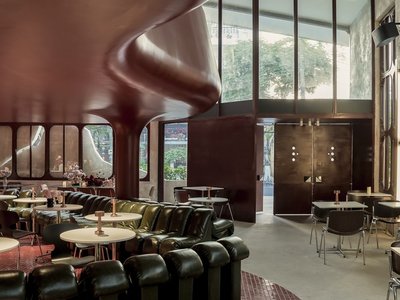
1.61 Design Workshop Wraps a 600-Square-Meter Café in Vietnam in Sculptural Burgundy Drama
Reden Café & Bistro pairs a helical staircase, mosaic floors, and deep red interiors to rethink Vietnamese hospitality space.

The Unbound Brain: A School Shaped by Cognitive Architecture
Cylindrical learning pods radiate like neurons from a central cortex, turning the floor plan into a spatial model of human thought.


Explore Urban Design Competitions
Discover active competitions in this discipline




The Global Benchmark for Architecture Dissertation Awards

Challenge to design mud housing for contemporary communities
Comments (0)
Please login or sign up to add comments
No comments yet. Be the first to comment!