

Bridge House by Wallmakers: A Suspended Sanctuary Between Land and Sky in Karjat, India
A suspended eco-home in Karjat, bridging a natural gorge with thatch-mud construction, hyperbolic forms, reclaimed materials, and immersive forest views.


A Revolutionary Residential Retreat Elevated Above Nature
Nestled in the lush hills of Karjat, India, the Bridge House by Wallmakers redefines residential architecture through ingenuity, lightness, and ecological sensitivity. Designed by acclaimed architect Vinu Daniel and his team, this 4,500-square-foot home transcends conventional construction by hovering above a natural gorge carved by the TATA spillway stream. Instead of resisting the site’s constraints, the design embraces them—elevating architecture into a poetic response to terrain, ecology, and material scarcity.
This visionary suspended residence stands as an example of long-span sustainable design, context-responsive architecture, and experimental material innovation, reflecting Wallmakers’ ongoing quest to build with earth, craft, and intelligence.

Designing With Constraints: From Topographical Challenge to Architectural Innovation
The site presented formidable challenges: a 7-meter deep ravine sliced the property in two, and environmental constraints prohibited foundations within a 100-foot spillway zone. Heavy construction equipment also needed clearance beneath the structure, and local resources were scarce—with only wild grass available within miles.
Rather than filling or bridging conventionally, Wallmakers conceived a habitable suspension bridge—a radical yet sensitive solution where architecture becomes landscape.
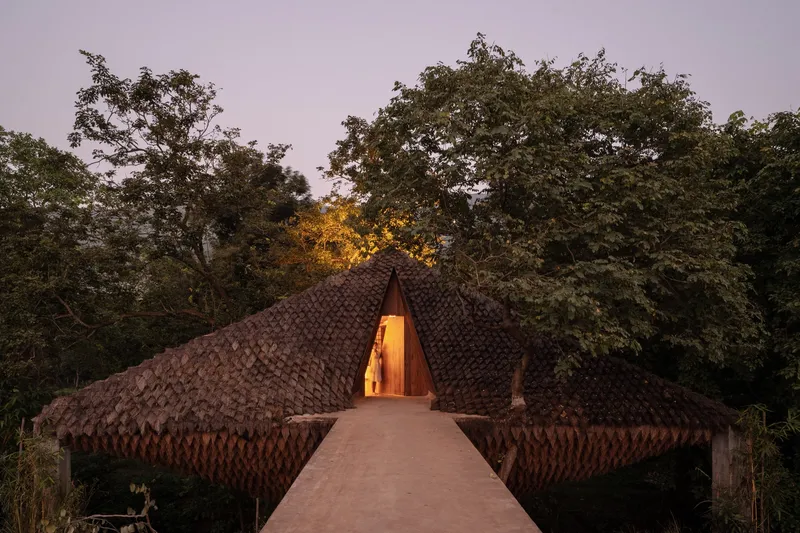
The Bridge House spans the ravine with four hyperbolic parabolic forms, creating a 100-foot lightweight tensile structure supported by minimal steel pipes and tension tendons. This engineering approach allowed the architects to preserve the natural landform and vegetation, creating minimal ground disturbance and leaving ecological processes intact.


Biomimicry and Material Intelligence
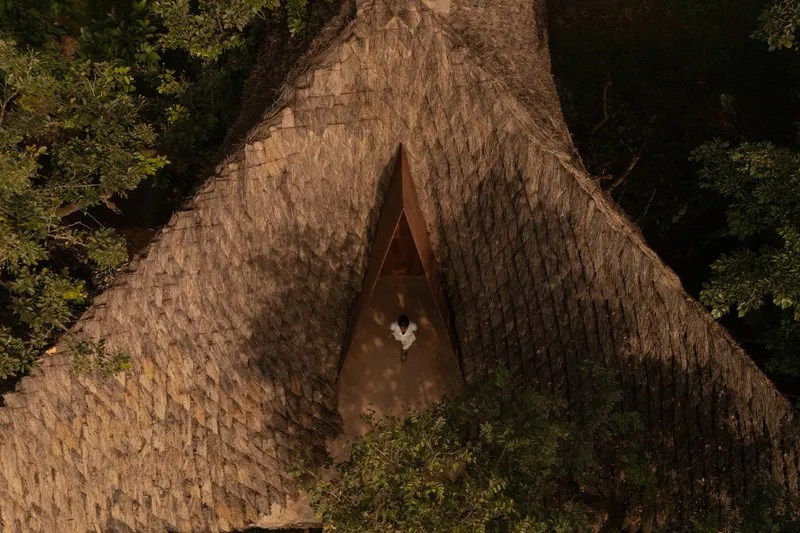
Inspired by the protective scales of a pangolin, the roof and walls are wrapped in a thatch-and-mud composite skin. This layered system offers:
- Thermal insulation and passive cooling
- Compressive strength without heavy concrete
- Pest resistance through mud plaster sealing
- Lightweight construction with four minimal footings
The result is a natural cocoon that blends into the forest canopy, achieving both environmental camouflage and climatic comfort.
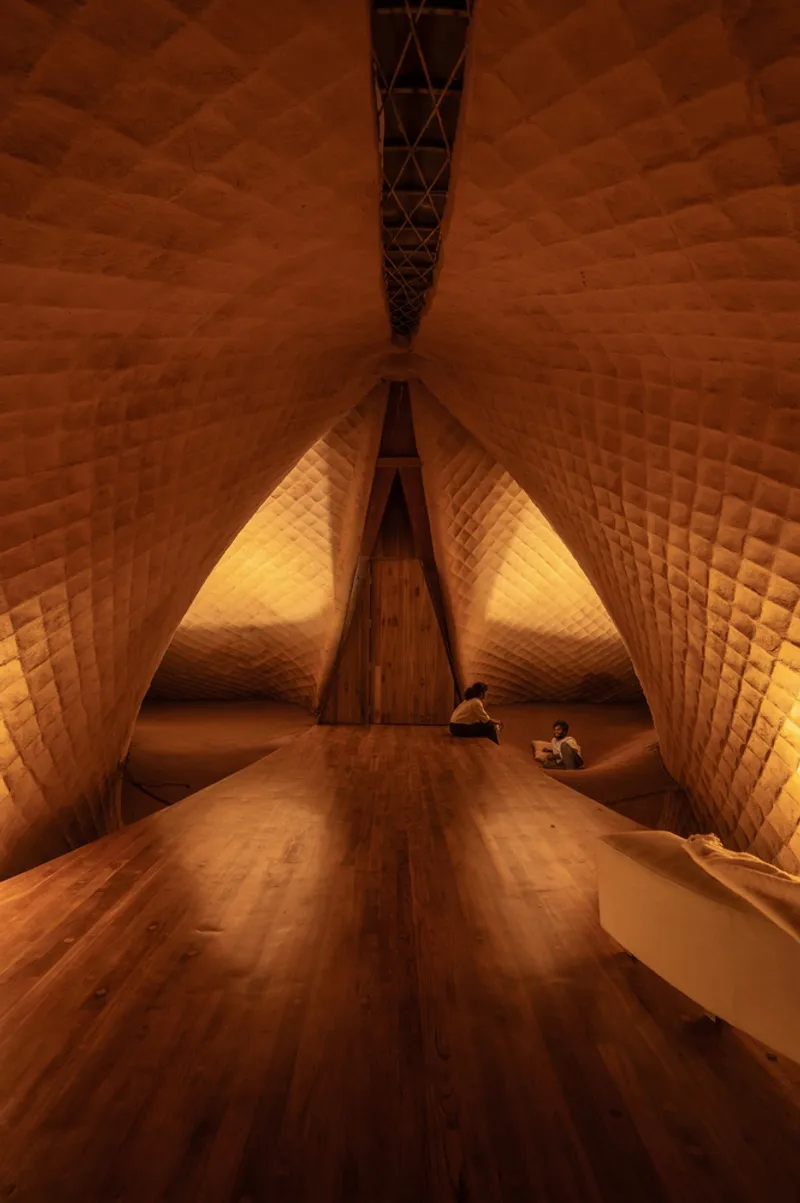
Inside, reclaimed ship-deck timber flooring, jute screens, and mesh partitions celebrate circular design and low-impact material reuse—showcasing how rustic textures can merge seamlessly with contemporary living.

Spatial Experience: Floating Living in a Forest Canopy
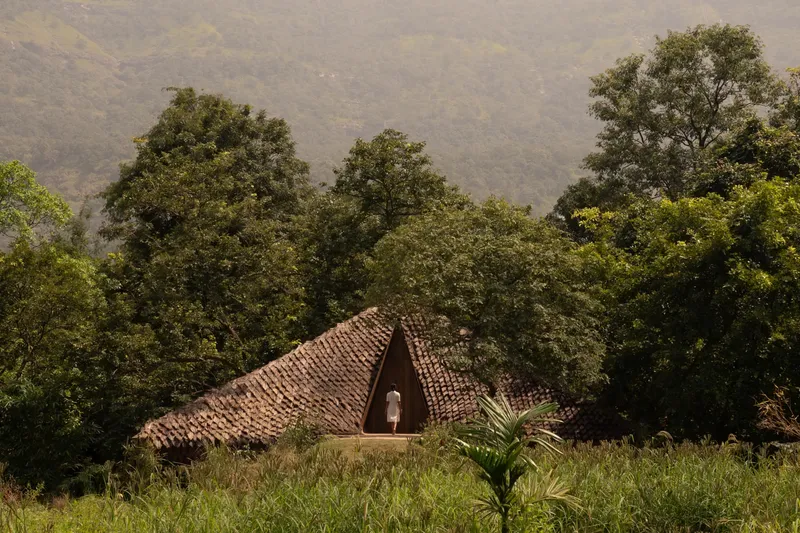
Suspended between dense trees, the home offers an immersive forest-living experience. Its open-plan layout orients living spaces to the sky, stream, and surrounding foliage. A central oculus functions as an indoor courtyard, channeling light and rain into the heart of the home while strengthening the building’s dialogue with nature.
Four bedrooms offer panoramic views of the gorge and surrounding wilderness, creating intimate yet open sanctuaries suspended above flowing water and rustling leaves. The house becomes a breathing habitat, where humans live inside a protective shell while wildlife thrives around it undisturbed.
An Ecological Vision for the Future of Living
The Bridge House is more than a residence—it is a philosophical and ecological statement. Amid strict constraints, Wallmakers turned adversity into innovation, developing a new typology where architecture becomes a suspended ecosystem that respects land rather than occupying it.
By prioritizing site preservation, natural materials, and inventive structural logic, the Bridge House stands as a powerful future-home model that balances innovation and humility.

Project Details
Architect: Wallmakers Lead Architect: Vinu Daniel Location: Karjat, India Project Type: Residential / Farmhouse Area: 4,500 sq ft Completion: 2025 Photography: Studio IKSHA
Bridge House by Wallmakers in Karjat, India is a groundbreaking 4,500-sq-ft suspended residence spanning a natural gorge, featuring hyperbolic parabolic design, thatch-mud composite construction, and reclaimed materials for a sustainable, site-responsive home.

All photographs are works of Studio IKSHA


Popular Articles
Popular articles from the community


The Musturak Paradise: Senior Living Architecture for a Connected Future in Temara, Morocco
The Musturak Paradise reimagines senior living architecture in Temara via private homes, social spaces, culture, community, and shared care.

The Earth Pod: 3D Printed Homes for Resilient Refugee Communities
The Earth Pod reimagines refugee housing through 3D printed homes made from clay, combining resilience, self-sufficiency, and rapid shelter.

AL-JANNAH: Sustainable Architecture and Permaculture for Afghan Widows
AL-JANNAH uses sustainable architecture and permaculture to create resilient oasis of housing, learning, work and renewal for Afghan widows.

Hill & Cross Opera: Sculptural Opera House Architecture Shaped by Tallinn’s Landscape and Identity
Hill & Cross Opera reimagines opera house architecture in Tallinn through its sculptural hill, civic plaza, glass wave and a luminous cross.


Similar Reads
You might also enjoy these articles


Hodi-Mandai Geram
Project Function: Preservation and revitalization of the Intangible heritage and socio-spatial identity of the Hodi by Housing, Cultural Memory Center, Sacred Grove, landscape, local tourism economy


Olio Towers: A Mid-Rise for Performers That Fuses Housing, Rehearsal, and Stage
Located blocks from Houston's Theater District, this modular tower stacks living units around a central performance atrium.

Oasis: Modular Green Housing Carved into Dhaka's Urban Fabric
A shortlisted Plugin Housing entry reclaims unauthorized settlements in Dhaka with stepped concrete volumes, green roofs, and ventilation-driven design.

Black Hole: A Floating Megastructure for the Post-Physical Era
Emiliano Mazzarotto envisions a spherical, self-scaling arena where e-sports, digital hotels, and holographic stadiums replace traditional public space.


Explore Mechanical Bridge Competitions
Discover active competitions in this discipline


Challenge to design mud housing for contemporary communities


Challenge to reimagine the Iron Throne


Photograph architecture without architects


Illustrate the lost glory of Angkor Wat - Render Challenge
Comments (0)
Please login or sign up to add comments
No comments yet. Be the first to comment!