

Brooks Scarpa Huber Turns a Sacramento Housing Block into a Neighborhood Porch
A 67-unit net-zero affordable housing project in Sacramento replaces defensive walls with a carved-out courtyard open to its community.


Affordable housing in the American West tends to announce itself with fences, blank stucco walls, and a general posture of distrust toward the street. Brooks Scarpa Huber took the opposite approach at Northview Point Apartments in Sacramento, carving a generous central courtyard through the middle of a 1.23-acre site and lining it with breezeways, open walkways, and communal seating. The 67-unit complex, completed in 2025, provides housing primarily for people who have recently experienced homelessness, yet it reads less like a social service facility and more like a well-designed neighborhood that happens to share a front porch.
That porch metaphor is deliberate. Situated among freestanding houses and low-rise apartments in Sacramento's Northview neighborhood, near the confluence of the American and Sacramento Rivers, the project was conceived as a walk-up scaled to its suburban context but organized around social space rather than private enclosure. At 37 units per acre it achieves meaningful density on a tight parcel, and it does so while earning LEED Platinum certification and operating as a fully electric, net-zero development. The architecture never reads as heroic, which is exactly the point. It reads as neighborly.
The Porous Perimeter


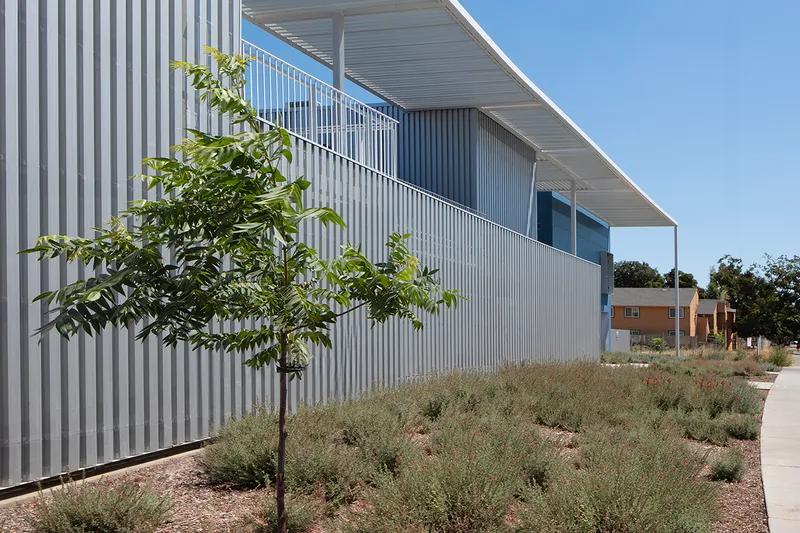
From the street, the building presents corrugated metal siding punctuated by projecting window boxes and playful fins that catch Sacramento's relentless sun. These elements do real work: they refract light throughout the day, casting shifting shadow patterns across the facades and keeping direct solar gain off glass surfaces. But they also signal openness. Unlike the blank perimeter walls that define most affordable housing in the region, the facade here has rhythm, texture, and visible life. Planted grasses and drought-tolerant shrubs line the sidewalk edge, softening the boundary between public right-of-way and private property.
The material palette is economical but considered. Stucco, corrugated metal, and cement board siding keep costs in check across the $28.4 million project, while solid aluminum panels in light blue and silver-colored perforated metal add visual variety without luxury pricing. Very little steel was used in construction, a pragmatic choice for a two-story, 23-foot-tall structure that stretches every dollar toward livability rather than structural spectacle.
A Courtyard That Works as a Living Room
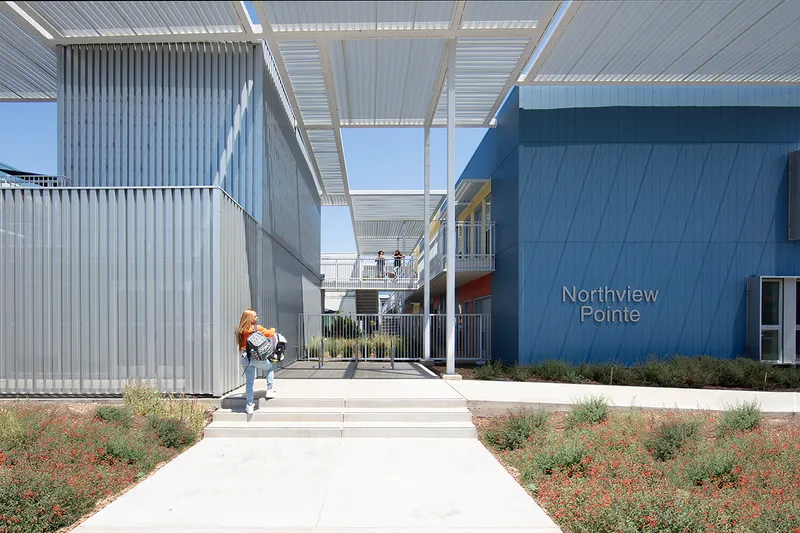
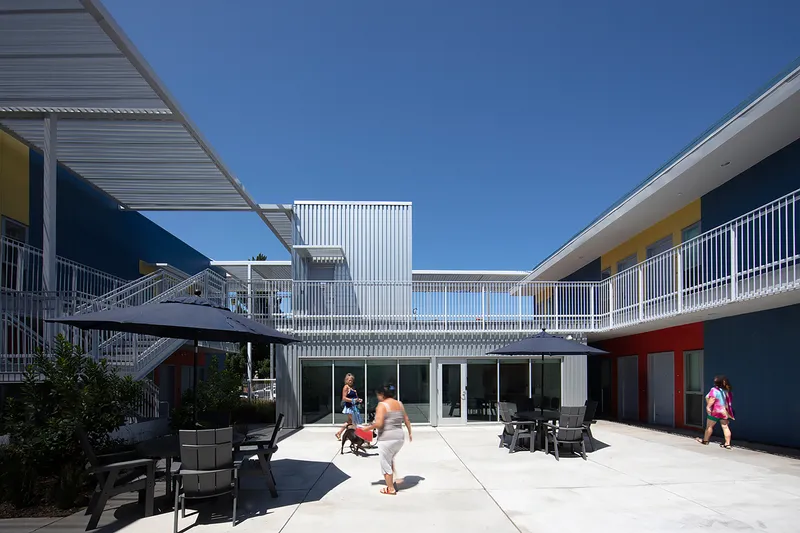

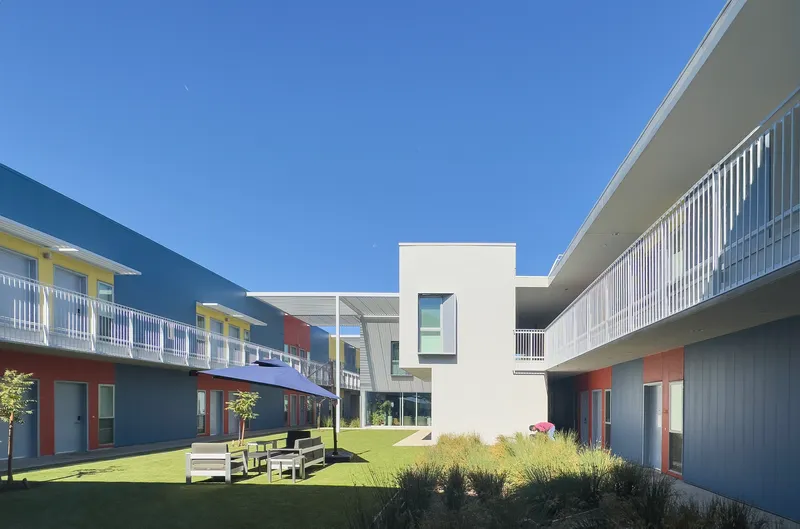
The carved-out central court is the building's defining move. Two-story wings line the perimeter and face inward, framing a sequence of shared spaces that include a garden, communal courtyard, and covered walkways. Apartments look onto these voids rather than turning their backs to them. The result is a spatial logic that de-emphasizes private territory in favor of collective presence: you see your neighbors, and they see you, without anyone being forced into proximity.
Large entrance portals allow daylight to spread through the corridors, and the breezeways double as passive cooling infrastructure. Sacramento's extreme Mediterranean climate pushes summer temperatures above 38°C, so the project relies on cross-ventilation, daylighting, and a two-story trellis to deliver shade and dappled light without mechanical overkill. A community room with large sliding doors acts as a threshold between interior and exterior, collapsing the distinction between building and courtyard when conditions allow.
Color, Materiality, and Identity

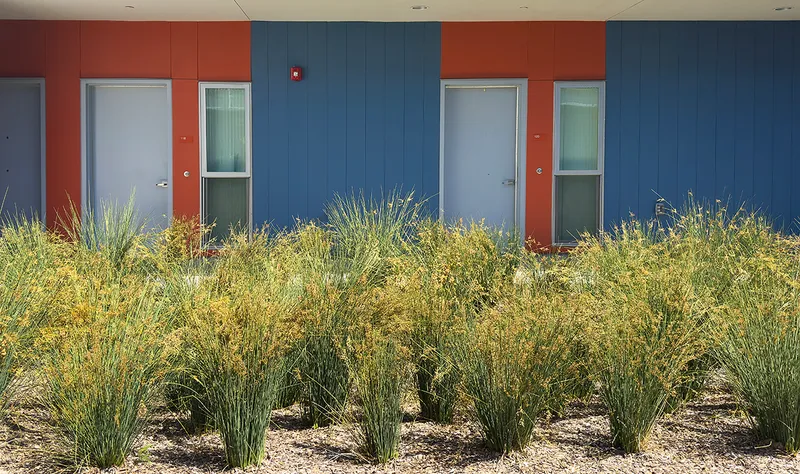
The blue and orange panel facades along the courtyard elevations give individual units a sense of address. Entry doors sit behind planted beds of native grasses, so the transition from shared space to private threshold feels layered rather than abrupt. It is a small detail, but it matters enormously in housing designed for residents who may not have had a stable front door in years. The color choices are bright without being institutional, legible without being patronizing.
Upper-level walkways and white metal railings keep the circulation visible and open to the air. Exterior corridors are not a compromise here; they are the design strategy. They promote airflow, reduce the need for enclosed hallways, and make every trip to the mailbox or laundry a moment of casual social contact. Brooks Scarpa Huber understood that for this population, the space between units is as important as the space within them.
Landscape as Infrastructure
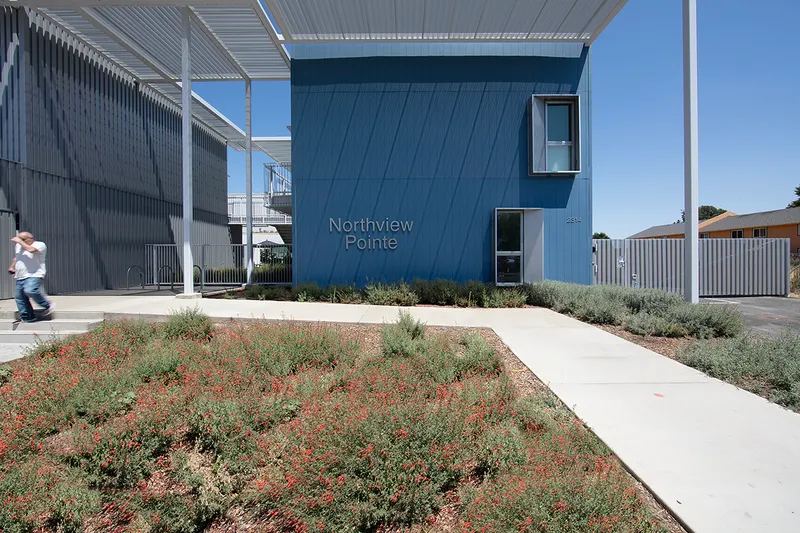
The project's proximity to the confluence of the American and Sacramento Rivers places it within one of the most ecologically sensitive zones in the San Francisco Bay watershed. The landscape strategy responds directly: native and drought-tolerant plantings replace turf lawns, impervious surfaces are minimized to allow water to filter naturally into the soil, and the overall design supports riparian ecology through habitat restoration and resilient planting. These are not decorative gestures. They reduce runoff, protect nearby waterways, and lower long-term maintenance costs for a project that must remain financially viable for decades.
The entry pathway is lined with low planting beds that lead visitors toward the blue panel facade, establishing a clear sequence from sidewalk to courtyard. Lawn areas within the courtyard are modest and intentional, providing usable green space without the water demands of conventional suburban landscaping. Every square foot of planting earns its place.
Plans and Drawings

The axonometric drawing reveals how tightly the program is packed onto the 1.23-acre site while maintaining legible circulation and generous shared space. Rooftop solar panels are visible across the full extent of both wings, reinforcing the net-zero energy strategy. Material callouts throughout the drawing confirm the economical palette: corrugated metal, cement board, aluminum panels. The diagram also makes clear how the building's U-shaped footprint creates the central void, turning what could have been a cramped double-loaded corridor block into a porous, inward-facing community.
Why This Project Matters
Northview Point Apartments matters because it refuses the false choice between affordable and dignified. At 31,100 square feet and 67 units, the project is modest in scale but precise in ambition. It proves that net-zero performance, LEED Platinum certification, riparian-sensitive landscaping, and genuinely communal space can coexist within a budget that serves people transitioning out of homelessness. The architecture never calls attention to its own virtue; it simply provides a good place to live.
More broadly, the project reimagines the suburban walk-up as a social type. Instead of stacking units behind a security gate and calling it housing, Brooks Scarpa Huber organized the entire complex around the idea of the porch: a threshold between private life and public community where residents can choose to engage on their own terms. In a city where summer heat punishes bad design and housing insecurity punishes bad policy, Northview Point offers a credible, buildable alternative to both.
Northview Point Apartments by Brooks Scarpa Huber. Sacramento, United States. 31,100 square feet. Completed 2025. Photography by Tara Wujcik.
About the Studio
Share Your Own Work on uni.xyz
If projects like this are the kind of work you want to make, uni.xyz is a place to publish your own, find collaborators, and enter design competitions.


Popular Articles
Popular articles from the community

Temporary Home for Dogs: A Reversed Zoo Rethinks Animal Shelter Architecture
In Bucharest, a sinuous corridor and freed landscape flip the logic of containment, designing a shelter that works to make itself unnecessary.

Cloaked Colonization: A Mobile Underwater Habitat That Moves Like a Fish
Micah Abaya's shortlisted EHC Pacific entry reimagines ocean settlement as a dispersed network of self-sustaining architectural organisms.

Opera on the Sea: Driftwood Logic Shapes a Timber Opera House on Estonia's Coast
Trevor Orgill's opera house translates the entangled drift of floating timber into a civic building where wood, water, and music converge.

Tsunami Convergenics: Turning Catastrophic Ocean Forces into Underwater Housing Infrastructure
A speculative underwater settlement off the coast of Onagawa, Japan, treats tsunamis and typhoons as energy sources rather than threats.

Similar Reads
You might also enjoy these articles

Bao Huynh Watercolor Atelier: A Serene Art Retreat in Hội An
Bao Huynh Watercolor Atelier in Hội An blends multifunctional art spaces, sustainable design, local materials, and family-friendly living in a serene environment.

Atelier Macri Concept Store Interior Design by CASE-REAL
Atelier Macri store features a "ko" counter, walnut wood details, cork displays, blending retail, gallery, and seamless customer experiences.

Manuel Vargas Izquierdo Stadium and High-Performance Sports Center: Architectural Excellence in Jalpa de Méndez
The Manuel Vargas Izquierdo Stadium blends sustainable design, inclusive sports facilities, and cultural-inspired architecture, revitalizing Jalpa de Méndez’s public spaces.

KAKR Buluh Awar Hall: Revitalizing Community and Ecology Through Bamboo Architecture
Community built bamboo hall revitalizes Buluh Awar village, empowering youth, restoring ecology, celebrating vernacular craftsmanship through sustainable architecture and culture.


Comments (0)
Please login or sign up to add comments
No comments yet. Be the first to comment!