
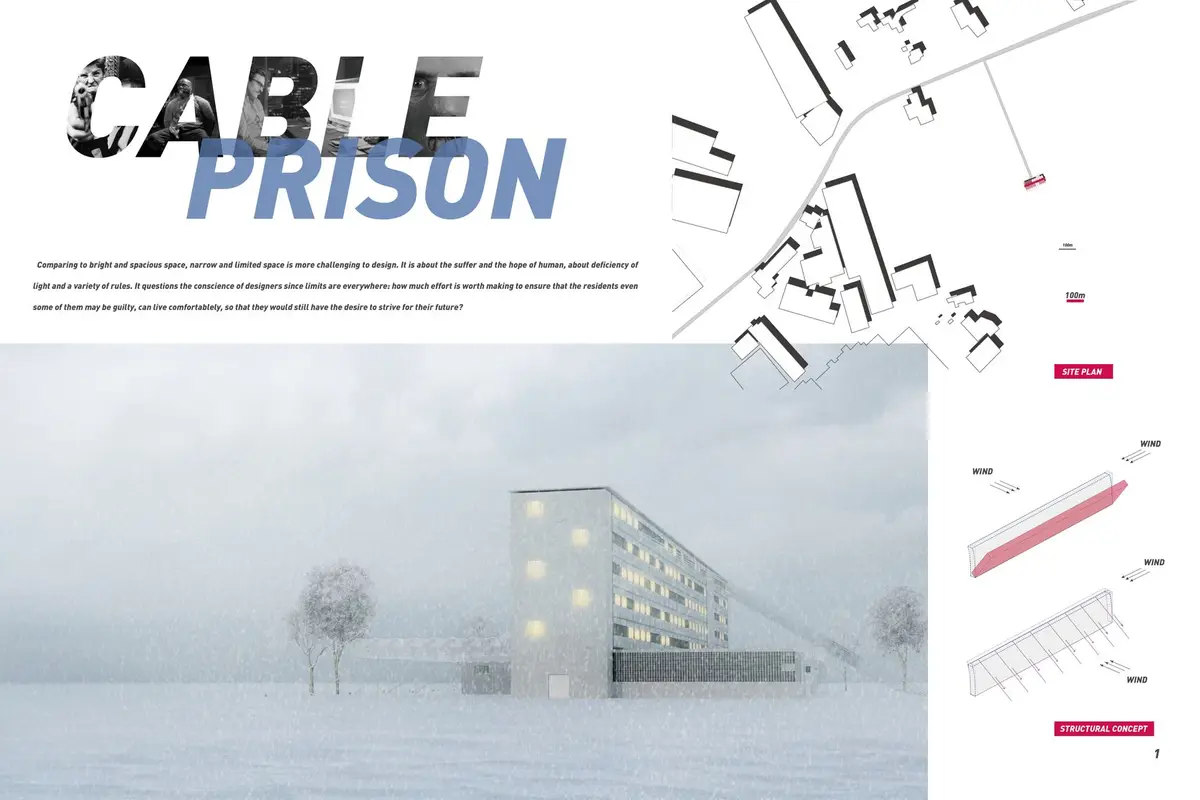
Cable Prison: Modular Architecture That Reframes Incarceration as Rehabilitation
A cable-supported, timber-framed correctional facility designed around transparency, dignity, and the spatial logic of community integration.


What if prisons weren't designed to punish, but to prepare people for the world outside? Cable Prison starts from that question and builds outward, literally, through a modular cable-supported framework that treats each inmate cell as a replaceable unit within a larger spatial system. The result is a correctional facility that reads less like a fortress and more like a civic institution: open, legible, and programmatically rich enough to function as a place of genuine rehabilitation.
Designed by Suqi Huang, Cable Prison is a shortlisted entry in the Switching Prisons competition. The project proposes a correctional facility divided into two primary zones: one for the general prison population and another for permanent detainees, alongside administrative and police functions. Notably, the design pays direct attention to cybercrime offenders, envisioning them not merely as inmates but as potential contributors to digital security infrastructure through technology labs and workshops.
Timber, Light, and the Architecture of Transparency
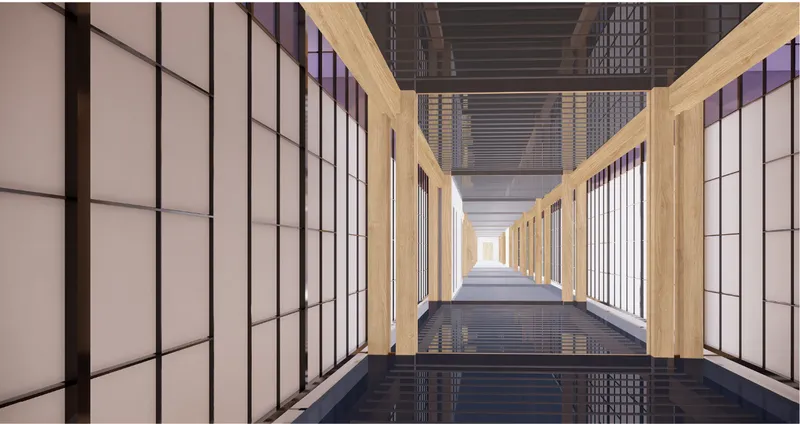
The corridor shown here is a statement of intent. Timber framing, translucent shoji-like screens, and perforated metal flooring work together to dissolve the oppressive solidity that defines conventional prison interiors. Light passes through, shadows fall below, and the space communicates openness without sacrificing enclosure. Surveillance here is embedded in the architecture itself: transparent partitions allow police officers to observe activities directly, reducing reliance on heavy-handed control systems while lowering the psychological burden on inmates.
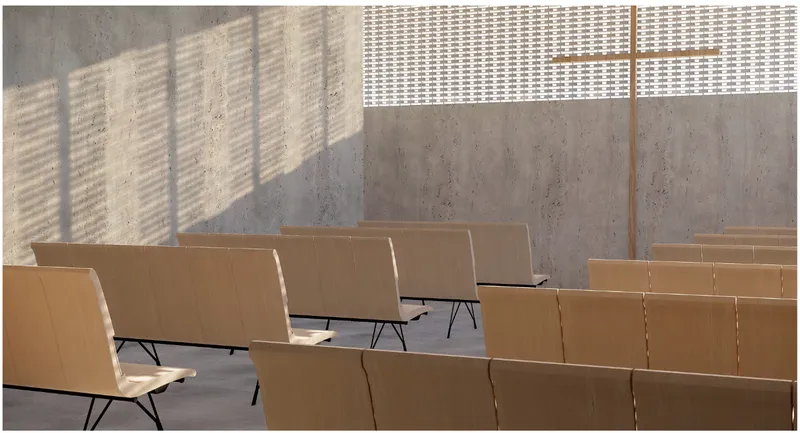
The prayer hall reinforces this material strategy. Rows of timber benches sit beneath patterned clerestory light that washes across raw concrete walls, creating a contemplative atmosphere drawn from Dutch and Scandinavian design principles. These are warm, natural materials deliberately chosen to soften the harshness typically associated with incarceration. The interplay between concrete mass and filtered daylight gives each space a distinct emotional register while maintaining the facility's overall design coherence.
A Systematized Grid Built for Flexibility
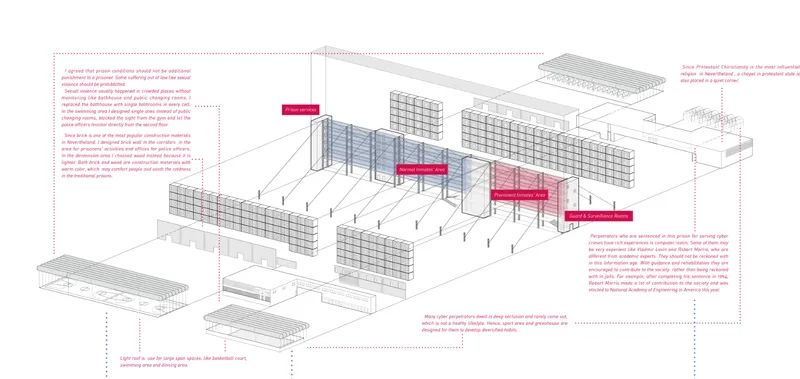
The axonometric drawing reveals the core logic of Cable Prison: a systematized grid and cable-supported framework that allows large-span spaces to remain open and unobstructed. Basketball courts, swimming pools, and shared amenities occupy these generous volumes, while the modular cell units plug into the structure as repeatable components. The system simplifies construction, reduces cost, and makes future expansion or reconfiguration straightforward. Each annotated component in the drawing reinforces the idea that the building is not a fixed object but an adaptable system, one that can evolve alongside changing correctional needs.
Interior Landscapes of Dignity and Community
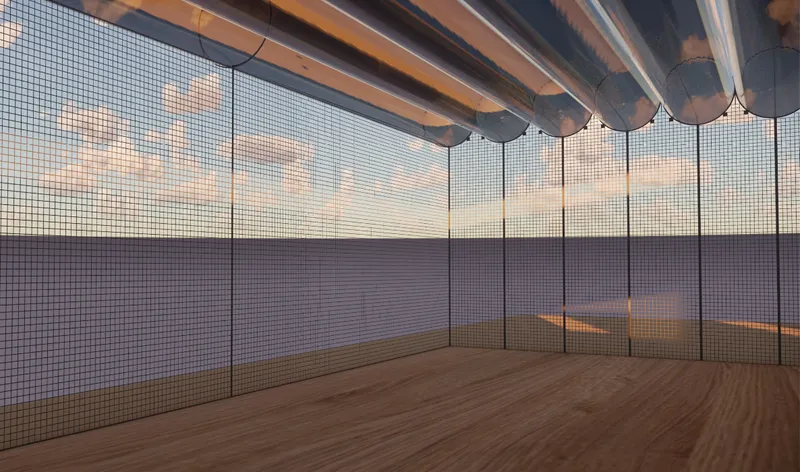
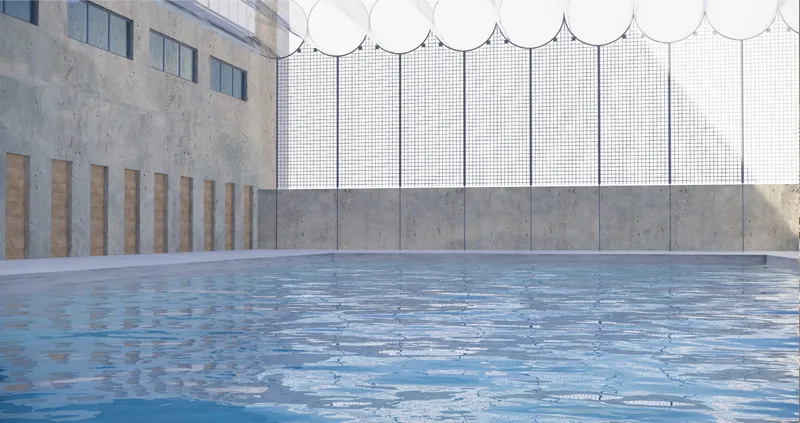
Two interior views demonstrate how Cable Prison constructs dignity through spatial generosity. Timber ceiling beams span over mesh screen walls and suspended textile partitions that filter golden light into shared areas. The effect is almost domestic in character, a deliberate counterpoint to the steel-and-concrete monotony of typical correctional facilities. In the courtyard pool, mesh screen facades and timber slats frame a calm volume of water against raw concrete, creating a space for physical wellness that feels earned rather than granted.
The first floor houses an ambitious program: 3D printing workshops, VR training suites, computer education rooms, cooking facilities, greenhouse cultivation spaces, and areas for religious worship. Shared amenities including the gym, swimming pool, and dining areas foster community among inmates. The second floor shifts to administrative functions, visitor rooms, a clinic, and isolation areas. The spatial clarity of the layout ensures that each function has its place while maintaining visual connections across the facility.
Screens, Shadow, and the Rituals of Daily Life
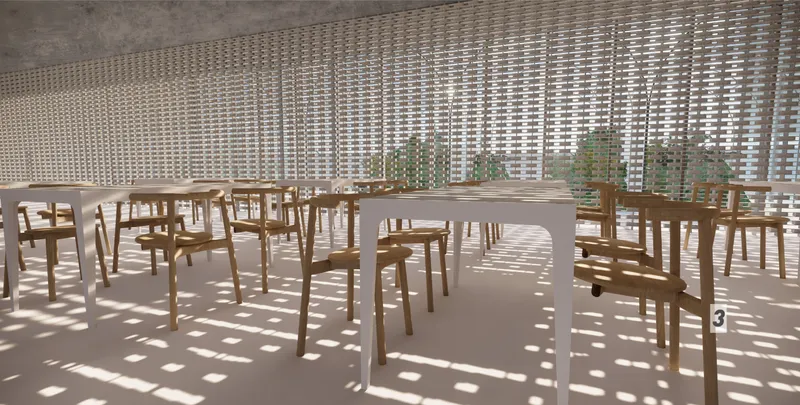
The dining area captures the project's commitment to spatial quality in everyday moments. Timber chairs and tables sit behind a woven mesh screen that breaks sunlight into dappled patterns across the floor. Eating together in a space like this is fundamentally different from eating in a bare concrete room under fluorescent tubes. The architecture insists that routine activities, meals, exercise, study, carry meaning, and that the quality of space shapes the quality of experience within it.
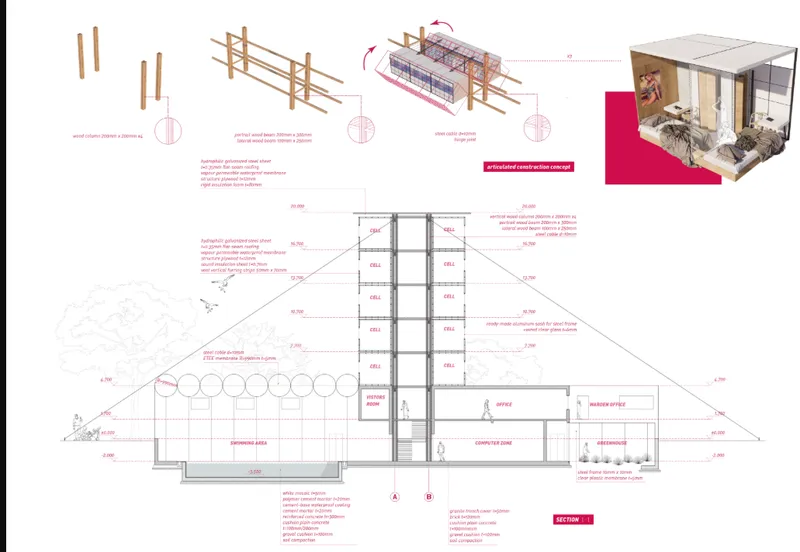
The section drawing ties the project together, revealing the multi-story structure's timber frame components and the vertical relationships between its interior spaces. Public and private zones are legible in section: open communal areas occupy the generous ground floor, while more controlled functions sit above. The cable-supported structure allows these relationships to remain visually and spatially connected, reinforcing the facility's identity as a place of community rather than isolation.
Why This Project Matters
Cable Prison challenges the assumption that security and humanity are opposing forces in correctional design. By treating the building as a modular system rather than a monolithic structure, Suqi Huang opens up the possibility of prisons that can be built affordably, adapted over time, and designed from the outset to support rehabilitation. The inclusion of technology-focused programs for cybercrime offenders is particularly sharp: it acknowledges that the prison population is changing and that architecture must change with it.
More broadly, the project repositions prison architecture within the discourse of public infrastructure. A correctional facility, in this framing, is not a place society hides from view but one it invests in, spatially and materially, with the same care given to schools, libraries, and community centers. Cable Prison demonstrates that this investment does not require extravagance. It requires clarity of purpose, a coherent material language, and the willingness to treat incarcerated people as members of the community they will eventually rejoin.
View the Full Project
About the Designers
Designer: Suqi Huang
Enter a Design Competition on uni.xyz
uni.xyz runs architecture and design competitions year-round that reward proposals with spatial conviction and real site intelligence.
Project credits: Cable Prison by Suqi Huang Switching Prisons (uni.xyz).


Popular Articles
Popular articles from the community


Singing Woman: An Opera House That Performs Before the Curtain Rises
Ovidiu Cristian Pavel's conceptual opera house translates Estonia's choral identity into a sculpted waterfront landmark facing the Baltic Sea.

The Amber Palace Opera: A Geological Fiction Surfaces on Tallinn's Baltic Waterfront
Pierre Brillard reimagines a Baltic legend as a public landscape, opera house, and waterfront promenade rooted in Tallinn's coastal identity.

Aquadapt: An Underwater Habitat That Rewrites Its Rooms by the Hour
Curved modules ring the seabed while one shell shifts from breakfast room to cinema, farm and football pitch as residents' needs change.

Opera on the Sea: Driftwood Logic Shapes a Timber Opera House on Estonia's Coast
Trevor Orgill's opera house translates the entangled drift of floating timber into a civic building where wood, water, and music converge.

Similar Reads
You might also enjoy these articles

Vereda Arquitetos Renovates a 40-Square-Meter Apartment Inside Niemeyer's Copan Building
A compact unit in São Paulo's most iconic residential tower gets a material overhaul that pairs exposed concrete with bold blue Formica.

Shakur's House: Exposed Brick as an Interior Organiser in a 168 m² Mashhad Residence
Brick moves indoors in this Mashhad residence, where masonry walls, glass partitions and teal planes sequence a compact home without closing it off.

Day and Night Park: A Time-Based Urban Newsstand in Beijing
A temporary urban newsstand in Beijing blending travel, light, and reading through poetic colors, compact form, and community-focused design.

Modernist Patio Renovation in El Masnou, Barcelona by Oliver Segura Arquitectura + Cebrià Arquitectura
Modernist patio renovation blending tradition and innovation with a movable pool, leveled floors, and Catalan materials in El Masnou.


Comments (0)
Please login or sign up to add comments
No comments yet. Be the first to comment!