

Carol Miluzzi Arquitetura Builds a Brick-Floored Mountain Retreat in Rural São Paulo
Assossego House in Araçoiaba da Serra layers over 200 square meters of hand-laid terracotta across an L-shaped plan rooted in its hillside.


The word assossego translates roughly to tranquility, and Carol Miluzzi Arquitetura took it as more than a mood board caption. Working alongside engineer Willian Carneiro de Vasconcelos on a sloping lot in the São Paulo countryside, architect Carolina Miluzzi organized 300 square meters of house into two L-shaped blocks that step down with the terrain rather than fight it. The result is a home that reads as a single white volume from the road but unfolds into a layered sequence of courtyards, terraces, and interior rooms once you cross the threshold.
What makes the house genuinely compelling is its obsessive commitment to a single material. More than 200 square meters of terracotta brick were laid piece by piece, in herringbone patterns, across virtually every floor surface, interior and exterior. The brick extends from the living room to the pool terrace to the covered pergola, unifying indoor and outdoor zones into a continuous ground plane. Overhead, exposed timber trusses and rafters do the same work at the ceiling. Between these two material systems, a clean white envelope plays quiet host.
A White Volume Against the Hills
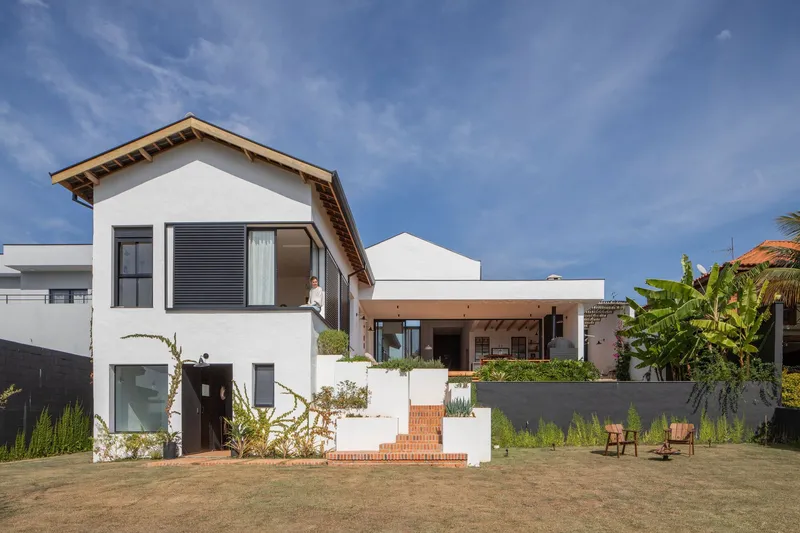
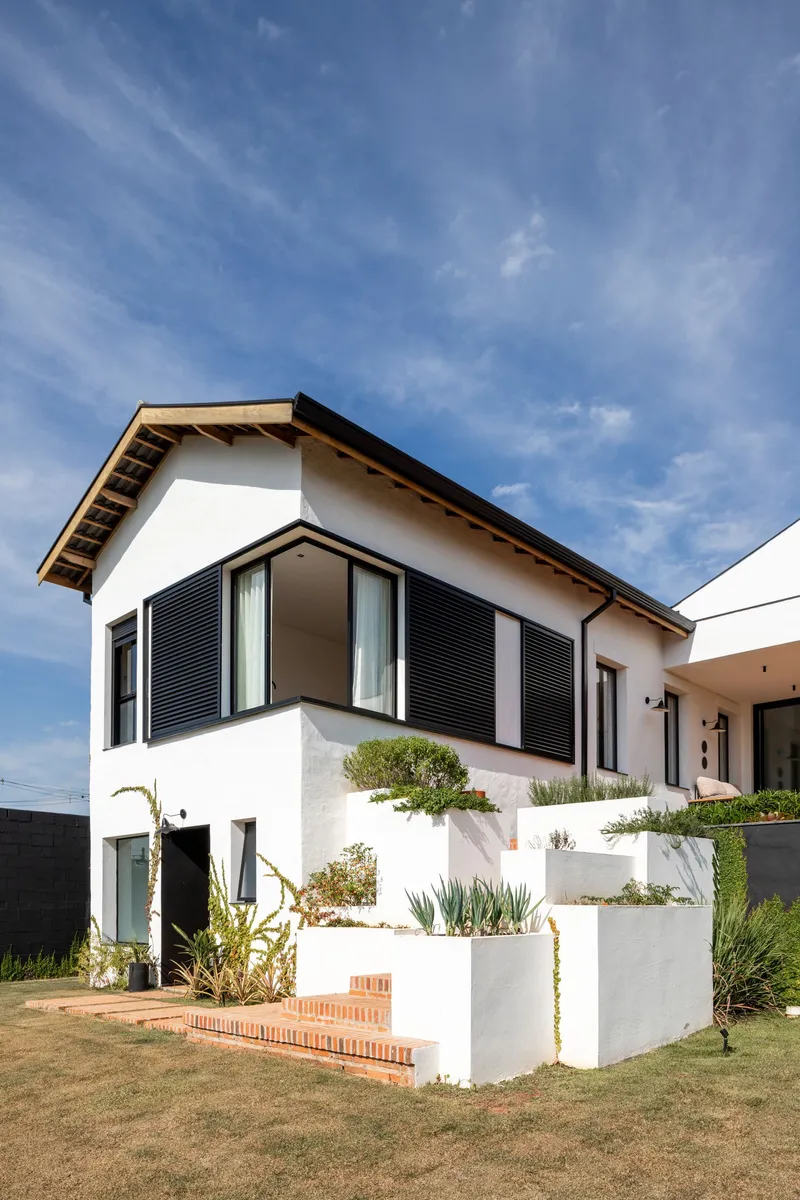

From the street, Assossego House presents itself as a modest composition of white stucco surfaces punctuated by black-framed openings. A central gable hints at the exposed timber structure inside, while a dark metal flue pipe signals the fireplace at the home's core. Horizontal shutters and tiered planter boxes add texture without complicating the elevation. The approach is deliberately understated for a rural context where neighboring houses tend toward either sprawling fazenda nostalgia or generic suburban boxes.
The restraint pays off. Against the green foothills of Araçoiaba da Serra, the white volume registers as both contemporary and settled, never trying too hard to blend in or stand apart. A chimney stack and the occasional vertical slat screen give the massing just enough articulation to hold interest from different vantage points.
Terracotta as Infrastructure
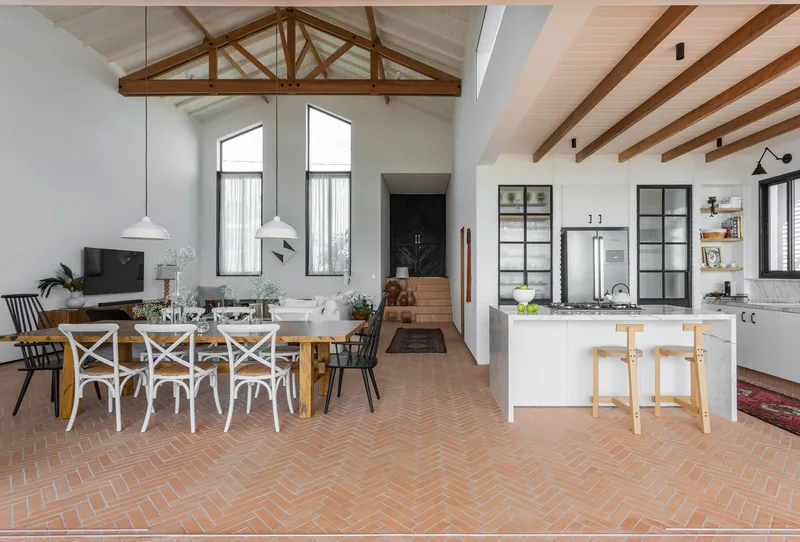
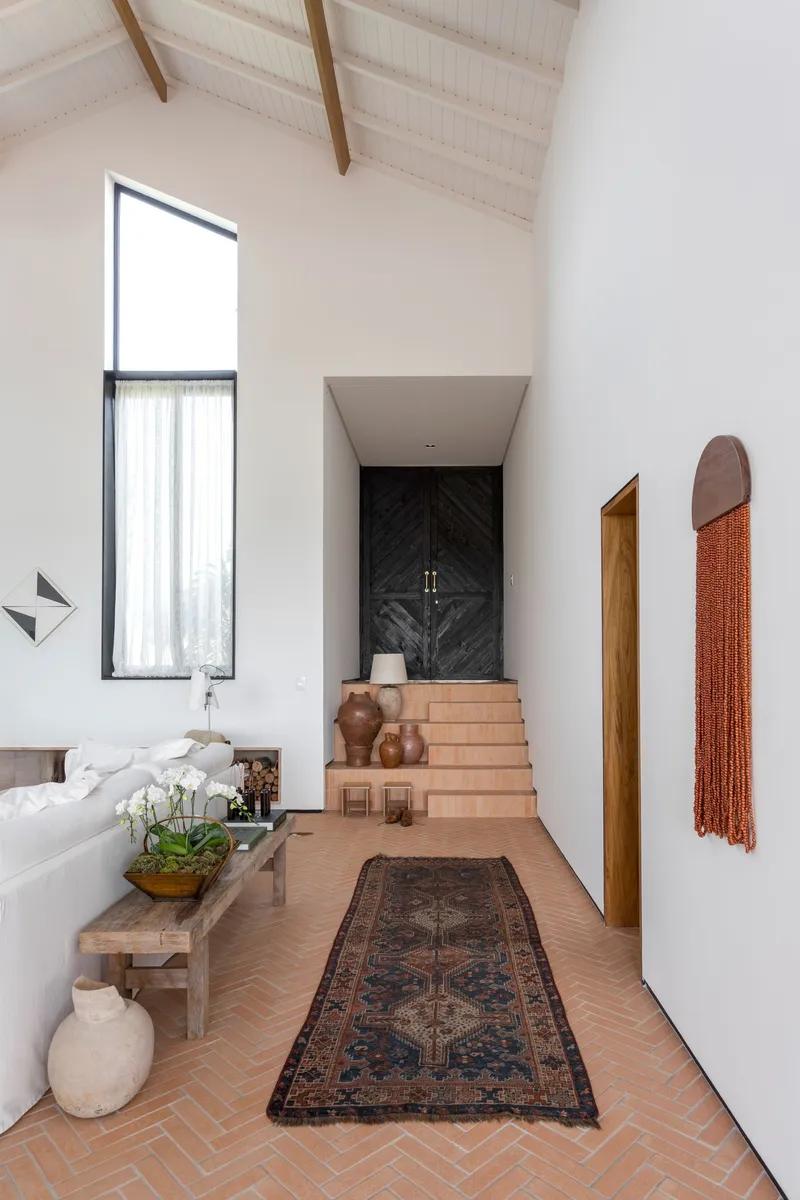
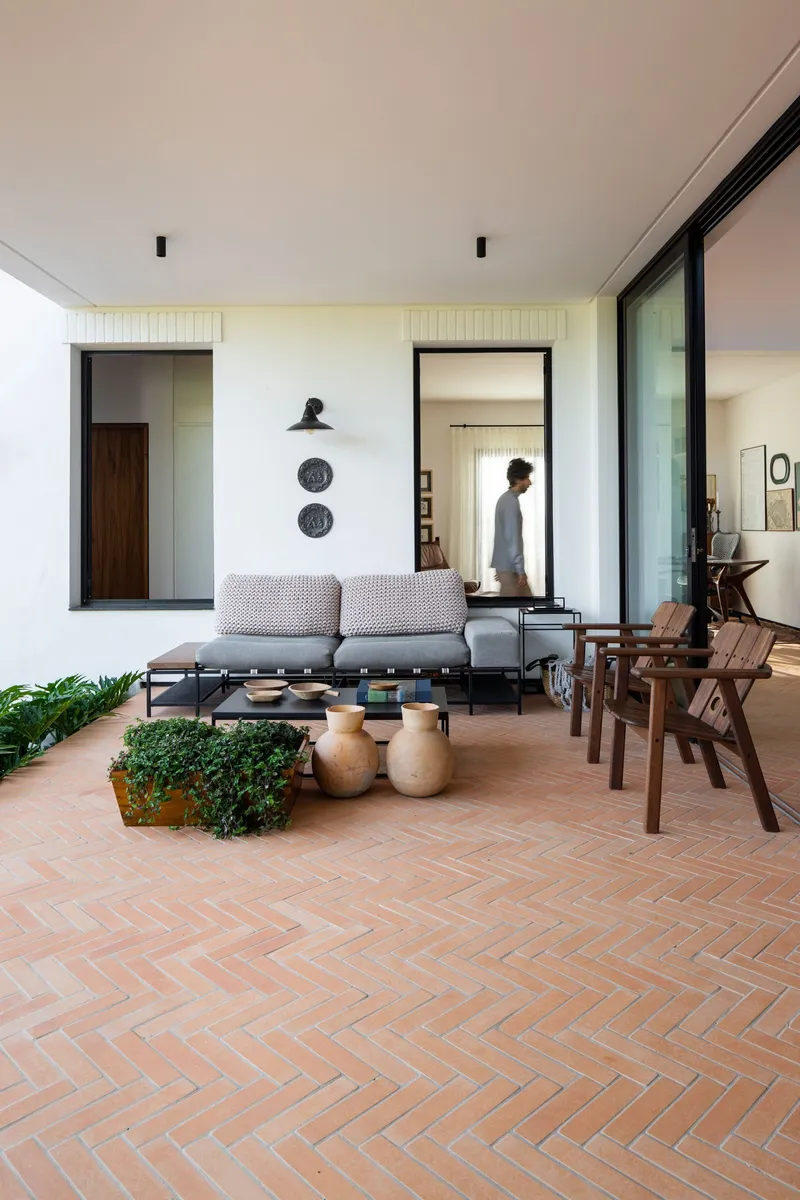
Step inside and the herringbone terracotta takes over completely. The entry hall sets the tone: warm clay tiles run wall to wall beneath a vaulted ceiling of exposed timber rafters, the combination evoking something between a Brazilian farmhouse and a Mediterranean cloister. But the scale and precision of the brickwork push it into clearly contemporary territory. Each piece was set by hand, and the pattern shifts subtly in orientation between rooms, marking spatial transitions without needing walls or thresholds.
The herringbone floor is not decorative. It operates as the connective tissue of the entire plan, tying the open-plan living zone to the dining area, the kitchen, and eventually out to the covered terrace. When a single material is this pervasive, it becomes less about surface and more about ground. You stop noticing the floor and start noticing the way light, furniture, and framed views sit on top of it.
Living Under the Truss
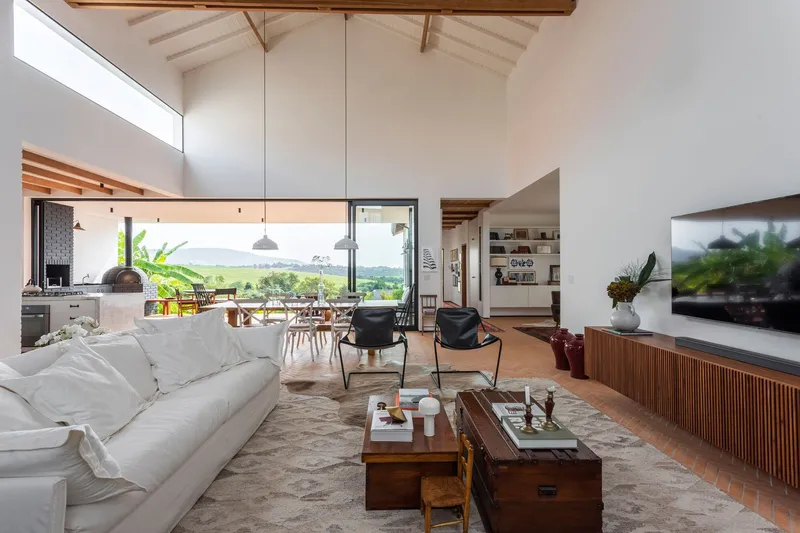
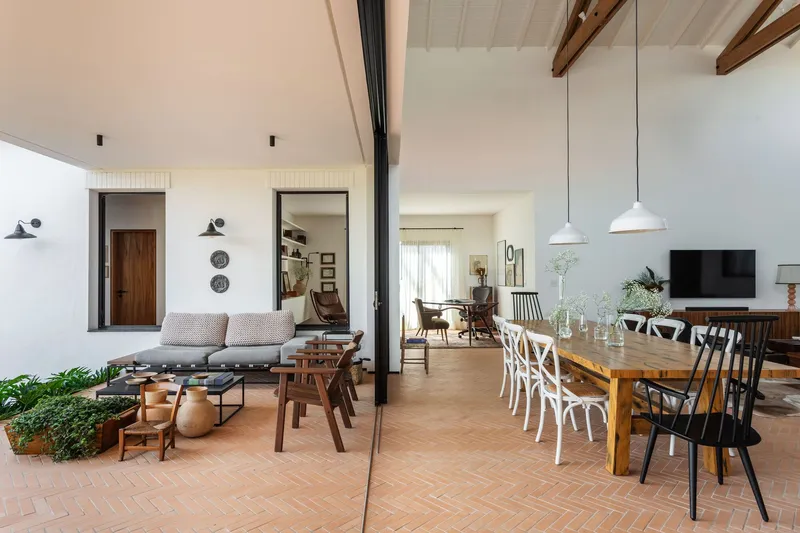
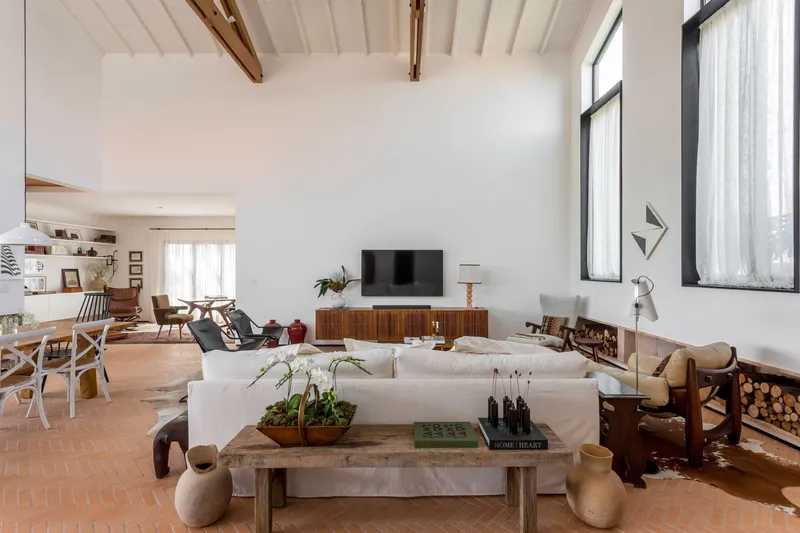
The pitched timber roof is the second protagonist. Miluzzi chose to leave the full truss system exposed in the main living areas, creating tall vaulted ceilings that breathe above the open-plan ground floor. Clerestory windows at the ridgeline wash the timber with natural light, and the height differential between the ridge and the eave walls gives the interior a generous verticality that the modest footprint wouldn't otherwise suggest.
In the living room, a white sectional sofa sits beneath the peak while a built-in firewood storage wall anchors one side. The juxtaposition is classic: rough sawn timber overhead, clean upholstered planes below, terracotta underfoot. It could tip into cliché, but the proportions are controlled and the palette stays tight. There are no competing materials vying for attention.
Kitchen and Hearth
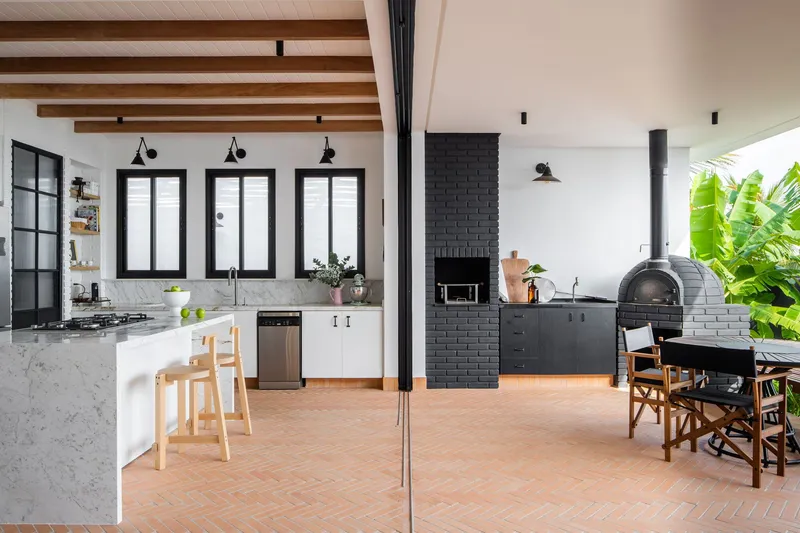
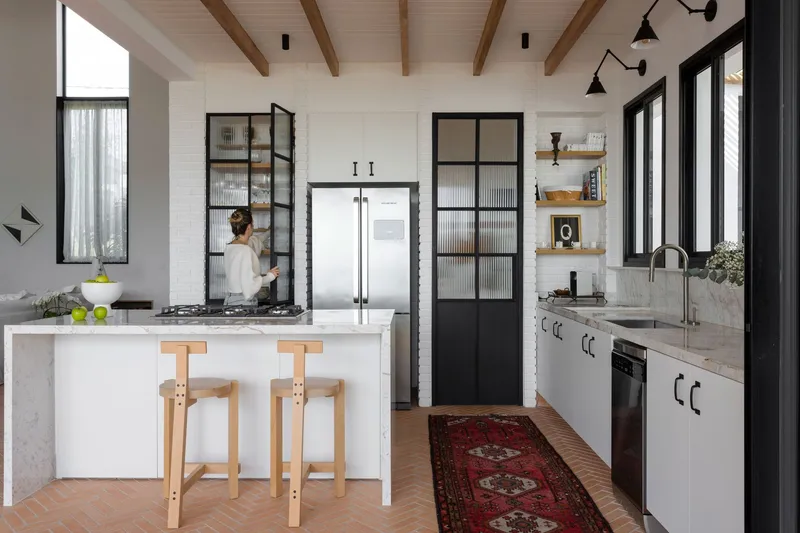
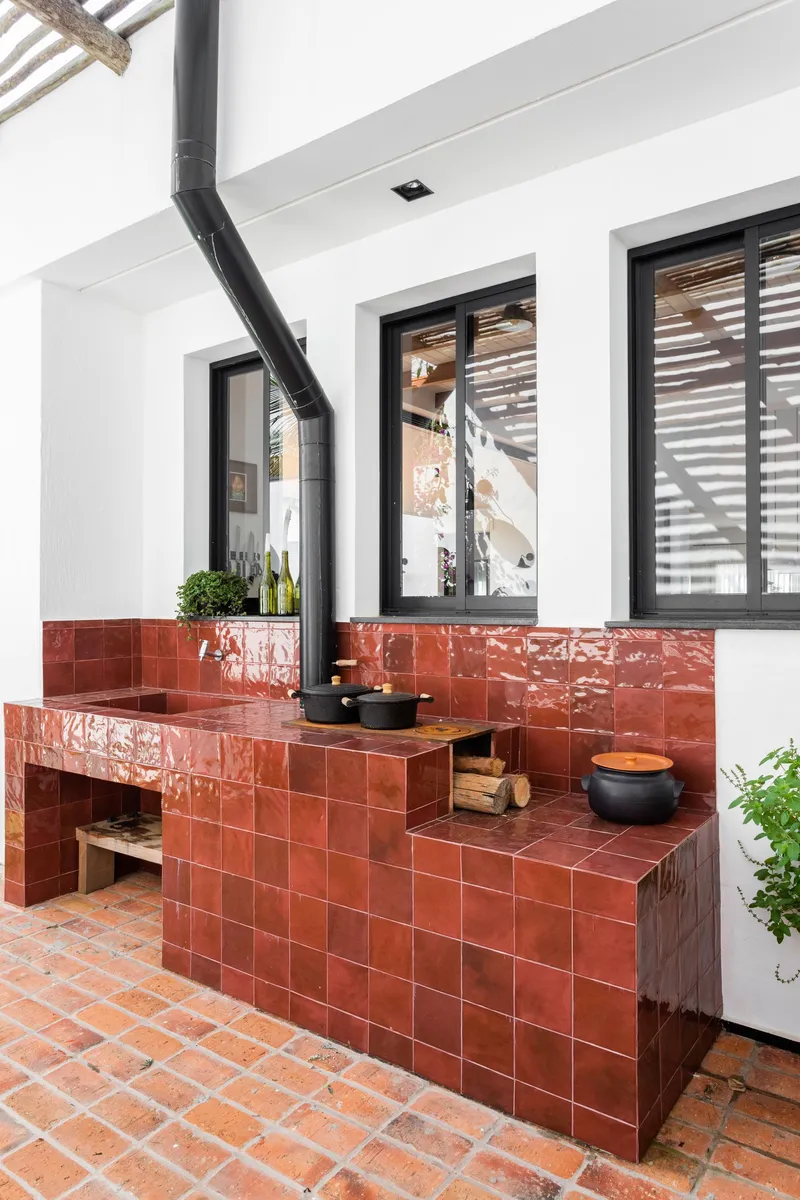
The kitchen is where the project's rustic-contemporary dialogue gets most interesting. A white marble island sits in front of a black brick fireplace, with exposed timber beams running overhead and reeded glass panels set into black steel frames at the side doors. Then, around a corner, a red glazed tile counter and backsplash appear beneath white arched openings, introducing a saturated color that appears nowhere else in the house. It reads as a deliberate nod to traditional Brazilian kitchens, where the fogão a lenha (wood-burning stove) was always the most colorful element in the room.
The black steel-framed glass doors create a rhythm of transparency and enclosure, letting you see through to the hills beyond while maintaining a clear boundary between the cooking zone and the terrace. Miluzzi treats the kitchen not as a service area tucked away from view but as a social anchor equal in stature to the living room.
Terrace, Pergola, and Pool
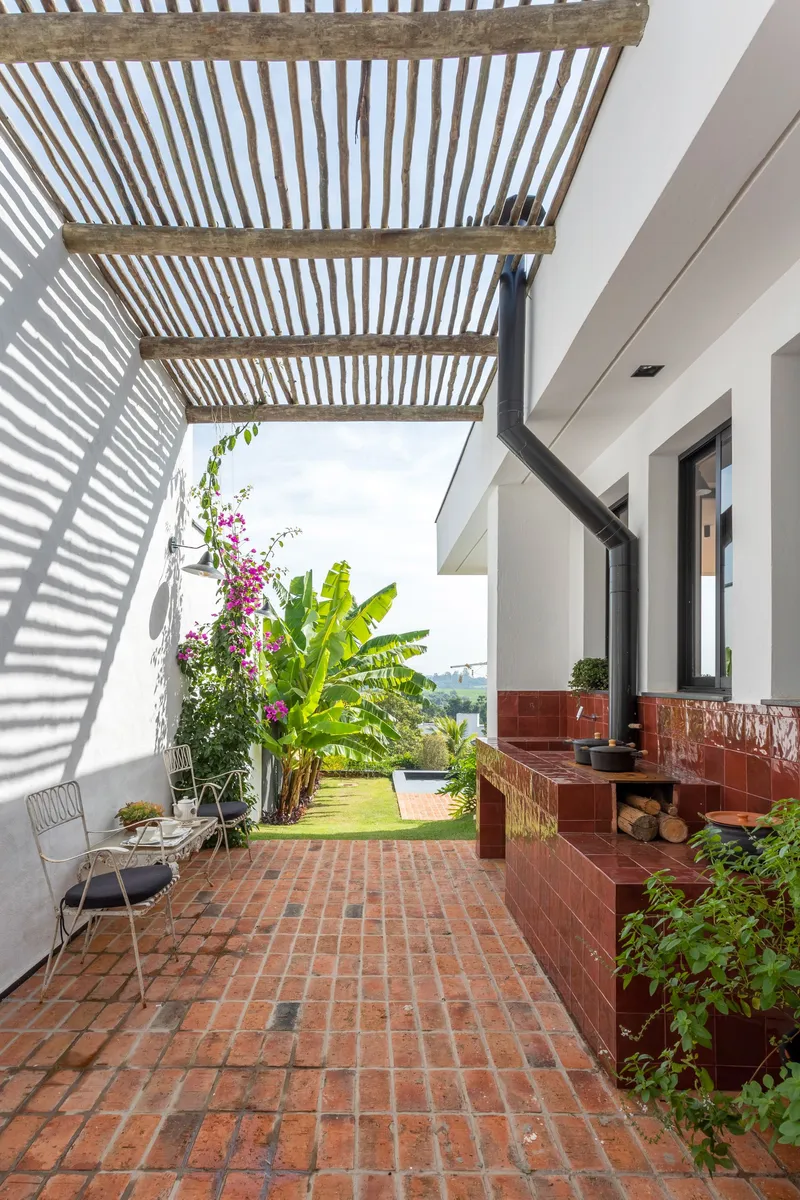
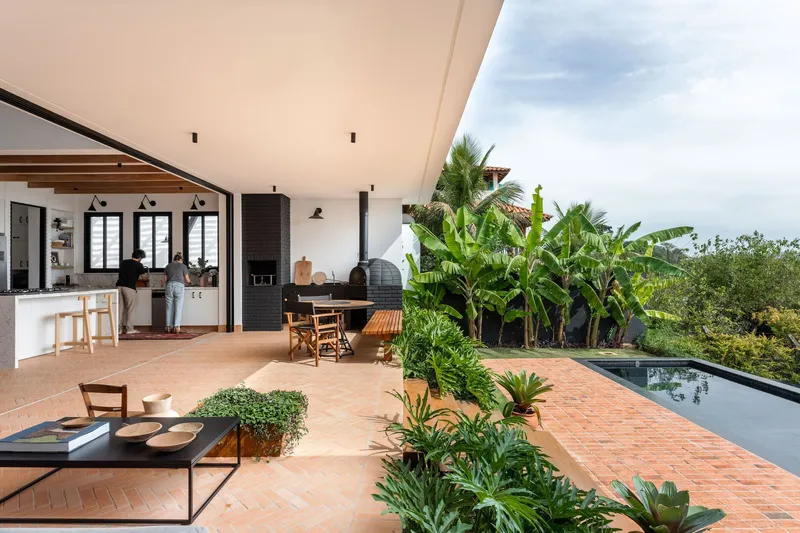
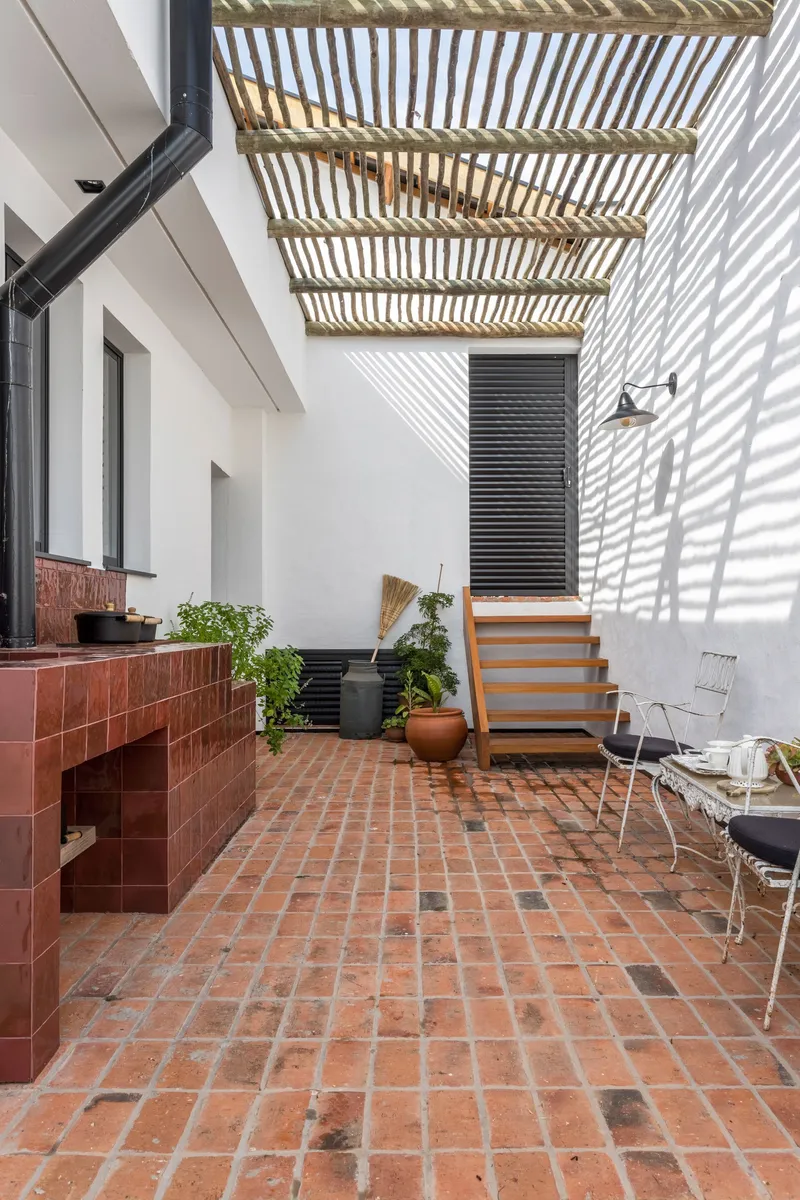
The outdoor spaces are not afterthoughts. A timber slatted pergola casts striped shadows across the terracotta pavers, creating a covered terrace that functions as a genuine room without walls. Planted beds soften the edges where the terrace meets the pool, and the dark tile of the pool basin provides a visual counterpoint to the warm clay everywhere else. The courtyard formed by the L-plan is sheltered enough to feel private but open enough to frame the surrounding mountains.
By extending the same herringbone brick from inside to outside, Miluzzi collapses the distinction between living room and deck. Mandatory setback areas required by local code were converted into these planted and paved living zones rather than being left as dead lawn. It is a smart land-use strategy that turns regulatory constraints into spatial assets.
Bedrooms and Private Quarters
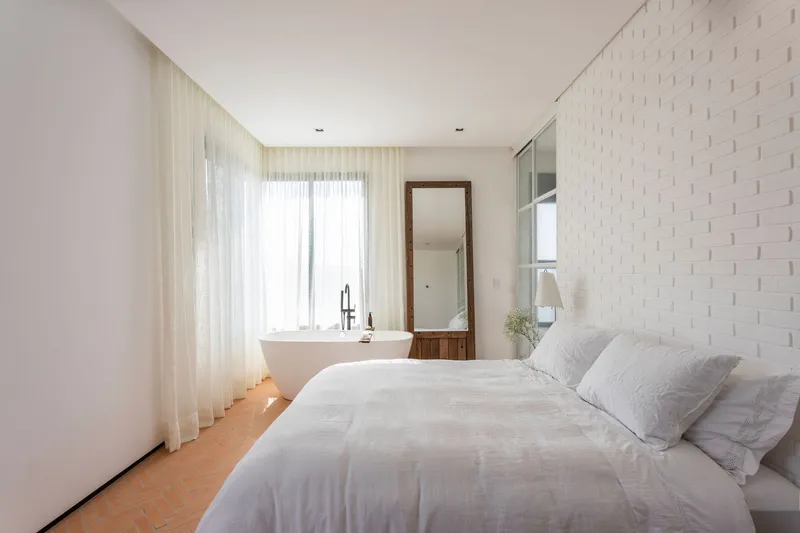
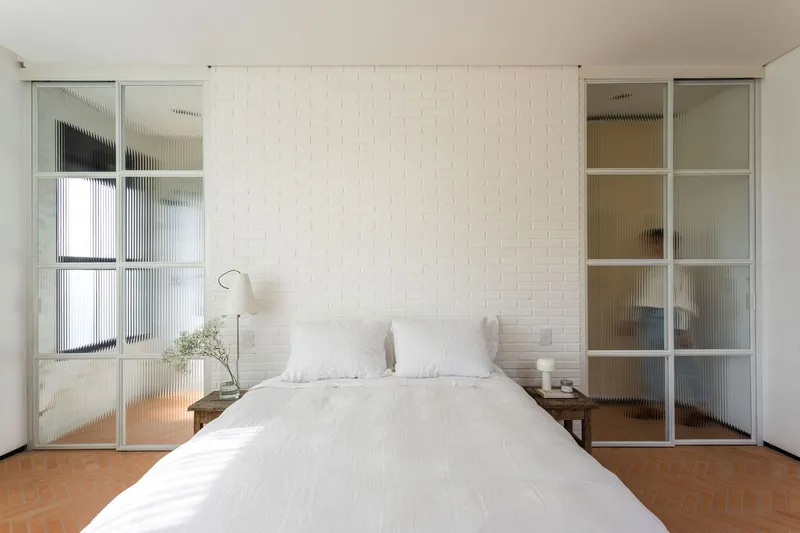
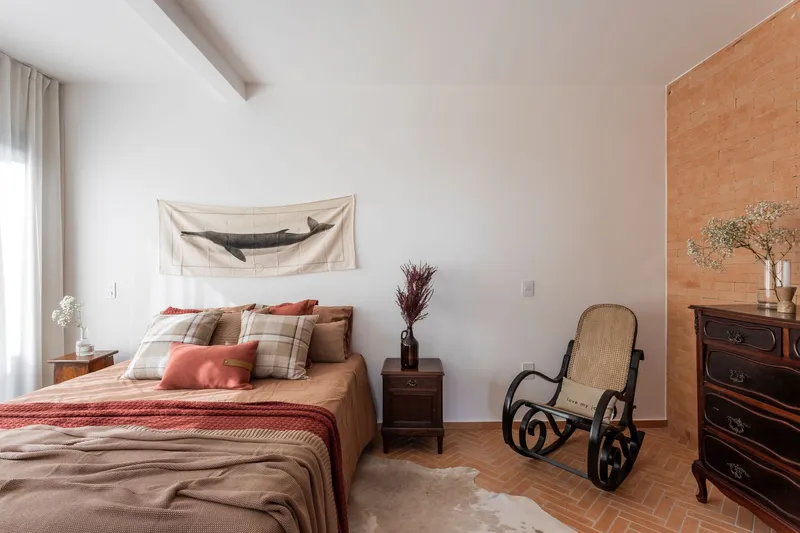
The private rooms demonstrate how the material palette can modulate mood without changing registers. One bedroom places a freestanding bathtub beside floor-to-ceiling windows draped in sheer white fabric, creating an almost ethereal quality despite the robust terracotta floor. Another uses a white tile accent wall flanked by ribbed glass sliding doors, introducing translucency as a privacy strategy. A third room goes the opposite direction, embracing an exposed brick accent wall and pairing it with a bentwood rocking chair for an unapologetically rural atmosphere.
The variety across bedrooms proves that the project's tight palette does not limit spatial character. Miluzzi uses window proportion, surface finish, and furniture selection to give each room a distinct identity while maintaining coherence with the whole.
Corridors and Thresholds
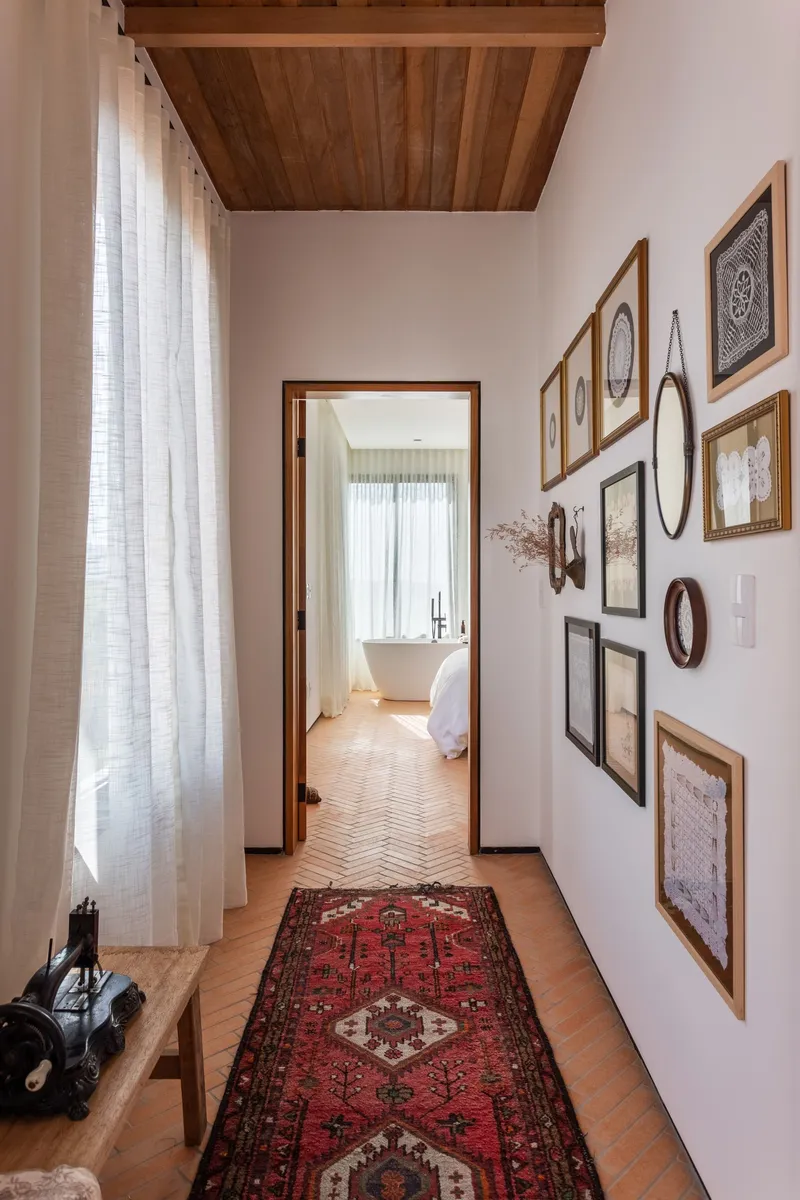
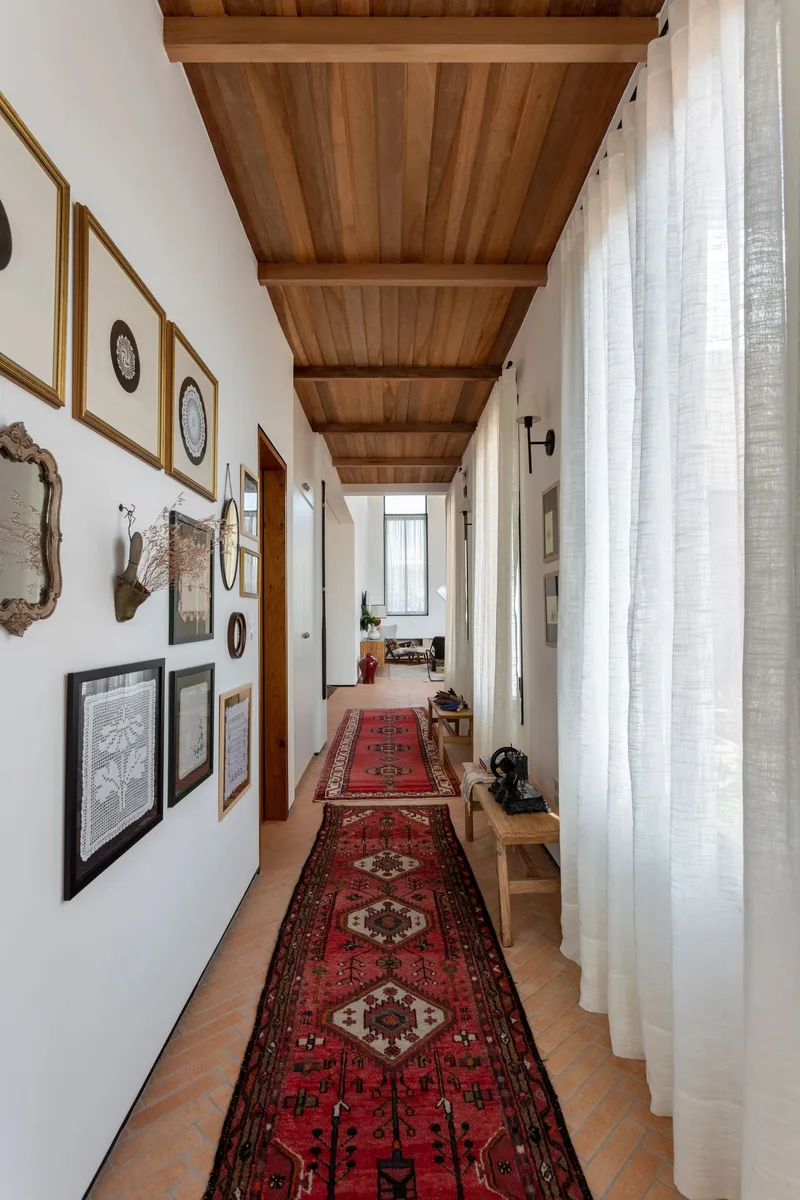
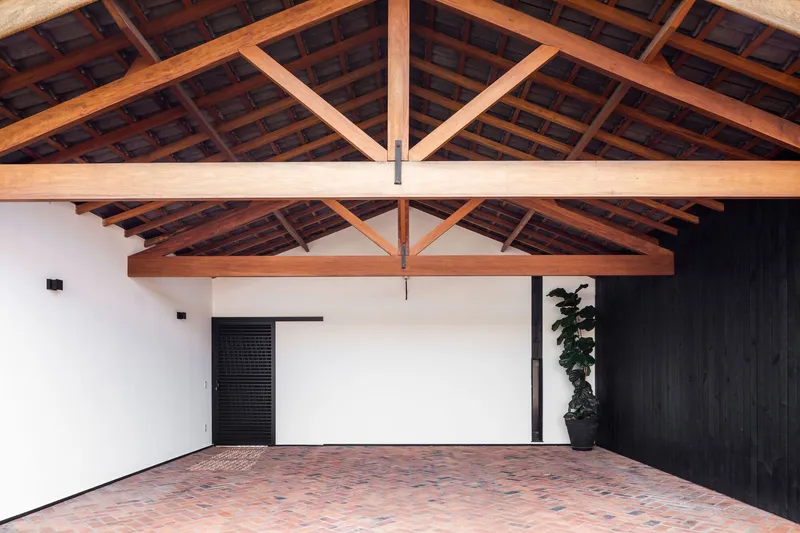
Circulation spaces get careful attention. A narrow hallway becomes a gallery wall lined with framed artworks beneath a timber ceiling inset. A longer corridor uses sheer curtains to filter daylight along its length, producing a soft gradient of illumination that makes the walk from the social zone to the bedrooms feel like a gradual retreat. In the most striking threshold moment, charred timber wall cladding meets exposed rafters and clay tile roofing at a corner detail, revealing how the house layers its materials from structure to skin.
These in-between spaces are where you sense the project's real quality. Any architect can design a handsome living room. It takes discipline to make a hallway feel considered.
Plans and Drawings
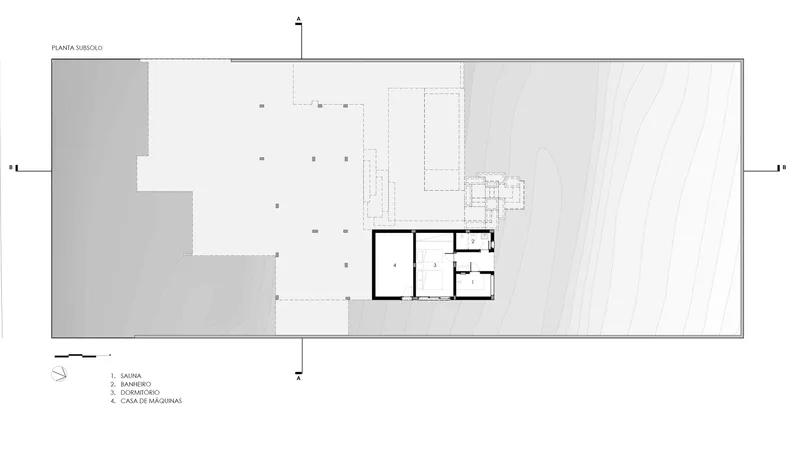
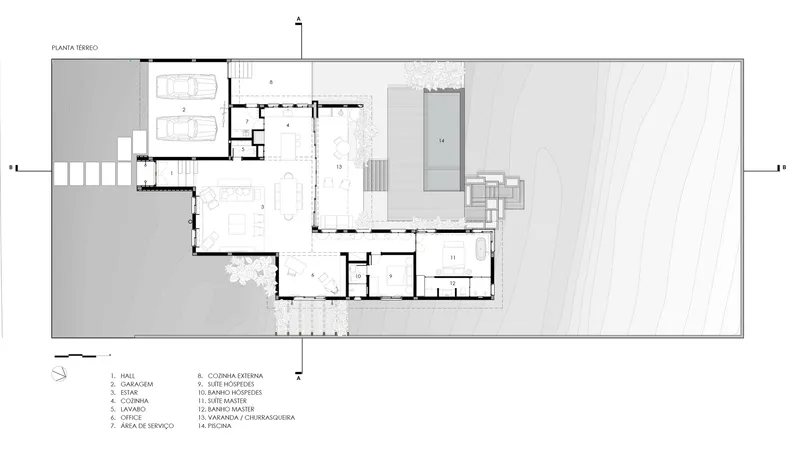
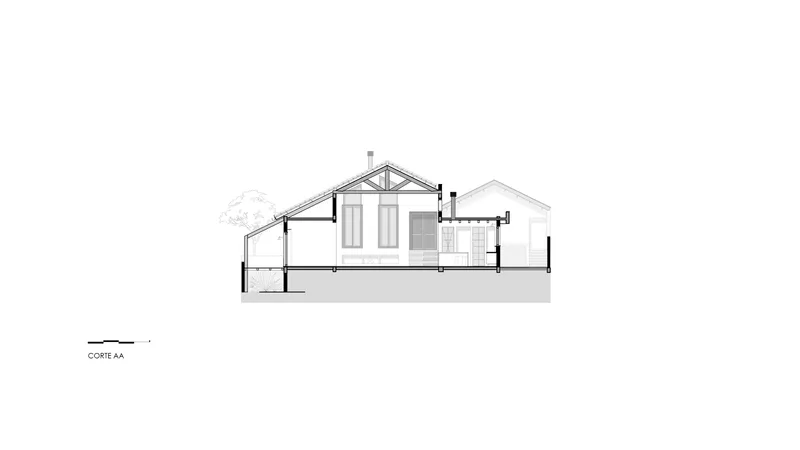
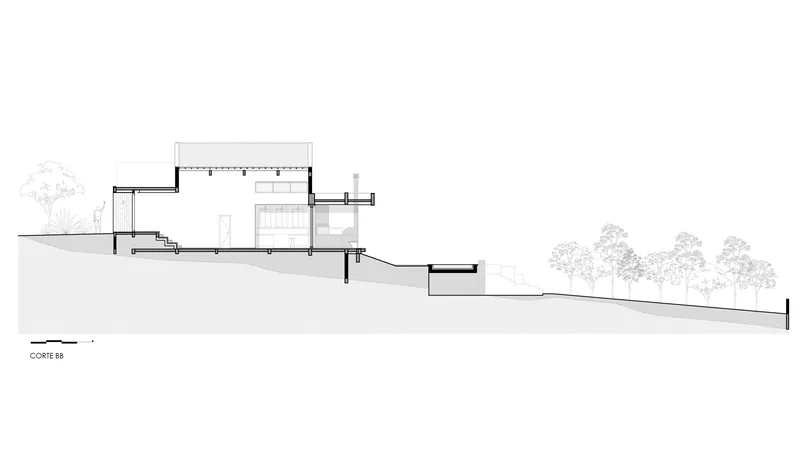
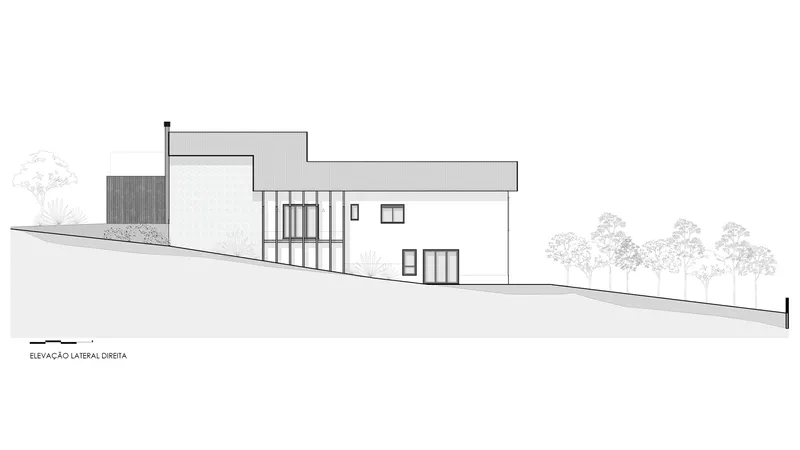
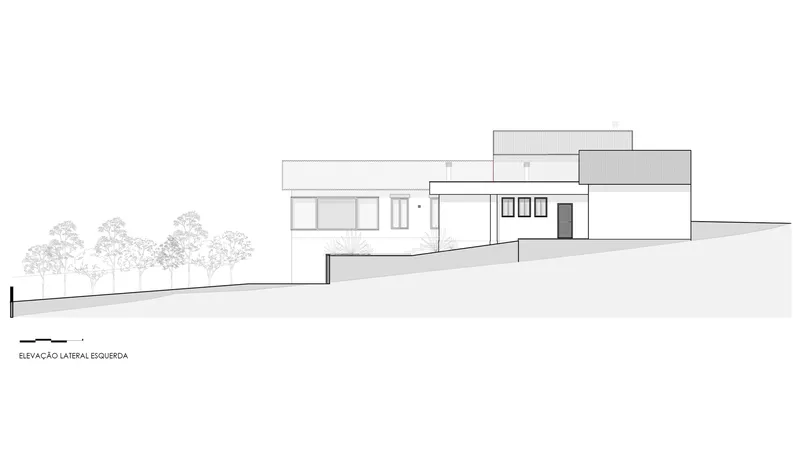
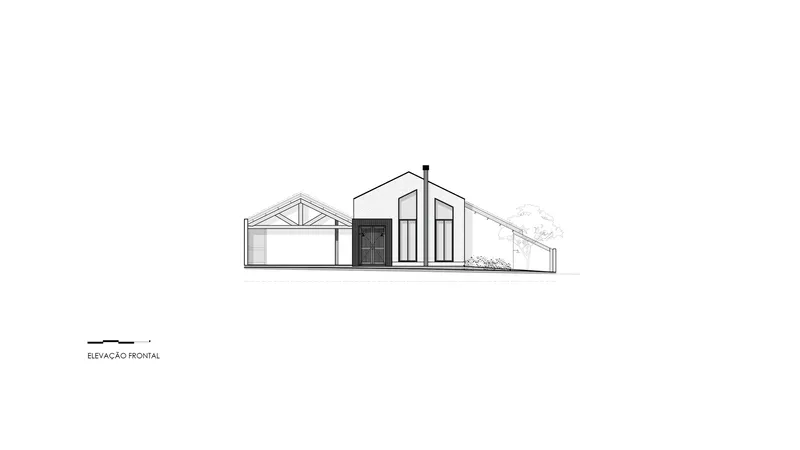
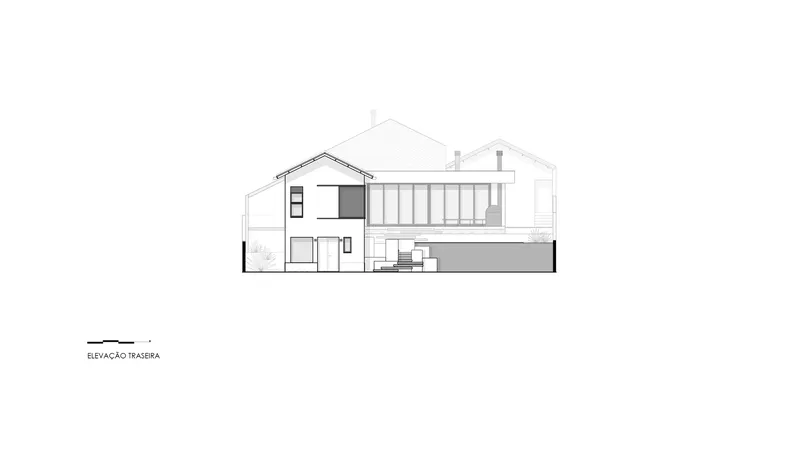
The drawings confirm what the photographs suggest: the house steps down a sloping site in a series of half-level shifts, with the basement tucking a small suite and service spaces into the lower corner of the lot. The ground floor plan reveals how the L-shaped arrangement wraps around the pool terrace and outdoor kitchen, directing views toward the surrounding landscape while screening the garage and utilitarian areas. Section cuts show the exposed truss roofing rising to generous heights in the social areas before dropping over the bedrooms, a move that creates a clear spatial hierarchy without resorting to multiple roof types.
The elevations are particularly revealing. The front elevation reads as a composed, almost symmetrical gable, while the side elevations expose the stacking of two stories on the sloped terrain with vertical slat screening providing solar and privacy control. The rear section drawing peels the house open to show how interior levels negotiate the grade change, making explicit a complexity that the clean white facade works hard to conceal.
Why This Project Matters
Assossego House is a reminder that material commitment can substitute for formal gymnastics. Miluzzi did not reach for a dramatic cantilevered volume or an elaborate facade system to make the house interesting. Instead, she doubled down on terracotta brick and timber, deployed them with consistency and precision, and let the resulting warmth do the work. In a contemporary residential landscape saturated with concrete and glass minimalism, the choice to build warmth from the ground up, literally, reads as both quietly radical and deeply rooted in Brazilian building traditions.
The project also demonstrates an intelligent approach to topography and regulation. By stepping the house down its hillside and converting mandatory setbacks into active living spaces, the design extracts maximum value from its site without forcing the land into submission. At 300 square meters, this is not a small house, but it feels calibrated rather than sprawling. Every room, corridor, and terrace has a reason to exist, and each one reinforces the overarching pursuit of tranquility that gave the project its name.
Assossego House by Carol Miluzzi Arquitetura, led by Carolina Miluzzi with engineering by Willian Carneiro de Vasconcelos. Located in Araçoiaba da Serra, Brazil. 300 m². Completed 2021. Photography by Thiago Travesso.
About the Studio
Share Your Own Work on uni.xyz
If projects like this are the kind of work you want to make, uni.xyz is a place to publish your own, find collaborators, and enter design competitions.


Popular Articles
Popular articles from the community


U.GA Architects Wraps an Oval Rooftop Pool in Curved Board-Formed Concrete on Busan's Jeollidan-gil
In Busan's Jeonpo-dong, a 454 m² mixed-use block stacks a neighborhood facility, guest rooms and an oval rooftop pool inside spiraling concrete walls.

David Ortega Stacks a Two-Story Mexico City Penthouse Around a Steel Stair and a Pergola-Shaded Roof Terrace
In Colonia Roma, a 300 m² penthouse uses oak joinery, a planted steel stair and a slatted roof pergola to make a new-build apartment feel like a house.

Cube Design Draws an Ecological Corridor Between Two Shenzhen Hills with the Nankai Building
Beside Shenzhen's container docks, the Nankai Building pairs stacked balconies with a climbing green screen to connect two hillsides across its height.

LT2A and OPEN Architectes Thread a Brick and Glass High School Through a Wooded Belgian Campus
In Braine-l'Alleud, a 3,000 m² wing for Collège Cardinal Mercier pairs pale brick with a glazed colonnade, deferring to a small chapel and a dense wood.

Similar Reads
You might also enjoy these articles


LAVA Architecten Gives Vocational Education a Sawtooth-Roofed Face on a Mechelen School Campus
In Mechelen, Belgium, a 2,053 m² STEM school on a 6×6 m grid turns workshops and classrooms into rooms that can be rearranged as teaching changes.

KEMA Studio Turns a Derelict Marvila Attic into a 60 m² Lighthouse Apartment Above Lisbon
In Lisbon's Marvila district, a rebuilt roof, four skylights and two plywood volumes turn an unlivable attic into a bright home facing the Tagus.

Pixel Gardens: One Repeated Module Stacked Into a Terraced Social Housing Tower for Famagusta
Salem Bader's shortlisted housing tower builds a vertical neighbourhood from one repeated module, offsetting units to carve terraces, light and air.

Bao Huynh Watercolor Atelier: A Serene Art Retreat in Hội An
Bao Huynh Watercolor Atelier in Hội An blends multifunctional art spaces, sustainable design, local materials, and family-friendly living in a serene environment.

Explore Residential Building Competitions
Discover active competitions in this discipline

Challenge to design mud housing for contemporary communities

Challenge to reimagine the Iron Throne

Photograph architecture without architects

Illustrate the lost glory of Angkor Wat - Render Challenge
Comments (0)
Please login or sign up to add comments
No comments yet. Be the first to comment!