
Gaëtan Le Penhuel Architectes Builds a Rammed Earth Retreat in Sicily's Val di Noto Hills
Casa Bendico uses board-formed concrete, timber, and passive cooling to root a domestic retreat in the Sicilian landscape.


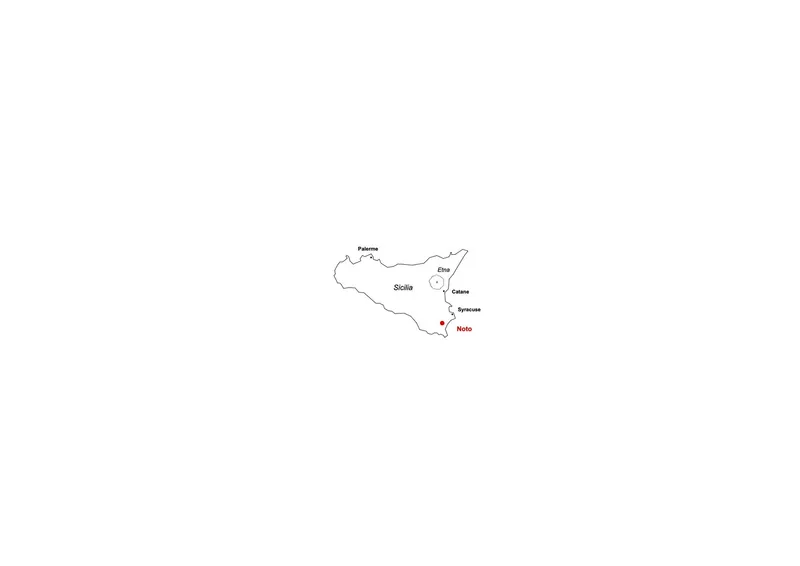
The Val di Noto, in southeastern Sicily, is UNESCO-listed for its Baroque architecture, but its terrain tells a longer story: dry limestone slopes, olive groves older than any church, and a sun that turns construction materials into a design problem. Casa Bendico, by Paris-based Gaëtan Le Penhuel Architectes, takes that problem seriously. The house sits low in the landscape, splitting into distinct gabled volumes that avoid the monolithic impulse of most vacation retreats. Instead of fighting the site's slope and aridity, the project accepts both and turns them into organizing principles.
What makes the house worth studying is its refusal to choose a single material identity. Board-formed concrete, horizontal timber cladding, porous stone, and reed canopies coexist without a hierarchy, each assigned to a specific task: thermal mass, shading, ventilation, enclosure. The result reads less like an exercise in rustic aesthetics and more like a serious argument about how low-tech passive strategies can still produce architecture that feels generous and open rather than bunker-like.
Volumes in the Grove
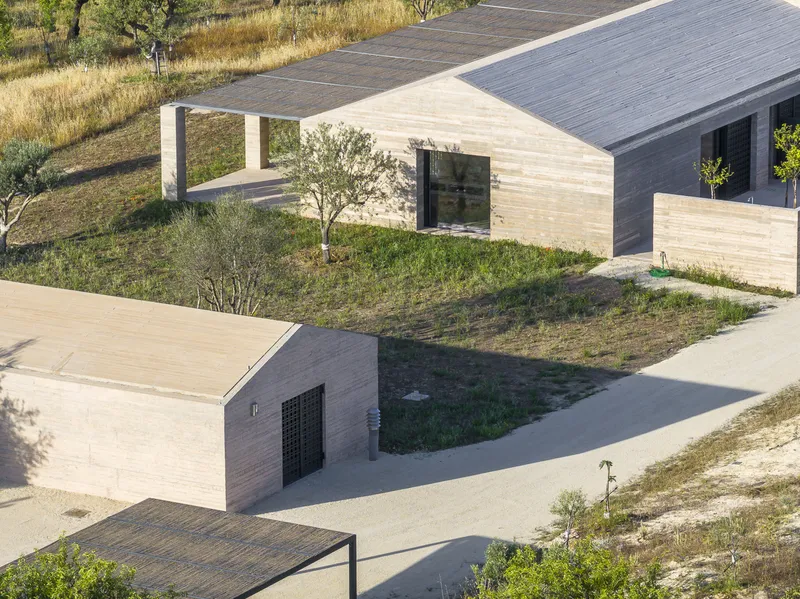
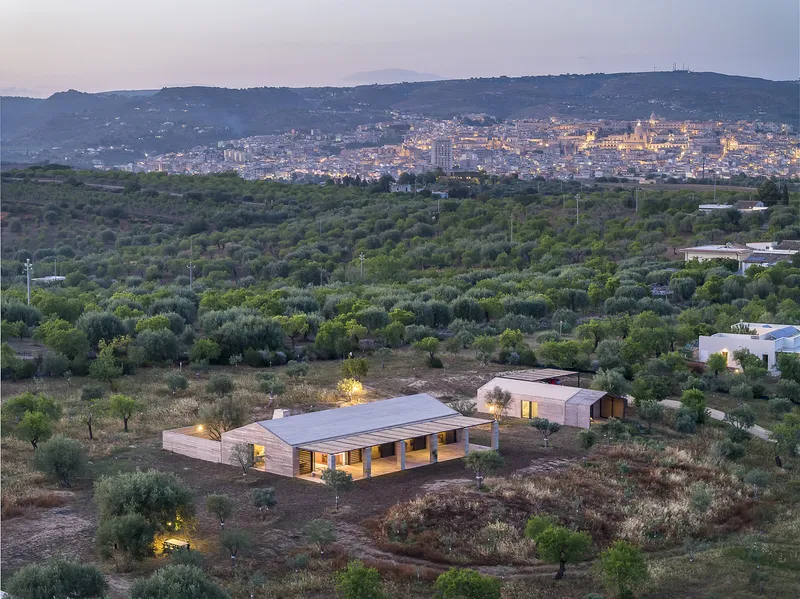
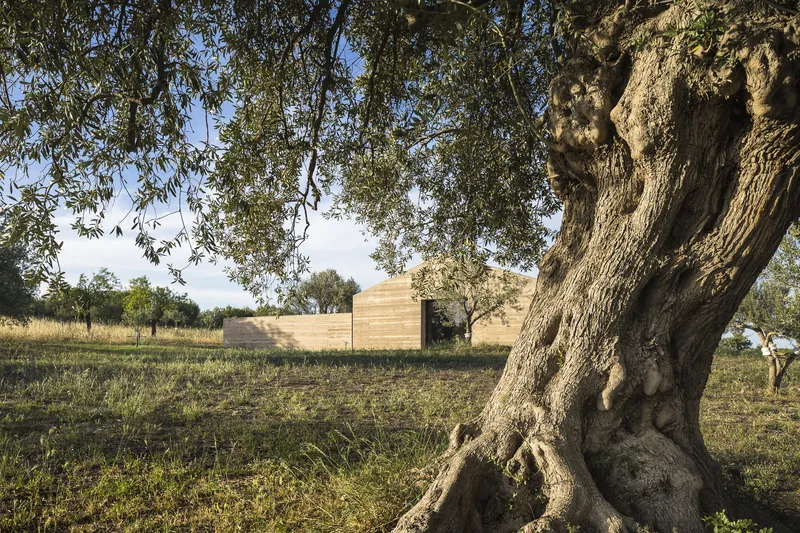
From the air, Casa Bendico dissolves into its hillside. The building is not one house but a cluster of gabled volumes separated by outdoor passages and courtyards, a strategy that reduces visual mass and lets the olive groves flow through the composition. At dusk, the residence glows from within, its low profile barely interrupting the horizon line. The architects clearly studied how traditional Sicilian agricultural buildings scatter across sloped land, and they borrow that dispersed logic without imitating the vernacular surface.
The decision to fragment the program into smaller pavilions is also a thermal one. Smaller volumes have more surface area relative to their interior, which in a Mediterranean climate means easier cross-ventilation and faster nighttime cooling. The gaps between buildings become shaded breezeways, not just picturesque interludes.
Timber, Concrete, and the Logic of Assembly
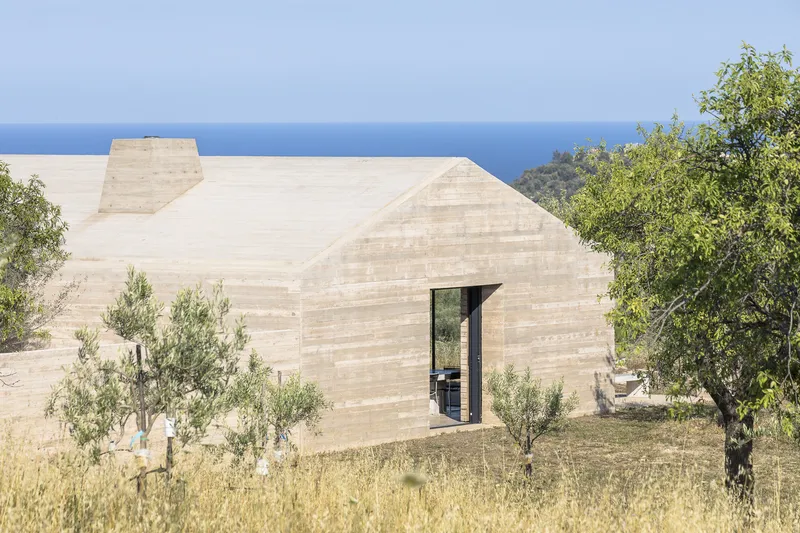
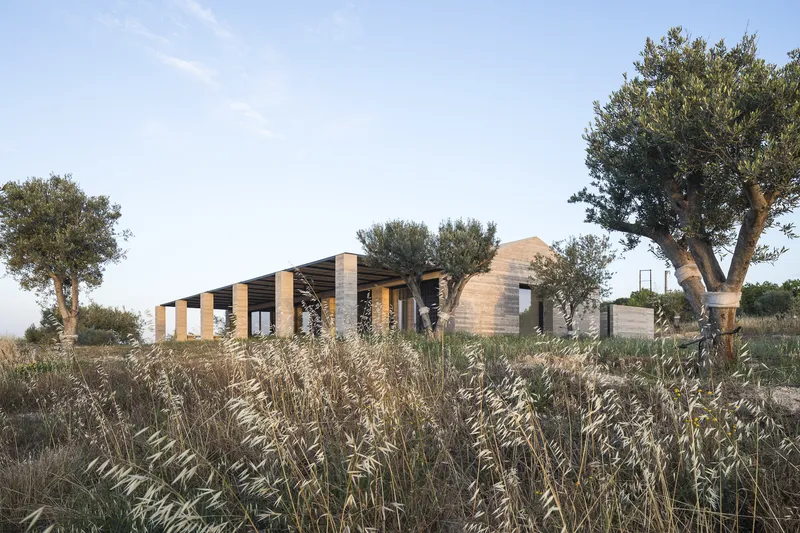
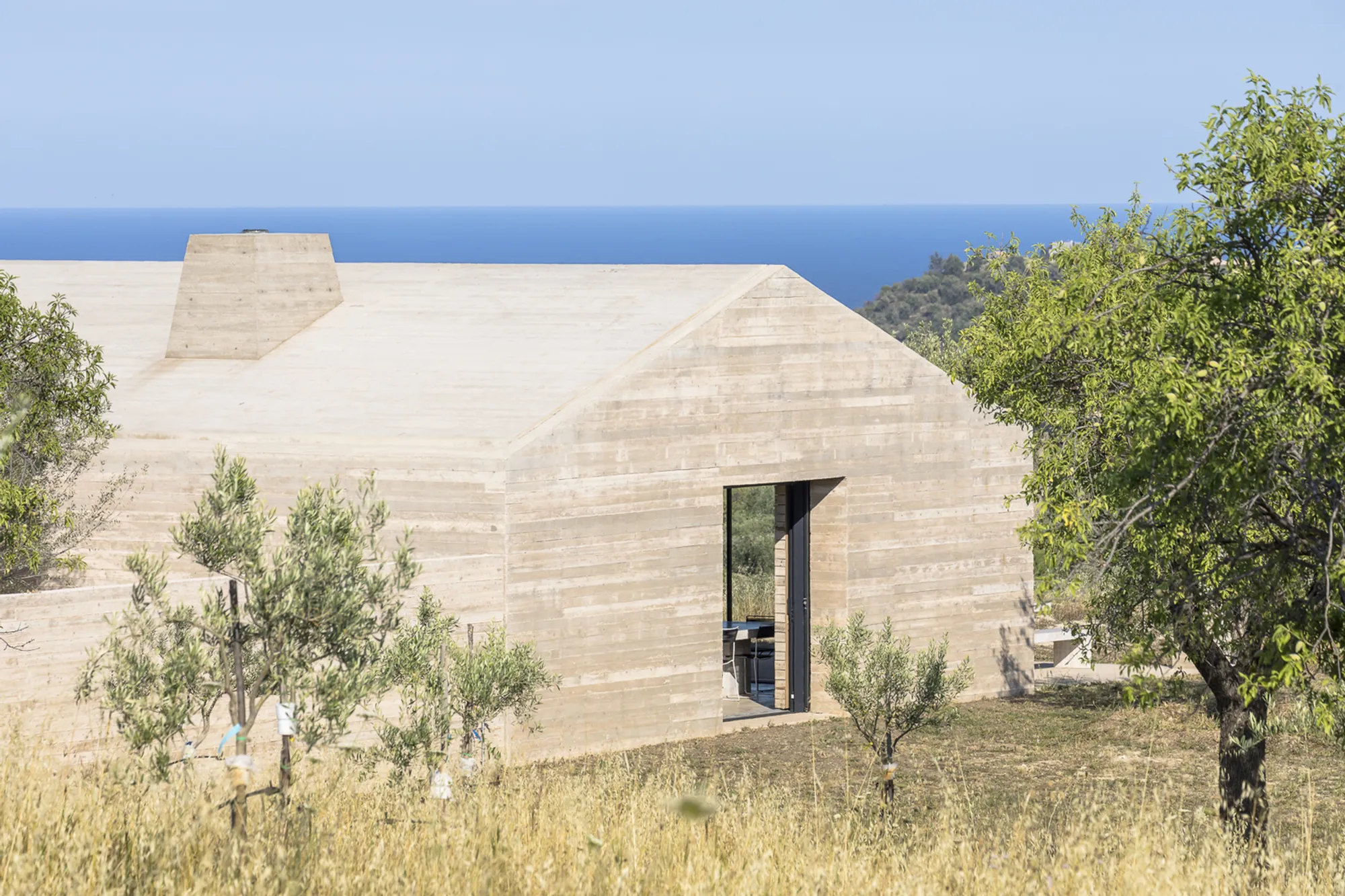
The two primary cladding systems, horizontal timber planks and board-formed concrete, are deployed according to orientation and function. Timber-clad pavilions face the sea, their warm grain catching late-afternoon light through dry grasses. The concrete volumes sit deeper in the plan, providing mass where thermal stability matters most. Up close, the board-formed surfaces reveal the coarse texture of their formwork, a tactile roughness that resists the polished minimalism common to Mediterranean holiday houses.
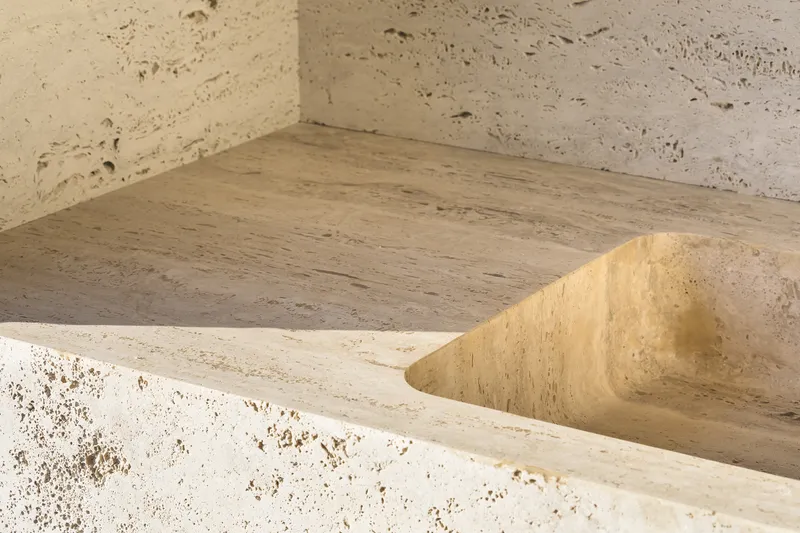
A detail shot of a concrete basin meeting porous stone wall tells a small but important story about joint resolution. Le Penhuel's team did not try to make these materials seamless. They meet abruptly, each retaining its own surface logic. The honesty of the connections suggests a construction process that valued clarity over concealment.
Interior Landscapes
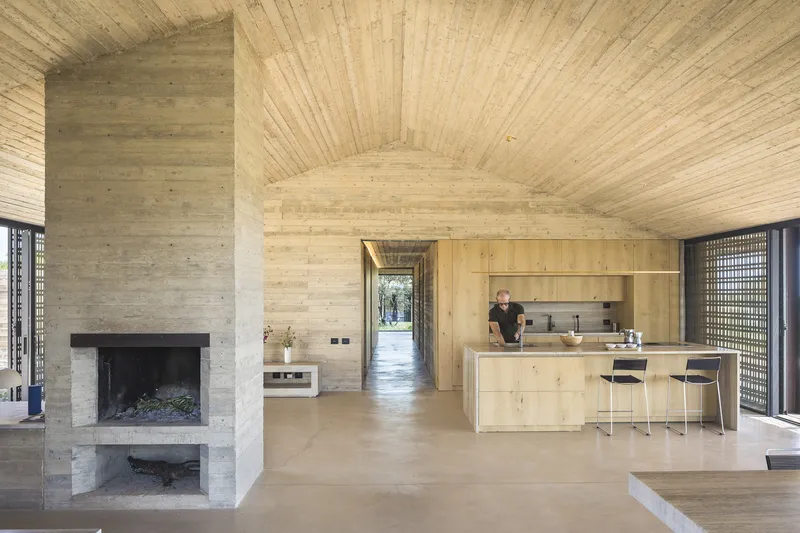
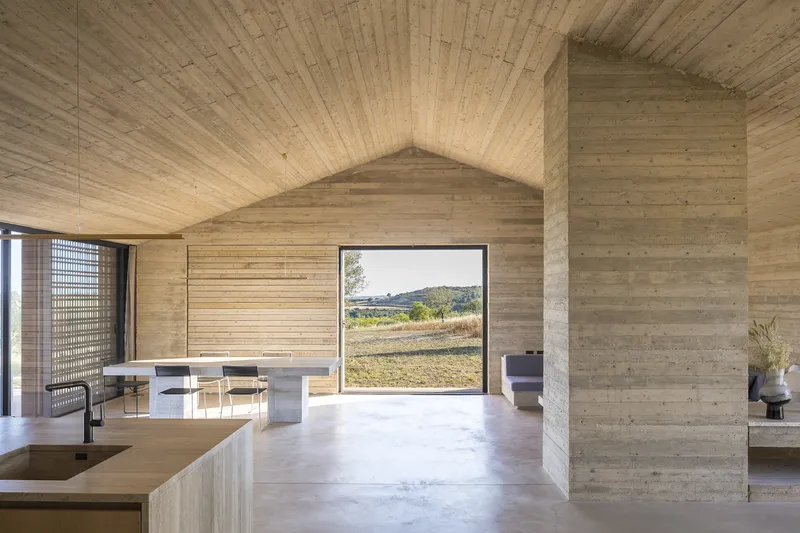
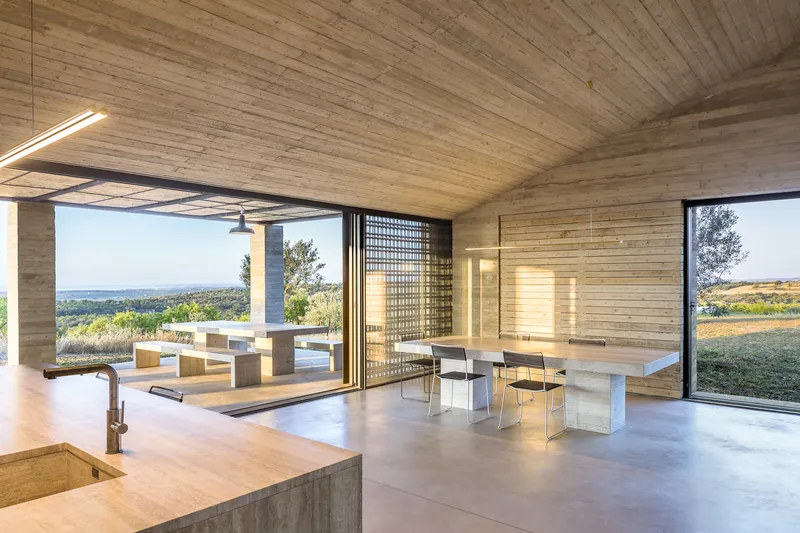
The main living space operates under a timber-lined vaulted ceiling that amplifies the gabled roof form from the inside. A stone fireplace anchors one end while a kitchen island runs beneath the ridge, and the room reads as a single generous volume rather than a sequence of defined zones. Board-formed concrete walls in an adjacent space frame a full-height glass opening to the landscape, turning the view into something almost confrontational: you are always aware of the dry hillside outside.
Sliding glass doors dissolve the boundary between the dining area and a terrace overlooking the olive groves. The threshold condition is repeated throughout the house, with lattice screens and deep overhangs mediating between interior comfort and exterior heat. These are not decorative screens. They are working shade devices calibrated to Sicilian sun angles.
Thresholds and Shade Structures
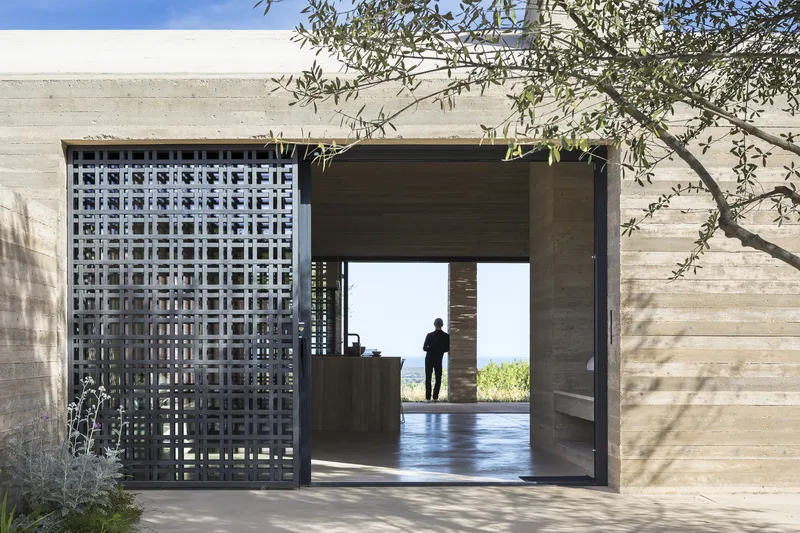
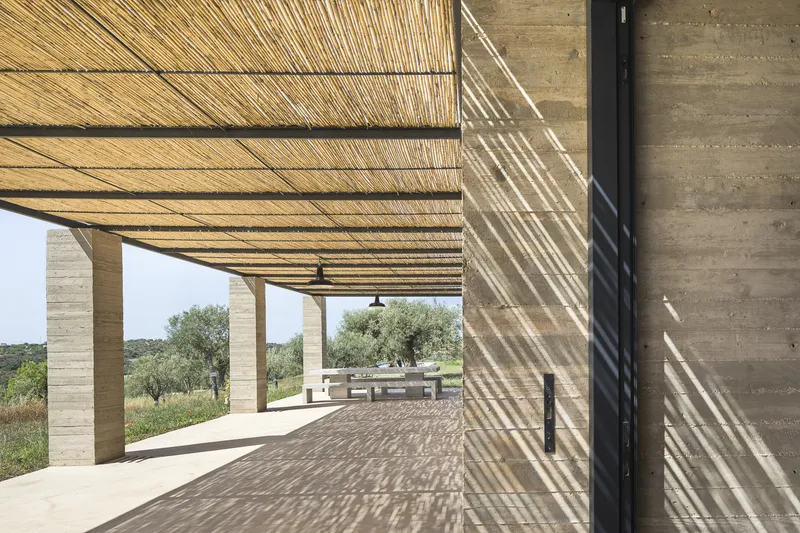
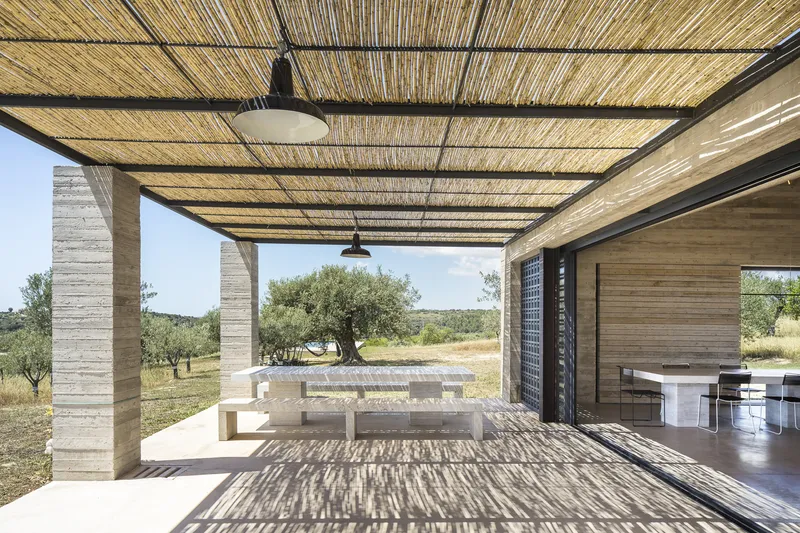
Some of the strongest images in the project capture the intermediate zone between inside and out. A lattice screen silhouettes a figure against blinding exterior light, compressing the entire thermal drama of the building into a single frame. Elsewhere, reed canopies on steel frames cast striped shadows across board-formed concrete columns, a low-cost solution that performs as well as any engineered brise-soleil.
The covered terraces are not afterthoughts or decorative pergolas. They are the project's primary living rooms for most of the year. Le Penhuel understands that in this climate, the shaded exterior is where domestic life actually happens, and the building's section is designed accordingly: deep overhangs, tall openings, and outdoor rooms with the same spatial ambition as the enclosed ones.
Private Rooms and the Pool Terrace
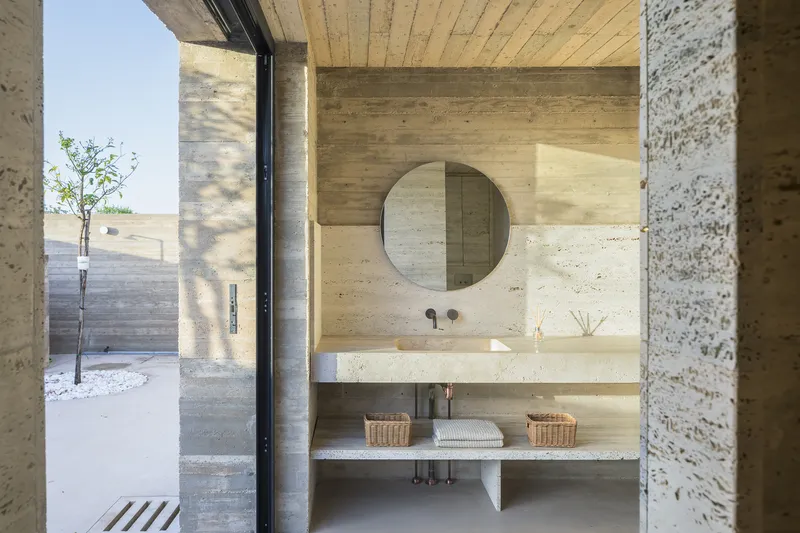
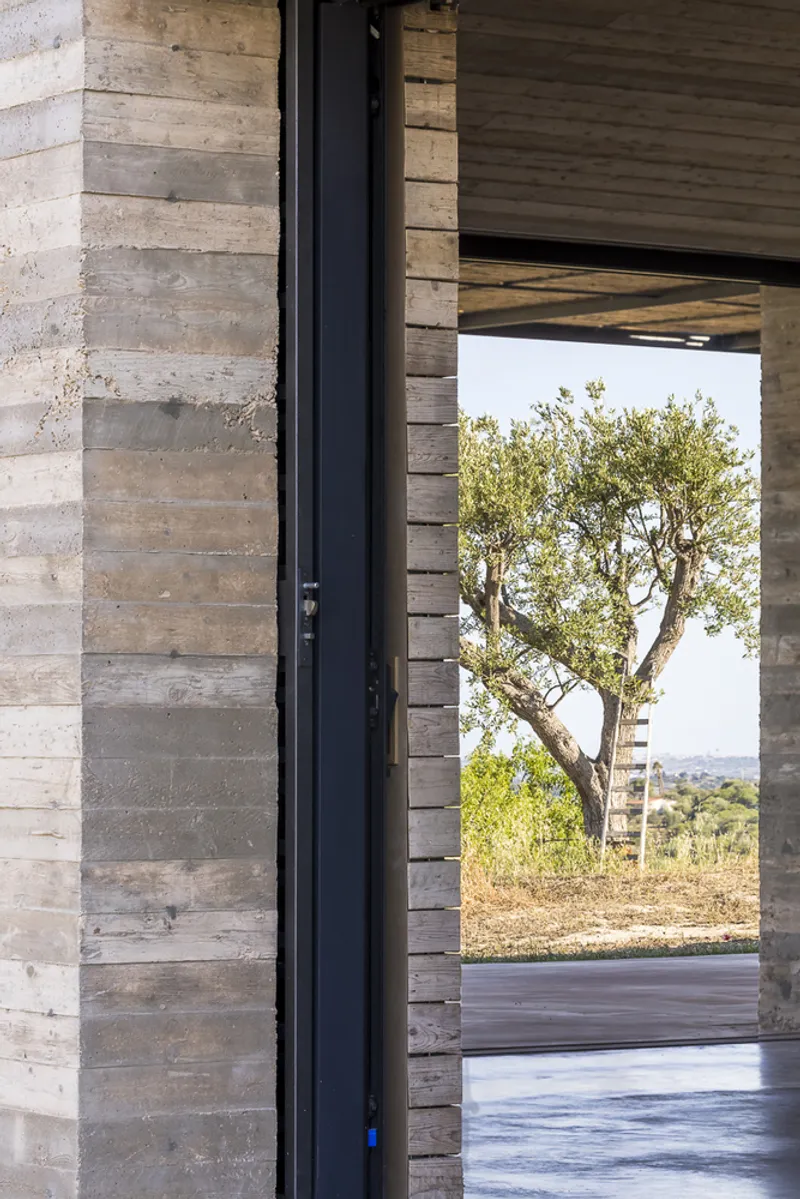
The private quarters maintain the same material palette at a more intimate scale. A bathroom vanity sits against board-formed concrete walls, its round mirror reflecting a small courtyard with a single young tree. The detail is restrained but specific: the architects chose to give even a secondary wet room its own piece of landscape. A black steel door frame punches through concrete to reveal an olive tree in full midday sun, a composition that feels almost photographic in its framing.
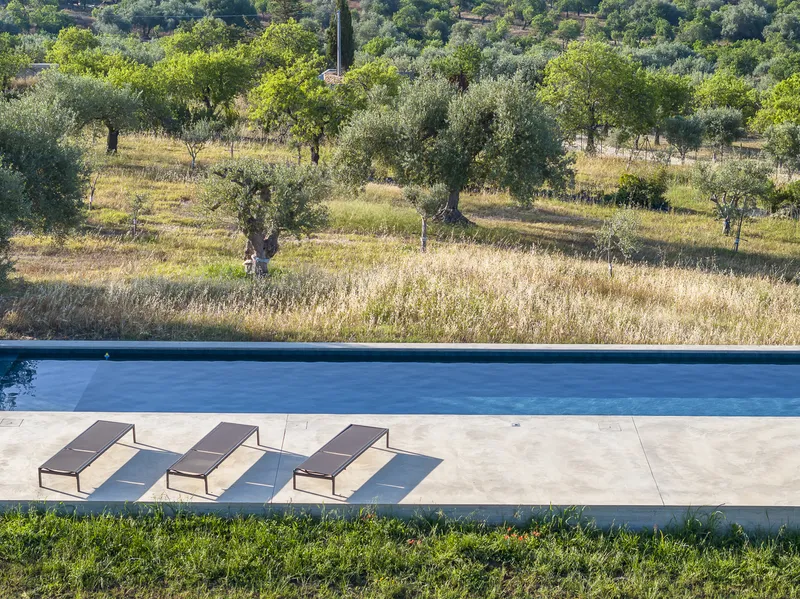
The swimming pool terrace, set among olive trees with three lounge chairs, is deliberately understated. No infinity edge, no dramatic cantilever. The pool is a simple rectangle aligned with the slope, and the grove provides the scenery. It is the rare luxury amenity that defers to its context.
Plans and Drawings
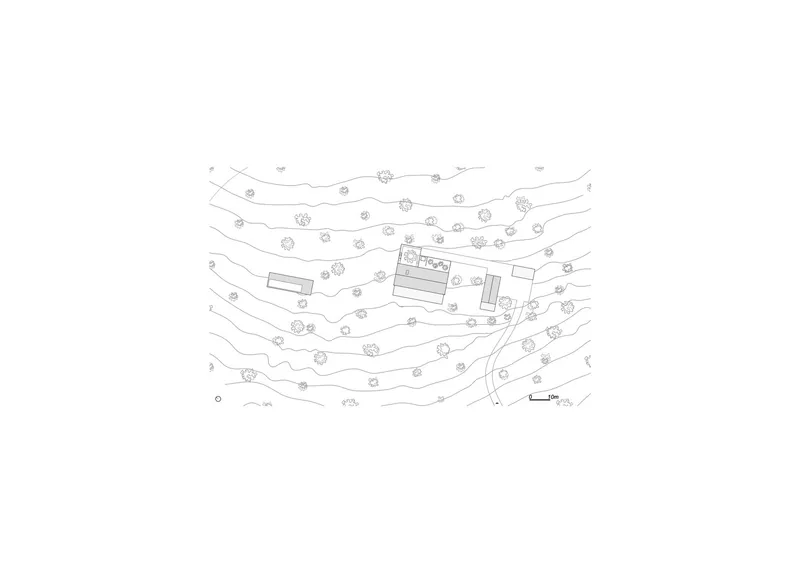
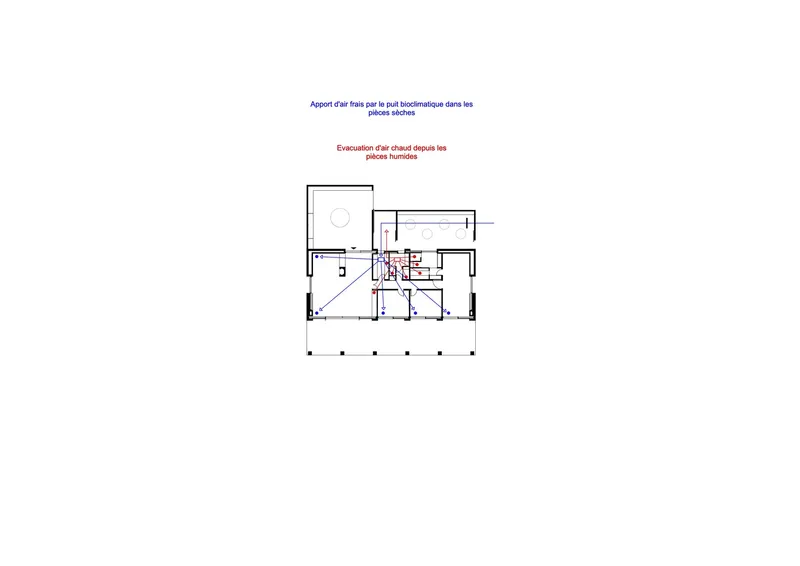
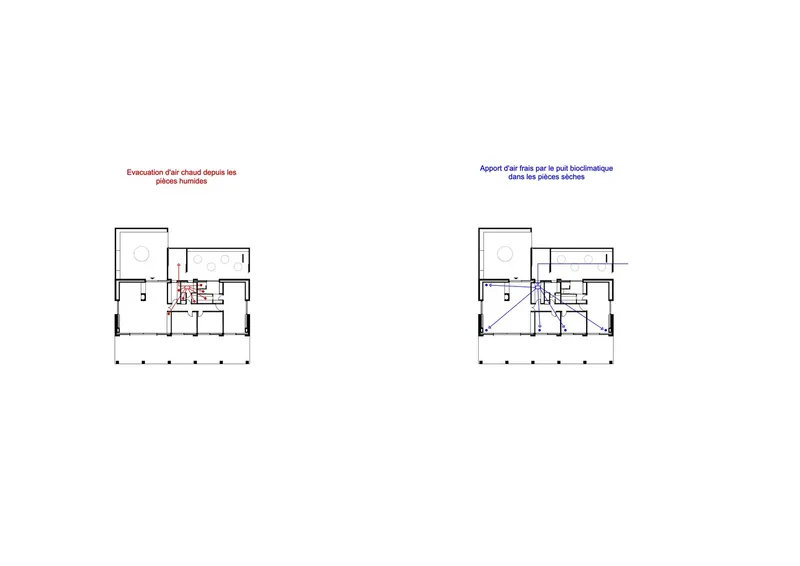
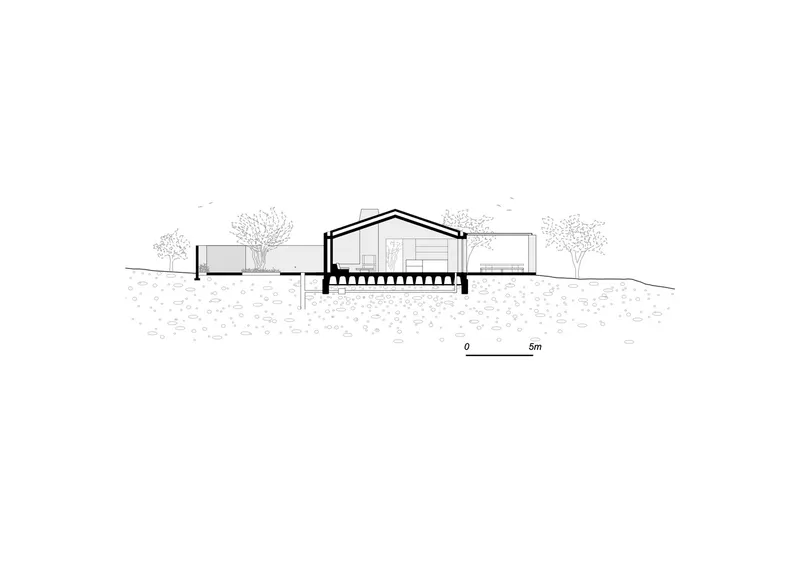
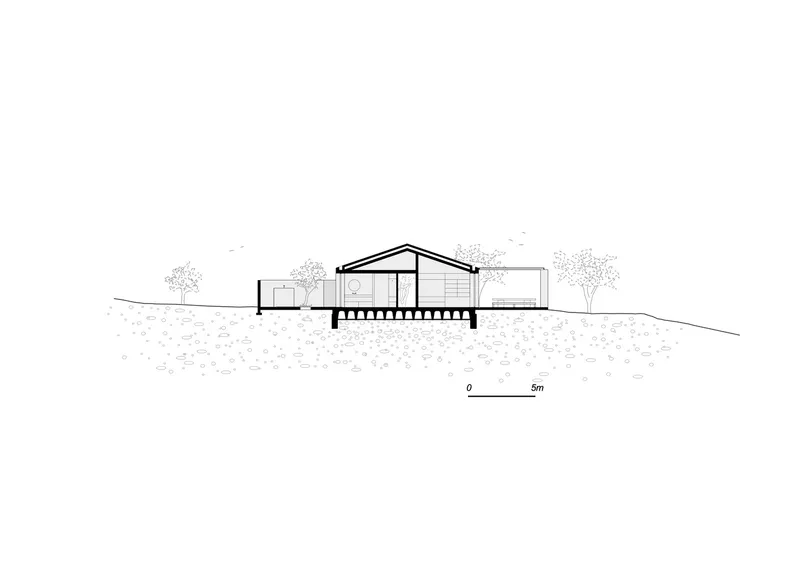
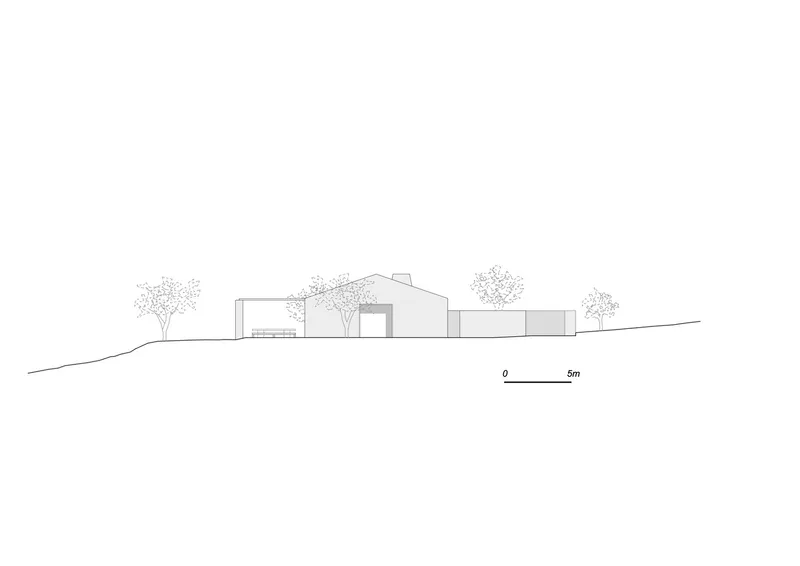
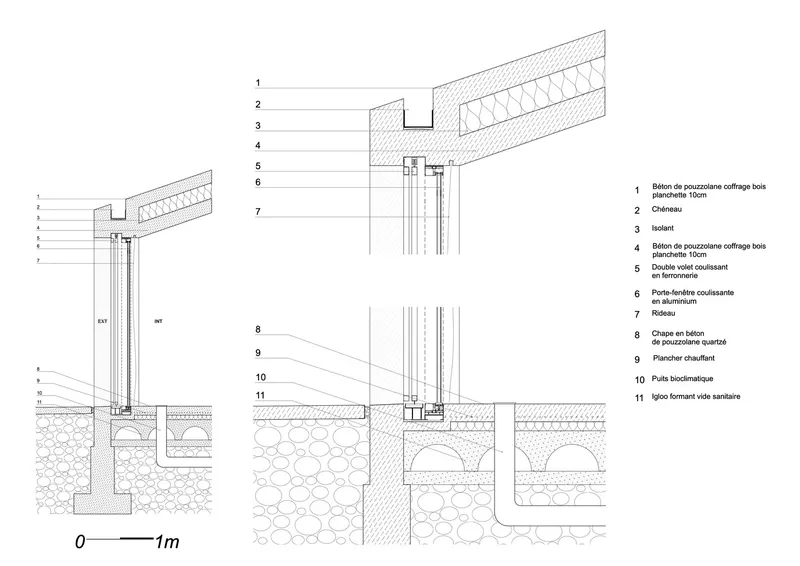
The site plan confirms the dispersed strategy visible in the photographs: building footprints scatter among contour lines and tree symbols, reading almost like a settlement rather than a single house. The floor plans show rectangular volumes organized around a central core, with passive cooling and heat circulation strategies diagrammed in a dedicated pair of drawings. These diagrams make explicit what the architecture only implies: summer ventilation paths, winter heat storage in mass walls, and stack-effect exhaust through the gabled roofs.
The sections are particularly revealing. One shows a gabled volume raised on columns amid landscape vegetation, suggesting that the building barely touches the ground in places. Another depicts the relationship between a tall central space and its flanking lower pavilions, clarifying the section-driven hierarchy of the project. Construction details at the foundation, wall assembly, roof eave, and floor connections lay out the material layers with an engineer's precision, confirming that the rustic appearance is backed by carefully resolved technology.
Why This Project Matters
Casa Bendico avoids the two most common traps of Mediterranean residential design. It does not retreat into a pastiche of local stone walls and terracotta, nor does it impose a glass-and-steel pavilion on a landscape that will punish anything without thermal mass. Instead, Le Penhuel's team builds a hybrid: board-formed concrete for mass, timber for warmth, reed canopies for shade, and olive trees for continuity with the centuries-old grove. The passive strategies are not greenwashing appliqués but genuine organizing forces that shape plan, section, and material choice.
More broadly, the project offers a useful model for rural construction in hot, dry climates. Its fragmented massing, deep threshold zones, and material specificity are strategies that could scale to hospitality, agriculture, or education, not just the private villa. In a moment when sustainability in architecture too often means high-tech systems grafted onto conventional plans, Casa Bendico argues for the opposite: letting climate shape the building from the inside out, with materials humble enough to age alongside the olive trees.
Casa Bendico by Gaëtan Le Penhuel Architectes, Val di Noto, Sicily, Italy. Photography by Sergio Grazia.
About the Studio
Share Your Own Work on uni.xyz
If projects like this are the kind of work you want to make, uni.xyz is a place to publish your own, find collaborators, and enter design competitions.




Popular Articles
Popular articles from the community


The Ocean Hive: Sustainable Architecture for a Self-Sufficient Civilization at Sea
The Ocean Hive imagines sustainable architecture at sea, where modular habitats, algae, wave power and ocean waste sustain a growing colony.
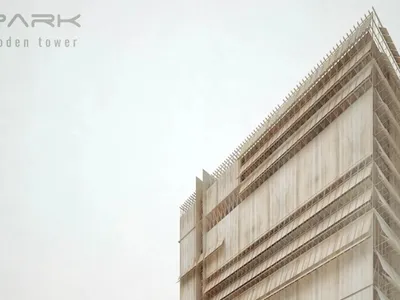
EW PARK: Sustainable Architecture Reimagines the Future of Urban Parking
EW PARK reimagines city parking as a modular wooden tower combining automation, solar energy, electric mobility, and adaptable urban design.

The Musturak Paradise: Senior Living Architecture for a Connected Future in Temara, Morocco
The Musturak Paradise reimagines senior living architecture in Temara via private homes, social spaces, culture, community, and shared care.

Hill & Cross Opera: Sculptural Opera House Architecture Shaped by Tallinn’s Landscape and Identity
Hill & Cross Opera reimagines opera house architecture in Tallinn through its sculptural hill, civic plaza, glass wave and a luminous cross.


Similar Reads
You might also enjoy these articles


Hodi-Mandai Geram
Project Function: Preservation and revitalization of the Intangible heritage and socio-spatial identity of the Hodi by Housing, Cultural Memory Center, Sacred Grove, landscape, local tourism economy


Olio Towers: A Mid-Rise for Performers That Fuses Housing, Rehearsal, and Stage
Located blocks from Houston's Theater District, this modular tower stacks living units around a central performance atrium.

Oasis: Modular Green Housing Carved into Dhaka's Urban Fabric
A shortlisted Plugin Housing entry reclaims unauthorized settlements in Dhaka with stepped concrete volumes, green roofs, and ventilation-driven design.

Black Hole: A Floating Megastructure for the Post-Physical Era
Emiliano Mazzarotto envisions a spherical, self-scaling arena where e-sports, digital hotels, and holographic stadiums replace traditional public space.

Explore Housing Competitions
Discover active competitions in this discipline



Challenge to reimagine the Iron Throne


Photograph architecture without architects


Illustrate the lost glory of Angkor Wat - Render Challenge


Design challenge to reuse E-waste
Comments (0)
Please login or sign up to add comments
No comments yet. Be the first to comment!