
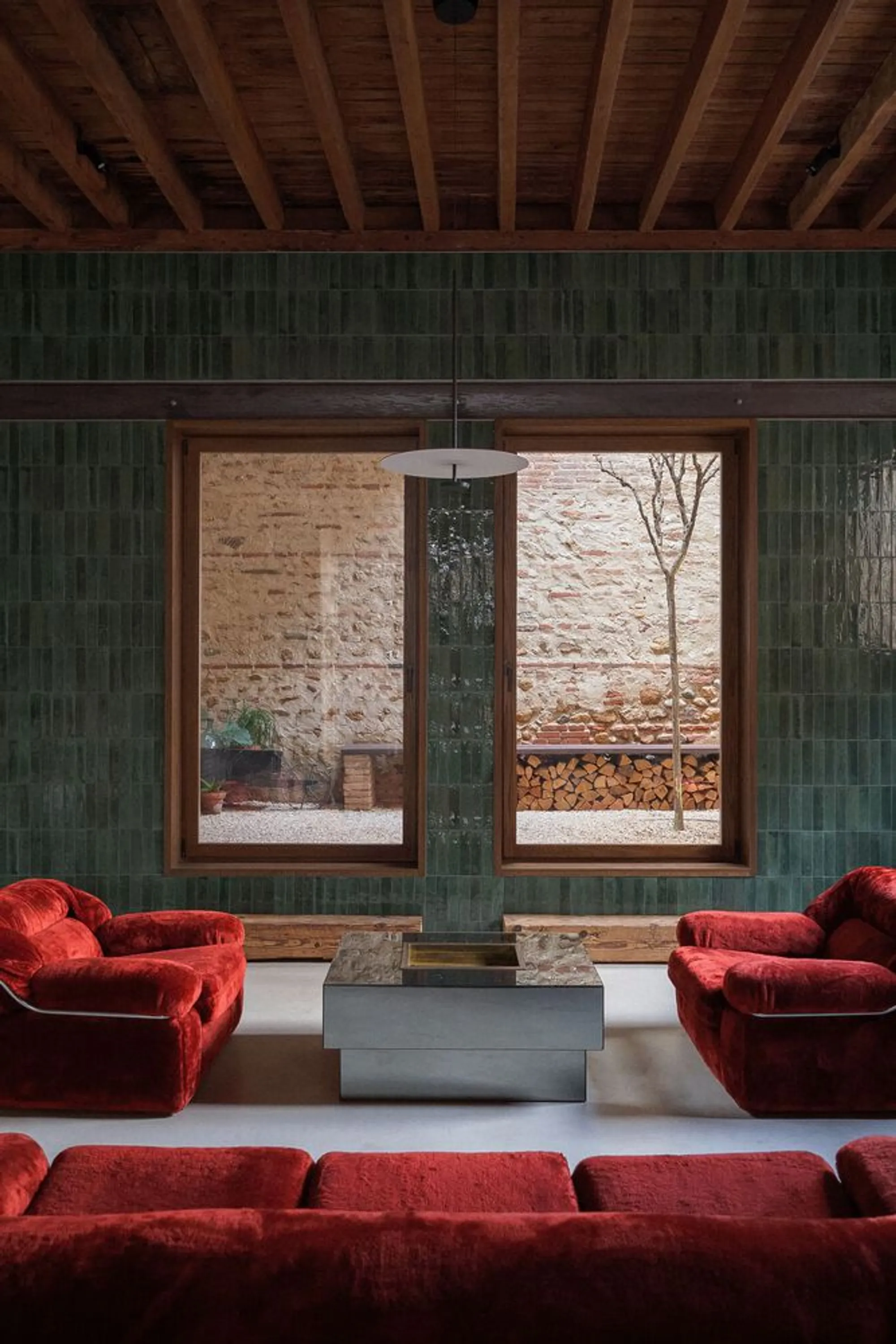
Symbiose Cracks Open a Catalan Cellar to Find a Loft, a Studio, and the Albères Mountains
Casa Descadrell converts a village cellar in Villeneuve-de-la-Raho into a live-work space rooted in river stone, cayrou, and southern light.


Somewhere beneath layers of plaster in a cellar in Villeneuve-de-la-Raho, a small village near Perpignan in French Catalonia, there were walls of river stone and cayrou brickwork waiting to be found. Symbiose Interior Architecture & Design took on the job of finding them, and of turning the cellar into something that could hold both a working architecture studio and a home. The result, completed in 2022, is Casa Descadrell: a project that treats excavation as a design act, peeling back the building's skin to recover what was already there before deciding what to add.
What makes this project worth studying is not its scale but its restraint. The most dramatic move, cutting a section from the southern end of the roof to create a double-height open-air patio facing the Albères mountains, is also the simplest. Rather than inserting a new architectural language, Symbiose let the building's existing bones dictate the intervention. Rafters, brickwork, stone, and timber framing were cleaned and preserved, and new elements like wood joinery and tiled surfaces were calibrated to sit quietly alongside them. The building's program splits vertically: studio on the ground floor, living space above, connected by the patio void. It is a compact live-work arrangement that draws its character entirely from what it inherited.
Stone, Cayrou, and the Archaeology of Walls
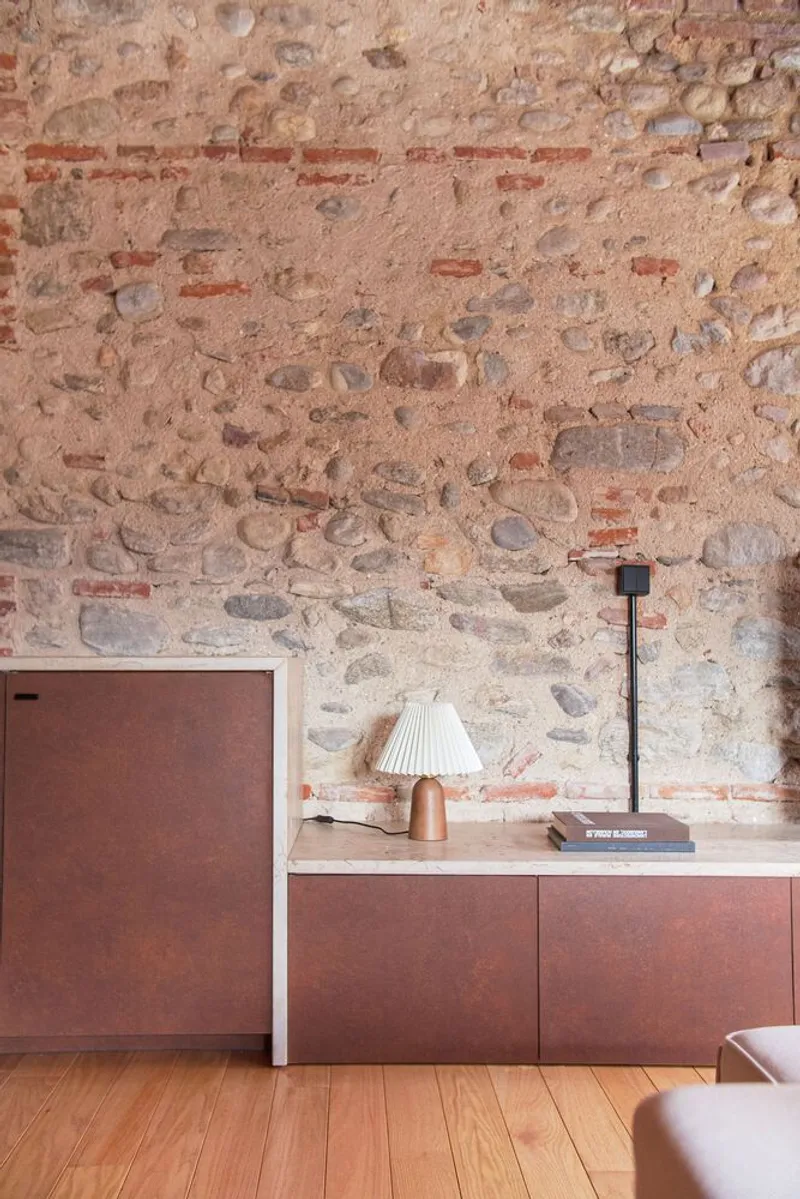
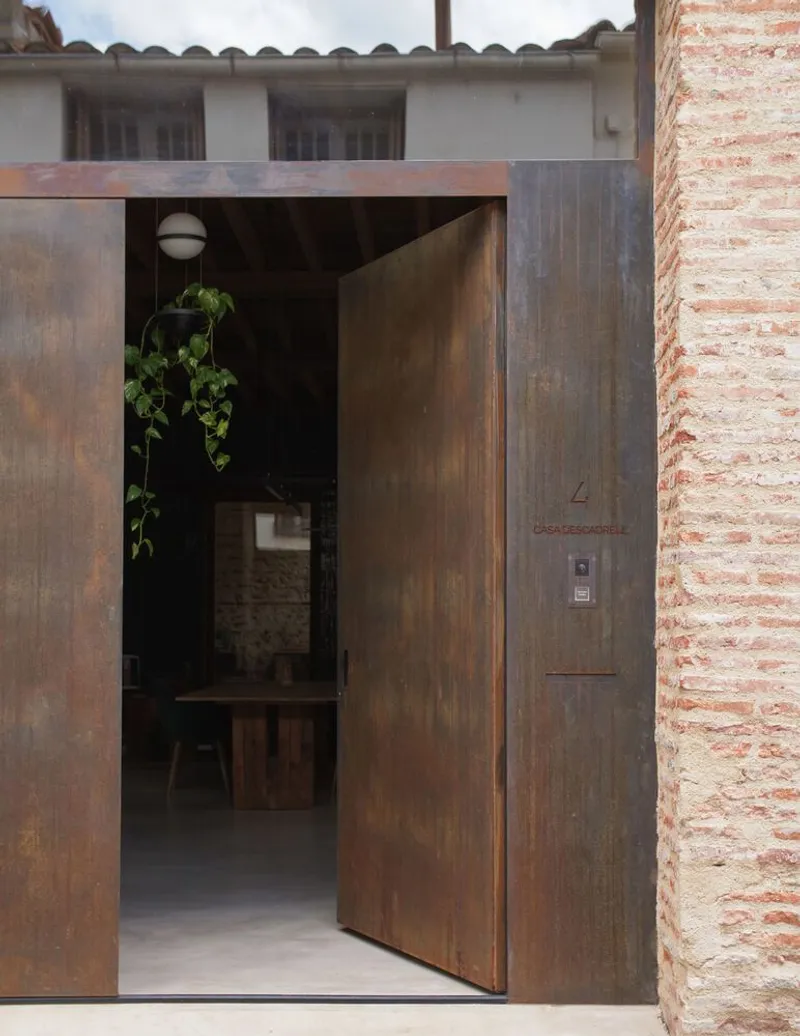
Stripping plaster from old masonry is a gamble. What lies beneath might be structurally compromised, visually incoherent, or simply dull. Here the bet paid off. The revealed walls are a layered composition of river stone and cayrou, the local terracotta-colored stone typical of Catalan construction, punctuated by bands of brick. The effect is geological: you read the history of the building in its section, each material a record of a different builder or era.
The weathered steel entry door, set into a frame of recycled brick, signals the approach from outside. It is industrial in tone but modest in scale, respecting the proportions of the village streetscape. Inside, a copper-toned cabinet placed against the layered stone wall demonstrates how the architects handled the meeting point between old fabric and new furniture: minimal contact, high contrast, and enough negative space to let the texture breathe.
The Patio as Vertical Hinge
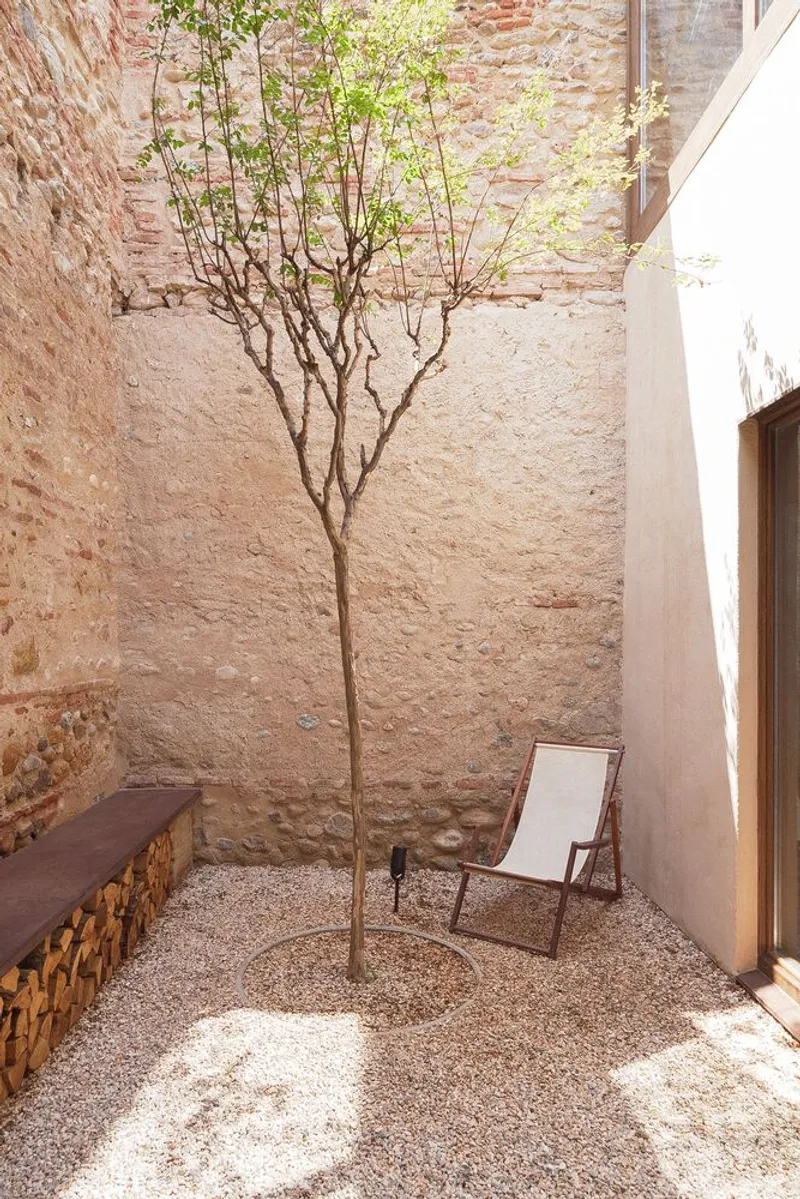
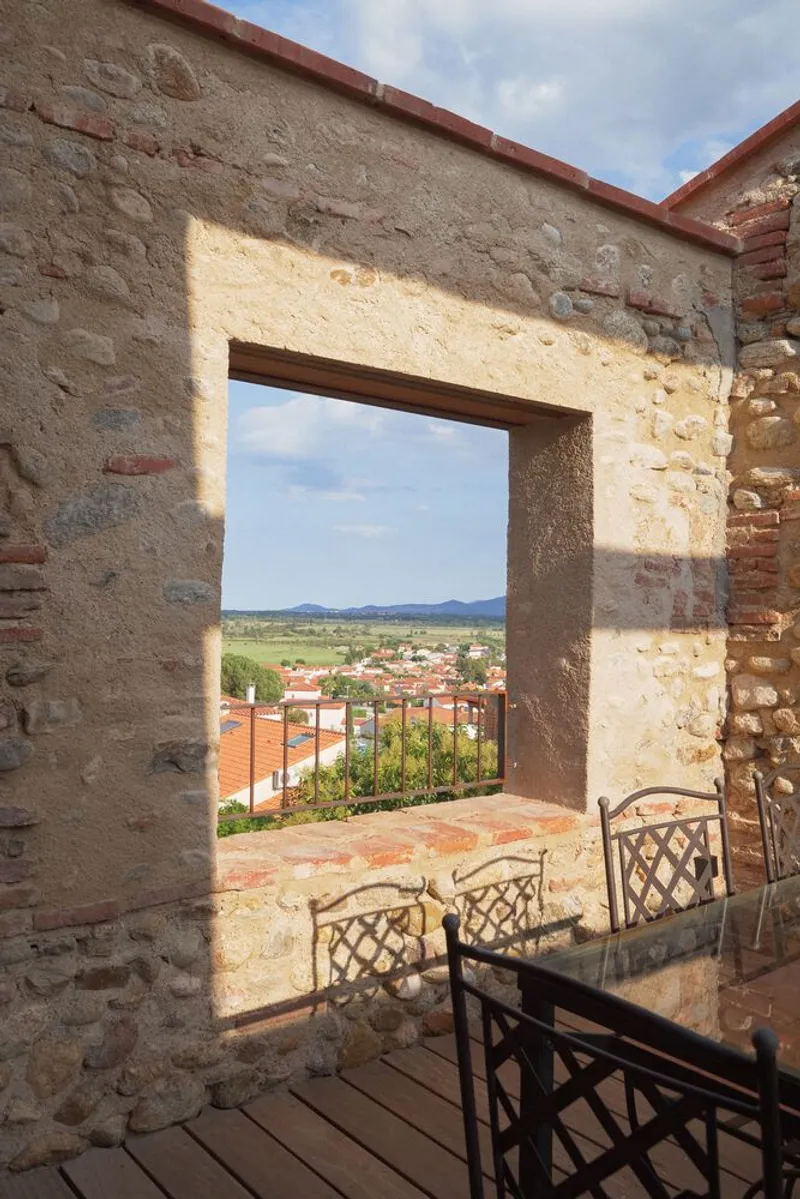
Removing part of the roof was the project's defining decision. The resulting gravel courtyard, open to the sky and oriented south toward the Albères range, does triple duty. It brings daylight deep into the plan, connects the ground-floor studio to the first-floor living space through a double-height void, and gives the inhabitants a framed view of distant hills and terracotta rooftops. A young tree planted in the gravel and a single canvas chair suggest how the space is actually used: casually, seasonally, as an outdoor room rather than a formal garden.
From the upper level, a stone and brick window opening captures the view with almost cinematic precision. The thickness of the masonry wall becomes the frame, and the distant landscape sits within it like a painting. It is a move that depends entirely on the original construction: no new wall could achieve that depth of reveal, that sense of looking through the building's body to what lies beyond.
Timber Framework and the Catalan Ceiling
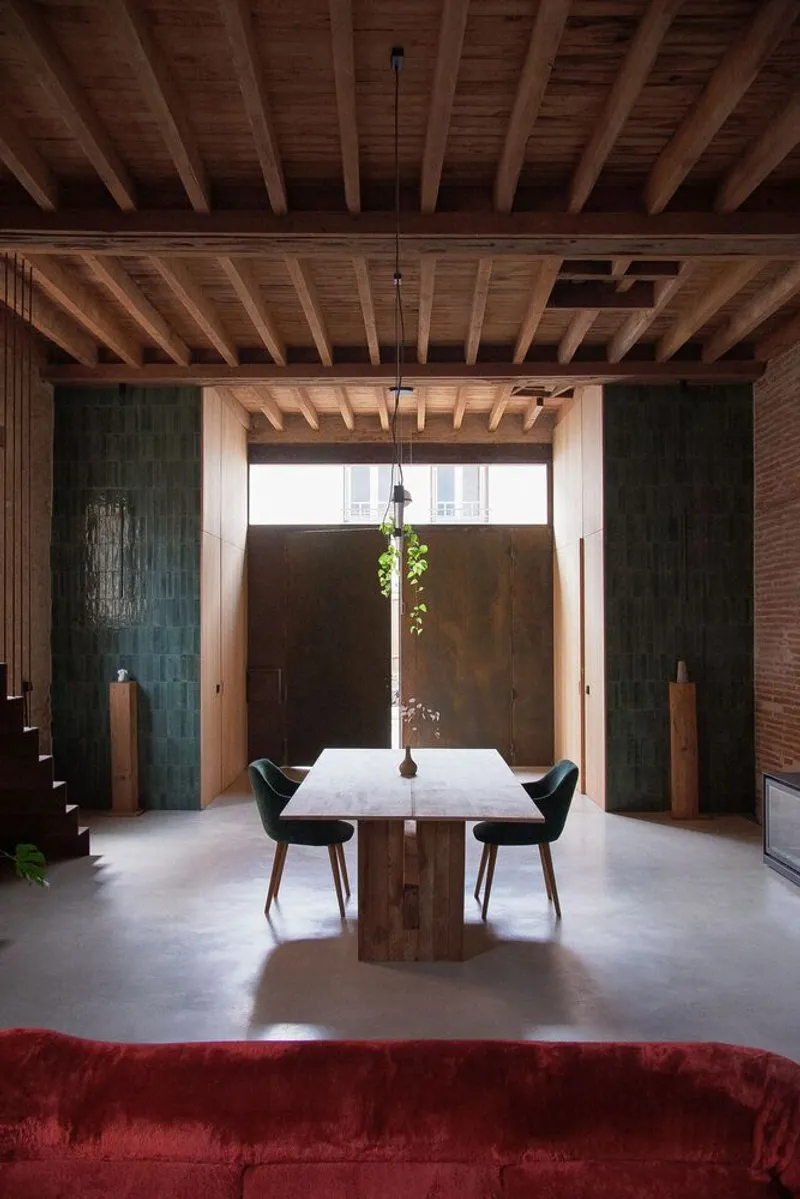
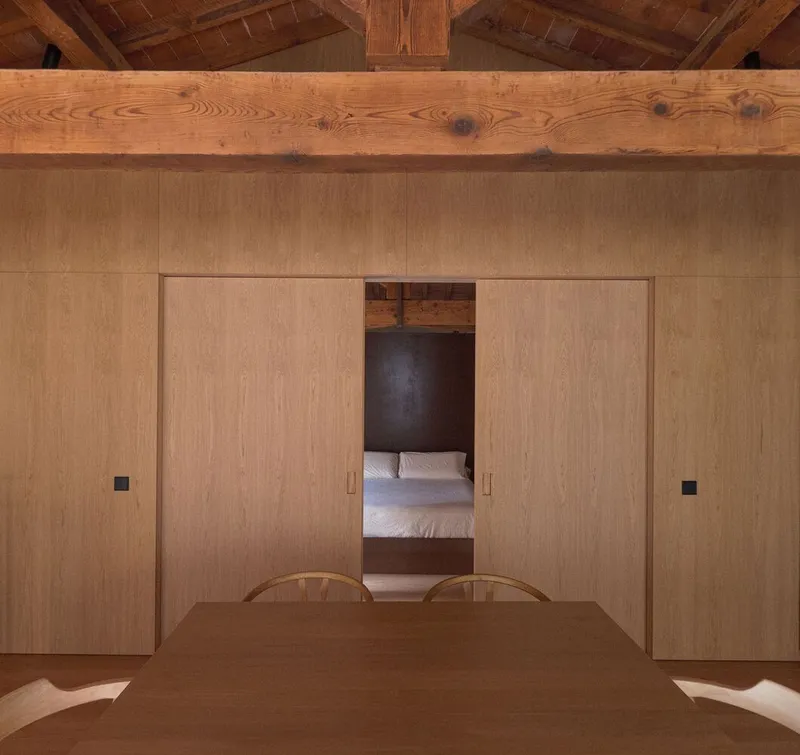
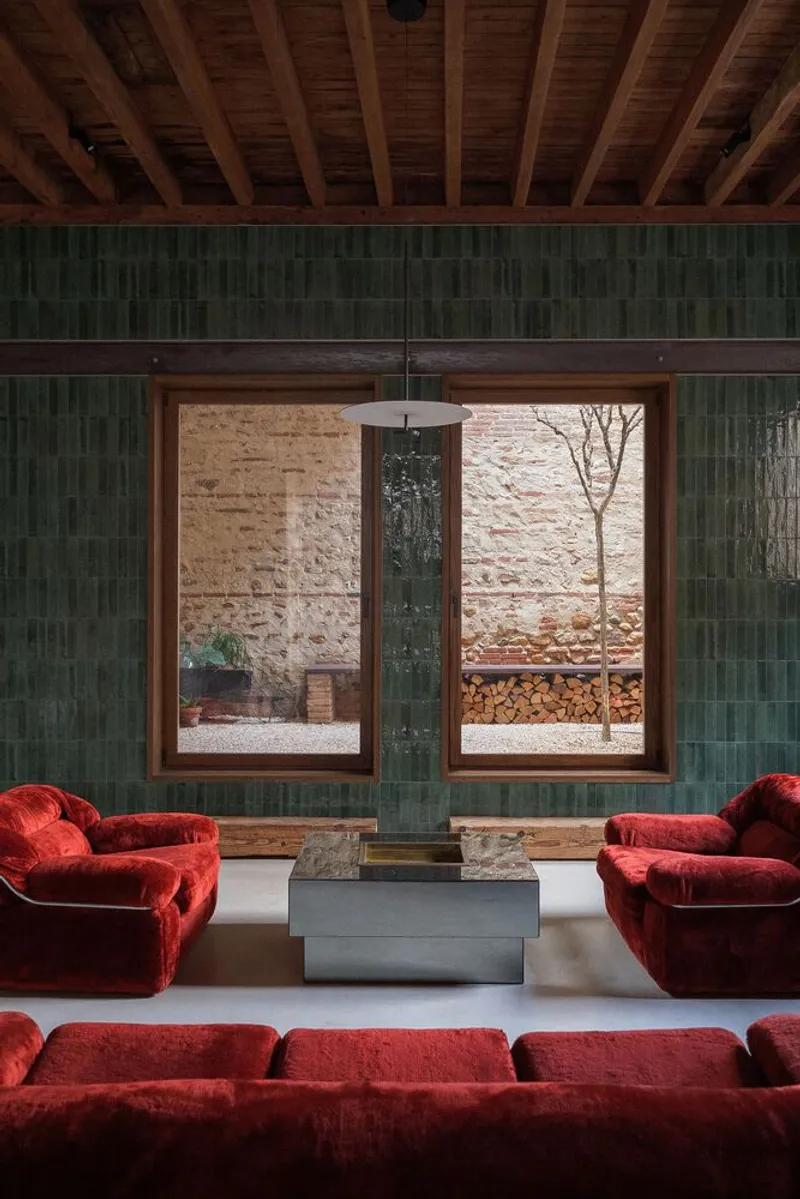
The preserved timber framework dominates every interior room. Exposed joists and rafters run overhead in a close rhythm, their dark patina contrasting with the lighter tones of new oak joinery. In the dining area, the ceiling reads as a continuous wooden plane, its weight balanced by a window flanked by green-tiled walls that pull the eye outward. The color choice is deliberate: green tile against warm timber is a chromatic pairing with deep roots in Mediterranean domestic architecture, and it works here without feeling borrowed or nostalgic.
Light oak sliding doors open to reveal a bedroom under the same exposed beam ceiling, maintaining material continuity across the living spaces. The joinery is precise but unfussy, with clean track-mounted panels that slide without competing with the rough texture of the beams above. It is the kind of detail that registers as effortless only because it was carefully thought through.
Living with Raw Surfaces
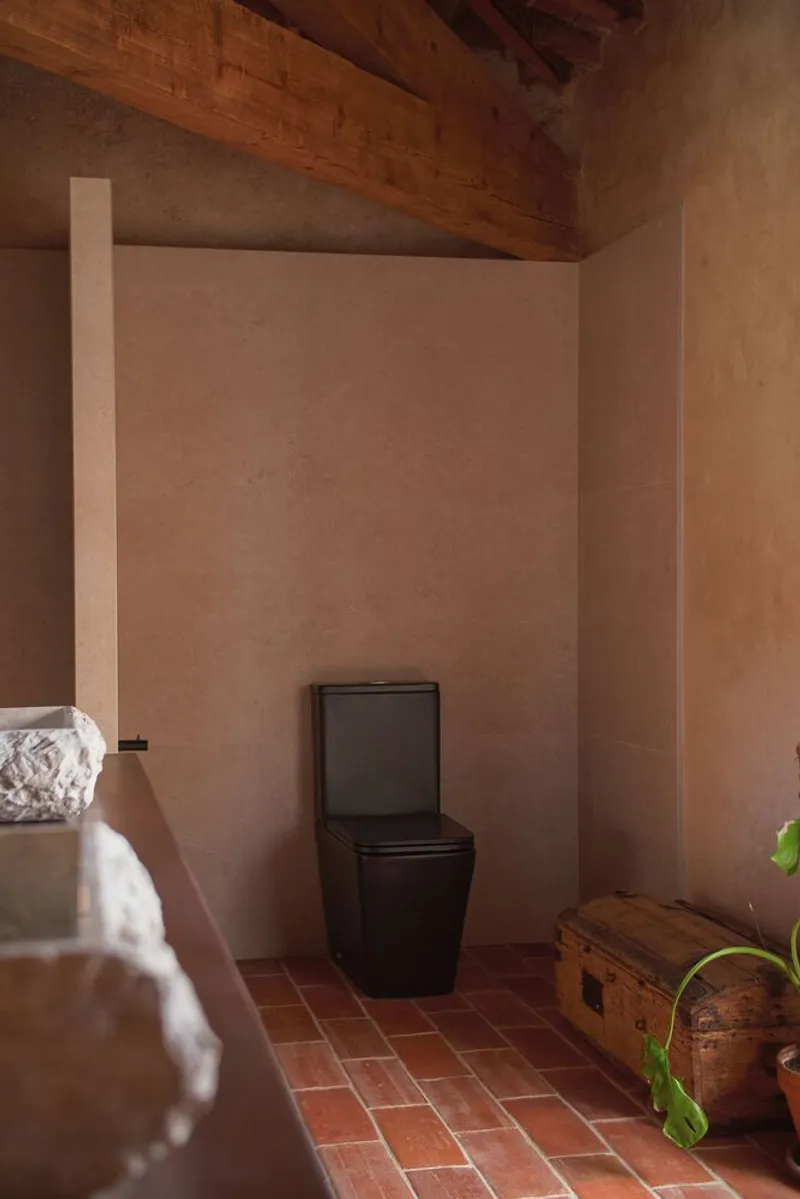
The commitment to raw materials extends into every corner of the house, including the bathroom, where a black fixture sits on terracotta tile beneath the exposed timber roof structure. There is no attempt to conceal the building's skeleton in the private rooms. The consistency is the point: if you accept the logic of preservation in the public spaces, it would be dishonest to hide it behind plasterboard in the bathroom.
In the main living space, a green tile column and deep timber window frames look out onto the courtyard below, with a stack of firewood tucked beneath the sill. The arrangement is practical and unpretentious. The firewood is not a decorative gesture; it heats the house. The tile is not an accent wall; it wraps a structural element. Every visible surface has a job, and nothing is present solely for effect. That discipline gives the interiors their particular quality: they feel inhabited rather than styled.
Why This Project Matters
Casa Descadrell belongs to a growing body of work in which the renovation of a modest vernacular building is treated not as a lesser commission but as a genuine design problem. The constraints are real: limited budget, protected village context, thick masonry walls that resist easy modification. Within those limits, Symbiose found a project strategy that is almost entirely subtractive. Remove the plaster, remove a piece of roof, recover the original openings, and let the building reveal its own logic. The additions, oak joinery, green tile, steel doors, are calibrated to amplify what was already there rather than to compete with it.
For architects working in historic village cores across southern Europe and beyond, this project offers a useful model. It demonstrates that adaptive reuse does not require spectacle, and that a coherent material palette drawn from the building itself can generate spaces with more character than most new construction achieves. The patio, in particular, is a lesson in doing one thing well: a single surgical cut that transforms the section, the light, and the relationship to landscape in a single move. That economy of means is worth paying attention to.
Casa Descadrell by Symbiose Interior Architecture & Design, Villeneuve-de-la-Raho, France, 2022. Photography by Lucille Descazaux.
About the Studio
Share Your Own Work on uni.xyz
If projects like this are the kind of work you want to make, uni.xyz is a place to publish your own, find collaborators, and enter design competitions.




Popular Articles
Popular articles from the community


Co-Life: Senior Housing Design That Reconnects Older Adults With the City
Co-Life reimagines senior housing design through healing gardens, shared streets, workshops, and a sustainable community across generations.

Conexión: Biophilic Design Reimagines High-Rise Living in Hong Kong
Conexión reimagines high-rise living in Hong Kong through biophilic design, green facades, shared spaces, daylight, water and nature within.

Co-life: Sustainable Architecture for Age-Friendly Community Living
Co-life reimagines sustainable architecture for seniors through courtyards, rammed earth, shared gardens, and spaces designed for belonging.

The Ocean Hive: Sustainable Architecture for a Self-Sufficient Civilization at Sea
The Ocean Hive imagines sustainable architecture at sea, where modular habitats, algae, wave power and ocean waste sustain a growing colony.


Similar Reads
You might also enjoy these articles


Hodi-Mandai Geram
Project Function: Preservation and revitalization of the Intangible heritage and socio-spatial identity of the Hodi by Housing, Cultural Memory Center, Sacred Grove, landscape, local tourism economy


Olio Towers: A Mid-Rise for Performers That Fuses Housing, Rehearsal, and Stage
Located blocks from Houston's Theater District, this modular tower stacks living units around a central performance atrium.

Oasis: Modular Green Housing Carved into Dhaka's Urban Fabric
A shortlisted Plugin Housing entry reclaims unauthorized settlements in Dhaka with stepped concrete volumes, green roofs, and ventilation-driven design.

Black Hole: A Floating Megastructure for the Post-Physical Era
Emiliano Mazzarotto envisions a spherical, self-scaling arena where e-sports, digital hotels, and holographic stadiums replace traditional public space.


Explore Architecture Competitions
Discover active competitions in this discipline



Challenge to reimagine the Iron Throne


Photograph architecture without architects


Illustrate the lost glory of Angkor Wat - Render Challenge


Design challenge to reuse E-waste
Comments (0)
Please login or sign up to add comments
No comments yet. Be the first to comment!