
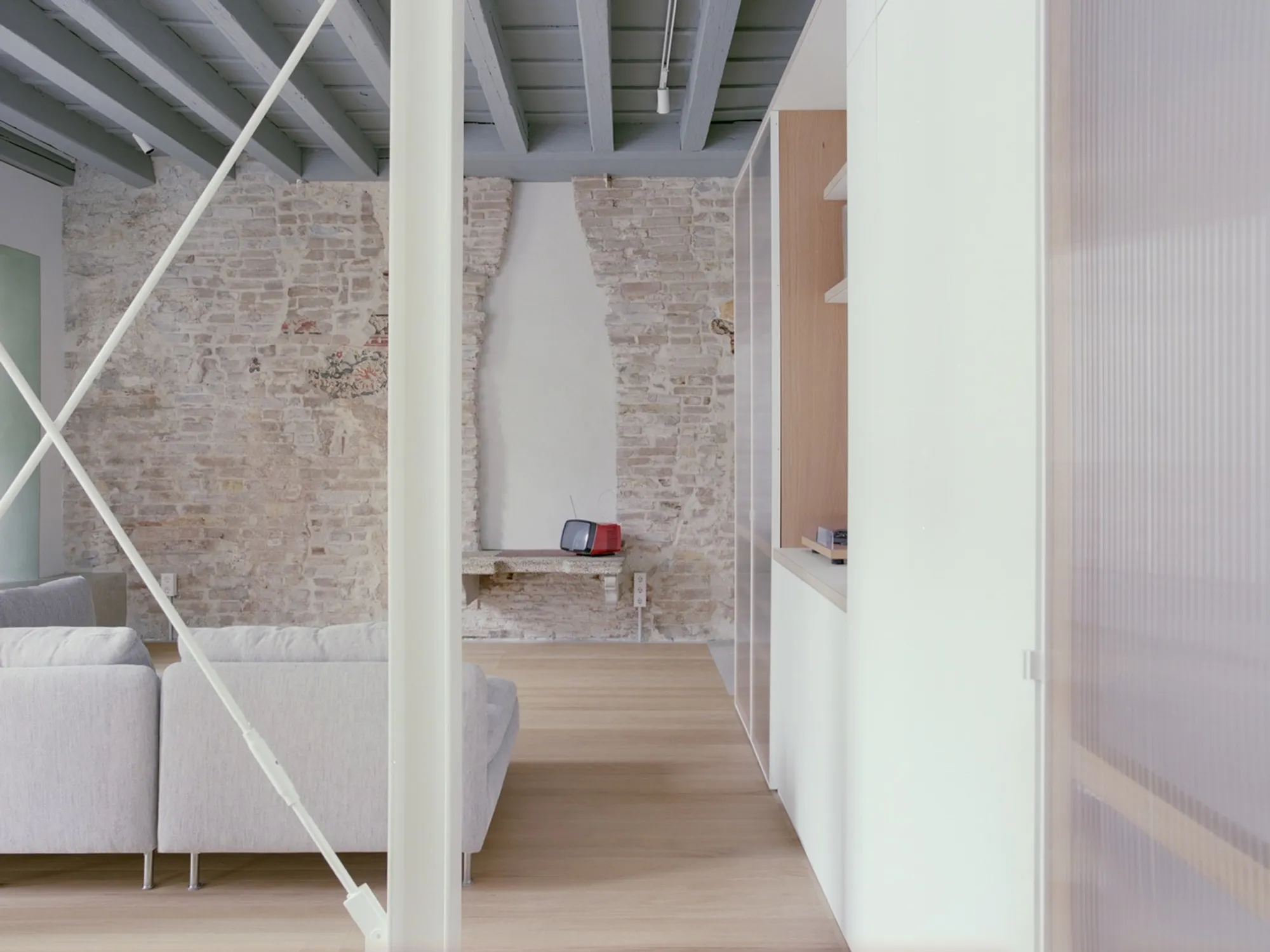
Vianello Gasparin Peels Back Five Centuries of Plaster in a Padua Apartment on Via del Santo
A sixteenth-century building on one of Padua's most storied streets becomes a lesson in letting demolition guide design.


Most renovations start with a plan. Casa ST started with a hammer. When Serena Vianello and Tommaso Gasparin of Vianello Gasparin began stripping back false ceilings and layers of lime plaster inside a sixteenth-century building on Padua's Via del Santo, they found something better than any concept sketch: grotesque frescoes surviving from centuries past, structural brick dating to the 1400s, and a pair of crossed tie-rods that would become the project's signature element. Rather than imposing a preconceived aesthetic onto the apartment, the architects let these discoveries steer every subsequent decision.
The result is a home where old and new coexist without pretending to be continuous. Contemporary additions, all rendered in white coatings, panels, and perforated metal, read as an abstract mono-material layer that deliberately refuses to mimic what surrounds it. A metal portal replaces a demolished partition wall. Polycarbonate conceals a mezzanine laundry. Gray Vicenza Stone forms a monolithic podium that doubles as seating. Every modern intervention announces itself, and in doing so, grants the historic fabric room to speak on its own terms.
Brick, Beams, and the Logic of Exposure
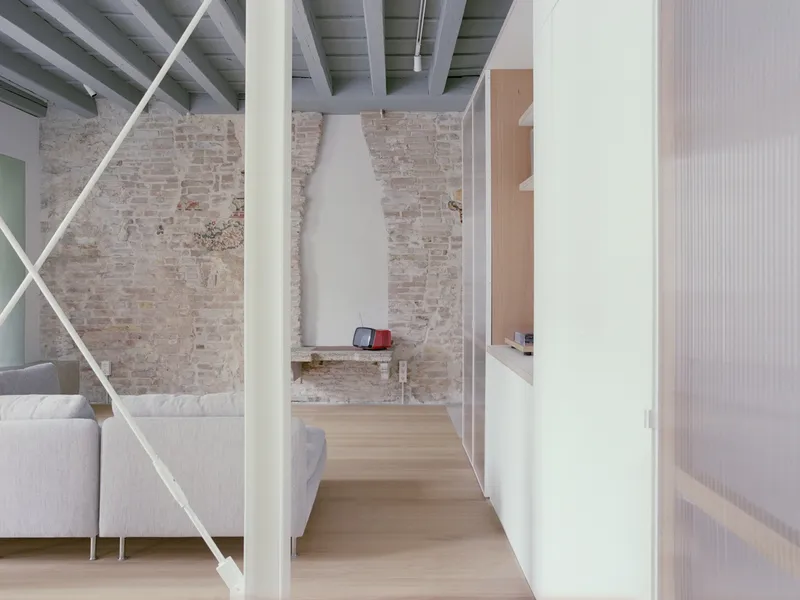
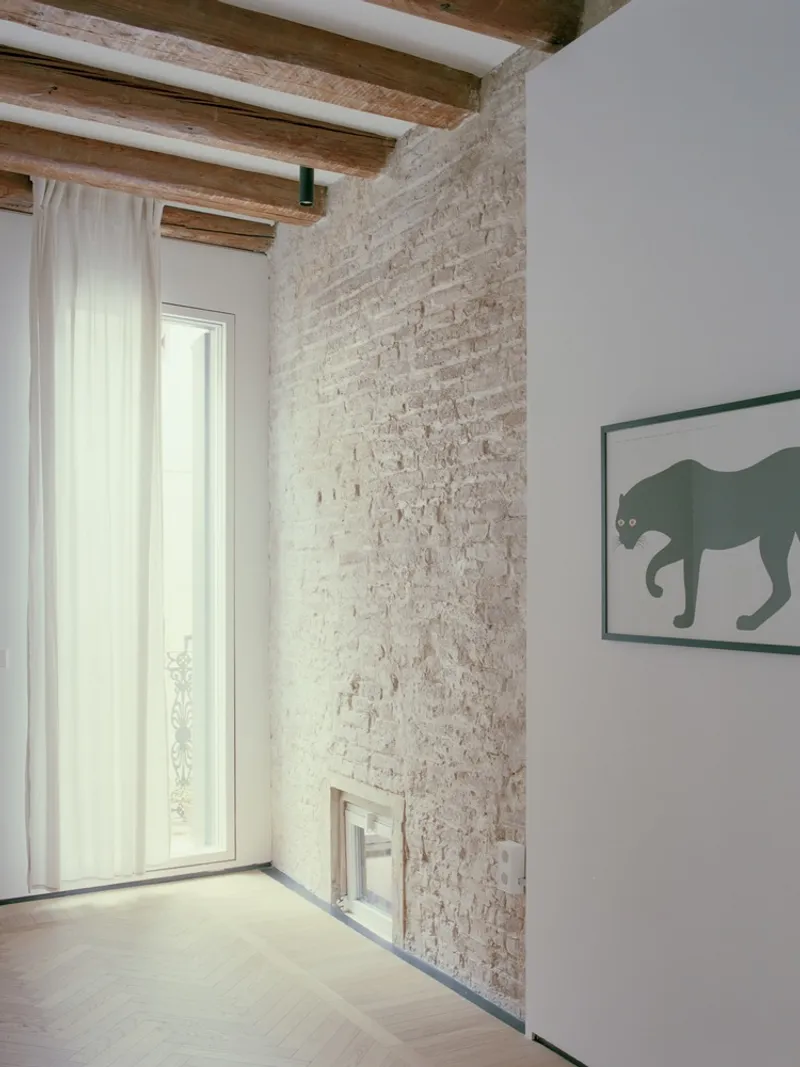
The most consequential design move in Casa ST is also the simplest: removing what hides the building's history. Reed ceilings were dismantled to reveal painted timber beams and original coffers. Walls were selectively stripped to expose rough brick cladding that carries the texture of five centuries of load-bearing duty. What remains is not a polished heritage display but a raw, material-perceptual narrative where each surface records a different era.
The tension between these surfaces and the white, precisely detailed contemporary insertions gives every room its energy. A tall window with white curtains sits against exposed masonry that has never been pointed or cleaned to look decorative. The timber beams overhead retain traces of original pigment. Nothing is cosmeticized, and that restraint is what makes the spaces feel genuinely old rather than merely old-looking.
The Metal Portal as Structural Gesture
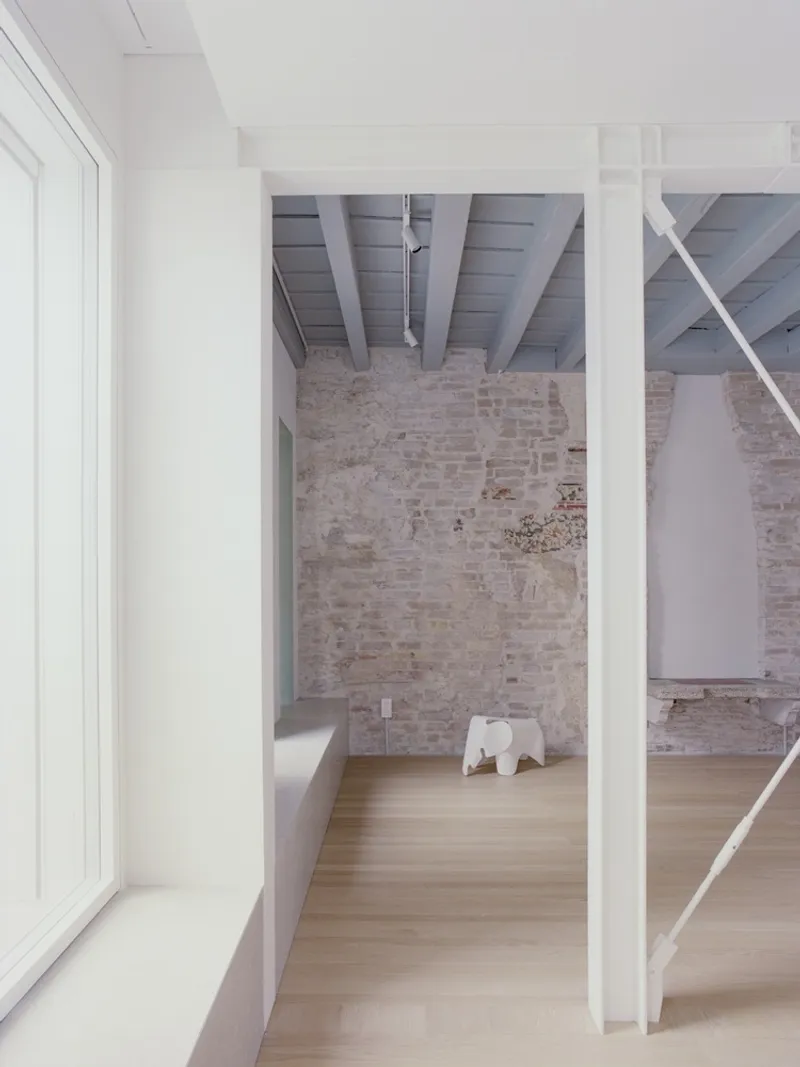
Demolishing the wall between two rooms to create a single unified living area required its replacement with a metal portal braced by counter-braces. Vianello Gasparin turned this structural necessity into the apartment's most theatrical moment. The portal intermittently frames grotesque decorations that survive on the surrounding masonry, acting less like a beam and more like a picture frame scaled to architecture.
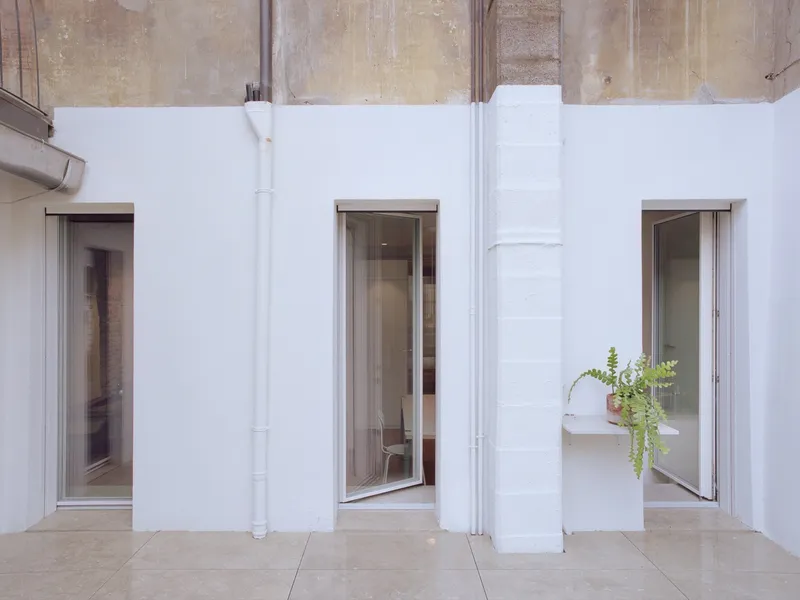
From the corridor, the effect is cinematic. White partition walls channel the view toward the double-height volume where exposed brick meets painted beams, and the metal structure reads as an honest, contemporary skeleton holding the historic body together. The courtyard-facing windows, visible in the exterior shot with their steel frames set into original masonry, were enlarged during the renovation to pull daylight deeper into the plan and provide access to the terrace.
Corridor as Threshold
The long corridor connecting living and sleeping zones is more than circulation. Its sections vary in width and height, and its walls shift between perforated metal wainscoting and polycarbonate panels that filter borrowed light from the mezzanine laundry behind. An octanium shade applied in the hallway and bathroom introduces a color temperature distinct from the white-on-brick palette elsewhere, marking this zone as transitional rather than purely functional.
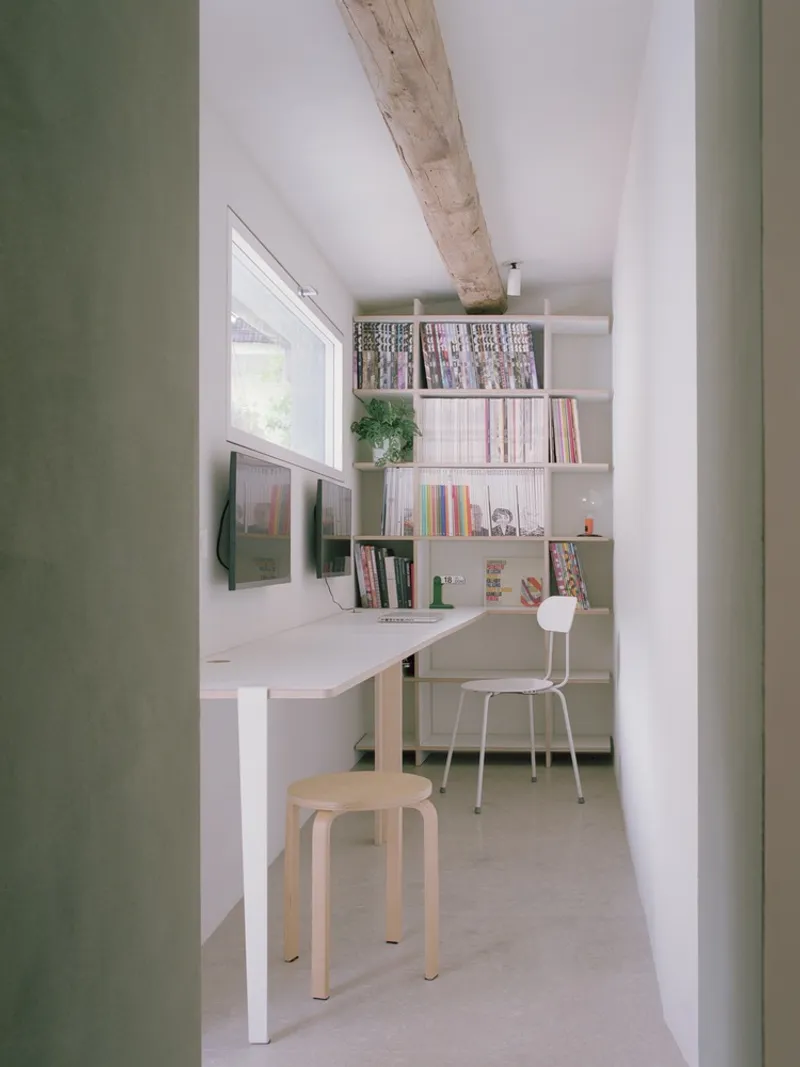
At the corridor's far end, the study alcove appears as a compact, purposeful room: built-in desk, floor-to-ceiling bookshelves, and an exposed timber beam running overhead that ties the space back to the apartment's structural memory. The study floor is gray Vicenza Stone, the same material that forms the living room's monolithic podium and the terrace paving, creating a material thread that links the most contemplative interior to the outdoors.
Material Strategy: Vicenza Stone and Cementitious Aggregate
Vianello Gasparin limited the material palette for new surfaces to a handful of elements that carry local resonance. Gray Vicenza Stone, quarried in the Veneto region, appears in three roles: as a monolithic seat in the living room, as study flooring, and as terrace paving. A cementitious conglomerate embedded with fragments of the same stone covers the remaining floors and bathroom surfaces, so the ground plane throughout the apartment reads as a single geological family.
Against this mineral base, the white insertions, boiseries, panels, perforated metal sheets, and painted surfaces function as a deliberately abstract counterpoint. They never try to match the brick or timber in warmth or age. The lack of continuity between old and new is not a flaw but the thesis: every element declares its date, and the apartment becomes legible as a timeline rather than a frozen moment.
Why This Project Matters
Casa ST matters because it demonstrates a method, not just a style. The approach of letting demolition reveal the design rather than confirm it is easy to describe and extremely difficult to execute. It demands architects willing to postpone decisions, clients willing to tolerate uncertainty, and a construction team capable of switching between preservation and precision fabrication on the same wall. Vianello Gasparin managed all three on one of Padua's most historically sensitive streets.
The project also reframes what energy performance means inside a protected historic envelope. Internal insulation, underfloor heating, and a heat-pump-driven air conditioning system were threaded through the building without compromising the facade or the newly exposed interior surfaces. That pragmatic layer, invisible in the photographs, is what makes this apartment genuinely habitable rather than merely visitable. Heritage renovation that ignores thermal comfort is scenography. Casa ST is architecture.
Casa ST by Vianello Gasparin (Serena Vianello and Tommaso Gasparin), Via del Santo, Padua, Italy. Apartment renovation, completed 2023. Photography by Marcello Mariana.
About the Studio
Share Your Own Work on uni.xyz
If projects like this are the kind of work you want to make, uni.xyz is a place to publish your own, find collaborators, and enter design competitions.



Popular Articles
Popular articles from the community


Riyadh For All: Intergenerational Urban Design for Active Aging in Rabat
Riyadh For All reimagines urban design in Rabat with intergenerational co-living, adaptive courtyards, and Moroccan cultural exchange today.

The Ocean Hive: Sustainable Architecture for a Self-Sufficient Civilization at Sea
The Ocean Hive imagines sustainable architecture at sea, where modular habitats, algae, wave power and ocean waste sustain a growing colony.

Co-life: Sustainable Architecture for Age-Friendly Community Living
Co-life reimagines sustainable architecture for seniors through courtyards, rammed earth, shared gardens, and spaces designed for belonging.

Hill & Cross Opera: Sculptural Opera House Architecture Shaped by Tallinn’s Landscape and Identity
Hill & Cross Opera reimagines opera house architecture in Tallinn through its sculptural hill, civic plaza, glass wave and a luminous cross.


Similar Reads
You might also enjoy these articles


Hodi-Mandai Geram
Project Function: Preservation and revitalization of the Intangible heritage and socio-spatial identity of the Hodi by Housing, Cultural Memory Center, Sacred Grove, landscape, local tourism economy


Olio Towers: A Mid-Rise for Performers That Fuses Housing, Rehearsal, and Stage
Located blocks from Houston's Theater District, this modular tower stacks living units around a central performance atrium.

Oasis: Modular Green Housing Carved into Dhaka's Urban Fabric
A shortlisted Plugin Housing entry reclaims unauthorized settlements in Dhaka with stepped concrete volumes, green roofs, and ventilation-driven design.

Black Hole: A Floating Megastructure for the Post-Physical Era
Emiliano Mazzarotto envisions a spherical, self-scaling arena where e-sports, digital hotels, and holographic stadiums replace traditional public space.


Explore Architecture Competitions
Discover active competitions in this discipline



Challenge to reimagine the Iron Throne


Photograph architecture without architects


Illustrate the lost glory of Angkor Wat - Render Challenge


Design challenge to reuse E-waste
Comments (0)
Please login or sign up to add comments
No comments yet. Be the first to comment!