

CAUKIN Studio Builds a Cyclone-Resistant Hilltop Cafe for a Fijian Village in Eight Weeks
Perched above Savusavu Bay on Vanua Levu Island, the Urata Look Out Cafe turns an informal roadside viewpoint into a community income source.


Between the towns of Labasa and Savusavu, a 90-kilometer mountain road crosses Vanua Levu, Fiji's second largest island. Near the hilltop village of Urata, drivers have long pulled over at an informal lay-by to photograph the panoramic sweep of Savusavu Bay. The spot was also full of litter. CAUKIN Studio, working with the Urata community and the Savusavu Rotary Club, recognized that the instinct to stop at this place could be channeled into something permanent: a 125-square-meter cafe that captures the view, generates sustained village income, and cleans up the hillside in the process.
What makes the project genuinely interesting is not the scenic location but the engineering discipline hidden inside a seemingly simple timber pavilion. Designed with ARUP structural engineers, the building had to resist Fiji's cyclone loads while remaining buildable by a mixed team of international architecture students and over 30 local community members across just eight weeks. Every decision, from the louvred glass panes that replace vulnerable sheet glazing to the portal frames prefabricated in the village and craned into place on site, serves that twin mandate of resilience and transferability. The resulting structure is lifted off the ground, braced at its weak points, and strapped down against uplift, yet it reads as a light, open pavilion rather than a bunker.
Anchored to a Hillside


The cafe sits on the crest of a steep, vegetated slope, its floor plate lifted clear of the terrain so the hillside can breathe beneath it. From below, the building appears almost treelike: a trunk of concrete piers supporting a canopy of timber and metal. From the road above, its striking cross-braced facade operates as a billboard, signaling to passing traffic that something worth stopping for exists here. CAUKIN Studio and lead architects Cassie Li and Joshua Peasley oriented three main openings toward the bay, calibrating the frame so that the view is always the subject and the architecture is always the frame.
Exposed Structure as Ornament


The diagonal cross bracing that stiffens the building against lateral cyclone forces is left fully exposed, turning necessity into the primary visual motif. Triangulated members march along the long elevations, their rhythm broken only by horizontal timber screens that filter sunlight and soften the facade. Inside, the same structural logic is legible overhead: heavy purlins are strapped to trusses with cyclone ties that remain visible as a kind of honest detailing. There is no plasterboard ceiling hiding the engineering.
The choice of treated timber as the sole structural material is deliberate beyond aesthetics. Timber is readily available across Fiji and has deep roots in the country's vernacular building traditions. By designing connections and techniques that local builders can replicate without specialized equipment, CAUKIN Studio intended the cafe as a knowledge-transfer project as much as a building. The 25 international participants who lived in Urata Village during construction were learners alongside the community members, not outside experts parachuting in.
Passive Comfort in a Tropical Climate
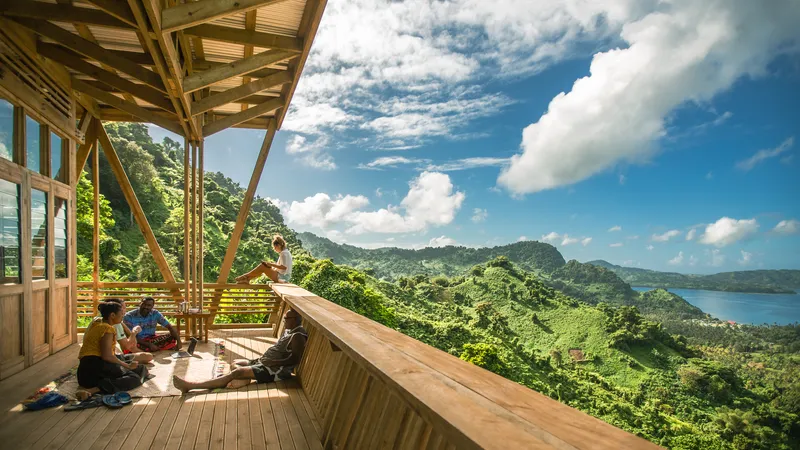
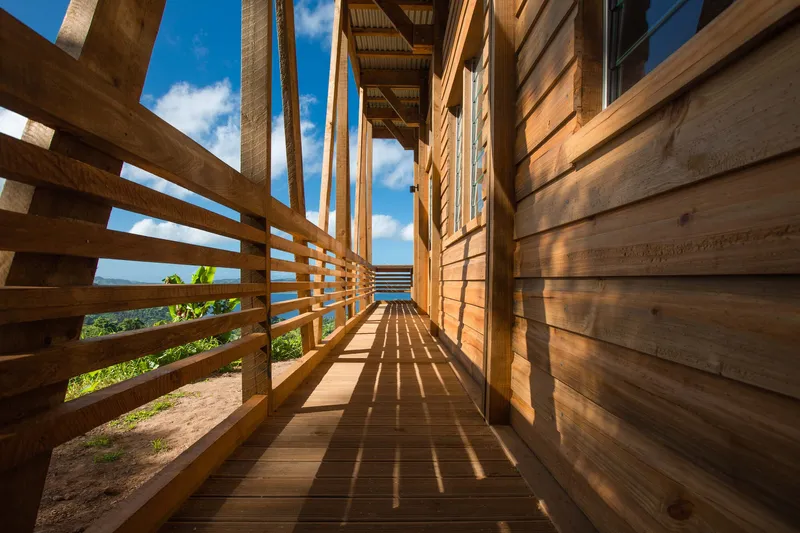

The asymmetric pitched roof is not just formal expression; it drives a stack effect that pulls hot air up and out while drawing cooler air in from the shaded veranda below. Large bifold and tri-fold doors dissolve the boundary between the open-plan interior and the wraparound deck, ensuring that cross ventilation does most of the climate work. There is no air conditioning. The building runs on a renewable, off-grid energy system, which is both a sustainability choice and a practical one for a rural hilltop site far from the nearest power infrastructure.
Louvred windows replace sheet glass throughout, a detail that may read as merely traditional but is in fact a calculated cyclone strategy. Individual glass panes in a louvre assembly are cheaper to replace and far less dangerous when broken by high winds than a full sheet of glazing. These are the kinds of decisions that distinguish a building designed for a specific place from one that merely sits in it.
Veranda Life and Flexible Interior

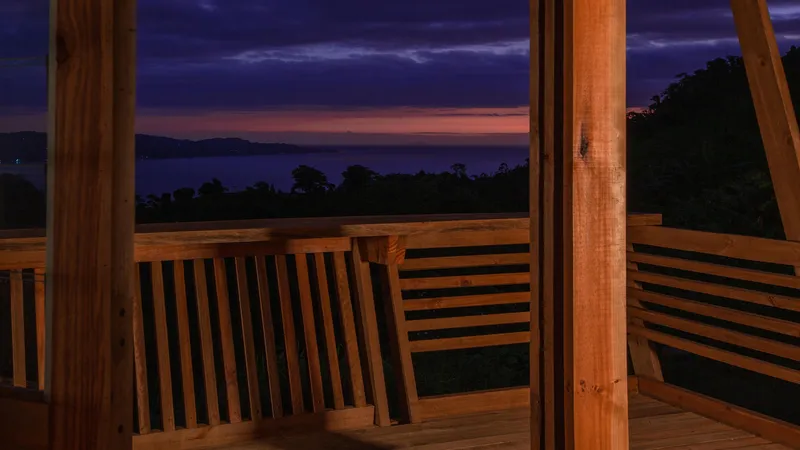
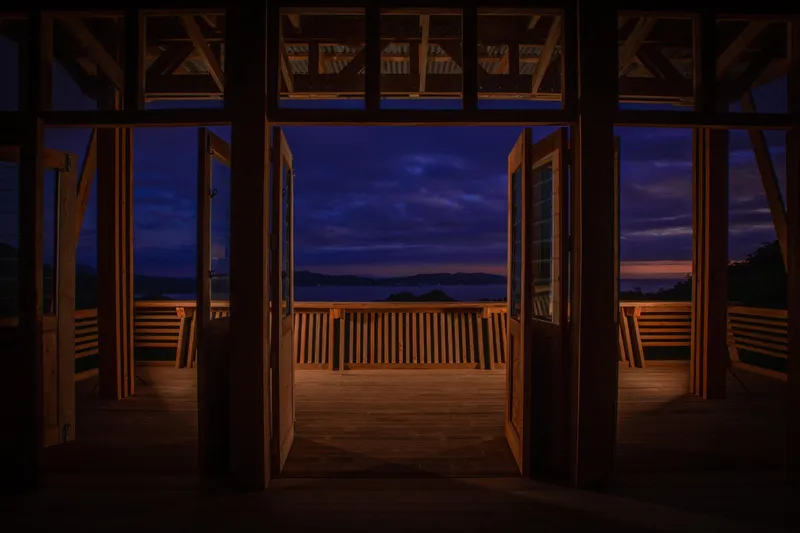
The program splits cleanly between a public cafe zone and a small private apartment for a live-in caretaker, complete with its own bathroom. Two public toilets serve visitors. But the real spatial asset is the flexibility of the open-plan interior: seating can be rearranged freely, the space can be hired for private events, and when the bifold doors swing open, the interior and the broad veranda merge into a single alfresco dining hall overlooking the bay.
The covered walkways and deep overhangs do double duty, providing shade during the heat of the day and shelter during rain, extending the usable season of the outdoor deck to essentially year-round. Horizontal slatted railings cast long afternoon shadows across the timber floor, turning the simple act of sitting with a coffee into a small event of light and landscape.
Building Together


A photograph of the construction workshop tells as much as any finished shot. Portal frames were assembled on plywood floors in the village, tested for fit, then disassembled and trucked uphill to the site, where a crane set them in position. Construction details were developed concurrently with the build itself, meaning the design adapted to the realities of material supply and skill levels in real time. Funding came from a US Embassy Fiji COVID recovery grant to the Savusavu Rotary Club, tying the project to the broader effort to rebuild rural economies after the pandemic.
At night, the finished pavilion glows against the hillside, its warm light visible from the road. Against a sky full of stars, it reads less as a commercial venue and more as a beacon for a community of around 70 houses split across three Mataqali, a land-owning unit fundamental to Fijian social structure. The cafe does not just serve coffee. It serves as proof that a village can build something lasting, resilient, and economically productive with its own hands and its own timber.
Plans and Drawings
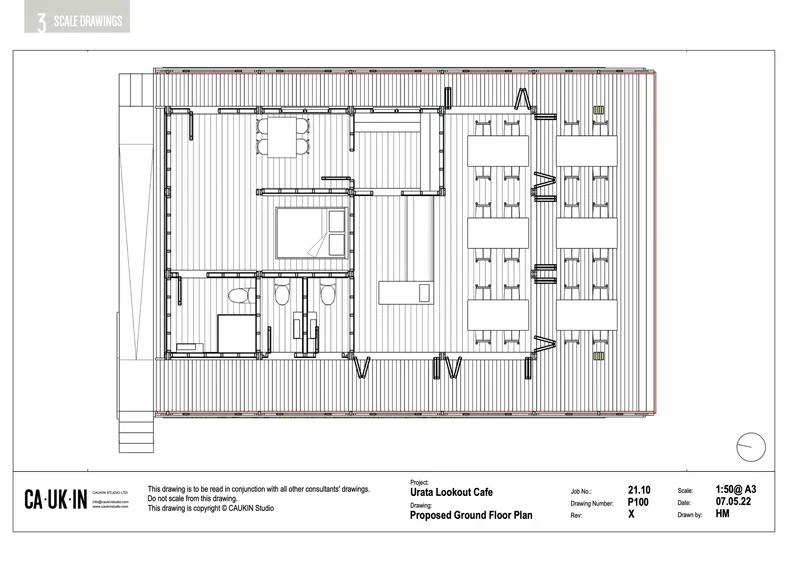


The floor plan reveals the efficiency of the 125-square-meter footprint: a rectangular volume organized around the central dining area, with service spaces and the caretaker's apartment tucked to one side. Section drawings make the stack-effect ventilation strategy legible, showing how the sloped roof lifts away from the occupied zone to exhaust warm air. The four elevations catalogue the full repertoire of screening devices: triangular bracing, horizontal slats, louvred windows, and glazed panels, each calibrated to its orientation. An isometric drawing maps the interior layout and a color-coded signage system that wraps the perimeter, a small but telling indicator that this building was designed to function as a real business, not just a beautiful object.
Why This Project Matters
Community-build projects in the Global South frequently get praised for their good intentions and forgiven for their architectural shortcomings. The Urata Look Out Cafe deserves attention precisely because it refuses that trade-off. The structural collaboration with ARUP means the building is engineered to survive the same cyclones that regularly devastate Fijian infrastructure. The design-build methodology, with frames prefabricated in the village and details developed in real time, is rigorous without being rigid. And the passive environmental strategy is not a gesture toward sustainability but the only viable approach for an off-grid site on a remote hilltop.
More broadly, the project challenges the assumption that rural economic development requires imported materials, imported expertise, and imported design languages. Everything here is local timber, local labor, and local knowledge, augmented by outside engineering support that was structured to leave skills behind when the team departed. The cafe turns a piece of roadside litter into a revenue stream for an entire village. That is a more radical architectural proposition than most buildings ten times its size will ever manage.
Urata Look Out Cafe by CAUKIN Studio (lead architects: Cassie Li and Joshua Peasley), Savusavu, Fiji. 125 m², completed 2022. Photography by Katie Edwards.
About the Studio
Share Your Own Work on uni.xyz
If projects like this are the kind of work you want to make, uni.xyz is a place to publish your own, find collaborators, and enter design competitions.


Popular Articles
Popular articles from the community


ETEH Reworks the Shared Spaces of São Domingos School in Brazil Around Timber, Color and Hanging Plants
At São Domingos School in Brazil, 436 m² of hall, refectory and library are recast with timber joinery, a yellow and blue code and trailing greenery.


Manzana Morphosis: Stretching Barcelona's Grid into a Living Landscape for 2050
A radical reworking of the Eixample manzana turns density into a tool for generous public space, vertical ecology, and environmental performance.

graciastudio Turns a Viewless Tijuana Lot Inward Around a Courtyard of Concrete, Timber and Trees
In Tijuana, Jorge Gracia's GA2 House stacks a timber-clad private floor over exposed concrete and replaces a missing view with a planted interior patio.

David Ortega Stacks a Two-Story Mexico City Penthouse Around a Steel Stair and a Pergola-Shaded Roof Terrace
In Colonia Roma, a 300 m² penthouse uses oak joinery, a planted steel stair and a slatted roof pergola to make a new-build apartment feel like a house.

Similar Reads
You might also enjoy these articles

LAVA Architecten Gives Vocational Education a Sawtooth-Roofed Face on a Mechelen School Campus
In Mechelen, Belgium, a 2,053 m² STEM school on a 6×6 m grid turns workshops and classrooms into rooms that can be rearranged as teaching changes.

KEMA Studio Turns a Derelict Marvila Attic into a 60 m² Lighthouse Apartment Above Lisbon
In Lisbon's Marvila district, a rebuilt roof, four skylights and two plywood volumes turn an unlivable attic into a bright home facing the Tagus.

Pixel Gardens: One Repeated Module Stacked Into a Terraced Social Housing Tower for Famagusta
Salem Bader's shortlisted housing tower builds a vertical neighbourhood from one repeated module, offsetting units to carve terraces, light and air.

Bao Huynh Watercolor Atelier: A Serene Art Retreat in Hội An
Bao Huynh Watercolor Atelier in Hội An blends multifunctional art spaces, sustainable design, local materials, and family-friendly living in a serene environment.

Explore Cafe Competitions
Discover active competitions in this discipline

Challenge to design a portable theatre

Challenge to design a portable music platform

Challenge to design an open learning module for the elderly
Comments (0)
Please login or sign up to add comments
No comments yet. Be the first to comment!