

CH21: Rethinking Communal Housing for Young Muscovites
A six-scale framework of collaboration shapes four housing blocks around shared courtyards, kitchens, and ecological systems in Moscow.


What if the antidote to urban isolation were baked into the architecture itself? CH21, or Communal Housing for the 21st Century, takes that premise seriously. Rather than treating shared space as leftover corridor between private units, the project makes collaboration the literal generator of form: a central pathway of movement radiates outward toward community zones, producing an architectural ecosystem where circulation and social life are inseparable.
Designed by Connor Hopper and published on uni.xyz, CH21 is sited within a dense district of Moscow with strong physical connections to surrounding rivers, urban pathways, and residential developments. Four housing blocks arranged around a landscaped courtyard form a micro-neighborhood for young residents, structured by a six-level framework of collaboration that scales from the individual room to the entire community network.
Six Levels of Collaboration as Spatial Logic
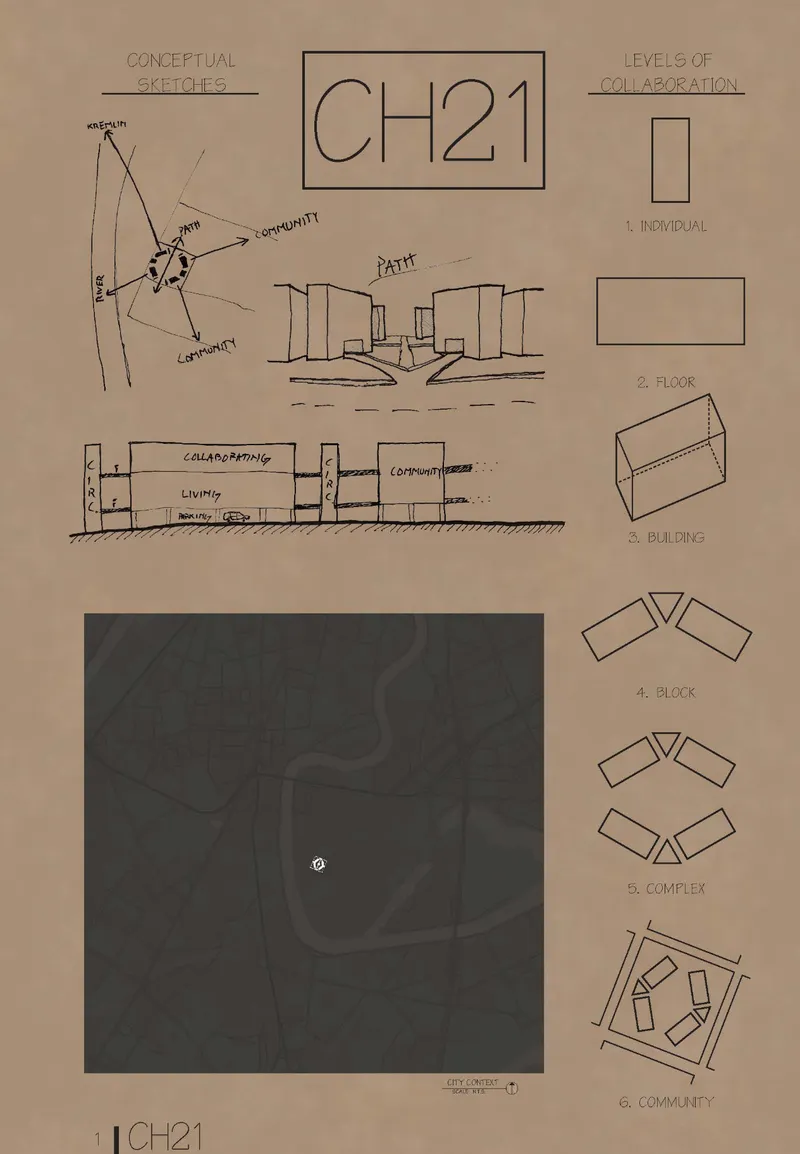
The conceptual diagram sheet lays out the project's DNA. Six nested scales of collaboration, from individual to floor, building, block, complex, and community, each expand the radius of shared experience. These are not abstract categories; they directly inform the spatial hierarchy of every plan, section, and threshold in the scheme. A private room is positioned in relation to a floor's shared kitchen, which connects to a building's communal café, which opens onto a block's courtyard, which feeds into the complex's circulation spine. Each decision reinforces the argument that community is designed, not accidental.
The site plan and section sketches on the same sheet reveal how these scales play out physically. The complex sits strategically within Moscow's urban fabric, acting simultaneously as a destination and a connector that strengthens local mobility. Angled building footprints maximize natural light and passive ventilation while creating triangular zones between blocks that serve as social thresholds for spontaneous gatherings, co-working, or quiet reflection.
Raised Volumes and Horizontal Banding
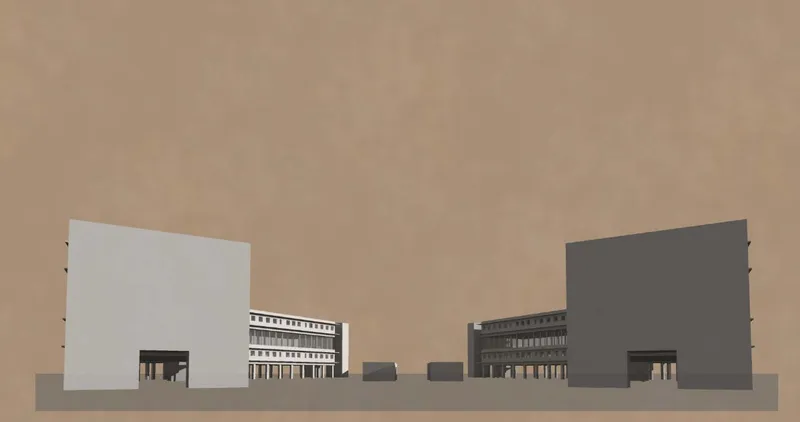
The elevation drawing shows two rectangular volumes flanking a central horizontal banded structure. Pilotis lift the buildings off the ground, allowing continuous public flow at grade level and blurring the line between indoor program and outdoor courtyard. The horizontal banding is not decorative; it registers the graduated shift from community-heavy ground floor programs (dining, recreation, socializing) through blended work and learning spaces on the second floor, up to mostly private living units on the third floor.
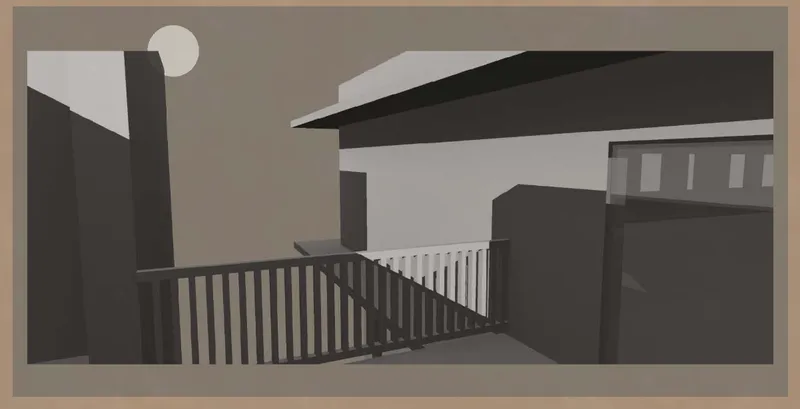
The perspective rendering of a pedestrian bridge between angular building volumes captures one of CH21's most compelling spatial moments. These bridges are more than connectors. They become inhabited thresholds where the six collaboration scales overlap: you are simultaneously on your floor, in your building, crossing to another block, and visible to the community below. Vertical railings and the narrow proportions of the crossing create a sense of compression that makes arrival into the next volume feel like entering a new social zone.
A Facade That Reads Its Own Program
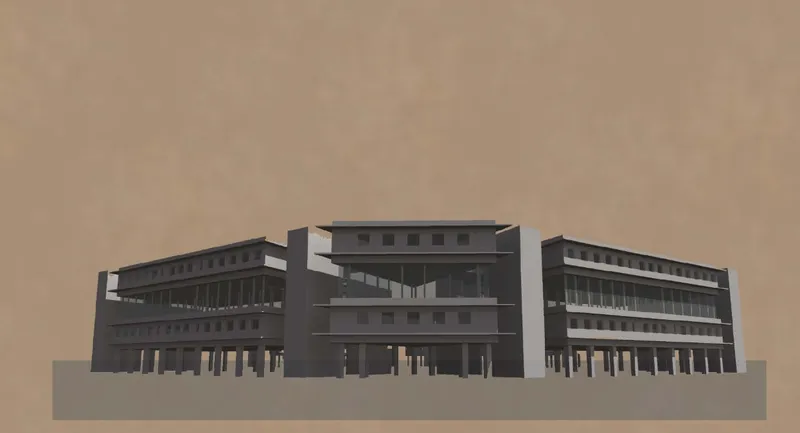
The frontal elevation model makes the building's internal logic legible from the street. A symmetrical facade with horizontal banding frames a central projecting volume that signals the primary communal core. The regularity is purposeful: it provides a calm, repetitive rhythm that lets the shared programs, visible through openings and setbacks, announce themselves without the architecture shouting. The projecting central mass creates depth, shadow, and a clear entry datum that orients residents and visitors alike.
Buildings on Pilotis with Inhabited Gaps
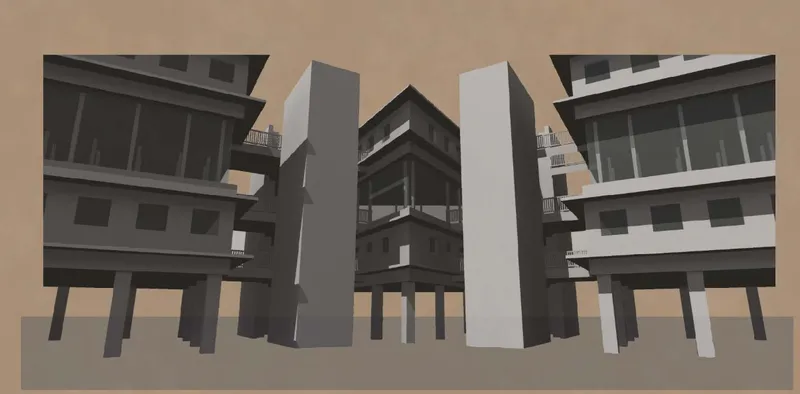
The physical model view of three buildings on pilotis reveals the full spatial strategy at the block scale. Narrow circulation spaces between the volumes are not dead zones but activated passages. Connecting bridges stitch the buildings into a single legible complex while maintaining enough separation for light, air, and visual porosity. The raised typology frees the ground plane for a central water body, sports areas, walking promenades, and vegetated buffers described in the masterplan. Vertical vegetation nodes and living machines (eco-based wastewater systems) are integrated into the program alongside shared kitchens, gyms, laundry facilities, community cafés, and even an animal shelter, reinforcing a shared-responsibility model of sustainable living.
Why This Project Matters
Most youth housing projects start with the unit and add common rooms as amenities. CH21 inverts that sequence. It starts with a theory of collaboration, defines six nested scales, and then derives the architecture from those relationships. The result is a scheme where every threshold, bridge, and courtyard has a social purpose that can be named and measured against the framework. That intellectual rigor gives the project a coherence that pure formal experimentation rarely achieves.
Connor Hopper's proposal also demonstrates that ecological responsibility and communal ambition are not competing agendas. Living machines, vertical vegetation, and passive ventilation strategies are woven into the same spatial logic that produces shared kitchens and game rooms. When the building's environmental systems depend on collective maintenance and the social systems depend on shared space, sustainability stops being a checklist and becomes a way of living together.
View the Full Project
About the Designers
Designer: Connor Hopper
Enter a Design Competition on uni.xyz
uni.xyz runs architecture and design competitions year-round that reward proposals with spatial conviction and real site intelligence.
Project credits: COMMUNAL HOUSING FOR THE 21ST CENTURY by Connor Hopper.


Popular Articles
Popular articles from the community


Architekt Andreas Gruber Scatters 23 Dark Timber Chalets Across a South Tyrolean Forest Edge
In Molini di Tures, Amonti Chalets breaks a resort into a hamlet of gabled timber houses, with parking, storage and services pushed into the slope.

GROUP A Strips a 1969 Rotterdam Harbor Headquarters to Its Frame and Wraps It in Timber Louvers
In Rotterdam's M4H harbor district, Ferro Offices reuses a 1969 frame, adds one timber storey and reaches BREEAM-NL Outstanding.

David Macias Steps a Doorless Stone and Plaster House Down a Tropical Colombian Hillside
In the humid hills of Colombia, Threshold House replaces the front door with an open void and terraces its 850 m² down the slope instead of fighting it.

David Ortega Stacks a Two-Story Mexico City Penthouse Around a Steel Stair and a Pergola-Shaded Roof Terrace
In Colonia Roma, a 300 m² penthouse uses oak joinery, a planted steel stair and a slatted roof pergola to make a new-build apartment feel like a house.

Similar Reads
You might also enjoy these articles


Aquadapt: An Underwater Habitat That Rewrites Its Rooms by the Hour
Curved modules ring the seabed while one shell shifts from breakfast room to cinema, farm and football pitch as residents' needs change.

Play: Fragments of Their World: Remembered Architecture Rebuilt as a Modular Playground for Refugee Camps
Tom Gardner abstracts domes, arches and towers from the homelands of displaced families into a kit of child-scaled play parts for camp settlements.
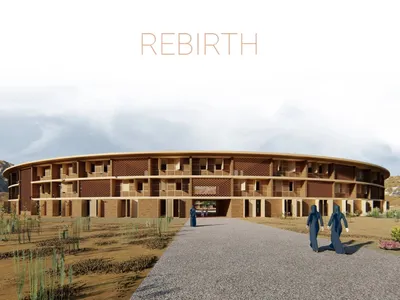
REBIRTH: A Circular Settlement Where Afghan Widows and Their Children Rebuild Life Together
A shortlisted Resile entry turns the circle into a protective ring of timber and brick, gathering homes, classrooms and gardens around a shared landscape.
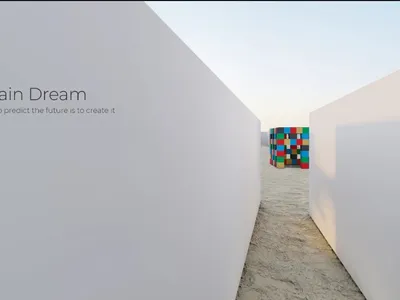
The Main Dream: A Recycled Plastic Kit That Lets Refugee Children Build Their Own Playground
Thirty-centimetre interlocking cubes that connect on three axes turn play into construction, letting children author the spaces they occupy.

Comments (0)
Please login or sign up to add comments
No comments yet. Be the first to comment!