

Zhubo Design and Nickl & Partner Build an Urban Forest Hospital for Children in Shenzhen
A 315,000-square-meter pediatric campus in Longhua District uses courtyards, color, and modular wards to ease the stress of childhood illness.


Hospitals for children carry a design burden that no office tower or museum will ever know: every corridor, every waiting room, every ward must quietly persuade a frightened child that this place is not hostile. In Shenzhen's Longhua District, Zhubo Design and Nickl & Partner Architekten have taken that obligation seriously across 315,000 square meters of built area, producing a 1,500-bed pediatric campus that is simultaneously one of the largest children's hospitals in southern China and one of the most deliberately playful.
What makes the Longhua Campus genuinely interesting is not its size but the clarity of its argument. The architects propose that a high-density medical facility on a constrained urban site can still feel intimate, bright, and almost domestic in scale. They achieve this through a strategy they call the "urban forest," which translates into staggered towers, cloverleaf ward plans, planted facades, and elevated green platforms that bring landscape into every zone of the building. The result reads less like a hospital and more like a small city designed exclusively for children.
Towers and Podium: Reading the Building from the Street
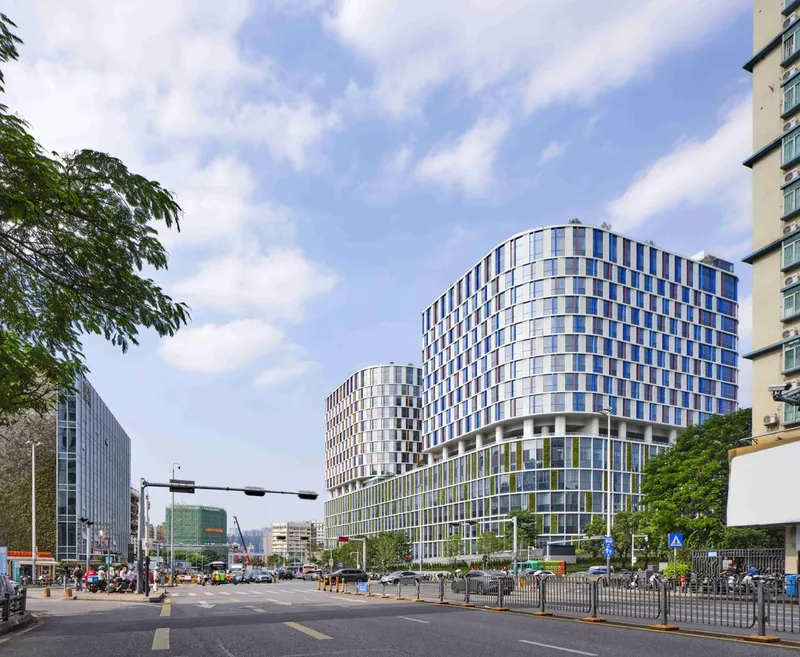
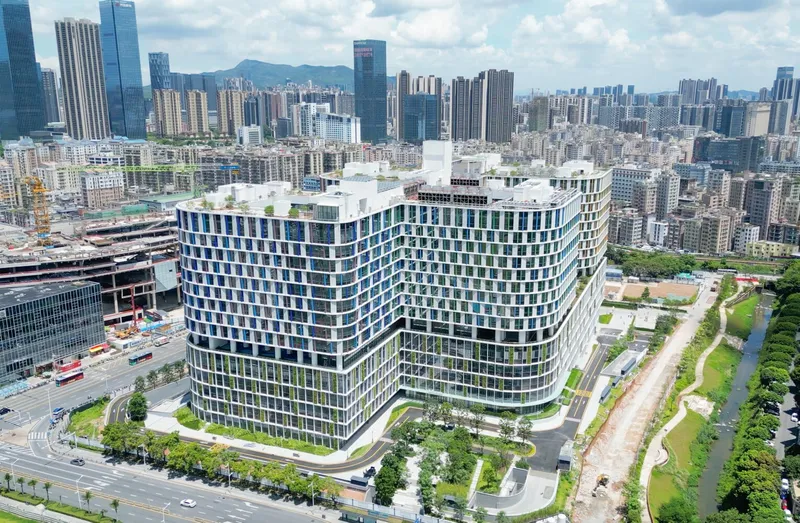
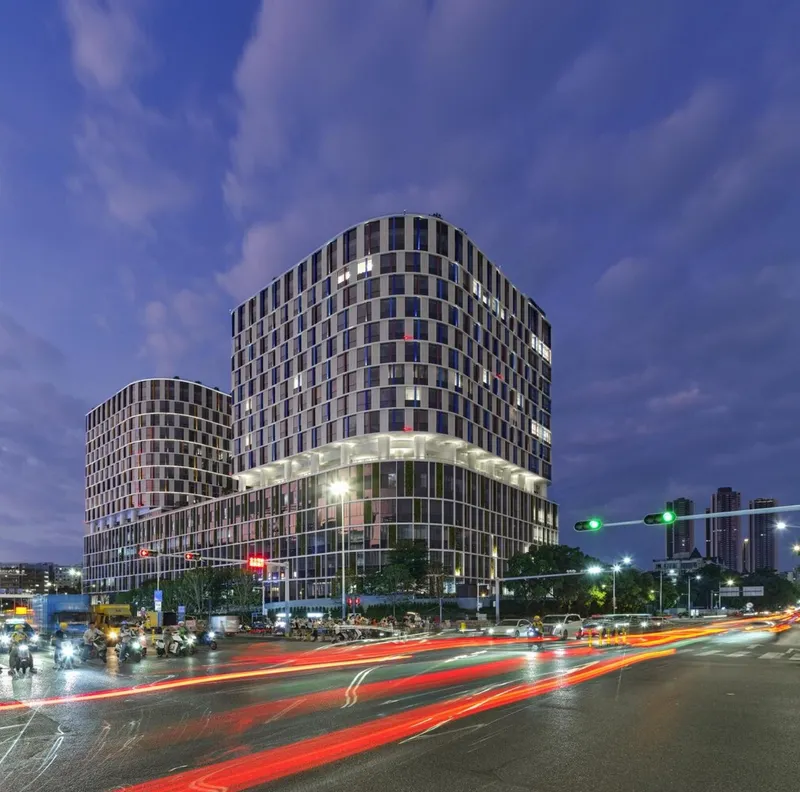
From street level the campus announces itself with twin curved glass towers rising above a transparent podium base. The chequered facades, composed of multicolored panels interspersed with vertical planted strips, give the building a soft, almost textile quality that is unusual for a structure of this scale. At dusk, the illuminated podium and the reflections on wet asphalt dissolve the boundary between building and city, making the hospital feel more like a public amenity than an institutional compound.
The aerial perspective reveals how carefully the twin towers have been placed to open sightlines and allow air movement through the site. Landscaped pathways, a canal, and generous setbacks from the road keep the hospital from overwhelming its neighbors in the Minzhi area. With a floor area ratio of roughly 5.1, density is high, but the architects have distributed mass in a way that never feels oppressive.
Vertical Greenery and the Living Facade
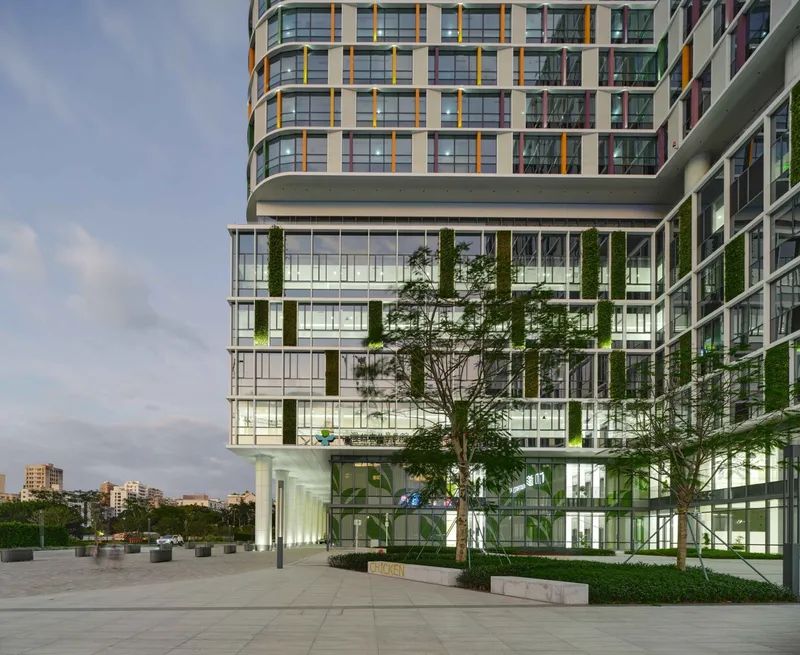
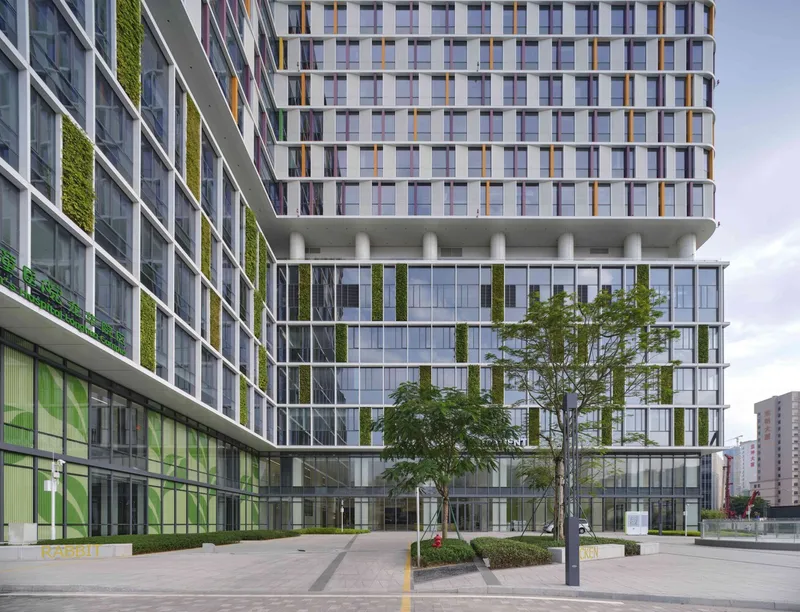
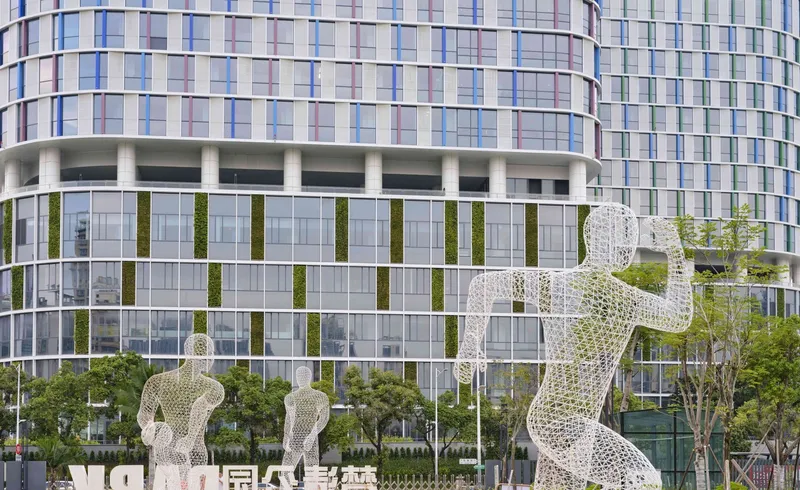
The most visible expression of the urban forest concept is the facade itself. Vertical green wall panels are threaded between glazed bays across the podium, turning what would otherwise be a standard curtain wall into a layered composition of glass, planting, and color. At the plaza level, trees in planters and young courtyard plantings reinforce the vertical greenery above, establishing a continuous gradient from ground to sky.
White mesh figural sculptures stationed outside the podium add a whimsical note that signals the building's purpose before anyone reads a sign. These gestures are deliberate: a child arriving for a blood draw or a consultation encounters animals and greenery before encountering a reception desk. That sequencing matters enormously in pediatric design, and the architects have embedded it into the approach to the building rather than relying on interior decoration alone.
Entrances and the Softened Threshold
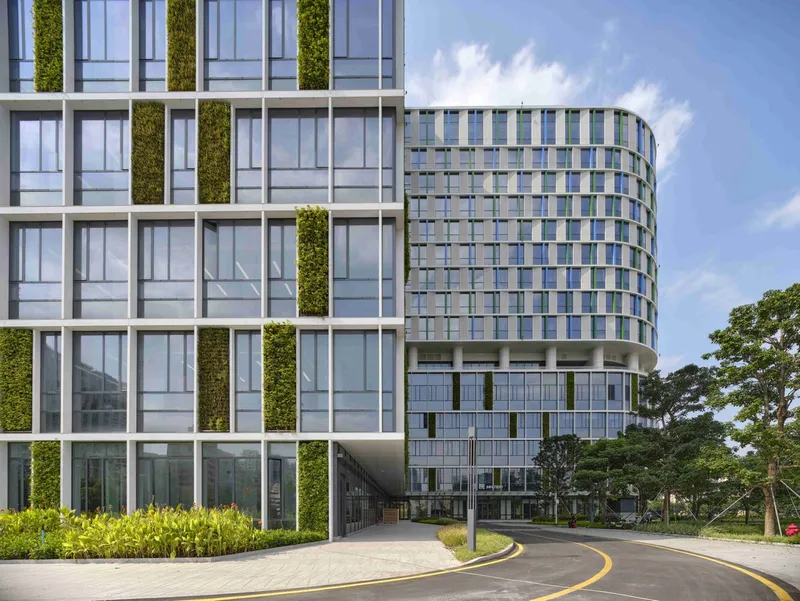
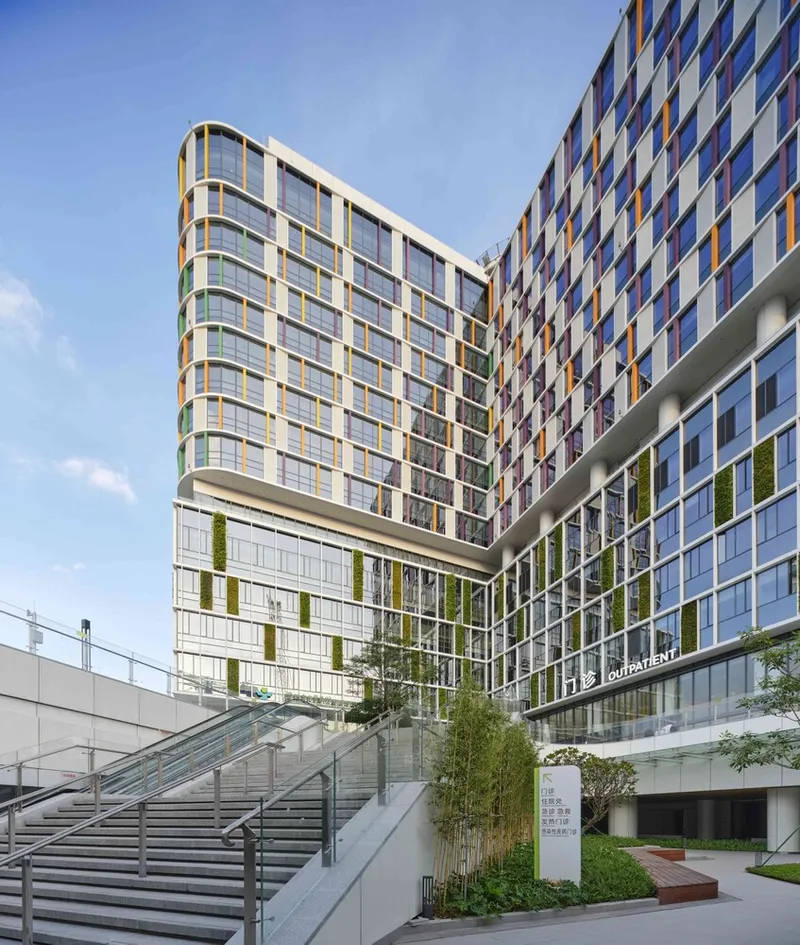
The curving driveway at the podium entrance is framed by greenery panels and a cylindrical glass volume that pulls visitors gently inward rather than confronting them with a monolithic facade. An exterior staircase ascending to a landscaped terrace beneath the cantilevered upper floors offers an alternative route that feels more like entering a park than a medical facility. These thresholds are where the hospital's argument about child-friendly scale is most legible: the building crouches down, opens up, and invites rather than directs.
Interior Atria: Light, Color, and Orientation
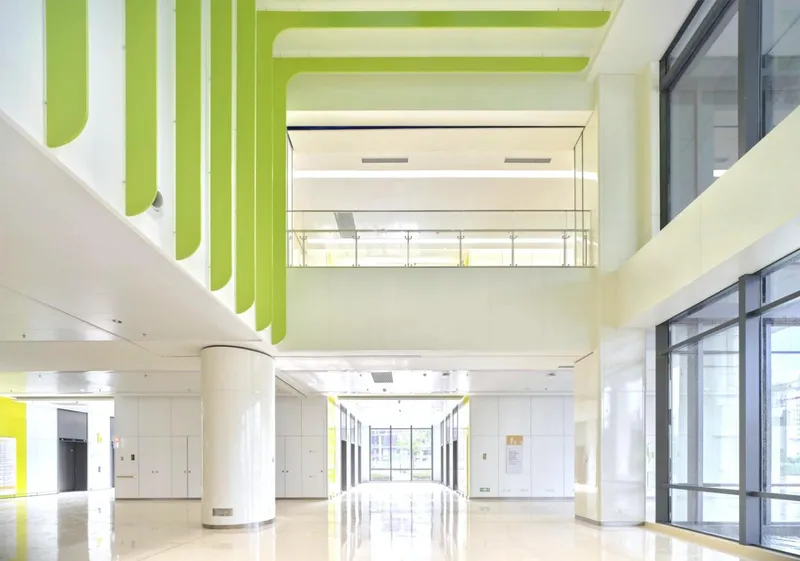
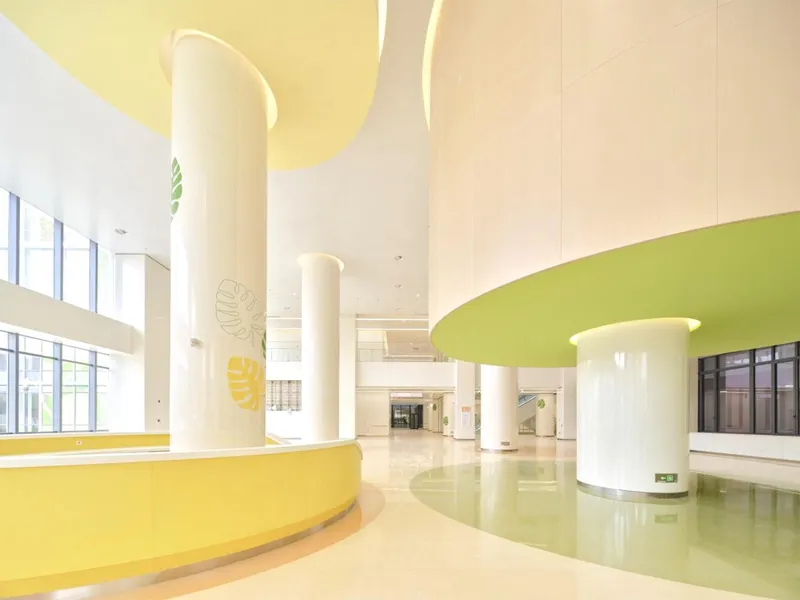
Inside, the hospital deploys a series of daylit atria that serve both wayfinding and therapeutic purposes. The double-height lobby with its white columns and lime-green ceiling baffles establishes a palette that is warm without being saccharine. A yellow curved reception desk and chartreuse ceiling disc in a secondary atrium introduce accent colors that help visitors orient themselves intuitively. Color is not decorative here; it is infrastructural.
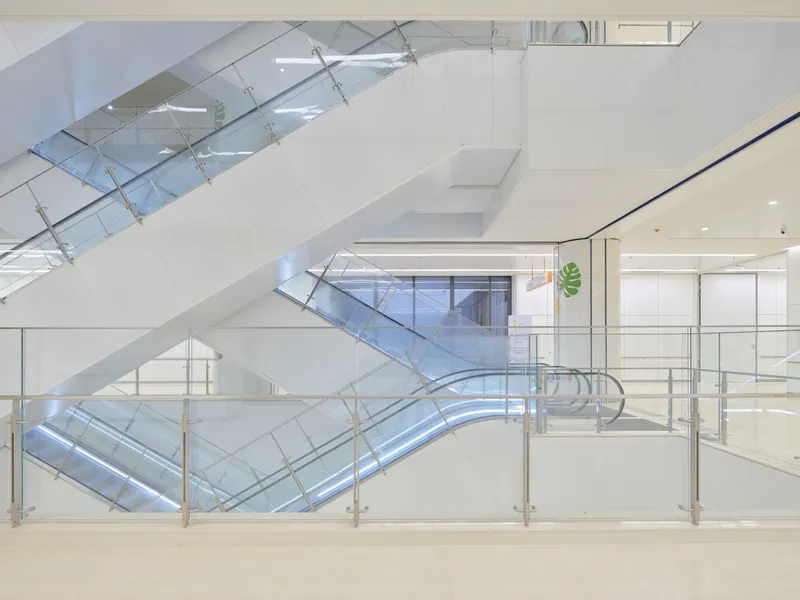
Crisscrossing escalators with glass balustrades connect multiple levels while maintaining visual continuity through the atrium void. Natural light penetrates deep into the plan, reducing reliance on artificial lighting and providing the kind of bright, airy atmosphere that the architects identified as one of their five core design principles. For a building this large, the sense of openness on the interior is remarkable.
Corridors and Ward Atmospheres
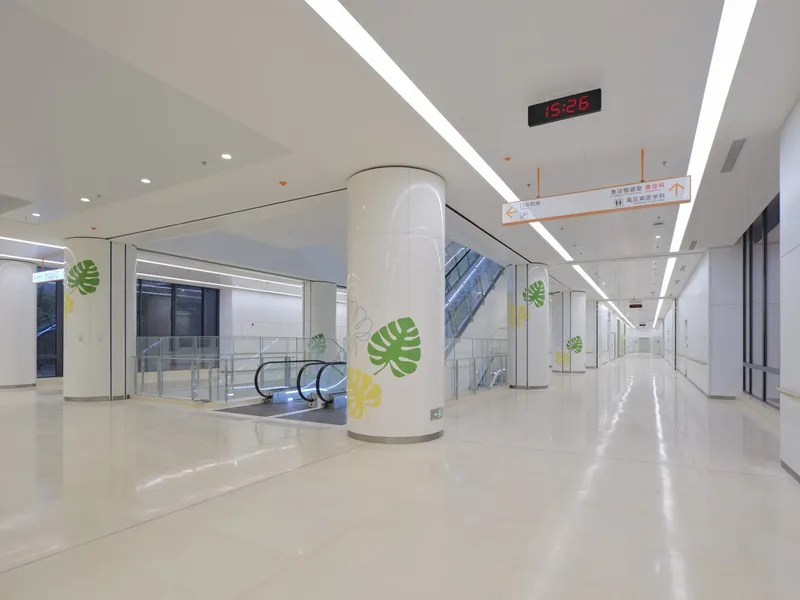
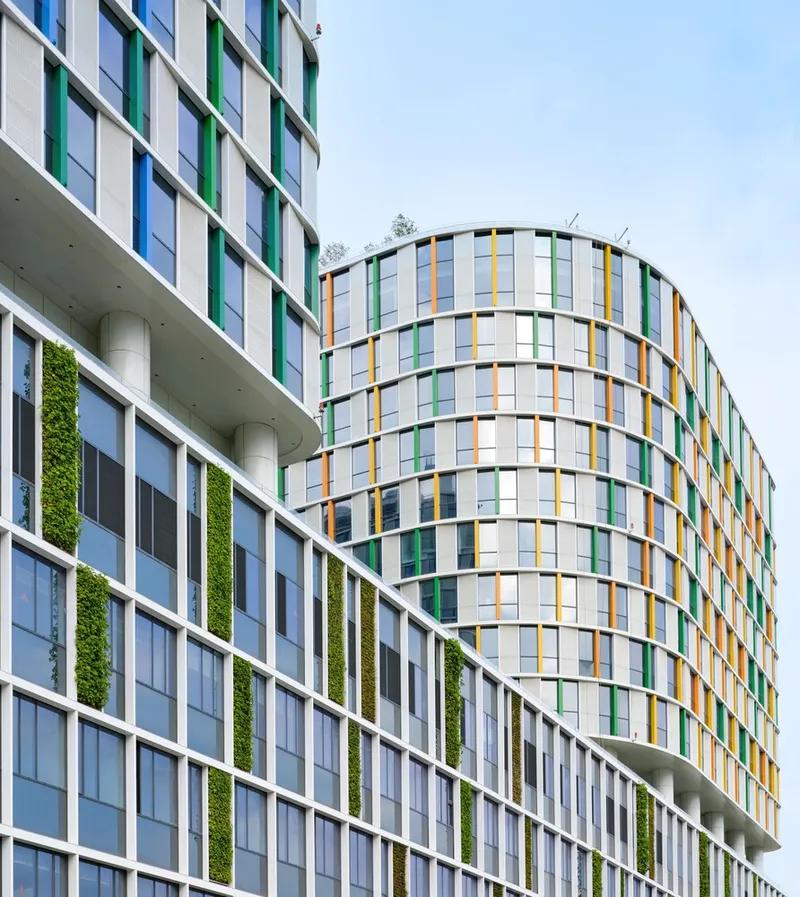
Lobby corridors lined with curved white columns, recessed linear lighting, and leaf-graphic appliqués demonstrate how a simple material palette can produce richness through geometry and pattern. The leaf motifs continue the forest metaphor at a haptic scale, giving young patients something to trace with their eyes as they move through the building. Meanwhile, exterior views of the towers reveal how the multicolored panelwork and vertical planting strips extend the interior logic outward, wrapping each ward floor in a distinct identity.
The single-story four-unit courtyard ward model, reportedly the first of its kind in China, gives each nursing unit its own outdoor space and natural ventilation. Independent yet connected, these modules can be adapted as medical needs evolve, a flexibility that is critical for a hospital expected to serve the region for decades.
Plans and Drawings
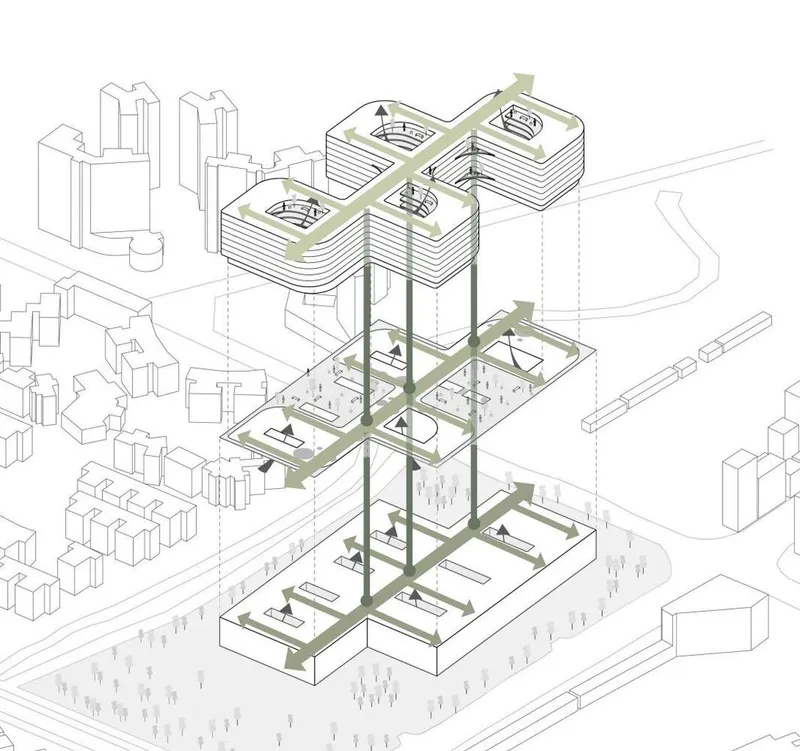
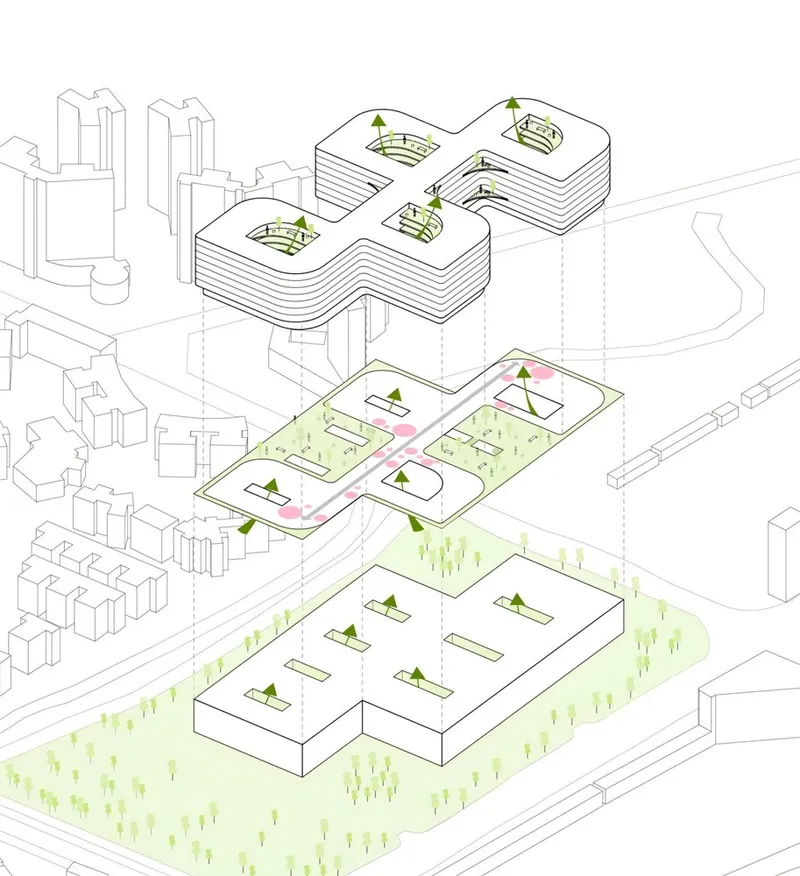
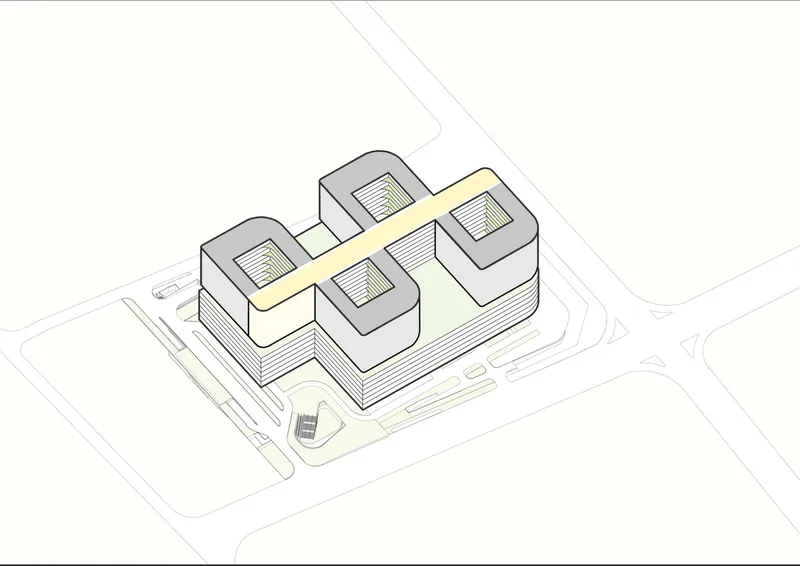
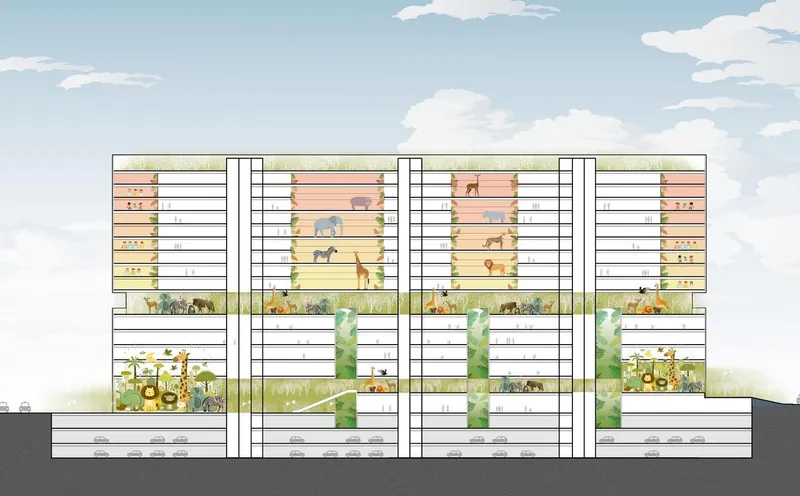
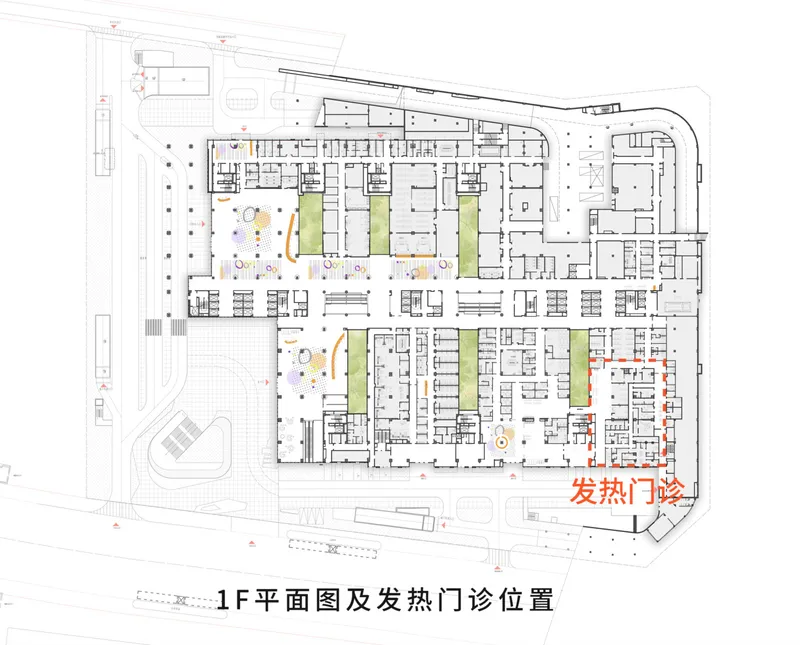
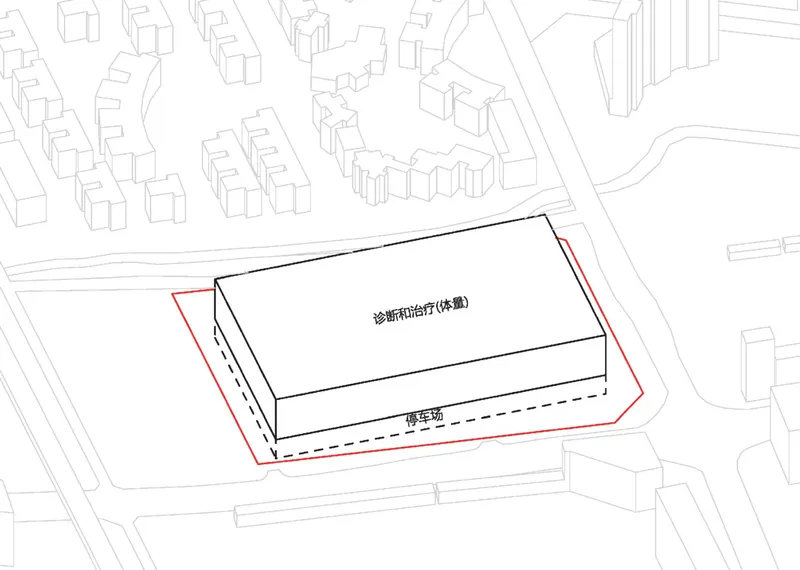
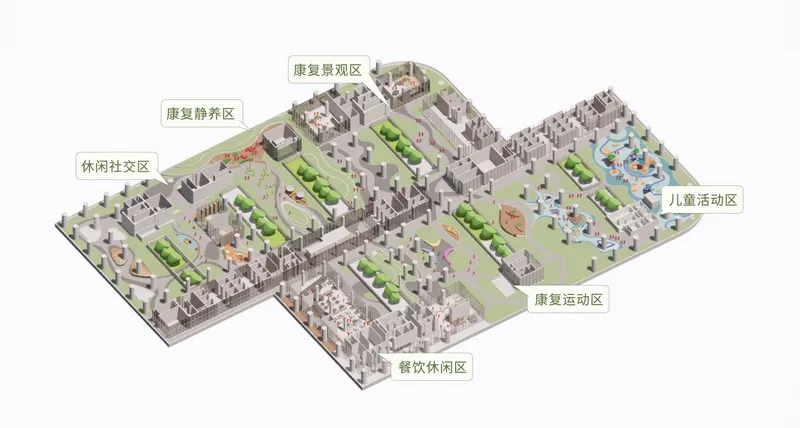
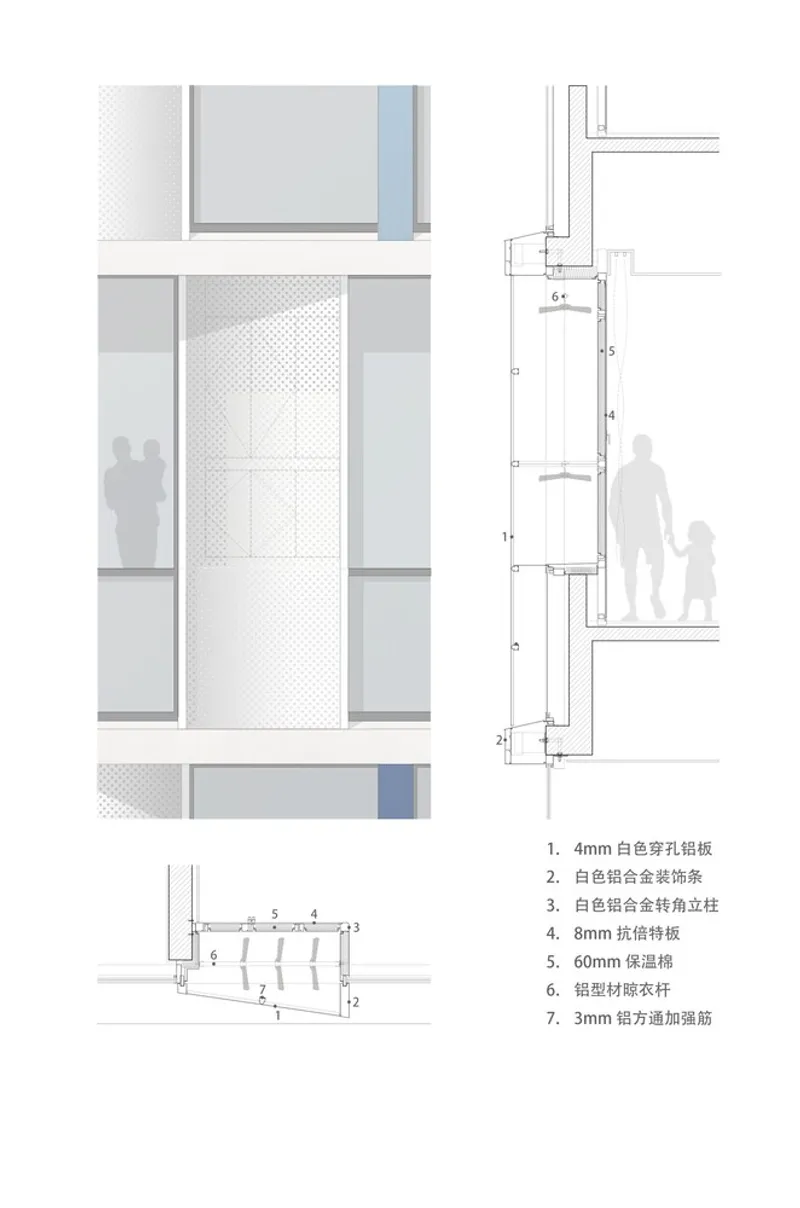
The drawings tell a story that photographs alone cannot. The axonometric of stacked cloverleaf floor plates connected by green circulation paths shows how each ward cluster opens onto rooftop courtyards, creating a vertical landscape that adds up to roughly 5,200 square meters of elevated green space. The exploded diagram makes the three-tier strategy explicit: a podium for outpatient and emergency functions, a middle zone of diagnostic modules, and tower wards above, each layer stepping back to admit light and air.
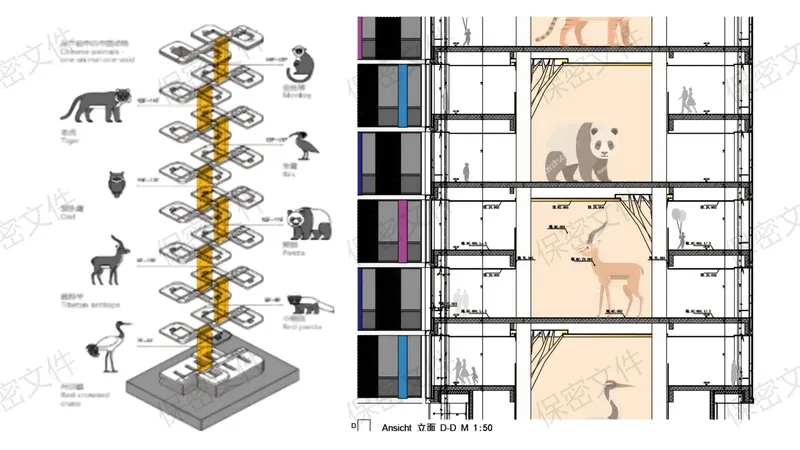
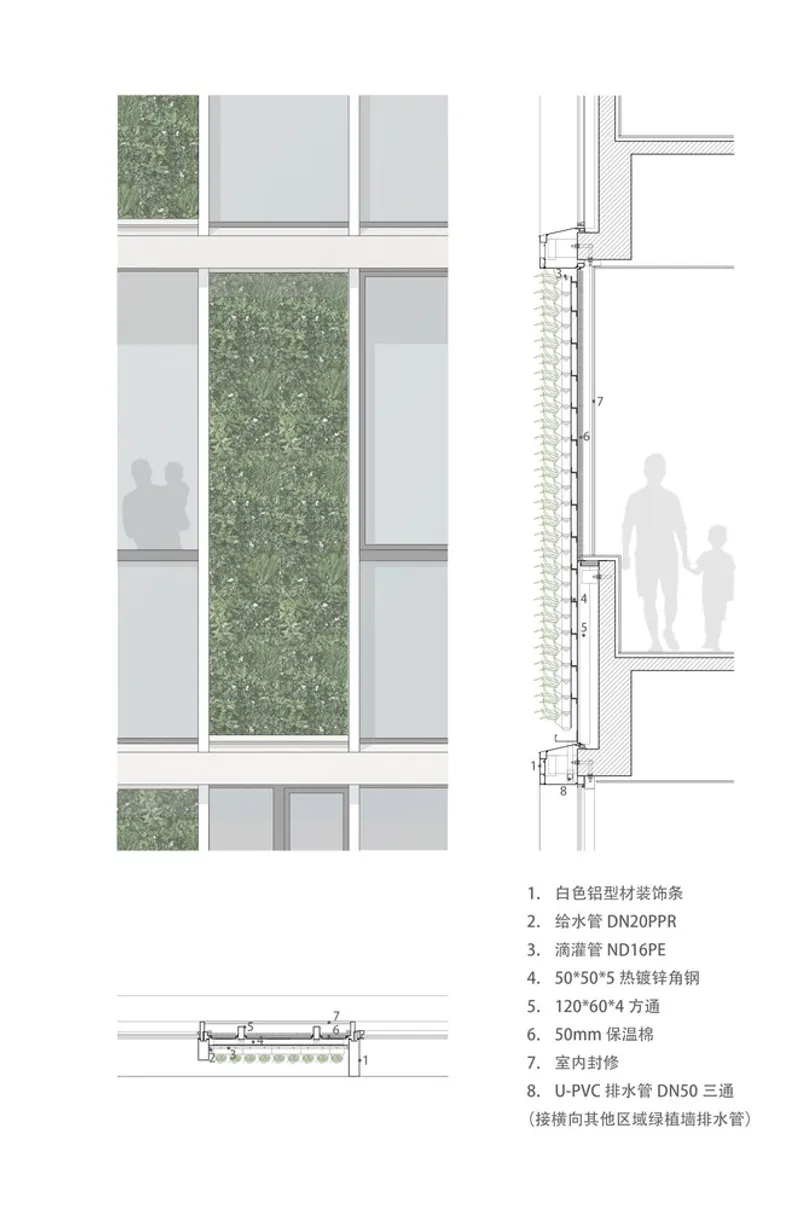
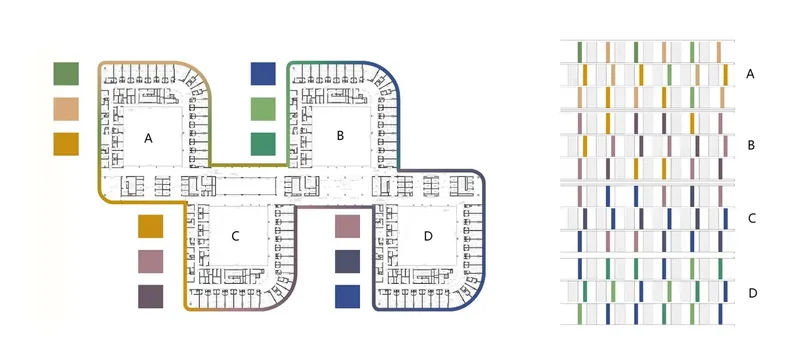
Section drawings with animal silhouettes, panda on one floor, deer on another, crane above, clarify the wayfinding strategy embedded in the facade panels. Each floor has its own creature and color, turning the building into a vertical zoo that children can read from outside. The facade detail sections confirm the integration of planted panels between glazed window units, revealing the structural depth required to support living walls at this height. Floor plans of the lobed ward volumes show how color-coded zones map directly onto the facade pattern, so the exterior is a legible diagram of the interior organization.
Why This Project Matters
Pediatric hospitals tend to fall into two traps. Some are ruthlessly efficient machines that happen to have cartoon murals glued to the walls. Others are so consumed by the desire to delight children that they neglect the logistical precision on which medical outcomes depend. The Shenzhen Children's Hospital Longhua Campus avoids both pitfalls. Its courtyard ward model, three-dimensional traffic system, and modular diagnostic units are rigorously organized around patient flow and clinical efficiency, while its color strategy, planted facades, and animal-themed floors address the emotional dimension of pediatric care with equal conviction.
The collaboration between Zhubo Design and Nickl & Partner Architekten produced a building that treats child-friendliness not as a style but as a spatial system. From the macro scale of the urban forest concept down to the micro scale of leaf appliqués in a corridor, every decision serves the same argument: that a hospital for children must be legible, navigable, and gently surprising at every turn. In a city as dense and fast-moving as Shenzhen, building 315,000 square meters of tenderness is no small achievement.
Shenzhen Children's Hospital Longhua Campus, designed by Zhubo Design and Nickl & Partner Architekten. Located in Longhua District, Shenzhen, China. 315,000 square meters. Completed 2024. Photography by Chaoying Yang.
About the Studio
Share Your Own Work on uni.xyz
If projects like this are the kind of work you want to make, uni.xyz is a place to publish your own, find collaborators, and enter design competitions.


Popular Articles
Popular articles from the community


Tsunami Convergenics: Turning Catastrophic Ocean Forces into Underwater Housing Infrastructure
A speculative underwater settlement off the coast of Onagawa, Japan, treats tsunamis and typhoons as energy sources rather than threats.

Manzana Morphosis: Stretching Barcelona's Grid into a Living Landscape for 2050
A radical reworking of the Eixample manzana turns density into a tool for generous public space, vertical ecology, and environmental performance.

Temporary Home for Dogs: A Reversed Zoo Rethinks Animal Shelter Architecture
In Bucharest, a sinuous corridor and freed landscape flip the logic of containment, designing a shelter that works to make itself unnecessary.

Faces of the Soviet Avant-Garde: Turning Moscow's Street Names into an Open-Air Museum
A network of sculptural installations across a Moscow residential district transforms forgotten architect names into spatial encounters with cultural memor

Similar Reads
You might also enjoy these articles


Hodi-Mandai Geram
Project Function: Preservation and revitalization of the Intangible heritage and socio-spatial identity of the Hodi by Housing, Cultural Memory Center, Sacred Grove, landscape, local tourism economy


Olio Towers: A Mid-Rise for Performers That Fuses Housing, Rehearsal, and Stage
Located blocks from Houston's Theater District, this modular tower stacks living units around a central performance atrium.

Oasis: Modular Green Housing Carved into Dhaka's Urban Fabric
A shortlisted Plugin Housing entry reclaims unauthorized settlements in Dhaka with stepped concrete volumes, green roofs, and ventilation-driven design.

Black Hole: A Floating Megastructure for the Post-Physical Era
Emiliano Mazzarotto envisions a spherical, self-scaling arena where e-sports, digital hotels, and holographic stadiums replace traditional public space.

Explore Healthcare Building Competitions
Discover active competitions in this discipline

Challenge to reimagine the Iron Throne

Photograph architecture without architects

Illustrate the lost glory of Angkor Wat - Render Challenge

Design challenge to reuse E-waste
Comments (0)
Please login or sign up to add comments
No comments yet. Be the first to comment!