

Chinese Bamboo Eight Pavilion by RoarcRenew
Chinese Bamboo Eight Pavilion in Chengdu blends calligraphy-inspired design, bamboo sustainability, and cultural symbolism, transforming temporary architecture into public furniture.


Located in the cultural heart of Chengdu, China, the Chinese Bamboo Eight Pavilion designed by RoarcRenew is a striking example of temporary architecture, cultural symbolism, and sustainable design. Built in 2023 to celebrate the eighth anniversary of Taikoo Li Chengdu, this 465 m² pavilion was envisioned as a 20-day installation. However, its architectural ingenuity and cultural significance extend far beyond its limited timeframe, making it a landmark in sustainable and symbolic design.
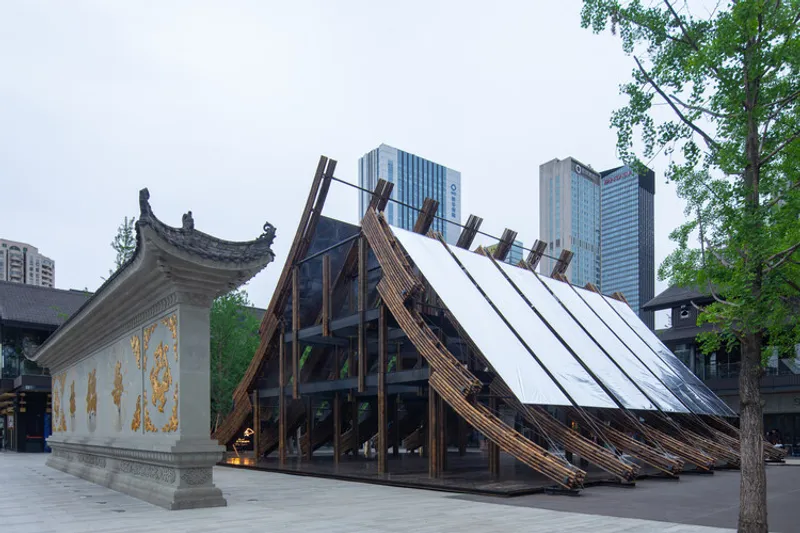
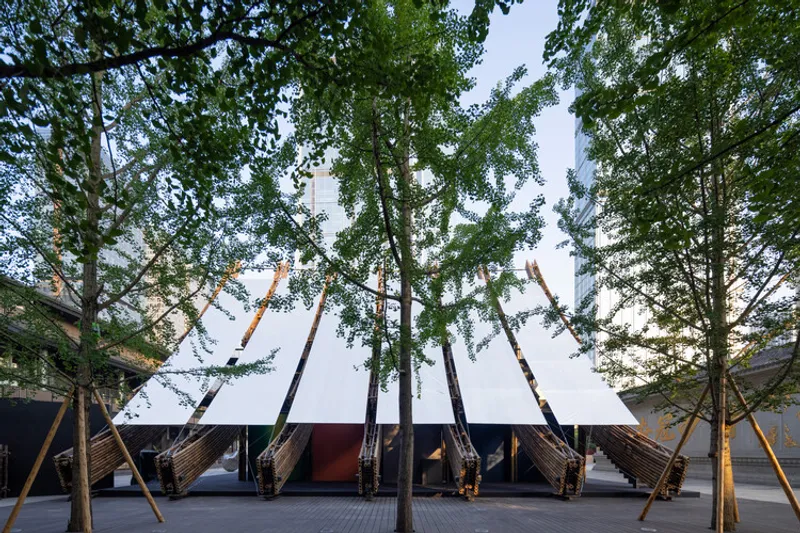
Concept & InspirationThe pavilion is inspired by the Chinese character "八 (eight)", symbolizing renewal, openness, and inclusivity. The strokes of the character also resemble "入 (entrance)" and "人 (people)", representing openness, connectivity, and community. This symbolism reflects the pavilion’s role as a gathering point for people from all walks of life. The triangular geometry inherent in these characters also aligns with principles of stability in architectural design, forming the foundation of the structure.
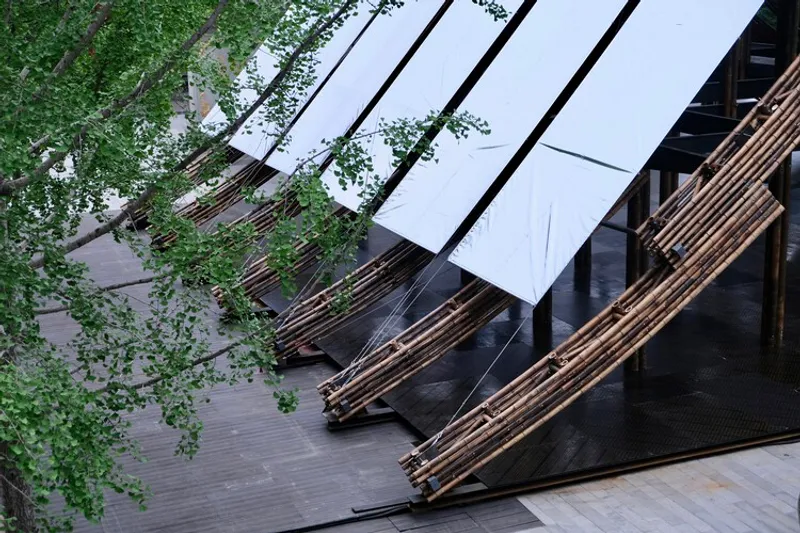

Materiality & SustainabilityBamboo was chosen as the primary building material, not only because it is deeply rooted in Chengdu’s cultural heritage but also for its ecological benefits. Bamboo grows rapidly—completing its cycle within two to three years—making it one of the most renewable natural resources. Once the pavilion completes its role as an exhibition space, its prefabricated bamboo elements will be disassembled and transformed into public seating, reinforcing the design’s circular sustainability.
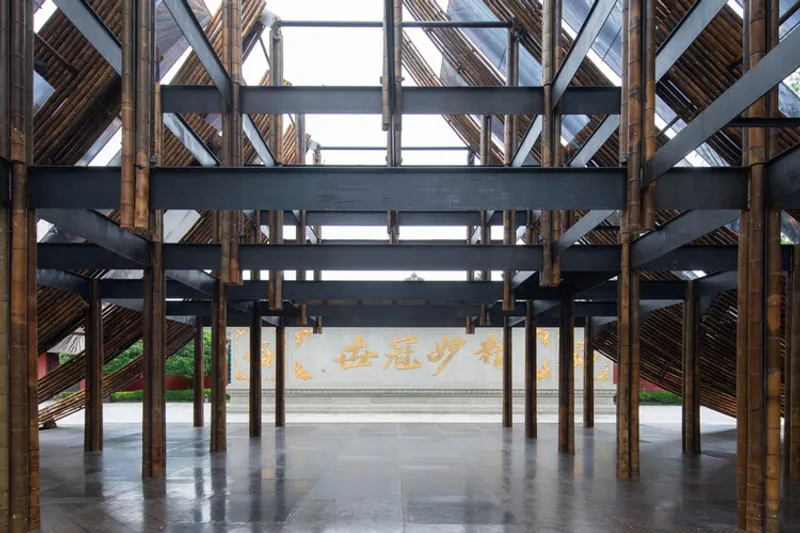
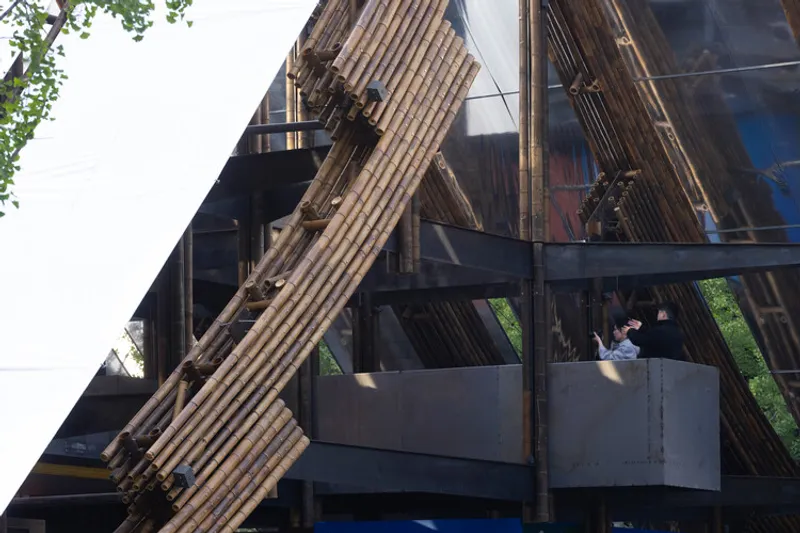
Each bamboo element follows a 550mm module, the standard dimension of a chair. This modularity ensures that after disassembly, bamboo components can be easily reconfigured into functional furniture for public spaces. Thus, the project exemplifies architecture-to-public life recycling.
Architectural Design & Structure


- Stroke-Inspired FormThe left and right strokes of the pavilion’s structure mirror traditional Chinese calligraphy, forming flowing, curved bamboo beams that transition gracefully. These strokes are subdivided into segments, with decreasing or increasing numbers of bamboo poles, creating dynamic rhythm and balance.
- Column and Tie FrameworkRooted in Sichuan’s traditional construction techniques, the pavilion employs a column-and-tie system to support oblique beams. The lower level hosts eight art spaces, while the upper levels include a steel veranda and rooftop terrace. From here, visitors can overlook both the historic Daci Temple and the modern Taikoo Li alleys, symbolizing a bridge between ancient and contemporary Chengdu.
- Prefabrication & ModularityThe pavilion was prefabricated at the EMCC Yancheng Plant, where 42 ranks of bamboo beams were produced before being assembled onsite. Bamboo beams are joined using steel bolts and connectors, creating an open-frame truss structure that is lightweight yet strong. This prefabricated system reduces construction time and simplifies dismantling for reuse.
- Lightweight Greenhouse RoofSemi-transparent greenhouse films cover the pavilion, allowing soft natural light to filter through. The film panels were carefully welded and tensioned with steel ropes and turnbuckles, creating a lightweight canopythat enhances the structure’s temporary yet atmospheric quality.

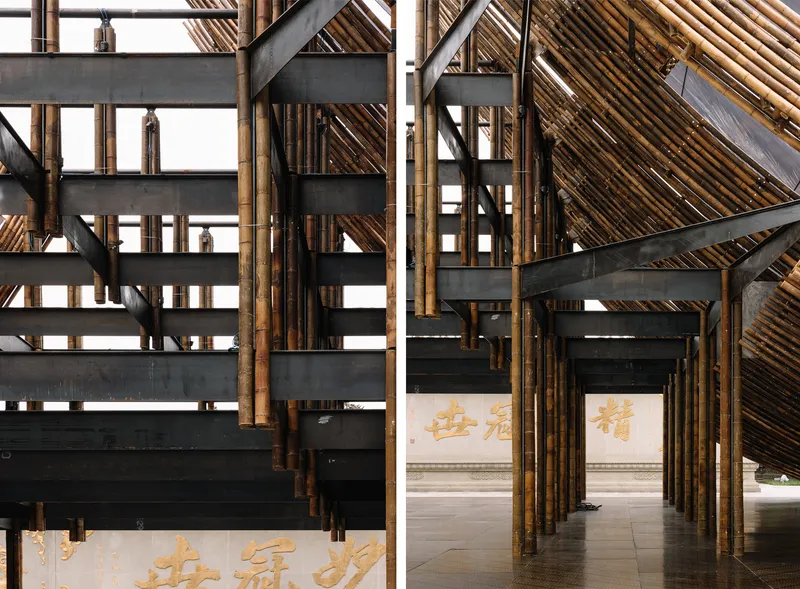
Sustainability & AfterlifeAt the end of its 20-day exhibition, the pavilion will not vanish—it will live on through transformation. Its bamboo materials will be repurposed into outdoor benches and stools, offering rest and gathering spaces across Chengdu. Alternatively, the pavilion may be reconstructed as a smaller-scale installation in local parks, ensuring the architectural memory continues within the cityscape. This approach demonstrates zero-waste architecture and redefines temporary buildings as time-limited structures with lasting social impact.

Cultural & Social ImpactThe Chinese Bamboo Eight Pavilion is more than an installation; it is a public cultural landmark. It embodies:
- Sustainability through bamboo reuse and modular design.
- Cultural symbolism through the expression of Chinese characters and calligraphy.
- Community engagement by transforming architecture into furniture for everyday public use.
- Urban dialogue by visually linking historic and modern Chengdu.

All the photographs are works of Arch-Exist, Shuang Han, Wen Studio


Popular Articles
Popular articles from the community


longwave studio Reorganizes a 112 m² Tainan Apartment Around the Daily Routines of a Family and Two Cats
In Tainan, Taiwan, birch plywood, rust-red furniture and a freestanding plaster wall link arrival, storage, work and family life in one apartment.

David Macias Steps a Doorless Stone and Plaster House Down a Tropical Colombian Hillside
In the humid hills of Colombia, Threshold House replaces the front door with an open void and terraces its 850 m² down the slope instead of fighting it.

Juan García Correa, John González and Claudia Rueda Sink a Circular Amphitheater into a Manizales Engineering Building
On the La Nubia campus in Manizales, Colombia, the S1 Building folds labs and offices into a hillside of ramped lawns that double as a campus route.

U.GA Architects Wraps an Oval Rooftop Pool in Curved Board-Formed Concrete on Busan's Jeollidan-gil
In Busan's Jeonpo-dong, a 454 m² mixed-use block stacks a neighborhood facility, guest rooms and an oval rooftop pool inside spiraling concrete walls.

Similar Reads
You might also enjoy these articles


Hodi-Mandai Geram
Project Function: Preservation and revitalization of the Intangible heritage and socio-spatial identity of the Hodi by Housing, Cultural Memory Center, Sacred Grove, landscape, local tourism economy


Olio Towers: A Mid-Rise for Performers That Fuses Housing, Rehearsal, and Stage
Located blocks from Houston's Theater District, this modular tower stacks living units around a central performance atrium.

Oasis: Modular Green Housing Carved into Dhaka's Urban Fabric
A shortlisted Plugin Housing entry reclaims unauthorized settlements in Dhaka with stepped concrete volumes, green roofs, and ventilation-driven design.

Black Hole: A Floating Megastructure for the Post-Physical Era
Emiliano Mazzarotto envisions a spherical, self-scaling arena where e-sports, digital hotels, and holographic stadiums replace traditional public space.

Explore Chinese Small Scale Architecture Competitions
Discover active competitions in this discipline

Challenge to reimagine the Iron Throne

Photograph architecture without architects

VR headsets Storefront design competition

Illustrate the lost glory of Angkor Wat - Render Challenge
Comments (0)
Please login or sign up to add comments
No comments yet. Be the first to comment!