
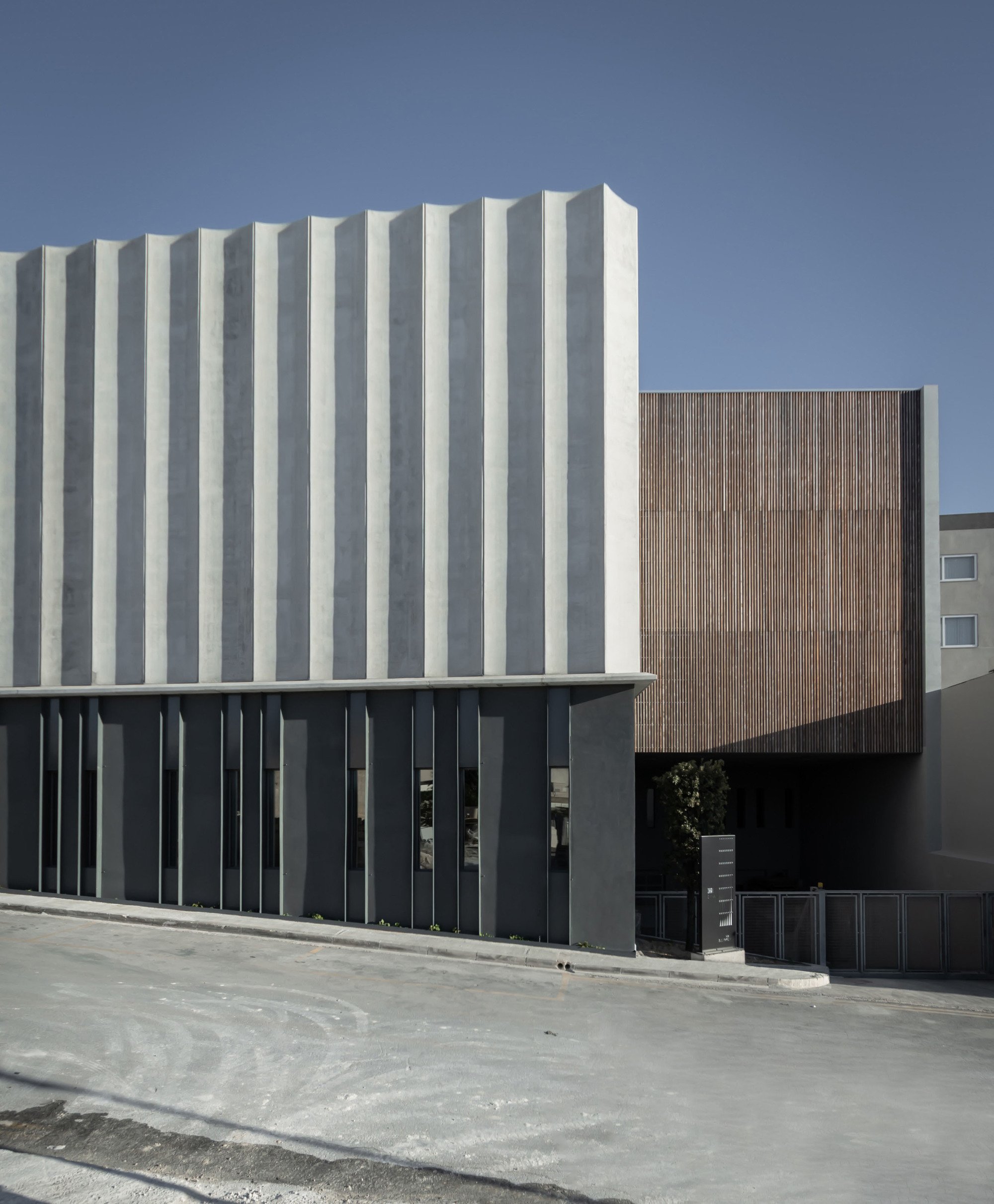
Chris Briffa Architects Wraps a Maltese Furniture Factory in a Curtain of Precast Concrete
In Qormi's industrial belt, a 10,000 square meter extension turns manufacturing into architecture worth looking at.

Industrial buildings rarely get the attention they deserve. They tend to be sheds first and architecture never. SAW Factory & Offices, designed by Chris Briffa Architects in Qormi, Malta, refuses that premise entirely. The project is a 10,000 square meter extension to an existing furniture manufacturing operation that began life as a small carpentry workshop garage in 1991. What was once a modest two-storey building has grown into a 12,000 square meter facility wrapped in a ribbed, curtain-like veil of locally cast precast concrete panels, each standing ten meters high.
The interesting move here is not just that the factory looks good. It is that the architects placed the comfort and well-being of the people who work in the building every day at the center of the design proposition. That means rooftop offices organized around light shafts and terraces, south-facing courtyards flanking reception and meeting rooms, a viewing gallery into the production floor, and an environmental strategy that recovers heat from the compressed air system for winter heating. The result is a factory that operates like architecture, not like a box with machines inside it.
A Concrete Veil for an Industrial Perimeter
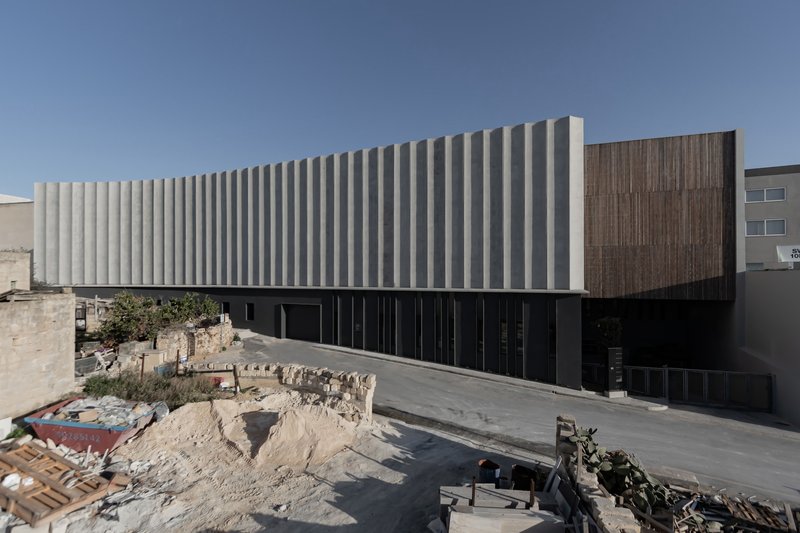
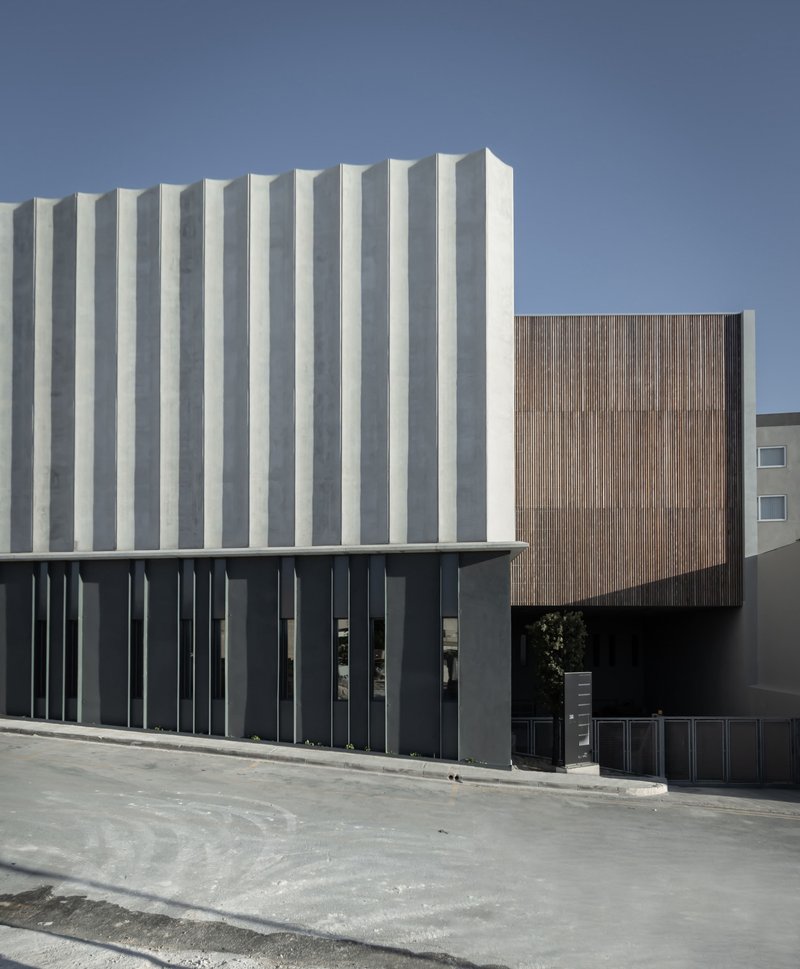
The defining gesture is the facade: ten-meter-high curved concrete panels cast locally onto bespoke steel formwork, then clad as prefabricated reinforced concrete elements onto a superstructure. The panels create a continuous ribbed surface that reads as a curtain draped around the entire site perimeter. It is a bold formal decision for an industrial zone in Qormi's Tal-Handaq area, where neighbours are warehouses and logistics yards, not galleries.
Prefabrication was chosen deliberately. Casting panels off-site reduced particle and noise pollution during construction, cut down on retrofitting and micro-snagging, and made siteworks significantly more time-efficient. The trade-off was longer design times to develop the bespoke formwork, but the payoff is a level of surface precision and consistency that in-situ casting rarely delivers. Standardised Y and T beams roof over the newly built spaces, keeping the structural language coherent from wall to ceiling.
Light Shafts, Courtyards, and the Office on Top
The spatial organization stacks intelligently. Manufacturing spaces occupy the volumes enclosed within the perimeter walls, while administration and design offices sit on the top floor, built around light shafts and terraces that pull natural daylight deep into the plan. Two south-facing courtyards flank the reception and meeting rooms at a lower level, giving visitors an immediate sense of openness despite the building's fortified exterior.
A timber-clad corridor and glass-partitioned offices create a material contrast to the raw concrete exterior, signalling the shift from production to knowledge work. Sound-absorbing panelling inside the offices is cut in the same pattern as the building's facade, a detail that ties interior and exterior into a single design vocabulary. It is a small move, but it shows a level of care that distinguishes the project from the anonymous boxes that surround it.
Passive Cooling and Heat Recovery in a Mediterranean Climate
Malta's climate demands serious thinking about heat gain, and the project responds with a layered environmental strategy. A northeast-facing perimeter terrace and the south-facing courtyards provide natural light while generous greenery cools the terraces and courtyards in summer. Offices and breakout areas are naturally lit to minimize electricity consumption, supplemented by a Building Management System with control sensors on all lighting systems.
On the mechanical side, heat recovery units and air handling units manage thermal comfort, but the more inventive move is recovering waste heat from the compressed air system and reusing it in winter to heat the factory spaces. The finishing areas operate under total environment control, with a filtration system that prevents hazardous emissions. Waste material from production is collected through a silo system and redistributed to local farmers as animal bedding. These are not flashy sustainability gestures. They are practical, integrated responses to the realities of running a furniture manufacturing operation.
Why This Project Matters
SAW Factory & Offices makes a case that industrial architecture does not have to default to anonymity. The precast concrete veil gives the building civic presence in an area that has none. The rooftop offices, courtyards, and light shafts give workers conditions that most office buildings would envy. And the environmental systems treat energy and waste as design problems, not afterthoughts. It is no surprise the project received the Commercial and Public Buildings Award at the Malta Architecture and Spatial Planning Awards.
What matters most is the underlying argument: that a factory can be architecture, and that the people who spend their days inside a production facility deserve the same spatial quality as anyone else. Chris Briffa Architects built that argument in concrete, timber, glass, and greenery across three levels and 12,000 square meters. It holds up.
SAW Factory & Offices by Chris Briffa Architects, located in Qormi, Malta. 10,000 m² extension (12,000 m² total). Completed in 2021. Photography by Hanna Briffa.
About the Studio
Share Your Own Work on uni.xyz
If projects like this are the kind of work you want to make, uni.xyz is a place to publish your own, find collaborators, and enter design competitions.




Popular Articles
Popular articles from the community

The Faith: Modular Architecture for Play, Learning, and Hope in Kutupalong Refugee Camp
A modular playground architecture project in Bangladesh where play, learning, safety, and hope rebuild childhood inside a refugee camp anew.
IKC de Geluksvogel: Sustainable School Architecture Designed for Free Movement and Digital Learning
IKC de Geluksvogel turns sustainable school architecture into a flexible Maastricht campus for digital learning, nature, and free movement.

Kaffeebühnen: Coffee Shop Architecture Designed as a Civic Stage Between Vienna’s City and Park
Kaffeebühnen turns coffee shop architecture into a civic stage, linking Vienna’s park edge, urban life, warm timber yards, and coffee craft.
PLATAFORMArq Folds a Concrete Roof Over the Portuguese Mountains in House #474
A 220-square-meter residence in Teixoso, Portugal, wraps board-formed concrete into an angular canopy that frames the Serra da Estrela foothills.


Similar Reads
You might also enjoy these articles
Freebird Residence by Alexis Dornier: A Tropical Modernist Sanctuary in Bali
Floating living pavilion above pool anchors H-shaped tropical villa, blending Japanese minimalism, sustainable strategies, lush landscape, and sculptural interiors.
127af Flips a Tiny Bagnolet Rowhouse Upside Down with a Handcrafted Roof Extension
A 55-square-meter terraced house on the edge of Paris gains a luminous upper living floor through lightweight timber and steel.
1.61 Design Workshop Wraps a 600-Square-Meter Café in Vietnam in Sculptural Burgundy Drama
Reden Café & Bistro pairs a helical staircase, mosaic floors, and deep red interiors to rethink Vietnamese hospitality space.

The Unbound Brain: A School Shaped by Cognitive Architecture
Cylindrical learning pods radiate like neurons from a central cortex, turning the floor plan into a spatial model of human thought.


Explore Industrial Building Competitions
Discover active competitions in this discipline




The International Standard for Design Portfolios


The Global Benchmark for Architecture Dissertation Awards


The Global Benchmark for Graduation Excellence


Challenge to reimagine the Iron Throne
Comments (0)
Please login or sign up to add comments
No comments yet. Be the first to comment!