
ODOS Architects Turns a Dormant Irish Grain Mill into a Whiskey Distillery of Corten and Concrete
On the banks of the Grand Canal in County Kildare, an 18th century malthouse finds new life as the Church of Oak Distillery.

For 150 years, a grain mill on the outskirts of Monasterevin in rural County Kildare processed and stored grain. Then it sat empty. The buildings along the Grand Canal, including a malthouse, mill race aqueduct, storehouses, and furnaces, gradually weathered into the landscape. When ODOS Architects won an international competition in 2018 to convert the site into a working whiskey distillery and visitor destination, the challenge was not simply restoration. It was a question of how to insert a fully operational, technically demanding production facility into a heritage shell without turning the old buildings into scenography.
The answer, completed in August 2023 after construction that spanned the pandemic, is the Church of Oak Distillery: 3,386 square meters of production, hospitality, and exhibition space organized around two parallel circulation routes. One follows the grain from milling through mashing, cooking, fermentation, and distillation. The other follows the visitor from reception through interpretive galleries, mezzanines, terraces, and retail spaces. The two paths overlap at critical moments, so that the architecture treats whiskey production as theatre, giving visitors direct sightlines into copper stills, mash tuns, and fermentation vessels. It is a convincing argument that industrial architecture and public experience are not competing programs but mutually reinforcing ones.
Corten Pyramids and a Rural Skyline
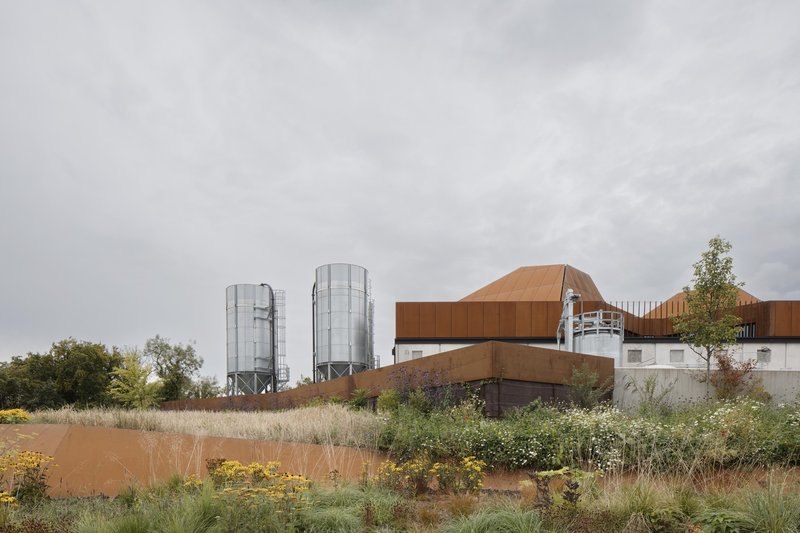
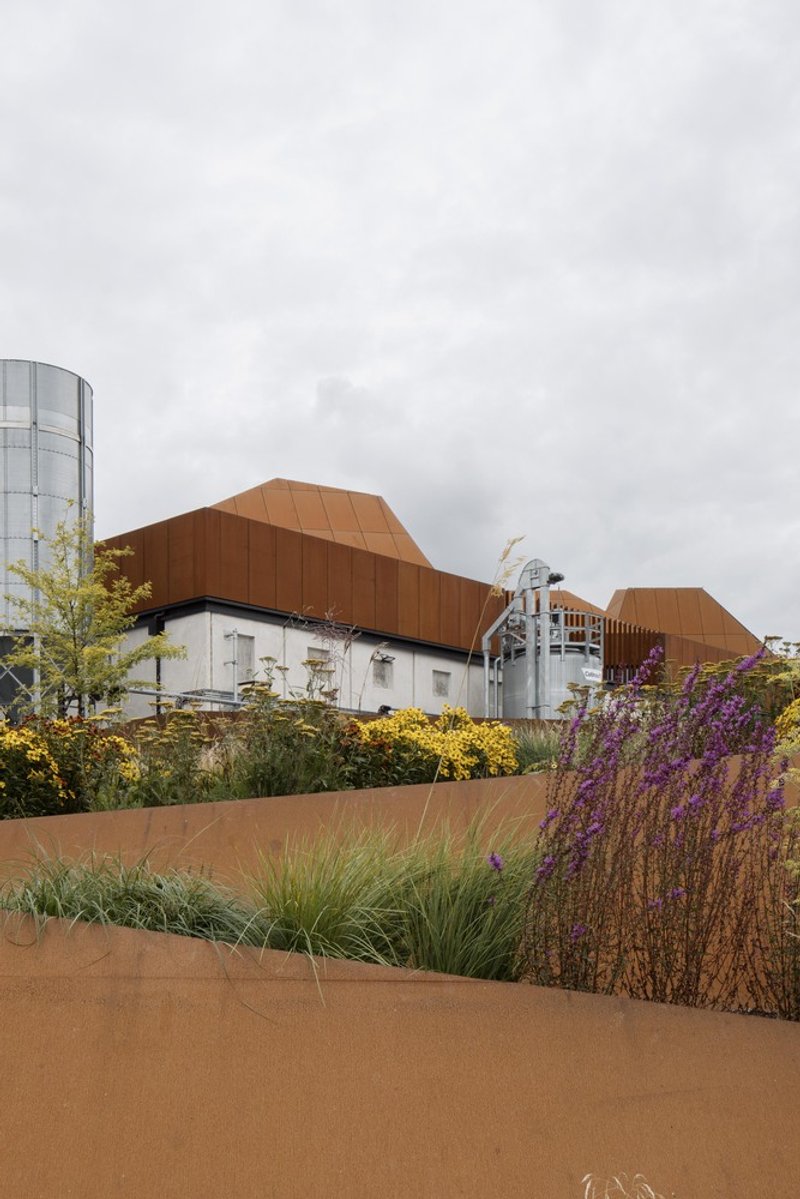
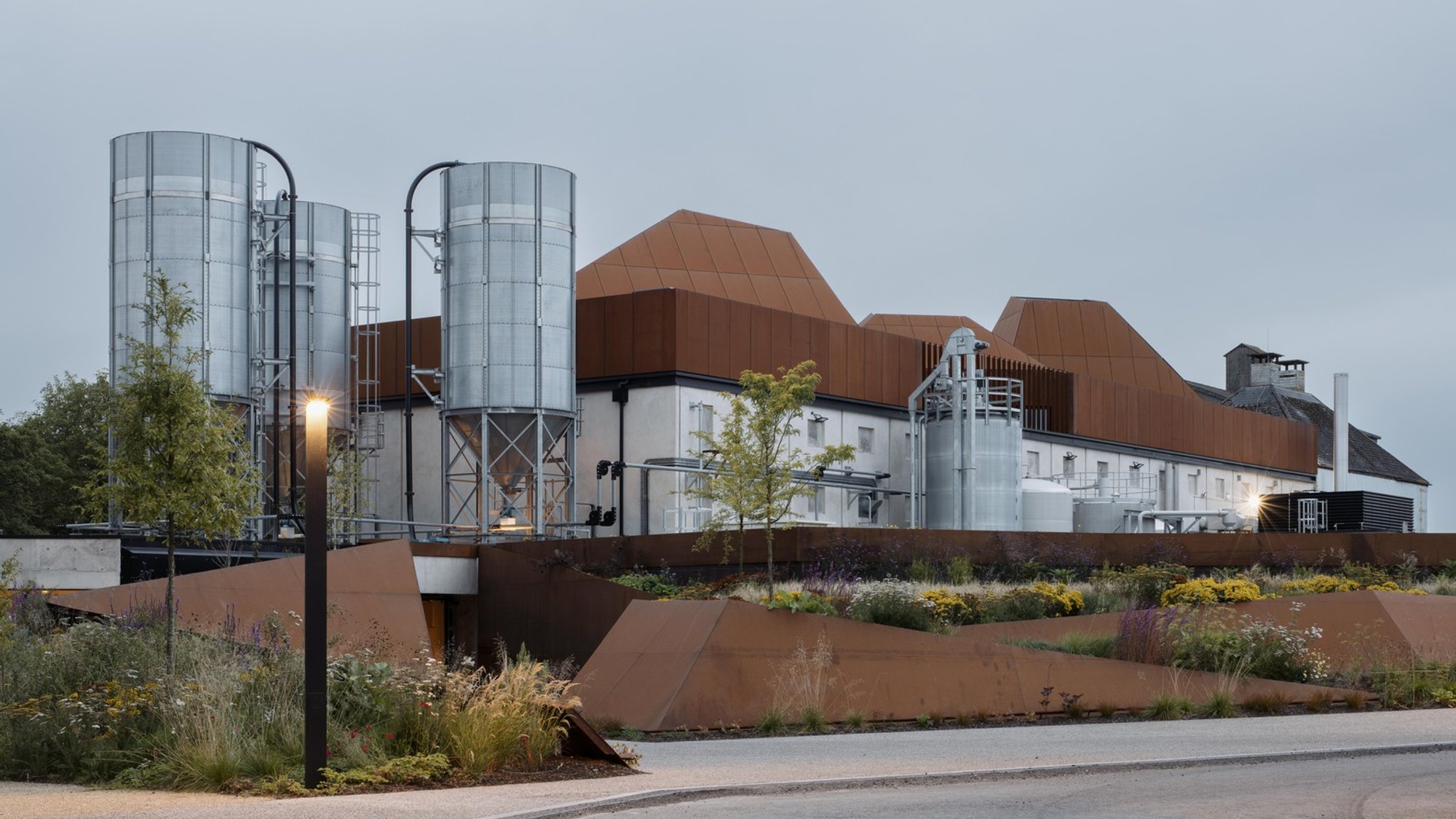
The most immediately striking move is the roofscape. Truncated pyramidal forms in weathered corten steel rise above the white and concrete volumes of the original mill buildings, their geometry derived from the pitched roofs of the site's existing malting kilns. These are not arbitrary sculptural gestures. They house rooflights that pull daylight down into the deep plan of the malthouse below, and their silhouette gives the complex a legible identity from a distance without overwhelming the flat, agricultural landscape of barley and wheat fields that surrounds it.
The corten has a practical and aesthetic logic. It weathers to a warm rust that reads as a natural material alongside the lime render and fair-faced concrete of the existing structures. Over time, the steel will continue to patinate, drawing closer to the tones of the surrounding earth and stone. Against the meadow of indigenous wildflowers that ODOS designed as part of the landscape strategy, the pyramidal forms look less like additions and more like geological outcrops that have always been part of this stretch of canal bank.
Concrete Old and New
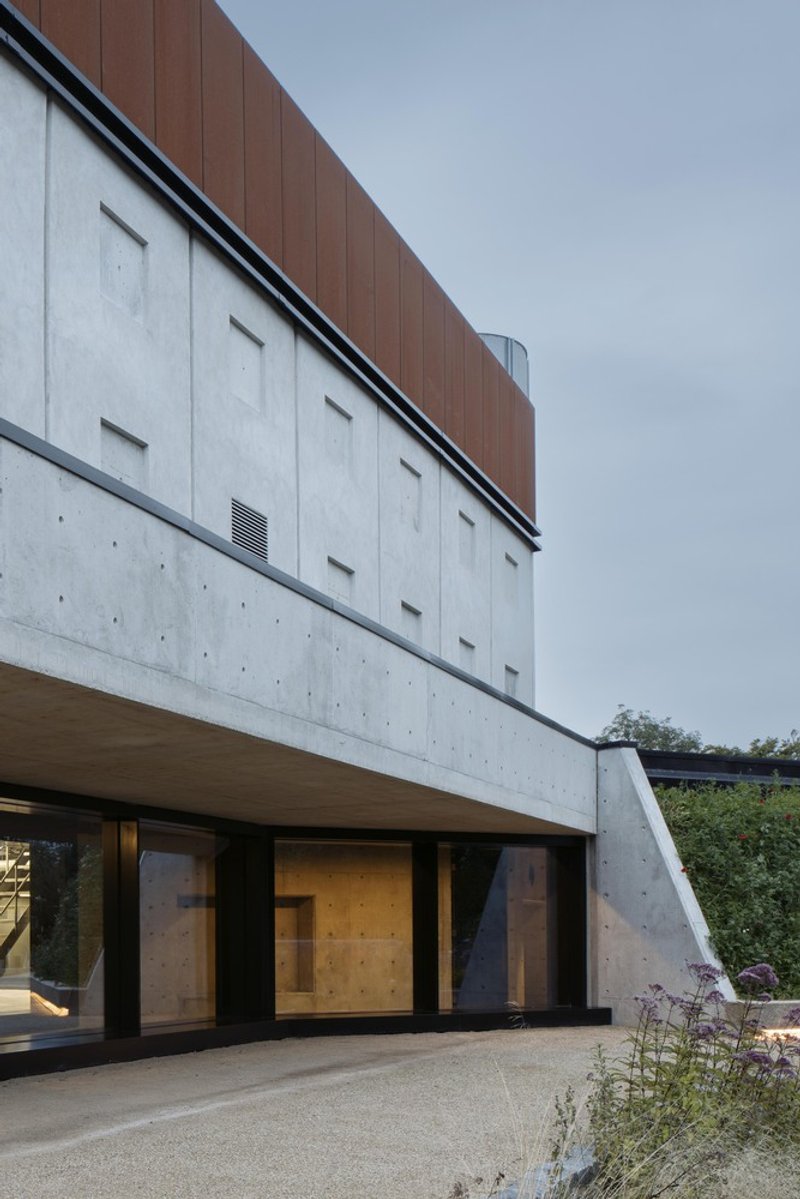
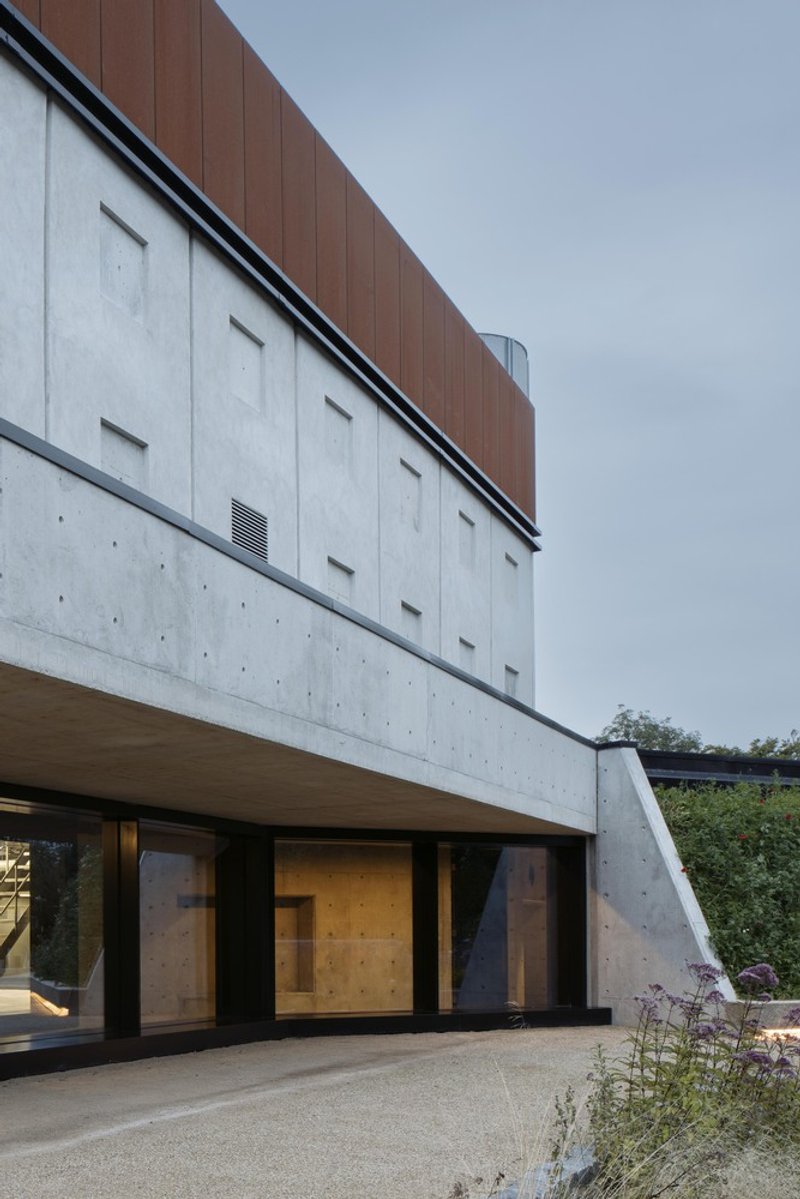
The existing malthouse is an early example of mass concrete construction, and ODOS made the decision to let concrete remain the dominant language of the new interventions. The firm cites Tadao Ando as an influence, and you can see it: the board-formed surfaces are spare and precise, the joints clean, the overall effect one of weight and permanence. But where Ando tends to work in idealized geometric volumes, the Church of Oak's concrete has to negotiate the irregular rhythms of an industrial ruin.
The detailing of the facade is where this negotiation becomes most legible. Concrete infill panels are recessed within the punched openings of the original structure, maintaining the cadence of the historic facade while clearly reading as insertions rather than restorations. These recessed, window-like elements preserve the legibility of the old wall as a datum, so the building's history is not erased but annotated. The cantilevered copper-clad volume that appears at upper levels introduces a third material register, connecting visually to the hand-beaten copper stills inside.
Landscape as Infrastructure
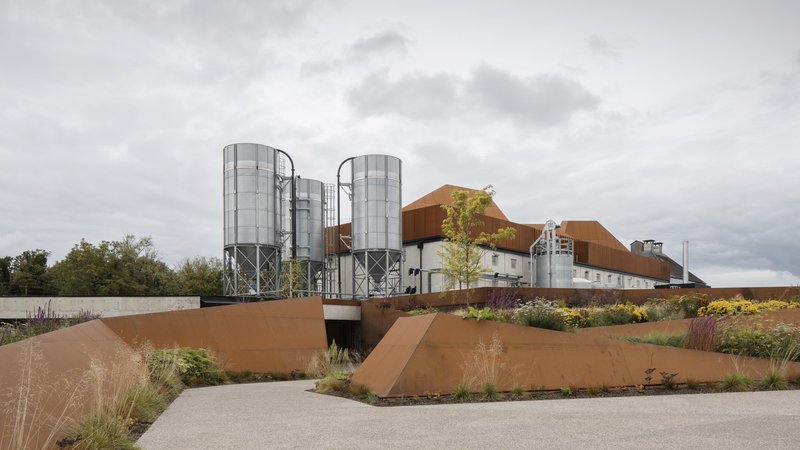
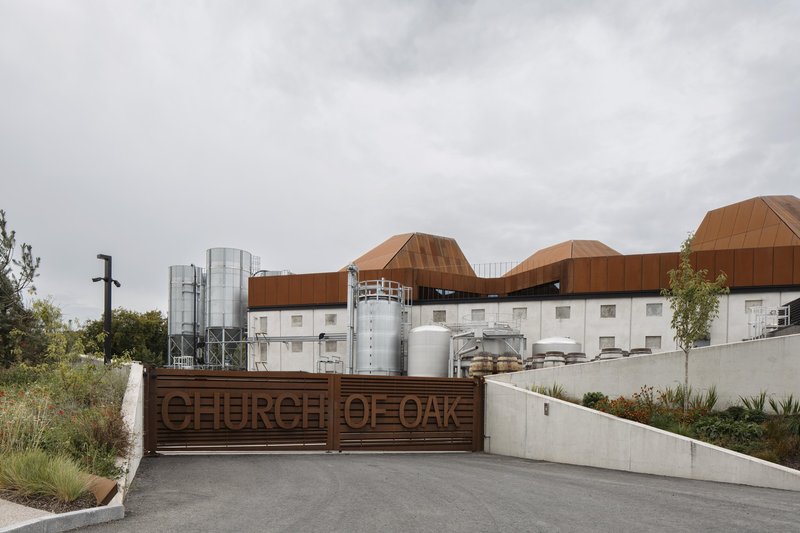
The 4.5-acre site is not treated as leftover space around a building. ODOS designed the landscape with corten retaining walls, planted berms, and a meadow of indigenous wildflower varieties that establish a gradient from the canal edge to the distillery entrance. An artificial lake was created not only as a visual amenity but as a functional component of the fire strategy, a detail that reveals how thoroughly the architects integrated site engineering with spatial experience.
The approach sequence is carefully orchestrated. Corten landscape walls and planted beds frame the visitor's path toward the industrial silos and roof forms, compressing and then releasing views of the complex. The entry gate, with its timber cladding and concrete flanking walls, acts as a threshold between the pastoral surroundings and the precise, controlled environment of the distillery. This kind of landscape choreography is common in museum design but rare in production facilities, and it signals the ambition of the project from the first moment.
Dusk and the Illuminated Complex
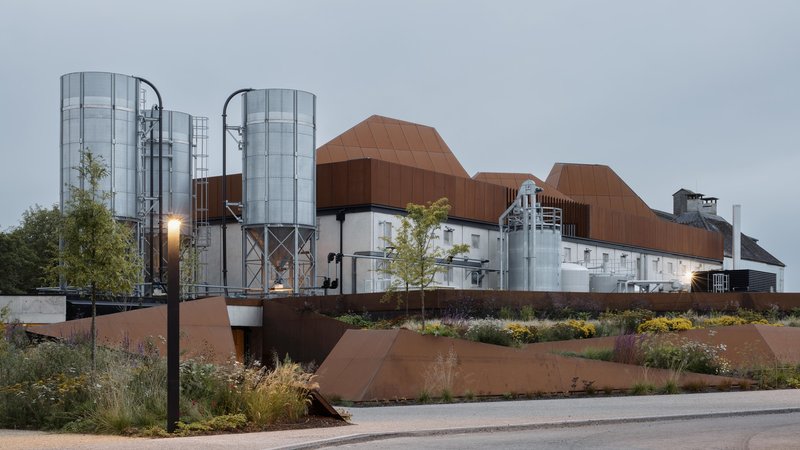
At dusk, the Church of Oak Distillery reveals a second character. Warm light spills from the ground-floor glazing of the extensively glazed west facade, turning the production spaces into a lantern visible from the road and the canal. The silos, silhouetted against the sky, and the corten roofscape take on a monumental quality. The planted berms glow in the last light, and the entire composition reads as a small campus rather than a single building.
This duality matters. By day, the distillery is a working production facility embedded in an agricultural landscape. By evening, it becomes a civic presence, a destination that signals activity and welcome. For a town the size of Monasterevin, that kind of architectural generosity, where a private enterprise offers something back to the public realm through the quality of its physical presence, is significant.
Why This Project Matters
Adaptive reuse projects often fall into one of two traps: either the old building becomes a decorative wrapper for entirely new construction, or the new program is awkwardly shoehorned into spaces that cannot support it. The Church of Oak Distillery avoids both. The grain's journey through the building, from silos stored above the cafe and gallery to copper stills rising through floor voids, is legible and dramatic. The visitor's journey is equally considered, with mezzanines, glazed floors, and terraces that offer constantly shifting vantage points onto the production process. The architecture does not merely contain the program; it amplifies it.
ODOS Architects have also demonstrated something important about material honesty in heritage contexts. The decision to let concrete remain the primary language, to use corten as a weathering complement rather than a contrast, and to detail the junctions between old and new with precision rather than pastiche gives the building an integrity that will age well. In a sector where distillery architecture is increasingly driven by brand theatrics, the Church of Oak stands out for treating the building itself, its materials, its spatial sequences, its relationship to the canal and the fields, as the most compelling story it can tell.
Church of Oak Distillery by ODOS Architects. Monasterevin, County Kildare, Ireland. 3,386 m². Completed 2023.
About the Studio
Share Your Own Work on uni.xyz
If projects like this are the kind of work you want to make, uni.xyz is a place to publish your own, find collaborators, and enter design competitions.




Popular Articles
Popular articles from the community

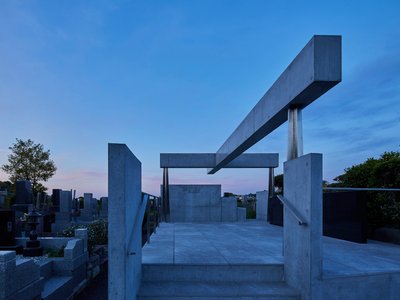
Takeshi Hosaka Architects Suspends a Concrete Cross Above a Yokohama Cemetery
A 28-square-meter burial renovation in Yokohama lifts the symbol of resurrection into the sky so mourners see it against heaven.

20 Most Popular Office Building Projects of 2025
From biophilic workspaces in India to net-positive energy offices in New Delhi, 20 office building projects that defined architecture in 2025.

YOAP Architects Round a Corner in Yeongcheon with a Cylindrical Community Hub
A 197-square-meter brick and ribbed-clad tower turns a forgotten alley corner in South Korea into a public garden with a low threshold.
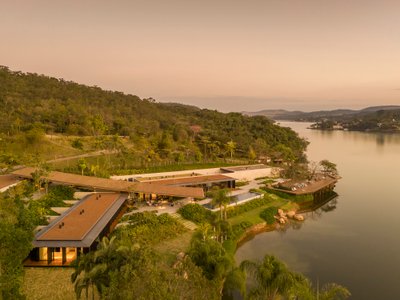
Bernardes Arquitetura Stretches a Timber Roof Along a Reservoir's Edge in Minas Gerais
Dam House in Itaúna lets a sweeping wooden canopy dissolve the boundary between hillside terrain and open water.


Similar Reads
You might also enjoy these articles
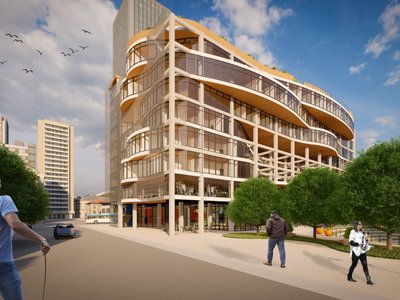
Olio Towers: A Mid-Rise for Performers That Fuses Housing, Rehearsal, and Stage
Located blocks from Houston's Theater District, this modular tower stacks living units around a central performance atrium.

Oasis: Modular Green Housing Carved into Dhaka's Urban Fabric
A shortlisted Plugin Housing entry reclaims unauthorized settlements in Dhaka with stepped concrete volumes, green roofs, and ventilation-driven design.

Black Hole: A Floating Megastructure for the Post-Physical Era
Emiliano Mazzarotto envisions a spherical, self-scaling arena where e-sports, digital hotels, and holographic stadiums replace traditional public space.
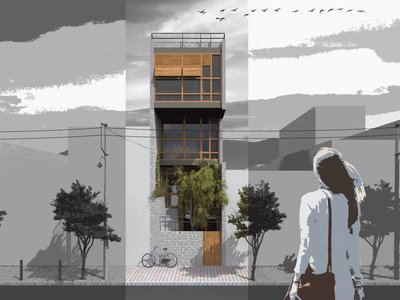
Compact & Sustainable Living in Piraeus: A Four-Level Family Home Built Around Light and Air
A narrow townhouse in one of Greece's densest port cities uses a central atrium and passive strategies to house three generations under one roof.


Explore Architecture Competitions
Discover active competitions in this discipline




The International Standard for Design Portfolios


The Global Benchmark for Architecture Dissertation Awards


The Global Benchmark for Graduation Excellence


Challenge to reimagine the Iron Throne
Comments (0)
Please login or sign up to add comments
No comments yet. Be the first to comment!