

Cicero Ferraz Cruz and Fábio Mosaner Build a Mountain House as a Ruin Reborn in Timber and Stone
Perched on the sun-warmed slopes of Brazil's Bocaina range, a CLT and fieldstone retreat reimagines the deep time of its own landscape.


Some houses begin with a program. This one begins with a fiction: what if the stones on this hillside had been rearranged by centuries of wind and rain into something that only resembled a dwelling? That speculative premise, equal parts geological fantasy and architectural provocation, is the generative idea behind the Bocaina-Paraty House, designed by Cicero Ferraz Cruz and Fábio Mosaner on the verdant slopes outside the historic town of Paraty in southeastern Brazil. The result is a building that looks both ancient and precisely contemporary, a quality that very few houses manage to sustain past the first glance.
What makes the project genuinely compelling is the disciplined contrast between two material registers. A heavy fieldstone base, built from rock indigenous to the site, anchors the house to the hillside like a retaining wall that forgot to stop. Above it, cross-laminated timber panels and broad sheets of glass form a lighter superstructure, an element clearly brought from elsewhere, from industry rather than geology. The dialogue between these two registers is not decorative. It structures the spatial experience, the thermal strategy, and the narrative of the house from first approach to bedroom window.
Reading the Landscape Before Drawing a Line
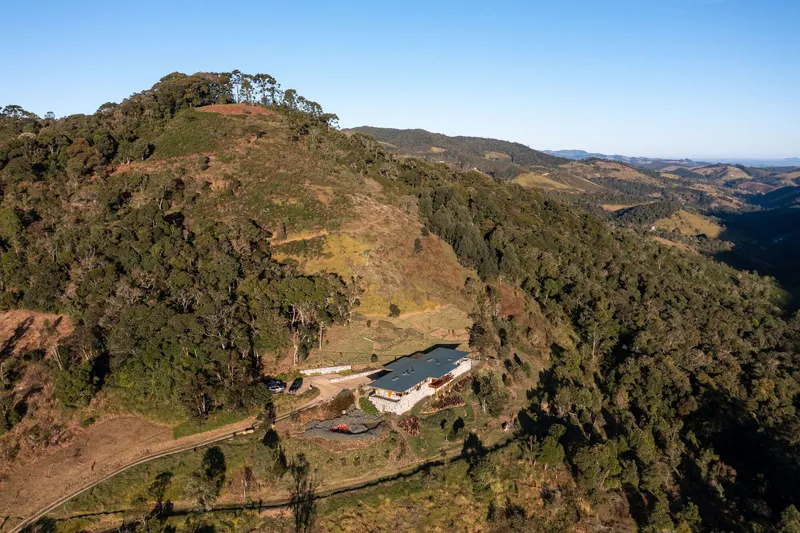
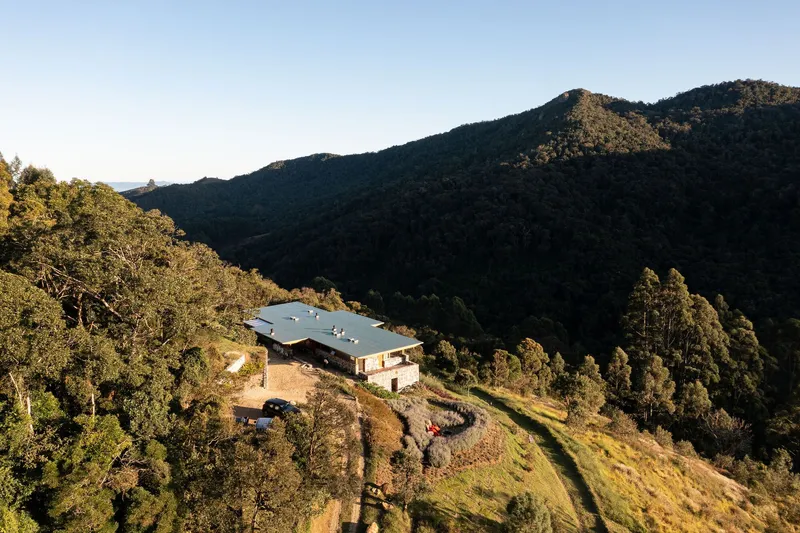
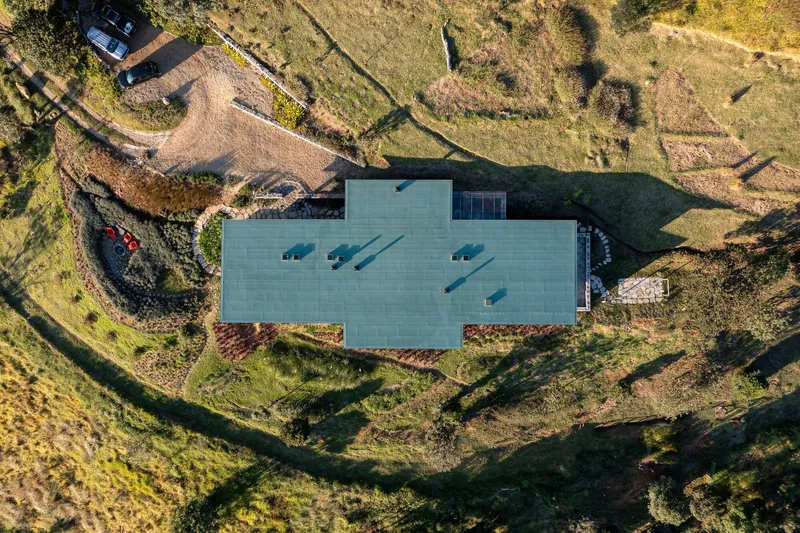
The aerial views reveal a building that has been placed with deliberate patience. The architects spent months observing the site before settling on the sunniest slope, one protected from southerly winds and open to the northern sun (a critical orientation in the Southern Hemisphere). From above, the three-lobed metal roof reads almost like a geological formation itself, its muted gray tone disappearing into the surrounding forest canopy. Four skylights punctuate the surface, suggesting that the interior life below depends on captured daylight as much as on framed views.
The valley context is lush but not undifferentiated. Agricultural fields, secondary forest, and ridgelines create a layered backdrop that the house addresses rather than ignores. Siting the building into the hillside rather than on top of it keeps its profile low, deferring to the topography instead of announcing a human presence.
Stone as Foundation, Stone as Character
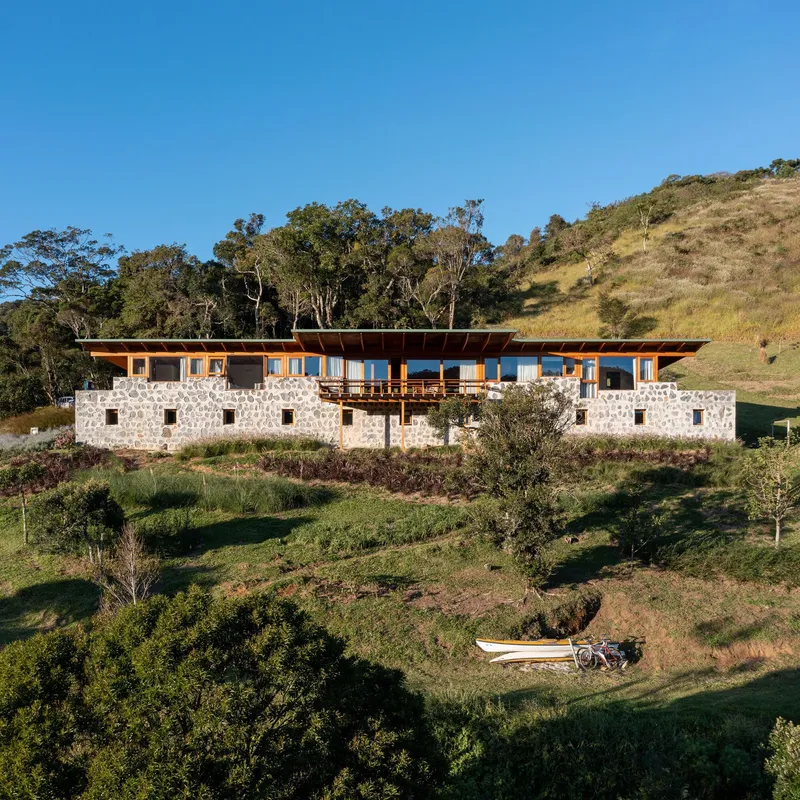
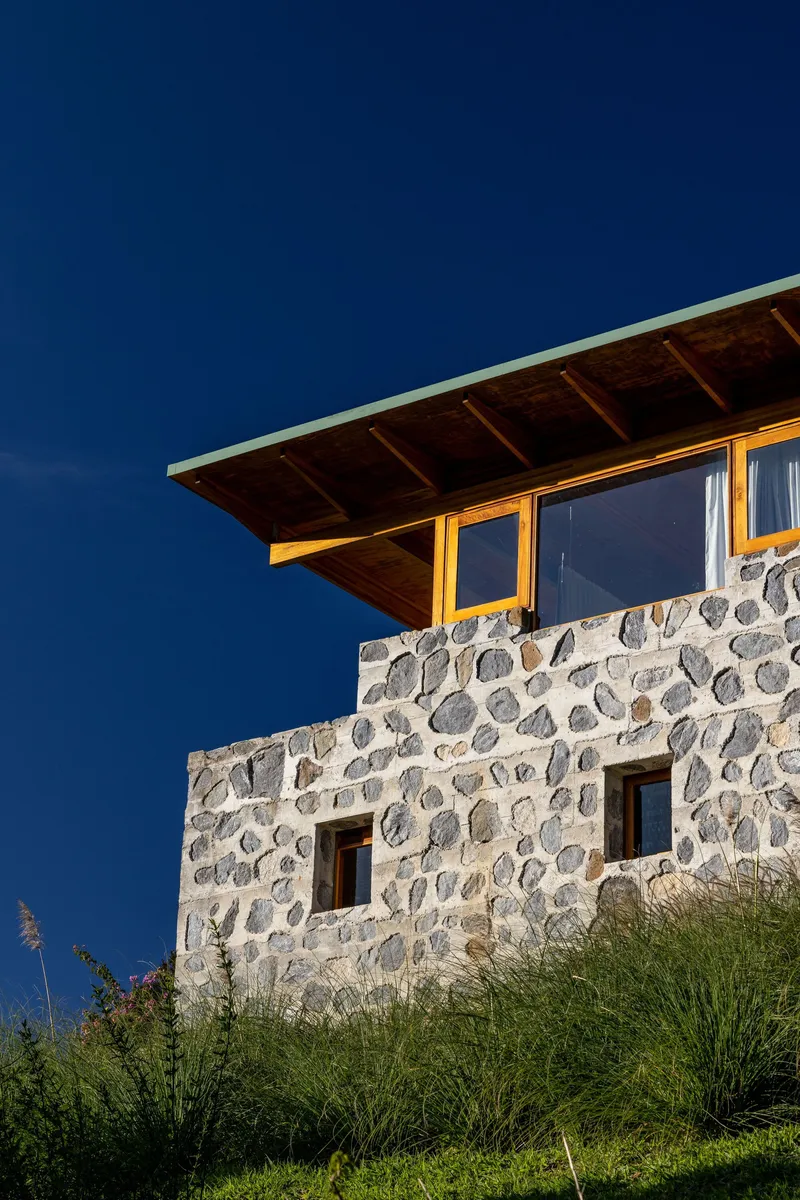

The fieldstone walls are the emotional center of the project. They are not veneer; they are thick, structural, and deliberately rough, coursed with an irregularity that suggests hand-placement rather than machine precision. At the base level they merge with the terrain, and at the upper level they frame windows and terraces with an almost defensive solidity. The twilight image of the upper facade captures this dual quality perfectly: the stone absorbs the last warmth of the day while the timber roof floats overhead like a parasol.
The dusk shot of the residence from a distance completes the picture. The broad overhanging roof, the low profile, and the stone base together produce a silhouette that could belong to a rural shed or a centuries-old farmstead. Only the proportion and the consistency of the glazing betray the hand of trained architects working with modern structural capacity.
Living Under Timber: The Upper Volume
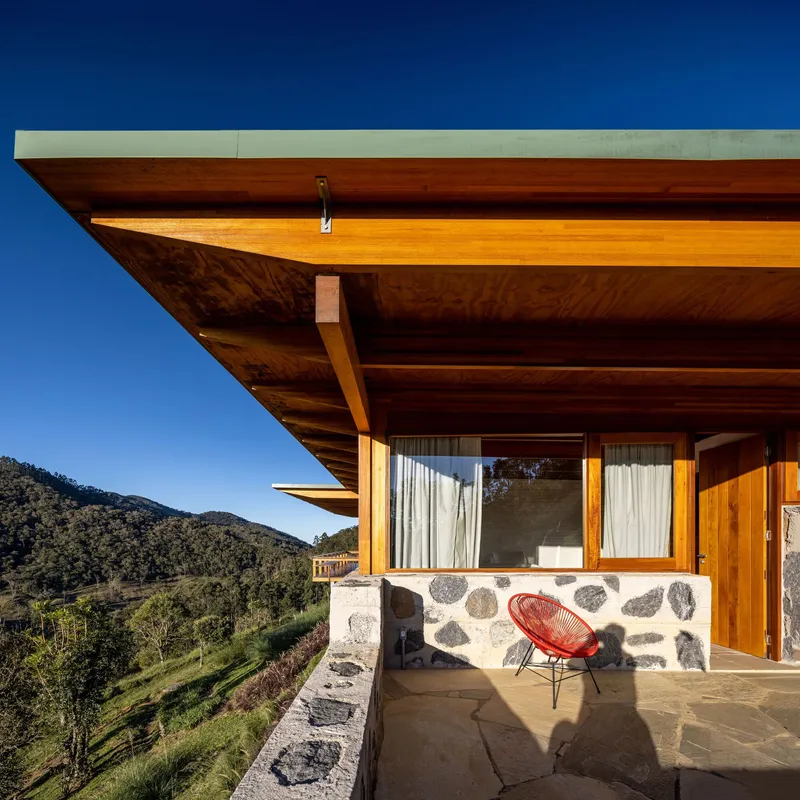
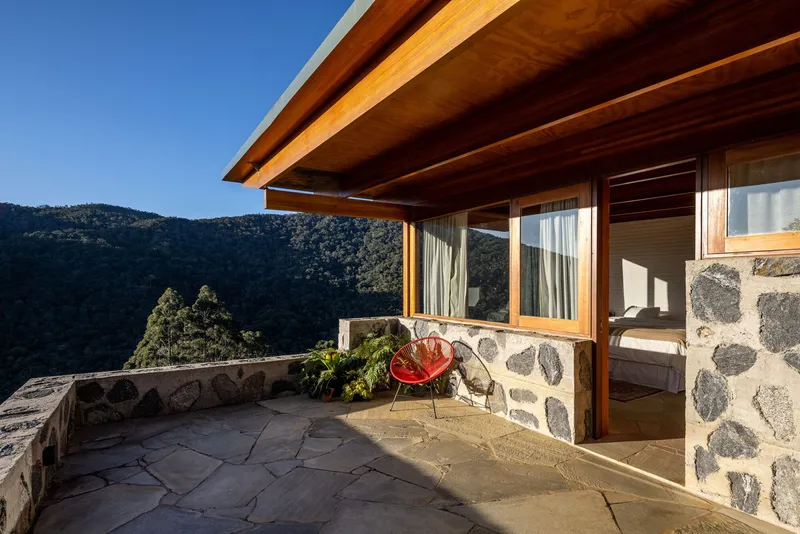
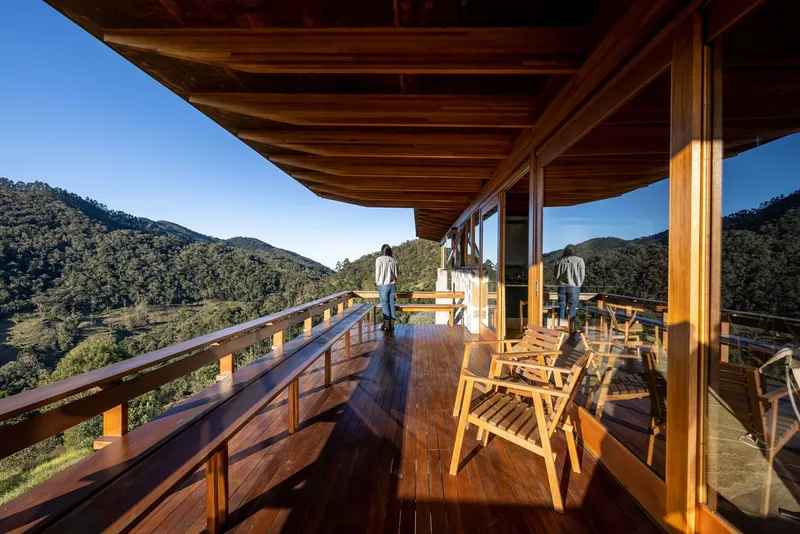
The covered terraces are where the house truly performs. Exposed CLT beams and rafters create a warm, rhythmic ceiling plane that extends well past the glass line, sheltering generous outdoor living areas. The stone paving underfoot continues the material vocabulary of the base, blurring the boundary between interior and exterior. A red lounge chair on one terrace, two figures leaning on a railing on another: these are spaces designed for slow occupation, not circulation.
The overhang is not merely aesthetic. It manages solar gain in a region with intense equatorial light, allowing winter sun to penetrate while shading the glazing during hotter months. The timber structure, being CLT rather than traditional post-and-beam, gives the architects long spans without the visual clutter of secondary framing, keeping the ceiling planes clean and legible.
Interior Rooms That Work with Raw Surfaces

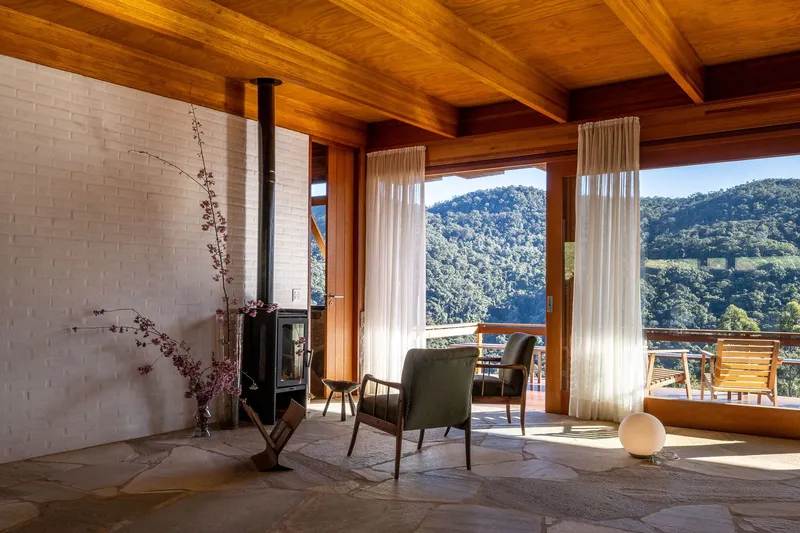
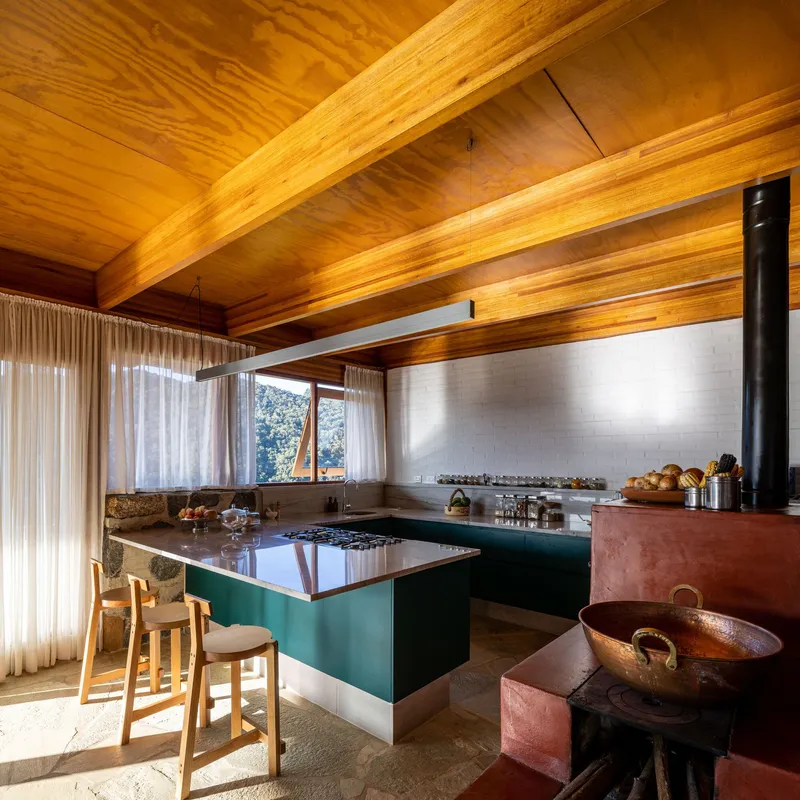
Inside, the material palette remains disciplined but never austere. The dining area is a standout: morning sunlight rakes across an irregular stone floor beneath exposed timber beams, and the room feels both grounded and luminous. The living room introduces a white brick fireplace as a vertical counterpoint to the horizontal timber ceiling, with floor-to-ceiling glazing pulling the valley into the room. The kitchen, centered on a green island and a wood-burning stove, is frankly domestic in a way that resists the temptation to turn every room into a landscape gallery.
What unifies these spaces is the insistence on tactile, unfinished surfaces. The stone floors are not polished. The timber is exposed, not clad. The fireplace is painted but not plastered smooth. The architects clearly trust their materials to age well, a confidence that only makes sense when those materials are honestly deployed.
Private Rooms and Thresholds

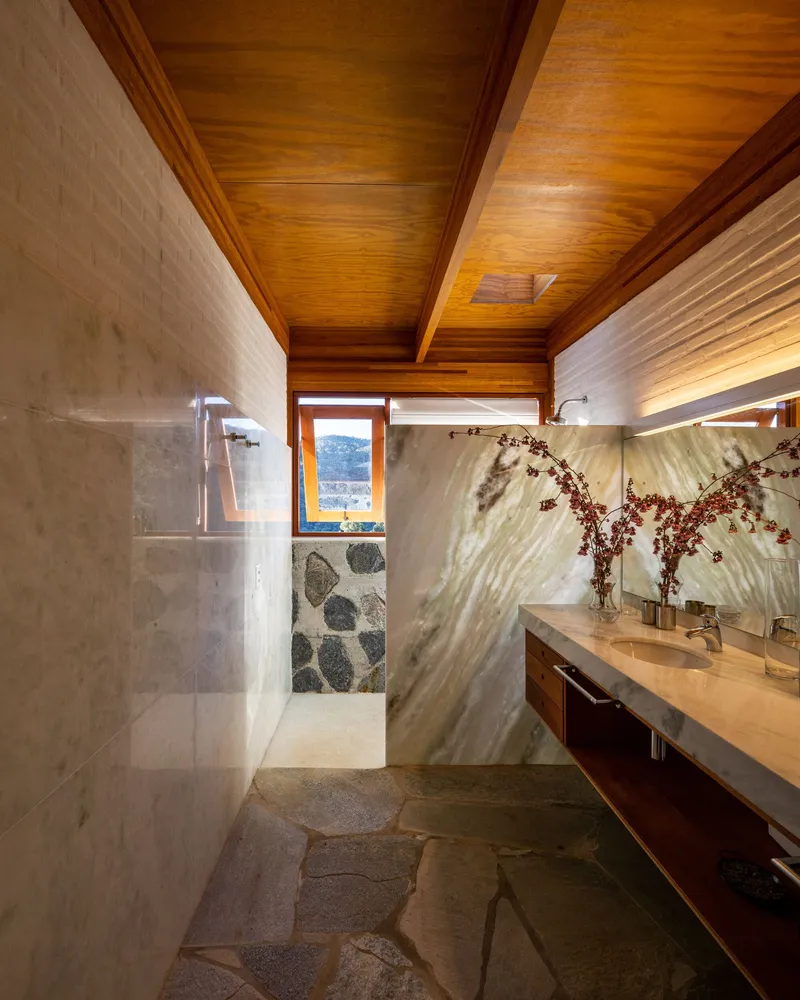
The bedroom is a masterclass in restraint. A river stone half-wall rises to sill height, and corner windows frame two perpendicular mountain views without any structural column at the join. The timber ceiling wraps the room in warmth, and the absence of curtains or heavy furnishings suggests a deliberate vulnerability to the landscape. The bathroom pushes the material richness further: veined marble wall panels sit beside a stone floor and timber ceiling, with a window that treats the mountain view as the primary ornament.
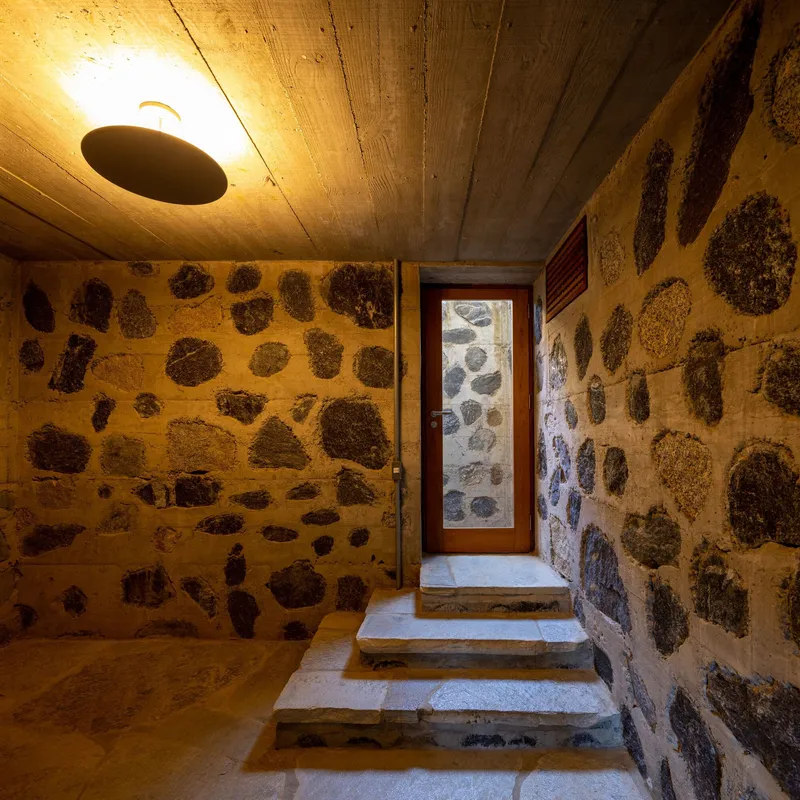
The stone staircase is worth pausing on. Rounded fieldstone walls curve upward beneath a timber plank ceiling, and a circular ceiling fixture provides the only artificial light. The passage is tight, almost cave-like, and the contrast with the open terraces above makes the arrival into daylight feel earned. Circulation here is not neutral; it is an experience in compression and release.
The Pool and Its Stone Chamber


Below the main living level, an indoor pool occupies a stone chamber that feels more like an excavation than a room. Fieldstone walls and board-formed concrete ceilings create a deliberately heavy enclosure, and the water reflects natural light from carefully framed windows. The adjacent corridor, with its flagstone paving and shadow-casting concrete beams, reinforces the sense that you have descended into the geological base of the house, into the ruin that the architects imagined at the project's inception.
A library with built-in timber bookshelves and glazed doors offers a transition back to the hillside. Books, stone, glass, and distant green hills coexist in a single frame, a reminder that this house accommodates intellectual life as comfortably as it accommodates weather.
Opening Up: Decks and Sliding Thresholds


The timber-framed sliding doors are a key detail. When fully retracted, they dissolve the wall plane entirely, turning the living spaces into covered outdoor rooms. A dog resting on the deck beneath distant hills is the kind of incidental detail that speaks to the house's actual use: this is not a museum of materials but a place where daily life unfolds among wildflowers and afternoon breezes. The two-level facade, seen from the meadow, confirms that the house sits lightly despite its stone mass, its proportions more horizontal than vertical, more landscape than object.
Plans and Drawings
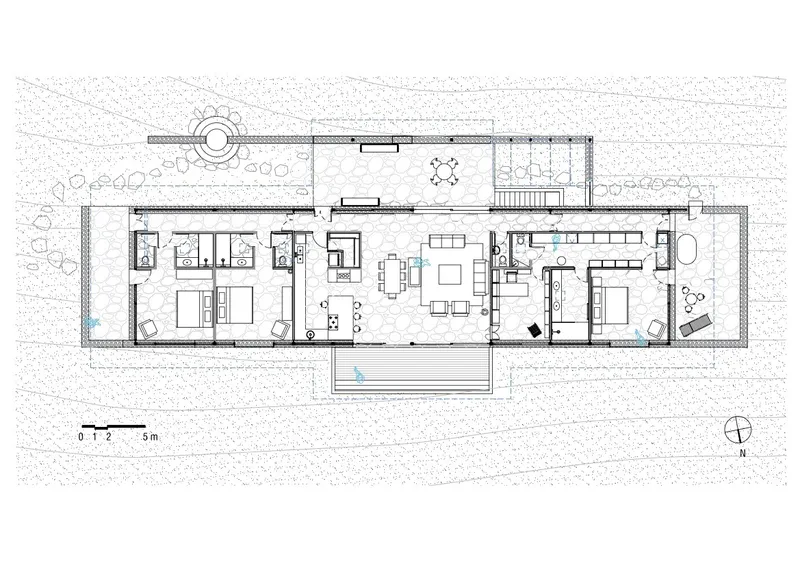
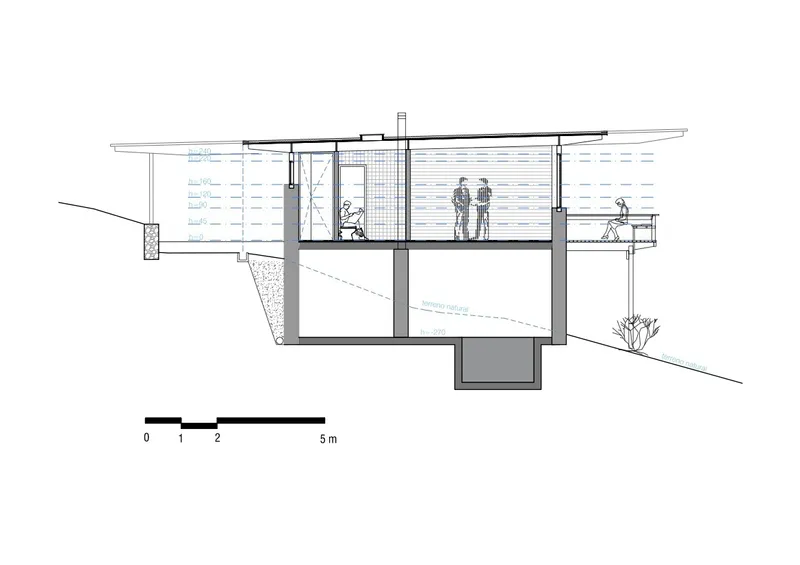
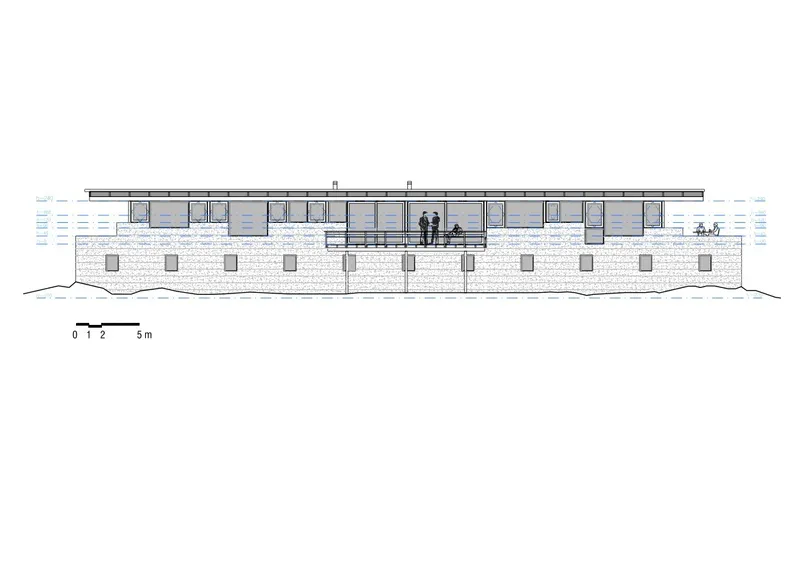
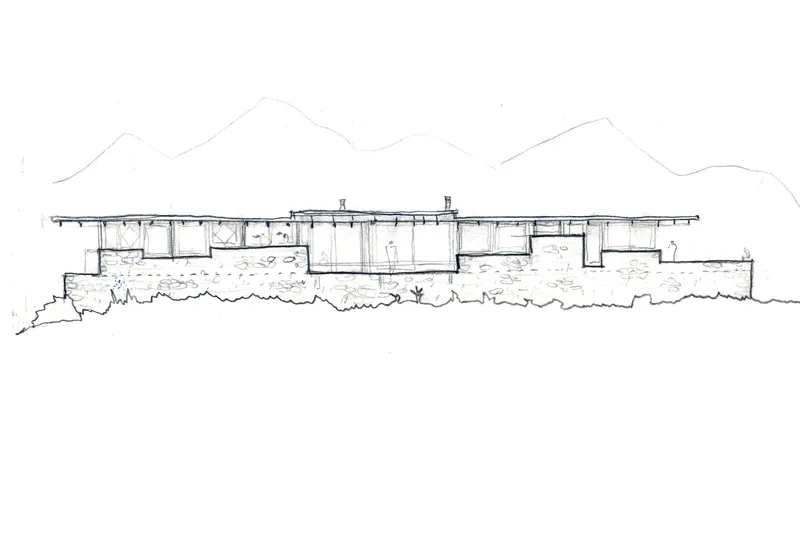
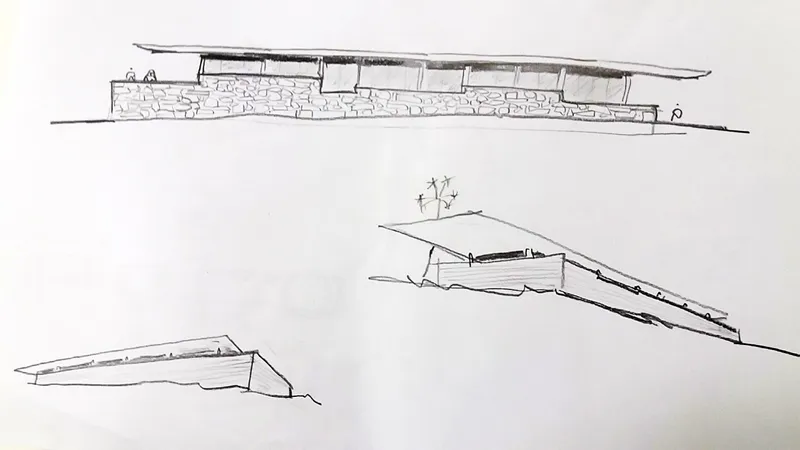


The floor plan reveals a linear arrangement of bedrooms and living spaces organized around a central courtyard, a strategy that ensures cross-ventilation and gives every room access to both intimate garden views and expansive valley panoramas. The section drawings are especially instructive: the split-level interior follows the natural slope, stepping down through the house rather than leveling the terrain. The elevation sketches show the stone base as a continuous datum from which the glazed timber volume lifts off, and the perspective drawings capture the architects' original vision of a low, cantilevering form hovering over a textured stone plinth. The hand-drawn quality of these sketches is worth noting; they convey intention and atmosphere in a way that renders often cannot.
Why This Project Matters
The Bocaina-Paraty House matters because it takes a poetic conceit, the idea of a natural ruin, and builds it into a rigorous architectural strategy. The stone is not scenography; it is load-bearing, thermal, and spatial. The CLT is not a trendy material choice; it is a structural system that enables the long spans and clean ceilings the design depends on. And the glass is not indiscriminate; it is placed where views and light warrant it and withheld where mass and enclosure serve better. Every material decision follows from the founding idea, which is the definition of conceptual integrity.
More broadly, the project demonstrates that a contemporary house in the Brazilian countryside does not need to choose between regional tradition and global technique. Fieldstone construction and cross-laminated timber manufacturing belong to different centuries and different economies, but here they coexist without hierarchy or nostalgia. The house does not romanticize the rural; it simply takes the landscape seriously enough to spend months observing it before committing a single line to paper. That kind of patience is rare, and it shows.
Bocaina-Paraty House by Cicero Ferraz Cruz and Fábio Mosaner. Cunha, Brazil. Completed 2022. Photography by Manuel Sá.
About the Studio
Fábio Mosaner
Share Your Own Work on uni.xyz
If projects like this are the kind of work you want to make, uni.xyz is a place to publish your own, find collaborators, and enter design competitions.


Popular Articles
Popular articles from the community


Juan García Correa, John González and Claudia Rueda Sink a Circular Amphitheater into a Manizales Engineering Building
On the La Nubia campus in Manizales, Colombia, the S1 Building folds labs and offices into a hillside of ramped lawns that double as a campus route.

longwave studio Reorganizes a 112 m² Tainan Apartment Around the Daily Routines of a Family and Two Cats
In Tainan, Taiwan, birch plywood, rust-red furniture and a freestanding plaster wall link arrival, storage, work and family life in one apartment.

Jaramillo Van Sluys Arquitectura and Urbanismo Turn a Demolished Registry Lot in Quito into an Orchard Plaza
In Quito's Centro Histórico, a 2,800 m² plaza exposes the San Agustín convent wall and redraws its lost Augustinian orchard in volcanic stone.

David Ortega Stacks a Two-Story Mexico City Penthouse Around a Steel Stair and a Pergola-Shaded Roof Terrace
In Colonia Roma, a 300 m² penthouse uses oak joinery, a planted steel stair and a slatted roof pergola to make a new-build apartment feel like a house.

Similar Reads
You might also enjoy these articles


LAVA Architecten Gives Vocational Education a Sawtooth-Roofed Face on a Mechelen School Campus
In Mechelen, Belgium, a 2,053 m² STEM school on a 6×6 m grid turns workshops and classrooms into rooms that can be rearranged as teaching changes.

KEMA Studio Turns a Derelict Marvila Attic into a 60 m² Lighthouse Apartment Above Lisbon
In Lisbon's Marvila district, a rebuilt roof, four skylights and two plywood volumes turn an unlivable attic into a bright home facing the Tagus.

Pixel Gardens: One Repeated Module Stacked Into a Terraced Social Housing Tower for Famagusta
Salem Bader's shortlisted housing tower builds a vertical neighbourhood from one repeated module, offsetting units to carve terraces, light and air.

Bao Huynh Watercolor Atelier: A Serene Art Retreat in Hội An
Bao Huynh Watercolor Atelier in Hội An blends multifunctional art spaces, sustainable design, local materials, and family-friendly living in a serene environment.

Explore Residential Building Competitions
Discover active competitions in this discipline

Challenge to design mud housing for contemporary communities

Design challenge to reuse E-waste
Comments (0)
Please login or sign up to add comments
No comments yet. Be the first to comment!