
City Center, Indore: An Urban Lifestyle Complex
A future-ready mixed-use architecture proposal that fuses culture, commerce, and community into a dynamic urban lifestyle destination for Indore.


The rapid transformation of Indian cities demands architectural models that are flexible, inclusive, and socially engaging. City Center, Indore, An Urban Lifestyle Complex is a comprehensive architectural thesis that explores mixed-use architecture as a future-proof urban strategy. Conceived as a hybrid of cultural hub, commercial center, and convention-scale public infrastructure, the project "CITY CENTER - "AN URBAN LIFESTYLE COMPLEX "" proposes a compact yet powerful urban node that responds to contemporary demographic, economic, and cultural demands.
Designed as a convergence point for social, cultural, and commercial activities, the City Center challenges conventional zoning by integrating multiple urban programs into a single cohesive environment. The project envisions architecture not merely as built form, but as a catalyst for interaction, exchange, and shared urban life.
Project Aim: A Hybrid Urban Node
The core aim of the project is to create a city-level node capable of holding, hosting, and enhancing everyday urban experiences. The proposal positions itself as a reduced-scale hybrid of:
- A Cultural Hub for exhibitions, performances, and collective expression
- A Commercial Center supporting retail, offices, and economic activity
- A Convention-like Public Platform enabling gatherings, events, and civic engagement
By merging these typologies, the project addresses the evolving needs of Indore’s urban population while maintaining spatial efficiency and functional synergy.
Architectural Challenges Addressed
The thesis critically examines the relationship between commerce and culture within Indian urban contexts. Key architectural challenges include:
- Exploring the symbiotic relationship between commercial and cultural spaces
- Breaking social and spatial segregation created by single-use developments
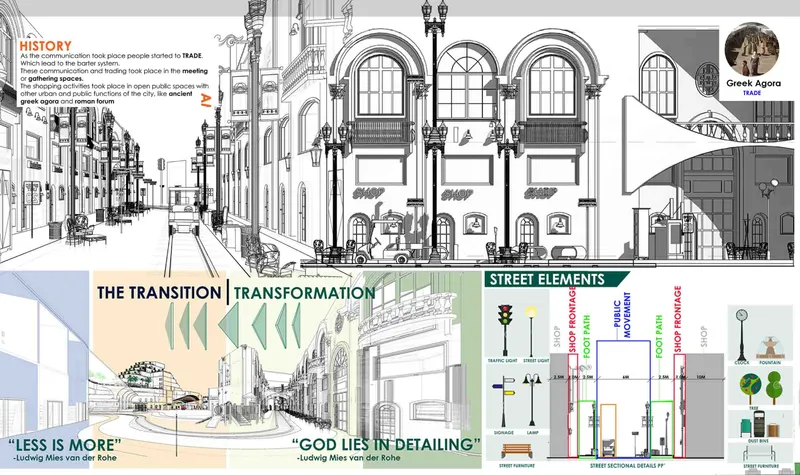
- Reinterpreting the conventional Indian market into a contemporary, inclusive urban form
- Integrating diverse functions that traditionally exist at large distances into a compact, walkable environment
Through mixed-use architecture, the project dissolves rigid boundaries and creates spaces accessible to all segments of society.
Design Principles: Structuring the Urban Experience
The design is guided by three primary principles that shape both form and function:
1. Attractors
Indore’s identity as a clean, multicultural city becomes the main attraction. Cultural diversity, public programs, landmarks, and gathering spaces are layered to draw people from within and beyond the city.
2. Connections
The site is strategically located in a rapidly growing urban zone. New streets, pathways, landscapes, and waterscapes strengthen pedestrian connectivity, dissolve hard edges, and link the development seamlessly with its surroundings.
3. Typologies
New architectural typologies are introduced to redefine the city image. Mixed densities, adaptive forms, and program-driven volumes reflect cultural diversity while responding to functional needs.
Programmatic Composition: A True Mixed-Use Architecture Model
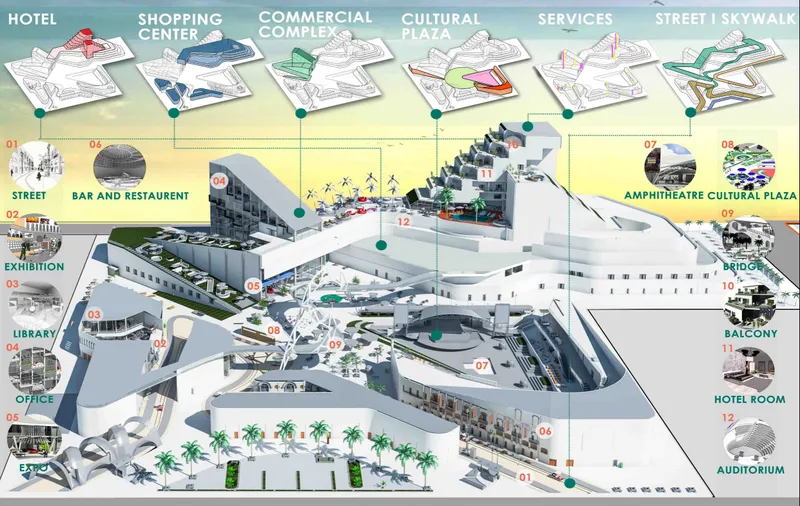
The City Center integrates multiple programs into a unified architectural system:
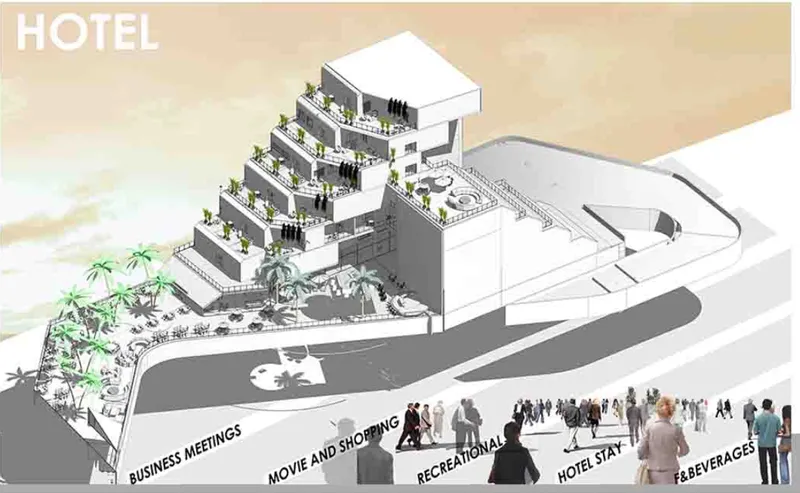
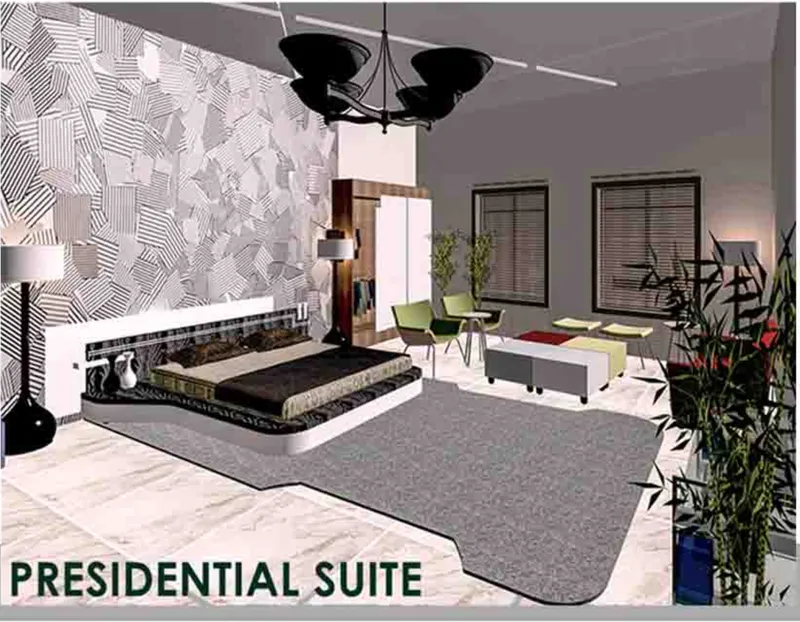
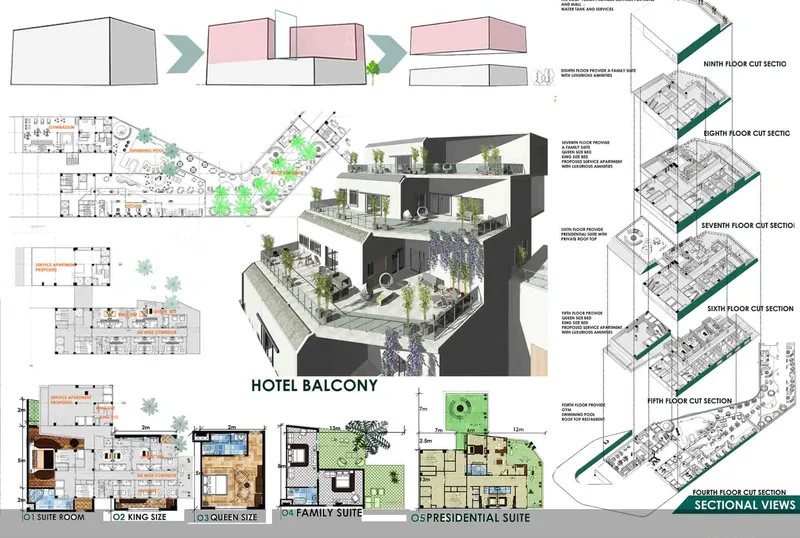
- Hotel and hospitality facilities
- Shopping Center and retail streets
- Commercial Complex with offices and workspaces
- Cultural Plaza with amphitheatre and exhibition areas
- Library, Auditorium, and Expo Spaces
- Restaurants, Bars, and Food Courts
- Street Networks and Skywalks enhancing pedestrian movement
Each function is carefully layered vertically and horizontally, creating visual connectivity and seamless transitions between public and private realms.
Site Planning and Urban Integration
The site planning strategy emphasizes pedestrian priority, efficient vehicular movement, and clear zoning. Multiple entrances, service lanes, and circulation loops ensure smooth operations without disrupting public activity. Landscaped plazas, shaded streets, and open courtyards act as breathing spaces within the dense urban fabric.
By maximizing commercial frontage and minimizing vehicular dominance, the design strengthens street life and reinforces the project’s role as an active urban destination.
Evolution of Form and Spatial Experience
The architectural form evolves through a series of transformations:
- Dividing and stepping built masses to allow light and ventilation
- Sloping and connecting volumes to create continuous public spaces
- Integrating green terraces, roof plazas, and open decks
- Blending indoor and outdoor programs to enhance user experience
The result is a fluid architectural language that supports interaction, movement, and visual continuity across the complex.
Social, Cultural, and Economic Impact
As a mixed-use architecture proposal, the City Center functions as:
- A social condenser for everyday urban life
- A cultural platform for performances, exhibitions, and learning
- An economic engine supporting retail, offices, and tourism
- A family-oriented destination with spaces for children, youth, and seniors
The project redefines the idea of a city center as a place of participation rather than mere consumption.
City Center, Indore, An Urban Lifestyle Complex presents a holistic vision for future Indian cities through the lens of mixed-use architecture. By integrating commerce, culture, and community within a single adaptive framework, the project proposes an efficient, inclusive, and resilient model for urban development.
Rooted in local context yet forward-looking in approach, the design demonstrates how architecture can shape better urban futures: where spaces are shared, experiences are layered, and cities truly belong to their people.
Project By: Keshav Rathi



Popular Articles
Popular articles from the community


Co-life: Sustainable Architecture for Age-Friendly Community Living
Co-life reimagines sustainable architecture for seniors through courtyards, rammed earth, shared gardens, and spaces designed for belonging.

Hill & Cross Opera: Sculptural Opera House Architecture Shaped by Tallinn’s Landscape and Identity
Hill & Cross Opera reimagines opera house architecture in Tallinn through its sculptural hill, civic plaza, glass wave and a luminous cross.

Play: Fragments of Their World
Familiar architecture becomes modular playground design, creating safe spaces where displaced children can learn, connect, imagine and play.

Riyadh For All: Intergenerational Urban Design for Active Aging in Rabat
Riyadh For All reimagines urban design in Rabat with intergenerational co-living, adaptive courtyards, and Moroccan cultural exchange today.

Similar Reads
You might also enjoy these articles

Maya Harvest: A Cacao Resort Village Rooted in Mayan Tradition and Local Craft
Situated within a Tabasco cacao plantation, this shortlisted resort proposal merges vernacular materials with hands-on cultural immersion.
Harmonia: A River-Shaped Community That Grows Over Decades in Boa Vista
Curved pathways and modular grid structures along the Branco River create a phased settlement designed to evolve from 2030 to 2050.
The Architecture of Bathing: A Mughal Hammam Reimagined Across the Yamuna
Charlotte May's honorable mention entry for The Black Taj reinterprets Agra's bathing rituals through red sandstone, water, and framed views of the Taj Mah
Om-1: A Wall-Hung System That Moves Your Workspace Off the Desk
Modular plywood boards, magnetic pegs, and utility elements migrate clutter from the horizontal surface to the vertical plane.
Comments (0)
Please login or sign up to add comments
No comments yet. Be the first to comment!