

To Tower, Not to Sepulcher: A Memorial That Dismantles Itself as Species Disappear
Each species becomes a tetrahedral unit; as extinctions mount, the tower sheds its skin and pyramids fill the Egyptian desert as sepulchers of loss.


Most memorials arrive after the fact. They mark a loss already complete and ask visitors to look back. To Tower, Not to Sepulcher refuses that posture. Its subject is the sixth mass extinction, an event still unfolding, so the building is designed to unfold with it. Every species on Earth is assigned a modular unit, and every extinction removes one unit from a living tower and lays it to rest in a pyramid on the ground. The monument does not depict collapse; it keeps count of it, in real time, in material.
The project was shortlisted in the Hourglass competition, which asked entrants to rethink what a memorial for climate change could be. Designed by Weiyu Xu, Hongyi Zhu, 金 飞灵 and Rui Su, the scheme is sited in a vast Egyptian desert, a landscape already saturated with the architecture of the dead. That choice is pointed: the team borrows the pyramid, the most durable tomb form humanity has built, and turns it into a ledger for species lost on our watch.
A Field of Tombs That Fills While the Tower Thins
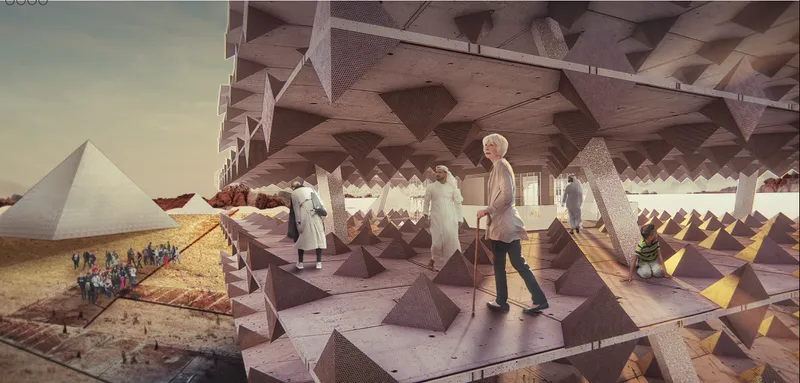
The rendering captures the scheme at human scale: a floor slab studded with small pyramid forms, an elderly couple and a child crossing it at dusk, the larger desert pyramids on the horizon. The generational pairing is not incidental. The design plays out across three phases, and these visitors are walking through the slow middle one. In the initial phase the tower stands dense with millions of species units while the surrounding pyramids remain translucent and empty. In the intermediate phase units are systematically stripped away, exposing the structural skeleton, and the pyramids shift from transparency toward opacity as they fill.
What makes the narrative work is that loss is spatially conserved. Nothing simply vanishes; density migrates from the vertical to the horizontal, from the vital to the sepulchral. By the final phase the tower is reduced to its bare core and the completed pyramids dominate the landscape. A child visiting today and returning as an adult would read the difference without a single label, which is a rare thing for a memorial to achieve.
Three Layers, Built to Be Undone
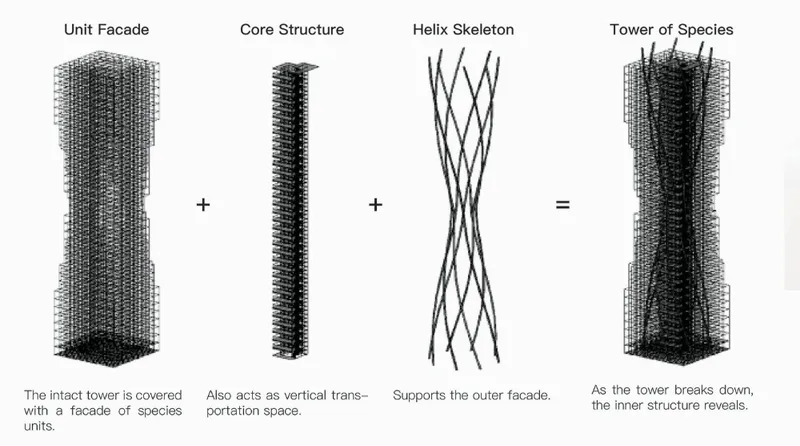
The tower diagram separates the structure into three components: a unit facade, a core structure and a helix skeleton. Read in reverse, it doubles as a demolition sequence. The facade, composed of the species units, is the sacrificial layer; as units are removed, it dissolves and reveals the helix and core beneath. Most buildings hide their structure behind a finished skin. Here the exposure of structure is the plot, and every bay that opens up is a record of species gone.
On the ground the logic inverts. Pyramids are assembled by modular aggregation, with units interlocking through precise geometric constraints so the system can keep growing for as long as extinctions continue. It is a sobering design requirement: the team had to plan for open-ended accumulation, and the architecture accepts that its burial grounds may never be finished.
A Wedge of Pyramids Between Highway and Dune
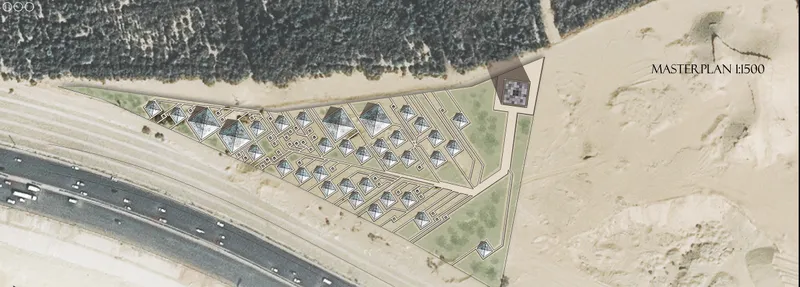
The master plan arranges the pyramidal pavilions in a triangular wedge pressed between a highway and pale desert dunes, with a square building anchoring the tip. That edge condition matters. One side faces infrastructure and movement, the other faces emptiness, and the field of tombs sits between them as a threshold between the human systems driving extinction and the barren ground that results.
Within the wedge the pyramids form a distributed, maze-like field. Visitors navigate varying densities and scales of loss rather than viewing them from a single vantage point, so the experience of extinction becomes something walked through, sometimes disorienting, rarely legible all at once. Set against the open desert, the contrast between barrenness and architectural density sharpens the warning.
From Double Helix to Tetrahedron
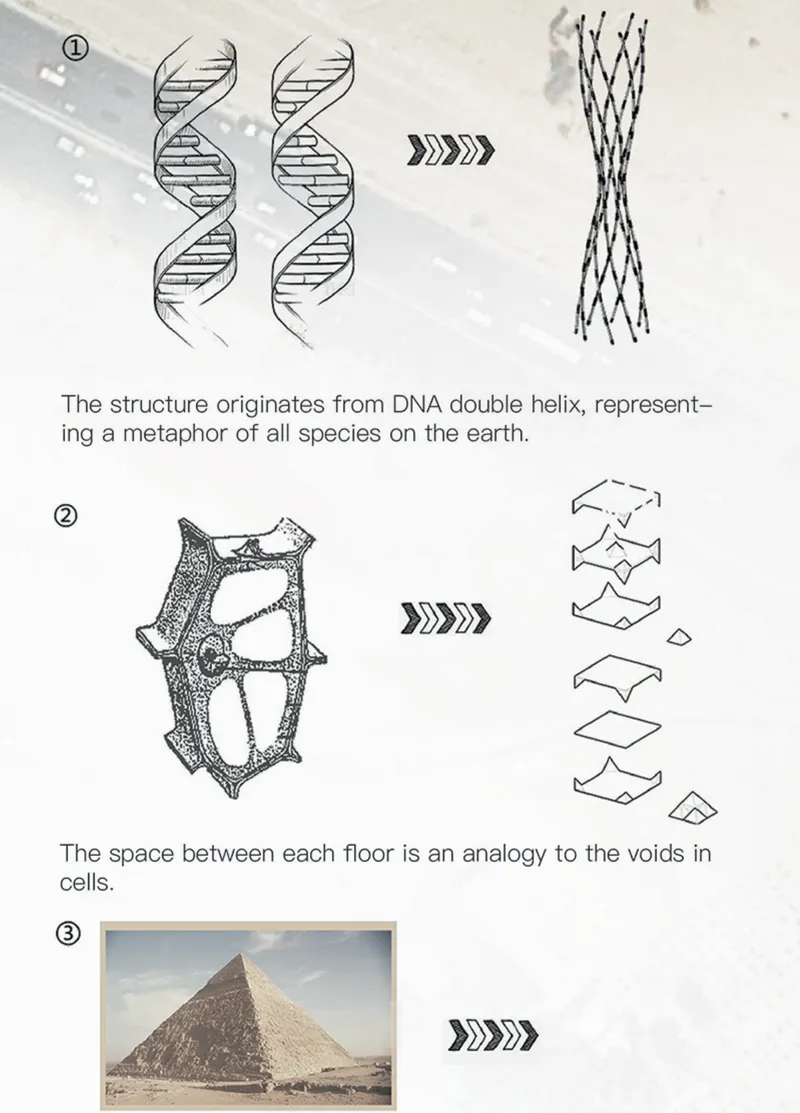
The concept sketches trace how the form was derived: the DNA double helix, the voids of a cell and the stone pyramid are drawn into the tower's structure and floor forms. The helix becomes the skeleton that survives at the end; the pyramid becomes the vessel of memory. Biology and burial are fused into one formal vocabulary.
The more provocative move is the encoding. Each species is translated into a binary string, which drives geometric variation within a tetrahedral unit, so no two units are identical and each carries the identity of a specific organism. This gives the project a computational backbone in line with contemporary parametric methods, but its real value is ethical: extinction stops being a statistic and becomes a particular, irreplaceable object moved from one place to another.
Why This Project Matters
Climate memorials tend to fail in one of two ways: they abstract loss into a gesture too vague to feel, or they freeze a single moment that quickly dates. To Tower, Not to Sepulcher sidesteps both by making the building a running index. Its form at any given moment is a reading of the planet's biodiversity, and its slow transformation from tower to tomb gives visitors something no static monument can: evidence of change across their own lifetime.
There are open questions, from how removal would be governed to how the field might be maintained over decades, but the conceptual clarity is hard to dismiss. By tying each unit to a species and each removal to an extinction, the team turns architecture into an accountable instrument. Its title reads as a choice still available to us, and the building is designed to show, unit by unit, which way that choice is going.
View the Full Project
About the Designers
Designers: Weiyu Xu, Hongyi Zhu, 金 飞灵, Rui Su
Enter a Design Competition on uni.xyz
uni.xyz runs architecture and design competitions year-round that reward proposals with spatial conviction and real site intelligence.
Project credits: To Tower, Not to Sepulcher by Weiyu Xu, Hongyi Zhu, 金 飞灵, Rui Su Hourglass (uni.xyz).


Popular Articles
Popular articles from the community


LT2A and OPEN Architectes Thread a Brick and Glass High School Through a Wooded Belgian Campus
In Braine-l'Alleud, a 3,000 m² wing for Collège Cardinal Mercier pairs pale brick with a glazed colonnade, deferring to a small chapel and a dense wood.

longwave studio Reorganizes a 112 m² Tainan Apartment Around the Daily Routines of a Family and Two Cats
In Tainan, Taiwan, birch plywood, rust-red furniture and a freestanding plaster wall link arrival, storage, work and family life in one apartment.

U.GA Architects Wraps an Oval Rooftop Pool in Curved Board-Formed Concrete on Busan's Jeollidan-gil
In Busan's Jeonpo-dong, a 454 m² mixed-use block stacks a neighborhood facility, guest rooms and an oval rooftop pool inside spiraling concrete walls.

GROUP A Strips a 1969 Rotterdam Harbor Headquarters to Its Frame and Wraps It in Timber Louvers
In Rotterdam's M4H harbor district, Ferro Offices reuses a 1969 frame, adds one timber storey and reaches BREEAM-NL Outstanding.

Similar Reads
You might also enjoy these articles
Healing Façade: A Modular Chapel System That Restores Ethiopia's Sacred Forests
Winner of the Eco-Chapel competition, this circular timber façade collects water from air to rebuild soil and reforest degraded Ethiopian landscapes.
Kaffeebühnen: Where Coffee Shop Architecture Becomes a Civic Stage in Vienna
A linear sequence of timber boxes, transparent shells, and open yards turns the Viennese café tradition into a public performance space.
Eco Chapel: A Modular Forest Pavilion That Grows Like the Landscape It Protects
Hexagonal timber modules weave through existing trees, turning a chapel into a living system for prayer, education, and reforestation.


Urban Forest: A Vertical Ecosystem for 5,000 Workers in Singapore's Changi Business Park
Radially stacked pods and layered green decks turn a 7-acre plot into 47 acres of ecological workspace projected for 2040.

Explore Architecture Competitions
Discover active competitions in this discipline

Challenge to reimagine the Iron Throne

Photograph architecture without architects

Illustrate the lost glory of Angkor Wat - Render Challenge

Design challenge to reuse E-waste
Comments (0)
Please login or sign up to add comments
No comments yet. Be the first to comment!