

The Panic Pillar and Museum of Climate: A Memorial Built to Collapse Beside the Pyramids of Giza
A leaning concrete pillar near Giza is designed to decay as carbon levels rise, turning a buried bunker museum into a live gauge of planetary health.


Most memorials ask us to remember. The Panic Pillar and Museum of Climate asks us to brace. Instead of honouring a catastrophe that has already happened, it stages one that is still on its way: a tilted pillar whose material is meant to respond to rising carbon dioxide, deteriorate as climate thresholds are crossed, and eventually fall. The building is a countdown you can stand beneath, and it is not built to last.
The project was designed by Georgia Lloyd, Lillian He, Nemanja Vujinovic and Danica Cruz. They chose a provocative site next to the Pyramids of Giza, humanity's most famous argument for permanence. That choice is the thesis. Beside monuments that have endured for millennia, the team places a structure that openly expects to fail, setting ancient stability against the instability of a civilisation that is altering its own climate.
A Leaning Anomaly on the Giza Plateau


The aerial view sets the baseline: three pyramids on a hazy plateau, geometry so stable it has become shorthand for eternity. The designers do not compete with that silhouette. They bury most of the programme. The second rendering shows the only major surface gesture, a sunken rectangular courtyard cut into open desert, with a towering dust cloud rising behind it. The cloud reads as an omen, a climate event approaching on the horizon while the architecture sits low and braced.
Placing the museum below ground does two jobs. It keeps the plateau visually quiet around the pyramids, and it turns the building into a hidden system that unfolds through descent. Above grade, only the inclined pillar breaks the horizon. That single off-vertical line is enough to register as wrong in a landscape defined by perfect triangles, which is exactly the point.
Bunker Interiors That Withhold Comfort

Underground, the museum borrows from bunker architecture, a typology built for isolation and survival. The interior rendering shows a raw concrete hall with a cantilevered stair and a single wooden bench, visitors moving through soft, filtered light. It is calm in the image, but the route around it is designed for tension: narrow corridors compress the body before releasing it into larger exhibition halls, a rhythm of squeeze and release that keeps visitors unsettled rather than soothed.
This is the project's sharpest departure from conventional memorial design. Many memorials aestheticise grief into serene reflection. Here the team treats discomfort as content. The bench is a pause, not a resolution, and the cantilevered stair hangs without visible support, a small echo of the structural precarity outside.
Red Cables Holding Back the Fall

Looking straight up the tapered concrete shaft, the most memorable detail appears: red cables anchored to orange chevron plates, visibly restraining the pillar's lean. The colours borrow the language of hazard tape and warning signage, so the structure reads less like a monument and more like an emergency intervention. The pillar is an abstracted pyramid, pulled out of balance, and the cables make that imbalance legible. Something is being held, and it may not hold forever.
This is where symbol becomes mechanism. The pillar's material is conceived to react to environmental conditions such as elevated carbon dioxide, so its slow deterioration would track real planetary conditions. Architecture becomes a temporal event: a building whose eventual collapse would be a public, physical readout of collective failure.
A Section Pierced by a Single Slanted Line

The perspective section explains the whole proposal in one cut. Stacked underground galleries descend layer by layer, and through them runs the slanted pillar, rising out of the ground above. The diagonal ignores the orthogonal logic of the floors it crosses. It punctures the museum rather than sitting on top of it, tying every level to the same threat.
Reading the drawing, you see how the experience depends on that relationship. Visitors descend through spaces that seem safe and enclosed, yet the leaning element passes through them, linking the sheltered bunker below to the exposed, failing marker above. The section makes the argument structural: no part of the building is separate from what happens to the pillar.
Why This Project Matters
Climate architecture usually speaks through efficiency metrics and green credentials. The Panic Pillar takes a different route and works on emotion and time. By designing a memorial that anticipates loss instead of recording it, the team reframes commemoration as warning. Its setting beside the Pyramids of Giza sharpens that message into a contrast anyone can grasp: one monument shows what endures, the other shows what we may be unable to keep.
The proposal also takes a real risk by treating its own collapse as part of the design brief. A building built to deteriorate in step with carbon thresholds challenges the profession's default assumption that architecture should last. Whether or not such a material could be built today, the idea leaves a strong question behind: what if our buildings were honest about the future we are making, and were designed to show it?
View the Full Project
About the Designers
Designers: Georgia Lloyd, Lillian He, Nemanja Vujinovic, Danica Cruz
Enter a Design Competition on uni.xyz
uni.xyz runs architecture and design competitions year-round that reward proposals with spatial conviction and real site intelligence.
Project credits: The Panic Pillar and Museum of Climate by Georgia Lloyd, Lillian He, Nemanja Vujinovic, Danica Cruz.


Popular Articles
Popular articles from the community


Aquadapt: An Underwater Habitat That Rewrites Its Rooms by the Hour
Curved modules ring the seabed while one shell shifts from breakfast room to cinema, farm and football pitch as residents' needs change.


FCC Arquitectura Expands a Portuguese Granite House with a Board-Marked Concrete Wing
In Portugal, JV House pairs a cleaned-up whitewashed and granite dwelling with a timber-shuttered concrete extension, courtyards and a garden pool.

ETEH Reworks the Shared Spaces of São Domingos School in Brazil Around Timber, Color and Hanging Plants
At São Domingos School in Brazil, 436 m² of hall, refectory and library are recast with timber joinery, a yellow and blue code and trailing greenery.

Singing Woman: An Opera House That Performs Before the Curtain Rises
Ovidiu Cristian Pavel's conceptual opera house translates Estonia's choral identity into a sculpted waterfront landmark facing the Baltic Sea.

Similar Reads
You might also enjoy these articles
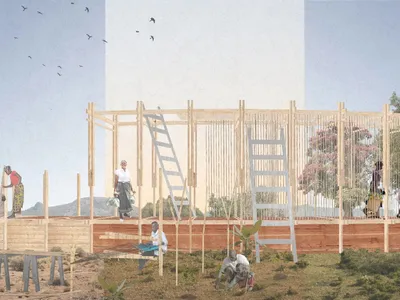
Healing Façade: A Modular Chapel System That Restores Ethiopia's Sacred Forests
Winner of the Eco-Chapel competition, this circular timber façade collects water from air to rebuild soil and reforest degraded Ethiopian landscapes.
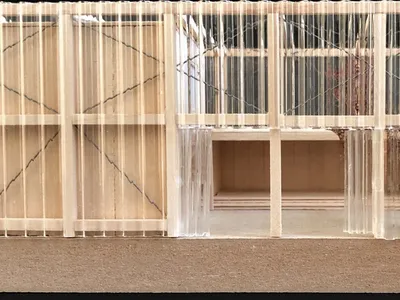
Kaffeebühnen: Where Coffee Shop Architecture Becomes a Civic Stage in Vienna
A linear sequence of timber boxes, transparent shells, and open yards turns the Viennese café tradition into a public performance space.
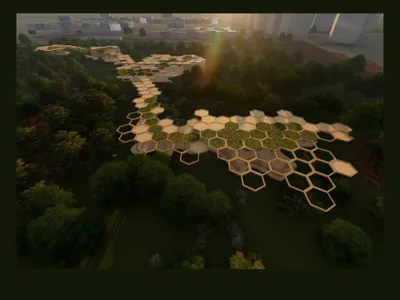
Eco Chapel: A Modular Forest Pavilion That Grows Like the Landscape It Protects
Hexagonal timber modules weave through existing trees, turning a chapel into a living system for prayer, education, and reforestation.


Urban Forest: A Vertical Ecosystem for 5,000 Workers in Singapore's Changi Business Park
Radially stacked pods and layered green decks turn a 7-acre plot into 47 acres of ecological workspace projected for 2040.

Comments (0)
Please login or sign up to add comments
No comments yet. Be the first to comment!