

Earth's Time: A Desert Walk from Ecological Collapse to Hope, Shortlisted in Hourglass
Four staged spaces, from a barren Land of Death to a sunlit Color Square, turn the passage of climate time into a walk visitors physically complete.


Most climate architecture argues with data. Earth's Time argues with your feet. The project, also titled EnvironmenTime, takes the abstract arc of environmental damage and human realization and lays it across a desert as a route. You walk out of a dead landscape, through a field of concrete, into a shaft of sunlight, and finally into colour and openness. The argument is built into the order of the rooms: you understand what the project is saying by the time you reach the end.
The proposal was shortlisted in the Hourglass competition and designed by 성민 조, seunghee ock and 선아 이. They start from scientific reality, citing rising global temperatures and greenhouse gas concentrations, and choose a desert as both symbol and site of environmental extremity. They do not drop an object onto the sand. They use what the desert already has in abundance, light, shadow and exposed ground, to make climatic conditions legible. The route has four stages: Realization, Alteration, Introspection and Hope. Each one is a physical place, not a label on a diagram.
Realization Begins Where Life Has Already Left

The sequence opens on the Land of Death, a projection of a future in which ecological collapse can no longer be reversed. The designers keep the vocabulary sparse on purpose: minimal vegetation, barren ground and scattered spatial elements that suggest abandonment rather than design. Absence does the architectural work here, and that takes some nerve. Leaving a space nearly empty is harder to defend in a competition than filling it.
Putting this zone first is the key narrative decision. Visitors face the consequences before they see the causes, which flips the usual sequence of climate exhibitions. The desert stops being a backdrop and becomes the warning itself, a version of every landscape pushed to its end state.
A Concrete Forest Where Light Arrives Broken

In Alteration, the emptiness gives way to density. The Concrete Forest is a field of monolithic volumes that stands in for urban expansion and industrial intervention. Repeated geometries and tight circulation make the space deliberately disorienting. The most precise move is the treatment of daylight. Light reaches the floor only in fragments, and the designers read that as the thinning ozone layer. The atmospheric damage is something you register through your skin and eyes, not something you read about on a panel.
This is the project at its most critical. The heavy forms do not offer shelter or comfort; they press in on the visitor. It is a fair, if uncomfortable, picture of how development and sustainability rub against each other, and it gives the route a real middle act instead of a quick hop from doom to recovery.
Following a Single Beam of Sunlight Inward

Follow the Sunshine turns the experience inward. The designers describe it as an underground or semi-enclosed volume where one controlled beam of sunlight guides both movement and attention. After the scattered light of the Concrete Forest, the shift to a single directed ray is a strong spatial contrast. Light that was a symptom of damage becomes a guide.
Compression and a subdued material palette slow the visitor down. This is the room built for reflection, and it gets that effect with very little: a narrowed space, a quiet surface and one source of light. The project trusts restraint to produce introspection, and the choice holds up.
Color Square and the Release Into Open Ground


The route ends in the Color Square, where openness and brightness replace the enclosure of the previous stage. Circular canopies and soft ground conditions make a calm, restorative place. After heavy monoliths and a tight light well, the round canopies read as a deliberate softening of the architectural language, a geometry of gathering in place of a geometry of pressure.
Colour works as visual relief and as the spatial sign of hope, the last word in the four-part narrative. Its strength comes from what precedes it. Seen alone, the square would be pleasant. Reached after the Land of Death and the Concrete Forest, it feels earned.
Why This Project Matters
Earth's Time treats sequence as a design material. The four zones are not separate pavilions. They are chapters, and each depends on the contrast with the one before it: emptiness, then density, then a single ray of light, then open colour. That dependency is the project's main lesson for narrative architecture. Emotional effect comes less from any one space than from the transitions between them.
The project also shows how a site's existing extremes can carry a message. By working with desert light and shadow rather than masking them, the designers make climate conditions the medium of the experience rather than its subject. As a shortlisted Hourglass entry, it sets a useful benchmark: architecture that does not lecture on climate change, but walks its visitors from realization toward hope one threshold at a time.
View the Full Project
About the Designers
Designers: 성민 조, seunghee ock, 선아 이
Enter a Design Competition on uni.xyz
uni.xyz runs architecture and design competitions year-round that reward proposals with spatial conviction and real site intelligence.
Project credits: EnvironmenTime by 성민 조, seunghee ock, 선아 이.


Popular Articles
Popular articles from the community


Jaramillo Van Sluys Arquitectura and Urbanismo Turn a Demolished Registry Lot in Quito into an Orchard Plaza
In Quito's Centro Histórico, a 2,800 m² plaza exposes the San Agustín convent wall and redraws its lost Augustinian orchard in volcanic stone.

Cube Design Draws an Ecological Corridor Between Two Shenzhen Hills with the Nankai Building
Beside Shenzhen's container docks, the Nankai Building pairs stacked balconies with a climbing green screen to connect two hillsides across its height.

Juan García Correa, John González and Claudia Rueda Sink a Circular Amphitheater into a Manizales Engineering Building
On the La Nubia campus in Manizales, Colombia, the S1 Building folds labs and offices into a hillside of ramped lawns that double as a campus route.

Architekt Andreas Gruber Scatters 23 Dark Timber Chalets Across a South Tyrolean Forest Edge
In Molini di Tures, Amonti Chalets breaks a resort into a hamlet of gabled timber houses, with parking, storage and services pushed into the slope.

Similar Reads
You might also enjoy these articles
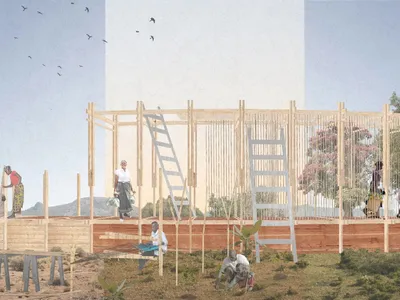
Healing Façade: A Modular Chapel System That Restores Ethiopia's Sacred Forests
Winner of the Eco-Chapel competition, this circular timber façade collects water from air to rebuild soil and reforest degraded Ethiopian landscapes.
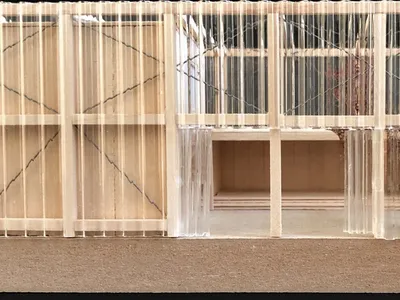
Kaffeebühnen: Where Coffee Shop Architecture Becomes a Civic Stage in Vienna
A linear sequence of timber boxes, transparent shells, and open yards turns the Viennese café tradition into a public performance space.
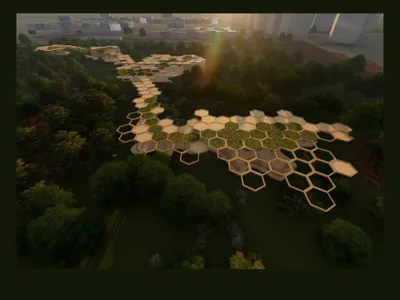
Eco Chapel: A Modular Forest Pavilion That Grows Like the Landscape It Protects
Hexagonal timber modules weave through existing trees, turning a chapel into a living system for prayer, education, and reforestation.


Urban Forest: A Vertical Ecosystem for 5,000 Workers in Singapore's Changi Business Park
Radially stacked pods and layered green decks turn a 7-acre plot into 47 acres of ecological workspace projected for 2040.

Explore Architecture Competitions
Discover active competitions in this discipline

Challenge to reimagine the Iron Throne

Photograph architecture without architects

Illustrate the lost glory of Angkor Wat - Render Challenge

Design challenge to reuse E-waste
Comments (0)
Please login or sign up to add comments
No comments yet. Be the first to comment!