

Climate-Responsive Architecture for Education: Kindergarten Re-vival by Reparametrize Studio
A climate-responsive kindergarten transforming rural education through adaptive design, passive systems, and safe, interactive learning spaces.


In the expanding field of climate-responsive architecture, educational environments are increasingly being reimagined as adaptive, sustainable systems. Kindergarten Re-vival, a project by Reparametrize Studio and a shortlisted entry for Education '20, exemplifies this shift by addressing both environmental and social challenges through design. Situated in Timeabu village, the project responds to the urgent lack of educational infrastructure while embracing local climatic conditions and material intelligence.
Context: Designing for Rural Education
Timeabu village faces significant limitations in access to structured educational spaces, particularly for early childhood learning. Rather than imposing a rigid architectural solution, the project proposes a flexible and modular system that evolves with its context. The design prioritizes accessibility, safety, and engagement, creating an environment where children can learn, play, and interact within a thoughtfully designed spatial framework.
The project by Reparametrize Studio positions architecture not merely as shelter, but as an active participant in shaping educational experiences. It addresses both physical and psychological comfort, ensuring that children feel secure, inspired, and connected to their surroundings.
Spatial Strategy: A Dynamic Learning Ecosystem
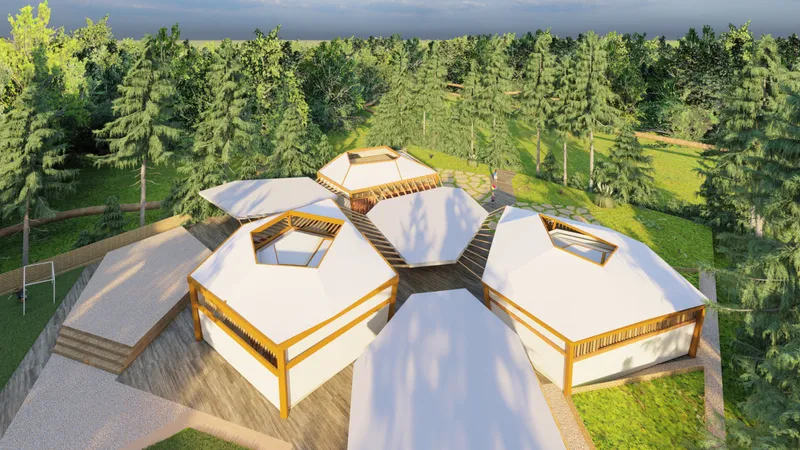
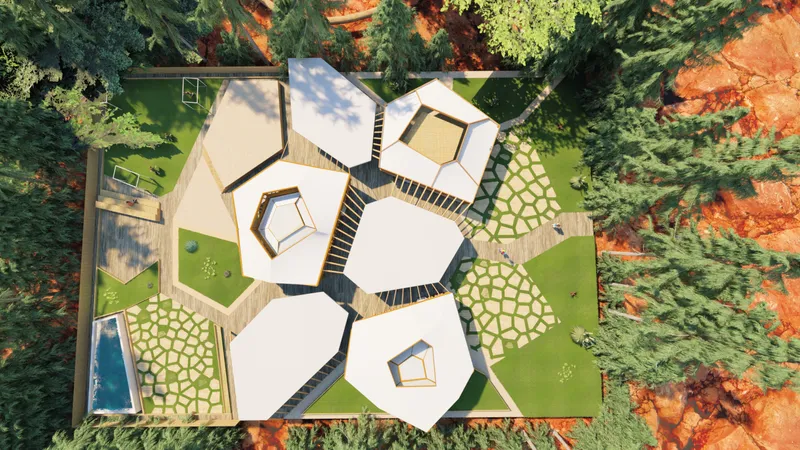
The architectural layout is composed of multiple interconnected hexagonal units, forming a clustered system that encourages movement, interaction, and adaptability. This modular configuration allows the kindergarten to function as a dynamic organism rather than a static building.
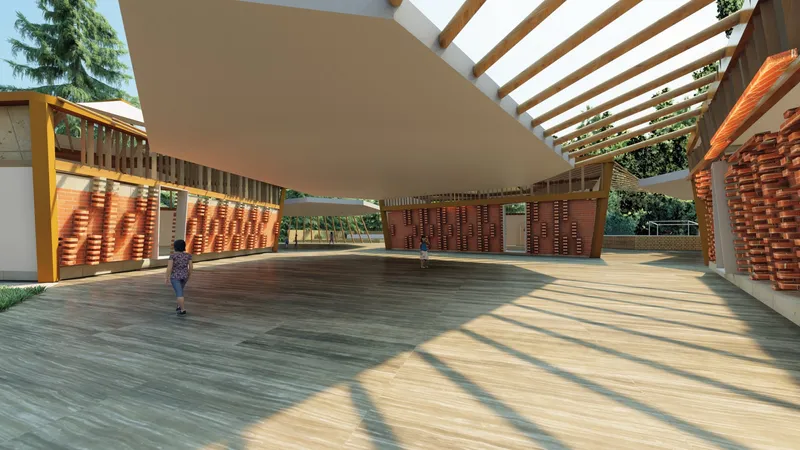
Each unit is designed to operate independently while contributing to a larger network of spaces. The central gathering areas, shaded walkways, and open transitions between indoor and outdoor zones create a fluid learning environment. This spatial permeability enhances supervision, encourages collaboration, and supports diverse modes of learning.
Climate-Responsive Design Approach
A key strength of the project lies in its integration of passive design strategies tailored to hot and rainy climates. The architecture leverages form, materiality, and orientation to regulate temperature and optimize comfort without reliance on mechanical systems.
The roof geometry plays a critical role, with sloped surfaces facilitating rainwater collection while also allowing hot air to rise and escape. Openings and layered envelopes enable cross ventilation, ensuring continuous airflow throughout the spaces. These strategies collectively reduce heat gain while maintaining a comfortable indoor environment.
Natural light is carefully modulated through roof apertures and shading devices, creating a balance between illumination and thermal control. The interplay of light and shadow becomes an experiential quality, enriching the spatial atmosphere and enhancing sensory engagement for children.

Material System and Construction Logic
The construction strategy emphasizes locally available and low-cost materials, reinforcing both sustainability and feasibility. The structural system is primarily composed of a wooden framework, supported by earth-based construction techniques.
Compressed earth blocks, cob walls, and bamboo elements form the primary enclosure, offering thermal mass and durability. Corrugated metal sheets are used strategically for roofing, enabling efficient rainwater harvesting. The use of manual fabrication methods further ensures that the construction process remains accessible and adaptable to local skills.
This material palette not only reduces environmental impact but also establishes a tactile and relatable environment for users, connecting children to the materiality of their surroundings.
Environmental Systems Integration
The project incorporates integrated environmental systems that enhance both sustainability and functionality. Rainwater harvesting is a central feature, with the roof acting as a collection surface that channels water into storage systems for reuse.
Ventilation strategies are embedded within the architectural form, allowing air to circulate naturally through high-level openings and shaded corridors. This passive cooling approach significantly improves indoor comfort while minimizing energy dependency.
The design also maximizes daylight penetration, reducing the need for artificial lighting and reinforcing a connection to natural cycles.
User Experience: Interactive and Safe Learning Spaces
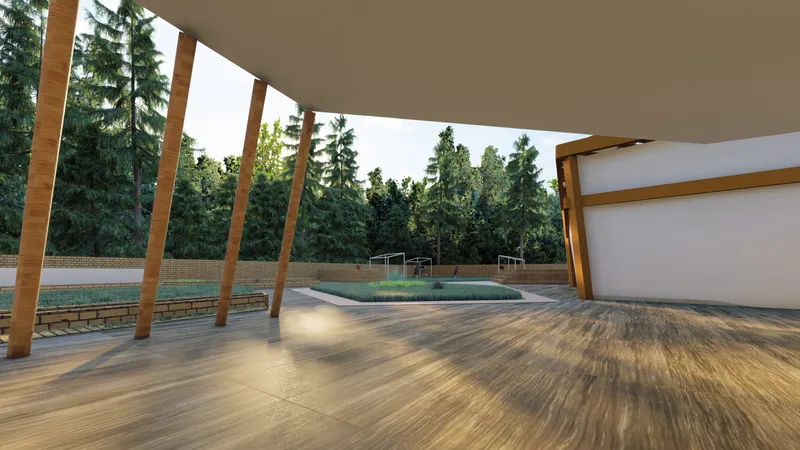
At its core, Kindergarten Re-vival is designed around the experience of children. The spatial configuration encourages exploration, interaction, and play, while maintaining clear visual connections for safety and supervision.
The semi-open nature of the architecture creates a seamless relationship between interior and exterior environments. Outdoor play areas, shaded courtyards, and transitional spaces provide opportunities for informal learning and social engagement.
The scale, material warmth, and openness of the design contribute to a welcoming and inclusive atmosphere, supporting both cognitive and emotional development.
Kindergarten Re-vival by Reparametrize Studio demonstrates how climate-responsive architecture can address critical gaps in rural education infrastructure. By combining modular design, passive environmental strategies, and locally grounded construction methods, the project creates a resilient and adaptable learning environment.
As a shortlisted entry for Education '20, the project stands as a compelling example of how architecture can move beyond form-making to become a catalyst for social impact, environmental responsibility, and meaningful user experience.




Popular Articles
Popular articles from the community


Conexión: Biophilic Design Reimagines High-Rise Living in Hong Kong
Conexión reimagines high-rise living in Hong Kong through biophilic design, green facades, shared spaces, daylight, water and nature within.

Riyadh For All: Intergenerational Urban Design for Active Aging in Rabat
Riyadh For All reimagines urban design in Rabat with intergenerational co-living, adaptive courtyards, and Moroccan cultural exchange today.

The Ocean Hive: Sustainable Architecture for a Self-Sufficient Civilization at Sea
The Ocean Hive imagines sustainable architecture at sea, where modular habitats, algae, wave power and ocean waste sustain a growing colony.

The Musturak Paradise: Senior Living Architecture for a Connected Future in Temara, Morocco
The Musturak Paradise reimagines senior living architecture in Temara via private homes, social spaces, culture, community, and shared care.

Similar Reads
You might also enjoy these articles

Eco Chapel: A Green Architecture Pavilion Designed in Symbiosis with the Forest
Eco Chapel uses green architecture to weave prayer, learning and reuse into a forest pavilion shaped by modular hexagonal canopies for life.
Kaffeebühnen: Coffee Shop Architecture Designed as a Civic Stage Between Vienna’s City and Park
Kaffeebühnen turns coffee shop architecture into a civic stage, linking Vienna’s park edge, urban life, warm timber yards, and coffee craft.
Healing Façade: Sustainable Architecture for Reforestation, Community, and Sacred Ecology in Ethiopia
Healing Façade reimagines sustainable architecture as a living wall that restores soil, catches water and renews Ethiopia's forest churches.


Urban Forest: A Vertical Ecosystem for 5,000 Workers in Singapore's Changi Business Park
Radially stacked pods and layered green decks turn a 7-acre plot into 47 acres of ecological workspace projected for 2040.


Comments (0)
Please login or sign up to add comments
No comments yet. Be the first to comment!