

Climate Time Machine: An Inverted Pyramid That Leads Visitors Down Through Earth's Extinctions
A shortlisted Hourglass entry in Egypt's desert that sinks a pyramid into the ground and turns a ramped descent into a record of planetary loss.


For four and a half millennia, the pyramid has meant one thing in Egypt: a reach toward the sky, toward permanence. Climate Time Machine flips that gesture upside down, driving the form point-first into the desert. The pyramid stops being a monument to ascent and becomes a funnel for reckoning. Visitors do not climb toward glory. They walk down through deep time, past the formation of the planet and its successive mass extinctions, until they arrive under a buried dome that stands for the Anthropocene, the age we are living in now.
Designed by Кирилл Бастричев, the project was shortlisted in the Hourglass competition. It treats a memorial as an environmental narrative instead of a static exhibition. The complex is set in Egypt's desert landscape and borrows the geometric clarity of ancient Egyptian construction. It pairs that language with stabilized rammed earth, passive cooling and solar power, so the building's own performance supports the argument it makes about consumption and depletion.
A Pyramid Read as a Void in the Ground
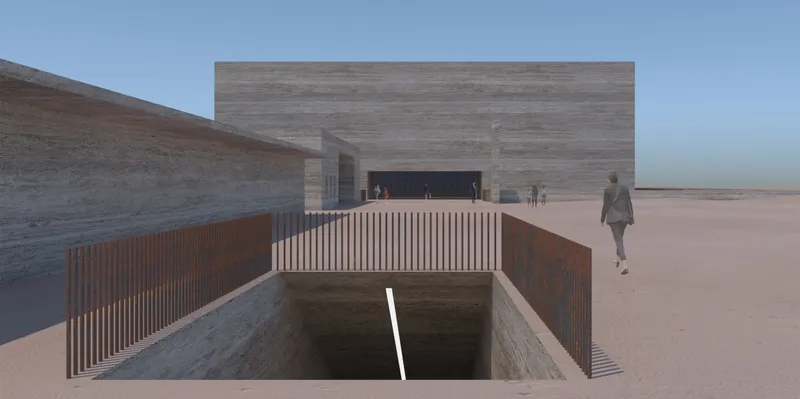
The first encounter is a cut in the earth, not an object on the horizon. A stone-lined pit opens in the pale sand, edged by rusted steel bar railings, and a solid block sits just beyond it. The scale of the void against a single walking figure shows the project's central reversal: the most important architecture here is below eye level, and you notice it as an absence before you understand it as a form.
Inverting the pyramid works as both metaphor and spatial strategy. Bastrichev describes the downward form as a picture of progress that has led to depletion rather than elevation. In practice, it means the building asks for introspection from the start. You look down before you go down, and the railing marks the edge between the everyday desert surface and the chronological descent below.
Restrained Volumes on an Open Desert Plane
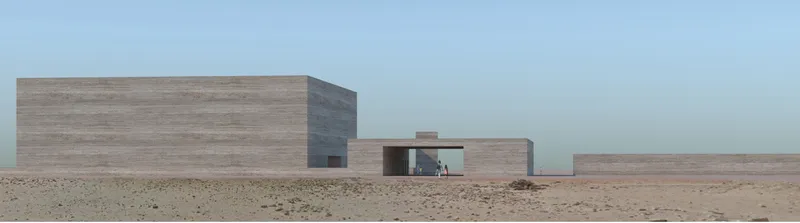
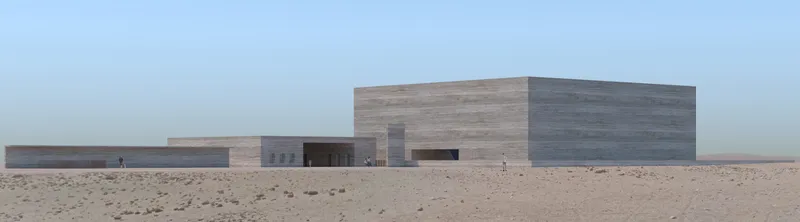
Above ground, the complex is kept deliberately quiet. A large banded cube stands beside a low gateway portal, and in the longer view across stony ground, low wings stretch out from the main mass. The tiny figures near the entrance give the composition its monumental register. As in ancient Egyptian construction, proportion, mass and void carry the symbolism instead of ornament, and the forms are simple enough to read clearly from a long way off in a flat landscape.
The banded surfaces relate to the material strategy. The structure combines Stabilized Rammed Earth with reinforced concrete, a hybrid of traditional low-tech building and contemporary engineering. Using local soil cuts transportation impact and roots the volumes in their site, so the walls share the colour and texture of the ground they rise from. For a project about humanity's footprint, building from the dirt underfoot is a coherent position.
Ramps That Compress the Visitor Into Deep Time
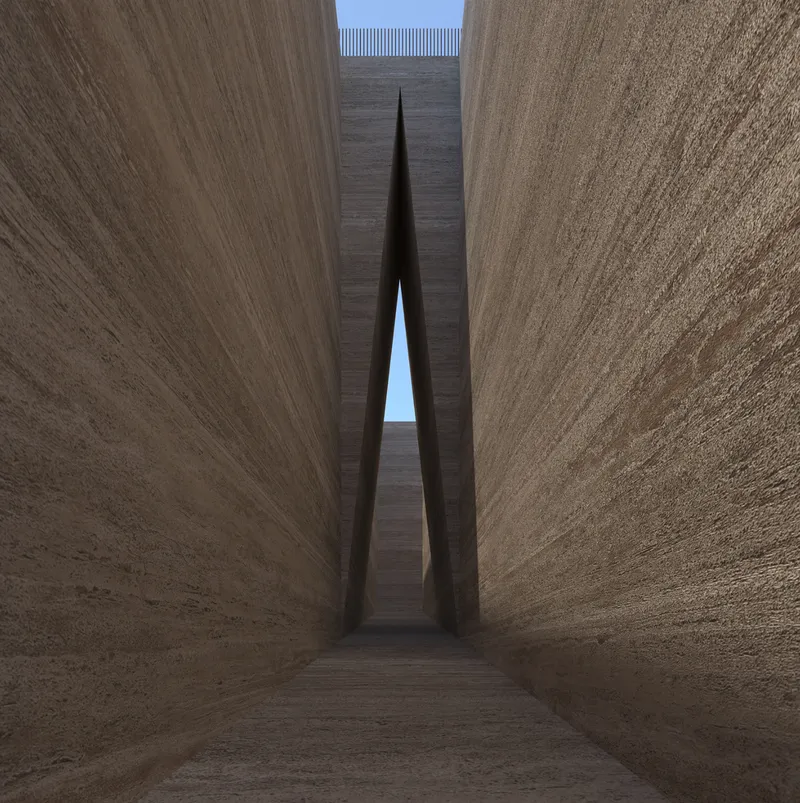
Below the surface, the experience narrows sharply. A canyon-like passage runs between tall layered walls, with only a thin triangular slit of sky and a railing high overhead. This is the ramp system that carries the chronological story: the formation of Earth, the evolution of life, and the mass extinctions that mark planetary history. The layered walls look like geological strata, so the passage reads like walking down through a section of the planet's past.
The compression is intentional. The descent is designed to be psychological as well as physical, and the tightening walls and shrinking strip of sky make the visitor feel the weight of the narrative. These shaded ramps and staircases also have an environmental job. They are the cool lower zones from which the building draws its fresh air, so the route that tells the story is also part of the ventilation system.
A Thermal Engine Carved Into the Desert
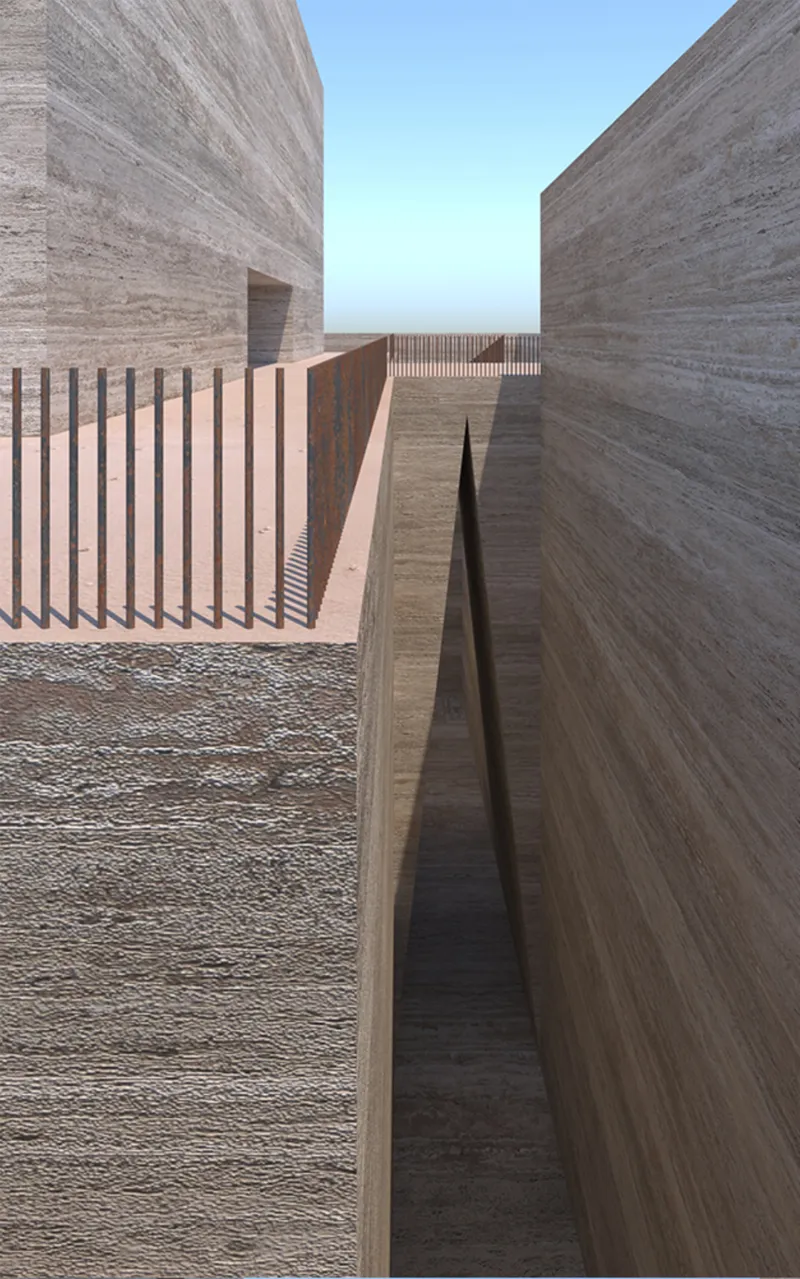
Here, a deep slot drops away beside a terrace edged with rusted vertical bars. It shows how the sunken geometry handles the desert climate. The inverted pyramid works as a thermal engine: during the day, heated air rises and leaves through the upper openings, creating a low-pressure zone that pulls cooler air up from the shaded ramps and stairs. The result is continuous airflow without heavy mechanical systems, using strategies drawn from traditional Middle Eastern architecture.
The dome at the bottom of the journey gains from its depth as well. Set below ground, it uses the thermal stability of the earth to reduce temperature swings, while solar panels on the pyramid faces supply renewable power for the building's technological systems. Where the narrative turns from history to accountability, and visitors face the scale of human impact and overconsumption, the building is quietly showing a lower-energy alternative.
Why This Project Matters
Most climate memorials ask visitors to read about catastrophe. Climate Time Machine makes them walk through it. By turning the most recognisable form in Egyptian architecture upside down, Bastrichev gives the idea of decline a physical shape: a descent rather than an ascent, compression rather than display, and an arrival underground instead of at a summit. The concept is clear enough to be understood without a single panel of text.
Just as important, the building backs up its message. Rammed earth from local soil, stack-effect ventilation through shaded ramps, earth-tempered space and solar-clad faces mean that the memorial is not simply lecturing about restraint. The project points to a useful direction for young designers: monumental architecture can draw on ancient precedent and low-tech intelligence and still speak directly to the most pressing problem of the present.
View the Full Project
About the Designers
Designer: Кирилл Бастричев
Enter a Design Competition on uni.xyz
uni.xyz runs architecture and design competitions year-round that reward proposals with spatial conviction and real site intelligence.
Project credits: Climate Time Machine by Кирилл Бастричев Hourglass (uni.xyz).


Popular Articles
Popular articles from the community


Juan García Correa, John González and Claudia Rueda Sink a Circular Amphitheater into a Manizales Engineering Building
On the La Nubia campus in Manizales, Colombia, the S1 Building folds labs and offices into a hillside of ramped lawns that double as a campus route.

Cube Design Draws an Ecological Corridor Between Two Shenzhen Hills with the Nankai Building
Beside Shenzhen's container docks, the Nankai Building pairs stacked balconies with a climbing green screen to connect two hillsides across its height.

U.GA Architects Wraps an Oval Rooftop Pool in Curved Board-Formed Concrete on Busan's Jeollidan-gil
In Busan's Jeonpo-dong, a 454 m² mixed-use block stacks a neighborhood facility, guest rooms and an oval rooftop pool inside spiraling concrete walls.

LT2A and OPEN Architectes Thread a Brick and Glass High School Through a Wooded Belgian Campus
In Braine-l'Alleud, a 3,000 m² wing for Collège Cardinal Mercier pairs pale brick with a glazed colonnade, deferring to a small chapel and a dense wood.

Similar Reads
You might also enjoy these articles
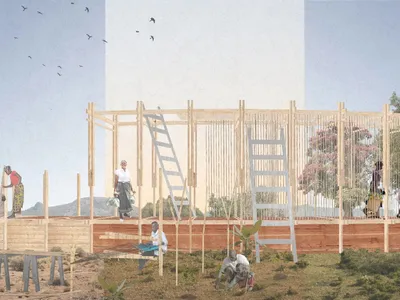
Healing Façade: A Modular Chapel System That Restores Ethiopia's Sacred Forests
Winner of the Eco-Chapel competition, this circular timber façade collects water from air to rebuild soil and reforest degraded Ethiopian landscapes.
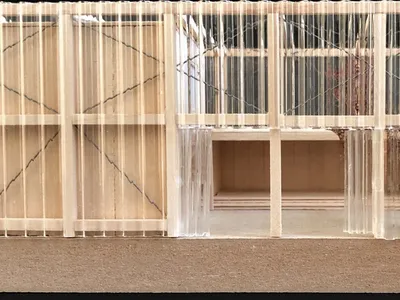
Kaffeebühnen: Where Coffee Shop Architecture Becomes a Civic Stage in Vienna
A linear sequence of timber boxes, transparent shells, and open yards turns the Viennese café tradition into a public performance space.
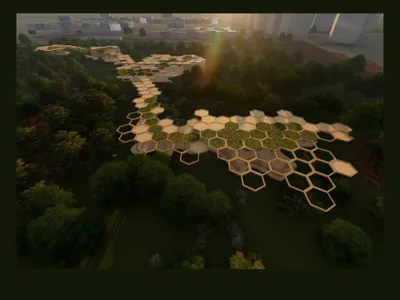
Eco Chapel: A Modular Forest Pavilion That Grows Like the Landscape It Protects
Hexagonal timber modules weave through existing trees, turning a chapel into a living system for prayer, education, and reforestation.


Urban Forest: A Vertical Ecosystem for 5,000 Workers in Singapore's Changi Business Park
Radially stacked pods and layered green decks turn a 7-acre plot into 47 acres of ecological workspace projected for 2040.

Explore Architecture Competitions
Discover active competitions in this discipline

Challenge to reimagine the Iron Throne

Photograph architecture without architects

Illustrate the lost glory of Angkor Wat - Render Challenge

Design challenge to reuse E-waste
Comments (0)
Please login or sign up to add comments
No comments yet. Be the first to comment!